CONSTRUCTION OF MULTI-LEVEL ELECTRICAL AND
ELECTRONIC PRACTICE SYSTEM
SHOUCHENG DING
College of Electrical and Information Engineering, Lanzhou University of Technology, Lanzhou 730050,
Gansu, China
ABSTRACT
The science multi-level practice teaching system not only can improve the students’ basic practical skills, but also improve students' practical ability and ability to operate, and can identify problems through practice, analyze problems, to solve the problem. Also it can promote the students integrated use of the theory knowledge, and further propose new ideas, new theories, and then design a new practice, explore new ideas, acquire new knowledge, stimulate innovative thinking. The article studied the experimental system based on LAN and virtual experimental simulation system. After years of reform and teaching practice, this paper explores a set of electrical and electronic course practice teaching system; the teaching effect is very significant, and it is a popular promotional value.
Keywords: Multi-level Practice Teaching, Capacity, Quality, Innovative Thinking
1.
INTRODUCTIONLanzhou University of Technology, in the electric and electronic foundation courses teaching team-building process, constantly updated teaching philosophy, established an effective team-building mechanism, the formation of a teachers’ teaching and research capacity and promote each other, and play the teachers teaching and the teaching team innovation in teaching the role of fruitful teaching, and make a positive contribution to improve the quality of personnel training and discipline construction. The electrical and electronic courses national teaching team is depending on the education teaching team and assume the school electricity class professional and non-electric professional electric and electronic teaching of basic courses, including electrical engineering, circuit, analog electronics, digital electronics, electronic, EDA, electromagnetic fields, motor and drag, sensor technology, digital signal processing teaching tasks, and electronic systems design comprehensive training, electrical assembly training, comprehensive training in signal detection, signal processing integrated training and other practical aspects of teaching tasks. The team assumed the electrical and electronic courses science and engineering professional technical courses, involving 12 colleges and 33 undergraduate majors of the whole school [1, 2].
Department of electrical and electronic was founded in 1958. For over 50 years, the department of chronicles teachers have inherited the tamarisk spirit of hard work, self-improvement, pragmatic, pioneering and innovative, rooted in the west of electrical engineering foundation course teaching, curriculum development, educational reform, teaching practice and comprehensive training has made remarkable achievements. The electric and electronic teaching team has now become the demonstration the school teaching team, and provincial-level teaching team, and state-level teaching team. This article focuses on the ways and means of the electric and electronic experimental teaching, which will conduct some research [3].
2.
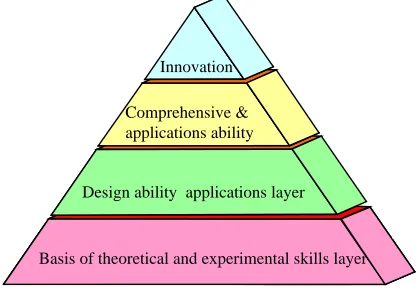
HIERARCHICAL PRACTICE SYSTEMIn the rapid development of electronic information technology, electrical and electronic courses, technical courses as science and engineering students, both theory teaching and practice teaching, should be sufficient attention. Based on years of practice teaching reform and practice, we actively carry out all types and all levels of practice teaching reform and exploration, constantly absorbing domestic and foreign teaching reform of higher engineering education research, to explore the construction of experimental teaching system the theoretical teaching reform combination of the four levels of open practice teaching system, and it is shown in Figure 1. Basic experiment skills
training and the training of practical ability and engineering capabilities, will to cultivate the spirit of technological innovation, engineering and technical personnel training to meet the needs of society. With this experimental teaching system, the experimental teaching methods, forms, and can fully resources and fully mobilize the students' enthusiasm, favor individualized [4, 5].
3.
EXPERIMENTAL MANAGEMENT ANDSIMULATION SYSTEM
3.1 LAN-based Experimental System
Besides the essential funds, equipment and teaching-force, we also need an outstanding administration system to run the open-experiment teaching scientifically & efficiently. The guiding ideology of the administration system is: design a set of administration software of open-experiment based on LAN, realize online publishing, make an appointment, skim through and preview CAI, work out various kinds of forms, etc; The system manger carries on the resource administration of experiment, information issue; The teacher carries on experiment guiding, online performance rating, etc, reduce hand-operated labor intensity, guarantee normal teaching going on orderly. Using the
system, students could study on their own, help individuals’ character foster, meet the quality-oriented education demand, adapt to the expand of high-education scale, meet the need of combined teaching resources, create the conditions for open experiment teaching.
The system is applied to the environment of campus network, which is the Internet based on TCP/IP technology, so from the point of view of root, it is an administrative system of open experiments based on LAN. The topological structure of the network is showed as Figure 2. Apparently, one can realize the establishment of the access to networks and servers flexibly through TCP/IP agreement or FIP agreement. One can also realize the distributed application of the database, such as store the user’s information, record the information into the teaching affairs department, store the information regard to the tests into the laboratory server, etc. Adopting Microsoft ASP (Active Server pagers) and ADO technology combination to visit the database, namely the system does the development with the platform supported ASP (windows 2000 server + SP4 + IIS5.0 net framework + SQL server 2000). The browser adopts IE5.5 edition or the above.
3.2 Virtual Experiment Systems Architecture
Virtual experimental technique originated in the late 20th century, is relying on virtual reality technology generation and development of a movie mode. Web-based virtual experiment teaching system refers to the use of computer technology,
network communication technology, multimedia technology and other related information processing technology, virtual reality experiment, and determined according to certain principles of experimental procedure, experimental rules in order to establish an authentic and experiments are consistent virtual experiment environment in which the experimental teaching in time and space to be extended. Currently the more common network
Comprehensive & applications ability
Design ability applications layer
[image:2.612.90.298.264.408.2]Basis of theoretical and experimental skills layer Innovation
Figure 1: Four-level practice teaching diagram
Figure 2: Topological Structure
[image:2.612.318.520.477.603.2]technology to build virtual experiment platform FLASH, JAVA, VRML and Matlab and so on, each technology has its own advantages, especially Matlab in circuit analysis, electric machinery and electrical control of the field of simulation application to be promoted and the use of given motor type of programs to open up a new trend in experimental studies, therefore, development and construction Matlab web server support of the experimental simulation system is imperative.
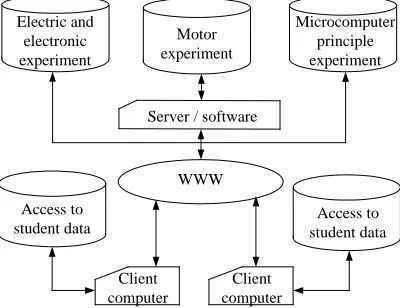
Matlab provided the core functionality with web tool Matlab web server. It can be HTTP protocol; web server installed on the host, and provided remote computing service Matlab. Using Matlab web server will extend the application of Matlab to the network, remote visual modeling and simulation. It was for the development of virtual electric and electronic experiment system had created better conditions. Matlab -based virtual experiment platform features powerful as Matlab itself, in data processing and analysis showed strong advantage. Virtual experiment system used active control technology and the Matlab web
server. Through ASP (Active Server Pages) web page programming, it implemented a virtual experiment system [6, 7]. Its overall structure is shown in Figure 3.
4.
BASIC THEORY AND PRACTICAL SKILLS TRAININGThis level is the most basic level of practice teaching; the main level includes foundation courses experiment, the use of instrumentation, basic practices, data analysis and processing. On the content of the arrangements in practice, both the number of accounts for the vast majority of the verification practice, there are a certain amount of integrated and design practice; some will do
practice, while others elect to do the practice. On the content of the design in practice, it is necessary to consider the basis of practice, to focus on the basic practical skills and basic methods of cultivation, also practice appropriate depth and breadth. By the level of practice, so that students master the basic practical skills and methods, enhancing basic skills, and to lay the foundation.
Electric and electronic basic practice plays a role as a bridge the transition to the professional courses, technical courses and students' proficiency in basic practice will have a direct impact on the entire practice of professional courses. So, the basic practice is the basis of the practical teaching system, a compulsory practice, requires students to master. The basic practice includes the verification experiment and the comprehensive practice.
4.1 Basic Experiment
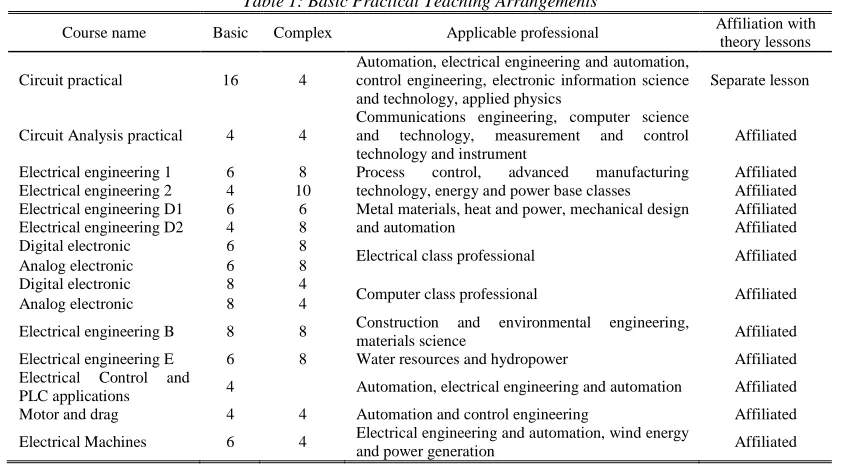
According to the characteristics of different professions in science and engineering, we are planning the basic practice of the content of the application of different professional degree of the different needs of students. Basic experiment, students can verify the theory of knowledge, and learn to master the basic experiment with the use of the equipment, instrumentation skills, learn to record and handling practices, and practice to meet regulatory requirements and write reports. This will not only train the students the basic ability and practical skills, but also students rigorous scientific study style. The basic experiment arrangements of different professional students in electrical and electronic courses, is shown in Table 1. Circuit practice and circuit analysis practice are set up a separate class, calculated independently credits; the remaining basic experiment assessment to account for the proportion of theoretical hours of basic experiment and comprehensive practical achievements, such as electrical engineering 1, 2 practice scores out of all18 points and so on.
Server / software Motor experiment
Access to student data Access to
student data
Client computer
[image:3.612.92.292.367.521.2]Client computer WWW
Figure 3: Virtual experiment systems architecture diagram Electric and
electronic experiment
4.2 Comprehensive Practical
According to the characteristics and needs of different students, specifically set comprehensive practical teaching, it is built in the basic validation experiments based on practical aspects; also belong to the professional subsidiary theory compulsory teaching practice link. Integrated practice is usually a combination of several practices and course content, the practice should focus primarily on the internal relations to demonstrate knowledge on training students practice ability.
Such as electrical and electronic specialty, after the completion of the basic skills of digital electronic technology practice to arrange an electronic stopwatch practice, practice to use the RS flip-flop, Schmitt trigger, constable flip-flops, counters, etc. such teaching would be better, no doubt is essential to strengthen the ability of the student electronic technology circuit synthesis. Such as electrical engineering and automation, after the complete motor learning basic experimental arrangement drag once set, power generation, power distribution in an integrated practice link, to enable students to principles and applications of the motor system effectively combine, consolidate abstract and difficult to understand the basic knowledge of the motor has a lot of benefits, and the teaching effect is significant.
5.
DESIGN APPLICATION CAPABILITIES TRAININGIn electric and electronic education teaching, to research and development of a LAN-based electrical and electronic experiments open management system. Student experimental projects online booking, online preview, the experimental results computer management, the experimental teachers’ work records, laboratory courses and computer arrangements, as well as equipment, computer management, laid the foundation for the open experimental teaching. Additional experimental project on the basis of experimental teaching normal assurance program, students choose to do, independently of the students under the guidance of teachers; organize and planned to organize open across college to help students understand the different experimental methods courses, to broaden of knowledge.
[image:4.612.93.514.102.334.2]By the level of practice, to enable students to further familiarize themselves with the application of technology, devices, equipment and development environment, to junior engineering applications design. The practice includes part of the confirmatory practice, but more comprehensive and design practice, practice course content that contains knowledge, but also pays attention to the combination of engineering practice. The major practical projects: microcomputer principle, Psoc programming and applications, sensor technology Table 1: Basic Practical Teaching Arrangements
Course name Basic Complex Applicable professional Affiliation with
theory lessons
Circuit practical 16 4
Automation, electrical engineering and automation, control engineering, electronic information science and technology, applied physics
Separate lesson
Circuit Analysis practical 4 4
Communications engineering, computer science and technology, measurement and control technology and instrument
Affiliated
Electrical engineering 1 6 8 Process control, advanced manufacturing technology, energy and power base classes
Affiliated
Electrical engineering 2 4 10 Affiliated
Electrical engineering D1 6 6 Metal materials, heat and power, mechanical design and automation
Affiliated
Electrical engineering D2 4 8 Affiliated
Digital electronic 6 8
Electrical class professional Affiliated
Analog electronic 6 8
Digital electronic 8 4
Computer class professional Affiliated
Analog electronic 8 4
Electrical engineering B 8 8 Construction and environmental engineering,
materials science Affiliated
Electrical engineering E 6 8 Water resources and hydropower Affiliated
Electrical Control and
PLC applications 4 Automation, electrical engineering and automation Affiliated
Motor and drag 4 4 Automation and control engineering Affiliated
Electrical Machines 6 4 Electrical engineering and automation, wind energy
applications, programmable controller applications, EDA technology, DSP technology, the virtual instrument technology, computer simulation technology and CAD technology courses.
The virtual laboratories established make up the deficiencies of the traditional laboratory, and it make teaching more lively and more flexible design of the experiment. The experiment in teaching innovation in the reform process, virtual labs to reduce the dependence on the hardware devices that can keep the current trend of technological development, but also it is the experimental development of national virtual developments.
6.
TRAINING OF PRACTICAL ABILITY AND ENGINEERING APPLICATION CAPABILITIESThis level in the context of engineering practice, designed in accordance with the instructor training topics, or optional subject, combining the expertise and engineering practice, the comprehensive application of knowledge to solve an engineering problem, system design requirements according to the task to develop the practice of program . Finally, students must complete the system debugging and writing design specifications. It is primarily a comprehensive range of training courses, curriculum design, skills training courses for the whole school opened and graduation design. Main course of practice: electronic technology training (3 weeks), electrical control and PLC training (three weeks), motion control integrated training (three weeks), computer-controlled technology training (three weeks), signal detection and processing training ( 3 weeks), the EDA technology training (three weeks), advanced control training (2 weeks), PLC applications integrated training (two weeks), design and production of electronic (2 weeks), the application of electrical skills training (2 weeks), maintenance electrician skills training (2 weeks), electronic assembly practice (1 week), computer principles of curriculum design (two weeks), power engineering curriculum design (two weeks), power supply technology, curriculum design (two weeks), relay protection curriculum design (2 weeks), power system analysis (2 weeks) course design, and graduation design.
On the design and implementation of the training content, it has a comprehensive application, engineering and systematic. These training courses are the students for the training topics comprehensive application of the knowledge system design, and students in the laboratory can lap and debug circuit. The training topics are
generally from the instructor's projects, it has significant engineering background and background. In the training process, highlighting the systematic, require students to design and debug a system.
Combined with professional features, continuous improvement training methods, rich training content, modern technology into the practice of teaching, such as electronic technology training, the students first in accordance with the requirements of the circuit design, and then simulate the circuit design, and buy their own components (College under the title situation to provide appropriate funding for education), and to complete the installation and commissioning. Electronic circuit design through the session, not only training, but also fosters the development of students' computer application ability. Subject design, traditional topics, there CPLD / FPGA topic, such as those based on FPGA, DDS technology design sine wave / square wave generator based on FPGA design taxi meter. Electrical control and PLC training requires students to complete stand-alone PLC training (including circuit design, wiring, programming, debugging), familiar in the practice room of Schneider electric the large PLC network applications, understanding of engineering design methods; integrated motion control training in addition to the completion of the traditional DC and AC variable speed training content, but also in the advanced motion control practice room for power electronics, AC DC drive training, in full accordance with the practice room practice device from the system design to equipment configuration, configuration requirements of the industrial site, state-of-the-art technology, and students in the practice room is not only familiar with the basic content of AC and DC drives, PLC, inverter to achieve speed and familiar modern drive technology[8, 9].
In the design of training topics, highlighting the systematic, engineering, comprehensive attention to the diversity of training topics, contact attention to the knowledge of this course and other courses knowledge, training topics to students leaving a space of free play, helping to train students' innovative spirit and ability.
requirements. Integrated design practice aims at cultivating the comprehensive ability of students to apply knowledge and awareness of innovation.
7.
SET THE INNOVATIVE COURSES AND OPEN PRACTICE PROJECTThe spirit of the document in order to better promote innovation and personnel training, according to the views of Lanzhou University of Technology of principles on the revision of the undergraduate training programs (2010) "and" Implementation views of the students' innovative education plan of Lanzhou University of Technology ", positive implementation of research-based teaching, through the creation of innovative programs to develop students' awareness of innovation, and teach innovative ways to inspire the students learning initiative and creativity. The principle of the creation of innovative curriculum, changing the concept of traditional education, teacher-student relationship and teaching methods, and to cultivate the students' innovative spirit and ability to innovate, and to further enhance the level of undergraduate teaching. After the team meticulously organized and reporting, and through expert assessment and school publicity, and finally, the motor and electrical control fault diagnosis and repair, digital image detection and real-time processing, electronic circuit production and commissioning courses classified as innovative curriculum [10, 11].
In order to further expand students' practical skills, students of the scientific spirit and literacy, give full play to the effectiveness of the practice room resources, to promote the practice of teaching reform, and constantly improve the level of practice teaching, the school decided to undergraduate foundation practice room pilot open to all students, in order to The accumulated experience of opening wider to the outside world and to improve the quality of open. The selected open basis of good practice room, practice as an open pilot units. The electrical and electronic practice center is responsible for the two projects "PLC Programming and Applications" and "PSoc Programmable Systems and Applications" that will be open for all students.
The innovative open practice teaching is the inevitable outcome of the credit system, is an important means of teaching training high-quality, strong innovation ability, and important practice is people-oriented philosophy of education. Innovative open practice is all open practice, practice projects prepared by the students mastered and ready, the teacher student services only, or as a
consultant. For innovation credits, proved an effective strength of college students in the highly competitive employment. To make my school electrician practice of electronic content, practice time, practice rooms and a full range of open practice has successfully developed a set of open practice teaching in a local area network management system, running well; it guarantees a smooth implementation of the full open practice teaching. The implementation of the open practice teaching for student research and innovation activities to provide a platform for some of the students took part in the national undergraduate electronic design contest and the national CCTV robot competitions have achieved good results [12].
Teaching form and means of physical aids, computer simulation, network technology, multimedia technology and modern teaching equipment, a combination, so that the students from passive recipients of knowledge into active constructors of knowledge, to improve students’ ability to think independently and innovation.
8.
INNOVATION ACTIVITIES AND SCIENTIFIC RESEARCH ABILITY TRAININGThis level is mainly relying on the electronic design contest base platform of the robot practice rooms, student technology association institutions constitute the innovation activities, colonel-level electronic design competition, the challenge cup, the national robot game, smart car competition, the student innovation fund, students' Science and technology festival, students in science and technology community activities and other scientific and technological innovation activity. There are some students may be directly involved in the actual work training teachers of scientific research and engineering design. This level is open; it is primarily for students with a spirit of exploration and innovation spirit. Provide an effective platform for innovation activities through science and technology competition for students, students' scientific and technological innovation ability has been significantly improved, and made outstanding achievements in various scientific and technological competition, also played an exemplary role to other students [13]. Through participation in research activities at the same time, the student engineering capability has been markedly improved.
online booking, online preview, the experimental results computer management, the experimental teachers’ work records, laboratory courses and computer arrangements, as well as equipment, computer management, laid the foundation for the open experimental teaching. Additional experimental project on the basis of experimental teaching normal assurance program, students choose to do, independently of the students under the guidance of teachers; organize and planned to organize open across college to help students understand the different experimental methods courses, to broaden of knowledge. In addition, around the undergraduate electronic design contest, robot competitions, to carry out the serialized student innovative activities, provide students interesting experimental conditions, with a certain degree of difficulty and size of the course design projects, the establishment of different levels to the student, teacher-led, modular entire areas, full liberalization of the electric and electronic experimental teaching system, and enhance students’ practical abilities [14].
In order to further expand the students’ practical skills, students of the scientific spirit and literacy, give full play to the resource efficiency of the laboratory to promote experimental teaching reform, and constantly improve the level of experimental teaching, the implementation of the “school-oriented, individualized, forms, stress practical results” principle, to give students more autonomy to choose the space of the laboratory, pilot projects, and learning time, the pilot project in the spring 2012 semester electrical and electronic basis of laboratory pilot open teaching program: PLC programming and applications, electronic production and debugging. Facing the school open to students, teaching effectiveness reflects the better.
Students’ scientific and technological innovation activities is to cultivate students’ practical ability and creative spirit, enrich the extracurricular activities of students, enhance the exchange of learning and collaboration among students, active in the campus academic atmosphere in important ways and initiatives. Around the quality of talent training objectives, the electric and electronic teaching team at the 2011 applications and project production and debugging of electronic circuits, digital image detection and real-time processing, motor and electrical control fault diagnosis and repair of innovative curriculum, and set up innovation education credits. The team is also responsible for the construction of the undergraduate electronic design training base for the entire school and
college students’ robotics competition training base. At the same time students' extracurricular scientific and technological innovation, science and technology competitions in the entire training program also set an innovative education credits. For example, the invention patent of 5 credits, 1-3 credits provincial science and technology competitions prize. The teams combined with the training plan and course characteristics, and actively organize, training, guiding students to participate in a variety of scientific and technological innovation activities, access to innovation credits. Such as encouraging students to participate in research projects of teachers to organize students to participate in the scientific and technological innovation training of university students, to participate in the undergraduate electronic design contest, robot competitions, such as science and technology competitions, smart car competitions.
9.
CONCLUSIONThis level of practical teaching system: First, the system of practice from easy to difficult, step-by-step, in line with the law of the awareness of the objective things. The second is to ensure that each practice students master the basic knowledge, theory and practical skills, and to lay the foundation for higher level of practice. Firmly grasp the law of practice teaching: step-by-step, individualized. Fourth, exercise self-study ability of the students, especially in the integrated design practices and innovation in the open practice, in addition to difficult to understand to ask the teacher, their access to information, design their own program of practice, this process is undoubtedly self-study students ability is a great benefit. The fifth is to train students to analyze problems and problem-solving skills, as well as students of the scientific style. This practice teaching system will open a good atmosphere for innovation.
quality of the basis of practice, and to strengthen the comprehensive and designing appropriate to the creation of innovative practice; establish diversified practice teaching mode to adapt to the cultivation of students' abilities, encourage exploration and practice of teaching assessment methods. The entire practice teaching system throughout the entire process of the students throughout the four years of undergraduate education and teaching, teaching the students' ability to achieve different levels of training objectives at different stages.
ACKNOWLEDGEMENTS
This work was supported by national electrical teaching team funded of Lanzhou University of Technology.
REFERENCES:
[1] K. Wu, C.Y. Li, “Trusted Network Authorization Scheme Based on Cloud Model”,
Journal of Convergence Information
Technology, Vol. 7, No. 3, 2012, pp. 183-191.
[2] F. Yang, “Exploring electrical and electronic classroom teaching and improving teaching quality”, Experimental Technology and
Management, Vol. 29, No. 4, 2012, pp.
269-271.
[3] N. F. O. Serteller, “A basic introduction to finite element methods for solving electrical problems”, Energy Educ Sci Technol Part B,
Vol. 3, No. 4, 2011, pp. 487-496.
[4] S. C. Ding, L. M. Xiao, R. Huang, W. H. Li, S. Z. Yang, “Games Track Competition Project Information Management Based on Personal Computer”, JCIT, Journal of Convergence
Information Technology, Vol. 7, No. 15, 2012,
pp. 176 ~ 184.
[5] A. Sahin-Demirbas, “Some basic concepts in science education”, Energy Educ Sci Technol
Part B , Vol. 3, No. 4, 2011, pp. 449-454.
[6] S.C. Ding, W.H. Li, S.Z. Yang, J.H. Li, G.C. Yuan, “Design and Implement of the Electric and Electronic Virtual Experiment System”,
Journal of Networks, Vol. 5, No. 12, 2010,
pp.1490-1495.
[7] T. L. Wang, D. S. Chen, H. Y. Yuan, F. Lei, “Electrical and Electronic Laboratory virtual network teaching platform” , Laboratory
research and exploration, Vol. 27, No. 7, 2008,
pp. 50-53.
[8] S. C. Ding, G. C. Yuan, S. Z. Yang, “Deepening Reform of Experimental Teaching System through Construction of Provincial Model”, Research and Exploration in
Laboratory, Vol.28, No.7, 2009, pp. 92-94.
[9] B. X. Tan, J. J. Song, H. J. Miao, “Exploration of teaching reform for electrical and electronic practice”, Experimental Technology and
Management, Vol.25, No.7, 2008, pp.112–114.
[10] S.C. Ding, W.H. Li, “Research on Photoelectric Sensor Turbidity Detecting System”, Sensor Letters, Vol. 9, No. 4, 2011, pp.1571-1574.
[11] S.C. Ding, A.M. An, X.K. Gou, “Digital waveform generator based on FPGA”, Research Journal of Applied Sciences, Engineering and
Technology, Vol. 4, No. 14, 2012,
pp.2160-2166.
[12] S.C. Ding, J.H. Li, L.M. Xiao, R. Huang, S.Z. Yang, “Intelligent Digital Multi-purpose
Vehicle Instrument”,Przeglad
Elektrotechniczny, Vol. 88, No. 5B, 2012,
pp.64-67.
[13] X. He, L. Xiao, S.K. Liu, “The Localized Area Coverage algorithm Based on Distance Priority Scheme In Wireless Sensor Networks”, JDCTA,
Vol. 6, No. 3, 2012, pp. 271-279.
[14] H. Zhang, X.Y. Wang, Y.Y. Xiao, “Similarity Research for Urban Intersection Traffic Flow”,