ISSN: 1992-8645 www.jatit.org E-ISSN: 1817-3195
117
MODEL OF AN ADAPTATION AND INTERFACING SOA
MIDDLEWARE FOR THE INFORMATION SYSTEMS
INTEROPERABILITY
1
KHALIFA MANSOURI, 2 BOUCHAÎB RIYAMI, 3 MOHAMED YOUSSFI AND 4 OMAR BOUATTANE
Laboratory : Signals, Distributed Systems and Artificial Intelligence (SSDIA)
ENSET, University Hassan II of Casablanca, Morocco
E-mail: [email protected] , [email protected] , [email protected] , [email protected]
ABSTRACT
Today, the IT becomes the key pillar for effective structural and organizational management. All the scenarios related to the activity, the communication and the management of current businesses are made of information systems (IS). Besides, the need of companies cooperation converge them to exchange and communicate information about their information systems. This interconnection faces many complex challenges especially when it comes to real-time exchange or mergence of all or parts of IS connected. The aim of the model driven engineering (MDE) and the model driven architecture (MDA) is to bring good solutions to interoperability challenges between companies and organizations IS. They offer several significant improvements in the development of complex systems and enable to focus on abstract goals independent of technical platform. Moreover, service-oriented architecture (SOA) has established for some time as a good methodology for encapsulation of the complexities of the various components of IT as services, to implement major motivations such as: business alignment, technology neutrality and automation of business processes. In this paper, we propose a middleware layer composed of services, according to the SOA architecture for the interoperability of IS. It is composed of several transformation, integration, homogenization and adaptation services.
Keywords: Interoperability, Middleware Layer, Information System’s Adaptation, BPMN, BPEL, Reverse Engineering, ATL, BDD Anthology.
1. INTRODUCTION
Today’s companies need to corporate their business processes and share information through their information systems IS [1]. Information systems are complex systems because they represent different activities and business scenarios based on specific requirements. They are built from the integration of multiple computer subsystems for several purposes, such as sharing, consistency and reliability of information between the different company’s entities. Introducing a technique to facilitate the communication of the complex tasks, sharing, and the cooperation among information systems such as interoperability, has become a major need.
The problem of interoperability among information systems has appeared for several years. It is treated by several researchers at several levels (semantic, syntactic and technique) [2] [3] and several approaches (models driven approach MDA
[4], services oriented approach SOA [5], Intermediate approach or Type Mediation [6] mapping approach [6]) for the major objective of cooperation company's management process level, and at data level while keeping different physical architectures implementations.
Our contribution is based on an intermediate approach. It is about designing an adaptive and interfacing model. The IS’s interoperability is composed of a number of layers of transformations and adaptation.
118 make some conclusions and future works discussions.
2. DIFFERENT APPROACHES USED IN PROBLEM’S MODELING
In the modeling of the interface processes and the interoperability of information systems, we have used the following approaches:
The MDA [10] approach (Model Driven Architecture): Since November 2000, the OMG (Object Management Group) has announced that more than thousand companies initiating the MDA approach. This approach aims to provide a new way to build applications by separating the business logic of business processes of any technical platform implementation to a higher level of abstraction [11].
The SOA approach (Service Oriented Architecture): This architecture represents a solution to the problem of integration of business applications. A fundamental idea was put forward: it is the encapsulation of these applications as services, knowing that service is a reusable software unit decoupled as much as possible in its implementation that means the same service can have several possible implementations. The organization of communication between the services in this approach is via an orchestration [12].
The approach by intermediaries or mediator: There are several types of intermediaries: agents, mapping, mediators, ontologies ... etc. But each type is specific to an area for cooperating from different sources together. In most cases, these intermediaries use expressions and specific rules but also those rules and expressions are not general for all areas. [13] [27].
Our contribution is to use on one hand all the principles of the MDA approach which its capacity is noticed on the improvements of the complex business systems development, by focusing on more abstract concern (model and Meta model) than classical programming. We use the MDA approach in the transformation of BPMN [14] business process to BPEL [15] executable languages of two different information systems. Our contribution is to provide an executable common language BPEL composed by two BPEL languages, with the processing of differences through an ontological database. Based on the intermediaries architecture such as the creation of this ontological database for the processing and the adaptation of executable languages, there is a
common executable BPEL language that must be reapplied on the BPMN business process through the reverse engineering.
3. PROPOSED SOA MIDDLEWARE LAYER FOR INTEROPERABILITY OF
INFORMATION SYSTEMS
SOA middleware layer in our proposed contribution aims to hide the complexity and heterogeneity of interoperable IS modeling for different levels of the MDA approach. It helps to make IS more agile according to various transformations and adaptations, and to encapsulate each operation in a service based SOA.
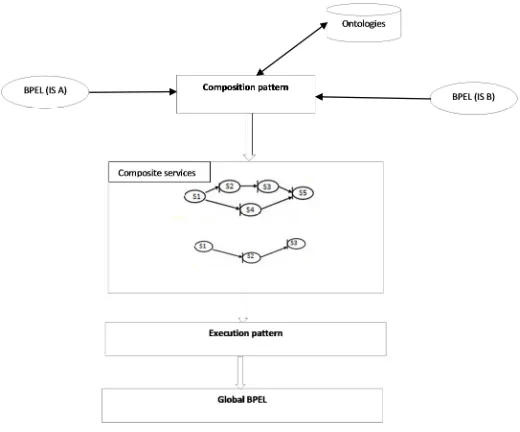
Our approach as presented in Figure 1 is based on MDA architectures and intermediaries. It is composed of a number of layers of transformations and adaptation:
• Layer 1: BPMN transformation of business process into executable BPEL language via a transformation language ATL (Atlas Transformation Language) by the MDA approach. The major objective of this transformation is to ensure the agility of the information system.
• Layer 2: development of a common BPEL from both BPEL business process through an ontological database. Other methods may be used such as thesaurus and Meta models, etc. but our motivation for the choice of using ontologies is that they allow sharing the common understanding of the structure of information among people or software manufacturers, knowledge reuse, analysis of knowledge on a domain, distinguished knowledge on an operational knowledge domain.
ISSN: 1992-8645 www.jatit.org E-ISSN: 1817-3195
119
4. DESCRIPTION OF THE BPMN - BPEL SERVICE TRANSFORMATION
The transformation service is the first one that runs to transform each BPMN process into BPEL executable code. The BPMN business processes of an information system, is represented by its abstraction model that is a subset of the information in this system and which avoids some details. The use and manipulation of the model is valid only if the terms used to describe it are specified. A model is represented by a meta-model. It defines the elements and the structure of a model and its semantics. Once the link between model and meta-model established, the use and the handling of meta-model is only valid if the language that can describe it is ready. In this case, it is a meta-meta-model. Finally, not to go into abstraction levels indefinitely, meta-meta-models are designed to be self-descriptive, that means, they are able to define themselves [17]. This is the main principle of the MDE (Model Driven Engineering) approach.
The model transformation principle is to start from its metadata source and target meta-model. We establish a set of relations expressing the actions to be performed on the input patterns to produce the corresponding output models. Several approaches with their classifications can be used in this transformation process [18] [19].
There are two types of transformations, model to model and model to text. The model to model transformations can produce and automatically modify templates and therefore represent a major interest of the MDE [20]. In this paper, we are interested in text to model transformation (BPMN model that represents to BPEL as an executable source code) to reunite with another BPEL source code to a well suited and structured common BPEL source code. BPEL is an executable standard language for web services composition according to the BPEL4WS 1.1 standard (BPEL for Web Services). The principle of this type of processing is to generate an executable source code for a set of elements of the source models in order to achieve such a task. The most currently used approach to code generation is the template [21] which its structure is generally quite closed to the generated code.
The technical tool used in our type of model transformations to text is ATL (Atlas Transformation Language) standard QVT (Query Views Transformation). ATL is a hybrid transformation language, which includes both programming paradigms, declarative and imperative ones [22]. The other transformation tools according to the QVT standard are tools that support only declarative and imperative programming paradigms.
120
5. CONSOLIDATION SERVICE, HOMOGENIZATION AND INTEGRATION
The second service running after the transformation service is the consolidation service of the two BPEL executable codes. In this operation, we obtain either equal or different BPEL. Our approaches is to compare the BPEL found via homogenization and integration service, and then bring them together in a common BPEL language containing the common elements of the two BPEL obtained and the differences between them.
The differences are processed through an ontological database based on rules and specific adaptation expressions. Finally, the consolidation, homogenization and integration service receive as an input the both BPEL executable codes and gives us one output common BPEL executable code. In Figure.4 we represent the structure of the consolidation, homogenization and integration service.
The utility of the ontological database in our approach is to manage and adapt the difference between the BPEL languages that are combined in a global BPEL. Knowing that a context consists of several concepts related to each other (inheritance relationships, composition relationships, logical relationships). A concept is made from the contents of ontology [23] [24]. The latter is closer to a specific field of application. The ontological database, we use, consists of a set of expressions,
terms and concepts that are closer to the studies field.
Ontologies can be represented using several ways: as a semantic network, a conceptual graph, a terminology graph, a set of logical rules or object-oriented schema [25]. In our approach, we propose ontologies as rules for connections between the elements of source process.
BPMN Source model Meta model
ATL BPEL : Executable code Transformation rules
Meta model transformation
Source model
Generatedtarget code Transformation engine
Conform to
Uses In accordance with Matching
[image:4.612.91.506.65.312.2]Service Output
[image:4.612.320.580.460.676.2]Figure 2 Transformation principle of model to BPEL executable code
ISSN: 1992-8645 www.jatit.org E-ISSN: 1817-3195
121
6.
ADAPTATION SERVICE« REVERSE
ENGINEERING »
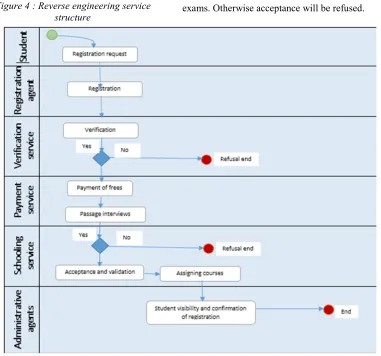
Once the transformation of BPMN to BPEL process is done, correction and adaptation of common language are made; we proceed with the update on BPMN sources of information systems so that we have a synchronization of BPMN business processes. The operation used in our approach to obtain raw patterns to their BPEL source code is reverse engineering [26]. This method includes a set of techniques to understand and determine the operation of an object. It is applied to software to find a design template or relationships model or class template or meta-model from their source code.
7.
IMPLEMENTATION
OF
OUR
APPROACH : A CASE STUDY
7.1 Institution A business processes PBMN
The education management procedures of students are described as follows:
1-The student applies for registration with the registration department (manual request).
2-The head of the registration department records information of the student and transfer the file to the verification service for registration validation.
3-The department head accepts or not the student's file as required documents and statements of marks. If the application is approved, the student will be summoned to pay the registration fee to another payment service to pass the acceptance interviews.
[image:5.612.131.512.349.705.2]4-If the interviews are successful; the student is accepted and assigned to the module level by the education department. The registration is completed and the student will be able to access courses and exams. Otherwise acceptance will be refused. Figure 4 : Reverse engineering service
structure
122 5-After assigning students to courses and exams, he will be visible to administrative staff.
After analysis of student enrollment procedures, we propose a business process BPMN presented in Figure.5.
7.2 Institution B business processes PBMN
The education management procedures of students are described as follows:
1-The student applies for registration with the registration department (manual request).
2-The system validates or does not validate the request of the student according to the information provided. In the case of the approved application, the file is automatically sent to the registrar's office and the student receives an online payment message or by bank transfer confirmation with the payment service. Otherwise the registration is denied.
3-If the payment is made; the student receives an access account to pass the online acceptance interviews. Otherwise the registration is denied.
4-If the interviews are successful; the student is accepted and assigned to the module level by the education department. The registration is completed and the student will be able to access coursesand exams. Otherwise acceptance will be refused.
5-After assigning students to courses and exams, he will be visible to administrative staff.
[image:6.612.150.504.385.701.2]After analysis of student enrollment procedures, we propose a business process BPMN as presented in Figure. 6.
ISSN: 1992-8645 www.jatit.org E-ISSN: 1817-3195
123
7.3 Analysis of both business processes BPMN, institutions A and B
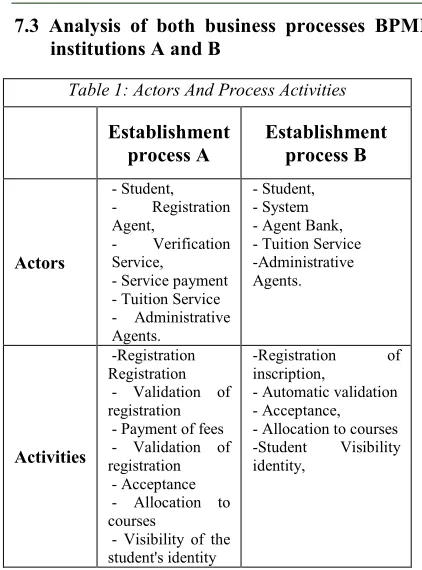
Every business process has a number of services (actors) and activities. The objective is to adapt both BPMN process at the actors and activities to define the adaptation rules for synchronization of both business processes.
7.4 Proposed approach to solving this problem Step 1: via the service transformation, each BPMN business process will be transformed into executable BPEL source code (XML file) using the ATL transformation tool.
Step 2: via the consolidation service, homogenization and adaptation union of two BPEL processes into one comprehensive BPEL process containing the elements that could be considered common between the two BPEL processes (actors, activities) and the various elements.
The different elements are processed through the use of an ontological database for the adaptation of actors and activities according to some ontological rules.
Actors and process activities are defined in Table 1.
The next step is to create an ontological database as rules for defining mappings between actors and activities of the two processes. These correspondences are presented in Table 2.
We used seven ontological rules for connection among the actors and the activities of the two schools. These rules can be grouped as follows:
• Rule 1: is a matching rule and direct equivalence between the actors of the two schools.
• Rules from 2 to 5 : allows to add actors either at A or B. the establishment
• Rules from 6 to7: helps in the choice of optional implementation of activities.
Once the matching rules are defined between the actors and the activities of the two processes are applied in the common BPEL process to obtain a BPEL process well suited.
Step3: it uses reverse engineering technique for reconstitution of the new BPMN business process that replaces the business process of both schools.
[image:7.612.83.294.87.372.2]The common BPMN process after applying the ontological rules and transformation is represented in Figure.7.
Table 1: Actors And Process Activities
Establishment process A Establishment process B Actors - Student, - Registration Agent,
- Verification Service, - Service payment - Tuition Service - Administrative Agents.
- Student, - System - Agent Bank, - Tuition Service -Administrative Agents.
Activities
-Registration Registration
- Validation of registration
- Payment of fees - Validation of registration
- Acceptance - Allocation to courses
- Visibility of the student's identity
-Registration of
inscription,
- Automatic validation - Acceptance, - Allocation to courses -Student Visibility identity,
Actor / activity Etablishment A
Actor / activity corresponding Etablishment B
Rules
Student Student
Rule 1
schooling Service tuition Service
administrative agents administrative officers
recording recording
validation validation
Passage interviews Passage interviews
acceptance acceptance
Assigning courses Assigning courses
Validation and visibility Validation and visibility
registration officer * Rule 2
verification Service * Rule 3
* system Rule 4
agent Bank Rule 5
Payment of Fees * Rule 6
[image:7.612.311.536.186.399.2]Subscription request * Rule 7
124 After synchronization of business processes through the improvements made by our contribution, the IS of the two schools can collaborate and interoperate with agility and ease in processing the message (activities) and exchange of information. Include some operations that can be achieved after switching from IS:
• A student at institution A can continue registration in the institution B;
• A student of institution B can continue his studies in the institution A with transfer these Traceability (notes, payments, project delays, absences, etc ....);
• A student can apply for registration at an institution B through institution A;
[image:8.612.99.527.56.561.2]• … etc.
ISSN: 1992-8645 www.jatit.org E-ISSN: 1817-3195
125
8. CONCLUSION AND PERSPECTIVES
Through this contribution, we proposed an SOA middleware layer composed of a number of transformation, consolidation, homogenization and integration services. We have integrated the most used approaches in terms of business processes namely the MDA approach to simplify the complexity of IS, the intermediate approach (ontologies) for homogenization and integration of IS and SOA approach to encapsulate each operation in a service for service orchestration. We have also integrated reverse engineering for the reconstruction of the business process model after transformation and adaptation.
As perspective, we intend to propose a model as an SOA middleware layer between multiple information systems in several areas. This model will also incorporate the latest aspects of SOA and MDA approaches for their optimizations and improvements in corporate business processes. We plan also to integrate and develop a Semantic layer in the intermediate approach to expand, vary and complete understanding for greater interoperability between information systems.
REFRENCES:
[1] : Philippe GERMAK et Jean-Pierre MARCA « Management des systèmes d’information », Manuel & applications, Editions Sup’FOUCHER 2007/2008
[2] : Amine EL KOUHEN « Spécification d’un Métamodèle pour l’adaptation des outils UML». Thèse de doctorat, de l’université Lille 1, Décembre 2013. Chapitre 3 IDM. [3][9], [11]: Salah BAINA, Hervé PANETTO et
Khalid BENALI « Apport de l’approche MDA pour l’interopérabilité des systèmes d’entreprises », Article dans des revues, Ingénierie des Systèmes d’Information, Lavoisier, 2006, 11/13, PP. 11-29.
[4]: Thomas Erl. SOA Principles of Service Design (The Prentice Hall Service-Oriented Computing Series from Thomas Erl). Prentice Hall PTR, UpperSaddle River, NJ, USA, 2007.
[5][22] :Jihad TOUZI « Aide à la conception de Système d’Information Collaboratif support de l’interopérabilité des entreprises ». Thèse de doctorat, Institut National Polytechnique de Toulouse INPT, Ecole des Mines d’Abi Carmaux, France Novembre 2007.
[6], [25] : F. Jouanot, Un modèle sémantique pour l'interopérabilité de systèmes d'information,
actes du 13e Congrès Inforsid, p. 16-19, Lyon, France, mai 2000.
[7], [10] :Annie Authosserre-Cavarero, Frederic Bertrand, Mireille Blay-Fornarino, Philippe Collet, Hubert Dubois, St_ephaneDu-casse, Sophie Dupuy-Chessa, atherine Faron-Zucker, Cy-ril Faucher, Jean-Yves Lafaye, Philippe Lahire, Olivier Le Goaer, Johan Montagnat, Anne-Marie Pinna-Dery« l’interopérabilité des systèmes d’information : Approche dirigée les modèles », communication dans un congrès Inforsid 2012, May 2012, Montpellier, France, pp. 11-30
[8],[15]: Mathias WESKE. Business Process Management: concepts, languages, architectures. Springer, 2007
[12] : Karim DAHMAN « Gouvernance et étude de l’impact du changement des processus métiers sur les architectures orientée services : une approche dirigée par les modèles». Thèse de doctorat, de l’université de lorraine, Octobre 2012.
[14],[16]:BouchaîbRiyami and KhalifaMansouri «Development of an adaptation and interface model, for the information systems interoperability». Communication dansuncongrèsIEEE_ISCV, Mars 2015. Scopus 2015.
[23]: T. GRUBER, "A Translation Approach to Portable Ontology Specifications". International Journal of Knowledge Acquisition for Knowledge-based Systems, Volume 5, n°2, June 1993.
[13]: Thomas Erl. SOA Principles of Service Design (The Prentice Hall Service-Oriented Computing Series from Thomas Erl). Prentice Hall PTR, UpperSaddle River, NJ, USA, 2007.
[17], [20] : VINCENT ARANEGA « traçabilité pour la mise au point de modèles et la correction de transformations », Thèse de doctorat, Ecole doctorale : Sciences pour l’ingénieur, université de lille1 Novembre 211, France chapitre (Ingénierie dirigée par les modèles et transformations de modèles). [18]: K. CZARNECKI et S. HELSEN :
Feature-based survey of model transformation approaches. IBM Syst. J., July 2006
126 [24] : N. GUARINO, "Semantic Matching: Formal
Ontological Distinctions for Information Organization, Extraction, and Integration", Summer School on Information Extraction, Frascati, Italy, July 1997 1997, Springer Verlag, p. 139-170.
[26] :Chikofsky E. J., Cross II J. H.,< Reverse Engineering and Design Recovery : A Taxonomy >, IEEE Softw., vol. 7, 1990, p. 13{17, IEEE Computer Society Press. [27]: Denivaldo Lopes, SlimaneHammoudi, Jean