ISSN: 1992-8645 www.jatit.org E-ISSN: 1817-3195
MODIFIED DYNAMIC NETWORK SELECTION
ALGORITHM FOR HETEROGENEOUS OVERLAID
NETWORKS
1V.BHARATHI, 2L. NITHYANANDAN
1
Research Scholar, Pondicherry Engineering College, Pondicherry, India 2
Professor, Department of ECE, Pondicherry Engineering College, Pondicherry, India 1
[email protected], [email protected]
ABSTRACT
To meet wide expectation and growing demand of mobile users, operators have started to deploy different overlapping radio access network technologies. In heterogonous overlaid networks, network selection decision is delegated to mobile users to avoid processing and signaling overhead. In user centric network selection, users select the network selfishly to maximize their utility and cause undesirable network states. Selecting optimal network to meet user experience with enhancement in network performance under dynamically varying network environment is a real challenge. The existing online dynamic network selection algorithm (DNSA) selects network only by considering change in user demand type to meet user experience. Network assisted selection is another existing algorithm which selects network based on dynamic change in network state and improves network performance. In this paper modified dynamic network selection algorithm (m-DNSA) is proposed which learns network state using Boltzmann-Gibb’s reinforcement algorithm, dynamic change in user demand type using Markov Decision Process and selects optimal network. The m-DNSA also considers cost of handover between different networks for selecting network. Hence, it jointly improves performance of network and user experience. The proposed algorithm is investigated in UMTS-WiMAX-WLAN overlaid networks with different type of services and various economical categories of users. Simulation results show that the proposed m-DNSA improves QoS of the users and also increases throughputs of individual network compared with existing DNSA.
Keywords: Overlaid Networks, Network Selection, Heterogeneous Networks, Qos, Qoe.
1. INTRODUCTION
Next generation wireless networks integrate different wireless technologies such as UMTS (Universal Mobile Telecommunication Systems), WLAN (Wireless Local Area Network) and
WiMAX (Worldwide interoperability for
Microwave Access) etc. Integration of these technologies increases the effective utilization of available bandwidth and improves the performance of wireless connectivity and seamless mobility for mobile users. UMTS is Code Division Multiple Access (CDMA) based network, which supports maximum achievable data rate of 2Mbps and covers wide range than WiMAX and WLAN. IEEE 802.16e standard mobile WiMAX [27] is an Orthogonal Frequency Division Multiplexing (OFDM) based network and supports up to 75 Mbps data rate. WiMAX is a packet switched network that can support multimedia services with expected QoS. The IEEE 802.11 standard provides low cost and effective wireless LAN service, 802.11b is one of the most commonly used
standards for the WLAN which can offer coverage of 100m with bandwidth of 11Mbps. Integration of these networks utilize the
ISSN: 1992-8645 www.jatit.org E-ISSN: 1817-3195
networks to select network which enhances user’s experience. It also derives OFDM and CDMA based networks present state information and learns long term network state with derived information using Boltzmann-Gibb’s reinforcement algorithm for selecting network which also enhances performance of network.
The proposed m-DNSA is verified using voice, video and FTP services with various economical categories of users. The essential QoS parameters for real time voice and video services are delay, throughput and for non real time FTP service are throughput and data drop. Users of various economical category needs different QoS for same service to meet economical aspect is called user experience or Quality of Experience of user (QoE). Three different economical category users are considered in this paper and they are excellent, good and fair users. Excellent users give highest priory for QoS and least priority for service cost, good users give equal preference for both and fair users gives highest priority for service cost. The proposed network selection algorithm is tested in UMTS-WiMAX-WLAN overlaid heterogeneous network. Seamless session continuity is the crucial requirement while integrating UMTS-WiMAX-WLAN networks. Internet Multimedia subsystem (IMS) network was introduced by Third Generation partnership program (3GPP) which uses Internet Engineering Task Force (IETF) protocol to provide seamless session continuity between circuit and packet switching networks. The proposed network selection algorithm is verified in IMS based hybrid coupled UMTS-WiMAX-WLAN network.
The rest of the paper is organized as follows: In the section 2, related works are discussed. The proposed algorithm and system model are explained in the section 3. In the section 4, simulation and results are discussed and conclusion is drawn in the section 5.
2. RELATEDWORK
Different radio access technology networks are started to deploy in same geographical area to meet growing demands of mobile users. The IMS is a common platform to integrate and provide seamless session and terminal mobility between 3GPP and IEEE standard networks. Interworking of WLAN-UMTS, WiMAX-UMTS using IMS core network and signaling analysis are proposed in [1-3]. IMS based modified hybrid coupled UMTS-WiMAX-WLAN overlaid network architecture for
enhanced real time service was proposed in [4]. Various vertical handover strategies to provide seamless connectivity in heterogeneous overlaid networks were discussed in [5]. Authors in [6] proposed the QoS based network selection in WiMAX-WLAN overlaid heterogeneous network, which selects network by estimating network states such as available bandwidth and network delay. Network selection using multiple criteria such as available bandwidth, cost of service, security level, call drop probability, power, coverage and cost of service were discussed in [7-11]. Dynamically reconfigurable relays select radio mode based on present states of CDMA and OFDM networks were discussed in [12] and it did not learn dynamic variation in network state. The network selection algorithms proposed in [5-12] selects the network by considering the present state of the available networks, however the state of wireless network environment is dynamic due to random variation in user demand and network state, so the network selection based on the present state alone is not efficient.
Different mathematical tools such as game theory and fuzzy logic techniques to model network selection under dynamic variation were introduced in [13]. Challenges and issues in game theory based network selection and advantages and limitations of various games in adopting network selection were discussed in [14-19]. Reputation based network selection, Dynamic spectrum leasing and stochastic learning based network selection algorithms were proposed in [20-22] and these algorithms utilized cooperative games which needs centralized system and increases signaling overhead. Hybrid games to learn strategy based on the perceived payoff and estimated payoff were discussed in [23], in which Boltzmann-Gibb’s reinforcement game learns strategy with incomplete information with high speed and obtains Nash-Equilibrium.
Online Dynamic network selection algorithm (DNSA) using Q-learning algorithm was proposed in [24], which considers dynamic change in user demand type but not derived any network information and dynamic variation of network for selecting network. Hence DNSA reduces network performance and user experience. Q-learning based Network assisted decision making algorithm proposed in [25] derives network information of OFDM based network but it does not derive network information of CDMA based network and not consider online dynamic variation in user
ISSN: 1992-8645 www.jatit.org E-ISSN: 1817-3195
algorithm used in [24,25] is simple but lower in speed. The proposed online m-DNSA derives information of OFDM and CDMA based network and learns long term network state using Boltzmann-Gibb’s algorithm. Boltzmann-Gibb’s reinforcement algorithm learns strategy from derived incomplete network information and converges with high speed. The m-DNSA also considers cost of handover between different networks and dynamic change in user demand type using MDP. Hence it jointly enhances network performance and user’s QoE.
3. MODIFIEDDYNAMICNETWORK
SELECTION ALGORITHM
In this paper, online m-DNSA is proposed to select optimal network to enhance user’s QoE with enhanced network performance. To verify m-DNSA mobile users are considered in UMTS-WiMAX-WLAN overlaid network with dynamic change in demand (video, voice or FTP) at each epoch of duration ‘l’ and network state dynamically varied based on the user arrival and departure. Present state of user is defined as w(t)={s(t), n(t)}, where s(t) denotes users demand type at time t and n(t) represents user associated network at time t. Each epoch of time user may change its demand type or network state may vary that leads to learn network selection probability corresponding to all available networks to the user. The m-DNSA derives network information such as achievable data rate, average throughput from incomplete information and using these parameters, it learns
network selection probabilities of available
networks using Boltzmann-Gibb’s reinforcement algorithm.
3.1.Derivation of Network State
The OFDM based WiMAX network utilizes different modulation and coding based on signal to noise ratio (SNR). Based on SNR value, users are categorized in to different zones. Achievable data rate and average throughput of user belongs to zone ‘k’ is derived using [25],
2
( ) . .log [ (mod ( ))].
( ( )).(1 )
=
−
a a a a
OFDM s f
a
b k N N sz k
R cod k BLER
(1)
where a
s
N and a
f
N respectively denote the number
of OFDM symbols and subcarriers per Resource unit sz(mod ( )a k
is the constellation size of
modulation schememod ( )a k
, R cod k( a( ))
is the coding rate of code (k) and BLER the block error rate obtained as a function of the user
signal-to-noise ratio. In the time dimension, resources are organized into frames of length Ta. When network ‘a’ allocates Nres resource units per frame to a user in zone Zk, its average throughput ‘th’ is given by [25]
a res
a N b (k) th
T
= (2)
Achievable data rate of CDMA based UMTS
networks
b
aCDMAis derived from bandwidth as[12], CDMA 2 CDMA γ 1
=W log 1+
2 Γ × a CDMA
b (3)
where W is the total available bandwidth,
CDMA
γ and ΓCDMAare SINR and channel coding loss
for radio network. Available bandwidth of WLAN network has been derived from network allocation vector(NAV) as, , 1 ( 1) 2 = − + − a WLAN o
n n c
NAV
b b L
T T N
(4)
3.2 Estimation of Long term Utility
Using derived information utility function for throughput/achievable data rate/bandwidth is evaluated as, 2 min -min max max 0 1- 1 + + ≤ = ≤ ≤ ≥ th th th
for th th
u e for th th th
for th th
α β
(5)
Utility function for data drop/delay/service cost is evaluated using
min
max
min max
max min
max
1 dd
dd
0 dd
≤ − = ≤ ≤ − ≥ dd for dd dd dd
u for dd dd
dd dd
for dd
(6)
The equations (5) and (6) are derived from [20], where ‘th’ is throughput of selected network, thmin and thmax are minimum and maximum data
throughput required for the service, , dd is data drop in the selected network, ddmin and ddmax are
minimum and maximum allowable data drop. The overall utility is evaluated from weighted sum of throughput, data drop and service cost and weights are assigned based on user preference and service type.
3.3 Estimation of Network Selection Probability
ISSN: 1992-8645 www.jatit.org E-ISSN: 1817-3195 evaluated by Boltzmann-Gibb’s algorithm with
handover cost from associated network to ‘a’ as,
,
,
1 ˆ ( )
, 1 , 1 , , ( )
ˆ ( ' )
' ( ) ( ) ( ) ∈ + ∈ ∈ = + − −
∑
j t j j
j t j j j
u a
j t j j t j j j t j j a n t u a
a j A e
x a x a x a c
e
λ λ
(7)
xj, t+1(aj) is the probability of selecting
network ‘a’ by user ‘j’ at time t+1, (particular network mode). xj, t(aj), network selection
probability to network ‘a’ for user ‘j’ at time t.
j , t j
ˆ
u ( a ) is estimated utility obtained in network
‘a’ for user ‘j’. ˆu (a' )j,t j is estimated utilities of
available networks other than ‘a’. Ca, n(t) is
handover cost from associated network n(t) to network ‘a’, if associated network n(t) and network ‘a’ are same Ca, n(t) will become zero.λj is
the learning rate and εj is a learning constant. From
(7), network selection probability of network ‘a’ for user ‘j’ at time t+1 is evaluated from network selection probability at time t and utilities of available networks, hence the m-DNSA selects network by considering dynamic change in network state.
3.4.Utility Function with User Change In State The m-DNSA also considers changes in user demand type in online for each epoch of time. Change in state of user is modeled using state transition matrix as follows,
• State :w(t)={s(t), n(t)}, the state space is W=S x N
• Action: a∈N
• Reward v(t)=average reward u(t)
• State transition matrix P’={p(w’|w),a}, w’,w∈W
', , ' ( | ') 0, = =
sw sw w
p n a
p w w
otherwise
where sw and nw are user demand type and
associated network in state w. Considering the probability transition matrix, utility can be obtained from network ‘a’ for user ‘j’ at time t+1 is evaluated as,
, 1 , , ,
ˆj t+( j)= ˆj t( j)+ ( ) *( j t−ˆj t( j))
u a u a v t u u a (8)
where v(t) is the average utility and ˆu (a ) is j,t j
estimated utility evaluated by considering probability of state transition at time ‘t’ and u j,t is
perceived utility in present state. The network selection probability in (7) is estimated utility at time t+1 and provides network selection based on change in user demand. The proposed m-DNSA algorithm steps are given in table 1 and it is
verified in UMTS-WiMAX-WLAN overlaid networks with varying demand users. Table 2 gives the QoE requirements for voice, video conferencing and FTP services of three different economical category (excellent, good and fair) users.
Table 1: The Proposed m-DNSA
Algorithm: Modified Dynamic Network Selection (m-DNSA)
for each player j do
• Initial action aj,o
• Initialize value uj,0 to zero • Learn handover cost
• Initialize network selection probability to any value
for t=1 to max, do for a=1 to max, do
• Derive the network information corresponding to network ‘a’ at time t
• Estimate utility uj,t(aj) from derived
information
• Derive the state information of available network a’ other than a
• Estimate utility uj,t(a’j) from derived
information
• Evaluate network selection probability for network ‘a’ using estimated utilities uj,t(aj), uj,t(a’j)
• Update network selection probability and estimated utility
End
• Estimate utility at time t+1 with change in user demand transition probability End
End
Table 2: QoE Parameters
G 7.11 Codec (96 Kbps)
Parameters Range MOS Category
Delay 0~80ms
80 ~ 200ms 200 ~300ms
3.5 and above 2.5 ~ 3.0 2.1 ~ 2.5
Excellent Good Fair Packet
Loss
0% ~ 3% 3% ~ 10% 10% ~ 18%
3. 5 and above 2.5 ~ 3.0 2.1 ~ 2.5
Excellent Good Fair Non real-time (FTP)
Delay 2~ 3s 3 ~ 7s 7 ~ 10s
4.3 and above 3.59 ~ 4.3 3.1 ~ 3.59
Excellent Good Fair Packet
Loss
0% ~ 3% 3% ~ 3.5% 3.4% ~ 4%
4.3 and above 3.59 ~ 4.3 3.1 ~ 3.59
ISSN: 1992-8645 www.jatit.org E-ISSN: 1817-3195
Video (x264) Delay 0 ~ 20ms
20 ~ 60ms 60 ~ 90ms
4.3 and above 3.59 ~ 4.3 3.1 ~ 3.59
Excellent Good Fair Packet
Loss
0% ~ 0.4% 0.4%~ 1.5% 1.5%~ 3.5%
4.3 and above 3.59 ~ 4.3 3.1 ~ 3.59
Excellent Good Fair
4. SIMULATION AND RESULTS
[image:5.612.89.304.73.169.2]To verify the performance of proposed m-DNSA, IMS based integrated UMTS-WiMAX-WLAN networks are simulated using OPNET [26] with 15 high velocity, 15 low velocity users and services are allocated as shown in Table 3. From these 30 users, 3 users are selected, in which user-1 changes its demand type from excellent voice to good video conferencing, user-2 changes its demand type from fair FTP to excellent voice and user-3 changes its demand type from good video conferencing to fair FTP service. Initially users are randomly selecting their networks and learn optimal network using m-DNSA. The QoS of users for appropriate demand type with network selection using m-DNSA is compared with network selection using existing DNSA.
Table 3: Simulation Parameters
Simulation Parameters Value
High Velocity Users 15
Low Velocity Users 15
Within High Velocity Users (60m/Sec):
Voice Users 10
Video Conferencing Users 02
FTP users 03
Within low Velocity Users (2m/Sec):
Voice users 10
Video conferencing users 03
FTP users 02
Transmitting Power of UMTS BS 1 W Transmitting Power of WiMAX BS 0.5W Transmitting Power of WLAN AP 0.005W
WiMAX PHY profile OFDM
WiMAX efficiency mode Mobility
and Ranging
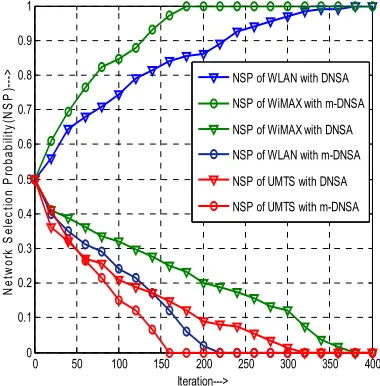
Figure 1 shows the network selection probabilities of available networks for user-1 with m-DNSA and DNSA. It is observed from the figure that the proposed m-DNSA algorithm selects the WiMAX as most favorable network for user-1 within 180 iterations for the demand type from excellent voice to good video conferencing. However, the DNSA selects the WLAN as optimal network after 360 iterations for the same demand of user-1. This optimal network selection performance is also verified for good video conferencing service by measuring packet end-to-end delay and packet delay variation. Packet end-to-delay of user-1 for video conferencing service with m-DNSA and
DNSA is shown in Figure 2. It shows that average packet end-to-end delay using proposed algorithm is 27 msec that satisfies good video user’s QoE requirement shown in table 2, whereas existing DNSA produces 72 msec that does not satisfies the QoE requirement of good video user Packet delay variation of user-1 for video conferencing service is given in table 4, which shows that packet delay variation is also lesser in m-DNSA compared with DNSA. This outperformance is due to selection of network is very faster and the selected network is more suitable for good video conferencing. DNSA selects WLAN network for user-1 based on dynamic change in user demand and service cost only but it does not consider long term network state for selection due to that user experience is not satisfied in WLAN network.
0 50 100 150 200 250 300 350 400
0 0.1 0.2 0.3 0.4 0.5 0.6 0.7 0.8 0.9 1
Iteration--->
N
e
tw
o
rk
S
e
le
c
ti
o
n
P
ro
b
a
b
ili
ty
(N
S
P
)-
--> NSP of WLAN with DNSA
NSP of WiMAX with m-DNSA
NSP of WiMAX with DNSA
NSP of WLAN with m-DNSA
NSP of UMTS with DNSA
[image:5.612.318.508.293.486.2]NSP of UMTS with m-DNSA
Figure 1 : Network selection probability for user-1
Network selection probabilities of available networks for user-2 with m-DNSA and DNSA are shown in Figure 3. Figure shows that user-2 selects optimal network as UMTS with in 220 iterations using m-DNSA whereas using DNSA it selects UMTS as optimal network after 320 iterations for changing demand type from fair FTP to excellent voice.
[image:5.612.93.295.390.560.2]ISSN: 1992-8645 www.jatit.org E-ISSN: 1817-3195 jitter increases MoS value of voice service for
[image:6.612.313.520.77.276.2]user-2 with m-DNSA and its value is given in table 4. From these results m-DNSA outperforms and provides better experience for user-2 due to that it uses Boltzmann-Gibb’s algorithm for learning which converge faster than Q-learning algorithm used in DNSA.
Figure 2: Average packet end-to-end delay of user-1 with DNSA and m-DNSA
0 50 100 150 200 250 300 350 400 0
0.1 0.2 0.3 0.4 0.5 0.6 0.7 0.8 0.9 1
Iteration--->
N
e
tw
o
rk
S
e
le
c
ti
o
n
P
ro
b
a
b
it
li
y
(N
S
P
)-->
[image:6.612.315.510.311.487.2]NSP of UMTS with DNSA NSP of UMTS with m-DNSA NSP of WiMAX with DNSA NSP of WiMAX with m-DNSA NSP of WLAN with DNSA NSP of WLAN with m-DNSA
[image:6.612.95.295.401.580.2]Figure 3: Network selection probability for user-2 with DNSA and m-DNSA
Figure 4: Packet end-to-end delay for user-2 with DNSA and m-DNSA
Figure5: Jitter for user-2 with DNSA and m-DNSA
0 50 100 150 200 250 300 350 400 0
0.1 0.2 0.3 0.4 0.5 0.6 0.7 0.8 0.9 1
Iteration-->
N
e
tw
o
rk
S
e
le
c
ti
o
n
P
ro
b
a
b
il
it
y
(N
S
P
)-->
NSP for WiMAX with DNSA NSP for WLAN with m-DNSA NSP for WLAN with DNSA NSP for WiMAX with m-DNSA NSP for UMTS with DNSA NSP for UMTS with m-DNSA
[image:6.612.317.507.501.678.2]ISSN: 1992-8645 www.jatit.org E-ISSN: 1817-3195 Network selection probabilities of available
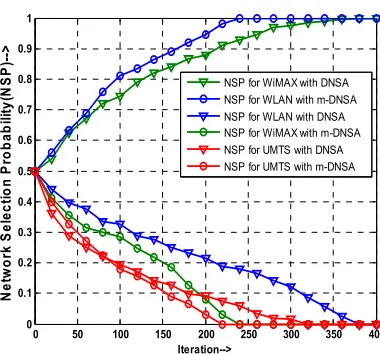
networks for user-3 with DNSA and m-DNSA are shown in Figure 6. From the figure it is observed that user-3 selects optimal network as WLAN using m-DNSA with 240 iterations for changing demand from good video conferencing service to fair FTP service. However, DNSA selects WiMAX is an optimal network for user-3 of same demand change with 380 iterations.
Experiences of user based on m-DNSA selected network are verified interms of FTP received packets and FTP response time and it is compared with DNSA selected network. Figure 7 shows FTP received packets of user-3 using proposed m-DNSA and DNSA. From the figure the proposed m-DNSA provides increased FTP traffic received compared with DNSA. The m-DNSA considers long term network state for selecting optimal network and selects WLAN due to that selected network provides better QoS, whereas DNSA selects WiMAX network without considering dynamic variation and long term traffics of that network which reduces FTP received packets. In m-DNSA selected WLAN network more FTP packets are received with less time compared with DNSA selected WiMAX network that reduces FTP response time of user-3 with m-DNSA compared with m-DNSA and it is given in table 4.
[image:7.612.315.521.94.211.2]Figure 7: FTP traffic received for user-3 with DNSA and m-DNSA
Table 4. Performance of Proposed m-DNSA for UMTS-WiMAX-WLAN networks
Type of Service
QoS
Parameter DNSA m-DNSA
Video conferencing
Packet delay
variation 0.0045 0.0005 Voice Packet delay
variation 1.8 0.001
Voice MoS Value 2.2 3.7
FTP Response
time 14 sec 1sec
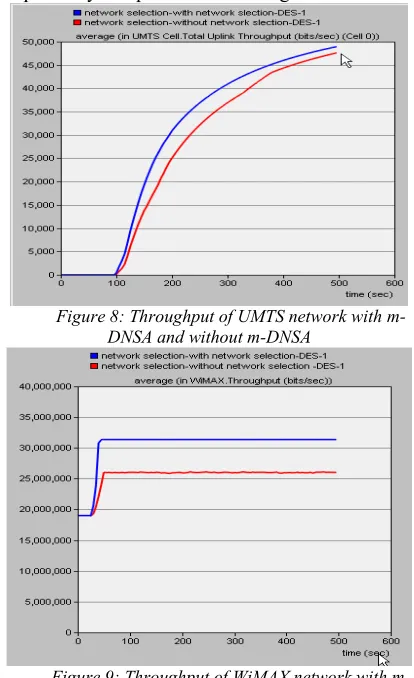
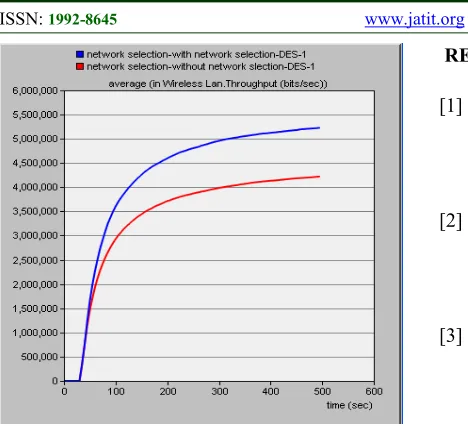
The m-DNSA selects network using derived network information and considering cost of handover that provides equilibrium between user preferences and traffic among available networks. Hence the proposed m-DNSA increases network throughput of individual networks by allowing more number of users to individual networks. Increased throughputs of UMTS, WiMAX and WLAN networks are shown in Fig 8, 9 and 10 respectively. From the figures it is observed that m-DNSA increases throughput of UMTS, WiMAX and WLAN by 2Kbps, 5 Mbps and 2 Mbps respectively compared with existing DNSA.
[image:7.612.313.520.370.709.2]Figure 8: Throughput of UMTS network with m-DNSA and without m-m-DNSA
ISSN: 1992-8645 www.jatit.org E-ISSN: 1817-3195
Figure 10. Throughput of WLAN network with m-DNSA and without m-m-DNSA
5. CONCLUSION
The proposed m-DNSA uses Boltzmann-Gibb’s learning algorithm and it selects efficient network by considering variation in user demand, dynamic network state, handoff cost and service cost. The m-DNSA converges with less time compared with DNSA and it selects efficient network by considering network variation and user demand variation which increases user experience and network performance. The performance of proposed m-DNSA is verified in modified hybrid coupled IMS based UMTS-WiMAX-WLAN overlaid networks with change in different type of service and different economical constraints. The performance of proposed m-DNSA is compared with existing DNSA with video, voice and FTP services. The proposed m-DNSA reduces packet end to end delay of video conferencing service by 62%, increases MoS of voice service by 40% and FTP traffic received by 33% compared with existing DNSA. The proposed m-DNSA selects by learning long term network state which jointly increases network performance and improves throughput of individual networks by effective load balancing. The proposed m-DNSA increases the throughput of UMTS, WiMAX and WLAN by 4.5%, 15% and 37% respectively compared with existing algorithm.
REFERENCES:
[1] K. Munasinghe and A. Jamalipour, “Interworking of WLAN-UMTS networks: an IMS-based platform for session mobility”, IEEE Communications Magazine, Vol. 46, No. 9, September 2008, pp. 184–191.
[2] FangminXu, Luyong Zhang and Zheng Zhou, “Interworking of WiMAX and 3GPP Networks based on IMS”, IEEE Communications Magazine, Vol. 45, No. 3, Mar. 2007, pp. 144-150.
[3] Shun-Ren Yang and Wen-Tsuen Chen, “SIP Multicast-Based Mobile Quality-of-Service Support over Heterogeneous IP Multimedia Subsystems”, IEEE Transactions on Mobile Computing, Vol.7, No. 11, November, pp. 1297-1311.
[4] V.Bharathi and L.Nithyanandan, “Modified Hybrid coupled architecture for UMTS-WiMAX-WLAN using IMS”, proceedings of
IEEE international conference on
communication and signal processing, pp. 1246-1250, Apr 2014.
[5] M. Kassar, B.Kervella and G.Pujolle, “An overview of vertical handover decision Strategies in heterogeneous wireless networks”, Computer communication, Vol. 31, No. 10, June 2008, pp 2607-2620.
[6] Dong Ma and Maode Ma, “A QoS Oriented Vertical Handoff Scheme for WiMAX/WLAN Overlay Networks”, IEEE Transactions on Parallel and Distributed Systems, Vol. 23, No. 4, 2012, pp.598-607.
[7] Amit Sehgal, and Rajeev Agarwal, “ QoS Based Network selection Scheme for 4G Systems”, IEEE Transactions on consumer Electronics, Vol. 56, No. 2, May 2010, pp. 560-565.
[8] GuannanXie, Huifang Chen, Lei Xie and aung Wang, “ A User-preference-aware Terminal-controlled Access Network Selection Scheme in Heterogeneous Wireless Networks”,
Proceedings of Vehicular Technology
Conference, September 2013, pp.1-5.
[9] Eng Hwee Ong and Jamil Y. Kahn, “On Optimal Network Selection in a Dynamic Multi Rat Environment”, IEEE Communications Letters, Vol. 14, No. 3, March 2010, pp. 217-219.
ISSN: 1992-8645 www.jatit.org E-ISSN: 1817-3195 on Mobile Computing, Vol. 12, No. 5, May
2013, pp. 868-884.
[11] S.p. Yeh, S.Talwar, g. Wu, et al., “Capacity and Coverage enhancement in heterogeneous networks,” IEEE Wireless Communication, Vol.18, No.3, Jun 2011, pp.32-38.
[12] Jun-pyo Hong, and Wan C hoi, “Dynamically Reconfigurable Relay Communications With Multiple Radio Access Technologies”, IEEE Transactions on Vehicular Technology, Vol. 59, No. 9, Nov. 2010 pp. 4608-14.
[13] Lusheng Wang and Geng- Sheng Kuo “Mathematical Modeling for Network Selection in Heterogeneous Wireless Networks- A Tutorial”, IEEE communications Surveys and Tutorials, Vol. 15, No.1, First quarter 2013, pp. 271-292.
[14] Ramona Trestian, Olga Ormond and Gabriel-MiroMuntean “Game Theory- Based Network Selection: Solutions and Challenges”, IEEE communications surveys and tutorials, Vol.14, No. 4, May 2011, pp.1-20.
[15] FayssalBendaoud, MarwenAbdennebi and FedouaDidi, “Network Selection Using Game Theory”, Proceedings of IEEE conference on
Control, Engineering & Information
Technology, May 2015, pp. 1-6.
[16] Dusit Niyato and Ekram Hossain, “Dynamics of Network Selection in Heterogeneous Wireless Networks: An Evolutionary Game Approach”, IEEE Transactions on Vehicular Technology, vol. 58, no. 4, May 2009, pp. 2008-2016.
[17] Nadine Abbas, siren Taleb, Hazem Hajj and Zaher Dawy, “A Learning-Based Approach for Network Selection in WLAN/3G Heterogeneous Network”, Proceedings on Communication and Information Technology, June 2013, pp. 309-313.
[18] Yu-Han Yang, Yan Chen, Chunxiao Jiang, Chih-Yu Wang and K.J. Ray Liu, “ Wireless Access Network Selection Game with Negative Network Externality” IEEE Transactions on Wireless Communications, Vol.12, No. 10, October 2013, pp. 5048-5060,.
[19] Illaria Malanchini, Matteo Cesana and Nicola Gatti, “Network Selection and Resource Allocation Games for Wireless Access Networks”, IEEE Transactions on Mobile Computing, Vol. 12, No. 12, December 2013, pp.2427-2439.
[20] Ramona Trestian, Olga Ormond and Gabriel-MiroMuntean, “Reputation Based Network Selection Using Game Theory”, Elsevier
Physical Communication, Vol. 4, July 2011, pp. 156-171.
[21] K. Zhu, D.Niyato, P.Wang and Z.Han, “Dynamic spectrum leasing and service selection in spectrum secondary market of cognitive radio networks”, IEEE. Transactions on Wireless Communication, Vol. 11, No. 3, Mar 2012, pp. 1136-1145.
[22] Li-Chuan Tseng, Feng-Tsunchien, Daqiang Zhang, Ronald Y. Chang, Wei-Ho Chung and Ching Yao Huang, “ Network Selection in Cognitive Heterogeneous Networks Using Stochastic Learning”, IEEE Communication Letters, Vol. 17, No. 12, December 2013, pp. 2304-2307.
[23] Manzoor Ahmed Khan, Hamidou Tembine and Athanasios V. Vasilakos, “Game Dynamics and Cost of Learning in Heterogeneous 4G Networks”, IEEE Journal on Selected Areas In Communications, Vol. 30, No. 1, January 2012, pp.198-214.
[24] Zhiyong du, Qihui Wu and Panlong Yang, “Dynamic User Demand Driven Online Network Selection”, IEEE communication letters, Vol.18, No.3, March 2014, pp. 419-422.
[25] Melhem El Helou, Marc Ibrahim, SamerLahoud, KindaKhawam, DanyMezher and Bernard Cousin, “A Network-assisted Approach for RAT Selection in Heterogeneous Cellular Networks”, IEEE Journal on Selected Areas in Communications, Vol. 33, No. 6, May 2015, pp. 1055-1067.
[26] OPNET: Network Modelling and Application Performance Monitoring: Network Simulator: Version 14A: OPNET Technologies , Dec 2013.