ISSN: 1992-8645 www.jatit.org E-ISSN: 1817-3195
343
FACEBOOK TO FACILITATE INSTRUCTOR ROLES IN
COURSE-RELATED ONLINE INTERACTION: A PILOT
STUDY.
1YAHYA M. AL-DHELEAI, 2ZAIDATUN TASIR
1,2
Department of Educational Science, Mathematics and Creative Multimedia, Faculty of Education, Universiti Teknologi Malaysia, Skudai, Johor Bahru, Malaysia
ABSTRACT
The popularity of Facebook as the most used platform among university youth made it an acceptable platform for professional purposes. The use of Facebook for educational purpose is becoming more accepted to facilitate and ease online interaction with the learning participants. The purpose of this study is to investigate students’ expectations towards the instructor role in learning interaction through Facebook and its correlation with students’ academic performance. Quantitative data was collected from the respondents through survey method of data collection. The findings of the study reveal that students have positive expectations of instructor role on Facebook interaction. Additionally, the findings reveal that there are a correlation between instructor role of facilitating discourse and direct instruction with students’ academic performance.
Keywords: Facebook, Instructor Role in Online Interaction, Instructor-student Online Interaction,
Academic Performance
1. INTRODUCTION
In online interaction, technology has provided a new avenue for students and instructors to communicate out of classroom time and extend learning beyond place and time boundaries. As a result, learners and instructors discussions have no longer limited to face-to-face interaction. Therefore, instructor-student discussion can be achieved through online medium anytime and anywhere. The desired online discussion can be achieved better through a medium that is preferable to learners and has the features that support students’ online interaction. The quality of online discussion depends on student’s acceptance of the medium [1] , the design of the interaction session and the guidance of the instructor [2]
Instructor-student interaction within higher education takes different forms of interactive components such as person-to-person interaction or group-based discussion activities [3]. Marks, Sibley, and Arbaugh [4]) pointed out that instructor–student interaction found to be the most important factor that affects student perceptions of learning. Interaction with instructors can help
students to correctly understand and interpret the course content and clarify unclear points [5]. Instructor interacts with students by providing knowledge content, appropriate scaffolding, clarifies misunderstanding, and increases students learning motivation [6]. Therefore, students expect online instructor to ask follow-up questions, introduce new concepts or new way of thinking to solve the problem, immediate answer to students’ questions, providing feedback, and discussing the students solutions [7]. This is aligned with the perceptions of instructors’ on their roles, where instructors classified their participations as to answer students’ questions, ask leading questions, continue discussion thread [7]. Murray, Pérez, Geist, and Hedrick [8] stated that instructor-student interaction can be in form of present information, guide students throughout the course, initiate dialog with students, provide feedback and student encouragement.
1.1 Interaction
ISSN: 1992-8645 www.jatit.org E-ISSN: 1817-3195
344 interactions in the learning process. According to social constructivists, knowledge construction is the product of social interaction, interpretation and understanding [9] and the reality is constructed through human activity [10].
Interaction is defined as the learner’s engagement with the course content, other learners, the instructor, and the technological medium used in the course [11]. Muirhead and Juwah [12] described interaction as “a dialogue or discourse or event between two or more participants and objects which occur synchronously and/or asynchronously mediated by response or feedback and interfaced by technology”. Therefore, learning is the result of social exchange of ideas, knowledge, and experiences either face to face or through online media.
1.2 Instructor Role in Online Interaction
One of the important roles of online instructor is to facilitate interaction among students through guiding students’ center approaches by maintaining students’ chance of having more control over their learning process [13]. Online instructor also works to maintain students motivation and interest to participate in online discussion [14]. Other roles of online instructor are to provide students with the guidelines of the quality and quantity of their participation ([15],[16]) and performance [17]. Therefore; instructor intervention can help learners to set up the direction of their discussion and define its boundaries [18]. Based on the importance of the instructor role in online interaction, this study will investigate instructor-student interaction based on the role of online instructor as a course designer, online discussion facilitator and the source of direct instruction.
Anderson, Rourke, Garrison and Archer [19] in their community of inquiry (COI) framework study believe that instructor is responsible to participate and facilitate purposeful learning in order to achieve its goals. According to them, instructor needs to share the control over the learning environment with learners through provided choices, guiding the discourse through reflective participation and learning misconceptions. Anderson and colleagues [19] classified the role of online instructor based on three characteristics, which are instructional design and organization, facilitating discourse, and direct instruction. The instructor role on Anderson and his colleagues study is called teaching presence and they define it as “the design, facilitation, and direction of
cognitive and social processes for the purpose of realizing personally meaningful and educationally worthwhile learning outcomes”. According to their definition instructor play an important role before the beginning of the course and during the course. Before the course instructor design the course, plan and prepares the course of the studies. While during the course, the instructor continues his role to facilitate the course discussion and provide direct instruction when needed.
1.3 Instructor-Student Interaction and Students’ Academic Performance
Instructor-student interaction can affect students learning perception and learning outcome. Different aspects of instructor-student interaction has been studied by many researchers ([20], [21],[22],[23] and [24]) in their efforts to identify its impact on students’ learning experience and academic performance. In their study, [20] examined the effect of academic, collaborative and social interaction on students’ learning and satisfaction. The sample of the study was 120 undergraduate students and the mixed method was used to collect the data of the study. The researchers found that social interaction between learners and the instructor contributed to increased learning achievement. Students perceived that the more interaction with their instructor the greater their course grades [21].
Another study was conducted by Sher [22] to investigates the relationship between interaction variables and student learning and satisfaction. A sample of 208 students from thirty class sections 73% graduate students and 27% undergraduate students enrolled on online learning program were the respondents of the questionnaire of the study. The findings of the study show that instructor-student interaction is positively associated with student learning and significant contributor to their learning [22]. More recently, Hankinson [23] conducted a quantitative study through online survey and collected data from 81 respondents. The findings of the study reported that learner-instructor interaction found to have a slightly higher impact on students’ perceived learning than learner-learner interaction.
ISSN: 1992-8645 www.jatit.org E-ISSN: 1817-3195
345 interaction in terms of interpersonal encouragement that was promoted by instructor’s strategies and not as the complete role of online instructor in online learning. Therefore, this study is an effort to contribute to the existing knowledge of online learning interaction.
2. RESEARCH OBJECTIVES
This study aims to achieve the following objectives:
1)To investigates students’ expectations of the instructor role on Facebook interaction.
2)To identify the differences on students’ expectations of the instructor role on Facebook interaction based on their form of study (Full time or Part time).
3)To find out the correlation between students’ expectations of instructor role on Facebook and their perceived academic performance.
4)
2. METHODOLOGY
This study used quantitative research method. The data of this study was collected using survey method. The questionnaire instrument was distributed among postgraduate students in semester 2-2014/2015 academic year.
3.1 Respondents of the Study
The population of this study was the current master students in educational multimedia department, Faculty of education in one of the public universities in Malaysia. The pilot study questionnaire was randomly distributed to 22 master students in educational technology. The respondents’ age ranged between 21 years old to 40 years. In terms of gender, 14 were female students and the rest of the respondents’ were male students. In terms of respondents’ form of the study, 9 were full time and 13 were part time students.
3.2 Research Instrument
The five point Likert scale (Strongly Disagree “1” to Strongly Agree “5”) questionnaire was used
as data collection instrument. The 17 items questionnaire comprised of four constructs. Three of the constructs were adapted from Arbaugh et al [25] to measure instructor-student interaction; design and organization, facilitating discourse and direct instruction; while the fourth construct was developed by the researcher to measure students’
perceived academic performance. The instrument was given to two experts in the field of online instruction for validation. Based on the experts’ suggestions, minor changes were done to the instrument to make it more specific and clear.
Questionnaire was modified to achieve the objectives of the study; the reliability of the instrument was measured to guarantee the internal consistency of the measurement instrument. The reliability of index Cronbach’s Alpha of the questionnaire was .92. The obtained Cronbach’s Alpha shows that the measurement instrument has high reliability.
3.DATA ANALYSIS
The data analysis were done using Statistical Package for the Social Science “SPSS, version .20” software. Students’ expectations of the instructor role in online interaction on Facebook were analyzed through descriptive analysis by finding the mean and standard deviation for every constructs. One simple t-test was used to analyze the difference between students based on their gender in their expectations about the role of the instructor in online interaction. Pearson correlation was used to find out the correlation between every instructor role and students’ academic performance.
5. FINDINGS
5.1Research Objective 1: Students’ Perception of
The Instructor Role on Facebook and Academic Performance:
In general, students have high perception about the ability of Facebook to be a medium that can enable the instructor to achieve his/her role while interacting with students. In general the findings in table 1 shows that students highly believe that instructor can achieve his/her role in instructional design and organization using Facebook with total mean 3.84 and SD .9403.
ISSN: 1992-8645 www.jatit.org E-ISSN: 1817-3195
346 Table 1: Students Perception On Instructor Instructional
Design And Organization (IDO) Role
Table 2 shows that students highly believe that instructor can achieve the role of facilitating students’ discourse using Facebook with mean 4.06 and SD.5432.
Table 2: Students Perception On Instructor Facilitating Discourse (FD) Role
Facilitating Discourse
Item No
Item Mean SD
1 FD 1 3.90 .71
2 FD 2 4.09 .68
3 FD 3 4.18 .59
4 FD 4 4.09 .61
5 FD 5 4.09 .68
6 FD 6 4.04 .79
Overall mean 4.06 .5432
Similar to students’ perception of instructor role of facilitating discourse (FD) on Facebook, students highly believe that instructor can achieve his/her role by providing students with direct instructions (DI) using Facebook with mean 4.06 and SD .5432 as shown in table 3.
Table 3: Students Perception On Instructor Direct Instruction (DI) Role
However, table 4 shows that students highly believe that the use of Facebook for interaction can enhance their academic performance with mean 4.06 and SD .6310.
Table 4: Student Perceived Academic Performance (SAP)
Student Perceived Academic Performance
Item No
Item Mean SD
1 SAP 1 4.00 .62
2 SAP 2 4.18 .73
3 SAP 3 4.09 .68
4 SAP 4 4.09 .68
Overall mean 4.06 .63
5.2 Research Objective 2: The Differences in Students’ Expectations of the Instructor Role on Facebook Interaction Based on the Form of Study
To compare different groups in their perceptions, an independent sample t-test was conducted to find out if there is any difference between full time and part time students on their perception regarding the role of the instructor on Facebook course-related interaction
As shown in table 5, the findings for comparing the two groups in terms of form of study showed that there is no significant difference in students’ perception about the role of instructor as well as all the three roles of the instructor.
Instructional design and organization
Item No
Item Mean SD
1 IDO 1 3.72 1.16
2 IDO 2 3.90 0.97
3 IDO 3 3.77 1.02
4 IDO 4 3.954 0.90
Overall mean 3.84 .9403
Direct Instruction
Item No
Item Mean SD
1 DI 1 4.09 .68
2 DI 2 4.00 .82
3 DI 3 4.0909 .81
ISSN: 1992-8645 www.jatit.org E-ISSN: 1817-3195
347 Table 5: T-Test Analysis Based On Form Of The Study
*Significant at α = 0.05
5.3 Research Objective 3: The Relationship Between Students’ Expectations of the Instructor Role on Facebook Interaction and Perceived Academic Performance.
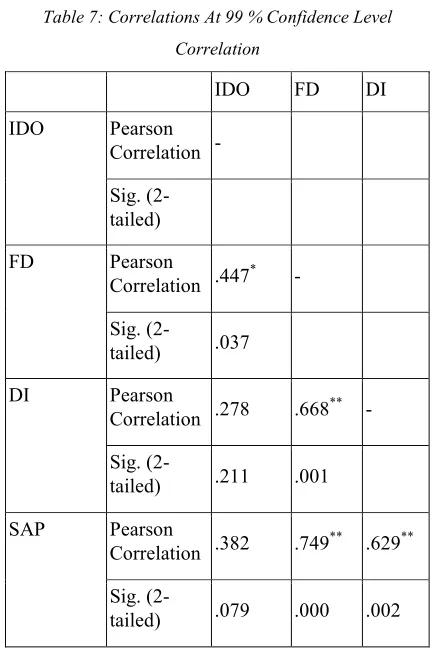
This study also analyzed the correlation between instructor roles and students’ academic performance to find out what instructor role has more correlation with students’ academic performance. The results of Pearson correlation shows that, students’ academic performance
(SAP) has high positive and significant correlation
with instructor role of direct instruction (DI) (r= 629, P < 0.01). Likewise, student academic performance (SAP) has high and significant correlation with instructor for facilitating discourse
(FD) (r= 749, P< 0.01). In contrast, the findings
shows that, there is no correlation between students’ academic performance (SAP) and instructor instructional design and organization
[image:5.612.309.526.92.418.2](IDO) (r= .382, p> 0.05).
Table 7: Correlations At 99 % Confidence Level
Correlation
*. Correlation is significant at the 0.05 level (2-tailed).
**. Correlation is significant at the 0.01 level (2-tailed).
6. DISCUSSION
The findings of the current study reveal that students showed positive expectations of the role of the instructor on Facebook interaction. As a result, instructor roles on Facebook interaction have a positive correlation with students’ academic performance. The findings of the study confirm that this type of online interaction is important for students’ learning, as it can links students with the course instructor outside of class time which help students to overcome the difficulties and to understand the course content.
In terms of instructors’ specific roles during interaction with students, this study showed different levels of students’ perception towards different instructor roles. Of course, students’ perception of all investigated roles is positive, but still in different in the level from role to another.
Construct Mean
P-value Full
time
Part time
IDO 3.44 4.04 .15
FD 3.83 4.15 .16
DI 4.11 3.94 .55
IDO FD DI
IDO Pearson
Correlation -
Sig. (2-tailed)
FD Pearson
Correlation .447 *
-
Sig.
(2-tailed) .037
DI Pearson
Correlation .278 .668 **
-
Sig.
(2-tailed) .211 .001
SAP Pearson
Correlation .382 .749 **
.629**
Sig.
ISSN: 1992-8645 www.jatit.org E-ISSN: 1817-3195
348 This difference tells us that certain online instructor roles can be achieved online more than others. For example, the findings indicated that instructor role of instructional design and organization has lower expectation to be achieved online compare to the other roles. Therefore, this findings is in line with [25] ) study. This findings might be attributed to the nature of instructional design and organization role as most of its work should be done before the time of course delivery and online interaction [25]. Although students still moderately believe some instructional design and organization work can be done during online interaction but they didn’t relate it with their academic performance.
However, students highly believe that instructor can achieve his role of Facilitating Discourse and Direct instruction on Facebook. In terms of instructor role of facilitating students discourse, students expect that instructor will work to guide the discussion and motivate them for more engagement in the discussion. In this role, instructor help students to identify the areas of agreement and disagreement during their discussion and at the end instructor will guide them to reach consensus about the discussion topic. By achieving this role, students can have more understanding of the course content.
Similarly, students believe that instructor role of direct instructions can be achieved via Facebook. In this role, instructor work with students to keep their discussion focused on topic under discussion. Additionally, instructor provides from time to time feedback by which he/she point out students’ areas of strength and weaknesses in order to overcome the weaknesses.
However, full time and part time students did not show any differences in their expectations of the three of the instructor online roles on Facebook discussion. This similarity can be attributed to nature of online session in which all students can interact with instructor any time they want. Moreover, online instructor role will equally be given to all students through Facebook no matter what their form of study is.
Interestingly, instructor roles of facilitating discourse and direct instruction found to be more connected to online interaction. This can be attributed to the strong presence of those two roles in online discussion compared to instructor role of instructional design and organization as most of its work is expected to be done prior to online discussion. Therefore, the findings of this study
revealed that there is no relationship between instructor role of instructional design and organization and students’ academic performance. On the other hand, instructor role of facilitating discourse and direct instructions shows high relationship with students’ academic performance as it can be seen directly and mostly used by instructor in online interaction with students.
Generally, the findings of this study showed that instructor roles in online interaction are highly expected by students and the instructor role can contribute to enhance students’ academic performance. However, the findings of this study support the findings of the previous studies findings ([20], [21], [22], [23]) and confirmed that instructor role in instructor-students interaction has its impact on students’ learning and academic performance.
7. CONCLUSION
The opportunity of using different media for learning in the current era is more than ever. In recent years, the use of social networking tools for learning is increasing because of its ability to provide more interactive tool for social interaction among learning participants. Facebook as mostly used by university aged youth can provide facilities for instructor role in online interaction. Instructor could use Facebook to achieve his/her role of instructional design and organization, facilitating discourse and direct instruction. Student support the idea of using social networking tool (Facebook) as a medium of course-related interaction to facilitate instructor role in online interaction as revealed in this study. Additionally, Students agreed that Instructor role in online interaction via Facebook can enhance their academic performance.
8. FUTURE WORK
Future studies should involve bigger simple size to make the finding more reliable and generalizable. An experimental study should be conducted in future studies to investigate the possibility of using Facebook for course-related interaction.
ACKNOWLEDGEMENT
ISSN: 1992-8645 www.jatit.org E-ISSN: 1817-3195
349 (Q.J13000.3010.00M68) initiated by UTM and MOE. This study also supported by the Ministry of Higher Education and Scientific Research- Sana’a, Yemen.
REFERENCE:
[1] Lee, M. K. O., Cheung, C. M. K., & Chen, Z. (2005). Acceptance of Internet-based learning medium: the role of extrinsic and intrinsic motivation. Information & Management,
42(8), 1095–1104,
DOI:10.1016/j.im.2003.10.007.
[2] Nir-Gal, O. (2002). Distance Learning: The Role of the Teacher in a Virtual Learning Environment. Ma’of u-Ma’aseh, 8, 23-50.
[3] Conrad, R.-M., & Donaldson, J. A. (2011). Engaging the online learner: Activities and resources for creative instruction (Vol. 38). John Wiley & Sons.
[4] Marks, R. B., Sibley, S. D., & Arbaugh, J. B. (2005). A structural equation model of predictors for effective online learning. Journal of Management Education, 29(4), 531–563.
[5] Thurmond, V., & Wambach, K. (2004). Understanding interactions in distance education: A review of the literature.
International Journal of Instructional
Technology and Distance Learning, 1(1).
[6] So, H.-J., & Brush, T. A. (2008). Student perceptions of collaborative learning, social presence and satisfaction in a blended learning environment: Relationships and critical factors. Computers & Education,
51(1), 318–336,
DOI:10.1016/j.compedu.2007.05.009.
[7] Mazzolini, M., & Maddison, S. (2007). When to jump in: The role of the instructor in online discussion forums. Computers & Education,
49(2), 193–213,
DOI:10.1016/j.compedu.2005.06.011.
[8] Murray, M., Pérez, J., Geist, D., & Hedrick, A. (2012). Student interaction with online course content: Build it and they might come.
Journal of Information Technology
Education: Research, 11(1), 125–140.
[9] Vygotsky, L. S. (1980). Mind in society: The
development of higher psychological
processes. Harvard university press.
[10] Lim, C. K. (2001). Computer self‐efficacy, academic self‐concept, and other predictors of satisfaction and future participation of adult distance learners. American Journal of Distance Education, 15(2), 41–51.
[11] Thurmond, V. A. (2003). Examination of
interaction variables as predictors of
students’ satisfaction and willingness to enroll in future web-based courses while
controlling for student characteristics.
Universal-Publishers.
[12] Muirhead, B., & Juwah, C. (2004). Interactivity in computer-mediated college and university education: A recent review of the literature. Educational Technology & Society, 7(1), 12–20.
[13] Baran, E., Correia, A.-P., & Thompson, A. (2011). Transforming online teaching practice: critical analysis of the literature on the roles and competencies of online teachers.
Distance Education, 32(3), 421–439,
DOI:10.1080/01587919.2011.610293.
[14] Balaji, M. S., & Chakrabarti, D. (2010). Student interactions in online discussion forum: Empirical research from “media richness theory”perspective. Journal of
Interactive Online Learning, 9(1), 1–22.
[15] Kuboni*, O., & Martin, A. (2004). An assessment of support strategies used to facilitate distance students’ participation in a web‐based learning environment in the University of the West Indies. Distance
Education, 25(1), 7–29,
DOI:10.1080/0158791042000212431.
[16] Matusov, E., Hayes, R., & Pluta, M. J. (2005). Using discussion webs to Develop an Academic Community of Learner.
Educational Technology & Society, 8(2), 16–
39.
[17] Dennen, V. P. (2005). From message posting to learning dialogues: Factors affecting learner participation in asynchronous discussion. Distance Education, 26(1), 127– 148, DOI:10.1080/01587910500081376.
ISSN: 1992-8645 www.jatit.org E-ISSN: 1817-3195
350 [19] Anderson, T., Rourke, L., Garrison, D. R., &
Archer, W. (2001). Assessing teaching presence in a computer conferencing context. Jaln, 5(2).
[20] Jung, I., Choi, S., Lim, C., & Leem, J. (2002). Effects of different types of interaction on learning achievement, satisfaction and participation in web-based instruction. Innovations in Education and Teaching
International, 39(2), 153–162.
[21] Swan, K. (2001). Virtual interaction: Design factors affecting student satisfaction and perceived learning in asynchronous online courses. Distance Education, 22(2), 306–331, DOI:10.1080/0158791010220208.
[22] Sher, A. (2009). Assessing the relationship of student-instructor and student-student interaction to student learning and satisfaction in Web-based Online Learning Environment.
Journal of Interactive Online Learning, 8(2),
102–120, ISSN: 1541-4914.
[23] Hankinson, K. M. (2012). Assessing the Relationship Between Classroom Interaction and Perceived Student Learning in Videoconferencing Remote Sites: A Social Learning Approach.
[24] Andersen, J. C. (2013). Learner Satisfaction in Online Learning: An Analysis of the Perceived Impact of Learner-Social Media and Learner-Instructor Interaction.
[25] Arbaugh, J. Ben, Cleveland-Innes, M., Diaz, S. R., Garrison, D. R., Ice, P., Richardson, J. C., & Swan, K. P. (2008). Developing a community of inquiry instrument: Testing a measure of the community of inquiry framework using a multi-institutional sample.
The Internet and Higher Education, 11(3),
ISSN: 1992-8645 www.jatit.org E-ISSN: 1817-3195
351
Abbendix 1
Instructional Design and Organization, IDO, Facilitating FD, and Direct Instruction DI questionnaire Statements
Students’ Academic Performance SAP questionnaire’s Statements
Students’ Academic Performance
SAP1 Interaction with the instructor through Facebook can enhance my academic performance.
SAP2 Interaction with other students through Facebook can enhance my academic performance.
SAP3 Using Facebook for course-related interaction can enhance my learning.
SAP4 Using Facebook for course-related interaction can enhance my academic performance
Instructional design and organization
IDO1 The instructor can clearly communicate important course topics via Facebook. IDO2 The instructor can clearly communicate
important course goals via Facebook. IDO3 The instructor can provide clear
instructions on how to participate in the course learning activities via Facebook. IDO4 The instructor can clearly communicate
important due dates/time frames for learning activities via Facebook.
Facilitating Discourse
FD1 The instructor can be helpful in identifying areas of agreement and disagreement on course topics via Facebook that help me to learn. FD2 The instructor can be helpful in guiding
the class towards understanding course topics via Facebook in a way that help me clarify my thinking.
FD3 The instructor can help to keep course participants engaged and participating in productive dialogue via Facebook. FD4 The instructor can help to keep the
course participants on task via Facebook in a way that help me to learn.
FD5 The instructor can encourage course participants to explore new concepts in this course via Facebook.
FD6 Instructor actions can reinforce the development of a sense of community among course participants via Facebook.
Direct Instruction
DI 1 The instructor can help to focus discussion on relevant issues via Facebook in a way that help me to learn. DI 2 The instructor can provide feedback via
Facebook that help me understand my strengths and weaknesses.