10th January 2014. Vol. 59 No.1 © 2005 - 2014 JATIT & LLS. All rights reserved.
ISSN: 1992-8645 www.jatit.org E-ISSN: 1817-3195
DESIGN OF A MODIFIED FUZZY FILTERING FOR NOISE
REDUCTION IN IMAGES
1EHSAN AZIMIRAD, 2JAVAD HADDADNIA
1PHD Student, Department of Electrical and Computer Engineering, Hakim Sabzevari University,
Sabzevar, Iran
2Associate Professor, Department of Electrical and Computer Engineering, Hakim Sabzevari University,
Sabzevar, Iran
E-mail: [email protected], [email protected]
ABSTRACT
Reducing noise from the color images is a very active research scope in image processing. In this paper, a modified fuzzy based image filtering algorithm is proposed for reducing impulse noise. This paper presents a new fuzzy filter for the removal Impulse noise in color images. For dealing with the Impulse noise, an algorithm is developed to search for a set of uncorrupted pixels in the neighborhood of the pixel of interest and to compute the median of this set. A modified fuzzy filter consisting of two sub filters with novel membership functions is proposed to cancel out the impulse noise. The first sub filter detects the noisy pixel by utilizing three fuzzy membership functions, defined for this purpose. The corrupted pixels are then corrected using the median of the noise free pixels. The second sub filter makes use of the relation between different color components of a pixel to remove the residual noise in the color image. Simulation results shows that the proposed fuzzy filter effectively removes the additive noise by preserving fine details in the image.
Keywords: Impulse Noise, Fuzzy Filter, Reducing Noise, Median Filter, Membership Functions
1. INTRODUCTION
Image restoration is a major research area in image processing. Images can become corrupted during any of the phase take acquisition, pre-processing, compression, transmission, storage and/or reproduction phases of the processing [1]. Noise reduction is a preprocessing step in image enhancement. Last one decade research in the image restoration of noise affected image into original image is going on. Image detail preservation and impulse noise attenuation are difficult to achieve simultaneously in the area of image restoration design. The types of the noise are: additive and multiplicative. The major category in additive noise is Impulsive noise and Gaussian noise. Speckle noise is the multiplicative noise [2].
Generally the noise reduction process has two phases. The first phase is called noise detection, which is used to identify whether the pixels are corrupted by noise or not. The second phase is noise reduction. Before applying the filter, the identified pixel is discriminated by either the pixel is noise or image fine details like edge, texture, color, etc. Then the noise affected pixel is replaced
by the filter value. Almost all noise reduction algorithms are executed in two steps, i) detect the corrupted pixels and ii) correct the pixels by replacing the filter estimated values [2].
The application of fuzzy techniques in image processing is a promising research field. Fuzzy techniques have already been applied in several domains of image processing (e.g., filtering, interpolation, and morphology), and have numerous practical applications (e.g., in industrial and medical image processing) [3].
Image filters exist in three domains: spatial, frequency and fuzzy domain. This study deals with fuzzy filters which offer several advantages over classical filters even as they preserve the image structure. Moreover, fuzzy filters are easy to realize by means of simple fuzzy rules that characterize a particular noise.
from [12]. Also, [13] represent a robust fuzzy median filter for impulse noise reduction of gray scale images. Most fuzzy techniques in image noise reduction mainly deal with fattailed noise like impulse noise. These fuzzy filters are able to outperform rank-order filter schemes (such as the median filter). Nevertheless, most fuzzy techniques are not specifically designed for Gaussian noise or do not produce convincing results when applied to handle this type of noise [3,4,6].
For dealing with the Impulse noise, an algorithm is developed to search for a set of uncorrupted pixels in the neighborhood of the pixel of interest and to compute the median of this set. A new fuzzy filter consisting of two sub filters with several novel membership functions is proposed to cancel out the impulse noise. The first sub filter detects the noisy pixel along with the amount of noise in it by utilizing three fuzzy membership functions, defined for this purpose. The corrupted pixels are then corrected using the median of the noise free pixels. The second sub filter makes use of the relation between different color components of a pixel to remove the residual noise in the color image. The result of this method can be compared with those obtained by other filters.
This paper is organized as follows. Section 2 presents the problem statement. Section 3 illustrates the design of the proposed fuzzy filter by introducing the relevant concepts. The main results are detailed in Section 4. Finally, conclusions are drawn in Section 5.
2. PROBLEM STATEMENT
2.1. Impulse Noise For Color Images
A color image can be represented via several color models such as RGB, CMY, HSV and CIE. The most well known of these is the RGB model which is based on Cartesian coordinate system. Images presented in the RGB color model consists of three component images, one for each primary color (Red, Green and Blue)[4]. Consider a color image represented in the i-j plane, then the third coordinate k =1,2,3 will represent the color component of the image pixel at (i,j). Let A be the image function then A(i,j,1) will represent the Red component of pixel at (i,j). Similarly, A(i,j,2) and A(i,j,3) represent the Green and Blue components respectively.
Images corrupted with impulse noise contain pixels affected by some probability. This implies that some of the pixels may not have a trace of any noise at all. Moreover, a pixel can have either all or
one or two of its components corrupted with impulse noise. Mathematical modeling of impulse noise in color images is as follows:
− =
) 1 ( )
, , (
) , , ( ) , , (
k k
p p with with k j i
k j i O k j i A
η
(1)Where, k =1,2,3 represents red, green and blue components. The probabilities' can have equal or unequal values. In Equation (1), A represents the final corrupted image, while O and are the numbers of corrupted and uncorrupted pixels respectively [4,5].
2.2. Algorithm For Median Of Noise
This paper uses an algorithm to determine the median of noise free pixels in the neighborhood of a pixel under interest that is presented in[4]. The median of the noise free pixels is utilized to modify the pixel corrupted with impulse noise. This median is computed separately for each color component in the following steps:
• Take a window of size centered on the pixel of interest in the corrupted image.
• Arrange all the pixels of the window as a vector. Sort the vector in an increasing order and compute the median of the sorted vector.
• Calculate the difference between each window pixel and the median of the vector.
• Arrange all the window pixels having the differences less than or equal to a parameter
in a vector.
• Sort the new vector and obtain the median med of the sorted vector.
The above Algorithm uses a mask for image scanning and median (med) is used to find the correction term for each pixel in the noisy image.
3. PROPOSED FUZZY FILTER
3.1. Structure Of Impulse Filter
The proposed filter is designed for the reduction of impulse noise in color images. The designing of Filter is done by treating each color component separately. Interactions among these color components are used to determine the similarity of the central pixel against the neighboring pixels. The nature of impulse noise is random in the sense that it corrupts some pixels while leaving others untouched. So our objective is to identify the noisy pixels along with the amount of noise present. It may be noted that the impulse noise bears similarity with the high frequency content of images like edges and fine details because both reflect sudden
k
p
η
1
δ
3 3×
10th January 2014. Vol. 59 No.1 © 2005 - 2014 JATIT & LLS. All rights reserved.
ISSN: 1992-8645 www.jatit.org E-ISSN: 1817-3195
changes in pixel values. The novel of three different membership functions, viz., Great, Dissimilar and Extreme are used to differentiate the noisy pixels from the high frequency contents. The proposed impulse filter consists of two sub filters as follows.
The primary task of this sub filter is to recognize the noisy pixel along with the amount of noise present, and modify the corrupted pixel value with the median (med) of the noise-free pixels present in the neighborhood. The three above mentioned
novel membership functions are framed
subsequently to identify the noisy pixels. The difference between the central pixel and the median of the noise-free pixels in the neighborhood of a window is denoted as [4,5]:
(2) The difference equations for the other two color
components are obtained by replacing 1 in Equation (2) by 2 and 3 respectively.
We now suggest a new membership function, to represent a fuzzy set “Great” that indicates how large the difference is. A pixel with higher noise will have a larger difference with the median value. This is defined by the membership function as:
(3)
[image:3.612.103.295.487.582.2]The parameters and in Equation (3) are obtained from experimentation. The membership function that represented by Equation (3) is depicted in Figure 1.
Figure 1: Membership Function for fuzzy set “Great”
The degree of similarity of a pixel with respect to its neighborhood pixels means whether it is noisy or not. To decide whether a pixel is similar to a neighborhood pixel, a similarity criterion is devised. For example, for the red component, the differences between red and green component and that between red and blue components are computed as follows [4,5]:
(4) Similarly the differences between red and green components and that between red and blue components of the neighboring pixels at ( ) are calculated as [4,5]:
(5)
The second differences of the above pair-wise differences in (5) are computed from the following equation:
(6)
We also need the differences between the neighboring pixels and the central pixel of the same color component in the window given by:
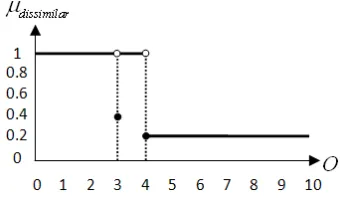
(7) A second membership function is devised to measure the degree of similarity of the central pixel to the neighboring pixels. This membership function describes the fuzzy set called Dissimilar over the discrete universe of discourse N ={0,1,2,3,4,5,6,7,8}. Let, N be the number of similar pixels in the window of size w×w. The number N is decided based on the differences calculated in Equations (6) and (7) and the similarity criterion. Considering a 3×3 window, the membership function is defined as:
(8)
Note that in Equation (8) is defined in Equation (2) and the parameter is the same as used in the similarity criterion. The membership function for Dissimilar is shown in Figure 2.
Figure 2: Membership Function for fuzzy set “Dissimilar”
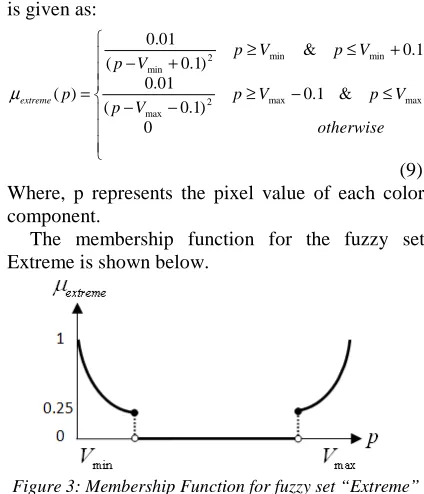
The third membership function is characterized as follows. If we arrange pixels of the window in a vector V and sort them in an increasing order, we will obtain two extreme pixel values, and . The closer the value of a pixel is to these extremes, the higher is the possibility of the pixel being noisy. This concept is used in obtaining Fuzzy set
1
α α2
( , , ) ( , ,1) ( , ,1)
m
D i j k = A i j −med i j
) 3 , , ( ) 1 , , ( ) , ( ) 2 , , ( ) 1 , , ( ) , ( j i A j i A j i d j i A j i A j i d rb rg − = − = ) 3 , , ( ) 1 , , ( ) , ( ) 2 , , ( ) 1 , , ( ) , ( ρ σ ρ σ ρ σ ρ σ ρ σ ρ σ + + − + + = + + + + − + + = + + j i A j i A j i d j i A j i A j i d rb rg ) , ( ) , ( ) , ( ) , ( ) , ( ) , ( j i d j i d j i j i d j i d j i rb rb rb rg rg rg − + + = + + ∆ − + + = + + ∆ ρ σ ρ σ ρ σ ρ σ ) 1 , , ( ) 1 , , ( ) ,
(i j Ai j Ai j
r + + = + + −
∆ σ ρ σ ρ
< = < ≥ = otherwise andD O andD O D O m m m dissimilar 1 3 4 . 0 4 2 . 0 ) , ( 2 2 δ δ µ m D 2 δ ρ σ + + j i , 2 1 1 2 2 1
1 ( , ,1)
( , ,1)
( ( , ,1)) ( , ,1)
0 ( , ,1)
m m
great m m
m
D i j D i j
D i j D i j
D i j α α
µ α α α
α
≥
−
= ≤ <
<
[image:3.612.335.508.513.612.2]“Extreme”. The membership function for the fuzzy set “Extreme” applicable to each color component is given as:
(9) Where, p represents the pixel value of each color component.
[image:4.612.90.302.118.365.2]The membership function for the fuzzy set Extreme is shown below.
Figure 3: Membership Function for fuzzy set “Extreme”
The degree of noise present in a pixel is ascertained from the following fuzzy rule [4]:
Lemma 3.1. IF is Great and is Dissimilar neighborhood and the central pixel is
Extreme THEN this pixel is noisy. In this rule, noise designated by is a
fuzzy variable. This rule is the Mamdani fuzzy model. Note that we are not using any membership function for the fuzzy set formed by the variables.
Let the membership functions Great, Dissimilar and Extreme be denoted by and for the red component. Then the degree of noise in the red component of a pixel is evaluated as[4,5]:
(10)
Equation (10) is obtained using the fuzzy rule in
Lemma 3.1. Antecedents in the fuzzy rule are combined using the fuzzy operator AND which is implemented as “minimum” operation. The correction term for the red component is computed as:
(11) As in Equation (10) gives the degree of
noise present in the Red component of the pixel at the location (i,j); It will be zero for noise free pixel and will have some value between 0 and 1 for the noisy pixel. The correction term will become zero if the pixel is noise free and its value is equal to the difference between the median (med) of noise free pixels in the neighborhood and the value of the
pixel itself in the case of extremely corrupted pixels. Now the modified pixels arising out of the first sub filter (i.e. the output) are obtained as:
(12) The extremely corrupted color components are replaced with the median (med) of the noise free color components of the neighborhood while the noise free components are left untouched. Pixels having noise in between are treated according to the amount of noise present in it. It can be observed that the above modified pixels are immediately put to use to correct the subsequent pixels.
The output from the first sub filter serves as the input to the second sub filter. This filter invokes the interactions among the color components to remove the impulse noise.
Differences between the color pairs are given as [4]:
(13)
A fuzzy rule is framed to express the degree of noise present in the color component of a pixel as part of this sub filter. For example for the Red component have [4]:
Lemma 3.2. IF is Great and is Great THEN the red component of the pixel is noisy.
This rule does not hold always. Suppose there is a red color region then the above differences will be large even without any noise but in that case the median of the region is again red. Hence this situation doesn’t affect the performance of our filter. Similar fuzzy rules are coined for other color components. We fuzzify adaptive differences (13) to evolve the membership function (3) with two parameters and . Note that and will replace the original and in the function Great so as to have different shapes. Correction terms for this filter are computed in similar lines as in the first sub filter. The degree of noise present in a pixel is[4]:
(14)
Where, and are the membership functions of Great sets of color pairs, red-green and red-blue respectively.
The correction term is given by: Median (med) values are calculated again as in
the first sub filter whose output is . The final output of the impulse filter is a set of modified pixels given by:
(16) (15) ≤ − ≥ − − + ≤ ≥ + − = otherwise V p V p V p V p V p V p p extreme 0 & 1 . 0 ) 1 . 0 ( 01 . 0 1 . 0 & ) 1 . 0 ( 01 . 0 )
( 2 max max
max min min 2 min µ ) 1 , , ( ji
Dm A( ji, ,1)
) 1 , , ( ji Nd
dr gr
µ
µ
,µ
er))} 1 , , ( ( )), 1 , , ( , ( )), 1 , , ( ( min( ) 1 , , ( j i A j i D O j i D j i N er m dr m gr d µ µ µ = )) 1 , , ( ) 1 , , ( ( ) 1 , , ( ) 1 , ,
(i j N i j med i j Ai j
A = d × −
∆
) 1 , , ( ji Nd ) , , ( ) , , ( ) , , (
1 i j k Ai j k Ai j k
AF = +∆
) , (i j
drg drb( ji, )
) 3 , , ( ) 2 , , ( ) , ( ) 3 , , ( ) 1 , , ( ) , ( ) 2 , , ( ) 1 , , ( ) , ( 1 1 1 1 1 1 j i A j i A j i d j i A j i A j i d j i A j i A j i d F F gb F F rb F F rg − = − = − = 2
β
1β
2α
1α
grgµ
µ
grb)) 1 , , ( ) 1 , , ( ( ) 1 , , ( ) 1 , , ( 1
1 i j n i j medi j A i j
AF = d × − F
∆ ) , , ( ) , , ( ) , ,
( 1 1
2 i j k A i j k A i jk
AF = F +∆ F
1
α
α
2)} , ( ), , ( min{ ) 1 , ,
(i j i j i j
nd = µgrg µgrb
1
F
10th January 2014. Vol. 59 No.1 © 2005 - 2014 JATIT & LLS. All rights reserved.
ISSN: 1992-8645 www.jatit.org E-ISSN: 1817-3195
The modified pixels from the second sub filter are immediately employed to correct the subsequent pixels [4,5].
3.2. ALGORITHM FOR IMPULSE FILTER The steps of the algorithm for Impulse filter by consider one color component are as follows [4,5]:
Step 1: Compute the median of noise free pixels (med) as per algorithm in 2.1.
Step 2: Compute and Determine in the fuzzy set Great using (3).
Step 3: Calculate no. of pixels similar to central pixels ‘O’ using “Similarity Criteria”.
Step 4: Determine the degree of similarity of in the fuzzy set Dissimilar using (8).
Step 5: Determine the membership value of pixel in the fuzzy set Extreme using (9).
Step 6: Calculate the correction term using (11) and add it to original value to obtain denoised value. Repeat the steps for other color components. Apply the process for the whole image pixel by pixel.
Step 7: For the image obtain in above, Compute the differences: and as per (13) and fuzzify them using membership function Great with parameter and . Step 8: Use (14) to calculate correction term for
red component and for other similar equations are used.
Step 9: Final output of impulse filter is obtained using (16).
4. MAIL RESULTS
A color image consisting of an M × N ×3 array of pixels at locations (i,j) was seen as three gray scale images corresponding to RGB components. The data class of the component images determines their range of values. If an image is of class double, the range of values is [0,1]. Similarly, the range of values is [0,255] or [0,65535] for RGB images of class uint8 or uint16, respectively[4].The color images as follows with the impulse noise are considered as test images. The original images are shown in figure 4.
Figure 4: Original Images for Simulation The impulse noise is added to above original images. Percentage of the added impulse noise to images or noise density is %20. The noisy images are shown in figure 5.
(a)
[image:5.612.317.526.216.367.2](b)
Figure 5: Impulse Noise in Images: (a). Noisy density is 20%, (b). Noisy density is 30%.
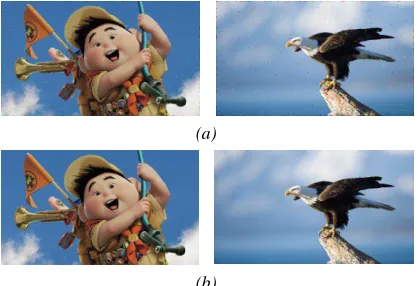
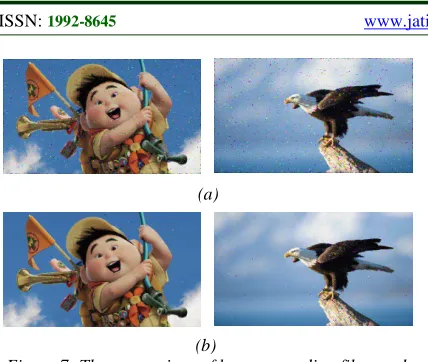
4.1. Results Of The Impulse Noise Fuzzy Filter In this paper, the window size of 3×3 is experimented. The primary process of simulation is done by median filter. A comparison between median filter and proposed fuzzy filter for different noisy densities (up to 20% and 30%) are drawn in Figures 6 and 7. The best results for higher percentages of the impulse noise, as the window size of 3×3 produces better results up to 30% impulse noise, this filter is meant to deal with low and middle percentages of the impulse noise. This level of noise is usually found in many practical applications.
(a)
[image:5.612.318.527.552.695.2](b)
Figure 6: The comparison of between median filter and designed fuzzy filter (noisy density is 20%): (a). Results of Median Filter, (b). Results of fuzzy filter.
( , ,1) ( , ,1) ( , ,1)
m
D i j = A i j −med i j
great
µ
rb rg d
d , dgb
1
β β2 ( , ,1)
(a)
[image:6.612.95.309.71.252.2](b)
Figure 7: The comparison of between median filter and designed fuzzy filter(noisy density is 30%): (a).Results of Median Filter, (b). Results of fuzzy filter.
The performance of this filter is illustrated through a set of color images with the impulse noise of densities up to 30%. The optimal values for the parameters of discussed in Section 3 are experimentally determined to be 0.078, 0.15, 0.5, 0.6, 0.0001 and 0.0001 respectively. They are obtained using a window size of 3×3 for the lower and the middle percentage of the impulse noise. It can also be observed visually that the proposed filters are quite effective in noise reduction. The under tables demonstrate the result of experiments.
Table 1: The Comparison Of Between Methods (Nd=20)
Methods Noisy
Density(ND)
Percentage of Improvement
Median Filter %20 %60
Fuzzy Filter (Proposed) %20 %90
5. CONCLUSION
This paper proposed a new fuzzy filter for additive noise reduction consisting of only impulse noise. This filter recognizes the noisy pixel, modifies the corrupted pixel value and removes impulse noise. Its main feature is that this filter with the new proposed of membership functions in equations (3), (8) and (9), removes the impulse noise of densities up to 30% (Table 1) and tries to determine corrupted pixels to reduce their contribution in smoothing process. The shape of the applied membership functions is modified and adapted according to the remaining amount of noise after each iteration, such that the performance of designed fuzzy filter is excellent toward median
filter. Simulation results shows that the proposed fuzzy filter effectively removes the additive noise by preserving details in the color images. Experimental results show the feasibility of the new filter.
REFRENCES:
[1] Dimitri Van De Ville, Mike Nachtegael, Dietrich Van der Weken, Etienne E. Kerre, Wilfried Philips, Ignace Lemahieu, Noise Reduction by Fuzzy Image Filtering, IEEE Transaction on Fuzzy System, Vol. 11, NO. 4, August 2003.
[2] P. Murugeswari, D. Manimegalai, Noise Reduction in Color image using Interval Type-2 Fuzzy Filter (ITType-2FF), International Journal of Engineering Science and Technology (IJEST), Vol. 3 No. 2 Feb 2011.
[3] Mahesh T R, Prabhanjan S, M Vinayababu, Noise Reduction by Using Fuzzy Image Filtering, Journal of Theoretical and Applied
Information Technology, Islamabad
PAKISTAN, Vol.15. No.2., 31st May 2010. [4] Om Prakash Verma, Madasu Hanmandlu, Anil
Singh Parihar, Vamsi Krishna Madasu, Fuzzy Filters for Noise Reduction in Color Images, ICGST-GVIP Journal, Volume 9, Issue 5, September 2009.
[5] Stefan Schulte, Mike Nachtegael, Valerie De Witte, Dietrich Van der Weken, Etienne E. Kerre, A Fuzzy Impulse Noise Detection and Reduction Method, Fuzziness and Uncertainty Modelling Research Unit.
[6] Dimitri Van De Ville, Wilfried Philips, Noise Reduction by Fuzzy Image Filtering, IEEE Transaction on Fuzzy System, VOL. 11, NO. 4, AUGUST 2003.
[7] F. Russo, G. Ramponi, A fuzzy operator for the enhancement of blurred and noisy images, IEEE Trans. Image Processing, vol. 4, pp.1169–1174, Aug. 1995.
[8] F. Russo, A fuzzy filter for images corrupted by impulse noise, IEEE Signal Processing Letters, vol. 3, pp. 168–170, June 1996. [9] F. Russo, Fire operators for image processing,
Fuzzy Sets Syst., vol. 103, no. 2, pp. 265–275, 1999.
[10]C.-S. Lee, Y.-H. Kuo, P.-T. Yu, Weighted fuzzy mean filters for image processing, Fuzzy Sets Syst., no. 89, pp. 157–180, 1997.
1, 2, 1, 2, 1, 2
10th January 2014. Vol. 59 No.1 © 2005 - 2014 JATIT & LLS. All rights reserved.
ISSN: 1992-8645 www.jatit.org E-ISSN: 1817-3195
[11]C.-S. Lee, Y.-H. Kuo, Fuzzy Techniques in Image Processing, Studies in Fuzziness and Soft Computing, ch. Adaptive fuzzy filter and its application to image enhancement, (New York: Springer-Verlag 2000, vol. 52, pp. 172– 193).
[12]F. Farbiz, M. B. Menhaj, Fuzzy Techniques in Image Processing, Studies in Fuzziness and Soft Computing, ch. A fuzzy logic control based approach for image filtering, (New York: Springer-Verlag 2000, vol. 52, pp. 194–221). [13]Jagadish H. Pujar, Robust Fuzzy Median Filter
for Impulse Noise Reduction of Gray Scale
Images, World Academy of Science,