FACTOR INFLUENCING THE USE OF SMART PHONE BY
MALAYSIAN’S ELDERLY
1NAIM CHE PEE, 2ZULISMAN MAKSOM, 3AZIR REZHA NORIZAN
1Senior Lecturer, FICT, UTeM, Malacca, Malaysia, 2Senior Lecturer, FICT, UTeM, Malacca, Malaysia,
3Researcher, FICT, UTeM, Malacca, Malaysia
E-mail: [email protected], [email protected], [email protected]
ABSTRACT
The smart phone has become essential part of personal and business life across all age boundaries. The smart phone usage can potentially play a significant role in assisting the elderly in many ways especially in terms of maintaining social relationship, providing a sense of safety and accessibility. However, elderly seems to be the neglected user group in the design of recent smart phone interface and the penetration of the technology to the elderly are very low. Hence this paper attempt to report issues that are related to why this particular group of user aged 40 years old and above was influenced to own the smart phones and the data gathering was done specifically in Malaysia context. This research used an interview and survey instrument to obtain the data from the intended target group of user whom are using smart phones. The result indicates three main factors that influence the respondents to own their smart phone which is family encouragement, the use of mobile internet and social networking.
Keywords: Interface Design, Elderly, Smartphone, Influencing Factors, And Technology Penetration
1. LITERATURE
The uses of smart phone today have become a phenomenon in which a significant improvement can be seen in developing nations. More than just the latest electronic gadget, smart phones have become integral parts of business and personal lives. According to Department of Statistics Malaysia [1][6], by 2009, there were eight mobile phones per 100 people of Malaysia and this indicates the penetration level of mobile phones where every single citizen could have more than one mobile phone. In early 2010, 62% of mobile phone sales are smart phones and in 2011, 13% of the Malaysian population have smart phones.
Department of Statistics Malaysia in 2010 recorded 7.9 percent of senior citizens across the country and this number is expected to rise to 9.9 percent by 2020. This amount is expected to increase to 15 percent in 2030 [2]. Today, the smart phone has become essential part of personal and business s life across all age boundaries, however the numbers of elderly user is still very small compared to the other age groups. This amount is expected to increase over the next 10 to 20 years due to the higher acceptance by the consumer at ages 40-50 years. The 40s were among those who received early admission of mobile communication
technology such as feature phones and PDA in Malaysia, and this to some extent helps the adoption and the use of new technologies such as smart phones [3][6].
The elderly often stated had problems with the old mobile phone technology. Most complaints are related to displays that are too small and difficult to see, buttons and characters that are too small causing them to push the wrong button frequently. Nowadays, most smart phone devices were developed based on touch screen technology as the primary input and the use of the touch screen has been proven to facilitate user interaction with a computer interface [4][7]. The same issues promoting the use of wider screen size for display interface. Previous and on-going researches in term of such aspects are important to solve and facilitate the elderly to use smart phones as the current interface and usability are too complex [5].
This paper attempts to collect information about the factor that influences the user of 40 years old and above to change to smart phones. The study was conducted to see the difference between factors that might influence the adult and elderly in term of personal encouragement and their purpose to change to smart phone. We believe the data gathered from this study should be taken into consideration for future development of smart phone interactive or interface design.
2. MATERIALS AND METHODS
This study aims to identify factors that motivate target groups change to smart phones, particularly in Malaysia and the information were compared with socioeconomic factors, lifestyle and the surrounding environment. Essentially, we perform the initial literature review on the use of mobile technology among the elderly, looking at the broader context of mobile device, service issues and current problems highlighted in various previous studies. Mostly, the review is focused comprehensively on the past published studies on mobile phone or feature phone usage and design issues. All information was gathered from journals, technical report, article, and other using online search.
Based on the reading of previous studies, a set of questionnaires is produced and then distributed directly to the target groups using smart phones. The target group was divided into 3 groups: Group A (age 40-49), Group B (age 50-59) and group C (age 60 and above). Distribution of this group was to distinguish the group of users based on the rate of technology and smart phone adoption. The 40’s as described above were among the earliest receiving the mobile technology while the 60's and above on the other hand, are slow to receive the technology, and the 50's are placed in the middle.
The respondents were chosen from a population which residing in the urban area in Malaysia. The respondents were divided into three groups as stated above and each group consists of 15 males and 15 females and the total of respondents were 90 overall.
3. DEMOGRAPHY INFORMATION
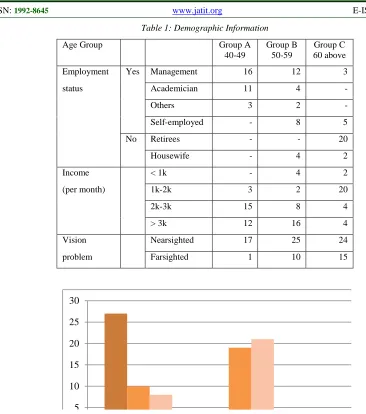
The demography information has been organized in the first section in the questionnaires which comprises several multiple choice questions and the attribute of respondents covered in this question such as their employment status, monthly income and vision problem. Exactly 90 respondents
participated in the survey which had been divided into three groups of three ranges of age and each group consists of 15 male and 15 females.
The information in Table 1 indicates the employment status were divided into six which is management sector, academia, self-employed, retirees, housewife and other type of job. Most of the respondents from group A and B are still working because the retiring age in Malaysia was set at 60 years old and the number of retirees is higher in group C. The retiring age was only set for the government sector but not in the private sector where as long as the persons have the potential in their work, they still work for them. The information gathered also shows that some of the respondents from group B and C are self-employed as they are managing their own business and this does not indicate how long has them being in their business. Some of them just start to grow their own business after the retirement of their previous services.
The majority of respondents from group A and B are having monthly income more than RM 2000 and this value are appropriate as most of them are working in management and academic environment plus individual at their age should already have a lot of working experience. Some of the respondents are working out of the two environments which do not involve management works such as cook, cashier, security guard, product promoter and direct seller. These types of work pay lower because does not need any high level education certificate to start working. Housewife does not get steady income as they are not working but they still gain income from family members who are working. The data above shows housewives from group B and C gain less than RM1000 monthly. The retirees are mostly depending their monthly income from pension funds as the respondents stated the range of the pension funds are from RM1000 to RM2000.
Extra information was collected to measure if a vision problem is occurring in each group and the question asked if the respondent having a vision impairment such as nearsightedness and shortsighted. The result shows most of the respondents are having nearsighted, on the other hand, the number of respondents with farsighted was only one in group A and drastically increasing in group B and C because farsighted usually happen because of aging.
4. INFLUENCING FACTORS
factors and socioeconomic factors. As illustrated in Figure 1, majority of respondent from group A switch to smart phone technology on self-demand. The 40s were among those who received early admission of mobile communication technology such as feature phone as well as PDA in Malaysia and this to some extent help the adoption and use of new technologies such as smart phones. In contrast, the respondent group B and group C where the majority switch to smart phones with the encouragement of family members due to less exposure to the technology advancement especially in the fast growing communication technology. Family encouragements especially from the younger generation are absolutely necessary to give the technological education towards the elderly people because most of the younger generations have nowadays got the technological adoption from a very young age.
There are a few respondents from group B and C who are self-motivated to switch to smart phones and these indicate not all people aged 50 and above lack the exposure of technology and this result prove that the socioeconomic and environmental factors vary in each individual. Each individual's lifestyle is influenced by socioeconomic factors such as employment status and monthly income. Occupational factors are associated with social activities and how time is used in a day. Working in a modern environment indirectly increases the exposure to use technology due to the interaction with community that implement the use of technology in daily life. The same thing happens to unemployed individuals either pensioners or housewives where older adults lifestyle to some extent influenced by the young people who live together.
The five main factors influence the respondent of the three focus groups are demonstrated in Figure 2 which are for working purposes, smart phone as an internet surfing device, medium for social networking, the respondent is gadget collector and family encouragement to switch to smart phones. We set the function that's being used for work such as calendar, memos, e-mail and contacting individuals for work purposes. Internet browsing process is a process that involves the search for information online and reading e-news. Social media interaction limited to activities such as chatting, photo posting and updating current status. Gadget collecting is a hobby and family encouragement involves effective communication with family members.
The figure below shows a majority of respondents from group A and B tempted to switch to a smart phone for internet access and social media interaction. This shows how Internet activity and social interaction site has been well received by the 40's and 50's. In contrast to respondents from group C, only a few are switching to smart phone for the purpose of surfing the internet or online social interaction due to a lack of exposure to Internet technology in the age group above 60 years and most of them received encouragement from family members to change to a smart phone. Few from groups A and B get a smart phone because of interest in collecting electronic gadgets such as smart phone and this small number have a monthly income of more than RM3000 thus enabling them to get a smart phone to complement their hobby.
Among the initial impression of the results of this questionnaire is the respondents of the 40s and working change to smart phones to facilitate their work processes, however, the result shows unexpectedly where there only a little amount of the 40s switch to smart phones for work purposes and the amount is increasing as the age increase. This work factor is influenced by the type of occupation where if the person working in an office environment which have a desktop or a laptop are more likely to use computers for work purposes. Some type of occupations which do not require the person to interact with a computer will benefit by using smart phones for work purposes. The majority of respondents from group 1 worked in management and academic environment that normally use a computer to do the works and this explains the small number of smart phone use for working purposes. Respondents from group B and C which using a smart phone for the work purposes are the self-employed and these people usually do not depend on the office environment.
5. CONCLUSIONS
the smart phone technology is being used across all age boundaries. However undeniable, some functional decline due to aging affect their usability.
The result was divided into three different ranges of age shows a different use despite each group only differentiated by a small age gap. Based on the data obtained, all ages are affected by various factors for switching to smart phones such as socioeconomic, lifestyle and individual driver. The age range of the 40s and 50s today have been exposed to the Internet and has been very active with social activities online, but the adoption of Internet technology is still very little by the age group 60 years and above. This is expected to change over the next 10-20 years due to the high adoption of technology to the age of 40s and 50s today.
REFERENCES:
[1] Department of Statistics Malaysia. 2013. Available at: http://www.statistics.gov.my [2] Ajang, S., 2012. Populasi Warga Emas
Meningkat. Available at:
http://www.theborneopost.com/2012/02/08/pop ulasi-warga-emas-meningkat/
[3] Malaysian Communications and Multimedia Commission (JKMM). 2012. Handphone Users
Survey 2011. Available at:
http://www.skmm.gov.my/skmmgovmy/media/
General/pdf/SKMM-HANDPHONE-SURVEY-2011.pdf
[4] Jennifer, L., Arielle, M., Dana, B., Raul, R. and Michael, B. 2009. Senior-Friendly Computer
Interface To Enhance Learning And
Independent Use Of Email Among Seniors. The
19th International Association of Gerontology and Geriatrics World Congress. Paris, France. [5] Nielsen, J., and Budiu, R., 2012. Mobile
usability. New Riders.
[6] Mohd, H.N.M.N., Hazrina, H., and Nazean, J. 2008. The Use of Mobile Phone by Elderly: A
Study in Malaysia Perspectives. Journal of
Social Sciences 4(2): pp. 123-127.
[7] Zhao, X.J., Plocher, T., and Kif, L. 2007. Touch
Screen User Interfaces for Older Adults: Button Size and Spacing. Lecture Notes in Computer
Science. 554: pp.933–941.
[8] Berg, C.A., 2000. Intellectual development in
adulthood. Handbook of Intelligence:
Table 1: Demographic Information
Age Group Group A
40-49
Group B 50-59
Group C 60 above
Employment Yes Management 16 12 3
status Academician 11 4 -
Others 3 2 -
Self-employed - 8 5
No Retirees - - 20
Housewife - 4 2
Income < 1k - 4 2
(per month) 1k-2k 3 2 20
2k-3k 15 8 4
> 3k 12 16 4
Vision Nearsighted 17 25 24
problem Farsighted 1 10 15
5 10 15 20 25 30
Figure 1: Individuals Influence To Switch To Smart Phone
[image:5.612.145.471.531.683.2]4 6 8 10 12 14 16 18 20