© 2016, IRJET | Impact Factor value: 4.45 | ISO 9001:2008 Certified Journal
| Page 3079
“PROBLEM FORMULATION FOR DESIGNING PROSTHETIC LEG BY QFD
TECHNIQUE”
Harsimran Jeet Singh Sidhu
1, Harsimran Singh
2, Harvinder Singh
31
Assistant Professor, Department of Mechanical Engineering, Chandigarh Engineering college, Landran , Distt.
Mohali, Punjab
2
Assistant Professor, Department of Mechanical Engineering, Chandigarh Engineering college, Landran , Distt.
Mohali, Punjab
3
Assistant Professor, Department of Mechanical Engineering, Chandigarh Engineering college, Landran , Distt.
Mohali, Punjab
---***---Abstract
-
The objective of the work presented here is todevelop a low cost prosthetic leg exploiting QFD (Quality Function Deployment) technique, which is a planning tool that focuses on designing quality control into a product or service by incorporating customer needs. It is a system approach that involves cross-functional teams (whose members are not necessarily from product design) that looks at the complete cycle of the product development. With the help of quality function deployment it became easy to separate the amputee’s requirements and rate them according to the majority in the category. Every effort was made to make the amputee requirements fulfil with different age groups. Amputees from Deep Artificial Limb Centre Chandigarh, Navedac Prosthetic Centre, Zirakpur, Chandigarh participated and made their requirements what they wanted in the prosthetic leg. The objective statement of the QFD became, to make the prosthetic leg which should be low in cost and less in weight for the amputee’s. The weight of the prosthetic leg should be in the range of 4-5 kg and the price range should be between 20,000-25,000 Rs.
Key Words: QFD, Prosthesis,HDPE, PMC,Shin,Socket
1. INTRODUCTION
The number of amputees in India is increasing as result of road accidents, surgery, birth defect, vascular disease or other medical complications. Among amputees, most of the amputees are poor who cannot afford the imported legs, which are very costly and legs available in India are very heavy as they are made of polyurethanes, HDPE etc .As an engineer it is our duty to address the issue which hinders the society. The inspiration for the project lies in the sole realization of responsibility towards of serving those who due to economic reasons cannot afford to live the Normal Life. It would give me an immense pleasure and joy if the life
of any of these people can be improved with help of this dissertation work.
Numerous researches has been done and is still currently underway in the design of smart prosthetics with the focus being on the control system though overlooking the frame or foundation of the prosthetic .Prosthetic legs have found their way into the 21st century, in terms of their design.
Taking our cue from nature, we are able to model and design systems that maximize the functional advantages of nature without completely mimicking nature, resulting in less technological complexity. With the help of QFD, a study was conducted to find out the amputees’s requirement for the prosthetheic leg. This quality cycle starts with creating a design that meets customer needs and continues on through conducting detailed product analysis of parts and components to achieve the desired product, identifying the processes necessary to make the product, developing product requirement, prototype testing, final product or service testing, and finishing with after sales troubleshooting.
© 2016, IRJET | Impact Factor value: 4.45 | ISO 9001:2008 Certified Journal
| Page 3080
needed in products and processes and serves as a guide forresource allocation.
QFD reduces the product development cycle time in each functional area-from product inception and definition to production sales. By considering product and part design along with manufacturing feasibility and resource restriction, QFD cuts down on time that would otherwise be spent on product redesign. Midstream design changes are minimized, along with concerns on process capability and post introduction problems of the product. This results in significant benefits for product with long lead times such as automobiles.
[image:2.595.35.281.459.739.2]2. QFD Process
Figure 6 shows a QFD matrix, also referred to as the house of quality. The objective statement delineates the scope of the QFD project, thereby focusing the team effort. The next step is to determine customer needs and wants. These are listed as “What’s” and represent the individual characteristics of the product or service. On determination of “Whats list”, a customer importance rating that prioritizes the “What’s” is assigned to each item. Typically, a scale of 1 to 5 is used with 1 being the least important and 5 being the most important .multiple passes through the list may be necessary to arrive at ratings that are acceptable to the team. The ratings serve as weighing factor and are used as multiplier for determining the technical of “HOW’S” The focus is on the attributes with high ratings.
The customer plays an important role in determining the relative position of the organisation with respect to that of
its competitors for each requirement or “What”. Such a comparison is entered in the section on “customer assessment of competitors”. Thus, customer perception of the product or service is verified, which will help identify strengths and weaknesses of the company.Different focus groups or surveys should be used to attain statistical objectivity.One outcome of the analysis might be new customer requirements, which would be then added to the list of “Whats,” or the importance ratings might change.Result from analysis will indicate what dimension of the product or service the company should focus on the same rating scale that is used to denote the importance ratings of the customer requirements is used in this analysis. Coming up with a list of technical descriptors-the “HOW’S”-that will enable company to accomplish the customer requirements is the next step in the QFD process.Multidisciplinary teams whose members originate in various departments will brainstorm to arrive at this list.Departments such as product design and development,manufacturing, marketing ,sales and customer service are likely to be presented in the team.The key is to have a breadth of disciplines in order to “capture” all feasible ‘Hows”.The correlation matrix of the relationship between the technical descriptor is the “roof” of the house of quality.In the correlation matrix ,four levels of relationships are depicted:strong positive,positive,negative,and storng negative.The matrix indicates the degree to which the “HOW’S” support or complement each other or are in conflict.Negative relationships may require a trade-off in the objective values of the “HOW’S” when a technical competitive assesment is conducted.
Following this, a technical competitive assesment of the “HOW’S” is conducted along the same line as the customer assesment of the competitors discussed previously.The difference is that, instead of using customers to obtain data on the relative position of the company’s ‘Whats” with respect to those of the competitors, the technical staff of the company provides the input.A rating scale of 1 to 5, may be used.Technical assesment of “HOW’S” assist in setting objective values,denoted by “How Muches”.The achievements of the highest-scoring companies are set as the “How Muches” which represents the minimum acceptable achievement level for each “How”.In conducting the technical competitive asssesment of “HOW’S” the probability of achieving the objective value is incorporated in the analysis.Using a rating scale of 1 to 5,5 representing a high probability scores to obtain weighted scores.These weighted scores now represents the relative position within the industry and the company’s chances of becoming the leader in that category.
The final step of the QFD process involves the relationship matrix located in the centre of the house of the quality.It provides a mechanismfor analyzing how each technical descriptor will help in achieving “What” is represented by the following scale:0≡No relatioship;1≡Low relationship;3≡Medium relationship;5≡High relationship.
Objective statement
Technical descriptor of “How’s”
Target goals of “HOW’S”
Customer requirement
s
or “What’s” Relationship matrix Between2 the “HOW’S” and the “What’s”
C
us
to
m
er
as
se
ss
m
ent
Technical competitive assessment of “HOW’S”
Im
po
rtan
ce
o
f
ra
ting
Correlation matrix of “HOW’S”
© 2016, IRJET | Impact Factor value: 4.45 | ISO 9001:2008 Certified Journal
| Page 3081
The cell values are obtained by multiplying the rated scoresby the importance rating of the corresponding customer requirement.The absolute score for each “How” is calculated by adding the values.
The relative score is merely a ranking of the absolute scores, with representing the most important.Finally,the QFD process identifies production requirements for operating the process under specified conditions.Use of quality function deployment in such a multiphased environment requires a significant commitment of time and resources.However, the advantages are-the spirit of teamwork, cross-functional understanding,and an enhanced product design.
2.1 Use of QFD to make prosthetic leg
A study was conducted to find out the amputees’s requirement for the prosthetheic leg. Amputees from Deep Artificial Limb Centre Chandigarh, Navedac Prosthetic Centre Zirakpur Chandigarh participated in the survey and made their requirements what they wanted in the prosthetic leg.Amputees of different age group and with different extremity proshetic participated.Amputees from different age groups were having different requirements and with the help of quality fuction deployment it became easy to separate the amputee’s requirements and rate them according to the majority in the category.Every effort was made to make the amputee requirements fulfill with different age groups.
The objective statement of the qfd became, to make the prosthetic leg which should be low in cost and less in weight for the amputee’s.The weight of the prosthetic leg should be in the range of 4-5 kg and the price range should be between 20,000-25,000 Rs.
This objective statement comes out as result of the questionarie which was provided to the amputees and after ratings given by the amputees and analysis done on that, the objective statement of the Quality Functiom Deployment was fixed.The Questionnaire provided to the respodents was as follows:
Questionnaire
1. Name ________________________.
2. Age ________________________. 3. Weight of the leg
I. 4-5 kg ________________________. II. 5-6 kg ________________________. III. 6-7 kg ________________________. 4. Leg to be used for
I. Walking _______________________. II. Squatting _______________________.
III. Sitting with crossed legs _______________________. IV. Sprinting ______________________ 5. How much you are willing to pay
i. 15,000-20,000rupee ___________________ ii. 20,000-25,000rupee ___________________ iii. 25,000-30,000 rupee ___________________ iv. Above 30,000 rupee ___________________ 6. Daily time duration of the leg to be used
_______________________.
7. Maintenance Cost of the leg/year i. 500-1000 rupee _______________________.
ii. 1000-1500 rupee _______________________. iii. 1500-2000 rupee _______________________. 8. Weight of the present leg (kg)
_______________________.
9. Material of the present leg ________________
[image:3.595.306.543.87.395.2]The next step of quality function deployment is to determine the amputee’s needs and wants. These are listed as “What’s”. Study was conducted to find the amputees requirements for prosthetic leg. No. of respondents were provided with the questionnaire, the analysis of which yielded the following amputees requirements.
Table 1 Customer assessment of competitors
Amputees requirement Importance rating
Low weight 5
Low cost 4
High functionality 3
Maintenance cost/year 2
© 2016, IRJET | Impact Factor value: 4.45 | ISO 9001:2008 Certified Journal
| Page 3082
After rating the customer requirements technicalsolutions have to be found in order to achieve the amputee requirement in the prosthetic leg. These are called target goals of “HOW’S”. These are as follows:
I. Design of Socket and Shin. II. Use of advanced materials. III. Use of additional attachments.
[image:4.595.36.292.354.545.2]Following this, a technical competitive assessment of the “HOW’S” is conducted along the same lines as the amputee assessment of competitors. A rating of 1 to 5 is used. Table 5 given below shows that how our technical team has assessed technical competitiveness for “HOW’S” in making of the prosthetic leg.
Table 2 Technical Competitive assessment of “HOW’S”
Competitors
Technical Descriptors (“HOW’S”)
How 1 How 2 How 3
Design of Socket and Shin
Use of advanced materials
Use of additional attachments
Wooden leg 1 1 1
HDPE leg 3 2 1
Composite leg 4 4 2
Imported leg 5 5 4
The analysis shown in table 5 can also assist in setting objective values, denoted by “How Muchs” for three technical descriptors. The achievements of the highest-scoring competitors are set as the “How Muchs” which represents the minimum acceptable achievement level for each how. For example if imported leg provides better design and use of advanced materials, then composite leg will strive to match or exceed.
In conducting the technical competitive assessment of “Hows,”the probability of achieving objective values (the “How Muchs”) is incorporated in the analysis. Using a rating scale of 1 to 5, 5 representing a high probability of success, the absolute scores are multiplied by the probability scores to obtain weighed scores.
The final step of the QFD process involves the relationship matrix located in the centre of the house of the quality. The relationship between “How” and “What” is
represented by the following scale: 0≡No relationship; 1≡Low relationship; 3≡Medium relationship; 5≡High relationship; -1≡Negative low relationship; -3≡Negative medium relationship; -5≡Negative high relationship. Table6 below shows the relationship matrix for the prosthetic leg. Consider, for instance, How#2(Use of advanced materials).Our team believes that this “How” has high relationship with providing low weight prosthetic leg, and so score of 5 is assigned. Furthermore this “How” has moderate relationship with providing low cost prosthetic leg, so a score of 3 is assigned. Similar interpretations are drawn from other entries in the table.”HOW’S” that have a large number of zeros and negative numbers do not support meeting the customer requirements.
How#1 Design of Socket and Shin
How#2 Use of advanced materials
[image:4.595.301.566.418.563.2]How#3 Use of additional attachments
Table 3 Relationship matrix between the “HOW’S” and the “What’s”
Amputee requirements
Importance rating
Technical descriptors (“HOW’S”)
How# 1 How# 2 How# 3
Low weight 5 3 5 -5
Low cost 4 0 3 -3
High functionality 3 0 0 5
Maintenance cost/year
2 0 0 -1
The relationship matrix represent the relationship between the “HOW’S” and “What’s” this needs to be multiplied by the importance rating of each “What’s” so we could get the exact contribution of each how towards meeting the customer requirement. This is represented in table 7 below
Table 4 Relationship Matrix of Absolute and Relative Scores
Amputee requirements
Importance rating
Technical descriptors (“HOW’S”)
1 2 3
Low weight 5 3(15) 5(25) -5(15)
© 2016, IRJET | Impact Factor value: 4.45 | ISO 9001:2008 Certified Journal
| Page 3083
High functionality 3 0(0) 0(0) 5(15)
Maintenance cost/year
2 0(0) 0(0) -1(-2)
Absolute Score 15 37 -14
Relative score 2 1 3
The relative scores represent the ranking of “HOW’S” to be focused for satisfying the customer requirements. The area of working is chosen as per the conclusion yielded from this study i.e. the Use of Advance Materials and Design of Shin and Socket are chosen for improvement. The Use of Additional Attachments however produces negative scores, hence not being focused by analysis.
Cu
st
ome
r
Imp
ort
an
ce
De
sign Materia
l
A
d
d
it
io
n
al
a
tt
ac
h
me
n
ts
Wo
od
en
L
eg
HDP
E L
eg
Co
mp
os
it
e L
eg
Imp
ort
ed
L
eg
Low Weight 5 3(15) 5(25) -3(-15) 1 2 5 3
Low Cost 4 0(0) 3(12) -3-(12) 4 3 3 1
High Functionality 3 0(0) 0(0) 5(15) 2 2 2 5
Maintenance cost 2 0(0) 0(0) -1(-2) 2 2 2 4
Absolute Score 15 37 -14
Relative Score 2 1 3
++ Strong relationship between “HOW’S”.
Figure 2 House of quality for prosthetic leg Technical
Requirement
Amputee Requirement
© 2016, IRJET | Impact Factor value: 4.45 | ISO 9001:2008 Certified Journal
| Page 3084
3. Conclusion:
After surveying and exploiting QFD (Quality Function Deployment) technique, we come up with ample of options but Polymer Matrix Composite is chosen as their weight is less as compared to other composite materials (Metal-Matrix composites and Ceramic-Matrix composites).The use of PMCs has increased considerably over the last decade.
The PMCs has been widely used for structural parts because of their superior mechanical and physical properties such as high strength synthetic fibers such as carbon, glass and Kevlar with thermoplastic resins (nylon and polyolefin), thermo set resins (epoxies, polyurethanes) and unsaturated polyesters. A composite is a structural material that consists of two or more constituents that are combined at a macroscopic level and are not soluble in each other. One constituent is called the reinforcing phase and the one in which it is embedded is called the matrix.
The composite material however, generally possesses characteristic properties, such as stiffness, strength, weight, high-temperature performance, corrosion resistance, hardness, and conductivity that are not possible with the individual components by themselves.
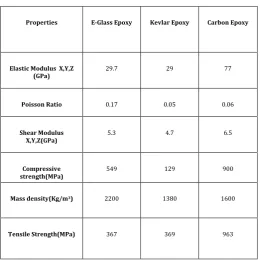
To make prosthetic leg the following three composites are chosen as they are most widely used.
[image:6.595.32.293.464.724.2]a. E-Glass Epoxy b. Kevlar Epoxy c. Carbon Epoxy
Table 5 Properties of composites
Properties E-Glass Epoxy Kevlar Epoxy Carbon Epoxy
Elastic Modulus X,Y,Z
(GPa) 29.7 29 77
Poisson Ratio
X,Y,Z
0.17 0.05 0.06
Shear Modulus X,Y,Z(GPa)
5.3 4.7 6.5
Compressive strength(MPa)
549 129 900
Mass density(Kg/m3) 2200 1380 1600
Tensile Strength(MPa) 367 369 963
Yield Strength(MPa) 300 1300 2280
But from above three composites, we use E-Glass Epoxy, because of easy availableness and less expensive than other two composites.
The most common reinforcement for the polymer matrix composites is a glass fiber. Most of the fibers are based on silica (SiO2), with addition of oxides of Ca, B, Na, Fe, and Al. The glass fibers are divided into three classes -- E-glass, S-glass and C-glass. The E-glass is designated for electrical use and the S-glass for high strength. The C-glass is for high corrosion resistance, and it is uncommon for civil engineering application.
Of the three fibers, the E-glass is the most common reinforcement material used in civil structures. It is produced from lime-alumina-borosilicate which can be easily obtained from abundance of raw materials like sand. The glass fiber strength and modulus can degrade with increasing temperature. The fiber itself is regarded as an isotropic material and has a lower thermal expansion coefficient than that of steel. Family of glassed with a calcium aluminum borosilicate composition and a maximum alkali composition of 2%. These are used when strength and high electrical resistivity are required. More work can be carried out by using E-glass fiber and epoxy which will fulfill the need of common Amputee in all respect mentioned by QFD.
4. REFERENCES
1. J. K. Chakraborty and K. M. Path; A new modular six-bar linkage Trans-Femoral prosthesis for walking and squatting prosthetic and orthotics International, 1994, 18, 98-108. 2. L. Peeraer, B. Aeyels and G. Van der Perre; Development of EMG-based mode and intent recognition algorithms for a computer-controlled above-knee prosthesis;178 J. Biomed. Eng. 1990, Vol. 12, May.
3. A. Bar, G. Ishai, P. Meretsky and Y.Korent. Adaptive; Microcomputer control of an artificial knee in level walking ; J. Biomed. Eng. 1983, Vol. 5, April 145.
4. G. Ishai and A. Bar; Evaluation of AK prostheses comparing conventional with adaptive knee control devices; J. Biomed. Eng. 1984, Vol. 6, January 27.
5. G.C. Nandi, A.J.Ijspeert , P.Chakraborty ,Anirban Nandi; Development of adaptive modular active leg (AMAL) using bipedal robotics technology robotics and autonomous Systems;57 (2009) 603_616.