© 2015, IRJET ISO 9001:2008 Certified Journal Page 757
ANALYSIS OF DIFFERENT MODULATION TECHNIQUE AT AWGN
CHANNEL WITH THE HELP OF MATLAB
Sneha Verma
1,S.Sugumaran
2, Raviprakash
31
M.Tech. SEECE, Galgotias University, UP, India
2
Assistan Professor Gr-III, SEECE, Galgotias University, UP, India
3Professors, E & I, UNSIET, UP, India
Abstract -
:
This Frequency Hopping Spread Spectrum transceiver is designed to provide the secure communication domain. FHSS is a radio transmission process where user information is sent on a radio channel that regularly changes frequency according to a predetermined code with the help of different modulation techniques. This system is very popular because it is a secure communication model which utilizes the Pseudo Random Noise (PN) Sequence as a carrier signal. And the communication channel used as Additive white Gaussian noise (AWGN) Channel is preferred in this work. And at receiver side the data recovered as well as the Bit Error Rate is estimated at the receiver. The overall design is modeled and simulated using MATLAB-Simulink. This paper focuses on error performance of BPSK, QPSK, DPSK at AWGN channel on the method of modulation and demodulation technique. AWGN channel has been reported here. To find out the best BER performance between BPSK QPSK and DPSK. we use SIMULINK software.Key Words:
BPSK, QPSK, DPSK, AWGN.
2. INTRODUCTION
:In initial application of spread spectrum technique was in development in military guidance and communication system by the end of World War II, spectrum spreading for jamming resistance was already familiar concept to radar engineers. [7]. In Wireless communication technology has taken on a prominent position in indoor environment applications recently and become important with advent of personal communication system,(pcs) which usually co-exist in the 2.4GHZ ISM band .Therefore, the interference rejection property has become very important in developing a reliable wireless
transmission system for indoor application. Wireless communication technologies for un-licensed band applications are the situations where it is necessary to sacrifice the efficient utilization at ion of these two resources in order to meet certain 0 and design object i.e. ability to reject the interference whether among the various signal .This requirement is catered to by a class of signaling techniques known collectively as spread spectrum modulation.in digital transmission, BER is the percentage of bits with errors divided by total number of bits that have been transmitted ,received or processed over a given time period.
3. DESCRIPTION OF BLOCK DIAGRAM:
In this technique of spread spectrum there is a transmission bandwidth employed is much greater than minimum bandwidth required to transmit the information the system is defined to be spread spectrum system.[3].Now consider spread spectrum technique in which the carrier hopes randomly from one frequency to another frequency is called Frequency Hop spread spectrum. A common modulation format for FH system is that of M-ary frequency shift keying, since frequency hopping does not cover entire spread spectrum. Instantaneously, we are led to consider the rate at
which the hop
occurs.[10].
© 2015, IRJET ISO 9001:2008 Certified Journal Page 758
3.1 PN SEQUENCE GENERATON
The block of PN sequence generator generates a sequence of pseudorandom binary numbers using a linear-feedback shift register (LFSR). The LFSR is implemented using a simple shift register generator (SSRG, or Fibonacci) configuration. A pseudo noise sequence can be used in a pseudorandom scrambler and descrambler. It can also be used in a direct-sequence spread-spectrum system.
3.2 CHANNEL ENCODER
A major feature of digital transmission is the myriad techniques use d to protect data or speech through coding adds additional bits to the original payload to provide a means of protecting original information.
3.3 CHANNEL DECODER
Decoding is the opposite process the conversion of an. encoded format back into the original sequence of characters. And the data receives by the desired receiver.
3.4 MODULATOR
In electronics and communication , modulation is the
process of varying one or more properties of a periodic waveform, called the carrier signal, with a modulating signal that typically contains information to be transmitted and this operation is performed by modulator.
3.5 DEMODULATOR
A demodulator is an electronic circuit (or computer program in a software-defined radio) that is used to recover the information content from the modulated carrier wave.
3.4 CHANNEL
A channel is used to convey an information signal for example bit stream, from one sender to several senders to one to several receivers. A channel has certain capacity for
transmitting information often measured by its bandwidth in HZ or its data rate in bits per second. If the noise is introduced primarily by electronic components and the amplifiers at the receiver, it may be characterized as a thermal noise. This type of noise statistically as a Gaussian noise process. Hence the resulting mathematical model for the channel is usually called additive white Gaussian channel. [5]
4 SIMULATION DIAGRAM:
Fig-2:
simulation of BPSK
4.1
DESCRIPTION OF SIMULATION DIAGRAM:
4.1.1
PN SEQUENCE:
© 2015, IRJET ISO 9001:2008 Certified Journal Page 759
Fig-3
: generation of PN sequence
All r registers in the generator update their values at each time step according to the value of the incoming arrow to the shift register. The adders perform addition modulo 2. The shift register is described by the Generator Polynomial parameter, which is a primitive binary polynomial in z, grzr+gr-1zr-1+gr-2zr-2+...+g0. The coefficient gk is 1 if there is a connection from the kth register, as labelled in the preceding diagram, to the adder. The leading term gr and the constant term g0 of the Generator Polynomial parameter must be 1 because the polynomial must be primitive.
4.1.2
BUFFER
The Buffer block redistributes the input samples to a new frame size. Buffering, to a larger frame size scalar input Buffering to a smaller frame size yields an output with a faster frame rate than the input, as illustrated below for scalar output. This block supports triggered subsystems when the block's input and output rates are the same. Sample-based full-dimension matrix inputs are not accepted.
4.1.3
SAMPLE BASED OPERATIONBuffering to a smaller frame size yields an output with a faster frame rate than the input, as illustrated below for scalar output. The block coordinates the output frame size and frame rate of non-overlapping buffers such that the sample period of the signal is the same at both the input and output: Tso = Tsi.
4.1.4
FRAME SIZE:
The
Frame Conversion block passes the input through to the output and sets the output sampling mode to the value of the Sampling mode of output signal parameter, which can be either Frame-based or Sample-based4.1.5
MFSK MODULATOR BASEBAND
The M-FSK Modulator Baseband block modulates using the M-ary frequency shift keying method. The output is a baseband representation of the modulated signal. The M-ary number parameter, M, is the number of frequencies in the modulated signal. The Frequency separation parameter is the distance, in Hz, between successive frequencies of the modulated signal. The sampling frequency must be greater than M multiplied by the Frequency separation or the output signal will be aliased. :
4.1.6 RANDOM INTEGER GENERATOR
The Random Integer Generator block generates uniformly distributed random integers in the range [0, M-1], where M is the M-ary number defined in the dialog box. The M-ary number can be either a scalar or a vector. If it is a scalar, then all output random variables are independent and identically distributed (i.i.d.). If the M-ary number is a vector, then its length must equal the length of the Initial seed; in this case each output has its own output range.
If the Initial seed parameter is a constant, then the resulting noise is repeatable.
4.1.6
BPSK MODULATOR BASEBAND
The BPSK Modulator Baseband block modulates using the
binary phase shift keying method. The output is a baseband representation of the modulated signal. For both integer and bit inputs, this block can accept the data types int8, uint8, int16, uint16, int32, uint32, Boolean, single, and double. input must be a discrete-time binary-valued signal. If the input bit is 0 or 1, respectively, then the modulated symbol is exp(jθ) or -exp(jθ) respectively, where θ is the Phase offset parameter.
© 2015, IRJET ISO 9001:2008 Certified Journal Page 760
The AWGN Channel block adds white Gaussian noise to a
real or complex input signal. When the input signal is real, this block adds real Gaussian noise and produces a real output signal. When the input signal is complex, this block adds complex Gaussian noise and produces a complex output signal. This block inherits its sample time from the input signal. This block uses the Signal Processing Block set™ Random Source block to generate the noise. Random numbers are generated using the Ziggurat method, which is the same method used by the MATLAB random function. The Initial seed parameter in this block initializes the noise generator. Initial seed can be either a scalar or a vector whose length matches the number of channels in the input signal. For details on Initial seed, see the Random Sourceblock reference page in the Signal Processing Block set documentation set. The signal inputs can only be of type single or double. The port data types are inherited from the signals that drive the block.
4.1.7 MATH FUNCTION
The Math Function block performs numerous common mathematical functions.
4.1.8 BPSK MODULATOR
When used with default parameter values, the Product block outputs the result of multiplying its two inputs, which can be two scalars, a scalar and a no scalar, or two non-scalars that have the same dimensions. The default parameter values that specify this behavior are:
Multiplication: Element-wise (.*), Number of Inputs: 2 Setting non-default values for either of these parameters can change a Product block to be functionally equivalent to a Divide block or a Product of Elements block. See the documentation of those two blocks for more information. If all you need is to multiply two inputs to create an output, you can use the Product block with default parameter values. If you need additional capabilities, see Product Block Capabilities.
4.1.9 BER WORKSPACE
The BER Workspace block inputs a signal and writes the signal data to the MATLAB workspace. The block writes the data to an array or structure that has the name specified by the block's Variable name parameter. The Save format parameter determines the output format.
4.1.10
DISPLAY
The Display block shows the value of its input on its icon. We control the display format using the format parameter :If the signal input to a Display block has an enumerated data type (see Using Enumerated Data):The block displays enumerated values, not the values' underlying integers. Setting the Format to any of the Stored Integer settings causes an error. The amount of data displayed and the time steps at which the data is displayed are determined by the decimation block parameter and the Sample time property: The decimation parameter enables you to display data at every nth sample, where n is the decimation factor. The default decimation, 1, displays data at every time step.
4.2 SIMULATION DIAGRAM QPSK:
Fig- 4
simulation of qpsk
4.2.1 RANDOM INTEGER GENERATOR
© 2015, IRJET ISO 9001:2008 Certified Journal Page 761 the Initial seed parameter is a constant, then the resulting
noise is repeatable.
4.2.2 QPSK MODULATOR BASEBAND
The QPSK Modulator Baseband block modulates using the quaternary phase shift keying method. The output is a baseband representation of modulated signal. Quadrature Phase Shift Keying (QPSK) is a form of Phase Shift Keying in which two bits are modulated at once, selecting one of four possible carrier phase shifts (0, 90, 180, or 270 degrees).QPSK allows the signal to carry twice as much information ordinary PSK using the same bandwidth. QPSK is used for satellite transmission of MPEG2 video, cable modems videoconferencing, cellular phone systems, and other forms of digital communication over an RF carrier [2].
Fig-5 QPSK modulator
4.2.3 QPSK DEMODULARED BASEBAND-
The QPSK Demodulator Baseband block demodulates a signal that was modulated using the quaternary phase shift keying method. The input is a baseband representation of the modulated signal. The input must be a discrete-time complex signal. The input can be either frame based or sample based.
4.3 SIMULATION DIAGRAM OF DPSK:
Fig -6
simulation of DPSK
4.3.1 DPSK MODULATION OR DEMODULATION
:
DPSK stands for Differential Phase Shift Keying. It is the version of BPSK. In DPSK, there is no absolute carrier phase reference, instead transmitted signal itself used as phase reference In DPSK demodulation, phase of the received bit is compared with phase of the previous bit. DPSK may be viewed as the non-coherent version of PSK. It eliminates the need for a coherent Reference signal at the receiver by combining two basic operations at the transmitter.
5
RESULT AND ANALYSIS
TABLE NO 1-
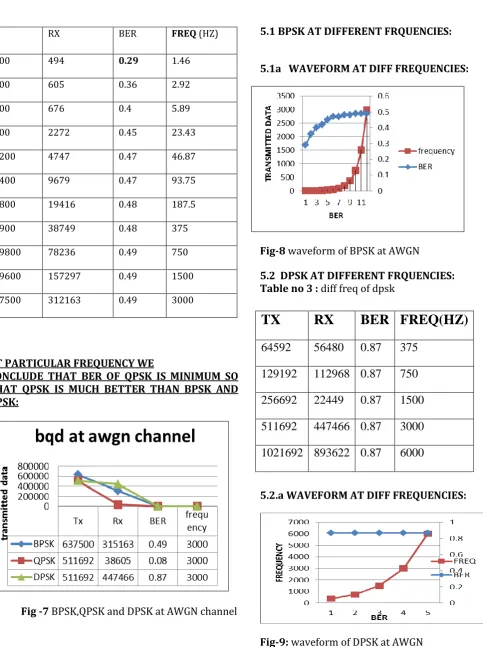
BER of QPSK, DPSK, and BPSK at 3000 H
TX RX BER FREQ.
(HZ)
TECH
637500 315163 0.49 3000 BPSK
511692 38605 0.08 3000 QPSK
© 2015, IRJET ISO 9001:2008 Certified Journal Page 762
AT PARTICULAR FREQUENCY WE
[image:6.595.48.532.87.735.2]CONCLUDE THAT BER OF QPSK IS MINIMUM SO
THAT QPSK IS MUCH BETTER THAN BPSK AND
DPSK:
Fig -7
BPSK,QPSK and DPSK at AWGN channel
5.1 BPSK AT DIFFERENT FRQUENCIES:
5.1a WAVEFORM AT DIFF FREQUENCIES:
Fig-8
waveform of BPSK at AWGN
5.2 DPSK AT DIFFERENT FRQUENCIES:
Table no 3 :
diff freq of dpsk
5.2.a WAVEFORM AT DIFF FREQUENCIES:
Fig-9:
waveform of DPSK at AWGN
TX RX BER FREQ (HZ)
1700 494 0.29 1.46
1700 605 0.36 2.92
1700 676 0.4 5.89
5100 2272 0.45 23.43
10200 4747 0.47 46.87 20400 9679 0.47 93.75 40800 19416 0.48 187.5 79900 38749 0.48 375 159800 78236 0.49 750 319600 157297 0.49 1500 637500 312163 0.49 3000
TX
RX
BER FREQ(HZ)
64592
56480
0.87
375
129192
112968 0.87
750
256692
22449
0.87
1500
511692
447466 0.87
3000
© 2015, IRJET ISO 9001:2008 Certified Journal Page 763
5.3 QPSK AT DIFF FREQUENCIES:
Table no 4:
diff freq of qpsk
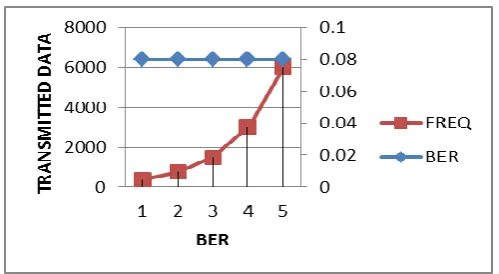
5.3 a WAVEFORM AT DIFF FREQUENCIES:
Fig -10
waveform of QPSK at AWGN
6. CONCLUSIONS:
QPSK is much better than BPSK & DPSK at AWGN channel In AWGN, BER will increase on increasing input signal powerwith the help of Simulink models of BPSK & QPSK, the graph between SNR and BER is obtained. Additive white Gaussian noise (AWGN) channels with 100 random input powers are used in simulation.AWGN Channel block adds white Gaussian noise to a real or complex input signal. This block inherits its sample time from the input signal. This block supports multichannel input and output signal as well as frame based processing. AWGN channel has lower BER than Raleigh and Rician fading channel.
SUGGESTIONS FOR FUTURE WORK:
Based on gathered observations while completing this project; topicks were identifying which would benefit for further investigation.
1. The spreading technique is analyzed for its processing gain, because it characterized this technique.
2. Using different-different length of the Spreading code it can once more analyzed.
3. For short range communication i.e. Blue tooth (2.4 ISM band) unlicensed band applications it should also be analyzed.
4. This technique is also analyzed for multipath propagations using both cons erring fading phenomena and without considering fading phenomena, no of path will also very as pre requirements.
5. This technique is also be used for coding and spreading of the CDMA, to show its practical approaches.
REFERENCES:
[1] Simon Haykins, “Digital Communication”, Published by John Wiley & Sons, 4th Edition.
[2]MIT International Journal of Electrical and Instrumentation Engineering, Vol. 3, No. 2, August 2013, pp. 62–66
[3] Bernard Saklar, Pabitra Kumar Raj, (2013), “Digital communications fundamentals and applications, Pearson Publications.
[4]Adachi F. “Coherent multi-code DS- CDMA mobile radio
access”. IEICE Transactions on Communications 1996; E79-B: 1316–1325.
[5] John.G. Proakis & Masoud Salehi, “Digital
communications (5th Edition), published by McGraw- Hill: New York.
[6]Porkies JG. “Digital Communication (4th edition)”. MC Grew-Hill; New York.
[7] Scholtz, R.A., “The origin of spread spectrum communication”, IEEE Trans. Comm., Vol. COM30,no.5, may,1982, PP.822.85.
[8]Hara S, Prasad S. “Overview of multicarrierCDMA”.
IEEE Communications Magazine; 35: 126–133.
[9]Alamouti S[2012] . “A simple transmit diversity
technique for wireless communications”.
[10]Simon Hykins, (2011), “Digital Communication,
Published by John Wiley & Sons 3th edition.
[11]Behrauz A, Foraunzon. “Data Communication and
Networking”. MC grew-Hill; New York.
TX
RX
BER
FREQ
(HZ)
64592
4918
0.08
375
129192
9734
0.08
750
156692
19374
0.08
1500
[image:7.595.34.284.335.472.2]
© 2015, IRJET ISO 9001:2008 Certified Journal Page 764
[12]Guinn-Harg Heng “A Low Complexity MSK-based M-ary Cyclic Shift-Keying Transceiver for direct sequence spread spectrum system over multipath fading channels”..
[13]Peterson RL, Ziemer RE, Borth DE. “Introduction to
Spread Spectrum Communications”. Prentice-Hall: Englewood Cliffs, NJ.
[14]Cook CE, Marsh HS. “An introduction to spread
spectrum”.IEEE magnize of communication.
[15]Herbert Toub, Donald L Shilling[. “Principle of