_______________________________________________________________________________________
© 2016, IRJET ISO 9001:2008 Certified Journal
Page 238
A THEORETICAL STUDY ON DI-METHYL ETHER: AN ALTERNATIVE FUEL
FOR FUTURE GENERATIONS
Modi Musalaiah
1[email protected]
Asst.Prof. Indira Institute of Technology and Sciences
Bharat Gorantla
2[email protected]
Engineer, Teamec Chlorates
Katuri Peddintaiah
3[email protected]
Asst.Prof. JNTUA College of Engineering, Pulivendula
Abstract:
Dimethyl ether (DME) has been considered a potential and promising energy alternative for petroleum subproducts due to its good burning characteristics, and to its high cetana content which is superior to that of diesel. Furthermore, DME can be considered a cleaner fuel than diesel. DME can be produced by dehydration reaction of methanol by using solid catalysts in catalytic reactions. This report consists of a pre-preliminary study of dimethyl ether which is alternative fuel. Dmethyl ether is used in different applications. The important features of dimethyl ether, applications, methods of preparation, the factors should be consider at the time of plant construction and the safety methods are discussed here. This study shows dimethyl ether is a future energy source.
Key Words: Dimethyl Ether, Alternative Fuel, Cetane Number, Process Technology and Safety&Health
.1. Introduction
The general formula of the Ethers is CnH2n+2O and its general structures is R-O-R (dimethly ether has a chemical formula,
C2H6O or CH3OCH3). Ethers of the individuals are named according to the alkyl groups attached to the Oxygen atom.
Historically, dimethyl ether derived from, methyl ethers of halogenated phenols have been identified in marine air samples from the north and south hemispheres. The components are tribromoanisole, pentachloroanisole, tetrachlorohydroquinone dimethylether. It has historically been used as a propellant in consumer products. It can be used in a wide variety of consumer applications, namely personal care (e.g., hairspray, shaving creams, foams, and antiperspirants), household products, automotive, paints and finishes, food products, insect control, animal products, and other related applications. It is commonly used in organic synthesis as a reaction solvent for systems requiring volatile polar solvents. A new and potentially large volume application of it is as a fuel Promising fuel applications include, LPG Blending and Substitute, Diesel Blending and Substitute, Power Generation, Acetylene Substitute. The structure of dimethyl ether has tetrahedral bond angle (like water with sp3 hybridization) and the different names of dimethyl ether are DME, wood ether, Oxybismethane, Dimethyl oxide, Demeon, Dymel A, Prozone, Ice Blue, Blue Fuel, Holzether etc.
2. Properties
_______________________________________________________________________________________
© 2016, IRJET ISO 9001:2008 Certified Journal
Page 239
3. Features (as an Alternative Fuel)
Dimethyl ether has features as a fuel. Some of them are discussed below,
3.1. Domestic Fuel
Domestic fuels used in large and medium cities in China are still mainly natural gas, coal gas and LPG (liquefied petroleum gas). DME is similar to LPG in property. Liquefied DME has many advantages as a domestic fuel. As DME contains oxygen, it burns completely with no residual liquid, and the tail gas conforms to the national environmental standard. As the pressure of liquefied DME can meet the requirements of LPG at normal temperature, it can be stored in LPG cylinders, share cookers with LPG and is safer than LPG in storage, transportation and use. Besides, DME can be blended with coal gas at any ratio to improve combustion properties and increase the heat value of coal gas.
3.2. Mixed Fuel
DME can also be used in alcohol/ether fuel (mixed fuel composed of DME, methanol and other components). Compared with alcohol-based fuel, alcohol/ether fuel has advantages. Alcohol-based fuel has a relatively low steam pressure and therefore needs preheating before use. Alcohol/ether fuel has no such defect. In addition, alcohol/ether fuel has higher heat value, moderate price and convenient application dissemination. Alcohol/ether fuel is however not as good as liquefied DME in safety and convenience.
3.3. Synthetic Fuel
DME is a synthetic fuel that is to diesel what LPG is to gasoline, while gaseous at ambient conditions it can be liquefied at moderate pressure. With a high cetane number, DME is clean-burning, sulfur-free, and with extremely low particulates.
3.4. Diesel Fuel
Use of DME as a diesel fuel replacement can reduce NOx emissions 90%. A dedicated DME vehicle might not require a
particulate filter but would need a purpose-designed fuel handling and injection system as well as a lubricating additive.
3.5. DME for Cocking and Heating
DME can be blended with LPG (in a proportion of up to 20%) and used for domestic cooking and heating, without modifications to equipment or distribution networks. Growth in DME’s use for domestic applications is expected to increase sharply as DME use and blending becomes more widespread within the large and growing LPG market – especially in developing countries where portable (bottled) fuel is providing a safer, cleaner and more environmentally benign fuel for cooking and heating.
3.6. Cetane Number of DME Fuel
Cetane number is the vol% of n-cetane present in the mixture of n-cetane and α-methyl naphthalien. Cetane rating is a measurement of the diesel fuel’s combustion quality of during compression ignition. Cetane number of DME fuel is 55-56, compared to fossil diesel 42-48 and biodiesel 52-55. Higher cetane fuels permit an engine to be started warmed more easily.
3.7. Sulfur and Pollutions Content
DME is a pure substance, not the mixture of diverse hydrocarbons as fossil fuels. It is chemically free of sulfur also no other pollutions such as phosphorous and cancerous aromatic compounds-benzene and toluene. DME is almost nontoxic.
3.8. Vehicle Conversion
Most diesel engines are suitable for an DME conversion. We get the cost and environmental benefits of driving an DME vehicle immediately after conversion. Many service companies are specialized in convention gasoline engines to be able to run on propane –butane. Conversion diesel engines to run on DME are similar task. There may be computer tuning a little different.
4. Applications
DME has several industrial applications. Some of the applications are discussed below,
4.1. An Aerosol Propellant
_______________________________________________________________________________________
© 2016, IRJET ISO 9001:2008 Certified Journal
Page 240
use of fluoro-chloro-hydro-carbon, DME has gradually replaced fluoro-chloro-hydrocarbon and propane (butane) gas due to its features of easy volatility, no toxicity, no carcinogenicity and good water/alcohol solubility and become the fourth-generation propellant for the aerosol sector.
4.2. Refrigerant
DME used as a refrigerant (adding a certain amount of other assistants) has the advantages of low pollution and good refrigerating effectiveness. The consumption of DME in this sector will increase with technical advances.
4.3. Foaming Agent
The use of DME as foaming agent for polystyrene, polyurethane and thermoplastic polyester foam has already been developed in foreign countries. Foamed products have even pore size, great flexibility and improved pressure resistance.
4.4. Chemical Intermediate
In the synthesis of chemical products with high added value such as Dimethyl sulfate, Dimethyl sulfide, Dimethyl carbonate and polycarbonates. With the price rise of crude oil in recent years, the use of Dimethyl ether as a substitute fuel has become a market focus.
4.5. Laboratory Reagent and Solvent
DME is a low-temperature solvent and extraction agent, applicable to specialised laboratory procedures. Its usefulness is limited by its low boiling point (−23 °C), but the same property facilitates its removal from reaction mixtures. DME is the precursor to the useful alkylating agent, trimethyloxonium tetrafluoroborate. DME is a promising fuel in diesel engines, petrol engines (30% DME / 70% LPG), and gas turbines owing to its high cetane number, which is greater than 55 compared to diesel, which is 40–53. Only moderate modifications are needed to convert a diesel engine to burn DME. DME is being developed as a synthetic biofuel (BioDME), which can be manufactured from lignocellulosic biomass.
4.6. Power Production
DME has potential applications as a chemical building block. In addition, since the characteristics of DME are similar to those of LPG and given its higher heating value, it has been speculated that DME could be used in large scale power production. DME has a performance comparable to natural gas when used for the production of electric power, and it has been approved by manufacturers as a fuel for use in the gas turbines. DME is an efficient alternative to other energy sources for medium-sized power plants, especially in isolated or remote locations where it can be difficult to transport natural gas and where the construction of liquefied natural gas (LNG) re -gasification terminals would not be viable.
4.7. Cleaning Material
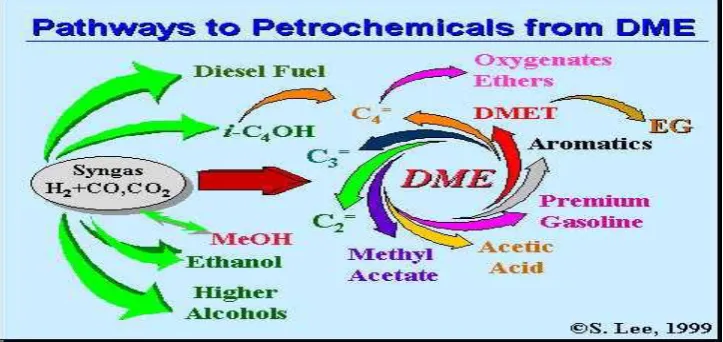
[image:3.595.118.480.557.728.2]Given that DME is miscible with many resins and solvents, it is now being used as a cleaning material for laboratory systems and some high precision, high value added cleaning applications, such as in electronics. Different pathways to petro chemicals from dimethyl ether shown in Figure 1.
_______________________________________________________________________________________
© 2016, IRJET ISO 9001:2008 Certified Journal
Page 241
5. Manufacturing Process by Fenix Process Technology
DME can be produced by different methods. One of the methods which are used abundantly by industries is Fenix Process Technology.
5.1.FenixProcessTechnology
A process for production and recovery of DME by dehydration of methanol which significantly reduces the distillation duties associated to the preparation of the fresh methanol feed stock and/or the recovery of unconverted methanol for use as recycle feed stock to the DME production process while maintaining a high rate of conversion of methanol to DME. In this method, we have two types of processes. They are
Two-Step Process
One-Step (Direct) Process.
5.1.1. Two-Step Processes
The only current commercial two step technology process in use for the production of DME is via fixed bed catalytic dehydration of methanol. Because the process is relatively simple, this method is commonly used because of the low capital investment required and the availability of feedstock. Currently, the production of dimethyl ether based on a two step process is offered by industries.
Methanol and shift catalysts are typically copper based. Increasing temperatures rapidly decrease catalyst activity so that isotherms need to be carefully controlled. Different types of catalysts are employed for methanol dehydration. Of these, the catalytic activity of g -alumina and silica-alumina catalysts has been investigated more thoroughly than most.
5.1.2. One-Step (Direct) Processes
Haldor Topsoe has developed a process technology for large scale production of DME via direct synthesis from natural gas, without having to first produce and purify methanol.
The direct synthesis of DME (or single step) process requires a dual catalyst system that acts as a methanol synthesis catalyst and a methanol dehydration catalyst in a single unit. In the 1990s, Air Products and Chemicals discussed the use of Cu/ZnO/ y -Al 2O 3 shift catalysts as a single catalyst for single step processes.
5.2. Synthesis of DME from Methane
DME is produced in a minimum of two steps. First, hydrocarbons (predominant feedstock for DME production is natural gas) are converted into synthesis gas, a combination of carbon monoxide and hydrogen. The synthesis gas is then converted into DME, either via methanol (conventional process) or directly in one step. The predominant feedstock for DME production is natural gas. Current commercial synthesis gas technologies include steam methane reforming, partial oxidation, auto thermal reforming, and combined reforming. Technologies under development include compact reformers and ceramic membranes. The chemistry behind the formation of DME is shown in Figure 2.
_______________________________________________________________________________________
© 2016, IRJET ISO 9001:2008 Certified Journal
Page 242
6. Plant Considerations
The location of the plant can have a crucial effect on the profitability of project, and the Scope for the expansion. Factors considerartion while selecting a plant site are:
Transportation
Source and costs of raw materials
Prospective market for the products
Corporation long range planning
Water source –quality and quantity
Special incetive
Climate conditions
Pollution requriements (Waste
disposal)
Utilities-cost,quantity,and realiability
Fuel-costs,reliability,and availablity
Amount of site preparation
necessary(site condition)
Construction costs
Operating labor
Taxes
Living condition
Corrosion
Expansion possibilities
Other factors
Three factors are usually considered the most important. These are the location of the markets, raw materials and the type of transportation to be used. The economic construction and efficient operation of a process depend on how well the plant and equipment specified flow sheet is laid out. The principal factors to be considered are:
Economic consideration
Construction and operation costs
The process requirement
Convenience of operation
Convenience of maintence
Safety
Future expansion
Modular construction
7. Safety& Health
Safety and health aspects of the personnel and equipment are important in the plant. A safe and comfortable working environment is essential for the efficient operation of the plant. Control measures are taken to prevent exposures and contacts to harmful or objectionable levels of contaminants. The organization will also have to consider loss prevention. The term Loss Prevention is an insurance term, the loss being the financial loss caused by an accident. This loss will not only be the cost of replacing damaged plant and third party claims but also the loss of earnings from lost production cost and lost sales opportunity. All manufacturing processes are to some extent hazardous, but in the chemical processes there are additional, special hazards, associated with the chemicals used and the process conditions.
The awareness of these hazards and their application of sound engineering practices to keep the risks associated to a minimum is an engineer’s job. As a consequence we will have to consider the characteristics like toxicity, flammability, chemical instability, reactivity, operating conditions, corrosive properties etc. in order to analyze the hazards and provide safe and healthy working conditions. Fire accidents, exposure to chemicals, explosions are some of the major hazards in the operation of the plant. The presence of various chemicals and there handling is very important and the relevant precautions to be followed in storage are mentioned subsequently in the material safety data sheets.
8. Conclusions
Use of DME has a major role in future due to decreasing of non renewable energy sources like petrol, diesel etc. The preparation, storage of DME is easier and which have more applications. Future world is based on the energy, so the use of DME is one of the options to regain energy sources.
References
[1] Jamshidi LCLA, Barbosa CMBM, Nascimento L and Rodbari J R, Catalytic Dehydration of Methanol to Dimethyl Ether (DME) Using the Quasicrystalline Alloy, Chemical Engineering &Process Technology
[2] Erdener H, Arinan A, Orman S (2011) Future Fossil Fuel Alternative; DME (A review). IJRER 1.
[3] Sun KP, Lu W, Qiu F, Liu S, Xu X (2003) Direct synthesis of DME over bifunctional catalysts: surface properties and catalytic performance. Appl Catal A: Gen 252: 243-249.
[4] Shen WJ, Jun KW, Choi HS, Lee KW (2000) Thermodynamic investigation of methanol and dimethyl ether synthesis from CO2 hydrogenation. Korean J Chem Eng 17: 210-216.
_______________________________________________________________________________________
© 2016, IRJET ISO 9001:2008 Certified Journal
Page 243
[6] Bruce E.Poling, John M.Prausnitz and John P.O’Connel, Properties of gases and liquids, 5th edition.[7] Richard Turton, Richard C. Baillie, Wallanc B. Whiting and Joseph a. Shaeiwitz, Analysis synthesis and design of chemical processes.
[8] Estrella M, Barrio L, Zhou G, Wang X, Wang Q, et al. (2009) In Situ Characterization of CuFe2O4 and Cu/Fe3O4 Water-Gas Shift Catalysts. J Phys Chem C 113: 14411-144.
[9] Nascimento L, Agostinho LCL, Cavalcanti BF (2009) Comportamento Da Oxidação Na Fase Icosaedral Do Quasicristal Al62,2Cu25,3Fe12,5. Acta Microscópica 18: 295-303.
[10] Turquier F, Cojocaru VD, Stir M, Nicula R, Lathe C, Burkel E (2004) Formation and stability of single-phase AlCuFe quasicrystals under pressure. Rev Adv Mater Sci 8: 147-151.
[11] Agostinho LCL, Nascimento L, Cavalcanti BF (2010) Aplicação da liga quasicristalina Al62,2Cu25,3Fe12,5 em reação catalítica do metanol. Revista Analytica ANO 8: 78-85.
[12] Cheung Y, Chan CK, Zhu HY (2001) Characterization of Icosahedral phase in as-cast quasicrystalline Al65Cu20Fe15 alloys. Materials Characterization 47: 299-305.
[13] Rosas G, Perez R (2001) on the transformations of the ψ-AlCuFe icosahedral phase. Material Letters 47: 225-230. [14] Faungnawakij K, Tanaka Y, Shimoda N, Fukunaga T, Kikuchi R, et al. (2007) Hydrogen production from dimethyl ether steam reforming over composite catalysts of copper ferrite spinel and alumina. Appl Catal B: Environ 74: 144-151.
[15] Fang DR, Ren WZ, Liu ZM, Xu XF, Zhang HM, et al. (2010) Synthesis of mesoporous Cu-Mn-Al2O3 materials and their applications to preferential catalytic oxidation of CO in a hydrogen-rich stream. Chem Res 26: 105-109.
[16] Krishnan V, Selvan RK, Augustin CO, Gedanken A, Bertagnolli H (2007) EXAFS and XANES investigations of CuFe2O4 Nanoparticles and CuFe2O4-MO2 (M= Sn,Ce) Nanocomposites. J Phys Chem C 111: 16724-16733.
[17] Bergstein A (1968) Forma ion of the spinel Cu0.5Fe2.5O4 from CuFe2O4 and αFe2O3. Materials Research Bulletin 3: 787-796.