International Journal of Emerging Technology and Advanced Engineering
Website: www.ijetae.com (ISSN 2250-2459, ISO 9001:2008 Certified Journal, Volume 7, Issue 3, March 2017)
105
Solar Air Conditioning System by Using Peltier Module
Nawale G. K.
1, Nhavakar R. S.
2, Sonawane V. R.
3, Mistari N. M.
4,
Prof. Sawant S. G.
5, Prof. Darade P. P.
61,2,3,4
UG Student, Savitribai Phule Pune University, SND COE & RC, Yeola, Dist-Nashik, Maharashtra, India 5,6Assistant Professor, Savitribai Phule Pune University, SND COE & RC, Yeola, Dist-Nashik, Maharashtra, India
Abstract—The development of nonconventional energy is on the rise worldwide because of the growing demand on energy, prices of oil is high, conventional energy sources are depleting and concerns of environmental impact. In recent year, progress on solar-power air conditioning system increase now a day’s .Air conditioning system is almost a must in every building if we want to have good indoor comfort inside the building. Such as air purification, temperature, humidity etc. in conventional air conditioning system it uses as component compressor, condenser, evaporator and expansion valve etc. in this project our aim only to reduce the electricity consumption required to drive the conventional AC and people attract to use nonconventional energy (solar energy).
Keywords—Air Conditioning, Solar Energy, Dehumidify, thermoelectric Module, Peltier Module.
I. INTRODUCTION
Solar AC system It is purpose, in a building or an automobile, is to provide comfort during either hot or cold weather. with this also potential of green house gases is increasing so, it is the need of the day opt for some other source of air conditioning source. So we will be designing an air-conditioner working on solar energy. To overcome the problem green house gases some other cooling source viz Peltier will be used this will be totally eliminating the source of green house gases. The device is powered by a Non-conventional energy resource, here PV Cells.
II. PROPOSED METHODOLOGY
Now, we discuss the final proposed system with all the modifications and advancements that is done referring different study reports and research work.
Generally air-conditioner developed till dates are employing the principle of passing air over heat sink of cold side of module. As Heat Sink is made of Copper or Aluminum (Copper and aluminum are very good conductors of heat). But now in proposed new design we are using radiator instead of heat sink this will increase contact surface area for cooling. We are increasing area by connecting aluminum sink. The hotter side of the plates are fixed and fitted with heat sink which is basically used for the more effective heat removal. The heat sink used in fabrication consists of the aluminum finned aluminum plate.
The duct used in air-conditioner is basically sucks the air of the room from one side and throws it in the room from the other side and as there are least corners and bends in the duct, hence there are the least loses in the same. The duct is used only for cool air. For exhaust air we are using a straight duct so that there is no there is no blockage or any kind of restriction in the heat removal. We are using total five fans for removal of heat. For the most efficient cooling we require to separate the cold side and the hot side of the peltier modules. Wood are used to separate cold and hot side of peltier module. Fans used for circulation of cool air are ‗90x90x20 lbh 12V 0.15Amp‘ rating. These have the following two advantages:-
1. Flow is appropriate for the given specification of the thermoelectric modules.
2. It fits in the selected cabinet of air-conditioner
Fans used for exhaust heat removal are smaller in size (which fits in cabinet) hence are five in number and works on DC power supply these fans are used along with heat sink.
International Journal of Emerging Technology and Advanced Engineering
Website: www.ijetae.com (ISSN 2250-2459, ISO 9001:2008 Certified Journal, Volume 7, Issue 3, March 2017)
106
III. BASICS OF AIR CONDITIONER
Basic function of air-conditioner to maintain pleasant condition inside the workspace by controlling temperature and humidity of the surrounding. Commonly used terms relative to heat transmission and load calculations are defined below.
Temperature, Dry Bulb – is the temperature of air indicated by a regular thermometer.
COP (Coefficient of Performance): COP is the ratio of the heat removed (or added, in the case of heating) divided by the input power.
Heat Pumping: The amount of heat that a thermoelectric device is capable of removing, or "pumping", at a given set of operating parameters
Passive Heat Load: The heat transferred by virtue of a temperature difference. For example, this is the heat that Another example is the heat from solar radiation.
Thermoelectric Module: A semiconductor-based electronic component that functions as a small heat pump.
[image:2.612.341.546.177.593.2]
Fig.2. Working Cycle
IV. WORKING OF CONVENTIONAL VAPOR COMPRESSION
AIR CONDITIONING UNIT
The coils and pipes in an air conditioning unit contain refrigerant gas.
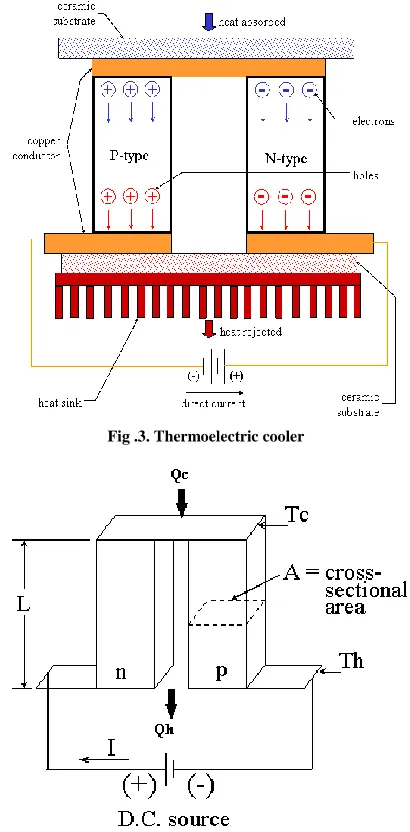
Thermoelectric Cooling
Fig .3. Thermoelectric cooler
Fig .4. Notations of Thermoelectric Module
1.
Condenser
2.
Expansion
[image:2.612.54.289.381.515.2]International Journal of Emerging Technology and Advanced Engineering
Website: www.ijetae.com (ISSN 2250-2459, ISO 9001:2008 Certified Journal, Volume 7, Issue 3, March 2017)
107
V. SELECTION OF PELTIER MODULES FOR ABOVE
CONFIGURATION
Rating: maximum 4.4 amps
Power: maximum 70 watts
Temperature difference: maximum 590 C at an ambient temperature of 30 oC and with no load.
Number of p-n junctions: 127
Footprint: 4 cm x 4 cm
Thickness: 4mm
Weight: 28 grams
Referring datasheet of Nippon India Peltier Module No TEC1-12706 is selected for our project . According to calculation four peltier module of 35 w rating is required but considering better cooling effect of device five peltier modules are employed for cooling process.
Specification of Selected Msodule: TEC1- 12706
Operating Voltage: maximum 14.5V. Potential may be applied either way. The only difference is the sides which heat up and cool down.
Rating: maximum 8 amps
Power: maximum 71.1 watts
Temperature difference: 67 C
Footprint: 4 cm x 4 cm
Thickness: 3.3mm
Selection Of Fan
Model : 90x90x20 hbl
Bearing type : brushless type
Rating voltage : 12V DC
Power ( amp) : 0.14 A
Selection Of Solar Panel
Panel specification
Output voltage=12 Volts (D.C.)
Output Watts= 5 watt
Required quantities
Air conditioner input voltage=12V (D.C.)
Input for battery = 24 Volts (D.C.)
VI. BASIC FUNCTIONS OF COMPONENTS
Once we have acquired this component we will begin with fabrication process.
First and foremost thing of any device is its structure, and in our case it will be provided by the cabin of the air conditioner. Basic needs to be fulfilled by cabin of air conditioner are as follows:
Provide room for mounting all the components (via Blower, Heat sinks, Battery, Power Devices Switches) Inner structure of air conditioner should be such that it helps in proper flow of conditioned air and also it prevents mixing of hot side and cold side air.
Cabinet should be mechanically strong so that it provides firmness to the device.
Now second thing is the Blowers / Fan required for the circulation of conditioned air in the space. Basic requirement from Fan are as follows:
Should have less vibration and produce less noise. Should have high discharge so that air can travel the
passage comfortably.
Function of air filter is to prevent the passage of any impurity in the system. It can be achieved by putting gauge paper of very less or tiny opening through it.
Heat sinks should be such that it easily dissipates heat from hot side of the thermoelectric module and provide sufficient area for flow of air over cold side.
VII. ASSEMBLY OF DIFFERENT COMPONENTS
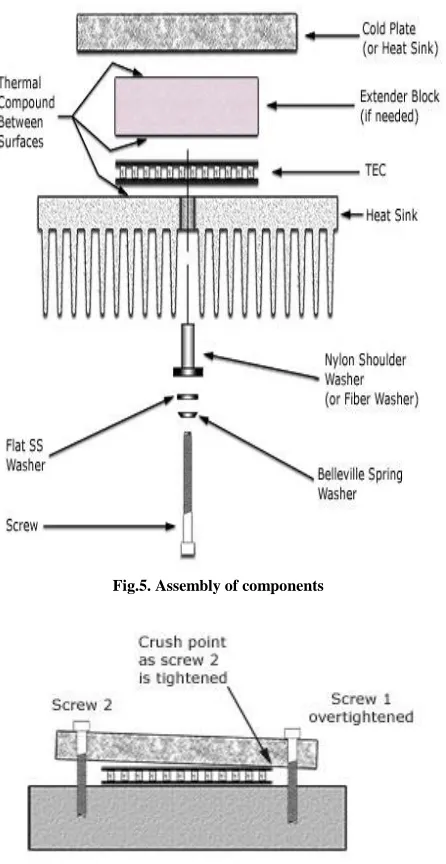
Thermoelectric Module Mounting
There are three methods of mounting thermoelectric modules:
1. Adhesive bonding using a thermally conductive
adhesive such as epoxy.
2. Compression assembly using thermal interface
materials such as thermal grease or thermal sheets. 3. Solder mounting.
International Journal of Emerging Technology and Advanced Engineering
Website: www.ijetae.com (ISSN 2250-2459, ISO 9001:2008 Certified Journal, Volume 7, Issue 3, March 2017)
[image:4.612.59.282.138.570.2]108
Fig.5. Assembly of components
Fig 6. Crushing due to over tight
Mounting of Fan/Blower in the Cabin
Fans are mounted in the cabin for circulation of air. Passage of the air is of volute shape at the centre fan is mounted with help of screws so that it sucks air from the room, as air is passed over the heat sink on cold side of thermoelectric module it gets cooled and after which it is accumulated in the passage and another fan is utilized for the purpose of throwing the cooled air in the room. So, basically two fans are mounted on the two ends passage to do the circulation of air effectively in the room.
Although task can be fulfilled using single fan but so as to increase the flow and decrease the load on the system two fans are used. As auxiliary fan is mounted almost at the end of the passage dampers are installed at the end of the passage so as to evenly distribute the air in space.
Heat Removal Duct
For the purpose of removal of heat from the condenser end of heat sink air duct is employed. It passes air through the corrugated fins and hot air is discharged out of the system. While fabricating the duct it is ensured that hot air does not enters in the conditioned space and this is done by using polyurethane sheets as they are bad conductors of heat and doesn‘t allow heat to enter in cold chamber. At one end of duct fans are installed to have forced convection over heat sink.
Insulation of Cold Chamber
We are having the old chamber of a window air-conditioner and for proper insulation of all the chambers of the cabin Thermacole layer is laid throughout the inner side wall of the cabin, it is necessary as we are having compact structure and heat transfer due to radiation may take place also small heat mixing may impact on efficiency of the system.
VIII. ADVANTAGES & DISADVANTAGES
Advantages
1. It works on renewable source of energy i.e. solar energy
2. There is no use of any refrigerant do not require the use of chlorofluorocarbons. Therefore they are safe for the environment
3. Thermoelectric modules have no moving parts,
inherently reliable, and virtually maintenance free. 4. They can be operated in any orientation and are ideal
for cooling devices that might be sensitive to mechanical vibration.
Disadvantages
1. Lowefficiency: it gives only10%-15% output of the total power consumed
2. Iinitial cost is high: As peltier modules are not available easily.
International Journal of Emerging Technology and Advanced Engineering
Website: www.ijetae.com (ISSN 2250-2459, ISO 9001:2008 Certified Journal, Volume 7, Issue 3, March 2017)
109
IX. CONCLUSION
In this overview, we built up a Green AC working on the phenomenon called peltier effect. The prepared model of solar cell driven, thermoelectric cooling system was designed and tested experimentally. The following valuable information regarding an environmental friendly cooling device is obtained.
1.This air conditioning unit does not produce any harmful green house and ozone depleting gasses. 2.It uses solar energy as a power source so it does not
need conventional electricity which is produced from polluting thermal power plants.
3.This system is compact as compared to conventional air conditioning system.
4.This system is free from bulky components like condenser and evaporator as this air condition unit does not run on conventional thermodynamic cycles.
5. Noiseless operation and can be used as both winter and summer air conditioning unit.
So aim of manufacturing a light weight green air conditioning unit is achieved successfully.
REFERENCES
[1] Dongliang Zhao, Gang Tan*,‖ A review of thermoelectric cooling: Materials, modeling and applications‖, Applied Thermal Engineering 66 (2014) 15e24
[2] D. Astrain a,*, J.G. Vi_an a, M. Dom_ınguez b,‖ Increase of COP in the thermoelectric refrigeration by the optimization of heat dissipation‖, Applied Thermal Engineering 23 (2003) 2183–2200 [3] Zhong Bing Liu, Ling Zhang∗, GuangCai Gong, YongQiang Luo,
FangFang Meng,‖ Experimental study and performance analysis of a solarthermoelectric air conditioner with hot water supply‖. Energy and Buildings 86 (2015) 619–625