Temperate phages both mediate and drive
adaptive evolution in pathogen biofilms
Davies, E, James, C, Williams, D, O'Brien, S, Fothergill, J, Haldenby, S, Paterson, S,
Winstanley, C and Brockhurst, M
http://dx.doi.org/10.1073/pnas.1520056113
Title
Temperate phages both mediate and drive adaptive evolution in pathogen
biofilms
Authors
Davies, E, James, C, Williams, D, O'Brien, S, Fothergill, J, Haldenby, S,
Paterson, S, Winstanley, C and Brockhurst, M
Type
Article
URL
This version is available at: http://usir.salford.ac.uk/id/eprint/39088/
Published Date
2016
USIR is a digital collection of the research output of the University of Salford. Where copyright
permits, full text material held in the repository is made freely available online and can be read,
downloaded and copied for noncommercial private study or research purposes. Please check the
manuscript for any further copyright restrictions.
Submission PDF
Temperate phages both mediate and drive adaptive
evolution in pathogen biofilms
Emily Davies1,2,§, Chloe James1,3,§, David Williams1,2,§, Siobhan O’Brien4, Joanne Fothergill1, Sam Haldenby2, Steve
Paterson2, Craig Winstanley1,#, Michael A. Brockhurst4,#,*
1. Institute of Infection and Global Health, University of Liverpool, Liverpool, UK 2. Institute of Integrative Biology, University of Liverpool, Liverpool, UK 3. School of Environment and Life Sciences, University of Salford, Manchester, UK 4. Department of Biology, University of York, York, UK§Joint first authors # Equal contribution * Corresponding author
Submitted to Proceedings of the National Academy of Sciences of the United States of America
Temperate phages drive genomic diversification in bacterial pathogens. Phage-derived sequences are more common in pathogenic than non-pathogenic taxa, and are associated with changes in pathogen virulence. High abundance and mobilisation of temperate phages within hosts suggests that temperate phages could promote within-host evolution of bacterial pathogens. How-ever, their role in pathogen evolution has not been experimen-tally tested. We experimenexperimen-tally evolved replicate populations of Pseudomonas aeruginosawith or without a community of three temperate phages active in cystic fibrosis (CF) lung infections, including the transposable phage, ɸ4, which is closely related to phage D3112. Populations grew as free-floating biofilms in artificial sputum medium, mimicking sputum of CF lungs where P. aeruginosais an important pathogen and undergoes evolution-ary adaptation and diversification during chronic infection. While bacterial populations adapted to the biofilm environment in both treatments, population genomic analysis revealed that phages altered both the trajectory and mode of evolution. Populations evolving with phages exhibited a greater degree of parallel evolu-tion and faster selective sweeps than populaevolu-tions without phages. Phage ɸ4, integrated randomly into the bacterial chromosome
but integrations into motility-associated genes and regulators of quorum sensing systems essential for virulence were selected in parallel, strongly suggesting that these insertional inactivation mutations were adaptive. Temperate phages, and in particular transposable phages, are therefore likely to facilitate adaptive evolution of bacterial pathogens within hosts.
Pseudomonas aeruginosa | cystic fibrosis | mobile genetic element |
experimental evolution | bacteriophage
INTRODUCTION
Comparative genomics suggests that temperate phages play an important role in the evolution and genomic diversification of bacterial pathogens (1). Bacterial genomes often contain a range of intact and remnant prophage elements (1-3) and ecologically important bacterial traits are believed to be phage-derived (e.g. phage-derived bacteriocins (4)). Phage-related sequences are ob-served more frequently in pathogenic than nonpathogenic strains (5), and prophage acquisition can be associated with changes in pathogen virulence (6, 7). Prophages can directly contribute accessory gene functions (1, 8), or disrupt bacterial genes by insertional inactivation. Of particular note are the transposable class of temperate phage (also known as mutator phage), includ-ing D3112 of P. aeruginosa(9, 10), which integrate throughout the chromosome disrupting existing genes and increasing the supply of mutations available to selection. Recent reports of high rates of phage mobilization within hosts (11) and high temperate phage abundance in humans (12), including at sites of chronic infection where phage particles have been observed to exceed bacterial host densities by 10-to-100-fold (13), suggests that tem-perate phages could play an important role in driving within-host evolution of bacterial pathogens. However, experimental
tests of the hypothesis that temperate phages contribute to rapid evolutionary adaptation of pathogenic bacteria are lacking.
Pseudomonas aeruginosa is an important opportunistic pathogen and the major cause of chronic lung infection leading to morbidity and mortality in Cystic Fibrosis (CF) patients (14). Populations ofP. aeruginosain the CF lung grow as microcolony biofilms suspended within lung sputum and undergo extensive genetic diversification (15-17) and rapid evolutionary adaptation (18, 19) to this host environment. Characteristic bacterial adap-tations to life in the CF lung and the transition to chronicity include the evolution of mucoidy, altered metabolism, loss of motility, quorum sensing defects, and resistance to antibiotics (18, 20). Despite detailed knowledge of the targets of selection, we still have only a very limited understanding of the causes of selection driving the evolution of these phenotypes. Phages are known to be present in the CF lung, have been cultured from lung sputa (21, 22) and detected at high abundance using culture independent molecular approaches (13). Moreover, prophages are a common feature ofP. aeruginosasequenced genomes (23), and lysogenic conversion has been linked to the evolution of key clinical phenotypes (e.g., mucoidy (24, 25)). Therefore it is likely that temperate phages may both impose selection on P. aeruginosain the CF lung, and contribute to pathogen adaptation to this host environment.
We used experimental evolution to directly test how temper-ate phages affect P. aeruginosa adaptation in artificial sputum
Significance
During chronic infection bacterial pathogens undergo rapid evolutionary adaptation and extensive genetic diversification affecting patient symptoms and treatment outcomes. Tem-perate phages are common in pathogen genomes and phage particles can reach high abundance in human infections, but their role in pathogen evolution is unclear. Using experimental evolution and population genomics we show that temperate phages found in human infections accelerated pathogen evo-lution by increasing the supply of beneficial mutations and imposing strong selection on bacterial populations. Notably phages accelerated the loss of clinically important virulence-related bacterial traits, including motility and quorum sensing. Temperate phages are likely therefore to facilitate rapid evolu-tion of bacterial pathogens and contribute to their adaptaevolu-tion to the host environment and clinical treatments.
Reserved for Publication Footnotes 1
2 3 4 5 6 7 8 9 10 11 12 13 14 15 16 17 18 19 20 21 22 23 24 25 26 27 28 29 30 31 32 33 34 35 36 37 38 39 40 41 42 43 44 45 46 47 48 49 50 51 52 53 54 55 56 57 58 59 60 61 62 63 64 65 66 67 68
Submission PDF
Fig. 1. | Fitness response to selection in populations evolving with and without phages.Data points represent the mean±1 S.E. fitness calculated as selection rate for populations evolved with (filled symbols) or without (open symbols) phages in competition against either ancestral PAO1, or an isogenic phage-resistant competitor, PAO1ΔpilA.
medium (ASM), anin vitroenvironment that recapitulates key physiochemical and biofilm growth properties of CF lung sputum (26). Specifically, we propagated 6 replicate populations of P. aeruginosaPAO1 in the presence versus absence of an assemblage of 3 temperate phages (LESɸ2,ɸ3 andɸ4) for approximately 240 bacterial generations. These temperate phages naturally coexist as prophages in the genome of theP. aeruginosaLiverpool Epi-demic Strain (LESB58) (27), the dominant clone infecting the UK CF population (28), and contribute to its competitivenessin vivo(27, 29, 30). Whereasɸ2 andɸ3 are insertion site specific,
ɸ4 is closely related to D3112, which is known to insert ran-domly throughout theP. aeruginosachromosome (9, 10), and may therefore play an important role in facilitating the evolutionary adaptation ofP. aeruginosaby increasing mutational supply. All phages display high rates of lytic activity in chronic CF lung infections (13), including being induced into the lytic cycle by clinically relevant antibiotics (21).
RESULTS AND DISCUSSION
In the experimental populations, phages had no effect on bacte-rial densities (Fig S1a) despite evidence of on-going phage lysis in all replicate populations of the phage treatment (Fig S1b). At the end of the experiment, free virions of all phages were detected in 4/6 populations, whereas in the other 2 populations onlyɸ3 andɸ4 virions were detected (Fig S1c). We observed high rates of lysogeny (i.e., integration of prophage(s) into the bacterial chromosome) in 5/6 populations but the phages differed in their propensity to form lysogens: lysogens of the transposable phage
ɸ4 approached fixation in 5/6 populations, whereas lysogenisation of bacteria by the other phages was less common, and, where ob-served, was typically as a polylysogen in combination withɸ4 (Fig S2). Thus lysogeny, and indeed polylysogeny, was rapidly estab-lished in our experimental populations, and moreover lysogeny appears to have been essential for the long-term maintenance of phages in populations.
each evolved population against the ancestral PAO1 in ASM, and because lysogens may have higher fitness simply due to phage-mediated killing of susceptible competitors (29, 31), we also per-formed competitions against a phage-resistant PAO1ΔpilA(all of the temperate phages used here infect via the type IV pilus (32)). We observed that evolved populations from both treatments were fitter relative both to PAO1 and PAO1ΔpilA(Fig 1; one-sample t-test (alt=0), all significant at an alpha-level of 0.0125). Popu-lations evolved with phages had higher fitness than popuPopu-lations evolved without phages relative to PAO1, but this fitness advan-tage of evolving with phages was lost when competing against PAO1ΔpilA(Fig 1; treatment ×competitor interaction:F1,20= 8.54, MSE = 0.59,p< 0.01; simple effect of treatment against competitor PAO1:F1,10= 7.12, MSE = 0.71,p< 0.025; simple effect of treatment against competitor PAO1ΔpilA:F1,10= 1.53, MSE = 0.06,p= 0.24). Together these data confirm that popula-tions in both treatments adapted to the sputum-like environment and that lysogenised hosts had enhanced competitiveness against phage-susceptible competitors.
To determine the genetic basis of the observed evolutionary adaptation we performed whole genome sequencing on tion samples containing 40 random clones pooled per popula-tion from the end of the experiment. All populapopula-tions contained single nucleotide polymorphisms (SNPs) and small insertions or deletions (indels), and all replicate populations that had evolved with phages contained integrated prophages. At the genome-wide scale, populations evolved with or without phages did not differ in abundance or frequency of SNPs and indels (excluding insertions caused by prophage integrations) and both groups had high variance of polymorphic sites: between 16 and 173 among the free populations and 17 to 176 among the phage-containing populations (Table S1).
Parallel evolution at a particular locus, where independent mutations are observed more often than expected by chance, is strong evidence for positive selection. For example, in the absence of selection, the probability of observing a mutation in two populations at the conclusion of the experiment is onlyp
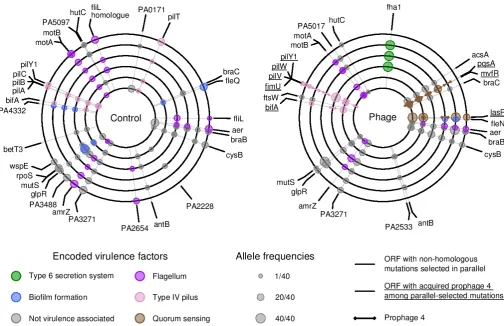
= 0.003, andp= 0.0002 if observed in three populations (for an average 1004 bp sized protein coding sequence in the PAO1 genome). Thus to identify loci likely to have been under selection during experimental evolution we concentrated our analyses on the subset of genes that had been targeted by mutations in≥2 replicate populations per treatment (Fig 2, Tables S2 and S3). A greater degree of parallel evolution was observed in the presence of phages (measured as the probability of randomly drawing a pair of mutated genes from different populations, with phages 0.056±0.016 s.e., without phages 0.024±0.007 s.e.,p< 0.05 by Bootstrap Test). Some parallel targets of selection were shared among treatments, including genes involved in the type IV pilus motility, flagellar motility, biofilm formation, metabolism and regulation, suggesting that these mutations were beneficial in the sputum-like environmentper se. Interestingly, some loci were more likely to evolve in the presence of phages. In particular, mutations affecting the quorum sensing (QS) regulatorslasRand
mvfRwere each observed in 5/6 replicate phage-treated popula-tions, compared to only 1/6 replicate phage-free populations. In addition, 3/6 populations evolving with phages versus 1/6 evolving without phages contained mutations infha1, which encodes an FHA domain protein that post-translationally activates type VI secretion (33). A further indication of stronger selection due to phages is that parallel selected loci displayed higher allele frequencies in the phage treatment (mean allele frequency = 34.33±3.2 s.e.m / 40) compared to the control treatment (mean allele frequency = 22.67±3 s.e.m. / 40), suggesting that selective sweeps in the phage treatment were closer to fixation (discussed in more detail in Supplementary Materials).
138 139 140 141 142 143 144 145 146 147 148 149 150 151 152 153 154 155 156 157 158 159 160 161 162 163 164 165 166 167 168 169 170 171 172 173 174 175 176 177 178 179 180 181 182 183 184 185 186 187 188 189 190 191 192 193 194 195 196 197 198 199 200 201 202 203 204
2 www.pnas.org --- --- Footline Author
Submission PDF
Fig. 2. | Genetic loci under positive selection as indicated by parallel genomic evolution in populations evolving with and without phages.Each concentric circle corresponds to a replicate population in either the control (without phages) or treatment group (with phages), as indicated. Positions around each concentric circle, starting at the 12 o'clock position and in a clockwise direction, correspond to positions around the publishedP. aeruginosaPAO1 single circular chromosome. The smaller circles around each concentric circle indicate the positions of variants in each replicate that were observed in an open reading frame under positive selectioni.e., mutated in parallel in at least one other replicate. Only variants infha1were at precisely the same position and were likely to be homologous. Variants are also listed in Table S8.
A key difference between the populations evolving with, versus without phages is that a substantial fraction of ORFs under positive selection (8 of 26; figure 2) contained mutations caused by prophage integration in the phage-containing treat-ment. Prophage 2 and 3 were found exclusively at the intergenic sites homologous to their positions in the LESB58 chromosome from where they were isolated (4,629,220 bp and 4,103,724 bp in the PAO1 chromosome) and were therefore excluded from analyses. In contrastɸ4 integrations were observed at 19 different positions across the 6 replicates, suggesting thatɸ4 integration provided an additional source of genetic diversity for selection to act upon. Althoughɸ4 is closely related to D3112 and therefore likely to integrate randomly throughout the chromosome (27, 32, 34), we tested for hotspots of integration with an exhaustive search of sequence motifs using the MEME and MAST algo-rithms (35, 36) in the 1000 bp region around each of the inte-gration sites. Only very weakly conserved motifs were identified (Table S4), suggesting thatɸ4 has the low integration specificity characteristic of transposable phages like D3112. Despite the very low integration specificity ofɸ4, all of the 19 integration sites were located within or adjacent to only 7 different operons, which is consistent with positive selection for integrations at those regions (Fig 2; Tables S5 and S8). The functions most commonly predicted to be disrupted by positively selectedɸ4 integration events were type IV pilus motility and QS. Thus transposable temperate phages likeɸ4 may commonly alter the mode of bac-terial evolution by increasing the supply of mutations available to natural selection.
Because all of the temperate phages used here infect via the type IV pilus (32) and PAO1ΔpilAmutants showed higher fitness compared to PAO1 against lysogenized bacteria evolved in the phage treatment (Fig 1), we hypothesised that disruption of type IV pilus motility associated genes may have been selected to prevent superinfection and lysis ofɸ4 lysogens. Notably, while
ɸ4 lysogens have strong superinfection immunity againstɸ4, they remain susceptible to infection and subsequent lysis byɸ2 and
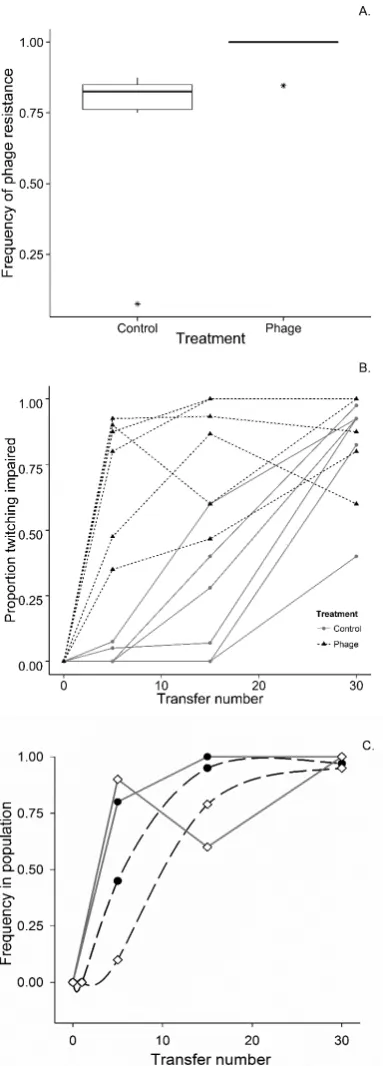
ɸ3 (32), suggesting that loss of type IV pili could be beneficial in the presence of a diverse phage community. In support of this we observed higher rates of phage resistance in populations that evolved with versus without phages (Fig 3a; Mann–Whitney test; W = 24.0, n1 = n2 = 6,p= 0.02). Correspondingly, type IV pilus-dependent twitching motility was lost more rapidly in phage-containing populations than in phage-free populations, suggest-ing that the loss of type IV pilus function was more strongly selected in the presence of phages (Fig 3b). To determine whether loss of type IV pilus twitching motility phenotype was associated withɸ4 integration, we tracked allele frequency dynamics in 2 replicate populations. Specific PCR primer sets (Table S6) were used to detect integratedɸ4 prophage infimUandpilV. In both cases there was a positive association between the allele frequency dynamics and the rise in frequency of twitching motility deficient mutants (Fig 3c). We next contrasted the allele frequencies of SNPs, indels andɸ4 prophage-integration mutations occurring at type IV pilus associated loci. Across 6 phage-treated populations, 12 mutations of the type-IV pilus associated genes were detected in parallel, the majority (n=9) were caused by ɸ4 prophage-273
274 275 276 277 278 279 280 281 282 283 284 285 286 287 288 289 290 291 292 293 294 295 296 297 298 299 300 301 302 303 304 305 306 307 308 309 310 311 312 313 314 315 316 317 318 319 320 321 322 323 324 325 326 327 328 329 330 331 332 333 334 335 336 337 338 339 340
Submission PDF
Fig. 3. | The evolution of resistance to phages and pilus-dependent twitch-ing motility traits.(A.) Boxplot of phage resistance in endpoint populations. The thick horizontal line denotes the median frequency of isolates resistant to one or more LES phages in a population for each treatment. Asterisks and narrow horizontal lines denote outliers and the upper and lower quartiles, respectively. (B.) Frequency of bacterial isolates in each population through time displaying impaired twitching motility. (C.) Allele frequency dynamics of LESω4 integrated intofimUandpilVfor populations P7 and P11, respectively, and loss of twitching motility in these populations. Closed black circles and open white diamonds represent populations P7 and P11, solid grey lines twitching motility data, and dashed black lines allele frequency data.
integration, and half of them (n=6/12) occurred at high frequen-cies (≥10/40 clones per population). However, in the absence of
parallel (n=16), only 13% of these mutations occurred at high frequency (Table S3). Consistent with the phenotypic data (Fig. 3b, c), this suggests that there was stronger positive selection for mutations disrupting type IV pilus associated genes in the presence of phages, driving faster selective sweeps, compared to type IV pilus disrupting mutations occurring in the absence of phages. The exception to this pattern is replicate 3 of the phage treatment, where the impairment of twitching motility in 35 isolates can be explained by a single frame-shift deletion variant at 35/40 inpilY1(PA4554; encodes a type IV pili biogenesis protein; Fig 2). It is notable that a low frequency of lysogeny was observed in this population, unlike all other phage treatment replicates where lysogens approached fixation (Fig S2).
Our genomic data suggest that temperate phages promoted the loss of QS with positive selection ofɸ4 prophage integrations, SNPs and indel mutations at themvfRandlasRloci. Mutations tolasRlead to disruption of the acyl-homoserine-lactone (AHL) signaling system (37), whereas mutations to mvfRlead to dis-ruption of the Pseudomonas Quinolone Signal (PQS) system (38), suggesting large-scale alterations to QS cell-cell signaling in populations evolving with phages. To test whether QS defi-cient bacteria have higher fitness in the presence of phages, we
competed PAO1 against PAO1ΔlasRin ASM with and without
the temperate phages. There was no effect of phages on the fitness of PAO1ΔlasR(Fig. S3; two-sample t-test, t10= -0.7989,
p= 0.44), which was substantially fitter relative to PAO1 in both the presence (one-sample t-test (alt=0), t5 = 5.0331,p<0.01) and absence (one sample t-test (alt=0), t5 = 6.7065,p= 0.001) of phages. These data suggest thatlasRmutations are beneficial in ASMper se. This is consistent with the observation that single populations in the phage-free treatment also acquired mutations in QS genes, but suggests that the rate of evolution at these loci was higher in the presence of phages. Secondly, we compared the rates of spontaneous phage lysis ofɸ4 lysogens constructed
in both the PAO1 and PAO1ΔlasRbackgrounds: There was no
significant difference in production of free phages in stationary phase cultures (median free phage density: PAO1, 3.4 x 10⁸p.f.u. per ml, PAO1ΔlasR, 3.3 x 10⁸ p.f.u. per ml; Mann-Whitney test;
W= 92.0,P= 0.345). Thus although direct interaction between temperate phages and bacterial QS has been reported in other systems, via QS induced lysis by phages (39) or QS mediated alter-ation of phage receptor expression by bacteria (40), this does not appear to be an important factor in our study. Phages may have simply increased the supply of large effect mutations available to natural selection, notably viaɸ4 prophage integrations intomvfR
(Fig 2). Alternatively, there may have been epistatic interactions between the fitness effects of QS mutations and other positively selected mutations, which strengthened selection for loss of QS in the presence of phages. Mutations in QS regulators are commonly observed to accumulate over time in CF chronic infection (41). Both AHL and PQS signaling are required for full virulence in
P. aeruginosa(42) suggesting that temperate phage selection may accelerate the loss of virulence in chronic infections.
In summary, we have shown that temperate phages enhanced parallel evolution inP. aeruginosabiofilms in a sputum-like en-vironment. Our data suggest two ways in which this may have occurred: Firstly, the transposable phageɸ4 mediated adaptive evolution by increasing the supply of positively selected mutations via insertional inactivation of genes caused by prophage integra-tions, particularly in type-IV pilus and QS associated genes. Sec-ondly, we present evidence that temperate phage strengthened selection, particularly for mutations in type IV pilus associated genes, accelerating the evolutionary loss of type IV dependent pilus motility presumably to avoid super-infection and subsequent lysis by phages which infect via the type IV pilus. A recent transpo-son sequencing study ofP. aeruginosaPA14 shows that mutations 410
411 412 413 414 415 416 417 418 419 420 421 422 423 424 425 426 427 428 429 430 431 432 433 434 435 436 437 438 439 440 441 442 443 444 445 446 447 448 449 450 451 452 453 454 455 456 457 458 459 460 461 462 463 464 465 466 467 468 469 470 471 472 473 474 475 476
4 www.pnas.org --- --- Footline Author
Submission PDF
in type IV pilus associated genes increase fitness in the murine lung (43). Moreover, loss of both motility (44, 45) and QS (46, 47) functions are known to frequently evolve inP. aeruginosachronic infections of the CF lung. Temperate phages, including those used here, can be present at very high densities in the CF lung (exceeding bacterial densities by orders of magnitude (13)), which taken together with our findings suggests that temperate phages could play an important role in CF lung infections by driving the evolution of these clinically important traits inP. aeruginosa. In addition, our data suggest that living in a sputum-like environ-mentper seselects for mutations in genes associated with motility, biofilm formation, metabolism and regulation. Similar mutations observed in CF lung isolatedP. aeruginosaare therefore likely to be at least partially explained simply as adaptations to selection imposed by the sputum environment, but could have implications for susceptibility to antibiotics (48) or host immune responses (49) as correlated responses (50). Experimental evolution in clinically relevant infection models has the potential to enhance our understanding of the causal links between sources of selection and the evolutionary responses of pathogens in infections (51), advancing our understanding of within host pathogen evolution and our ability to direct this for improved patient health.
METHODS SUMMARY
Twelve replicate microcosms (30 ml glass universals contain-ing 5 ml ASM) were inoculated with 5 x 10⁷ cellsP. aeruginosa
strain PAO1 and grown as a biofilm (37 °C incubation with
shaking at 60 r.p.m.). LES phagesφ2, 3 and 4 were added to six microcosms after 24 hours of growth to a total multiplicity of infection of 0.1 (phage treatment), and the remaining six were designated phage-free controls. Phages were added only once, at the beginning of the experiment. After a further 72 hours growth, biofilms were homogenized with an equal volume of Sputasol and the homogenate transferred (1:100) into fresh ASM. Transfers were repeated every 4 days, to a total of 30 transfers (approximately 240 bacterial generations). Every other transfer, bacterial and total free phage densities were enumerated, and every 5 transfers, the frequency of prophage carriage in the phage treatment was estimated with a multiplex PCR assay using primers targeted to each of the LES phages. At transfers 5, 15 and 30, 40 isolates per population were screened for the type IV-pilus mediated twitching motility phenotype using the agar stab method.
At the end of the experiment, DNA was extracted from 40 iso-lates per population and pooled, and the pooled DNA sequenced on an Illumina HiSeq 2000. European Nucleotide Archive acces-sion number for the project is PRJEB9801. Polymorphisms were called from reads aligned to the published PAO1 genome treating each sample as having ploidy = 40, reflecting the number of
pooled isolates.ɸ4 prophage insertion sites were estimated from the mapping locations of reads that mapped to the PAO1 chromo-some and whose mate read mapped to theɸ4 prophage sequence. The MEME software suite (35, 36) was used for motif analysis. First, the 20 most conserved motifs atɸ4 prophage integration sites were selected using the MEME algorithm. Second, the entire host chromosome was searched for motif occurrences using the MAST algorithm (see supplementary materials for details). Frequencies of each prophage integration site were estimated based on the number of read pairs split between prophage and reference chromosomes as a proportion of read pair depth in that region. Open reading frame (ORF) annotations from the published sequence were supplemented using the STRING v10 database (52). Counts of ORFs affected by mutations in more than one population per treatment were implemented using the BioPython library ver. 1.65 (53) and chromosome map plots implemented using the svgwrite library ver. 1.1.3 in Python ver. 2.7.10. Included in the parallel selected loci were those exhibiting the“multi-diverse”signature of unlinked polymorphisms in the same ORFs. The method is implemented in the CheckLinkage option of BAGA (http://github.com/daveuu/baga) (54) and dis-cussed in the Supplementary Materials.
Relative free phage abundances in endpoint populations were estimated separately for each phage using a qPCR as-say of DNAse-treated supernatants, using primers targeted to each phage, and comparison to a set of standards of known concentration. Competitions were performed between endpoint populations against the ancestral PAO1 (labelled with a gen-tamicin resistance marker), or an isogenic LES phage-resistant competitor, PAO1ΔpilA(labelled with a tetracycline resistance marker), in conditions identical to one transfer of the selection experiment. The density of each competitor was determined by plating onto antibiotic selective and non-selective media. Fit-ness was calculated as the selection rate constant. Free phage densities were measured for LESφ4 lysogens in both PAO1 and PAO1ΔlasR. Ten independent lysogens were constructed in each
host background (PAO1 and PAO1ΔlasR)and cultured in LB
until stationary phase, and free phage densities in the supernatant quantified using a plaque assay. Full methods are included in the supplementary information.
ACKNOWLEDGEMENTS.
This work was funded by project grants from The Wellcome Trust (089215/Z/09/Z awarded to CW & MAB and 093306/Z/10 awarded to SP, CW & MAB), and a studentship co-funded by Medical Research Council and the Institute of Infection and Global Health, University of Liverpool. SOB is funded by the Wellcome Trust ISSF grant supporting the Centre for Chronic Diseases and Disorders (C2D2) at the University of York. A. Buckling and V. Friman kindly provided the bacterial strains PAO1ΔpilA and PAO1ΔlasR,
respectively, used in this study.
1. Brussow H, Canchaya C, & Hardt WD (2004) Phages and the evolution of bacterial pathogens: from genomic rearrangements to lysogenic conversion.Microbiology and molecu-lar biology reviews : MMBR68(3):560-602, table of contents.
2. Bobay LM, Touchon M, & Rocha EP (2014) Pervasive domestication of defective prophages by bacteria.Proceedings of the National Academy of Sciences of the United States of America 111(33):12127-12132.
3. Bobay LM, Rocha EP, & Touchon M (2013) The adaptation of temperate bacteriophages to their host genomes.Molecular biology and evolution30(4):737-751.
4. Hockett KL, Renner T, & Baltrus DA (2015) Independent Co-Option of a Tailed Bacterio-phage into a Killing Complex in Pseudomonas.mBio6(4):e00452.
5. Busby B, Kristensen DM, & Koonin EV (2013) Contribution of phage-derived genomic islands to the virulence of facultative bacterial pathogens. Environmental microbiology 15(2):307-312.
6. Pallen MJ & Wren BW (2007) Bacterial pathogenomics.Nature449(7164):835-842. 7. Figueroa-Bossi N & Bossi L (1999) Inducible prophages contribute to Salmonella virulence
in mice.Molecular microbiology33(1):167-176.
8. Figueroa-Bossi N, Uzzau S, Maloriol D, & Bossi L (2001) Variable assortment of prophages provides a transferable repertoire of pathogenic determinants in Salmonella.Molecular microbiology39(2):260-271.
9. Taylor AL (1963) Bacteriophage-induced mutation in Escherichia coli.Proceedings of the National Academy of Sciences of the United States of America50(6):1043.
10. Rehmat S & Shapiro JA (1983) Insertion and replication of the Pseudomonas aeruginosa
mutator phage D3112.Molecular and General Genetics MGG192(3):416-423.
11. Modi SR, Lee HH, Spina CS, & Collins JJ (2013) Antibiotic treatment expands the resistance reservoir and ecological network of the phage metagenome.Nature499(7457):219-222. 12. Letarov A & Kulikov E (2009) The bacteriophages in human- and animal body-associated
microbial communities.Journal of applied microbiology107(1):1-13.
13. James CE, et al.(2015) Lytic activity by temperate phages of Pseudomonas aeruginosa in long-term cystic fibrosis chronic lung infections.The ISME journal9(6):1391-1398. 14. Harrison F (2007) Microbial ecology of the cystic fibrosis lung.Microbiology153(Pt
4):917-923.
15. Mowat E, et al.(2011) Pseudomonas aeruginosa population diversity and turnover in cystic fibrosis chronic infections.American journal of respiratory and critical care medicine 183(12):1674-1679.
16. Williams D, et al.(2015) Divergent, coexisting Pseudomonas aeruginosa lineages in chronic cystic fibrosis lung infections.American journal of respiratory and critical care medicine 191(7):775-785.
17. Jorth P, et al.(2015) Regional Isolation Drives Bacterial Diversification within Cystic Fibrosis Lungs.Cell host & microbe18(3):307-319.
18. Folkesson A, et al.(2012) Adaptation of Pseudomonas aeruginosa to the cystic fibrosis airway: an evolutionary perspective.Nature reviews. Microbiology10(12):841-851.
19. Diaz Caballero J, et al.(2015) Selective Sweeps and Parallel Pathoadaptation Drive Pseu-domonas aeruginosa Evolution in the Cystic Fibrosis Lung.mBio6(5).
20. Winstanley C, O'Brien S, & Brockhurst MA (2016) Pseudomonas aeruginosa Evolutionary 545
546 547 548 549 550 551 552 553 554 555 556 557 558 559 560 561 562 563 564 565 566 567 568 569 570 571 572 573 574 575 576 577 578 579 580 581 582 583 584 585 586 587 588 589 590 591 592 593 594 595 596 597 598 599 600 601 602 603 604 605 606 607 608 609 610 611 612
Submission PDF
biology.
21. Fothergill JL, et al.(2011) Effect of antibiotic treatment on bacteriophage production by a cystic fibrosis epidemic strain of Pseudomonas aeruginosa.Antimicrobial agents and chemotherapy55(1):426-428.
22. Tejedor C, Foulds J, & Zasloff M (1982) Bacteriophages in sputum of patients with bron-chopulmonary Pseudomonas infections.Infection and immunity36(1):440-441.
23. Silby MW, Winstanley C, Godfrey SA, Levy SB, & Jackson RW (2011) Pseudomonas genomes: diverse and adaptable.FEMS microbiology reviews35(4):652-680.
24. Miller RV & Rubero VJ (1984) Mucoid conversion by phages of Pseudomonas aeruginosa strains from patients with cystic fibrosis.Journal of clinical microbiology19(5):717-719. 25. Martin DR (1973) Mucoid variation in Pseudomonas aeruginosa induced by the action of
phage.Journal of medical microbiology6(1):111-118.
26. Sriramulu DD, Lunsdorf H, Lam JS, & Romling U (2005) Microcolony formation: a novel biofilm model of Pseudomonas aeruginosa for the cystic fibrosis lung.Journal of medical microbiology54(Pt 7):667-676.
27. Winstanley C, et al.(2009) Newly introduced genomic prophage islands are critical de-terminants of in vivo competitiveness in the Liverpool Epidemic Strain of Pseudomonas aeruginosa.Genome research19(1):12-23.
28. Fothergill JL, Walshaw MJ, & Winstanley C (2012) Transmissible strains of Pseudomonas aeruginosa in cystic fibrosis lung infections.The European respiratory journal40(1):227-238. 29. Burns N, James CE, & Harrison E (2015) Polylysogeny magnifies competitiveness of a
bacterial pathogen in vivo.Evolutionary applications8(4):346-351.
30. Lemieux AA, et al.(2016) Genes Required for Free Phage Production are Essential for Pseu-domonas aeruginosa Chronic Lung Infections.The Journal of infectious diseases 213(3):395-402.
31. Brown SP, Le Chat L, De Paepe M, & Taddei F (2006) Ecology of microbial invasions: amplification allows virus carriers to invade more rapidly when rare.Current biology : CB 16(20):2048-2052.
32. James CE, et al.(2012) Differential infection properties of three inducible prophages from an epidemic strain of Pseudomonas aeruginosa.BMC microbiology12:216.
33. Mougous JD, Gifford CA, Ramsdell TL, & Mekalanos JJ (2007) Threonine phosphorylation post-translationally regulates protein secretion in Pseudomonas aeruginosa.Nature cell biology9(7):797-803.
34. Rehmat S & Shapiro JA (1983) Insertion and replication of the Pseudomonas aeruginosa mutator phage D3112.Molecular & general genetics : MGG192(3):416-423.
35. Bailey TL & Elkan C (1994) Fitting a mixture model by expectation maximization to discover motifs in biopolymers.Proc Int Conf Intell Syst Mol Biol2:28-36.
36. Grant CE, Bailey TL, & Noble WS (2011) FIMO: scanning for occurrences of a given motif. Bioinformatics27(7):1017-1018.
37. Schuster M, Sexton DJ, Diggle SP, & Greenberg EP (2013) Acyl-homoserine lactone quorum sensing: from evolution to application.Annual review of microbiology67:43-63.
aeruginosa: old molecules, new perspectives.International journal of medical microbiology : IJMM296(2-3):83-91.
39. Ghosh D, et al.(2009) Acyl-homoserine lactones can induce virus production in lysogenic bacteria: an alternative paradigm for prophage induction.Applied and environmental micro-biology75(22):7142-7152.
40. Hoyland-Kroghsbo NM, Maerkedahl RB, & Svenningsen SL (2013) A quorum-sensing-induced bacteriophage defense mechanism.mBio4(1):e00362-00312.
41. Winstanley C & Fothergill JL (2009) The role of quorum sensing in chronic cystic fibrosis Pseudomonas aeruginosa infections.FEMS microbiology letters290(1):1-9.
42. Jimenez PN, et al.(2012) The multiple signaling systems regulating virulence in Pseudomonas aeruginosa.Microbiology and molecular biology reviews : MMBR76(1):46-65.
43. Roux D, et al.(2015) Fitness cost of antibiotic susceptibility during bacterial infection.Science translational medicine7(297):297ra114.
44. Mahenthiralingam E, Campbell ME, & Speert DP (1994) Nonmotility and phagocytic resistance of Pseudomonas aeruginosa isolates from chronically colonized patients with cystic fibrosis.Infection and immunity62(2):596-605.
45. Chang YS, Klockgether J, & Tummler B (2007) An intragenic deletion in pilQ leads to nonpiliation of a Pseudomonas aeruginosa strain isolated from cystic fibrosis lung.FEMS microbiology letters270(2):201-206.
46. Bjarnsholt T, et al.(2010) Quorum sensing and virulence of Pseudomonas aeruginosa during lung infection of cystic fibrosis patients.PloS one5(4):e10115.
47. Jiricny N, et al.(2014) Loss of social behaviours in populations of Pseudomonas aeruginosa infecting lungs of patients with cystic fibrosis.PloS one9(1):e83124.
48. Breidenstein EB, de la Fuente-Nunez C, & Hancock RE (2011) Pseudomonas aeruginosa: all roads lead to resistance.Trends in microbiology19(8):419-426.
49. Alhede M, Bjarnsholt T, Givskov M, & Alhede M (2014) Pseudomonas aeruginosa biofilms: mechanisms of immune evasion.Advances in applied microbiology86:1-40.
50. Bell G (2008)Selection : the mechanism of evolution(Oxford University Press, Oxford ; New York) 2nd Ed pp xiii, 553 p.
51. Brockhurst MA (2015) Experimental evolution can unravel the complex causes of natural selection in clinical infections.Microbiology161(6):1175-1179.
52. Szklarczyk D, et al.(2015) STRING v10: protein-protein interaction networks, integrated over the tree of life.Nucleic acids research43(Database issue):D447-452.
53. Cock PJ, et al.(2009) Biopython: freely available Python tools for computational molecular biology and bioinformatics.Bioinformatics25(11):1422-1423.
54. Williams D, Paterson S, Brockhurst MA, & Winstanley C (2016) Refined analyses suggest that recombination is a minor sourde of genomic diversity inPseudomonas aeruginosachronic cystic fibrosis infections.Microbial Genomics.
682 683 684 685 686 687 688 689 690 691 692 693 694 695 696 697 698 699 700 701 702 703 704 705 706 707 708 709 710 711 712 713 714 715 716 717 718 719 720 721 722 723 724 725 726 727 728 729 730 731 732 733 734 735 736 737 738 739 740 741 742 743 744 745 746 747 748
6 www.pnas.org --- --- Footline Author