The Integration between Knowledge Management
and Total Quality Management and its Impact on
Educational Performance
Mohammad Mehdi Berrish
II
The Integration between Knowledge Management
and Total Quality Management and its Impact on
Educational Performance.
Mohammad Mehdi Berrish
School of the Built Environment,
University of Salford, Salford, UK
I
TABLE OF CONTANETS
TABLE OF CONTANETS ...I LIST OF TABLES ... V GLOSSARY OF TERMS AND ABBREVIATIONS ... X ABSTRACT... XI
CHAPTER ONE ... 1
INTRODUCTION ... 1
1.1 Introduction ... 1
1.2 Jordan: General Overview... 2
1.2.1 The Education System in Jordan ... 2
1.2.2 Higher Education... 3
1.2.3 Universities in Jordan ... 3
1.2.4 Background of the Study... 4
1.2.5 The Quality of Higher Education in Jordan ... 5
1.2.6 The Dearth of Research on KM and TQM in Jordan ... 6
1.3 The Research Problem ... 7
1.4 Importance of the Study ... 8
1.5 Study Aim and Objectives... 9
1.6 Research Conceptual Framework ... 10
1.6.1 Research Framework ... 10
1.6.2 Theoretical Framework ... 11
1.7 Research Variables ... 11
1.8 Research Hypotheses... 12
1.8.1 The First Hypothesis: ... 12
1.8.2 The Second Hypothesis ... 13
1.9 Thesis Structure. ... 14
1.10 Summary ... 16
CHAPTER TWO ... 17
KNOWLEDGE MANAGEMENT ... 17
2.1 Introduction ... 17
2.2 Knowledge ... 17
2.2.1 The Historical Background of Knowledge ... 18
2.2.2 The Concept of Knowledge... 18
2.2.3 Organisational Knowledge ... 21
2.2.4 The Importance of Knowledge... 23
2.2.5 Knowledge and Related Terminologies ... 24
2.2.6 Knowledge Resources ... 27
2.2.7 Knowledge Types... 27
2.3 Knowledge Management (KM) ... 29
2.3.1 Emergence of Knowledge Management ... 30
2.3.2 The Concept of KM... 31
2.3.3 Models of KM ... 33
2.3.4 Elements of KM ... 36
2.3.4.1 KM Processes ... 37
2.3.4.2 KM Technology ... 44
2.3.4.3 Knowledge Team ... 50
2.3.5 KM in Higher Education Institutions ... 56
2.3.5.1 Concept of KM in Educational Institutions... 56
2.3.5.2 Justifications for the Application of KM in Educational Institutions ... 59
II
2.4 Summary ... 61
CHAPTER THREE ... 62
TOTAL QUALITY MANAGEMENT ... 62
3.1 Introduction ... 62
3.2 Quality ... 62
3.2.1 The Concept of Quality ... 63
3.2.2 Quality in Education... 64
3.2.3 Inspection ... 66
3.2.4 Quality control... 66
3.2.5 Quality Assurance ... 66
3.3 Total Quality Management (TQM) ... 67
3.3.1 The Concept of TQM ... 67
3.3.2 Total quality management (TQM) Definition ... 69
3.3.3 TQM as a Comprehensive System ... 72
3.3.4 TQM as an Approach ... 72
3.3.5 TQM as a Philosophy ... 73
3.3.6 The Components of TQM ... 75
3.3.7 Quality Experts and their Contributions... 77
3.3.7.1 Edwards W. Deming ... 77
3.3.7.2 Joseph M. Juran ... 79
3.3.7.3 Philip Crosby... 81
3.3.7.4 Armand V. Feigenbaum ... 83
3.3.7.5 Kaoru Ishikawa ... 83
3.3.7.6 Genichi Taguchi ... 84
3.3.7.7 Shigeo Shingo ... 85
3.3. 8 Quality Awards ... 86
3.3.8.1 The Deming Prize... 86
3.3.8.2 Malcolm Baldrige National Quality Award (MBNQA) ... 87
3.3.9 Models of TQM... 93
3.3.10 TQM in Higher Education... 95
3.3.11 Elements of TQM ... 100
3.3.11.1Effective Leadership ... 101
3.3.11.2Continuous Improvement... 103
3.3.11.3Employee Involvement ... 105
3.3.11.4Strategic Planning ... 106
3.3.11.5Customer Focus... 108
3.3.12 Requirements for TQM Application in Institutes of Higher Education:... 112
3.3.13 Indications of TQM in HEIs... 113
3.3.14 The implementation of TQM in Higher Education Institutions ... 115
3.3.15 The Benefits of the Application of Quality Systems in Universities ... 116
3.4 KM Integration with Total Quality Management ... 117
3.5 Previous Studies Related to KM and TQM... 119
3.5.1 What Distinguishes the Current Study from Previous Studies? ... 121
3.6 Summary ... 121
CHAPTER FOUR... 122
EDUCATIONAL PERFORMANCE ... 122
4.1 Introduction ... 122
4.2 Performance ... 123
4.2.1 Areas and Measures of Performance... 124
4.2.2 Balanced Score Card (BSC) Model ... 125
4.2.2.1 Identification of the BSC Model ... 126
III
4.2.2.3 The Basic Components of the BSC Model ... 130
4.2.2.4 The basic Rules for the Implementation of the BSC Model ... 130
4.2.2.5 Advantages of Balanced Performance BSC Model: ... 131
4.2.3 How Does Higher Education Measure Performance? ... 134
4.2.4 Educational Performance Indicators ... 135
4.2.5 Research Performance Indicators ... 135
4.2.6 Management Performance Indicators... 135
4.2.7 Applying the BSC to a Higher Education Institute (HEI)... 136
4.2.8 The BSC in the Education Criteria for Performance Excellence ... 136
4.2.9 Institutional Performance ... 137
4.3 BSC, Four perspectives ... 138
4.4 Summary ... 142
CHAPTER FIVE ... 143
RESEARCH METHODOLOGY... 143
5.1 Introduction ... 143
5.2 Philosophical Assumption and Concept of Social Research... 143
5.3 Research Design and Methodology... 146
5.3.1 Research Approach ... 146
5.3.2 Rationale of the Research Technique ... 147
5.4 The Questionnaire ... 148
5.4.1 Development of Questionnaire... 148
5.4.2 Structure of the Questionnaire... 150
5.4.3 Piloting the Questionnaire ... 152
5.5 Sample population ... 153
5.6 Data Collection... 154
5.7 Survey Research ... 154
5.8 Reliability and Validity of the Questionnaire ... 155
5.8.1 Reliability ... 155
5.8.2 Testing Reliability ... 155
5.8.2.1 Reliability Analysis: ... 156
5.8.3 Testing Acceptability ... 156
5.9 Self- Administered Questionnaire ... 157
5.10 Conducting the Case Study ... 158
5.11 Data Analysis ... 159
5.11.1 Descriptive Analysis ... 159
5.11.2 Correlation Analysis... 160
5.11.3 Multiple Regression Analysis ... 161
5.11.4 Structural Equation Modeling ... 161
5.12 Summary ... 162
CHAPTER SIX ... 163
DATA ANALYSES AND RESPONDENT CHARACTERISTICS ... 163
6.1 Introduction ... 163
6.2 The Demographic Characteristics of Respondents ... 163
6.2.1 Responses by Gender and Age Group ... 163
6.2.2 Responses by Academic Degree Level ... 164
6.2.3 Responses by Academic Degree, Experience, and Position ... 165
6.2.4 Responses by Sample Degree, Population Group, and Affiliation ... 166
6.3 Summary ... 167
CHAPTER SEVEN ... 168
RESEARCH FINDINGS FROM PUBLIC UNIVERSITIES ... 168
IV
7.2 The Quantitative Data Analysis of Respondent Perceptions in Public
Universities. ... 169
7.3 The Perception Towards KM ... 169
7.4 The Perception Towards TQM... 174
7.5 Perception Towards Performance ... 177
7.6 Correlation Coefficient of KM Process with Management-related Variables in Public Universities ... 181
7.7 The Effect of KM and TQM on Internal Process Perspectives ... 183
7.8 Summary ... 186
CHAPTER EIGHT ... 187
RESEARCH FINDINGS FROM PRIVATE UNIVERSITIES ... 187
8.1 Introduction ... 187
8.2 The Quantitative Data Analysis of Responses Perception in Private Universities. ... 188
8.3 The Perception Towards KM ... 188
8.3.1 The Perception Towards KM Process ... 188
8.3.2 The Perception Towards KM Technology ... 190
8.3.3 The Perception Towards KM Knowledge Team... 191
8.4 The Perception Towards TQM... 193
8.4.1 Effective Leadership ... 193
8.4.2 Continuous Improvements ... 194
8.4.3 Employees Involvement ... 195
8.5 Perception towards performance ... 196
8.6 Correlation coefficient of KM process with management-related variables in private universities ... 201
8.7 The effect of KM and TQM on internal process perspective ... 203
8.8 Summary ... 206
CHAPTER NINE ... 207
GENERAL DISCUSSION AND RECOMMENDATIONS ... 207
9.1 Overview of the Current Research ... 207
9.2 General Discussion... 207
9.3 Framework ... 213
9.4 The Revised Framework ... 213
9.5 Achieving the Aim and Objectives of the Study... 215
9.6 Contribution Knowledge ... 216
9.7 Limitations of the Research... 219
9.8 Suggestions and Recommendations ... 220
9.9 Conclusion... 222
REFERENCES ... 224
APPENDIX ... 261
Appendix.A: Questionnaire ... 261
Appendix.B: Invitation Letter ... 267
Appendix.C: Copy of samples of online survey steps ... 268
V
LIST OF TABLES
Table 1. 1 Progress of the establishment of public and private universities by year ... 4
Table 1. 2 Higher education and training quality in Jordan (Schwab, 2012) ... 6
Table 3. 1 Juran’s Six Steps to Problem Solv ing Source: James (1996, p. 65). ... 81
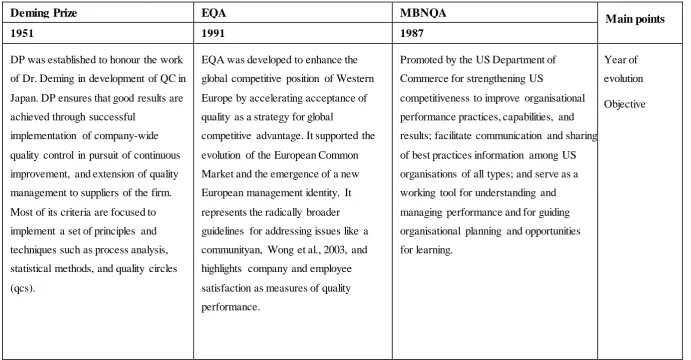
Table 3. 2 Comparative statements of MBNQA, and EQA, and Deming Prize adapted from (Sharma & Talwa r, 2007)... 89
Table 3. 3 The e le ments in TQM ... 110
Table 3. 4 Similarities and Differences: KM and TQM. ... 117
Table 4. 1 A list of universities that currently apply the Ba lanced Scorecard [Ro mpho, N. (2008). ... 133
Table 5 1 Va riab les and Measurement Ite ms. ... 148
Table 5 2 The Like rt rating scale used in this study. ... 150
Table 5 3 The general structure of the questionnaire... 151
Table 5 4 Jordanian universities that were involved in the current study.. ... 152
Table 5 5 measured correlat ions between the answers of a five repentants at two period time. ... 156
Table 5 6 Questionnaire groups from the two parts of case study organisations... 159
Table 5 7 Presents the details of those participants. ... 159
Table 6. 1 The distribution of respondents by sample population group and gender. 164 Table 6. 2 The distribution of respondents by sample population group and age groups. ... 164
Table 6. 3 The distribution of respondents by sample population group and academic degree. ... 165
Table 6. 4 The distribution of respondents by sample population group and academic rank. ... 165
Table 6. 5 The distribution of respondents by sample population group and work e xperience. ... 166
Table 6. 6 The distribution of respondents by sample population group and current position. ... 166
Table 6. 7 The distribution of respondents by sample population group and affiliation. ... 167
Table 7 1 Ranking order for statements related to knowledge creation: university administration depends on the following to create knowledge (N= 200). ... 169
Table 7 2 Rank order for statements related to storage of knowledge: University administration de pends on the following to store knowledge: (N= 200). ... 170
Table 7 3 Rank order for statements related to knowledge distribution: University administration depends on the following to distribute knowledge: (N= 200). ... 170
Table 7 4 Rank order for statements related to knowledge application: to apply knowledge, the university admin istration should: (N= 200). ... 171
Table 7 5 Statistics of the overall ranks for KM process (statements 1-20, Tab les 7.1-7.4) ... 171
Table 7 6 Rank order for statements related to variable o f KM technology (N= 200). ... 172
Table 7 7 Statistics of the overall ranks for KM technology (statements 21-28, Tab le 7.6). ... 172
Table 7 8 Rank order for statements related to Knowledge-make rs: (N= 200). ... 173
Table 7 9 Rank order for statements related to knowledge managers: University knowledge managers carry out the follo wing: (N= 200). ... 173
Table 7 10 Rank order for statements related to students' KM: student’s KM at the university is keen on: (N= 200). ... 174
Table 7 11 Statistics of the overall ranks for tea m knowledge (statements 29 -40, Tables: 7.8-7.10). ... 174
Table 7 12 Statistics of the overall ranks for KM (statements 1-40, Tables 7.1-7.4, 7.6-7.10). ... 174
Table 7 13 Rank order for statements related to variable of effective leadership (TQM Processes) (N= 200)... 175
Table 7 14 Statistics of the overall ranks for e ffect ive leadership (statements 41-47, Tables 7.13). ... 175
Table 7 15 Ran k order for statements related to variable of continuous improve men t (N= 200). ... 176
Table 7 16 Statistics of the overall ranks for continuous imp rovement (statements 48 -52, Table 7.13). 176 Table 7 17 Ran k order for statements related to variable of staff involved: (N= 200). ... 177
Table 7 18 Statistics of the overall ranks for e mp loyee involve ment (statements 53 -60, Tables 7.1)... 177
Table 7 19 Statistics of the overall ranks for TQM (statements 41-60, Tab les 7.13, 7.15, 7.17). ... 177
Table 7 20 Ran k order for statements related to variable internal processes perspective: (n= 200). ... 178
Table 7 21 Statistics of the overall ranks for perspective of internal processes (statements 61-65, Table 7.20)... 178
Table 7 22 Rank order for statements related to variable of customers (stakeholder) perspective: (N= 200)... 179
Table 7 23 Ran k order for statements related to e xternal stakeholders (ma rketplace ). (N= 200). ... 179
Table 7 24 Statistics of the overall ranks for customer (stakeholder) perspectives (statements 66-75, Tables 7.22-7.23). ... 179
Table 7 25 Ran k order for statements related to technological innovation. (N= 200). ... 180
Table 7 26 Ran k order for statements related to administrative innovation. (N= 200). ... 180
VI
Table 7 28 Statistics of the overall ranks for learning and growth perspective (statements 76-83, Tables
7.25-7.27). ... 181
Table 7 29 Statistics of the overall ranks for overall performance (statements 61-83, Tables 7.20-7.23, 7.25-7.27 ). ... 181
Table 7 30 Correlation coefficient of KM processes with TQM effective leadership, continuous improve ment, or e mp loyee involve ment in public universities (N=200). ... 182
Table 7 31 Correlation coefficient of KM technology with TQM effective leadership, employee involvement, and continuous improve ment in the public universit ies (N=200). ... 182
Table 7 32 Correlation coefficient KM team of knowledge with TQM effective leadership, continuous improve ment, and e mployee involve ment in public universities (N=200). ... 183
Table 7 33 Correlat ion coefficient of KM with TQM in public universities... 183
Table 7 34 Mu ltiple linear regressions of KM and TQM with internal processes perspective. ... 184
Table 7 35 Rank order for statement related to knowledge distribution: University administration depends on follo wing to distribute knowledge: (N= 200). ... 184
Table 7 36 The results of multiple linear regressions of the independent variables of KM and TQM with the learning and growth perspective. ... 185
Table 7 37 The results of multiple linear regressions of the independent variables, KM and TQM with adopted variable EP. ... 185
Table 8. 1 Rank order for Statements Related to Knowledge Creating: University Administration Depends on the Following to Create Knowledge (N= 151). 188 Table 8. 2 Rank order for statements related to storag e of knowledge: University administration depends on the following to store knowledge: (N= 151). ... 189
Table 8. 3 Rank order for statements related to knowledge distribution: University administ ration depends on the following to distribute knowledge: (N= 151). ... 189
Table 8. 4 Rank order for statements related to knowledge applying: to apply knowledge, the University administration should: (N= 151). ... 190
Table 8. 5 Stat istics of the overall ran ksfor KM process (statements 1-20, Tab les 8.1-8.4). ... 190
Table 8. 6 Rank order for statement related to knowledge distribution: University administration depends on follo wing to distribute knowledge: (N= 151). ... 191
Table 8. 7 Stat istics of the overall ran ksfor KM technology (statements 21-28, Tab les 8.6)... 191
Table 8. 8 Rank Order fo r State ments Related to Knowledge-Makers: (N= 151). ... 192
Table 8. 9 Rank Order for statements related to knowledge managers: University knowledge managers carry out the follo wing: (N= 151). ... 192
Table 8. 10 Rank order for statements related to Studen ts' KM: student’s knowledge management at the University is keen on: (N= 151). ... 193
Table 8. 11 Statistics of the overall ranksfor Tea m knowledge (statements 29-40, Tables 8.8-2.10). .... 193
Table 8. 12 Statistics of the overall ranksfor KM (statements 1-40, Tables 8.1-8.4, 8.6-8.10). ... 193
Table 8. 13 Rank order for statements related to variable of effective leadership (TQM Processes) (N= 151)... 194
Table 8. 14 Statistics of the overall ranksfor e ffect ive leadership (statements 41-47, Tables 8.13). ... 194
Table 8. 15 Rank order for statements related to variable of continuous improve ment (N= 151). ... 195
Table 8. 16 Statistics of the overall ranksfor continuous improvement (statements 48-52, Tables 8.13). ... 195
Table 8. 17 Rank order for statements related to Va riab le of Staff Involved: (N= 151). ... 196
Table 8. 18 Statistics of the overall ranksfor e mp loyee involve ment (statements 53 -60, Table 8.1). ... 196
Table 8. 19 Statistics of the overall ranksfor TQM (statements 41-60, Tab les 8.13, 8.15, 8.17). ... 196
Table 8. 20 Rank order for statements related to variable internal processes perspective: (n= 151). ... 197
Table 8. 21 Statistics of the overall ranksfor perspective of internal processes (statements 61-65, Table 8.20)... 197
Table 8. 22 Rank order for statements related to variable of customers (stakeholder)’ perspective: (N= 151)... 198
Table 8. 23 Rank order for statements related to externa l stakeholders (marketplace). (N= 151). ... 199
Table 8. 24 Statistics of the overall ranksfor customers’ (stakeholder) perspective (statements 66-75, Tables 8.22-8.23). ... 199
Table 8. 25 Rank order for statements related to technological innovation. (N= 151). ... 199
Table 8. 26 Rank order for statements related to admin istrative innovation. (N= 151). ... 200
Table 8. 27 Rank order for statements related to additional creativity (N= 151). ... 200
Table 8. 28 Statistics of the overall ranksfor learning and growth perspective (statements 76-83, Tables 8.25-8.27). ... 200
VII
Table 8. 30 Correlation Coefficient of KM processes with effective leadership, continuous improvement or e mployee involve ment in the private universities (N=151). ... 201 Table 8. 31 Correlation coefficient of KM technology with effective leadership, continuous or
improve ment in the private universities (N=151). ... 202 Table 8. 32 Correlation coefficient KM team of knowledge with effective leadership, continuous
improve ment or e mp loyee involvement in the private universities (N=151). ... 202 Table 8. 33 Corre lation coeffic ient of KM with TQM in the private universities... 202 Table 8. 34 Multip le linear regressions of KM and TQM with internal processes perspective... 203 Table 8. 35 Multiple linear regressions of the independent variables "of KM and TQM with customer
(stakeholder) perspective. ... 204 Table 8. 36 The results of multiple linear regressions of the independent variables "of KM and TQM
with learning and growth perspective... 205 Table 8. 37 The results of multiple linear regressions of the independent variables, KM and TQM with
VIII
LIST OF FIGURES
Figure 1. 1 The Reseach Frame Work For the Current Study ...10
Figure 1. 2 The current study research framework by showing variables ...12
Figure 1. 3 Hypotheses effecting integration between KM and TQM in EP ...14
Figure 2. 1 The relationship between knowledge and information (Source: Devinney, 1997). ...26
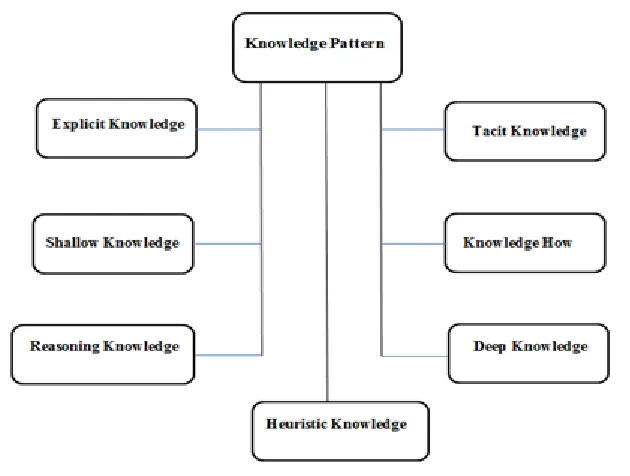
Figure 2. 2 Knowledge Pattern. ...29
Figure 2. 3 Duffy model for KM. Source (Duffy, 2000) ...34
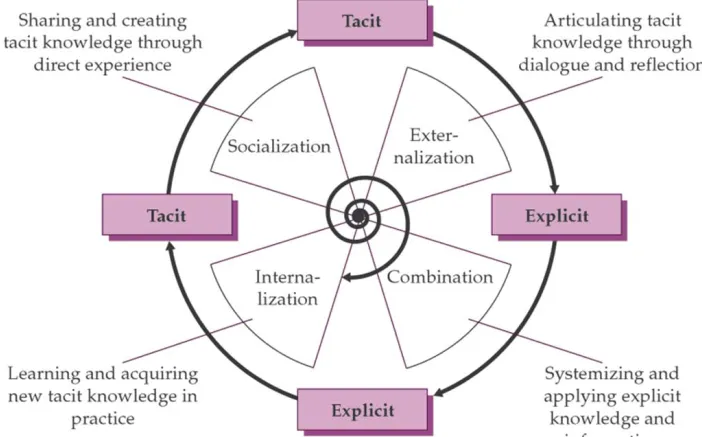
Figure 2. 4 SECI Model for KM. Source (Hussi, 2004). ...35
Figure 2. 5 Comptroller Model for KM By OSD. ...36
Figure 2. 6 Hope model for KM Source: (Yassin, 2004, p. 48). ...37
Figure 2. 7 Essential processes for KM. (Source: Mertins et al., 2001) ...38
Figure 2. 8 SECI Process of knowledge spiral ...40
Figure 3. 1 Major obstacles to implementing Deming’s philosophy. ...79
Figure 3. 2 Baldrige Model (NIST, 2008). ...92
Figure 3. 3 Alshabrawy TQM model (Alshabrawy, 1995). ...93
Figure 3. 4 Logothetis TQM model (Logothetis, 1997) ...94
Figure 3. 5 Krajewski and Ritzman TQM model (Krajewski & Ritzman, 1999). ...94
Figure 3. 6 Suggested TQM model ...95
Figure 3. 7 Plan-Do-Check-Act Diagram ...104
Figure 4. 1 BSC Model Source: (Kaplan & Norton, 1992) ...132
Figure 9. 1 The Theoretical Framework ...214
IX
ACKNOWLEDGEMENTS
This research is the culmination of the efforts and contributions of the many people who made this thesis possible and who gave me their continuous, untiring, and unconditional devotion, time, support, and love to achieve this important goal.
I sincerely thank my supervisor Professor Les Ruddock for his continuous support, encouragement, and follow up. I also would like to express the deepest appreciation to my volunteer advisor Dr Jassem G. Mahdi (Cardiff University, UK), who gave me valuable ideas, superb support and encouragement to pursue this journey and to strengthen my thesis. I also would like to express the deepest appreciation to Dr Abdulbaset Khashkosha who helped me to complete this work.
I would also like to express my thanks and appreciation to the academic staff and administrative employees in the Salford School of the Built Environment for their help and encouragement, especially Mrs Moira Mort (Research Officer) for her help.
This acknowledgement would be incomplete without thanking my father, mother, wife, brothers, sisters, sons, daughters and my friends, peer learners, and colleagues for their interest in my pursuit of this degree and for their continuous support and encouragement.
X
GLOSSARY OF TERMS AND ABBREVIATIONS
CI Continuous Improvement
CQI Continuous Quality Improvement CSF Critical Success Factor
EFQM European Foundation for Quality Management
EP Educational Performance
HEGS Higher Education General Secretary HEI Higher Education Institution
ISO International Organisation for Standardizations JHE Jordanian Higher Education
KM Knowledge Management
OSD Organisation and Systems Development PI Performance Indicators
QAA Quality Assurance Agency
QM Quality Management
QMS Quality Management System SOBE School of the Built Environment SPC Statistical Process Control TQM Total Quality Management
UK United Kingdom
UN United Nations
XI
ABSTRACT
Resulting from the development of management theory in the past few years, knowledge management (KM) has emerged, which is identifying information of value and how to use it well, as well as understanding cognitive assets of an organisation and how to exploit them. KM is important and necessary for the survival of an organisation and its superiority. It can be integrated into the philosophy of total quality management (TQM) to play a role in the development of the basis of performance of modern organisations. It can be strengthened to achieve its strategic objectives.
This study aims to identify the integration between KM and TQM and to highlight its role in improving and strengthening educational performance (EP).The approach adopted is a descriptive analytical method research style applied to ten public and private Jordanian universities as a sample for the study. The data collection technique used is an online questionnaire, where data was first manipulated and pre-processed. The responses were statistically analysed and insists and patterns were identified so that overall conclusions and recommendations were reached. The framework conceptualised is built upon formulating a number of variables namely: KM, TQM, and EP in academia. Three elements for each variable were identified and justified, in addition to the academic culture element, which formed the context investigated.
The study found the presence of integrity and a strong correlation between KM and TQM. The significant effect of this integration on the EP of the universities in the study sample included a number of recommendations that will help lead universities to eliminate ambiguity regarding KM and TQM. It also included the importance of complementarity and avoiding the shortcomings that accompany its application. Other recommendations seek to draw the attention of competent authorities to take advantage of such modern philosophies in all sectors of society.
1
CHAPTER ONE
INTRODUCTION
1. 1 Introduction
This research is related to knowledge management (KM) and total quality management (TQM) in higher educational institutions (HEIs) in Jordan. These two issues have attracted the attention of many researchers and writers in higher education (HE). The significance of these issues is that they are both associated with the effectiveness of the academic process. Therefore, the growing worldwide interest in KM among organisations has increased because it is related to the quality of education and learning as an alternative managerial action (Harvey, 1995). This is due to the competiveness among innovative firms in their fields of interest. When TQM became more defined, it was successfully applied by many organisations in HE. However, as KM was more defined, it was extensively applied in developed countries, and good results were obtained. At the same time, some organisations still lack the proper use and benefits of KM in achieving distinction through the use of TQM. This is especially evident from the inefficient integration of KM and TQM.
The quality of education is vital for promoting society and contributes to the enduring wealth and security of a country (Babbar, 1995). Therefore, this research project focuses on the integration of KM and TQM and its impact on educational performance (EP) in HE in Jordan. The purpose of this research is to learn about KM and TQM and to identify the integration that affects the use of it. Thus, this chapter gives an overview of the concept in the research problem and its rationale that underlines the main issues, including the research aim, objectives, and hypotheses.
2
1. 2 Jordan: General Overview
1.2. 1 The Education System in Jordan
The development of the educational system in Jordan can only be described as dramatic. Starting from almost nothing in the early 1920s, Jordan has forged a comprehensive, high-quality system in order to develop the human capital of its population. All villages and communities with ten or more school children are provided with a school so that the population who live in poor and remote areas have access to education. For all Jordanian primary and secondary school students up to the age of fifteen, education is free and compulsory. Jordan has achieved over 95% enrolment for its school-age children. Jordan’s policy of prioritising spending on basic education over HE has enabled the country’s aim to increase universal enrolment and has boosted literacy levels throughout the general population. Jordan’s education record has proven remarkable by international standards and results from the foresight of the country’s leadership who saw and continue to see the need to focus on building the country’s human capital to meet the challenges of the future (A Higher Education Cooperation Scheme between EU Member States Partner Countries, 2007).
3
1.2. 2 Higher Education
Holders of the general secondary education certificate have access to HE and can choose between community colleges (private or public) or universities (private or public). Higher education in Jordan started in the second half of the twentieth century (1960s) when many teachers’ colleges were established throughout the country. Their establishment provided the important teaching work force needed to meet the high demand on school education characterising that period (A Higher Education Cooperation Scheme between EU Member States Partner Countries, 2007).
Jordan’s community colleges offer specialised two or three-year programmes in various areas of study. All students who attend community colleges must pass a comprehensive government exam at the end of their study. Community colleges tend to offer practical education targeted at professions such as education, commerce, computer studies, medicine, pharmacology, hotel management, interior design, social work, nursing, and midwifery (A Higher Education Cooperation Scheme between EU Member States Partner Countries, 2007).
1.2. 3 Universities in Jordan
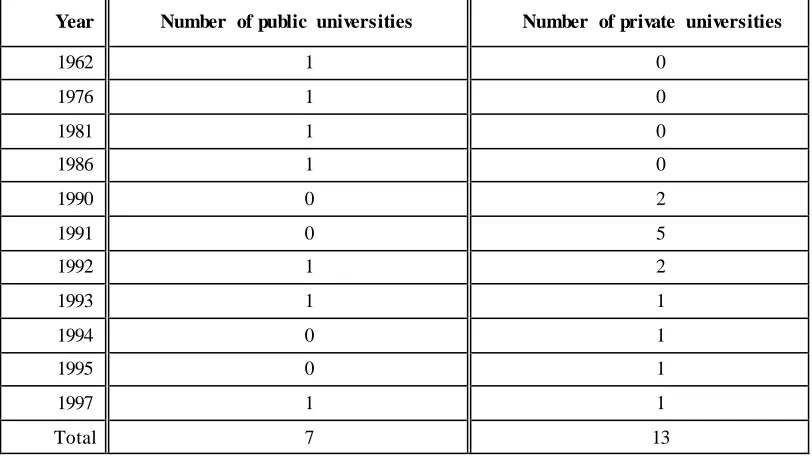
Higher education in Jordan has expanded dramatically since 1951. It started with a one-year postsecondary teacher training college. Later, in 1962 the first public university was established, the University of Jordan. Fourteen years later, the University of Yarmouk was established, which was followed by the establishment of six universities (Abu-El-Haija, 2014). Table 1.1 demonstrates the progress o f the establishment of public and private universities in Jordan since 1962. Nine universities, or approximately 43%, were established between 1990 and 1992.
4
Education Council in 1982 aimed to maintain the quality and efficiency o f education in Jordan (MoHESR, 2014).
[image:17.596.111.517.136.364.2]
Table 1. 1 Progress of the establishment of public and private universities by year
Year Number of public universities Number of private universities
1962 1 0
1976 1 0
1981 1 0
1986 1 0
1990 0 2
1991 0 5
1992 1 2
1993 1 1
1994 0 1
1995 0 1
1997 1 1
Total 7 13
The establishment of the Jordanian Council of Higher Education was in response to the need for the regulation and planning of HE policies and coordination among Jordanian public policies at the post-secondary level and the need for legislating up-to-date laws on HE.
1.2. 4 Background of the Study
5
According to Borhan and Ziarati (2002), a strong relationship exists between a country’s competitiveness and the quality of HE. Hence, countries need to assure themselves of the quality of their HE institutions. In Jordan, where the number o f HE institutions has expanded substantially, this has become an important issue. The growth in Jordan’s HE sector began with a large investment in state universities, which correspondingly attracted a large number of students. With a n increase in the student market and the resulting pressure on the public budget t o continually provide more HE locations, Jordan’s HE policy allowed the loca l public administration and private sector to establish universities, colleges, and technical HE institutions. Now, with the increasing number of private universities, the need to establish and maintain a competitive advantage is becoming increasingly significant. In this respect, the University of Jordan has adopted TQM and information technology systems (Abu-El-Haija, 2014). However, research has reported poor implementation of TQM principles in Jordanian colleges of physica l education (Altahayneh, 2014). In addition, in view of the increased demand on Jordanian universities, the King of Jordan and his prime minister encourage adopting a clear plan for improving quality in HE that enables universities to compete with the global market (Schwab, 2012).
Knowledge Management and TQM play vital roles in the modern management progress where KM contributes to innovation by creating, storing, transferring, and applying knowledge. The implementation of TQM practices is considered one of the important factors that influenced innovation in a positive way (Honarpour et al., 2012). Despite the vast growth in the implementation of TQM in HE institutions worldwide, there is no universal model for adopting TQM within a higher education context (Sarvan & Anafarta, 2005, p. 12). Indeed, it is documented (Hides et al., 2004) that the implementation of TQM in the public sector, particularly the HE sector, has lagged behind that of the private sector, essentially because the private sector is under pressure to respond to customer calls for continual improvement.
1.2. 5 The Quality of Higher Education in Jordan
6
at universities to have a high quality education and to enable both students and universities to compete in the global market.
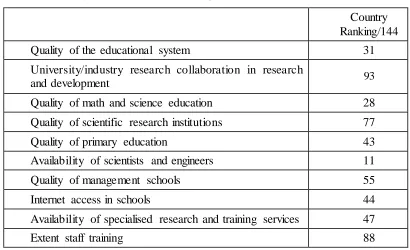
[image:19.596.115.525.177.427.2]The graduates of the Jordanian educational system in all disciplines are not sufficiently knowledgeable or trained to be productive, and graduates usually need extensive retraining. As such, the quality of HE in Jordan is illustrated in Table 1.2
Table 1.2. Higher education and training quality in Jordan (Schwab, 2012)
Country Ranking/144
Quality of the educational system 31
University/industry research collaboration in research
and development 93
Quality of math and science education 28
Quality of scientific research institutions 77
Quality of primary education 43
Availability of scientists and engineers 11
Quality of management schools 55
Internet access in schools 44
Availability of specialised research and training services 47
Extent staff training 88
The global rank of the quality of HE in Jordan was highest in the availability o f scientists and engineers (11 out of 144). However, the rank for university/industr y research collaboration in research and development, extent of staff training, and quality of scientific research institutions were, respectively, 93, 88, and 77 out o f 144 (Schwab, 2012). Furthermore, the quality of the educational system was ranked 31 out of 144. The overall assessment of HE in Jordan is more likely to indicate that the quality of the educational process supports business in Jordan.
1.2. 6 The Dearth of Research on KM and TQM in Jordan
7
TQM in developing the economy has attracted the interest of many researchers. This has encouraged empirical research to study TQM for improving the qualit y system of an organisation (Soltani & Lai, 2007). They found that the major discrepancy between the rhetoric of these systems and the reality of their practice is where organisations tend to develop a more strategic approach to managing soft aspects of quality management. However, literature indicated that the number o f organisations that implemented TQM successfully is comparatively small (Huq, 2005; Gibbs, 2009). In particular, the number of studies on quality in HE is relatively few (Lagrosen et al., 2004). Furthermore, KM processes including diagnosing, acquiring, generating, sharing, storing, and applying have been found to influence TQM (Aboyassin et al., 2011). Therefore, KM could be considered a key tool to higher educational long-term success. Thus, change initiatives in organisations, including educational institutions, can improve shareholder value (i.e., economic value theory) and develop organisational capabilities (i.e., organisational capability theory) (Soltani et al., 2007). Like any organisation, educational institutions (mainly private ones) are confronted by competition due to the presence of many universities and colleges in Jordan and other countries in the region. In addition, globalisation, the advancements in communications and information technologies, economic recession, and a simultaneous search for excellence are also encouraging competition; therefore, the desire to take up change initiatives has interested the majority of leading organisations (Soltani et al., 2007). The current study will explore the correlation between public and private universities in Jordan in terms of KM and TQM.
1. 3 The Research Problem
8
is required to develop the effectiveness of the educational process in terms of QM and TQM. Initially, research in QM and TQM attracted the interest of many universities in Jordan. Nonetheless, it is still necessary to continue the research to gain an insight into the real nature of what is required to achieve high standards using KM and implementing TQM. Therefore, it is possible to summarise the main issues that are related to KM and TQM in the following questions:
How deficient is the lack of personal knowledge of KM and TQM in Jordanian universities?
What benefits are gained from KM in the development of quality in Jordanian universities?
How clear is the vision with regard to the integration of KM and TQM? What impact is caused by this integration in EP to achieve excellence and leadership in universities?
Yet, the main question is what distinguishes the current study from previous studies? By reviewing past studies, it appears that some have examined the attitudes of managers towards the application of KM and other studies have examined the performance of KM, creativity, and decision- making as well as discovering the competitive advantage. The current study is distinguished fro m past studies and research by focusing on a vital aspect, which is the integration o f KM and TQM and its impact on EP in institutions of HE in Jordan and its role in achieving TQM in these institutions, where most efforts and research have bee n directed towards KM. In addition, the researcher has benefited from previous studies, and the benefit is reflected in two points. The first is the formulation of the theoretical framework for the study, and the second is the formulation o f hypotheses.
1. 4 Importance of the Study
9
universities in Jordan are adopting KM, implementing TQM, and measuring EP. Thus, the main objectives of the current study are to:
- Investigate what is required to develop the effectiveness of the educationa l process in terms of QM and TQM, and
- develop a deep understanding into the real nature of the requirements to achieve high standards using KM and implementing TQM.
On the surface, there are a growing number of anecdotal accounts of the “successes” of TQM and KM in education. Nevertheless, there has been almost no
theory-building and methodologically rigorous research to validate these evidences (Chen & Burstein, 2006; Venkatraman, 2007). In addition, the researches which linked TQM and KM were conducted in the manufacturing industry and do not reflect the service sector (such as Daud & Yusoff, 2011; J u et al., 2006; Ooi, 2009; Ooi et l., 2012), particularly the educational sector, whic h is of interest in this study. Thus, methodologically rigorous empirical studies that examine the link between institutional outcomes and institutional manageme nt initiatives are needed to fill these gaps.
1. 5 Study Aim and Objectives
The study aim is to establish a framework that represents the integration of KM and TQM to measure the performance of HE based on improvement of teaching and learning. Therefore, the research was set up according to the following objectives:
To review relevant literature on the concepts of KM and TQM and their significance for educational organisations and to contribute to the conceptua l framing of them.
To contextualise a framework for the integration of KM and TQM.
To identify integration and correlation between KM and TQM and its impact on EP.
To identify the impact of the integration of KM and TQM in the EP of organisations.
10
1. 6 Research Conceptual Framework
A research conceptual framework is a useful set- up tool for organising socia l research (Rodman, 1980). According to Labaree (2013), the theoretica l assumption connects the researcher to existing knowledge and gives a basis for hypotheses and research methods. In other words, the concept of the researc h framework can be extended to involve the inte gration of concepts and methods. I n this respect, the description of background information and research driving KM and TQM are associated with literature and the design of the current research. Literature helps develop research focus and its approach for deriving the required data for analysis and discussion (Labaree, 2013).
1.6. 1 Research Framework
Figure 1.2 shows the research framework in the sequence in which the current research was developed. This starts from an idea, which is supported theoretically by the literature before setting up the main research elements, including objectives, hypotheses, and methodology.
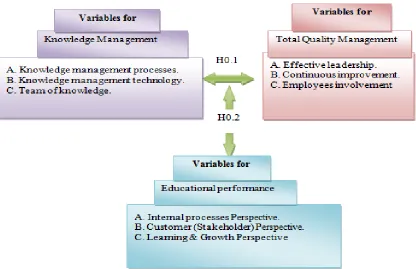
The details of the current study encompass variables related to KM, TQM, and EP. The concept related to these different variables is governed by two main hypotheses (see the next section). The sequence for the development of the current framework is illustrated in Figure 1.2.
The components of the three main variables (KM, TQM and EP) were used to investigate the integration between KM and TQM (Figure 1.2). These three issues were used in the literature as variables (Zwain, 2012).
Figure 1. 1 The Research Framework for the Current Study
Integration between KM & TQM and its impact on educational performance: A case study of higher education in Jordan.
Literature Aim and
objectives Hypothesis
Methodology
Data Collection
Data Analysis
11 1.6. 2 Theoretical Framework
This section proposes a theoretical framework alo ng with a set of hypotheses. The theoretical framework demonstrates the relationship between the variables in this study (Cavana, Delahaye, & Sekaran, 2001; Sekaran & Bougie, 2010). Based on the theoretical foundations, which are reviewed in the literature, a framework has been developed to investigate the relationship and integration among the study’s variables: TQM, KM, and its impact on EP for the Jordanian HE context. Figure (1.3) illustrates these relationships.
1. 7 Research Variables
The first main independent variable is KM, which is subdivided into the
following variables (Ali Zwain 2012):
A. KM processes. B. KM technology. C. Team of knowledge.
The second main independent variable is the TQM, which is subdivided into
the following variables (Lee et al., 2010):
A. Effective leadership. B. Continuous improvement. C. Employee involvement
The main approved variable is educational performance and is subdivided
into the following variables (perspectives) (Ali Zwain 2012A. A., & Alkhafaji, H. J. 2009):
12
Figure 1. 2 The current study research framework by showing variables
1. 8 Research Hypotheses
The current study considers two main hypotheses. Each of these hypotheses is subdivided into different sub-hypotheses. Generally, the hypothesis is an important element of research for scientific studies as it is one way to assist the researcher to focus on the main subject. It is also an alternative assumption made in order to draw out and test its logical or empirical consequences (Kenya, 2013). Therefore, the hypothesis is one of the fundamental tools for research. Merriam (2014) and others (Bogdan & Biklen, 1992) maintained that the hypothesis serves to guide the researcher in seeking answers to tentatively adopted generalisations (Punch, 2013). Here, the focus is on KM and TQM. These two contemporary terms are vital for the educational management process and its outcomes.
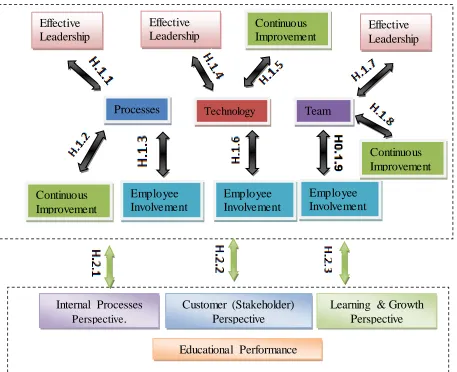
Two hypotheses to be justified are proposed in this study. The structure and their connection with the main variables of the current study are depicted in Figure 1.3.
1.8.1 The First Hypothesis:
13
H.1.1 There is significant relationship between the processes of KM and effective leadership.
H.1.2 There is significant relationship between the processes of KM and continuous improvement.
H.1.3 There is significant relationship between KM processes and employee involvement.
H.1.4 There is significant relationship between technology of KM and effective leadership.
H.1.5 There is significant relationship between technology of KM and continuous improvement.
H.1.6 There is significant relationship between technology of KM and employee involvement.
H.1.7 There is significant relationship between team knowledge and effective leadership.
H.1.8 There is significant relationship between team knowledge and continuous improvement.
H.1.9 There is significant relationship between the team and employee involvement.
1.8.2 The Second Hypothesis
H.2 There is a significant effect of the integration of KM and TQM on EP. Subdivided into the following sub-hypotheses:
H.2.1 There is a significant effect of the integration of KM and TQM on the perspective of internal processes.
H.2.2 There is a significant effect of the integration of KM and TQM on the customer (stakeholder) perspective.
14
Figure 1. 3 Hypotheses on the effect of the integration between KM and TQM on EP
1. 9 Thesis Structure.
This thesis contains seven chapters.
Chapter One is an introduction of the thesis. This chapter gives a genera l background of the current research topic, including the rationale and methodological approach. In addition, it gives a general description of the conceptual framework of the current research and the hypotheses involved.
Chapter Two focuses on the literature review related to KM. It introduces the concept of the main aspects related to the current study. These include KM. This THE INTEGRATION OF KNOWLEDGE MANAGEMENT AND TOTAL QUALITY
HYPOTHESES EFFECTING INTEGRATION BETWEEN KM & TQM IN EDUCATIONAL PERFORMANCE
Continuous Improvement
Processes Technology Team
Effective Leadership
Continuous Improvement
Employee Involvement
Continuous Improvement Effective Leadership Effective
Leadership
Employee Involvement Employee
Involvement
Learning & Growth Perspective Customer (Stakeholder)
Perspective Internal Processes
Perspective.
Educational Performance Continuous
15
chapter focuses on the explanation of the main related issues, including resources and models.
Chapter Three focuses on the literature review related to TQM. It introduces the concept of the main aspects related to the current study. These include TQM, the perspectives of quality. In all these aspects, this chapter focuses on the explanatio n of the main related issues, for example leadership.
Chapter Four focuses on the literature review related to EP. It introduces the concept of the main aspects related to the current study. These include EP elements. This chapter focuses on the explanation of the main related issues, including BSC.
Chapter Five focuses on methodology and its concept. This include s the philosophical assumption of social research, its methodology, and design. I n addition, this chapter discusses the rationale of the current research and its methodological approach to collecting data, including the design, structure, and development of the questionnaire and the statistical analysis of the obtained data.
Chapter Six focuses on the demographic characteristics of respondents in bot h public and private universities in Jordan. It also describes the overall data analysis using other tests.
Chapter Seven deals with the first part of the study, which is related to the analysis of data that reflect the perceptions of respondents in Jordanian public universities towards different issues related to KM, TQM, and EP. Various statistical analyses were used to analyse the data.
Chapter Eight deals with the second part of the study, which is related to the analysis of data obtained from respondents in Jordanian private universities. The same format and statistical analysis as in the previous chapter was used in the current chapter. Chapters seven and eight also focus on testing the hypotheses.
16
1. 10 Summary
17
CHAPTER TWO
KNOWLEDGE MANAGEMENT
2.1 Introduction
This chapter focuses on the first part of the literature review related to the concept of knowledge and knowledge management (KM). It aims to discuss the main issues related to knowledge and KM. The state of knowledge represents the continuous interaction between the tacit components of knowledge, such as experiences, skills, and mental abilities in the minds of individuals as well as the information and presented acknowledged strategies to achieve value. It is one o f the most important assets of an organisation and cannot be overlooked. Knowledge is endemic in an organisation with intellectual capital that seeks to retain it. In this respect, the sources of knowledge represent of all the sources of present information that individuals can convert into knowledge, in addition to the mental abilities, experience, and skills of these individuals. The term that expresses the ability of the team of knowledge in the organisation is associated with KM. The aspect of managing knowledge in modern organisations utilise s KM technology to carry out knowledge generation, storage, and distribution and is applied to achieve excellence and leadership. Adding to the importance of KM is its ability to handle many of the changes and challenges that are encountered by organisations, as well as its assistance to staff to achieve value for organisations that apply KM. Furthermore, the target of KM is to allow the sharing o f knowledge among employees and with customers and business partners to achieve and maximise returns. Therefore, KM ensures the work of an organisation is moving towards intellectual viability and achievement of the best value in the assets of the organisation. The structure of the current chapter involves the related issues on knowledge and KM, including definition, concept, and background.
2.2 Knowledge
18
section focuses on the historical background of knowledge, its concept, and its types and resources.
2.2.1 The Historical Background of Knowledge
While seeking to acquire knowledge is ancient, interest in it becomes rejuvenated and more complicated with the complexity of life and with the development that occurs in educational methods. Hammurabi from Iraq is considered the first ruler in history to have grasped the importance of education, establishing the first schoo l in the country two thousand years BCE. The Chinese philosopher Confucius (479-551 B.C.E.) renewed the call to spread knowledge when he said, “Knowledge is the only way to improvement and success on earth. ” The Greek philosopher Plato (347-427 B.C.E.) gave a new and strong push to the importance of knowledge throughout his call to establish Utopia, as he is the one who said, “Without knowledge the human being will not be able to understand his identity, only he who carries the knowledge will be able to understand his surroundings represented by the existence itself” (Hassan, 2003).
It is only natural for the interest in knowledge to continue in our present time after informatics and communication revolutions have paved the way and reduced distances, making it easier to exchange and rejuvenate knowledge. It is not strange that in light of these evolutions for the volume and quantity of knowledge to multiply every few years after it took a century to achieve (Kubaisi, 2004, p. 46). Therefore, understanding the term knowledge and its organisation and applicatio n helps the development of an effective educational organisation and strengthens its reputation
2.2.2 The Concept of Knowledge
19
By looking at this subject in literature, it has been demonstrated that trend researchers classified the concept of knowledge as following two main streams : looking at a partial perspective of knowledge constructed only through implicit acquired knowledge of information and the causal links that assist in making sense of this information (Sarvary, 1999, p. 96). Knowledge is described by Daft (2001, p. 258) as “the basis for the sense to measure the personal experience of intuitio n (intuition) or special view.” Knowledge, according to this definition, is the fundamental basis of the experience of an individual in judging things. Hislop et al. (2000, p. 1) add that the status of knowledge is defined as “a continuous process for the restructuring of ideas during exercise or ongoing experience. ” While to Drucker (1999) knowledge is “the ability to translate information into the performance to achieve a specific task, and this ability can only be done in humans with brains and intellectual skills” (Ibrahim, 1998, p. 4). This definition refers to performance as the director of knowledge to achieve specific targets, which was not mentioned in any of the above definitions.
Knowledge, in accordance with this route, reflects a changing state of mind. Its interactive and connected processes are considered natural in the human mind and in individual experiences, and this knowledge can be defined as the brain’s thoughts, which can be converted into performance and thus reach set goals. However, this definition is restricted to the implied aspect of knowledge, whereas there is another aspect that is focused on by many researchers.
20
individual’s skills and experiences; and perhaps the most important characteristic of this concept is referring to the added value that represents knowled ge, whic h produces a compilation of individuals in groups and integrated teams. More comprehensively, (Kubaisi, 2002, p. 48) knowledge is defined as “every piece o f information, tacit or explicit, that can be recalled by individuals to accomplis h their tasks perfectly or make right decisions”. However, there are many other objectives that seek achievement through knowledge, such as providing advisor y services to others, for example.
Knowledge is now considered the real core of today’s organisations, including educational organisations, and a successful contemporary administrative too l enabling them to adapt to the requirements of this era. This is because knowledge is the most important resource in creating fortune and achieving excellence and creativity in light of the intellectual facts ascending in its path, such as severa l intellectual concepts like globalisation and privatisation. Information evolutio n and the extended various types of society’s most important approaches for development of KM, which manages knowledge and change in our present time , have achieved a quantum leap in the level of performance in different organisations, especially educational institutions (Hamoud, 2010, p. 54). There is a type of harmony and synergy between KM and the activities of educationa l institutions. There is a certain level of consistency between the operational concept of knowledge and the mechanisms, activities, and events of educationa l institutions as cognitive institutions (Almahgob, 2004, p. 18). Many studies, suc h as the study by Almalak and Alathary (2002, p. 19) and Alamry (2004, p. 12), confirm that adopting KM in organisations results in several benefits, such as enhancing efficiency and effectiveness, improving decision- making processes, enhancing performance, increasing productivity and creativity, achieving a competitive advantage, and swift response to environmental changes.
21
undertaking an important role in society due to the nature of its functio ns, where it provides a collection of scientific and vocational disciplines not existing in other universities. This type of institution has proven its merit in several ways, in particular regarding the way it has adapted to the periodic increase in numbers o f youth who sought to register and has met their needs (Hamdan, 2004).
2.2.3 Organisational Knowledge
Currently, knowledge assets are very important in most organisations; these organisations hire brains, not hands. Knowledge is seen as one of the assets of the organisation, while information technology is seen as a factor in creating and sharing knowledge, and linking knowledge contributes to the strategic objectives of the organisation creating a clearly defined increase in the enthusiasm of the work force.
22
human capital is the knowledge possessed by individuals who generate it, and includes skills, experience, and creativity. Structural capital is the knowledge that is captured and kept in the systems and organisational structures. The customer’s capital represents the amount derived from satisfied customers, appointed exporters, and external resources, which provide an added value to the organisation. Building intellectual capital requires the organisation to follow the following steps (Linder & Jennifer, 1998, pp. 2-4):
1. To set high performance standards for all, while continuing to improve to arrive at the possible best method.
2. Staff development through new, difficult, and challenging assigned tasks.
3. Modification of each point of the interfaces of work (organisational culture, structure, and strategy).
4. Provide each level of the organisation new talent and recruitment of suitable individuals to solve problems.
5. Ensure the workers in the organisation are collectively involved in the process of change.
If intellectual capital disappears and its ideas and results become worthless, this affects the market value of the organisation because intellectual capital is essentia l for an existing organisation (Koenigi, 2000, p. 1). Intellectual capital may go to other organisations and countries because the organisation was unable to convert their experience and skills to the practice of executive functioning (Enzi, 2001, p. 17). The seriousness of this issue lies in the possibility of transferring these people, ideas, and experiences (that they personally own) as well as data and informatio n pertaining to the previous organisation to the new organisation, thus giving the new organisation a strategic opportunity and additional advantage against the threat and vulnerability of the previous organisation.
23
companies. While the latter focused on generating and converting explicit knowledge, the former focused on generating and converting the implicit knowledge embedded in the minds of individuals. In this context, Saleh (2001, p. 83) has identified the most important factors that help organisations maintain intellectual capital, namely:
Activating material and moral stimulation, Intercepting organisational traditionalism, Facing organisational frustration,
Reducing the chances of organisational alienation, and Enhancing organisational discrimination.
Since capital is a term of the industrial age, and the world is moving towards the era of knowledge, it is preferable (Sveiby, 1998; Barroso & Gomes, 1998, p. 5) to use the term intangible assets, rather than intellectual capital; the term externa l construction, instead of the customer’s capital; internal construction, rather tha n structural capital; and competitive individuals rather than human capital. The reason that knowledge, in some cases, can become reverse capital is because knowledge grows by sharing (participation) and usage, and knowledge can be used to damage capital.
The new term knowledge capital refers to the settlement of knowledge in organisations and has appeared in recent years in writings and research on this subject that attempted to explain and highlight it as a subject worthy of attention in the foreseeable future.
2.2.4 The Importance of Knowledge
The 1990s saw a genuine interest in the subject of knowledge in organisations, and this was largely the result of the emergence of reality, an inevitable topic deserving focus on a number of areas simultaneously.
24
knowing the status of the market, or the potential of a new technology, or through the participation of customers with the knowledge to guide the organisation in their work, and how their service would best benefit (Barroso & Gomes, 1998, p. 1). This is the reason organisational managers focus on knowledge for monitoring, implementation, and completeness of tasks (especially routine ones) so the manager must direct the interaction of the workers. Personal interaction arises in order to transfer knowledge (which is the basis of solving work problems). I n addition, knowledge is an important and decisive lead to creativity and success in an organisation and in directing its work. This internal interaction between people can benefit the organisation by obtaining new ideas and integrating them, which is called brainstorming (Hansen & Oetinger, 2001, p. 108).
In the view of certain management theories, the most important aspects of the knowledge of physical and financial assets is when the knowledge becomes centra l and strategically located, then the organisation’s success will depend on its abilit y to collect, produce, and sustain the continuation of the information that represents the anchor of knowledge.
Accordingly, the main advantage of knowledge is its ability to assist management to overcome all the difficulties they face and to overcome constraints. In addition, an advantage is its substantial role in the proper functioning of the organisation. A number of administrative theories state that cognitive assets are more valuable than financial and material assets. It also holds to the fact that when knowledge is situated centrally and strategically, the success of the organisation depends on its ability to collect, produce, manage and the continuously improving informatio n that represents an anchor of knowledge.
Accordingly, in terms of knowledge for management purposes, knowledge is central to allowing the proper functioning of an organisation, as well as reducing and mitigating any difficulties management may face.
2.2.5 Knowledge and Related Terminologies
25
as raw material and abstract facts unorganised and independent from each other in the form of numbers or words. In contrast, the term information represents the data attached to other subjects, like the target or other connections (Leesr, 2000, p. 3). In addition, Guendhilji (2005, p. 36) defined information as a group of organised, coordinated data collected in a suitable way in order to give a specific meaning. I n this respect, the combination of homogeneous ideas and concepts can enable the individual to use the term information in order to reach and discover knowledge. Laudon and Laudon (2007, p. 33) described the main difference between data and
information to be related to the degree of dependence on it while making decisions. Information could be very impo rtant when making a decision for a certain department, but for another department it may not be considered important and needs treatment before depending on it while making decisions.
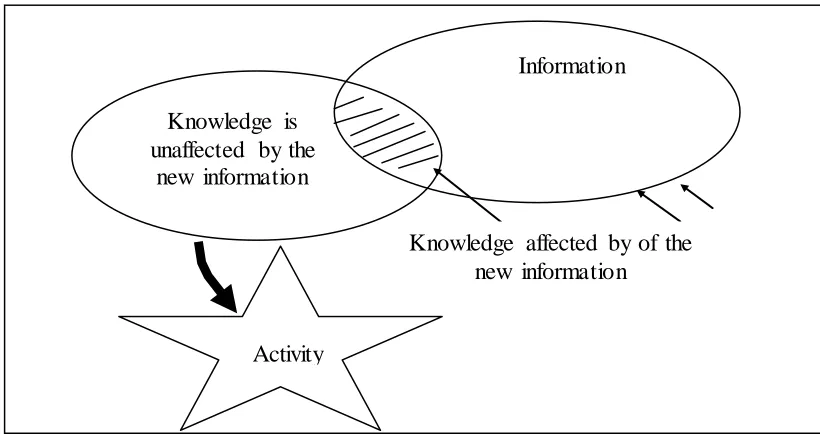
Furthermore, knowledge and information are closely associated with each other. I n this respect, knowledge can be expressed by language and graphics, while information can be part of a database and a strategic plan (Devinney, 1997). However, information does not afford a significant perspective for strategic actio n without the involvement of individual experience. Therefore, he considers information a commodity that can contribute to the production of knowledge. As illustrated in Figure 2.1, the association of information and knowledge play an important role for organisations to achieve success.
Devinney (1997) sees information as a commodity capable of producing knowledge, and with prolonged information, the indication is that we can lear n from it, but knowledge is a belief of information productivity.
26
Figure 2. 1 The relationship between knowledge and information (Source: Devinney, 1997).
Knowledge leads to the formation of beliefs and commitment to principles, gives meaning to living and non-living things, and serves as the basis for eac h performance. It follows (Blumentritt & Johnston, 1999: 10) that knowledge is different from information in such a manner that the former needs a medium (o f intelligence) where it is produced through a connection between the ongoing information to give a clear view of the fundamentals being used. Still, the difference between knowledge and information emerges through the limits made up by the existent intelligence system. Such limits may include the communicatio n tools used in the process of knowledge acquisition. Yet the same means cannot be used because a greater capacity will be needed for managing such knowledge. Important still, Daft (2001, p. 258) has pointed out that the main difference between them is the human role in building knowledge. Accordingly, in light o f the difference between knowledge and information shown (Zamel, 2003, p. 1), the difference between “knowledge management” and “information management” is that information management indicates dealing with objects (data and information) related to management information, and dealing with human beings is KM. To clarify further, the management of information concerns documentation and design drawings by computers, tables, electronic symbols, and programs, whic h deal exclusively with representation of data that is clear and obvious. While KM,
Information
Knowledge affected by of the new information
Knowledge is unaffected by the
new information