1. The Historical Development of
Chinese Piano Music
One hundred and sixty-six years ago, a small Chinese instrumental orchestra went abroad to perform in New York, and then, in Boston and London. Although the orchestra was a sensation at first, its influence was short-lived, however, as the first Chinese ensemble to venture into the West, their work was significant.1
In the 1950s, the piano was still a very rare and precious instrument in China. People could barely get to see this expensive instrument. On the other hand, learning piano was an even harder thing. There were only a few western pianists that were involved in the orchestras of Beijing and Shanghai that were able to teach the instrument. In these circumstances, the Chinese government sent a small number of pianists to the Soviet Union to study there. These included Ts’ong Fou, and Cheng Zong Ying.
Ts'ong Fou is now one of the greatest pianists in the world. He was born in Shanghai in 1934. His father was the famous Chinese scholar and translator Lei Fu who killed both himself and his wife during the Cultural Revolution. In 1953, Fou won the 3rd prize at the Bucharest Piano
Competition. Right after the competition he followed this with the Art
Mission tour to Poland, East Germany and the Soviet Union and visited
to other countries. In the same year, he began studies at the Warsaw Conservatory. In 1955, he gained 3rd prize at the 5th Chopin Piano
Competition in Warsaw. He was the first Chinese pianist to be a
winner at this prestigious competition (the 1st prize went to the Polish
pianist Adam Harasiewicz and the 2nd to Vladimir Ashkenazy). He was
also awarded the Polish Radio Prize there for the best performance of the Frédéric Chopin Mazurkas. In 1958, Fou moved to England and settled permanently in London. Afterwards, he built a very successful career as a concert pianist, and befriended many celebrated musicians including Jacqueline Du Pré, Martha Argerich and Daniel Barenboim.2
At the beginning of the Cultural Revolution, artists and musicians were severely persecuted and the Chinese music industry was almost destroyed. At that time, there was a unique cultural phenomenon called the ‘Model Opera’. It took the elements of outstanding works of Peking opera. They were The Red Lantern, Taking Tiger Mountain by Strategy, Sha Jia Creek, The Harbour, Raid the White-Tiger Regiment, Song of the Dragon River, Azalea Mountain, The Red Detachment of Women, The
White-Haired Girl, totaling eight ‘Model Operas’. The pianist Cheng Zong
Ying (born 1941) combined ‘Model Opera’ with piano performance and played with two Peking Opera singers in the Great of Hall of the People of Beijing in the 1stJuly,1968. This crossover performance gained a high
degree of appreciation from the leaders of China and Ying’s work contributed to the end of the prohibition of piano music in the country and Cheng Zong Ying consequently became a well-known figure within the Chinese music scene.3
From that historical moment, some composers began to explore elements of Chinese music and to incorporate these into their work. A large amount of adaptations and arrangements of Chinese music were
2FouTs’ong (Piano). Retrieved 6 October, 2016, from www.bach-catatas.com/Bio/Tsong-Fou.htm
written for piano. The composers took their influence from the piano music vocabulary and harmony that was already well established in the west and combined these with elements of the Chinese musical language. For example, composers incorporated aspects of the kinds of melodic and modal characteristics of Chinese music into the emerging piano repertoire. Following its appearance during the Cultural Revolution, Chinese-influenced piano music developed up to the point of being a beautiful art form in its own right and its appearance became more widespread across China.
Introducing Chinese Music into my recitals
The first time that I ever attempted to put Chinese elements of music in my concert was at China Central Normal University in Wuhan on3rdJuly,2014. As the concert was a courageous experiment, I spent a
lot of time thinking how to add Chinese music to a concert that was almost entirely made up of western music; I carefully needed to consider what kind of programme I should seek to create. After a few months of research into the wider Chinese piano repertoire, I decided to choose a work by one of the most famous contemporary composers in China, Zhao Zhang (born ). The piece that I chose is one of his magnum opuses and is called
Pi Huang.
Pi Huang is one of the most representative and characteristic Chinese
elements of the Peking Opera, such as motive, rhythm, and mode, unscrambling the work both in terms of its referential and connotative meaning.
The recital programme consisted of works for solo piano, piano four hands and piano with singer and the concert was divided to two parts with the vocal works appearing in the second half. The programme started with Scarlatti Sonata No 184, then, Prokofiev Sonata No 3 in its entirety and I put Pi Huang right after the Prokofiev sonata. It was the last piano solo piece of the whole concert. For the programme of piano four hands, I chose the works from Rachmaninoff and Ligeti. I was thinking Pi Huang
is a Chinese scenic music work. As it is a contemporary work, and the style and harmony has many features that are characteristic of the Chinese musical language, this contrasted quite dramatically with the rest of the recital programme which was entirely western in its origin. I did not want the audience to feel uncomfortable by suddenly changing to the Chinese piano piece in the middle of the recital. That was why I put the
Pi Huang as the last item on the solo programme, and between the piano
solo and piano four hands.
Apart from the Chinese piano music Pi Huang, the first part of the concert was more focused on Late-Romantic, Neo-Classical and Modern music. The partner, who was playing piano four hands with me, was Chinese pianist, and Masters graduate of Newcastle University, Ning Zhang.
soprano was Bao Yi Bi. She is one of the most famous Asian mezzo-soprano on the international operatic stage. She has studied and worked in Russian and Germany since 1980s until she came back to China in 2013. She was Professor of Voice within the faculty of the School of Music and Director of the Opera Centre, Central China Normal University. Now she is Dean of the Arts Centre of Southern University of Science and Technology.
This is the first time I had ever performed with her. When I mentioned to her that I want to try to put some Chinese piano works in a concert in order to introduce Chinese music to the audience, she immediately showed the willingness to sing at the concert. She is a sophisticated skilled singer and she has a big amount of repertoire at her disposal. Given the special sound of the Chinese work, she suggested that she could sing more melodic, Western pieces as this would help to create the levels of contrast that we agreed was required. We decided to choose Romantic or 20th Century works. At first, she wanted to sing some works
by Mahler, Debussy, and Schubert. After several discussions, we finally decided to perform the Gypsy Songs by Brahms as this song cycle is lyrical and delightful with each song having its own particular character.
2. Chinese Piano Music and the Adoption of
Chinese Musical Styles
The piano has over one hundred years of history in China. As a typical Western musical instrument, the development of piano music in China only began in the 20th century. In the middle of 20th century, the circumstances were turbulent in China. However, piano scholars, pianists and composers did not stop their career exploring Chinese piano music, and, in time, a culture of Chinese piano music emerged. The period from 1966 to 1976 was important due to the creative contribution of Cheng Zong Ying as his work adapting music of the Peking Opera for piano marked out the instrument as one of the only Western instruments that was used to perform Chinese music at the time. No such repertoire was available for other instruments coming out of the Western orchestral tradition (e.g. cello, oboe, clarinet etc.) hence the piano was given something of a privileged standing.
Chinese piano music has its variety of styles. It consists of five major categories which are:
(i) adaptations of musical works taken from Chinese Dance Drama and opera;
(ii) arrangements of Chinese songs;
(iii) transcriptions of pieces from local theatre and folk tunes; (iv) rearrangements of Chinese national instrumental music; (v) original compositions for piano.
this is the first time that a high-profile pianist has recorded an entire album consisting solely of Chinese piano music. Indeed, in China, pianists don’t often perform many Chinese works. This underlines the originality of the project and its contribution to new knowledge.
Researching the repertoire for this CD was amongst the first projects I undertook on commencing my DMA studies. Firstly, I chose the North
Wind is Blowing from one of the eight ‘Model Operas’, The White-Haired
Girl, and two short pieces, which are The Coral Dance and The
Waterweed Dance – two of the most famous melodic pieces found in the
dance-drama The Beautiful Mermaid. The North Wind is Blowing
describes the cypress trees which grow in the further northern area where itsuffers extreme weather. Nevertheless, it still a great survivor with indomitable spirit, which indicates the leading character, whose name is ‘Xi’er’ in the ‘Model Opera’.4
There is a large amount of piano music that has been created through the rearrangement of songs. China is a multi-national country. Different areas have their own style of songs. When selecting material for this CD, I focused on repertoire that was well-known in terms of the melodic content and popular (i.e. music that is often performed). In light of this, I chose The Liu Yang River from Hu Nan Province, Tea-Picking Girls
Catching Butterflies from An Hui Province, and an arrangement of four
folk songs taken from the north of Shan Xi Province, which are Blue Orchid, Red Flowers Blooming All Over The Mountain, Embroidering a
Golden Plaque and Day in Liberated Area. There are many arrangements
of folk songs and melodies in Chinese piano works and their quality is
4FENG, J.H. (2010). Music performance and analysis of the mermaid of piano suite of dance
often excellent. The flavours of Northern Shan Xi folk songs are popular and well-known across the country. Almost everyone can sing a few words.
In addition to material taken from the ‘Model Opera’ and the folk song, I chose to include some other pieces that derive from provincial or regional theatre and instrumental folk tunes. Cantonese opera, for example, is popular in Guang Dong province, Hong Kong and Macau. Autumn Moon
on Peaceful Lake is the transcription from the music of Cantonese opera.
Thunder in the Dry Season and Selling Fresh Provision are from
Cantonese local tunes. Thunder in the Dry Season is derived from a piece of Chinese instrumental music that is originally played on the Pi Pa.5 An
example of the work performed on solo pi pa can be found https://www.youtube.com/watch?v=WkxOAmdYM2Q (accessed 18/7/17)
The work has now also been performed by instrumental small ensembles (see http://www.365yg.com/group/6432630784431948034/ - accessed 18/7/17).
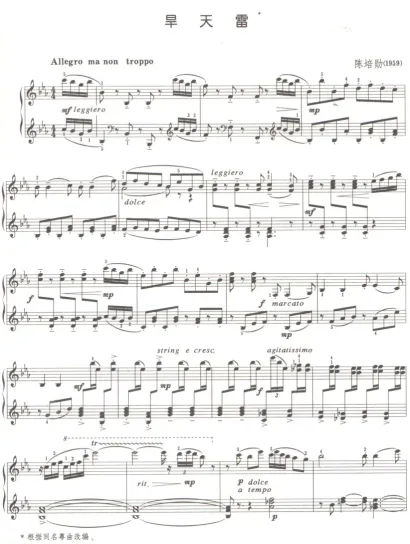
In 1959, Cantonese composer Pei Xun Chen (1922-2006) adapted this popular piece to for the piano. He kept the unique style, specific rhythm and the freedom of tempo found in the original, combining and adapting these to the wide-range of the piano keyboard. Following its composition,
Thunder in the Dry Season quickly became a prevalent and popular piece
within the Chinese piano repertoire. An extract from the piano score of Chen’s adaptation of Thunder in the Dry Season is shown in Figure 1, below.
Figure 1
Another style of Chinese piano music is classically influenced and Flute
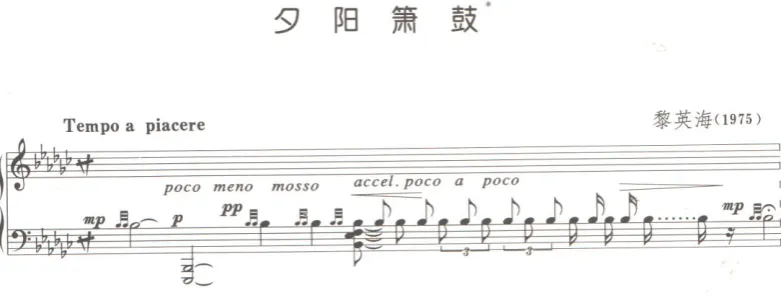
and Drum at Dusk is a very good example of this type of work and was
Dry Season, the work is commonly associated with the Pi Pa but has been arranged for larger ensemble. A typical performance can be found via the following link:
https://www.youtube.com/watch?v=7yGdVUH9ZOQ (accessed 18/7/17)
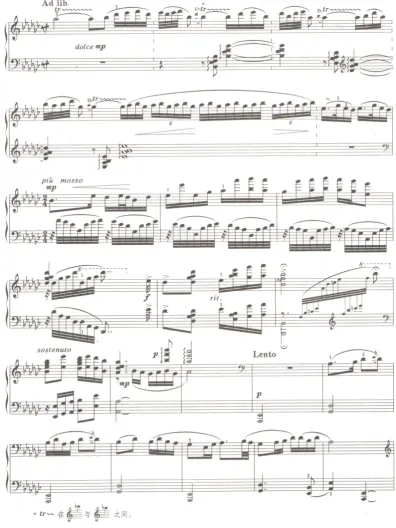
[image:10.595.107.498.416.567.2]From the name of the piece, it is obvious that the music is characteristically about the music that is associated with the bamboo flute and the Chinese drum. The piano offers an advantage as it is possible to create the illusion of two different instruments being combined while maintaining the specific features of each. For example, the percussive quality of the drum is reflected in the left hand of the piano during the opening of the work (figure 2) while the singing melodic character for the flute is woven into the later parts of the composition (figure 3).
Figure 3
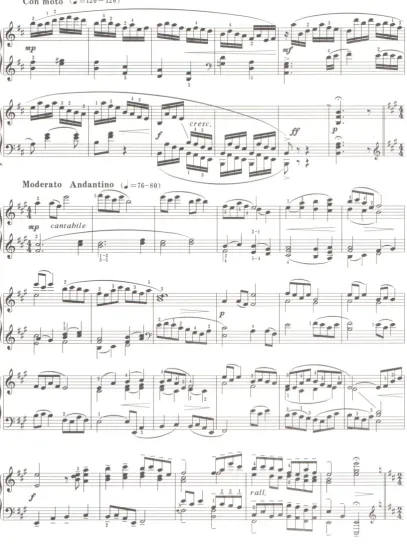
Selling Fresh Provision is a piano work that was composed in 1952 by
Figure 4
The original piano composition The Grain Flying in the Air by Yi Qiang
sections of the piece have a celebratory tone and the whole piece succeeds in showing a picture of the farmers’ harvest and happiness.
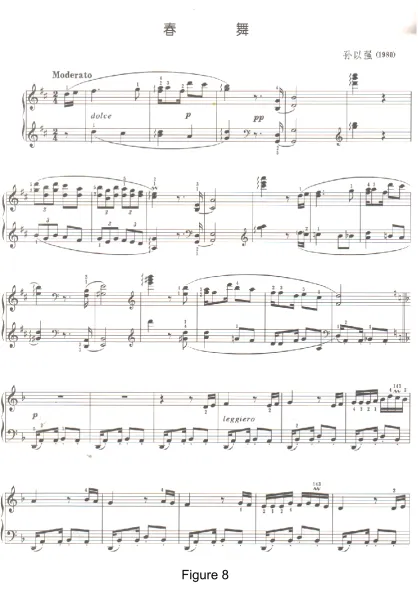
Besides the pieces of programme music, a lot of national dance music was composed as well. The Style Dance of Xing Jiang, composed by Zhi Hong Guo (born 1932) and Spring Dance by Yi Qiang Sun (born 1942) were written in 1958 and 1980. These two pieces are all about the character of Xi Jiang dance. However, the compositional styles and techniques of the works are totally different and they reflect changes in approaches to composition for the piano between 1958 and 1980. The development of composing is not only about the character and the rhythmic pattern, but also the approach to counterpoint, harmony and structure.
Whilst there have been a number of recordings made of Chinese piano music, the majority of these arise out of the work of pianists aligned to the Chinese Society in Canada and the USA. Recording this CD in Salford provided me with a unique opportunity, not only to be the first internationally recognised pianist to record a CD within Peel Hall, but also the first to record an album entirely comprised of music represents the entire range of the existing Chinese piano repertoire.
Once published this CD the aim is to arrange for this to be accompanied with sheet music so that it can be disseminated as a way of spreading knowledge of Chinese piano music, and especially to encourage younger musicians to gain experience and appreciation of this repertoire.
3. The Performance Environment
With the development of human science and technology, we can easily hear classical music through a wide variety of channels, media, and electronic devices. However, live performance is still the most attractive way to connect music and audience, even though the sound recording normally is flawless.
In the recording studio, musicians can play through a piece of music as many times as they like. The sound engineer is seamlessly able to fit all the music passages together and the modern techniques of recording engineering make the performance sound clean and perfect. For live performance, however, the musician has only one chance to play whilst on stage. It brings more pressure and yet, possibly, more atmosphere to the performance. On the other hand, the musician has to put more energy and concentration into the live performance. In this certain situation, some of the live performances are played in a rather mechanical, uncommunicative way. Nevertheless, it is possible that the most distinctive and outstanding sounding performances are those that occur in a live setting. The famous American piano master Murray Perahia said, “Only a live concert can reveal the true nature of the work.”6
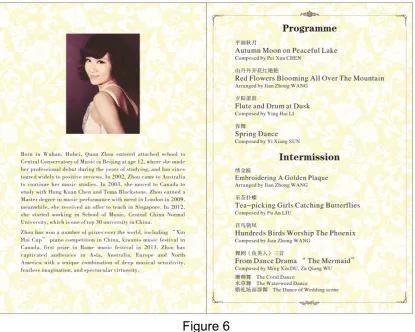
Two months after finishing the recording, in the spirit of presenting the authentic Chinese piano music in the context of my solo recitals, I returned to Salford to perform a recital in Peel Hall on 28 January 2016 (see figure 5). I split the concert into two halves. Most of the works in the programme also appear on my CD recording. In the first half, I played
6KOU, Y. (2011). Pianist Perahia, Live concert to show the charm. Retrieved 1 November, 2011,
Autumn Moon on Peaceful Lake, Red Flowers Blooming all over the
Mountain, Flute and Drum at Dusk, Spring Dance. After 10 minutes
intermission, I played Embroidering a Golden Plaque, Tea-picking Girls
Catching Butterflies, Hundreds Birds Worship the Phoenix, three selected
pieces from The Beautiful Mermaid (i.e.Coral Dance, Waterweed Dance
[image:16.595.135.460.238.669.2]and Dance of the Wedding Scene).
For me, musical performance requires a good deal of skill in terms of artistic interpretation. The musician appearing on the stage must attempt to express the composer’s intension. Through my experience of live performance, different environments seem to have a tangible effect on the musician resulting in unique music expressions as they move from concert hall to concert hall. No two performances are identical when performing live. With different concert halls, different acoustics, different audiences, and so on, all these elements combine to inspire the performer in different ways throughout the recital. Presenting new repertoire is exciting although it is always difficult to predict how the audience will respond. However great the risk, to play a whole recital with Chinese traditional piano music programme is certainly innovative, especially when performing in a western country such as the UK. I found the experience of performing in Peel Hall to be interesting as the acoustics are very good although the setting is still fairly intimate. I got a real sense of the building’s history as a Gothic concert hall while I was performing there.
For the opening of the recital, I started with Autumn Moon on the Peaceful Lake. It is a lyrical piece depicting the flowing water. The nice view of Peel Park and River Irwell beside Peel Hall, gave me a special way of interpreting the music. Despite the fact that I have played Autumn Moon
on the Peaceful Lake since I was in high school, I have never performed
grass to the building. With the sun shining, it is a beautiful scene; my experience is completely different if I play Flute and Drum at Dusk in the mountain when the weather is cloudy.
For the layout of the programme, I thought for a long time before finally deciding to start with a slow and lyrical adaptation piece with a folk tune. I wanted to give the audience a strong idea of what Chinese traditional music sounds like right from the very beginning of the recital. And then, I chose an arrangement of a well-known Chinese song, which is an exciting piece. During the wartime in 1940s, almost everybody sang this song. In order to create contrast, I played another pair of slow and fast pieces, Flute and Drum at Dusk and Spring Dance to finish the first half.
The programme of second half was more vivid. I played two arrangements of folk songs, Embroidering a Golden Plaque and
Tea-picking Girls Catching Butterflies as the opening. These two pieces are
bright and lively, but they are stylistically very different from one another. After that, I played a programmatic composition, Hundreds of Birds Worship the Phoenix. The music imitates a variety of birds, and uses special effects to mimic the sound of quarter tones. Hundreds of Birds
Worship the Phoenix is one of the most representative Chinese traditional
piano works. Then, I chose to play three small contrasting dance scenery pieces Coral Dance, Waterweed Dance, and Dance of Wedding Scene
Figure 6
4. Chinese Piano Music, its Composition and
Musical Characteristics
On the 1st of February 2016, I gave a public lecture on the topic of
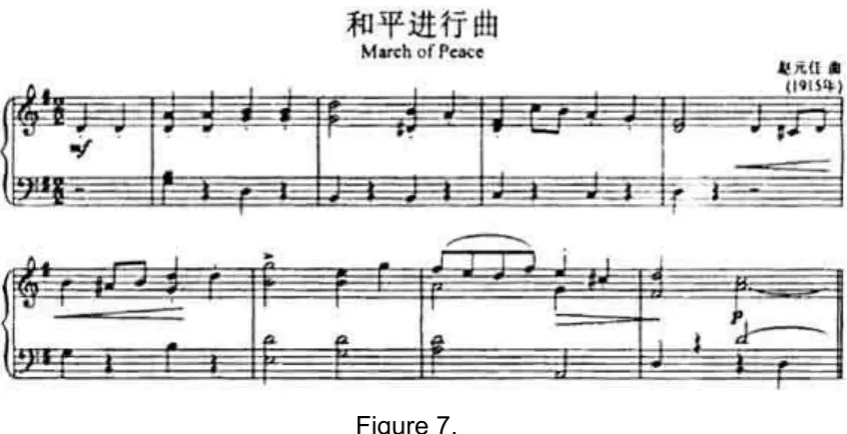
Chinese tradition piano music in the Adelphi Building of University of Salford. I introduced both the major compositional forms and characteristics of Chinese piano music. I introduced the lecture recital by talking about the composing history of Chinese piano music and the fact that it is only about a hundred years old. Chinese composers pushed the creation of Chinese piano music actively and strongly. The development of Chinese piano music arose through generations of hard working, although it had been interrupted during the certain historical time. The first published piano composition in Chinese music history is Peace
March which was written by Yuan Ren ZHAO in 1914.7 The piece was
simple and short (see figure 7). Evoking the sound of traditional Chinese instruments, the composer took the western tonality as the reference combining this with the Chinese pentatonic mode within the work. The finished work is tonal in its composition. Yuan Ren ZHAO wrote in his autobiography that “it was totally western style.”8
7GU, X.Y.(2003). A brief description of the creation of Chinese piano works. Journals of Shangqiu Teachers College, 19(6), 146-147
Figure 7.
Figure 8
rhythms, combining elements from the Chinese musical language with those deriving from the western Romantic period. It has significant meaning in the history of Chinese traditional piano music.
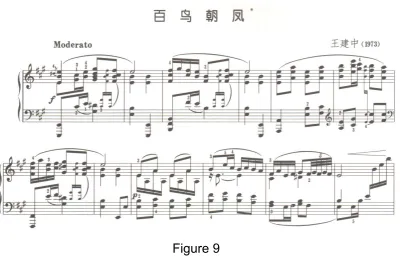
The pentatonic mode is perhaps the particular characteristic that is most often associated with traditional Chinese music. It has been used for composing Chinese instrumental music for at least two thousand years. Some piano works were adapted and rearranged from their traditional instrumental setting, incorporating the pentatonic mode. Hundreds of
Birds Worship the Phoenix was originally performed on the Suo Na.9 This
[image:23.595.101.502.374.631.2]piece was written using the pentatonic mode by Jian Zhong Wang (see figure 9).
Figure 9
This piece was special and unique in its use of passages that seek to imitate the sounds of various birds. Eventually, the Suo Na perfomers played quarter-tones for imitating the birds. Clearly it is impossible to play
quarter-tones on the piano, but, to overcome this. Jian Zhong WANG exquisitely doubled minor second and minor third intervals to make the performance sounded like shifting quarter-tones (see figure 10).
Figure 10
In Chinese traditional piano works, there are a lot of ornaments, trills, grace-notes, tremolandos and glissandos. These were drawn from their use in traditional Chinese instrumental music with composers using these symbolic elements in their piano works. Red Flowers Blooming All over
the Mountain was arranged by a well-known folk song of northern Shan
[image:25.595.96.508.282.558.2]Xi province. In this work, the arranger employed a variety of ornaments throughout the whole piece, and also devised different ways of performing the ornaments as part of the arrangement (see figure 11).
Figure 11
Flute and Drum at Dusk is a transcription of a piece that is traditionally
instrumental music.
The audiences in the lecture consisted of staff and students of the University of Salford along with invited members of the pubic. At the end of the lecture I played Red Flowers Blooming All Over The Mountain, Spring Dance, Hundreds of Birds Worship the Phoenix, Autumn Moon on
the Peaceful Lake for them. In the future, I want to integrate the spoken
5. Collaborative Performance Project for Solo
Piano and Visual Artist
Music has an intimate link to fine art. French composer Debussy’s composition was influenced by impressionistic painting, which inspired him to create his characteristic impressionism music. Russian composer Mussorgsky was inspired by ten great paintings in his magnificent piano suite Pictures At An Exhibition. However, the painter, as a creator, also can be stimulated by music. On the 2nd of April, 2016, I made a crossover
[image:27.595.91.509.405.611.2]concert exhibition with Chinese famous ink painter Yi Yuan LIU in Garden Art Pavilion, Wuhan Garden Expo in China (see Figure 12).
Figure 12
stayed in the institute to teach traditional bird-flower and landscape painting. Meanwhile, he kept on making innovative modernistic ink paintings. His works were listed in the major art collections, such as “The Complete Works of Modern Chinese Fine Arts”, “The Contemporary Chinese Fine Arts”, “Today's Chinese Fine Arts”, “China, 20 years of Experimental Ink”, “Chronicles of Chinese Fine Arts”, “An Art History of 20th Century China”. Yi Yuan LIU’s works has exhibited in Hong Kong, South Korea, France, and Switzerland. His collections are labeled as “Landscape of the Mind”10.
Wuhan Garden Expo celebrates the highest level of China’s landscaping industry. It is the largest international annual event in Hubei province. The Garden Art Pavilion is the main building of the core area in the Garden Expo. The concert I presented was designated as A Symphony of Spots
and Lines. It was a combined piano concert and art exhibition. Yi Yuan
LIU painted while I was playing the programme of piano music and he finished his painting at the same moment that I completed my performance. To my knowledge, this was the first time that the classical piano and fine art were integrated as a concert exhibition in China.
Before the concert started, LIU’s art collections were hanging on the wall. The piano was on the stage left. Yi Yuan LIU was standing on the stage right with the frame and painting materials. We found that this was an ideal position as we could easily see each other during the concert. As it was still a performing show, we decided to start together and end as well. Therefore, we need to contact each other during both of us performing.
The piano concert programme was contrast of Eastern and Western
music. It consists of the Piano Sonata by Argentine composer Alberto Ginastera with three dance scenery pieces The Coral Dance, The
Waterweed Dance, and The Dance of Wedding Scene from The Beautiful
Mermaid ballet drama. The Beautiful Mermaid was the first attempt from
the structure of classical ballet performance which was based on the traditional Chinese fairy story. It took the material of Chinese folk dance to innovate in the performance method and characters. It was a significant contribution to the development of Chinese ballet. The ballet music was broadcasted as a well-known scenic music.
Ink painting is strongly representative of the Chinese fine arts. However, Yi Yuan Liu’s style combines eastern approaches to texture with western-influenced methods when blending layers and colours. It is the mixture of ancient/eastern and modern/western approaches that inspired me for the designing of the music programme. For the order of the programme, I chose to alternate between western and Chinese piano music. I played the first movement of Ginastera’s Sonata at the beginning of the concert. In spite of its medium tempo, it features a violent and fierce style of music with the South American sharp rhythmic pattern throughout the whole movement. Then, I started play the Chinese small, uplifting piece The
Coral Dance. After that, I went back to play the second movement of the
Sonata. It was a twelve-tone music with a big development to the
vanished ending. Modernist music may be quite challenging to Chinese audiences. With this in mind, I played the flowing piece The Waterweed
Dance next to the second movement. And then, I played the rest of the
Sonata, the slow third movement and finally the powerful last movement.
When I finished the Sonata, we gave the question time to the audience to ask about either the pieces I play or the work that he just finished. At the end, I played The Dance of Wedding Scene from The Beautiful
[image:30.595.128.467.193.696.2]Mermaid ballet drama to finish this event (see figure 13).
6. Conclusion and areas for future research
The piano is a relatively young instrument as it is only about three hundred years since it was invented. From the middle of the 20th Century,
the piano started developing in China. It spread widely and rapidly and, over the last seventy years, a large amount of Chinese piano music has been created. Professional pianists have appeared in the international stage although the vast majority tend only perform repertoire taken from the canon of western European art music. Chinese piano music, drawing directly from the western harmony and counterpoint, has developed to incorporate a variety of musical styles including those that feature the unique characteristics of Chinese traditional music. For the past half century, Chinese traditional music has experienced generations of change.
Through my work over the course of the DMA I have discovered a large amount of repertoire for the piano that has been inspired in various ways by Chinese music and I have begun a process of performing and recording this material internationally.
During my period of practice-based research on the DMA programme I have
added to new knowledge in a variety of ways. In November 2015 I finished a
CD recording which was the first one to be made in Peel Hall, Salford and,
importantly, the first CD of entirely Chinese piano repertoire to be made. It is an
example of original curation as I was responsible for the selection of the pieces
for the CD. In my second project I performed a recital in Peel Hall at the
University of Salford in the 28th of January, 2016. This represents originality in
that it was the first entire recital of Chinese piano music in the world. On the 1st
in the Adelphi Building of University of Salford. At the lecture, I presented new
knowledge concerning the development of Chinese piano music. There are
currently no academic publications that focus on Chines piano music. As part
of my ongoing work raising the profile of Chinese piano music, I made a
crossover concert exhibition with Chinese famous ink painter Yi Yuan LIU on
the 2ndof April, 2016in Garden Art Pavilion, Wuhan Garden Expo in China. This
was the first time that a pianist and artist have presented in the context of a
recital in China. I created a unique form of programme, which mixed Chinese
and western works in a novel way.
Future developments
In China, there is a system of piano grading tests similar to the ABRSM in UK, however the majority of the repertoire selected for inclusion in the piano syllabuses derives from the West. As there is a minimal amount of Chinese repertoire in the grade system, I will try to address this by lobbying to make more Chinese music appear in the grading tests. I am actively seeking to raise the profile of Chinese piano music by featuring this in my high-profile recitals in China. At the same time I am working toraise awareness of Chinese piano music in the West and hope to introduce more Chinese piano music into the exam syllabuses for ABRSM.
Europe including WoodBrass (Switzerland) and Astute Music (UK). In China there are many competitions that encourage composers to write new music and also journals such as ‘Ren Min Yin Yue’ (‘People’s Music’) that feature new compositions including new music for piano. As a recipient of this core music journal I intend to select and publish new contemporary or other examples of Chinese piano repertoire and to make this available the West.
Bibliography and Web Resources
1. Xu, J.N. (2016) The Earliest Chinese Orchestra Performance in Western Country. Retrieved 2 October, 2016, from
dajia.qq.com//original/kaojupai/xjn161002.html
2. FouTs’ong (Piano). Retrieved 6 October, 2016, from www.bach-cantatas.com/Bio/Tsong-Fou.htm
3. XU, Y.Q. (2007). The artistic characteristics of Chinese piano adapted music during the Cultural Revolution. Literature Education, 7, 134-137
4. FENG, J.H. (2010). Music performance and analysis of the mermaid of piano suite of dance drama. Retrieved 16 October,2016, from
www.docin.com/p-1014755727.html
5. KOU, Y. (2011). Pianist Perahia, Live concert to show the charm. Retrieved 1 November, 2011, from
yule.sohu.com/20111101/n324107957.shtml
6. GU, X.Y.(2003). A brief description of the creation of Chinese piano works.
Journals of Shangqiu Teachers College, 19(6), 146-147
7. LUO, A.Q.(2014). From ‘the peace march’ to see the development of the early piano music in China. Yellow Bell Big Lv, 3,74-76
8. https://www.youtube.com/watch?v=WkxOAmdYM2Q (accessed 18/7/17)
9. http://www.365yg.com/group/6432630784431948034/ - accessed 18/7/17)
10.https://www.youtube.com/watch?v=7yGdVUH9ZOQ (accessed 18/7/17)