wasps reveal novel insights into the evolution of
sociality and the origin of alternative phenotypes
Ferreira
et al.
R E S E A R C H
Open Access
Transcriptome analyses of primitively eusocial
wasps reveal novel insights into the evolution of
sociality and the origin of alternative phenotypes
Pedro G Ferreira
1,6, Solenn Patalano
2,3, Ritika Chauhan
4, Richard Ffrench-Constant
4, Toni Gabaldón
1,
Roderic Guigó
1and Seirian Sumner
2,5*Abstract
Background:Understanding how alternative phenotypes arise from the same genome is a major challenge in modern biology. Eusociality in insects requires the evolution of two alternative phenotypes - workers, who sacrifice personal reproduction, and queens, who realize that reproduction. Extensive work on honeybees and ants has revealed the molecular basis of derived queen and worker phenotypes in highly eusocial lineages, but we lack equivalent deep-level analyses of wasps and of primitively eusocial species, the latter of which can reveal how phenotypic decoupling first occurs in the early stages of eusocial evolution.
Results:We sequenced 20 Gbp of transcriptomes derived from brains of different behavioral castes of the primitively eusocial tropical paper waspPolistes canadensis. Surprisingly, 75% of the 2,442 genes differentially expressed between phenotypes were novel, having no significant homology with described sequences. Moreover, 90% of these novel genes were significantly upregulated in workers relative to queens. Differential expression of novel genes in the early stages of sociality may be important in facilitating the evolution of worker behavioral complexity in eusocial evolution. We also found surprisingly low correlation in the identity and direction of expression of differentially expressed genes across similar phenotypes in different social lineages, supporting the idea that social evolution in different lineages requires substantialde novorewiring of molecular pathways. Conclusions:These genomic resources for aculeate wasps and first transcriptome-wide insights into the origin of castes bring us closer to a more general understanding of eusocial evolution and how phenotypic diversity arises from the same genome.
Background
Phenotypic plasticity is a fundamental biological process that allows organisms to adapt to changes in their envir-onment [1,2]. Examples of plastic phenotypes include insect castes [3,4], horn-polyphenic beetles [5] and sex differences [6], where they play a crucial role in shaping the ecology and evolution of species and ecosystems. Understanding how alternative phenotypes arise from the same genome is one of the most challenging ques-tions in modern biology [1,2].
The most impressive examples of phenotypic plasticity are found in the eusocial Hymenoptera (ants, some bees
and some aculeate wasps), where specialized reproduc-tive or non-reproducreproduc-tive phenotypes (castes) play a pivotal role in the ecological success of these insects [7]. Eusocial insect castes usually arise through differential expression of shared genes [8,9], but studies to date have been largely restricted to the highly eusocial bees and ants, where caste phenotypes are evolutionarily derived, being greatly modified from their ancestral state (for example, with morphological adaptations that are established early in development). Thus, some of the molecular processes underlying the origins of castes are likely to differ substantially from those underlying highly eusocial species [10,11]. Understanding how castes first arise is best studied in primitively eusocial species, but little is known about their molecular evolution, particu-larly in the aculeate wasps [12-15]. Thus, there is a need * Correspondence: [email protected]
2
Institute of Zoology, Zoological Society of London, Regent’s Park, NW1 4RY,
UK
Full list of author information is available at the end of the article
for comprehensive gene-level studies on primitively eusocial wasps.
In the evolution of eusociality, behavioral and physio-logical traits of the non-social ancestor become decoupled into complementary queen and worker phe-notypes [16], but we understand little about the molecu-lar patterns and processes by which this originates and to what extent molecular ground plans are re-organized. These questions are of general biological importance in understanding the evolution of phenotypic diversity [1,2]. Empirical assessment of how gene transcription is decoupled into alternative phenotypes has been difficult to obtain because it requires unbiased quantification of gene expression (of both known and novel (undescribed) genes) across whole genomes [17]. Microarray analyses of the highly eusocial honeybee (Apis mellifera) and fire ant (Solenopsis invicta) suggest marked functional decoupling of molecular processes in queens and work-ers, involving large numbers of genes [18-21]. Little is known about the patterns and processes of transcrip-tional decoupling for castes in primitively eusocial insects [12,14]. A simple prediction is that patterns of transcriptional and functional decoupling should be less pronounced than in highly eusocial species, because phenotypes are in the first stages of merely behavioral decoupling [9,12].
Processes of phenotypic decoupling at the molecular level may occur via several mechanisms [5,22]. Con-served toolkits of ancestral molecular processes may be redeployed to regulate similar alternative phenotypes across species and lineages [23-26]. In eusocial insects, conserved toolkit genes appear to be differentially expressed in castes across species, including bees and wasps [12,27]. An alternative, untested prediction is that at least some of the molecular processes underlying social phenotypes, in different social lineages and among different levels of social complexity, will differ substan-tially. This is because extensive molecular and develop-mental re-wiring or new gene evolution may be required for the loss of phenotypic plasticity and ela-boration of phenotype-specific traits [10,28]. There may also be rapid evolution of genes associated with the emergence of alternative phenotypes [6,17,29], and there is evidence for this in the highly eusocial honeybees and fire ants [30,31]. Finally, the importance of novel genes (that is, previously undescribed genes that lack any detectable protein-coding homologues from existing sequence data [32]) in the evolution of phenotypic inno-vations has recently emerged in animals as varied as yeast [33], hydra, reptiles [34-36], and also honeybees [37]. To date the eusocial insect literature has largely focused on conserved molecular pathways for social behavior [12,26,27,38,39], and the relative roles of the
different mechanisms of phenotypic decoupling are unknown.
We sequenced over 20 Gbp of genome-wide caste-speci-fic transcripts from the primitively eusocial, tropical paper waspPolistes canadensisusing high-throughput sequen-cing technologies. Castes inPolistesdiffer only in behavior and are determined through differential gene expression during adulthood [12-14], makingPolistesimportant mod-els for studying the early stage in the evolution of eusocial-ity and phenotypic plasticeusocial-ity [40].Polistesoriginated in the tropics, and the secondary adaptations to diapause found in temperate species (for example, [41]) will be absent in P. canadensis[42]. Typically a few foundresses build and provision new colonies (Figure 1). One foundress becomes the primary egg-layer (queen). Emerging adults help raise the offspring of their mother queen, but retain the ability to become egg-layers [43-45]. Thus,Polistescastes repre-sent an early stage of phenotypic decoupling in the evolu-tion of eusociality [16].
Here, we generate a genome-wide catalogue of aculeate wasp genes expressed in adult females to provide a resource for genomic analyses. We then conduct the first RNA-seq analyses of caste-biased expression in a wasp and primitively eusocial insect to test the above hypoth-eses on the patterns and processes of molecular decou-pling of alternative phenotypes at the early stages in the evolution of eusocial behavior. These datasets allow a first simultaneous assessment of the role of conserved genetic toolkits, novel genes and gene evolution when social behavior first evolves. We also use our data to re-assess the phylogenetic relationships between the three aculeate Hymenoptera subfamilies (bees, wasps and ants), which is vital information for interpreting common pro-cesses and lineage-specific novelties underlying the evo-lution of alternative phenotypes. Recently, there has been much debate over the relationships of aculeate bees, wasps and ants, challenging the morphology-based view that Vespoidea (ants plus aculeate wasps) are monophy-letic [46,47]. Genome sequences (or similar catalogue of genes) for aculeate wasps will help resolve this contro-versy and provide a basis for interpreting comparative data on social evolution.
Results and discussion
Gene assembly for an aculeate wasp
We first generated a reference assembly of the genes
expressed by P. canadensis adult female phenotypes
genomic analyses on non-model organisms. Library nor-malization meant that we were able to capture transcripts at all levels of the expression spectrum. The longer read lengths provided by 454 technology and the high coverage of these datasets increase the likelihood of full transcript assembly. The 454 reads were assembled into a reference transcriptome set of 26,284 isogroups - henceforth referred to as‘genes’for simplicity (Section 2 in Additional file 1; Additional file 2). This gene set included 98% of the core eukaryotic genes with equal coverage for each pheno-type (Section 3 in Additional file 1). Additionally, sequences were 100% identical to existing overlapping Sanger sequences for this species (n = 36 genes) [14]. Genes were equally spread across honeybee chromosomes and included 94% of publicly available ESTs for the
temperate paper wasp Polistes metricus(n = 422 genes [12]; Section 3 in Additional file 1). Although this assem-bly is restricted to the genes expressed in adult females, it provides an important step forward in generating a com-prehensive genome-wide sequence resource for aculeate wasps.
[image:4.595.58.540.88.482.2]We characterized in detail the sequence and expression features for two groups of genes. The first group corre-sponds to the set of genes with detectable homology to protein sequences of any species in the comprehensive GenBank non-redundant (NR) database. We identified homologs for 37.4% of the totalP. canadensisgenes (n = 9,839), which were then annotated using Gene Ontology (GO; Table 1; Section 4 in Additional file 1; Additional files 3 and 4): 71% of best hits were with the honeybee,
which reflects the wealth of genomic resources for this species rather than any close phylogenetic relationship (see below). This level of homology is comparable with data for the temperate waspP. metricuswhere 39% of the approximately 391K sequence fragments had putative orthologs [13]. In comparison, 60% to 70% of genes in the genomes of other social insects (ants and bees) had homology with sequences in other insects [48,49].
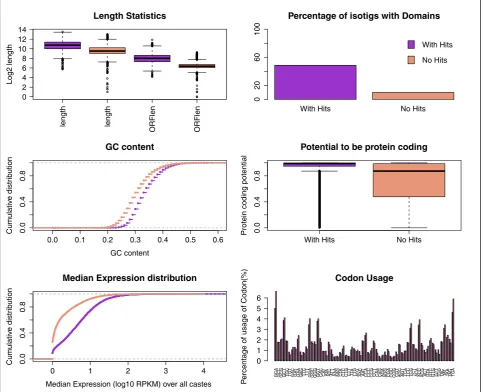
The second group of genes (n = 16,445; 62%) lacked detectable homology with protein sequences in NR data-bases, and will be referred to here as putative novel genes as they differ significantly in sequence from any described sequences to date (Section 5 in Additional file 1). These include taxonomically restricted genes, and they may be derived from ancestral coding genes, or arisede novo from noncoding ancestors [32]. Overall, transcripts with homology were longer (with-hits group, 1,718 ± 1,343; no-hits group, 736 ± 768) and had longer ORFs (with-hits group, 256 ± 205; no-(with-hits group, 83 ± 36) than those without (Figure 2a). By scanning the sequences for known protein domains with HMMscan [50] we detected domain homology in 48% of the sequences with NR hits and only 9.9% in the group without hits (Figure 2b). GC content was also lower in the no-hits group (mean GC with-hits, 0.337: no-hits, 0.306; Figure 2c). Analysis of protein coding potential with PORTRAIT [51] revealed a significantly lower potential for protein coding in the group of isotigs without hits (Figure 2d). We then exam-ined whether the novel isotigs could potentially be long non-coding RNAs (lncRNAs). First, we looked more clo-sely at the distribution of isotigs that are longer than 300 bp and have an ORF shorter than 90 amino acids (96% of theA. melliferatranscripts have an ORF greater than 90 amino acids). The vast majority of these isotigs lacked homology (n = 12,751 with no homology; n = 1,162 with homology), suggesting that the putative novel isotigs had shorter ORFs. Next, we imposed a PORTRAIT score lower than 0.5 (at which a sequence is more likely to be non-coding than coding), which yielded more isotigs in
the set lacking homology (n = 4,096), than those with (n = 314). Finally, we imposed the condition of no homol-ogy with known protein domains, which again yielded more isotigs in the set without homology (n = 3,824) than with (n = 262). These latter two results suggest lower pro-tein coding potential in the putative novel isotigs. The dis-tribution of the median expression across all castes shows that, in general, isotigs with hits have higher expression values than those without (Figure 2e; but see also expres-sion analysis below). The pattern of codon usage was simi-lar in both groups (P= 1, two samplet-test; Figure 2f).
The characteristics of isotigs lacking homology -namely shorter ORFs, lower protein coding potential, lower GC content and lower expression values [52] - sug-gest that a large proportion of novel isotigs correspond to non-protein coding transcripts. But low sequence conser-vation across species, lack of genomic information for aculeate wasps and the typical tissue specificity of the non-coding RNAs [52] may also explain the novelty of these genes.
We also verified that the abundance of novel genes was not an artifact resulting from assembly of transcript frag-ments rather than complete transcript sequences (Section 6 in Additional file 1). Our analyses suggested that less than 10% of genes were affected by this, and thus do not alter significantly our main analyses (below). However, without a genome sequence we cannot exclude the possi-bility that some genes may represent incomplete assemblies.
Paraphyly of Vespoidea
[image:5.595.57.540.100.187.2]Long-standing analyses based on the fossil record, cladis-tics and phylogenetic analyses of the aculeate Hymenop-tera place ants and aculeate wasps as a monophyletic clade - the Vespoidea - with the bees as a sister group. This has received mixed support from recent molecular analyses [47,53-55], but these studies were limited to a maximum of four genes and sparse data matrices. High-throughput transcriptomics data are a reliable source of Table 1 Number of best BLAST hits between the genes of sequenced genomes for aculeate hymenopterans
Species P. canadensis A. mellifera S. invicta C. floridanus H. saltator N. vitri-pennis
P. canadensis 22,460 (100%) 7,040 (31.3%) 5,548 (24.7%) 6,501 (28.9%) 5,880 (26.2%) 4,416 (19.7%)
A. mellifera 5,764 (52.1%) 11,062 (100%) 7,093 (71.4%) 8,197 (74.1%) 6,769 (61.2%) 5,366 (48.5%)
S. invicta 4,662 (28.2%) 6,293 (38.0%) 16,522 (100%) 8,864 (53.6%) 8,341 (50.5%) 4,935 (29.9%)
C. floridanus 5,422 (31.8%) 7,129 (68.6%) 11,741 (68.6%) 17,064 (100%) 12,492 (73.2%) 5,552 (32.5%)
H. saltator 4,913 (26.5%) 6,798 (36.6%) 10,591 (57.0%) 9,247 (49.8%) 18,564 (100%) 5,667 (30.5%)
N. vitripennis 3,861 (20.5%) 5,377 (28.6%) 6,144 (32.6%) 6,600 (35.0%) 5,725 (30.4%) 18,822 (100%)
Absolute number (and percentage of genes) shared between each pair of species are given. Annotations used for each species are: Official Gene Set (OGS)1.2 for the parasitoid waspNasonia vitripennis, OGS3.3 for the antHarpegnathos saltator, OGS3.3 for the antCamponotus floridanus, OGS2.2.3 for the antSolenopsis invicta, pre-release of OGS2.0 for the honeybeeApis mellifera, and the longest ORFs (putative coding genes only - that is, excluding 3,824 potential long non-coding RNAs) forPolistes canadensisfrom our RNAseq datasets. Rows represent the source species, which are compared with the test species in the columns. For instance, of the 11,062 genes found inA. mellifera, 5,764 have significant hits with genes found inP. canadensis, corresponding to 52.1% of the total 11,062 genes.P. canadensisshares 25 to 31% of genes with the other aculeate hymenopterans, but only 19.7% with the parasitoidN. vitripennis. Notably,P. canadensis
phylogenetic information [56]. Our transcriptome affords a first assessment of the monophyly of Vespoidea using a large and complete data matrix. We analyzed 93
con-served one-to-one orthologs of P. canadensisgenes,
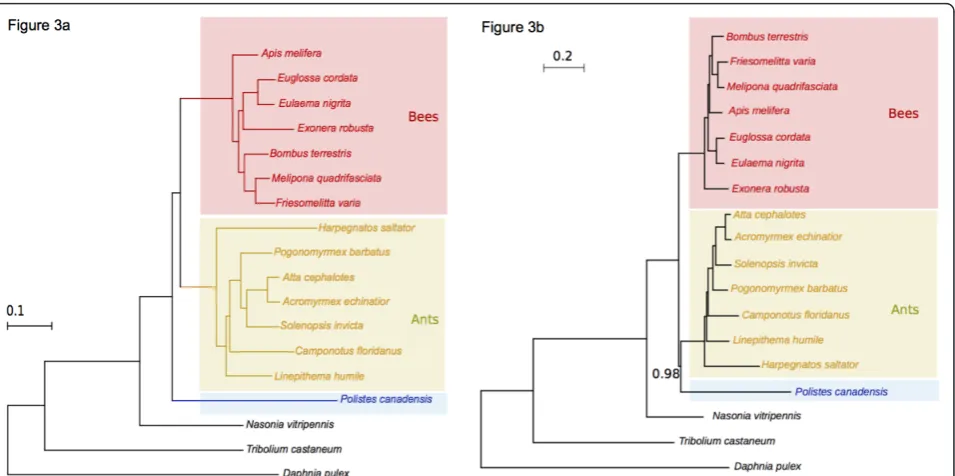
derived from 196 single-copy insect phylogeny markers in the eight fully sequenced hymenopteran genomes [57] and nine bee transcriptomes [38] (Additional file 5). A maximum-likelihood (ML) analysis of these genes across all 32 insect species placedPolistesas the basal, sister group to the bees and ants (Figure 3a). This topology was significantly more supported (P< 0.05, Shimodaira-Hase-gawa test) than the earlier proposal that Vespoidea (ants andPolistesin our study) are monophyletic. This result is consistent with the levels of gene sharing across aculeates
(Table 1), whereP. canadensis does not share more
genes with ants than bees, as would be expected if wasps and ants were monophyletic.
We further tested the phylogenetic relationships using a Bayesian framework. In contrast, this gave greater support to the classical view of aculeate wasps and ants being monophyletic (Figure 3b; Section 10 in Additional file 1). The reason for the discrepancy in the results of these two methods is likely to be due to the wasp clade being the most poorly represented in our analysis (with only one species), and moreover, it is the clade with the longest branch. Our dataset offers a first chance to examine sub-family relationships across large numbers of genes but, clearly, phylogenomic data on more species of aculeate wasps are required to determine whether the term‘ Ves-poidea’should be dropped, or reclassified as paraphyletic.
length length ORFlen ORFlen 0 2 4 6 8 10 12 14 Length Statistics Log2 length
With Hits No Hits
Percentage of isotigs with Domains
0 20 60 100 With Hits No Hits
0.0 0.1 0.2 0.3 0.4 0.5 0.6
0.0 0.4 0.8 GC content GC content Cum ulativ e distr ib ution
With Hits No Hits
0.0
0.4
0.8
Potential to be protein coding
Protein coding potential
0 1 2 3 4
0.0
0.4
0.8
Median Expression distribution
Median Expression (log10 RPKM) over all castes
Cum
ulativ
e distr
ib
ution
GCA GCC GCG GCT TGC TGT GA
C
GA
T
GAA GA
G
TTC TTT GGA GGC GGG GGT CA
C
CA
T
ATA ATCATTAAA AA
G
CT
A
CTC CTG CTT TT
A
TTG ATGAA
C
AA
T
CCA CCC CCG CCT CAA CA
G
AG
A
AG
G
CGA CGC CGG CGT AG
C
AG
T
TCA TCC TCG TCT AC
A AC C AC G AC T GT A
GTC GTG GTT TGG TA
C
TAT TAATAGTGA Codon Usage
P
ercentage of usage of Codon(%)
[image:6.595.57.541.94.486.2]0 1 2 3 4 5 6
Figure 2Sequence and expression characterization of the transcripts with and without detected homologs. (a) Length and longest ORF
length statistics.(b)Percentage of transcripts with known protein domains.(c)Distribution of GC-content.(d)Potential to be protein coding.(e)
This finding would have important general implications for our understanding of eusociality as it would suggest that bees and ants shared an aculeate wasp-like common ancestor, that ants are wingless wasps [58], and that bees are wasps that lost predacious behaviors. Primitively euso-cial wasps may therefore hold some important clues to the early stages of eusociality, if they are the basal descendants of non-aculeate Hymenoptera.
Transcriptional and functional decoupling at the origin of alternative phenotypes
We next conducted RNA-seq analyses of phenotype-biased expression to provide a first genome-wide look at molecular decoupling of alternative phenotypes at the early stages of eusocial evolution. We quantified genome-wide transcription in individuals (n = 2 to 12 per pheno-type) from each of the four adult female phenotypes by sequencing at least 3 Gbp of Illumina short-reads of brain cDNA per phenotype (Additional files 6, 7, 8 and 9). These samples appeared to capture most transcription across the genome since 99.8% of the 26,284 genes in the reference transcriptome were detected in our pooled Illu-mina dataset (Section 7 in Additional file 1).
We identified genes that were differentially expressed between phenotypes using NOIseq [59]. Of the 26,284 genes, 2,442 (9.3%) were differentially expressed in any one phenotype (Table 2; Section 8 in Additional file 1; Additional file 10). This suggests that a very small part of the adult female transcriptome is decoupled to produce alternative phenotypes in this species. This is similar to that detected in the temperate waspP. metricus, where 12% (n = 389) of genes on a microarray were caste-biased [12]. Because RNA-seq is a new methodology, we also confirmed that the number of differentially expressed genes was not artificially elevated due to gene fragmenta-tion (Secfragmenta-tion 9 in Addifragmenta-tional file 1). In a microarray study on whole body samples of the highly eusocial fire ant Sole-nopsis invicta, the proportion of examined genes that were differentially expressed between adult queens and workers (19% of 14,467 genes) [21] was twice that of Polistes. RNA-seq analyses on highly eusocial species like the fire ant are required to explore these patterns of transcrip-tional decoupling further.
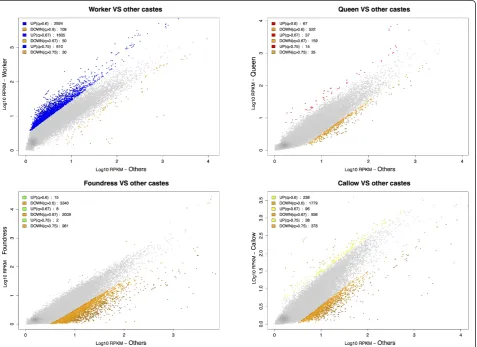
[image:7.595.61.539.88.326.2]Workers appear to upregulate significantly more caste-biased genes (n = 2,224; 91% of caste-caste-biased genes) than other phenotypes (callows, foundresses and queens)
Figure 3Phylogenetic relationships across hymenopterans with sequenced genomes or transcriptomes.(a)Phylogeny inferred from a
maximum-likelihood analysis of a set of 93 conserved proteins (see Materials and methods). The coleopteranTribolium castaneumand the
crustaceanDaphnia pulexare used as out-groups.P. canadensis(blue) appears basal to a clade formed by ants (yellow) and bees (red),
suggesting Vespoidea (ants + aculeate wasps) are not monophyletic. Non-maximal support values are indicated in the corresponding branches, and are based on Shimodaira-Hasegawa-like approximate likelihood ratio tests. This topology is statistically more supported than the alternative
scenario in whichPolistesis the sister group of ants (see Materials and methods).(b)Consensus tree from the Bayesian analysis placesPolistesas
(Figure 4 and Table 2). This result holds for all different NOIseq [59] selection thresholds (Figure 4) and is inde-pendent of the number of biological replicates per pheno-type analyzed (Section 8 and Table S2 in Additional file 1). Our original aim was to examine decoupling in queens
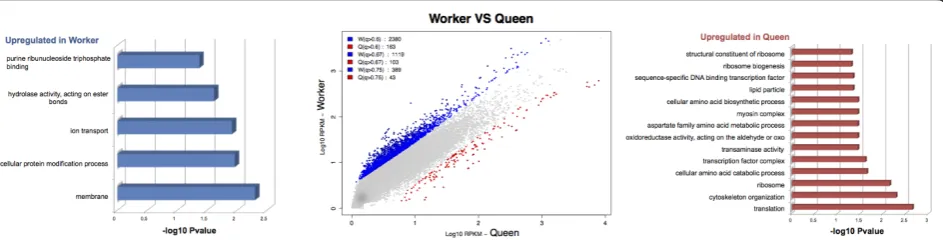
and workers. We therefore re-analyzed the data using only these two phenotypes and found an even greater asymme-try with workers up-regulating 93.1% (n = 1,797) of 1,909 worker/queen caste-biased genes (queens up-regulate only 112 genes; Table 3 and Figure 5). Upregulation of caste-Table 2 Isotig andisogroup differential expression statistics for the four adult female phenotypes inP. canadensis
Phenotype Up-regulated (q > 0.6) isogroups
(isotigs)
Isogroups with recognized
homologs
Isogroups with annotated homologs
Down-regulated (q > 0.6) isogroups
(isotigs)
Isogroups with recognized
homologs
Isogroups with annotated homologs
Queen 47 (67) 39 (82.9%) 20 (42.5%) 402 (522) 63 38
Worker 2,222 (2,924) 412 (18.5%) 238 (10.7%) 84 (109) 65 38
Foundress 11 (15) 8 (72.7%) 4 (36.4%) 2,389 (3,340) 776 507
Callow 162 (238) 142 (87.6%) 112 (69.1%) 1,454 (1,779) 322 194
Total 2,442 (3,244) 596 (24.4%) 370 (15.2%) 4,329 (5,750) 1,311 858
[image:8.595.58.538.100.194.2]We show the number of isogroups and isotigs found as differentially expressed by NOISeq at a threshold q > 0.6; number and percentage of differentially expressed genes with significant homologs recognized in GenBank non-redundant databases; the number and percentage of annotated homologs; and values across all castes are given in the final row of the table. Distribution of up-regulated isogroups, recognized homologs and annotated homologs are highly significantly different between queens and workers (chi-square test; respective chi-square values: 1,566 (1d.f.),P< 2.2e-16; 4,795 (1d.f.),P= 9.1 × 10⁻¹³; 5,382 (1d.f.),P< 2.2e-16).
[image:8.595.62.540.336.683.2]biased genes in workers, rather than queens, at the early stages of caste evolution may facilitate the expansion of worker trait complexity, typified by workers in the highly eusocial descendants of primitively eusocial species. These results support the emerging picture that much of pheno-typic evolution occurs in workers, rather than queens [21,37], and provide the first suggestion that molecular evolution of the worker caste is in place early in social evolution.
Interestingly, foundresses and callows accounted for the majority (89%) of down-regulated genes. Some of these could be attributed directly to a corresponding up-regulation in workers: specifically, 55% and 75%, respectively, of the down-regulated genes in foundresses and callows. But, the remaining foundress and callow down-regulated genes were not upregulated in other castes. This is also reflected in the GO classification (Additional file 5), where none of the 22 GO terms over-represented among the down-regulated genes in foundresses and only 5 of the 23 terms over-represented among the down-regulated genes in callows were up-regulated in workers. Although preliminary, these results raise some important questions: they suggest that cal-lows are born neither worker- nor queen-like, but per-haps instead as an undifferentiated state, as expected in a species where all females retain full reproductive toti-potency; down-regulation in callows may also reflect maturation processes that take place in the first days after emergence as an adult. Foundresses are thought to be hopeful reproductives, co-founding a nest in the
hope of becoming the dominant egg-layer (queen); our data suggest that foundresses are quite different from established queens, even though they fit the queen phe-notype in all other respects (that is, they are active egglayers, rarely absent from the nest, and are behavio-rally dominant). Taken together, these results highlight how the definition of a phenotype in this species is more complex than a simple distinction between queens and workers.
[image:9.595.54.541.100.148.2]Using the 268 genes differentially expressed between queens and workers that could be annotated (Table 3), we then looked for any signs of functional specialization between these castes. Of the GO terms corresponding to these genes (Additional file 4), 2.4% (53 out of 2,242) were significantly enriched between queens and workers (Additional file 5; 40 terms (1.7%) over-represented in queens, 13 terms (0.57%) over-represented in workers). Although many of our genes did not have any functional information, there are some interesting first insights from these analyses. The putative lack of substantial functional specialization between castes inPolistes con-trasts with the marked functional specialization in highly eusocial species, such as honeybees [19]. This may reflect selection on females to retain reproductive toti-potency in primitive societies, like P. canadensis, in order that they can exploit alternative reproductive stra-tegies [43], and minimize the risks of specialization asso-ciated with small colony size [60]. General terms overrepresented in workers include cellular protein modification processes, membrane and ion transport, Table 3 Isotig and isogroup differential expression in the comparison of only queen and worker castes
Caste Up-regulated (q > 0.6) isogroups (isotigs)
Isogroups with recognized homologs
Isogroups with annotated homologs
Putative lncRNAs (total identified = 3,824)
Queen 112 (163) 91 (55.8%) 51 (45.5%) 6 (5.3%)
Worker 1,797 (2,380) 347 (19.3%) 217 (12.1%) 339 (18.86%)
Significant differences between queens and workers in the numbers of isogroups and isotigs found as differentially expressed by NOISeq at a threshold of q > 0.6 (chi-square value, 1,083 (1d.f.);P< 2.2e-16); number and percentage of differentially expressed genes with significant homologs recognized in GenBank NR database (chi-square value 102 (1d.f.);P< 2.2e-16); the number and percentage of annotated homologs (chi-square value, 70 (1d.f.);P< 2.2e-16); number and percentage of putative lncRNAs (chi-square value, 236 (1d.f.);P< 2.2e-16) are given.
[image:9.595.65.537.582.702.2]which may suggest elevated cellular activity in worker brains. Among the over-represented terms in queens, several candidates associated with cell structure and cytoskeleton were found, such as homologs of myosin chains, actin isoforms and troponin, which may be asso-ciated with synaptic plasticity and memory [61]. How-ever, because so few of the genes up-regulated in workers could be annotated, and because of the lack of significant levels of enrichment between castes, these inferred func-tional differences between castes should be taken with caution and require further analyses once some function-ality can be assigned to the unknown genes.
Role of novel genes in the evolution of alternative phenotypes
We explored the hypothesis that novel genes (those lack-ing homologs in NR databases; see above) may play an important role in the early stages of phenotypic decou-pling inP. canadensis. The importance of novel genes was recently highlighted in organisms as varied asHydra to reptiles for their contribution to phenotypic diversity, through generating both behavioral and morphological variation [34-36]. Of the 2,442 up-regulated caste-biased genes (Table 2), 24.4% (n = 596 genes) had known homo-logues, indicating that both novel and described genes are important inP. canadensissocial behavior. Interest-ingly, 81.5% of worker-biased genes lacked homologs, compared to only 17.1% of queen-biased genes (Table 2). Foundresses and callows show similar levels of homology to queens. Lack of homology cannot be attributed to fragmentation or other anomalies arising from using transcriptome data (Section 6 in Additional file 1) and they are also valid for the stricter comparison of queens versus workers (Table 3). These results are exactly in line with Johnson and Tsutsui [37] and Barchuket al. [62], who found an over-representation of novel (taxonomi-cally restricted) genes up-regulated in honeybee workers (adults [37] and brood [62]), and suggested that these novel genes may facilitate expansion of worker behavioral complexity. Our data provide the first suggestion that novel gene transcription may be important at the early stages of worker evolution, confirming the potentially broad role of novel genes in eusocial evolution [37] and adding to the emerging general importance of novel genes in the evolution of phenotypic diversity [34-36]. It is important to note that microarray methods (as used in the honeybee studies) are largely biased towards con-served genes [37], as sequence conservation facilitates gene prediction. Thus, RNA-seq methods as used in our study offer new potential to explore the role of putative novel genes in phenotypic evolution.
Our ability to interpret what these novel genes are is limited without genome and proteome analyses, which is beyond the scope of this study. But, we explored the
hypothesis that many of the caste-biased novel genes were in fact non-coding RNAs, as identified from our whole transcriptome analysis (above). Interestingly, we found a significant difference in the proportion of novel transcripts that were putatively lncRNAs, with an over-representation in workers relative to queens (Table 3). lncRNAs are thought to play a role in gene regulation [63], but also may be evidence of de novo gene origin [33]. Future work will determine the significance of these processes in worker, rather than queen, evolution.
Conserved molecular toolkits associated with alternative phenotypes
correlation of 0.25 for worker, 0.14 for queen, 0.24 for foundress and 0.23 between gyne and callow; Additional file 5). This was unexpected since these two species are close relatives, share a recent common ancestor, and have similar social and behavioral traits. Differences in ecology of tropical and temperatePolistes, and possible secondary adaptation to temperate living [42], may contribute to these differences. These analyses suggest that the social toolkit represents a small portion of the genome involved in phenotype decoupling ofP. canadensis, and that there is much lineage and ecology-specific transcription underlying caste differences. This supports the hypothesis that the genes underlying castes in different social lineages will not necessarily be conserved, because extensive molecular and developmental re-wiring may be required in the evolution of caste commitment and eusociality [10,11].
Insights into gene evolution in alternative phenotypes
Rapid evolution of genes has been associated with alter-native phenotypes in a range of animals [6,17,29]. Caste-biased genes evolve rapidly in the honeybee and fire ant [30,31], possibly because fast-evolving genes are prefer-entially recruited into caste-biased gene expression [30]. Interestingly, we found no evidence of this inP. cana-densis(Section 10 in Additional file 1; Additional file 5), suggesting that at the early stages of phenotypic decou-pling genes are maintained through purifying selection. This agrees with social evolutionary theory that predicts that females retain the ability to exploit alternative reproductive opportunities (for example, to switch from worker to queen) to maximize individual-level inclusive fitness at the early stages of sociality [43]. Selection may be relaxed after workers commit to a non-reproductive pathway, as found in highly eusocial species [10,28], resulting in gene evolution, new genes and new gene networks [31,67-69]. Analyses of incipient phenotypic decoupling in other animals will help determine whether accelerated gene evolution only occurs after key innova-tions or fundamental shifts in life-history traits.
We next looked for evidence of processes that may have been lost or gained during phenotypic decoupling in euso-cial evolution (Section 10 in Additional file 1; Additional file 5). We identified 431 caste-biased genes from across eusocial insect species that are also conserved in the 19 insect species genomes available. From this conserved set of genes, 12 GO terms were over-represented in highly eusocial insects (see Section 10 in Additional file 1 for spe-cies list) relative toP. canadensis, and 217 terms were under-represented (Section 10 in Additional file 1; Addi-tional file 5). Under-represented groups (which include regulatory and signaling processes) may be less impor-tant in complex eusociality and hence not maintained by stabilizing selection. However, we cannot exclude the possibility that these differences are wasp-specific.
Over-represented terms may be important in complex eusocial behavior [30]. These included processes pre-viously highlighted for putative roles in caste determina-tion (for example, oxidadetermina-tion reducdetermina-tion, metabolic processes) [39], suggesting they reflect the level of eusoci-ality rather than differences in ecology or lineage.
Conclusions
Our RNAseq analyses of phenotypic decoupling in P. canadensisprovide some intriguing novel insights into the evolution of alternative phenotypes, and the early stages of caste evolution and sociality. First, they highlight the importance of novel genes in phenotypic diversity, emphasizing the need to expand existing genomic datasets beyond established model organisms to include a wider range of taxonomic groups. Secondly, they add important insights to the current emerging picture that much of the molecular changes that accompany social evolution occur predominantly in the worker rather than queen caste, with an over-representation of novel caste-biased genes in workers. These features may be important in facilitating the evolution of behavioral complexity in the worker caste. We show that these patterns are evident even at the early stages of sociality, where castes retain plasticity. Further, contrary to highly eusocial species, genes involved in caste differentiation do not appear to be subject to relaxed selec-tion at the early stages of sociality. Diversity in the mole-cular regulation of castes across social lineages is expected if many pleiotropic genes involved with sexual conflict are lost in the early stages of social evolution, when ancestral monogamy is required to generate the conditions for the evolution of worker behavior [10]. Subsequent evolution of queen and worker behaviors, therefore, may take very different molecular pathways in different lineages, requir-ing new gene networks to evolve independently [28]. Further RNA-seq studies on other species (for example, [70]) and also genome sequencing to explore the potential role of alternative splicing (for example, [71]) will help determine the complementary roles of conserved and novel molecular processes in shaping social and other polyphenisms, bringing us closer to understanding how genomes give rise to phenotypic diversity in general.
Materials and methods Source material
Transcriptome sequencing, assembly and analyses
454 sequencing of pooled samples of 37 wasps across phe-notypes (5 to 18 individuals per phenotype; 2.1 million reads, 80% brain, 10% abdomen, and 10% antennae) was used to generate a reference transcriptome (Section 2 in Additional file 1). Newbler v2.3 was used to generate the final assembled gene set (Table S1 in Additional file 1). Transcripts were annotated using GO categories assigned using BLASTx of GenBank NR databases with a conserva-tive e-value threshold of 10-5, and Blast2Go was used to assess enrichment of GO terms among phenotypes (Sec-tion 4 in Addi(Sec-tional file 1). Illumina sequencing of 14 bio-logical replicates (>377 million reads) across 5 lanes was conducted to quantify differential gene expression, expressed as RPKM (reads per kilobase per million) values (Section 8 in Additional file 1). We trialed a number of methods for identifying differentially expressed genes and settled on a novel non-parametric method (NOISeq [59]) This method infers the noise distribution from the data and performs pairwise comparison of the samples to iden-tify differentially expressed genes. A variety of probability thresholds were tested (Section 8 in Additional file 1). For the GO analysis we used a q-value >0.6 that represents a 50% chance that the gene is differentially expressed rather than not differentially expressed.
Phylogenetic analyses
Protein sequences were aligned using MUSCLE [72], with default parameters. This is a multiple sequence aligner that includes an iterative alignment refinement phase to overcome known pitfalls of the progressive alignment strategy. Subsequently, poorly aligned regions of the alignment were trimmed with trimAl v1.3. [73] to remove columns with gaps in more than 30% of the sequences. A maximum-likelihood analysis was conducted on the con-catenated alignment containing 33,506 sites using PhyML v3.0 [74]. Out of a total of five evolutionary mod-els (LG, JTT, WAG, VT, BLOSUM62), the general repla-cement model LG (after‘Lee and Gascuel’) was found to be the best fitting model using the AIC criterion [75]. In all cases four categories of evolutionary rates were used, estimating the gamma shape parameter and the propor-tion of invariable sites from the data. Branch supports were obtained using an approximate likelihood ratio test
as implemented in PhyML (’Minimum of SH and
chi-square’option). The resulting topology was compared to an alternative topology placingPolistesas a sister group to the ants. To do so, the phylogeny was re-computed, fixing the monophyly ofPolistesand ants, but allowing the rest of the topology to be optimized. Support for the two topologies were compared using a Shimodaira-Hasegawa test, as implemented in CONSEL [76]. A Bayesian analysis was conducted as implemented in PhyloBayes [77], using the default CAT model and
running two independent MCMC runs during 300,000 generations, and sampling every 100 generations. Con-sensus trees were built after removing the first 20% sampled trees and using a majority consensus rule.
Data access
Raw sequence data are available at the European Read Archive (accession number ERP001342). The Transcrip-tome Shotgun Assembly project has been deposited at DDBJ/EMBL/GenBank under the accession GAFR010 00001-GAFR01045087. The version described in this paper is the first version, GAFR01000000. All data and datasets can also be accessed at [78].
Additional material
Additional file 1: Sections 1 to 10 and Tables S1 and S2. Additional methods and results referred to in the main text can be found here. Table S1: comparison of transcriptome assemblies. Number of transcripts, genes and respective transcript length statistics for the optimal assemblies generated with Version 2.3 and Version 2.5 of GS Newbler Assembler, and Version 3.0.5 of Mira Assembler and Oases (with Illumina paired-end sequence data). Table S2: numbers of differentially expressed (q > 0.6) genes and transcripts was robust to different numbers of biological replicates.
Additional file 2: Read coverage from the 454 transcriptome assembly.(A)Distribution of the number of 454 reads per transcript
(truncated to transcripts with less than 500 reads).(B)Distribution
weighted by the transcript length (truncated plot). The majority of transcripts had more than 5.19 reads, on average.
Additional file 3: Functional groups identified in theP. canadensis transcriptome. Distribution of the number of genes according to different GO terms from the 454 pooled transcriptome assembly. Categories were filtered by a minimum number of sequences: 50 for cellular component; 200 for biological process; and 100 for molecular function.
Additional file 4: Information on the best BLAST hits in the NR database for each transcript; noncoding RNA potential for genes with and without hits in NR. Tabs:‘besthits_with_NR’, information extracted from the best hits for each transcript;
‘PortraitScore_transcriptsWithNOHits’,‘PortraitScore_transcriptsWithHits’,
score from the portrait program.
Additional file 5: Information on functional analyses and
comparison with existing caste expression data from other species.
Tabs are as follows.‘Toth2010_Pmetricus_Pcan’, mappings betweenP.
metricusandP. canadensistranscripts and their respective expression
levels and whether they are significantly differentially expressed inP.
canadensis.‘Whitfield2003_50cDNAS’, mappings between 50 most
discriminative cDNAs for worker behaviors inA. melliferafrom Whitfield
et al. [18] andP. canadensis, with respective expression values.‘
GO-Enrichment Differential Expressed (DE) Genes’, list of
over/under-represented GO terms for genes significantly up- and down-regulated in each caste comparison. Genes were categorized according to biological processes (P), molecular function (F) and cellular component (C). Most specific terms were retrieved with Blast2GO and correspond to the leaf nodes in the GO tree, this excludes cases where parent and child nodes may be included. Column labels are: Test (number of genes in the test set annotated with this GO term); Ref (number of genes in the ref set annotated with this GO term); notAnnotTest (number of genes in the test set NOT annotated with this GO term); notAnnotRef (number of genes in the reference set NOT annotated with this GO term), where
‘test’set is the set of genes up-regulated in queens, and the‘ref’set
those up-regulated genes in workers, and vice-versa.‘GO-Enrichment’, list
are conserved across the genomes of 6 eusocial insects.
‘genes_with_Behavior_GOterm’, genes classified with GO term thought
to be relevant to behavior, their respective descriptions and direction of
differential expression inP. canadensis.‘genes_accelerated_Pol_Bee_Ants’,
genes found accelerated inPolistes, bee and ants, and direction of
differential expression inP. canadensis.‘genes_accelerated_polistes’,
genes found accelerated only inPolistes; and direction of differential
expression inP. canadensis.‘phylogenetic marker identifiers’, a list of the
93 marker genes used in the phylogenetic analyses. These correspond to phylomeDB codes in the Aphid phylome used as the reference markers.
Sequences for these identifiers can be obtained from Huerta-Cepaset al.
[57].
Additional file 6: Number of mapped reads per individual.
Additional file 7: Basic information about the assembled transcripts.
Tabs:‘transcript_length’, length of each transcript;‘transcript_to_gene’,
correspondence between transcript and gene.
Additional file 8: Cumulative distribution of gene expression for the four phenotypes.
Additional file 9: Expression values in RPKM (reads per kilobase per million) for all the individuals, indicating which caste each isotig is up-regulated in.
Additional file 10: NOISeq probability values for each transcript for the comparison of each caste (that is, W (worker), Fo (foundress), Q (queen), or C (callow)) versus the others, and between queens and workers. Expression values for each caste and comparison, differential
expression statistics (’M’and‘D’[12]), probability of differential expression
(’prob’);‘ranking’, which is a summary statistic of‘M’and‘D’.
Abbreviations
bp: base pair; GO: Gene Ontology; lncRNA: long coding RNA; NR: non-redundant; ORF: open reading frame; RPKM: reads per kilobase per million.
Authors’contributions
SS conceived the idea and designed the research. SP and SS performed the fieldwork, SP performed wet-lab work. RC and Ff-C conducted the MIRA assembly; PGF and RG designed and conducted all other bioinformatics analyses. TG conducted the gene evolution and phylogenetic analyses. SS and PGF wrote the paper, with comments from all authors. All authors read and approved the final manuscript.
Competing interests
The authors declare that they have no competing interests.
Acknowledgements
We thank Centre for Genomic Regulation (CRG) (Heinz Himmelbauer and Francisco Câmara), GenePool and the Babraham Institute (Wolf Reik and Simon Andrews) for support and access to their sequencing facilities. We thank RCUK, CONSOLIDER (CSD2007-0005), the Spanish Ministry of Science (BIO2006-03380, BFU2009-09168), GTEX (NIH Project 1RO1MH090941-01), and a Wellcome Trust Senior Investigator Award to Wolf Reik. SS was supported by a UK Research Council (RCUK) fellowship, and PGF by a FCT postdoctoral grant (SFRH/BPD/42003/2007) from the Portuguese Ministry of Science and Technology. We thank the Smithsonian Tropical Research Institute (particularly William Wcislo, Mary Jane West-Eberhard, Jorge Morales and staff at the Galeta Field Station) for hosting the fieldwork, and Stephanie Dreier and Thibault Lengronne for assistance in the field. The fieldwork was conducted under ANAM Permit No. SE/A-33-09.
Author details
1Center for Genomic Regulation, Universitat Pompeu Fabra (CRG-UPF),
Doctor Aiguader, 88, 08003 Barcelona, Catalonia, Spain.2Institute of Zoology,
Zoological Society of London, Regent’s Park, NW1 4RY, UK.3The Babraham
Institute, Babraham Research Campus, Cambridge, CB22 3AT, UK.4Centre for
Ecology and Conservation, Biosciences, University of Exeter, Tremough,
Penryn, TR10 9EZ, UK.5Current address: School of Biological Sciences,
University of Bristol, Woodland Road, Bristol, BS8 1UG, UK.6Current address:
Department of Genetic Medicine and Development, University of Geneva Medical School, 25 Rue Michel Servet 1, 1211 Geneva, Switzerland.
Received: 17 December 2012 Revised: 31 January 2013 Accepted: 26 February 2013 Published: 26 February 2013
References
1. West-Eberhard MJ:Developmental Plasticity and EvolutionNew York: Oxford
University Press; 2003.
2. Nijhout HF:Development and evolution of adaptive polyphenisms.Evol
Devel2003,5:9-18.
3. Wilson EO:The evolution of caste systems in social insects.Proc Amer Phil
Soc1979,123:204-211.
4. Holldobler B, Wilson E:The AntsBerlin: Springer; 1990.
5. Moczek AP:Phenotypic plasticity and diversity in insects.Phil Trans R Soc
Lond B2010,365:593-603.
6. Ellegren H, Parsch J:The evolution of sex-biased genes and sex-biased
gene expression.Nat Rev Genet2007,8:689-698.
7. Oster GF, Wilson EO:Caste and Ecology in the Social InsectsPrinceton:
Princeton University Press; 1978.
8. Smith CR, Toth AL, Suarez AV, Robinson GE:Genetic and genomic
analyses of the division of labour in insect societies.Nature Rev Genet
2008,9:735-748.
9. Sumner S:Determining the molecular basis of sociality in insects:
prospects, progress and potential in sociogenomics.Ann Zool Fenn2006,
43:423-442.
10. Boomsma JJ:Lifetime monogamy and the evolution of eusociality.Phil
Trans R Soc Lond B2009,364:3191-3207.
11. Linksvayer TA, Wade MJ:Genes with social effects are expected to harbor
more sequence variation within and between species.Evolution2009,
63:1685-1696.
12. Toth AL, Varala K, Henshaw MT, Rodriguez-Zas SL, Hudson ME,
Robinson GE:Brain transcriptomic analysis in paper wasps identifies
genes associated with behavior across social insect lineages.Proc R Soc
Lond B2010,277:2139-2148.
13. Toth AL, Varala K, Newman TC, Miguez FE, Hutchison SK, Willoughby DA,
Simons JF, Egholm M, Hunt JH, Hudson ME, Robinson GE:Wasp gene
expression supports an evolutionary link between maternal behavior and eusociality.Science2007,318:441-444.
14. Sumner S, Pereboom JJM, Jordan WC:Differential gene expression and
phenotypic plasticity in behavioral castes of the primitively eusocial wasp, Polistes canadensis.Proc R Soc Lond B2006,273:19-26.
15. Hoffman EA, Goodisman MAD:Gene expression and the evolution of
phenotypic diversity in social wasps.BMC Biol2007,5:23.
16. West-Eberhard MJ:Wasp societies as microcosms for the study of
development and evolution.InNatural History and Evolution of
Paper-Wasps.Edited by: Turillazzi S, West-Eberhard MJ. Oxford Science
Publications; 1996:290-317.
17. Snell-Rood EC, Cash A, Han MV, Kijimoto T, Andrews J, Moczek AP:
Developmental decoupling of alternative phenotypes: insights from the transcriptomes of horn-polyphenic beetles.Evolution2011,65:231-245.
18. Whitfield CW, Cziko AM, Robinson GE:Gene expression profiles in the
brain predict behavior in individual honey bees.Science2003,
302:296-299.
19. Grozinger CM, Fan Y, Hoover SE, Winston ML:Genome-wide analysis
reveals differences in brain gene expression patterns associated with caste and reproductive status in honeybees (Apis mellifera).Mol Ecol
2007,16:4837-4848.
20. Alaux C, Sinha S, Hasadsri L, Hunt GJ, Guzmán-Novoa E,
DeGrandi-Hoffman G, Uribe-Rubio JL, Southey BR, Rodriguez-Zas S, Robinson GE:
Honey bee aggression supports a link between gene regulation and behavioral evolution.Proc Natl Acad Sci USA2009,106:15400-15405.
21. Ometto L, Shoemaker D, Ross KG, Keller L:Evolution of gene expression in
fire ants: the effects of developmental stage, caste, and species.Mol Biol
Evol2011,28:1381-1392.
22. Hughes AL:Evolution of adaptive phenotypic traits without positive
Darwinian selection.Heredity2012,108:347-353.
23. Brakefield P, Gates J, Keys D, Kesbeke F, Wijngaarden P, Monteiro A,
French V, Carroll S:Development, plasticity and evolution of butterfly
24. Abouheif E, Wray GA:Evolution of the gene network underlying wing polyphenism in ants.Science2002,297:249-252.
25. Moczek AP, Nagy LM:Diverse developmental mechanisms contribute to
different levels of diversity in horned beetles.Evol Dev2005,7:175-185.
26. Toth AL, Robinson GE:Evo-devo and the evolution of social behavior.
Trends Genet2007,23:334-341.
27. Amdam GV, Norberg K, Fondrk MK, Page RE:Reproductive ground plan
may mediate colony-level selection effects on individual foraging behavior in honey bees.Proc Natl Acad Sci USA2004,101:11350-11355.
28. Johnson BR, Linksvayer TA:Deconstructing the superorganism: social
physiology, groundplans, and sociogenomics.Quart Rev Biol2010,
85:57-79.
29. Suzuki Y, Nijhout HF:Evolution of a polyphenism by genetic
accommodation.Science2006,311:650-652.
30. Hunt BG, Ometto L, Wurm Y, Shoemaker DD, Soojin VY, Keller L,
Goodisman MAD:Relaxed selection is a precursor to the evolution of
phenotypic plasticity.Proc Natl Acad Sci USA2011,108:15936e15941.
31. Hunt BG, Wyder S, Elango N, Werren JH, Zdobnov EM, Yi SV,
Goodisman MAD:Sociality is linked to rates of protein evolution in a
highly social insect.Mol Biol Evol2010,27:497-500.
32. Ding Y, ZHou Q, Wang W:Origins of new genes and evolution of their
novel functions.Ann Rev Ecol Syst2012,43:345-363.
33. Carvunis AR, Rolland T, Wapinski I, Calderwood MA, Yildirim MA, Hidalgo A,
Barbette J, Santhanam B, Brar GA, Simonis N, Charloteaux B, Weissman JS,
Regev A, Thierry-mieg N, Cusick ME, Vidal M:Proto-genes and de novo
gene birth.Nature2012,487:370-374.
34. Dai H, Chen Y, Chen S, Mao Q, Kennedy D, Landback P, Eyre-Walker A,
Du W, Long M:The evolution of courtship behaviors through the
origination of a new gene in Drosophila.Proc Natl Acad Sci USA2008,
105:7478-7483.
35. Khalturin K, Anton-Erxleben F, Sassmann S, Wittlieb Jr, Hemmrich G,
Bosch TCG:A novel gene family controls species-specific morphological
traits in hydra.PLoS Biol2008,6:e278.
36. Fry BG, Roelants K, Winter K, Hodgson WC, Griesman L, Kwok HF,
Scanlon D, Karas J, Shaw C, Wong L, Norman JA:Novel venom proteins
produced by differential domain-expression strategies in beaded lizards and gila monsters (genus Heloderma).Mol Biol Evol2010,27:395-407.
37. Johnson BR, Tsutsui ND:Taxonomically restricted genes are associated
with the evolution of sociality in the honey bee.BMC Genomics2011,
12:164.
38. Woodard SH, Fischman BJ, Venkat A, Hudson ME, Varala K, Cameron SA,
Clark AG, Robinson GE:Genes involved in convergent evolution of
eusociality in bees.Proc Natl Acad Sci USA2011,108:7472-7477.
39. Fischman BJ, Woodard SH, Robinson GE:Molecular evolutionary analyses
of insect societies.Proc Natl Acad Sci USA2011,108:10847-10854.
40. Turillazzi S, West-Eberhard MJ:Natural History and Evolution of Paper Wasps
Oxford: Oxford University Press; 1996.
41. Hunt JH, Amdam GV:Bivoltinism as an antecedent to eusociality in the
paper wasp genus Polistes.Science2005,308:264-267.
42. Carpenter JM:Phylogeny and biogeography ofPolistes.InNatural History
and Evolution of Paper Wasps.Edited by: Turillazzi S, West-Eberhard MJ.
Oxford: Oxford University Press; 1996:18-57.
43. Leadbeater E, Carruthers JM, Green JP, Rosser NS, Field JP:Nest inheritance
is the missing source of direct fitness in a primitively eusocial insect.
Science2011,333:874-876.
44. Hughes CR, Beck MO, Strassmann JE:Queen succession in the social
wasp,Polistes annularis.Ethology1987,76:124-132.
45. Sumner S, Kelstrup H, Fanelli D:Reproductive constraints, direct fitness
and indirect fitness explain helping behavior in the primitively eusocial wasp, Polistes canadensis.Proc R Soc Lond B2010,277:1721-1728.
46. Savard J, Tautz D, Richards S, Weinstock GM, Gibbs RA, Werren JH,
Tettelin H, Lercher MJ:Phylogenomic analysis reveals bees and wasps
(Hymenoptera) at the base of the radiation of Holometabolous insects.
Genome Res2006,16:1334-1338.
47. Heraty J, Ronquist F, Carpenter JM, Hawks D, Schulmeister S, Dowling AP,
Murray D, Munro J, Wheeler WC, Schiff N, Sharkey M:Evolution of the
hymenopteran megaradiation.Mol Phylo Evol2011,60:73-88.
48. Smith CR, Smith CD, Robertson HM, Helmkampf M, Zimin A, Yandell M,
Holt C, Hu H, Abouheif E, Benton R, Cash E, Croset V, Currie CR, Elhaik E, Elsik CG, Fave M-J, Fernandes V, Gibson JD, Graur D, Gronenberg W, Grubbs KJ, Hagen DE, Viniegra ASI, Johnson BR, Johnson RM, Khila A,
Kim JW, Mathis KA, Munoz-Torres MC, Murphy MC,et al:Draft genome of
the red harvester ant Pogonomyrmex barbatus.Proc Natl Acad Sci USA
2011,108:5667-5672.
49. Smith CD, Zimin A, Holt C, Abouheif E, Benton R, Cash E, Croset V,
Currie CR, Elhaik E, Elsik CG, Fave M-J, Fernandes V, Gadau Jr, Gibson JD, Graur D, Grubbs KJ, Hagen DE, Helmkampf M, Holley J-A, Hu H, Viniegra ASI, Johnson BR, Johnson RM, Khila A, Kim JW, Laird J, Mathis KA,
Moeller JA, Munoz-Torres MC, Murphy MC,et al:Draft genome of the
globally widespread and invasive Argentine ant (Linepithema humile).
Proc Natl Acad Sci USA2011,108:5673-5678.
50. Eddy SR:Accelerated profile HMM searches.PloS Comput Biol2011,7:
e1002195.
51. Arrial RT, Togawa RC, Brigido MdeM:Screening non-coding RNAs in
transcriptomes from neglected species using PORTRAIT: case study of the pathogenic fungus Paracoccidioides brasiliensis.BMC Bioinformat
2009,10:239.
52. Derrien T, Johnson R, Bussotti G, Tanzer A, Djebali S, Tilgner H, Guernec G,
Martin D, Merkel A, Knowles DG, Lagarde J, Veeravalli L, Ruan X, Ruan Y, Lassmann T, Carninci P, Brown JB, Lipovich L, Gonzalez JM, Thomas M, Davis CA, Shiekhattar R, Gingeras TR, Hubbard TJ, Notredame C, Harrow J,
Guigó R,et al:The GENCODE v7 catalog of human long noncoding
RNAs: analysis of their gene structure, evolution, and expression.
Genome Res2012,22:1775-1789.
53. Davis R, Baldauf S, Mayhew P:The origins of species richness in the
Hymenoptera: insights from a family-level supertree.BMC Evol Biol2011,
10:109.
54. Pilgrim EK, von Dohlen CD, Pitts JP:Molecular phylogenetics of Vespoidea
indicate paraphyly of the superfamily and novel relationships of its component families and subfamilies.Zool Script2008,37:539-560.
55. Peters R, Meyer B, Krogmann L, Borner J, Meusemann K, Schutte K,
Niehuis O, Misof B:The taming of an impossible child: a standardized
all-in approach to the phylogeny of Hymenoptera usall-ing public database sequences.BMC Biol2011,9:55.
56. Dunn CW, Hejnol A, Matus DQ, Pang K, Browne WE, Smith SA, Seaver E,
Rouse GW, Obst M, Edgecombe GD, Sorensen MV, Haddock SHD, Schmidt-Rhaesa A, Okusu A, Kristensen RM, Wheeler WC, Martindale MQ, Giribet G,
et al:Broad phylogenomic sampling improves resolution of the animal
tree of life.Nature2008,452:745-749.
57. Huerta-Cepas J, Marcet-Houben M, Pignatelli M, Moya A, Gabaldon T:The
pea aphid phylome: a complete catalogue of evolutionary histories and arthropod orthology and paralogy relationships for Acyrthosiphon pisum genes.Insect Mol Biol2010,19(Suppl 2):13-21.
58. Wilson EO, Holldobler B:The rise of the ants: A phylogenetic and
ecological explanation.Proc Natl Acad Sci USA2005,102:7411-7414.
59. Tarazona S, García-Alcalde F, Dopazo J, Ferrer A, Conesa A:Differential
expression in RNA-seq: A matter of depth.Genome Res2012,
21:2213-2223.
60. Bourke AFG:Principles of Social EvolutionOxford: Oxford University Press;
2011.
61. Rex CS, Gavin CF, Rubio MD, Kramar EA, Chen LY, Jia Y, Huganir RL,
Muzyczka N, Gall CM, Miller CA, Lynch G, Rumbaugh G:Myosin IIb
regulates actin dynamics during synaptic plasticity and memory formation.Neuron2010,67:603-617.
62. Barchuk AR, Cristino AS, Kucharski R, Costa LF, Simoes ZLP, Maleszka R:
Molecular determinants of caste differentiation in the highly eusocial honeybee Apis mellifera.BMC Dev Biol2007,7:70.
63. Guttman M, Amit I, Garber M, French C, Lin MF, Feldser D, Huarte M, Zuk O,
Carey BW, Cassady JP, Cabili MN, Jaenisch R, Mikkelsen TS, Jacks T,
Hacohen N, Bernstein BE, Kellis M, Regev A, Rinn JL, Lander ES:Chromatin
signature reveals over a thousand highly conserved large non-coding RNAs in mammals.Nature2009,458:223-227.
64. Hughes WOH, Oldroyd BP, Beekman M, Ratnieks FLW:Ancestral
monogamy shows kin selection is key to the evolution of eusociality.
Science2008,320:1213-1216.
65. Ament SA, Corona M, Pollock HS, Robinson GE:Insulin signaling is
involved in the regulation of worker division of labor in honey bee colonies.Proc Natl Acad Sci USA2008,105:4226-4231.
66. Giray T, Giovanetti M, West-Eberhard MJ:Juvenile hormone, reproduction,
and worker behavior in the neotropical social wasp Polistes canadensis.
67. Gadagkar R:The evolution of caste polymorphism in social insects: genetic release followed by diversifying evolution.J Genet1997,
76:167-179.
68. Robinson GE, Ben-Shahar Y:Social behavior and comparative genomics:
new genes or new gene regulation?Genes Brain Behav2002,1:197-203.
69. Linksvayer TA, Wade MJ:The evolutionary origin and elaboration of
sociality in the aculeate hymenoptera: Maternal effects, sib-social effects, and heterochrony.Quart Rev Biol2005,80:317-336.
70. Colgan TC, Carolan JC, Bridgett SJ, Sumner S, Blaxter ML, Brown MJF:
Polyphenism in social insects: Insights from a transcriptome-wide analysis of gene expression in the life stages of the key pollinator, Bombus terrestris.BMC Genomics2011,12:623.
71. Lyko F, Foret S, Kucharski R, Wolf S, Falckenhayn C, Maleszka R:The honey
bee epigenomes: differential methylation of brain DNA in queens and workers.PLoS Biol2010,8:e1000506.
72. Edgar R:MUSCLE: multiple sequence alignment with high accuracy and
high throughput.Nucleic Acids Res2004,32:1792-1797.
73. Capella-Gutierrez S, Silla-Martinez JM, Gabaldon T:trimAl: a tool for
automated alignment trimming in large-scale phylogenetic analyses.
Bioinformatics2009,25:1972-1973.
74. Guindon S, Dufayard JF, Lefort V, Anisimova M, Hordijk W, Gascuel O:New
algorithms and methods to estimate maximum-likelihood phylogenies: assessing the performance of PhyML 3.0.Syst Biol2010,59:307-321.
75. Le SQ, Gascuel O:An improved general amino acid replacement matrix.
Molec Biol Evol2008,25:1307-1320.
76. Shimodaira H, Hasegawa M:CONSEL: for assessing the confidence of
phylogenetic tree selection.Bioinformatics2001,17:1246-1247.
77. Lartillot N, Philippe H:Bayesian phylogenetic software based on mixture
models.Molec Biol Evol2004,21:1095-1109.
78. Data and Datasets.[http://genome.crg.es/~pferreira/pcandata/pcan.htm].
doi:10.1186/gb-2013-14-2-r20
Cite this article as:Ferreiraet al.:Transcriptome analyses of primitively eusocial wasps reveal novel insights into the evolution of sociality and the origin of alternative phenotypes.Genome Biology201314:R20.
Submit your next manuscript to BioMed Central and take full advantage of:
• Convenient online submission
• Thorough peer review
• No space constraints or color figure charges
• Immediate publication on acceptance
• Inclusion in PubMed, CAS, Scopus and Google Scholar
• Research which is freely available for redistribution