International Journal of Emerging Technology and Advanced Engineering
Website: www.ijetae.com (ISSN 2250-2459, ISO 9001:2008 Certified Journal, Volume 6, Issue 9, September 2016)
231
Random Search as the Method of Nonlinear Programming.
Algorithms of Random Search
George Filatov, Professor, Doctor of Techn. Sciences
Dnepropetrovsk State Agrarian-Economic University, UkraineAbstract — In the work is adduced the brief overview of existing algorithms accidentally search. Considered the definition of random search method as the method of nonlinear programming. Is discussed the strategy of search of, his opportunities of decisions one- and multi-extreme problems. Is considered two classes algorithms: independent and wandering. Some specific of local and global search algorithms are offered.
Keywords — Random Search Method, Nonlinear Programming, Global Search
I. INTRODUCTION
We formulate the task of search engine optimization as a multi-step process of gathering information and making a decision based on the information received. For this purpose, we shall introduce the concept of space and the concept of search area. Unlike the real concepts of space (one-, two-, or three-dimensional) the mathematics operates by
n
dimensional space or hyperspace. The object which is subjected to optimization, normally represent the system that has some the inputs and outputs.
n
dimensional vector of controlX
(
x
1,
x
2,...,
x
n)
. The dimension of the space defined by the number of independent control variables that change their values during the search. In the graphic sense, each of the control variables vector Х defines one of the coordinate axes, whose beginning is in some initial point of the parameter space, and which can move in the permissible zone in the search process.Optimized object is characterized by scalar output, the value of which is determined by the vector of control variables
X
:
X
F
Q
, (1)where:
F
is some scalar deterministic function of a vector argument. This function determines the quality score of the object, so this function is called the function of the target or the target function. The objective function with the help of the vector of control variables)
,...,
,
(
x
1x
2x
n
X
can express the quality of the test process on the various stages of the search. Therefore, the objective function is also called the criterion of quality. Typically, the objective function is a mathematical model of the physical, energy, economic or other state of the object or process.The permissible area of control variables is allocated in the space by restrictions. The restrictions can be geometric, physical, economic, energy or have the any other content in the dependence on the problem statement. We introduce the vector restrictions
g
1,
g
2,....,
g
m
G
.Under the search we will be called the process of selection from great set of elements
X
one element
X
, which satisfy certain condition:
*)
(
F
F
X
, (2)where
a predetermined number.The aim of the search is to reach an extreme state of the object and the determination of such a vector of control variables that determine this condition.
The search process is divided into stages. At each step, is executed gather information and deciding on -stage process of gathering information and making a decision that is based on the information received [1].
The problem of mathematical programming can be formulated as follows: find a vector of control variables
* *
2 * 1 *
,....,
,
x
x
nx
X
, (3)that deliver the extreme objective function:
F
(
X
)
F
(
x
1,
x
2,....,
x
n)
(4)under the condition of the execution of restrictions:
(
),
(
),....,
(
)
)
(
X
1X
2X
X
G
g
g
g
m , (5)where restrictions
g
i
X
can take the form:
X
0
i
g
;g
i
X
= 0 org
i
X
0
.always achieved. However, this state is characterized by a limit, which can to solve the problem.
International Journal of Emerging Technology and Advanced Engineering
Website: www.ijetae.com (ISSN 2250-2459, ISO 9001:2008 Certified Journal, Volume 6, Issue 9, September 2016)
232
In the process of collecting of information the search may to adapt. The role of adaptation perform the training, that is, to establishing of succession between two successive steps. The learning of search engine is the result of accounting prehistory factor that determines the impact of the previous steps to choose from the following search steps. The process of learning can take place on such a scheme: on stage
m
from the point are performed the tentative steps and is defined the objective function at a point chosen randomly.The information thus obtained about the behavior of the objective function in the vicinity of the initial point
1
N
X
allows to take the decision to move the systemto another point
X
N
X
N1
X
N. At this displacement
X
N is determined in accordance with the chosen function of learning [1]:
X
N
U
N1,
X
(N1),...,
X
(NmN)
, (6)1
N
U
prehistory factor.Fig. 1. The two-dimensional space of control variables of system, that is subjected to optimization
The random selection of system state, in which is determined the objective function occurs in accordance
n
dimensional law of distribution:
p
X
(Ni)/
U
N1,
X
(N1),...,
X
(Ni)
, (7) which may be formed during the search process.The process of collecting information may also adapt. The adaptation occurs by the change in the distribution density (6) during collecting information. This means that the next steps in the parameter space are arranged so as to carry the most information about the gradient direction.
During the random search, the presence of restrictions (5) can be carried out by different methods. A universal method is called "the method of penalty functions" [2]. This method consists in the fact that the object of optimization is "penalized" by a corresponding increase of the objective function under the violation of the restrictions and, the greater is the violation of restriction, the more is "penalty". For this, is created a new Quality Score, which at violation of restrictions leads to the minimization of restrictions, i.e.
k
i
i k
i
i i
i
k
i
i
g
g
g
F
g
F
f
1 1
1
0
)
sign
1
(
при
)
sign
1
(
)
(
0
)
sign
1
(
при
)
(
,
X
X
G
X
(8)the gap of function
f
X,
G
on restrictions when0
i
g
, can be eliminated as follows:
k
i i i i
g
g
F
f
1
)
sign
1
(
)
(
,
G
X
International Journal of Emerging Technology and Advanced Engineering
Website: www.ijetae.com (ISSN 2250-2459, ISO 9001:2008 Certified Journal, Volume 6, Issue 9, September 2016)
233
where
i the weights coefficients of corresponding restrictions, which are chosen great enough.The following are some of algorithms for local and global random search, which solve the problem of mathematical programming.
II.LOCAL RANDOM SEARCH METHODS
2.1. The algorithm on the best test with lowering
As a starting point in the parameter space
R
we select the pointX
Nm
R
. From the pointX
Nm of radius equala
to the length of the working step, we build hyper-sphere and select on the surface of which them
random points m m N
m
N
X
a
Ξ
X
1
. From these points the system selects such points, those for which is performed the conditionX
Nm
R
. In each of the selected points we determine the value of the objective function
X
i
m
F
i
1
,
2
,....,
and from these points select such that satisfy the condition:
mN m
N
F
F
X
X
1 . (10)Finally, from the thus obtained points, we select one, for which a relative increase in the objective function is maximum:
n
i i
m N m N m
a
F
F
1 2
1
max
. (11)
The point
X
N1 determines the best direction ofdescent from point
X
Nm . In this direction is performed descent, as long as till is satisfied the condition:
la
F
l
a
F
mN m
N
X
1
X
. (12)In case it is not performed the condition in point
Ξ
X
ml
a
N
1
again we build the hyper-sphereof radius and again we select on surface of hyper-sphere
m
points for retrieving the best direction. If it turns out that all these test steps satisfy to condition
a
F
i
m
N
q
F
mN i
m
N
X
,
1
,
2
,....,
;
1
,
2
,....,
X
, (13)
Then the size of working step
a
is halved and is repeated selection of best direction. The process of crushing of the value of working step is continued till fulfill the conditions
0
,
1
,
2
,....
,
2
s
a
s
, (14)where
s
a predetermined small number. Search terminates when the condition (14).As can be seen from the algorithm, learning is carried out only at the first stage and at some intermediate stages of the search when turning of trajectory of search. The algorithm works in condition of "punishment". Distinguished by the excessive straightforwardness, for retrieving extreme algorithm with high precision requires a significant amount of testing.
The considered algorithm of random search to some extent uses training to select the next step. The learning and the search in this case are of a statistical nature. This is reflected in the fact that out of precisely defined number of tests at each step we choose only one, which determines the best direction. The relationship between the states of the system is very strong. The good one direction that has been found on previous step determines the subsequent search and the next step is not changed. Restructuring of the search system in a new direction takes place only if the objective function is not reduced or on the path of search system appears the restriction. The search system is too straightforward and is not optimal from the point of view of search costs. Probabilistic linkage between different states is absent. Learning takes place through trial and error in finding the most promising directions. Obviously, such direction can be found in other way by adjustment of probabilistic search characteristics and by introducing a self-learning of search system. Essential for such training is not only an increase or decrease in the objective function, but also an increase or decrease of each independent variable in the selected direction. Consider one of these algorithms.
2.2. The algorithm of random search method with the self-learning
This algorithm [3] is a modification of the algorithm self-learning with forgetting. It got its name due to the fact that at every stage of the search repeats the same standard set of operations.
The scheme of algorithm is as follows: from a given point X0 is performed a series of test steps, is
International Journal of Emerging Technology and Advanced Engineering
Website: www.ijetae.com (ISSN 2250-2459, ISO 9001:2008 Certified Journal, Volume 6, Issue 9, September 2016)
234
The recurrence relation, with accordance to which are performed the work steps for each stage of search has the following form:
N N N N NN
a
Ξ
U
U
X
X
1
1
, (15)where:
a
N increases after a successful step and decreases after a bad
N
U
vector of "prehistory", that indicate the average direction of the search on the previous steps:
N N
N NN
U
X
X
S
U
1
1
1
. (16)Here:
Ξ
N unit vector of normal deviations that is
the
the coefficient of forgetting (0
1
S
i vector of scale multipliers for scaling of spaceX
.On
N
-th step at determining a random vectorX
N1 and the vector of prehistoryU
N are averaged, as is evident from (16). StepX
N1 is considered successful if in pointX
N1 is performed the inequality
N
F
NF
X
1
X
. If the step was successful, thelength of step
a
N increases. In the opposite case, the stride length is decreased.This algorithm is not so rectilinear as a local algorithm on the best test with pull-down. The choice of a new direction at each step of this algorithm is carried out taking into account the experience gained in a form of vector of prehistory. Moreover, in order to avoid of superfluous determinism of search algorithm is introduced the forgetting of gained experience that could degrade the quality of its search. When choosing a new direction the algorithm uses a probabilistic relationship between the previous and the next state of the system and is classified as self-learning algorithm.
III. THE GLOBAL RANDOM SEARCH METHOD
The above algorithms of "wandering" random search solve the problem of the definition of a local extremum of the objective function. Meanwhile, there are problems that can be attributed to a class of multi-extreme tasks. Among these tasks is, for example, the task with concave restrictions that are imposed on the area of permissible parameters of the search, or the multi-connection task that requires a global extremum search in the area with ruptures, for example, the resonance zone, etc.
In this case, the problem can be solved by global search, which is many times more difficult then the process of determining of local extreme. That is why almost all global search methods are statistical in nature.
Most of the existing methods of global search can be divided into two classes: the class of "independent" and the class of "wandering" search methods.
The search techniques relating to the first class, at each stage use independent sample random values, in accordance with a given distribution. By appropriate selection of the density of distribution the trials are concentrated in the area, "suspect" to the existence of a global extremum. In the process of search the system gains an experience based on which occurs the transition from one distribution to the other.
The second class includes methods that mimic the wandering in area of optimized parameters in order to collect information about the object of optimization and to finding the global extremum.
Consider some of the global search algorithms belonging to both classes.
3.1. "Independent" Global Search
3.1.1. The random sorting [1].
One of the easiest algorithm of "independent" global search is a random sorting. This search algorithm is as follows:
0 1 0 1 0 1 0if
,
if
,
i i i i i i iF
F
F
F
X
X
X
X
X
, (17)
0 1 0 1 0 1 0if
,
if
,
i i i i i i iF
F
F
F
F
F
F
X
X
X
, (18)
Where
X
i - the i-th random state, selected in accordance with a predetermined distribution densityp
X
;X
i,
F
i0
F
X
i0 the objective function on the і-th step of the search. In accordance with this algorithm at each step of randomly determined value of the objective function calculated in this state
X
i and the obtained value is compared with a stored in memoryF
X
i . If
0 1
ii
F
F
X
is performed the next randomInternational Journal of Emerging Technology and Advanced Engineering
Website: www.ijetae.com (ISSN 2250-2459, ISO 9001:2008 Certified Journal, Volume 6, Issue 9, September 2016)
235
After this the next random sample is performed in accordance with given density in the area of parameters.
At the constant density of distribution of trials
p
X
this algorithm guarantees the finding of global extremum when
N
. The disadvantage of such an algorithm is the large losses on the search. Therefore, under the solving real-world problems such global search method has quite limited application. Obviously, the density distribution of trials at different stages of research is changing in such a way to increase the likelihood of accidental finding a state close to a global extremum. Thus search efficiency is greatly increased.Consider a general statement of the problem and some algorithms independent global research with controlled density distribution within the permissible area.
Suppose that in a compact, connected domain
D
n
-dimensional Euclidean spaceE
n exists the bounded functionF
X
F
x
1,....,
x
n
, which has inD
finite number of extremum values, ravines and saddle points. ThusD
X
E
n:
g
i
X
0
,
i
1
,
2
,...,
q
where gs(X
X
F
X
F
D X
min
is the minimum point of f(X) in D, and the function f (X) is such that for all C > f (X*) the set
C
D
f
C
W
X
:
X
non-empty. Thechallenge is to find a point of
X
, for which
X
X
.In the basis of the following algorithms laid modification of the algorithm of random search with the return after an unsuccessful step [4] of the following type:
N 1 N N 1 N 1 1if
,
if
,
X
X
X
X
X
X
X
f
f
f
f
N NN ,(19)
X
F
X
g
i
X
f
max
0
,
,(20)
the coefficient of fine for violation of restrictions;X
N1
X
N
Ξ
N,Ξ
N
E
n,
n
N
1,
2,...,
Ξ
distribution density
p
N
Ξ
.At each step of the vector components of the search
Ξ
are not correlated, and the parameters of functionp
N
Ξ
attunes based on the results of the previous steps in such a way that for all
X
N who havef
X
N
f
X
r
1 andr
0
1
N F W N NF
p
d
P
X
Ξ
Ξ
X
. (21)Here is used the notation, similar entries, that applied in [5]. It is assumed that for all
X
E
n, for which
1 X
X
f
f
is fairX
X
,
1
0
,0
. Then, for a series of points
X
N , which are constructed by algorithm (17) with the distribution density satisfying the condition (19), at each step, there is a theorem that is presented below.Theorem 3.1. Suppose that for any
C
f
X
set
C
W
has interior points, and the density distribution of random testsp
N
Ξ
satisfies the condition at each step (21). Then the sequence
X
N which is produced by algorithm (19) containsin itself a sequence
X
п.н.
X
K
N and
f
X
f
X
KN
п.н.
.
Is proved [27] that at this
X
N on the probabilities coincides with the optimum point. Using the theorem of Lebesgue-Rees, from the sequence
X
N , we select the sequence
K
N
X
that converges almost surely to
X
.At this the peculiarity of the construction of algorithms is stipulated by method of forming density, which satisfies the conditions of Theorem 3.1. Below adduced several of these algorithms.
3.1.2. Algorithm of "independent" global search with adaptation of the distribution of trials
Assume that the search area is the n dimentional parallelepiped (hyper-parallelepiped) [1]:
x
a
i
n
a
i i i11
,
2
,...,
2 1
1
, (22)and the initial density distribution
p
i
X
is uniform throughout the volume of this parallelepiped
n i i ia
a
V
1 1 1 1 21 , i.e.
p
i
X
1
/
V
1 for1
V
X
andp
1
X
0
forX
V
1.International Journal of Emerging Technology and Advanced Engineering
Website: www.ijetae.com (ISSN 2250-2459, ISO 9001:2008 Certified Journal, Volume 6, Issue 9, September 2016)
236
Suppose that after the first stage the minimum quality index value corresponds to a state
1 1 1
1 1
,
2,...,
m n mm
m
x
x
x
X
,
i
N i
m
f
f
X
X
1
1
1min
,2,...., , (23)In the second step the trials are performed in a similar parallelepiped with center in point
1
m
X
, but each side isreduced in
c
1
in comparison with the original parallelepiped i.e.
x
a
i
n
a
i12
i
i22
1
,
2
,...,
, (24)where :
c
a
a
x
a
m i ii i
2
1 1 1 1 2 1 1
,
c
a
a
x
a
m i ii i
2
1 1 1 1 2 1 1
.In this case the trials
X
should satisfy the inequalities of both stages (22) and (24), i.e. the sample density distribution in the second stage is of the form:
1 2V
c
p
n
X
. (25)As can be seen, the density has increased at least in
n
c
times. At the second stage we distribute in parallelepiped theN
2 trials, we determine the state2
m
X
that corresponds to the smallest value of the quality index, and then we pass to the next stage.At the j-th stage of the search the density of distribution the trials equals:
1V
c
p
jnj
X
, (26)and the search area is defined by inequalities
a
i 1k
x
i
a
i 2k;
i
1
,
2
,...,
n
;
k
1
,
2
,...,
j
, (27)Where
c
a
a
x
a
k i k i m i k i i k2
1 1 1 1 2 , 1 1
.Here:
mk1
i
x
− the coordinate of best point on)
1
(
k
-th stage.This algorithm at every stage of the research clarifies the result obtained in the previous step. By the narrowing the search area (24), we are increasing the distribution density of trials and, therefore, increase the likelihood of finding of global extremum. However, at this increases the likelihood of "loss" of the global extremum on each stage, which in turn depends on the number of trials on stage. If in order to reduce this probability to significantly increase the number of tests, we would must confine ourselves by one step, that is, the search would to degenerate into a random sorting. Thus, the above algorithm does not guarantee of finding of global extremum, but can find a state when Quality Score is sufficiently close to the value of the global extremum.
3.1.3. The algorithm with a controlled variance of trials distribution
In some cases, the distribution of trials is expedient take not uniform, but the normal with the center in best point of previous step [1]. In this case, a search algorithm is formulated as such:
The random trials are defined with the help of n-dimentional normal distribution:
0 22 2 /
2
1
exp
2
1
i i n i np
X
X
X
.(28) In the algorithm memory on each step are stored
o i
X
,F
i01. The recurrence formulas forX
io andF
i01store the form (17) and (18), but
i, the middle square deviation, is changed in accordance with rule:
0 1 1 1 0 1 0if
,
if
,
i i i i i i if
f
f
f
f
X
X
, (29)where
02
initial dispersion;f
a function which determines a decrease
i (for example,
iq
if
, where0
q
1
).International Journal of Emerging Technology and Advanced Engineering
Website: www.ijetae.com (ISSN 2250-2459, ISO 9001:2008 Certified Journal, Volume 6, Issue 9, September 2016)
237
This algorithm can also find a global extremum per a finite number of steps. However, it is more "cautious" algorithm, and due to the fact that the normal law has the endless "tails" it does not rule out in principle retrieving the global extremum and when
N
and appropriate choice of functionf
. For example, whenf
0
the considered search degenerates into a random sorting with a normal distribution of the tests, the convergence of which to the global extremum is intuitively obvious and proved in [5].
Global search methods discussed above have asymptotic character, that is, it is assumed that (at least in principle) is possible to do infinitely many tests, it is possible to be considered
N
. However, in practical calculations, when each test, i.e. each definition of quality indicators
X
f
requires expenditures, the number of experimentsN
is always limitedN
N
max. So naturally when determining the search strategy is necessary to take into account the valueN
max, that substantially affect the process of searching. Thus, is necessary to get the greatest effect perN
N
max trial steps. This statistical approach to the process of receipt of global extremum requires of some additional information about the object of optimization.3.2. The "wandering" global random search method 3.2.1. The theoretical grounding of wandering" global random search method
The "wandering" random global search method is a statistical development of regular gradient method [6, 7, 8]. In order to impart for search the global character on the gradient moving of system imposed random influences, creating a regime of random walk [1].
In minimizing the quality function
f
X
according to (1) in the case of a continuous gradient method reduces to the movement of pointX
inn
-dimensional space of optimization settings under "force" aimed in the direction opposite to gradient of Quality Score. The movement of the point iX
t
in this case is described by the equation:
X
X
F
a
dt
d
grad
. (31)The trajectory of movement
X
t
is caused by this equation leads to the extreme point of the system (in the open zone or on the edge of the feasible region
j
m
g
jX
0
,
11
,
2
,...
).If the starting point
X
0 is in the area of attraction of the global extremum, then the corresponding trajectory of the equation (31) would lead the system to a global minimum of the functionf
X
. If the point 0
X
does not belong to the zone of attraction of the global extremum, then the motion in the direction of the greatest decreasef
X
will result in a system that features a local minimum from which it is impossible to get under the influence of forces directed in the direction opposite to the gradient functionF
X
. In such cases it is useful to include in the search system a random mechanism. Random bumps can help the point
t
X
to overcome the barrier that separates the local minimum, which hit the system, from the area in which may still decrease. Such motion of a point under the influence of deterministic drift towards anti gradient and random impacts is determined by the following differential equation:
t
F
a
dt
d
Ξ
X
X
grad
, (32)where
Ξ
t
n-dimensional normal random process with zero expectation, delta similar autocorrelation function (normal white noise), and spectral density
2. The process described by this equation is a random Markov's process of diffusion type. The probability density of transitionp
X
,
t
from the initial state 0
X
to a pointX
in timet
satisfies the Kolmogorov equation − 9]
n
i i
n
i
i x
t p x
F t p x a t
t p
1 2 2 2
, 2
,
, X
X
X
(33)with a natural condition
1
,
X
X
t
d
p
F
the domain of the quality function.
Equation (33) has the stationary solution [36]:
2
2
exp
1
X
X
aF
c
p
, (34)where
X X
d aF
c
2
2 exp
International Journal of Emerging Technology and Advanced Engineering
Website: www.ijetae.com (ISSN 2250-2459, ISO 9001:2008 Certified Journal, Volume 6, Issue 9, September 2016)
238
This can easily be verified by direct substitution (34) into the equation (33).
The solution of this equation for any initial probability density
p
X
,
0
tends att
to the stationary solution (34).From equation (34) obvious that the maximum value
X
p
corresponds to the point of global extremum of functionf
X
. Thus, the most probably that the pointX
for quite a long time of search process is the position of a global extremum, and, as can be seen from the equation (34), the density
p
X
is determined by the equation:
X
X
X
p
0, (35)
where
the generalized delta function,X
the position of global minimum of function
f
X
. This means that with a decrease of variance of distribution of in the random trials probability of finding the system in an arbitrarily small neighborhood of a global minimumX
tends to unity.
The reaction on the unsuccessful result obtained at random step may be bilateral. On the one hand, it is an immediate reaction to the elimination of failure is to return, recalculation or extrapolation. On the other hand, with the help of the mechanism of self learning eliminates the possibility of such failures in the future, that is appropriately rearranges the probability characteristics of a random step. If the step was successful, then at the relevant law of self learning occurs the registration of this experience in the form of certain adjustment of properties of the probability of random step. Thus, the part of the result of the optimization is fall on one and the other part of this effect - on another type of reaction. Exclusion of any of these reactions do not deliver search engine optimization abilities.
Consider the global search obtained by eliminating the immediate reaction to a unsuccess step [1]. Let us assume, that the direction of test random steps in the area of parameters of optimization is determined by the given multi-dimentional distribution
p
Ξ
/
U
depends on somen − dimentional unit vector
U
u
1,
u
2,...,
u
n
as a parameter.Distribution
p
Ξ
/
U
must have such property in order the direction of the mathematical expectationΞ
over all possible implementations conformed to the direction of the vectorU
. Thus,U
defines the average direction of the search. On the other hand, it must depend on the direction of the search history, that is, to be the best in terms of the previous work. So is naturally to call vector the vector of experience.As you can see, this vector is very similar to the vector memory in the process of continuous self learning. The only difference is that in this case the vector of previous experience indicates only the direction but its magnitude does not carry information, as opposed to a vector memory, the module of which determines dispersion property of random test.
The search process we divide into stages. During the first phase (analysis) from the starting point, which determines the state of optimization in the parameter space of the system in - i -th moment and is executed m independent random tests in accordance with the existing density. The length of the test steps is constant and equal. In addition, each time determined the quality function
h
j
m
f
f
j
X
i
Ξ
j
1
,
2
,...,
. (36) At the second stage of the search (the decision) is determined by the direction of the working step1
X
i , which depends on the results of the analysis made in the first phase and from the decision ruleF
, which connects the previous experience and the received information:
m m i
i
a
L
Ξ
Ξ
F
F
U
X
1
1,...,
;
1,...,
,
, (37)Where
L
a vector unit function;a
– the length of the working steps in the parameter space. The functionL
is thus in a sense determines the best direction for next step. Therefore, a further search is necessary to execute in this direction. Based on the fact that the search direction is determined by the vector at the third stage (training) will naturally to change directionU
according to the new results, for example, as follows:
a
i i1
1
X
U
, (38)That is a new vector direction
U
i1 determined by the direction of made by the working step
X
i1.This algorithm has a global character. Indeed, the random tests
Ξ
1,...,
Ξ
m are carried out is not anywhere, but only in a particular sector, the best direction determined by the vector, that is a new vector direction determined by the direction of made by the working stepInternational Journal of Emerging Technology and Advanced Engineering
Website: www.ijetae.com (ISSN 2250-2459, ISO 9001:2008 Certified Journal, Volume 6, Issue 9, September 2016)
239
The direction of working steps is chosen according to certain rule
L
, based on the information thus obtained.On the other hand, such a search has a certain "inertia", because the direction of the search
U
is not significantly changes per one step, at least on average. Availability of distributionp
Ξ
/
U
i
, determines the direction of search steps, provides in some sense "smooth" motion of the system, which can be considered inertial. The system in the search process moves along the trajectory of moving of heavy point.If there is a ravine quality function search the system of search will move along ravine regardless of whether he or falls rises.
As you can see, the considered algorithm stimulates movement of the of search optimization system in direction ravine quality function. This allows the system to overcome the "ridges" on the "passes" of the objective function and find new areas of its "global lowlands." Further analysis of these areas in order to find a local extremum can be performed by any other local search method. Set out a search algorithm not finds the global extremum, but picks out from the parameter space the areas, where there may be a global extremum of the objective function.
Now consider and analyze a few specific search algorithms.
3.2.2. Algorithm with directing sphere [1].
Suppose that the random points are selected on the
n-dimentional hyper-sphere, and this very hyper-sphere slightly pushed in the direction of the vector memory
U
. Then the thus formed random directions tend shifts towardΞ
0, and this tendency is more strongly expressed than on a large value the hyper-sphere is shifted along the vector of memoryU
. This scheme forms the algorithm with the guide sphere. The direction of the test step in the algorithm is determined by the following formula:0 0
Ξ
U
Ξ
U
Ξ
c
c
, (39)Where
Ξ
0 random unit vector, distributed with equal probability in all directions of the paramec
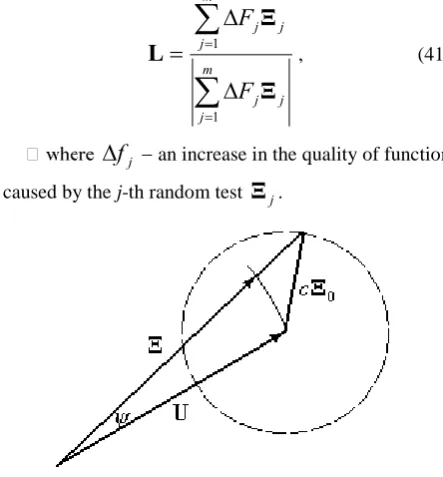
a constant magnitude (radius of hyper-sphere). Fig.2 shows the interaction of vectorsΞ
0 andU
in the process of formationΞ
. By a dotted line is indicated the hyper-sphere of possible realizations of a random vectorc
Ξ
0. As can be seen, atc
1
for all test steps are inside hyper-cone with the axisU
and angle of opening2
arcsin
c
.The smaller the value, the more narrow is the cone and the closer one test to another. The direction of the working steps in this case it is possible to determine the best test
L
Ξ
(40) or if the value of the quality function in the area of test steps, that is, in the area of the hyper-sphere radiusc
can be approximated with sufficient accuracy by the linear shape, the direction of working steps can be defined by the following formula:
m
j j j
m
j j j
F
F
1 1
Ξ
Ξ
L
, (41)j
f
[image:9.595.321.543.273.512.2]
an increase in the quality of function caused by the j-th random testΞ
j.Fig. 2. To definition of the direction in algorithm with a guide sphere
This equation is obtained by "weighing" of test directions. By "weight direction" is to be understood an increase in the objective function resulting from the test step along this direction. The larger the modulus of this increase, the more "significant" is the direction. Thus, the direction of the working step is a weighted average of all the random tests. A modification of this algorithm is an algorithm with a guide cone.
3.2.3. Algorithm with guide cone [1]
International Journal of Emerging Technology and Advanced Engineering
Website: www.ijetae.com (ISSN 2250-2459, ISO 9001:2008 Certified Journal, Volume 6, Issue 9, September 2016)
240
Calculating in them the objective function
g
j
Q
X
Ξ
, we define the point corresponding to the minimum value of the penalty objective function in accordance with (20):
j
m j
c f c
f X Ξ X Ξ
min
,..., 1
. (42)
In this direction performed the step which we will call the "working step". The search direction is determined entirely by this cone as since the random tests are selected inside. Therefore it is natural to call this guide cone.
The direction of the vector memory in this case it is possible to determine by the best test (40), and by the weighted average direction (41).
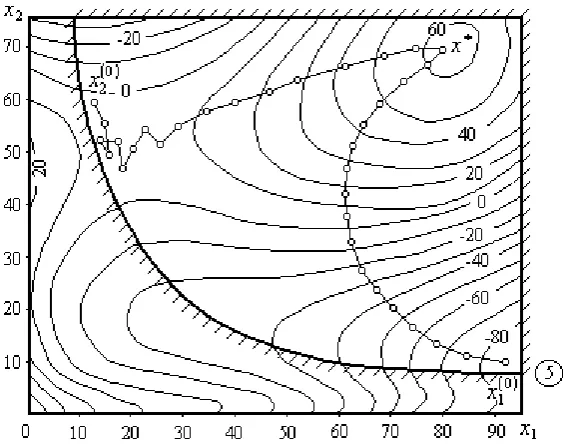
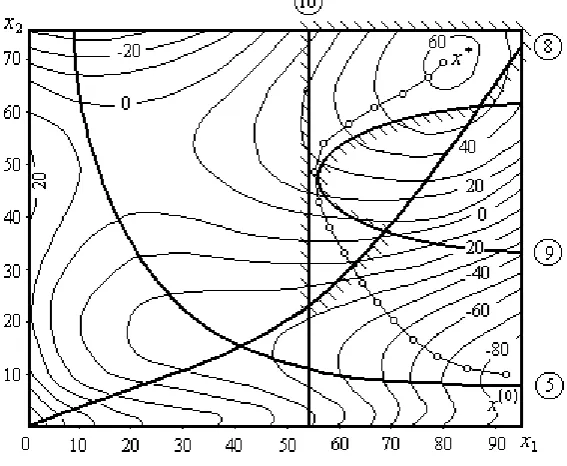
Fig.3. The algorithm with the guide cone. The motion of system in the space parameters of optimization
In Fig. 3 is shown a number of steps of search for
a
c
1
andn
m
2
out of the stateX
0 with an arbitrary initial vector the direction of memoryU
, which varies according to the best test in the search process. One can see that with the accumulation of information about the behavior of the objective function, this vectorU
turns in the direction opposite to the gradient. It is obvious that with a decrease in the opening angle of the cone of the vectorU
rotation opportunities in one working step are reduced, which is a consequence of the "inertness" of the search mentioned above. This means that at the sudden change in the direction of the gradient, the system will move in the same direction, and then gradually will rebuild the vector of memoryU
to a new state.On the other hand, the search expenditures for such algorithm at the correct direction of vector of memory
U
(or in the direction opposite the gradient) decrease with decreasing taper angle.
As the increasing of angle the system becomes more mobile, but by increasing the expenditures on search .
Mobility of system and the expenditure on search are investigated in [1]. As a measure of mobility of search is the middle angle of turn of the vector of memory
U
per one step search or the average curvature of the trajectory in the parameter space. Due to the random nature of the search the angle turning of trajectory
(Fig.3) is also a random variable.International Journal of Emerging Technology and Advanced Engineering
Website: www.ijetae.com (ISSN 2250-2459, ISO 9001:2008 Certified Journal, Volume 6, Issue 9, September 2016)
241
This remark also applies to the algorithm of guide − the working length of the step
a
, the value of the parameterc
and the number of testsm
. These parameters are determined in the same way the inertness of the search. Indeed, the greater the step and the number of tests or less than the parameter, the more inertness has the system of search , and vice versa. Obviously, the optimum values of search parameters depend entirely on the type of the objective functionF
X
and its features. In problems where this function has a lot of extremums, due much difficulty, obviously, the only practical way of finding the optimalvalues of the search parameters is the self-learning of search.
3.2.4. The global method of random search with controlled boundaries of the interval of parameters (SGEF)[10]
The proposed algorithm is a statistical method and is classified as one of wandering algorithms [1]. However, unlike the methods of random search with a return after an unsuccessful step this algorithm always produces a step:
,
i
,
,
i
,
1 1 1
1
N N
N
N N
N
Q
Q
f
Q
Q
f
N
X
X
X
X
X
X
X
(43)where:
Q
X
f
X
Q
X
max
0
,
g
s
X
,
s
1
,
2
,...,
q
(44) Here:
penalty coefficient for violation of therestrictions; gs (X)
constraints (s = 1,2, ..., q).
Let xi, xi+
limits of the control variables. Then geometric constraints take the form of:
Gs(X)= (xixi 0; xi+xi 0), (i = 1,2,....,n; s =1,2,...,q) (45)
XN+1= XN + XN; XN
E
n; XN = {x1, x2,....,xm} vector increments of coordinates, correlated the
results of previous steps. The process of correlation of increments of parameters to be optimized xi is executed
through the management by the boundaries the intervals of changing of variables xi.
This method was used in the numerical experiments for confirmation of evolutionary theory of identification of mathematical models of corrosion destruction, the main results of which are published in [11-16]. Therefore, this algorithm will be considered in more details.
Algorithm. Without loss of generality, we assume yi- =
0 ; yi+= 1, (i = 1,2,...,n). The density distribution of the
random vector YN is built by the each coordinative
reflection of the n - dimensional uniform law in hypercube with a side of [-1, 1]. The boundaries of this hypercube are reflected accordingly on the hyper-parallelepiped X.N. From any point XN for each
coordinate xi is performed step:
i= ( i i) i + i , ( i = 1,2,...,n ); (46)
yiN=(xiNxi -) / ( xi+ xi-) ; (47)
yiN+1 = ci ; (48)
yN+1= yiN+ yiN+1; (49)
xi
N+1
=yi
N+1
(xi +
xi
-) ; (50-)
xiN+1 = xiN+ xiN+1, (51)
where:
X
N(
x
1,
x
2,...,
x
n)
n- dimensional vector of parameters to be optimized on theN
- th search step; i,i − respectively the lower and upperboundaries of i th random variable
i, uniformlydistributed on the interval i, i; i a random
variable uniformly distributed on the interval [0,1]; yi
normalized value of i- th parameter in the previous step; yi
N+1
, xi
N+1
respectively normalized and non-normalized value of the i -th parameter in the
N
1
с a step size (0 c 1). After a successful step the value of step increases after
After each procedure, check the implementation of restrictions and if the restrictions are met, the next step is carried out from the point XN according to the
procedure (46)−(51). A similar procedure is performed
m times. The thus obtained vectors XN+1 are stored, and
the objective function (44) is calculated for each of them. From the thus found values of the function Q is selected best Qmin and appropriate vector Xmin is
International Journal of Emerging Technology and Advanced Engineering
Website: www.ijetae.com (ISSN 2250-2459, ISO 9001:2008 Certified Journal, Volume 6, Issue 9, September 2016)
242
The latter fact attach a global sense to algorithm of search, significantly reduces the impact of before-history of search, provides the flexibility to find direction in a difficult multi-extreme area, in case of the discontinuous objective function , in the presence of saddle points.
The mechanism of tracking successful search direction consists in the management change i - th variable in accordance with the law:
iN+1 = ||i|| (ii)/2; iN+1 = ||i|| + (ii )/2, (52)
where ||i|| = i/i2 ; i1.0 ; i 1.0.
As follows from expression (52), the boundaries of the variables i and i draw together with each successful step
interval [i, i] decreases. With the drawing together the
boundaries of the variable xi the influence of the second
term in expression (52) becomes insignificant and the value of the variable is determined by the boundaries of the vector norm . Thus, moving in the selected direction is stabilized. At the violation of any of restrictions is provided the crushing of step:
2
/
1 N N
c
c
, (11)where
In the case, if not crushing of step do not leads to further displacement of the search system, the boundary variables
i,i restored till the initial values 0,0 and retrieval
system makes a U-turn. If such a situation arises near the restriction, the search system moves away from restriction and finds a new way to improve the objective function.
To improve the convergence of the algorithm search is carried out from different starting points. The starting point can not be selected in advance, but formed by the search. As a starting point adopted the so-called "point that is the suspicious on the extreme value". It is the point at which the objective function as a result of the last step "impairs" own value.
Typically, these points lie on the boundary of permissible values of variables. The number of points is due in advance. According to the exhaustion of “point that is the suspicious on the extreme value” search stops. The algorithm operates in the global and local search mode. The search engine provides two modes of global research: basic and additional.
In the course of the main global search system performs the optimization of objective function, explores the area of permitted parameters and determines the "point of suspicious on extreme value ". In the course of additional search the system determines the extreme of objective function and refines the solution found in the local search mode. Then there is a return to the mode of the main global search with the restoration of all the parameters that the system was possessed before the additional search mode.
In further, the search is in native mode from the last starting point at previous basic mode, defined a new "point of suspicious on the extreme value of objective function", defines a new extremum, that is refined by the local search mode, etc. The best result is stored as a global extremum. Search stops on the reaching the limit on the number of starting points, which is due in advance.
The algorithm works in reverse mode and is capable find a maximal and minimal values of objective function. The initial starting point may be taken in the area of permitted parameters and outside of this area. In the latter case, the system of search includes the mode of fines at violation of restrictions. This mode is switched off as soon as the system of search return in the area of permitted parameters. Subsequently, the system of search can not go out from the permissible area.