transposition-based genome manipulations and their future
perspectives
Lajos Mátés*, Zsuzsanna Izsvák*
†
and Zoltán Ivics*
*Max Delbrück Center for Molecular Medicine, Robert-Rössle-Str., 13092 Berlin, Germany. †Institute of Biochemistry, Biological Research
Center of the Hungarian Academy of Sciences, Temesvári krt., 6726 Szeged, Hungary. Correspondence: Zoltán Ivics. E-mail: [email protected]
Abstract
To meet the increasing demand of linking sequence information to gene function in vertebrate models, genetic modifications must be introduced and their effects analyzed in an easy, controlled, and scalable manner. In the mouse, only about 10% (estimate) of all genes have been knocked out, despite continuous methodologic improvement and extensive effort. Moreover, a large proportion of inactivated genes exhibit no obvious phenotypic alterations. Thus, in order to facilitate analysis of gene function, new genetic tools and strategies are currently under development in these model organisms. Loss of function and gain of function mutagenesis screens based on transposable elements have numerous advantages because they can be applied in vivo and are therefore phenotype driven, and molecular analysis of the mutations is straightforward. At present, laboratory harnessing of transposable elements is more extensive in invertebrate models, mostly because of their earlier discovery in these organisms. Transposons have already been found to facilitate functional genetics research greatly in lower metazoan models, and have been applied most comprehensively in Drosophila. However, transposon based genetic strategies were recently established in vertebrates, and current progress in this field indicates that transposable elements will indeed serve as indispensable tools in the genetic toolkit for vertebrate models. In this review we provide an overview of transposon based genetic modification techniques used in higher and lower metazoan model organisms, and we highlight some of the important general considerations concerning genetic applications of transposon systems.
Published: 31 October 2007
GenomeBiology2007, 8(Suppl 1):S1 (doi:10.1186/gb-2007-8-S1-S1) The electronic version of this article is the complete one and can be found online at http://genomebiology.com/2007/8/S1/S1
© 2007 BioMed Central Ltd
Introduction
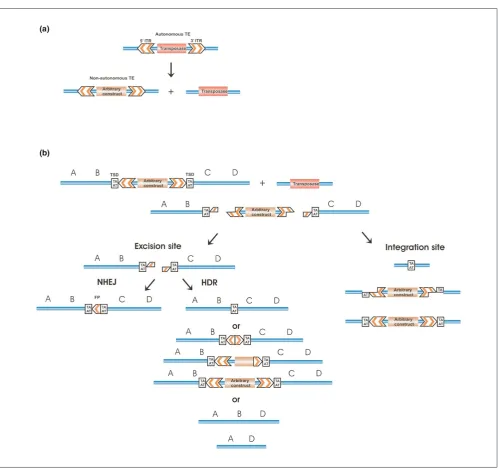
Class II transposable elements (TEs) that move in the host genome via a “cut and paste” mechanism are the most useful for genetic analyses, because of their easy laboratory handling and controllable nature. A schematic outline of the transposition process of a Tc1/mariner TE is presented in Figure 1a. Class II TEs are simply organized; they encode a transposase protein in their simple genome flanked by the inverted terminal repeats (ITRs). The ITRs carry the transposase binding sites that are necessary for trans-position (Figure 1a). The transtrans-positional process can easily be controlled by separating the transposase source from the
transposable DNA harboring the ITRs, thereby creating a non-autonomous TE. In such a two component system, the transposon can only move by trans supplementing the transposase protein (Figure 1a,b). Practically any sequence of interest can be positioned between the ITR elements, depending on experimental need. Transposition will result in excision of the element from the vector DNA and subsequent integration into a new sequence environment.
as L1; for coverage of such elements, the reader is referred to another review included in this supplement [1]. We describe those features of the transposons that are important to consider for their proper use as genetic tools. Next, we provide
[image:2.609.56.555.80.556.2]an overview of their applications in the most prominent animal models, with a focus on Caenorhabditis elegansand Droso-phila. Finally, we discuss and suggest directions for further development of transposon technology in vertebrate genetics. Figure 1
General considerations in the application of
transposons as DNA delivery tools
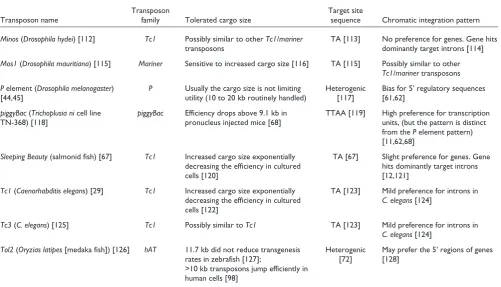
The class II TEs most frequently used in metazoan models are listed in Table 1. Five out of the eight TEs listed belong to the Tc1/marinerfamily. The predominant application of the
Tc1/marinerelements results mainly from their broad host range [2] as compared with other TEs (for example, the P
element is only active in Drosophilaflies). The basic require-ments for applicability of a TE in any given model organism are that there is a sufficient level of transpositional activity in the given host and that there is a lack of endogenous copies in the targeted host genome (in order to avoid mobilization of resident copies). Studies aimed at developing hyperactive transposon mutants have established that it is possible to increase transpositional activity using various laboratory modifications [3-5]. However, host restrictions of
Pelements could not be circumvented, despite much effort [6]. Because host specificity barriers cannot easily be challenged, transposon based genetic technologies in all of the major model organisms were dependent on the discovery of TEs that are active in the species of interest (for details, see below). The use of TEs that originated from distantly related species could guarantee satisfaction of the second requirement, if they still exhibit acceptable activity in the desired host. However, cross-mobilization is not fully
predictable and can be an issue, as was shown for the related
hATsuperfamily elements Hoboand Hermes[7].
Other important phenomena should also be considered when designing an individual experiment, such as cargo capacity of the TE, sensitivity to over-production inhibition (OPI), integration site preference, and transposition to linked chromosomal sites (‘local hopping’).
Capacity for cargo
For mutagenesis purposes, small TE vectors can be designed that retain two basic functions: the cis requirements for transposition and a mutagenic feature designed to disrupt normal gene function. However, size does matter for trans-genesis purposes, including the generation of germline modified laboratory stocks of model species and species of biotechnologic interest, as well as for human gene therapy applications. In these instances, transgene constructs that include coding regions of genes with all of the necessary transcriptional regulatory elements can exceed several kilobases in size. The effects of increasing the size of the DNA fragments cloned between the ITRs of the different TEs are listed in Table 1. Tolerance for cargo size varies greatly between elements. Although a 100 kilobase extended P
[image:3.609.55.557.119.406.2]element that is capable of transposition has been reported Table 1
The most frequently used transposable element systems in metazoan models and some of their main characteristics
Transposon Target site
Transposon name family Tolerated cargo size sequence Chromatic integration pattern
Minos(Drosophila hydei) [112] Tc1 Possibly similar to other Tc1/mariner TA [113] No preference for genes. Gene hits
transposons dominantly target introns [114]
Mos1(Drosophila mauritiana) [115] Mariner Sensitive to increased cargo size [116] TA [115] Possibly similar to other Tc1/marinertransposons Pelement (Drosophila melanogaster) P Usually the cargo size is not limiting Heterogenic Bias for 5’ regulatory sequences
[44,45] utility (10 to 20 kb routinely handled) [117] [61,62]
piggyBac(Trichoplusia nicell line piggyBac Efficiency drops above 9.1 kb in TTAA [119] High preference for transcription
TN-368) [118] pronucleus injected mice [68] units, (but the pattern is distinct
from the Pelement pattern) [11,62,68]
Sleeping Beauty(salmonid fish) [67] Tc1 Increased cargo size exponentially TA [67] Slight preference for genes. Gene decreasing the efficiency in cultured hits dominantly target introns
cells [120] [12,121]
Tc1(Caenorhabditis elegans) [29] Tc1 Increased cargo size exponentially TA [123] Mild preference for introns in decreasing the efficiency in cultured C. elegans[124]
cells [122]
Tc3(C. elegans) [125] Tc1 Possibly similar to Tc1 TA [123] Mild preference for introns in C. elegans[124]
Tol2(Oryzias latipes[medaka fish]) [126] hAT 11.7 kb did not reduce transgenesis Heterogenic May prefer the 5’ regions of genes rates in zebrafish [127]; [72] [128]
>10 kb transposons jump efficiently in human cells [98]
[8], members of the Tc1/mariner family are inhibited by increasing size. The minimal 5’ and 3’ terminal sequences necessary for highly active transposition are also well defined for the elements listed in Table 1.
Over-production inhibition
OPI describes a phenomenon of decreasing efficiency of transposition beyond a certain level of cellular transposase concentration. OPI has been described for a wide variety of TEs. Of the TEs listed in Table 1, it appears to affect at least theTc1/mariner elements [3,9] and piggyBac[10] (although a recent study [11] was unable to confirm OPI of piggyBac). Several lines of direct and indirect evidence suggest that
Tc1/marinertransposases act as oligomers. OPI is thought to occur when transposase monomers are present in excess concentrations; thus, in the absence of available DNA substrate, they form inactive or weakly active oligomers. Therefore, increasing the amount of transposase protein can have an inhibitory effect on transposition and, accordingly, the ideal level of transposase expression is not necessarily the highest level. In case OPI is an issue in a given experimental setup, it is advisable to test several conditions for transposase expression.
Integration site preference
Target site preference varies among transposons. For example, at the level of primary DNA sequence, the Tol2
element does not appear to exhibit a pronounced preference for any sequence for insertion. In contrast, the piggyBac
transposon targets the sequence TTAA, whereas all
Tc1/marinerTEs target their integration into TA dinucleo-tides (Table 1). In the case of Sleeping Beauty (SB), this preference was studied in detail, and palindromic AT repeats were found to be preferred sites for integration [12]. Compu-tational analyses revealed that target selection is determined primarily on the level of DNA structure, and not by specific base pair interactions. It was shown that preferred target sites have a bendable structure and increased distance between the central base pairs [12,13]. It is possible that similar structures are favored by other Tc1/mariner TEs. This could be interpreted as meaning that integrations will occur into any DNA available, depending solely on these preferences. This, however, is not the case. In the context of chromatin, Tc1/mariner elements have no or weak preference for transcription units, the 5’ regulatory regions are disfavored, and most hits in genes are localized in introns (Table 1). On the contrary, the Pelement has a clear preference for the 5’ regulatory regions of genes. The P
element in this respect is similar to retroviruses, because murinie leukaemia virus prefers the 5’ end of transcription units, whereas HIV exhibits strong preference for the entire length of transcription units (for review [14]). This control of integration at the chromatin level is poorly understood. One possible explanation for this can be the affinity of the transposase for unknown, chromatin associated factors. Supporting this hypothesis, a recent study showed that a
host protein, lens epithelium derived growth factor, is involved in directing HIV integration into active genes [15]. Integration site preference can greatly influence the utility of transposon vectors for different applications. For example, human gene therapy protocols would require application of transposon vectors showing the least preference for genes, for obvious safety reasons. On the contrary, mutagenesis screens can capitalize on elements that exhibit a tendency to land in genes. In this respect, the utility of transposons for mutagenesis is greatly enhanced by the availability of multiple vector systems with distinct preferences for insertion.
Local hopping
‘Local hopping’ describes a phenomenon of chromosomal transposition in which transposons have a preference to land into cislinked sites in the vicinity of the donor locus. Local hopping appears to be a shared feature of cut and paste transposons. However, the actual extent of hopping to linked chromosomal sites and the interval of local transposition varies. For example, the Pelement prefers to insert within about 100 kilobases of the donor site at a rate that is about 50-fold higher than that in regions outside that interval [16]. Similarly, in germline mutagenesis screens in mice using SB, 30% to 80% of transposons have been observed to reinsert locally on either side of the transposon donor locus [17-19]. In contrast to the Pelement, SB appears to have a much larger local transposition interval between 5 and 15 megabases [18].
The local hopping feature not only differs between different transposons; a given transposon may also exhibit great variation in different hosts, and variations can be seen between different donor loci even in the same host. For example, in case of Acelement transposition in maize, about 50% to 60% of the reinserted elements were distributed within a 5 cM distance of the donor site [20,21], whereas the frequency of local hopping greatly varies in Arabidopsis and tobacco, depending on the chromosomal location of the donor site [22-24]. Moreover, local hopping of the Ac
element in tomato appears to be overall less prevalent than in maize [25,26], and differences with regard to its tendency toward local hopping out of different transposon donor loci have been observed [27]. This variation in local hopping of the same element could possibly be explained by varying affinity of the transposase to unknown, chromatin associated factors in different hosts [28]. If that is the case, then it can be assumed that transposase mutants with altered tendency for local hopping could be created.
for saturation mutagenesis within limited chromosomal regions. Even for that purpose, however, starting with more donor sites could be the most effective arrangement, because even two donor sites in closely related loci can produce strikingly different local hopping frequencies [27].
Current state of applications of transposon
systems in prominent metazoan model organisms
In all model organisms described in the following sections, the TEs are used via slightly different approaches to reach similar goals. This is because of the distinct biology of the model organisms. Alterations in culturing or maintenance and other features of the organisms, and the features of the TEs alike, all influence the methodology of harnessing transposons as experimental tools in the particular model systems.Nematodes: Caenorhabditis elegans
In C. elegans, Tc1 and Tc3 (see Table 1) have been widely used for insertional mutagenesis during the past 20 years. The reason for this extensive use is their early discovery in this model organism. However, their use is also limited here because of two major drawbacks. First, all known isolates of
C. elegans contain multiple copies of Tc1 and Tc3, which makes identification of the relevant mutagenic insertions difficult. The second drawback is that germline mobilization of Tctransposons cannot be controlled in mutator strains, in which these elements are active in the germline. However, these drawbacks can to some extent be circumvented, because the Tcinsertion sites are well known in most of the laboratory strains, and because of differential transpo-sitional activity in the germline of the different strains.
With respect to Tc1copy numbers, the strains can be divided to low copy strains such as Bristol N2 (containing approxi-mately 30 copies) and high copy strains such as Bergerac (containing >500 copies per haploid genome) [29-31]. Tc1is active in somatic cells in all genetic backgrounds examined, but its germline activity is undetectable in Bristol and 1,000-fold lower as compared with somatic cells in Bergerac. Mutants have been isolated that exhibit increased Tc1(and occasionally other TE) activity in the germline, and their certain derivatives have low Tc1 copy numbers. These mutant strains with elevated germline transposition rates are the so-called mutator strains. Generally, the mutations in the mutators affect the RNA interference and transgene co-suppression pathways [32]. The mut-2mutator exhibits the highest frequency of transposition, at about 40-fold above Bergerac [33]. Some of its derivatives, in which the original mut-2 strain is back-crossed into the Bristol background, harbor fewer Tc1 copies. Intensive germline transposition in the mutator strains as well as stabilization of the new insertions by repeated back-crosses to low copy nonmutator strains can be achieved. The C. elegansmodel has significant advantages in supporting rapid crossing and selection procedures needed for mutagenesis by transposons.
More recently, use of the heterologous transposon Mos1
(Table 1) has also been established in C. elegans[34,35]. The
Mos1 elements are absent from the C. elegans genome; therefore, different experimental strategies involving this transposon could also be developed in C. elegans (see below).
Transposon-mediated reverse genetic approaches
Transformation of C. elegansis traditionally carried out by microinjection of DNA into the cytoplasm of the syncytial part of the gonad [36]. This predominantly results in forma-tion of long, extrachromosomal arrays (a special character-istic of C. elegans) that can pass through the germline. Infrequently, chromosomal integrations can also occur, depending on the injection conditions. Because this method is efficient, and the extrachromosomal arrays can be maintained in the transgenic strains for a long period of time, the transposon systems have not typically been utilized for the purpose of simple transgenesis.
Reverse genetics in C. elegans has been hampered by the practical inability to target specific mutations to a selected gene via homologous recombination based gene targeting. Developing this technology in C. elegans has been un-successful for a long time, because of the inefficient homolo-gous recombination and chromosomal transformation in this model organism. Recently, these difficulties were addressed by the introduction of DNA into the worms using novel methodology, which involved more efficient harvesting of chromosomal integrations and use of the new selection marker unc-119[37]. This method is not yet in routine use, however.
TE based mutagenesis is suitable for the purpose of target selected gene modifications in C. elegans. This approach relies on screening mutant libraries created by transposon insertions. In C. elegans it is relatively easy to isolate a specific transposon insertion in any genomic region of interest, using a polymerase chain reaction (PCR) based sib-selection method [38]. One difficulty in generating loss of function phenotypes with transposon insertions is that by using endogenous, unmodified Tc1-like elements, the chance for insertions creating null alleles is very low. For example, it was shown that animals homozygous for transposon insertions in the myosin light chain 2 (mlc-2) gene are phenotypically wild type. Interestingly, not even insertions in exons caused loss of function effects, because different atypical splicing events removed the Tc1part out of the mlc-2
pre-mRNA, leaving only small, in-frame deletions and insertions [39]. Analysis of five more Tc1insertions in two other genes revealed that each mutant expressed substantial quantities of mature mRNA from which most or all of the
Tc1sequences have been removed.
deletions following TE excision can be used. The following mechanism is suggested to explain transposition associated deletions. TEs generally create target site duplications upon insertion and leave footprints upon excision. These foot-prints are generated when the double strand break (DSB), created by the transposase at the excision site, is repaired by the nonhomologous end joining DNA repair pathway (Figure 1b). Alternatively, the DSB can undergo homology dependent DNA repair (HDR). This may not result in any change to the original sequence, if the wild-type homologous chromosome is available as template, and it is used for the repair. HDR can also fill back transposon sequences to different extents, in case a homologous template containing the transposon is available for repair (Figure 1b). However, one of the free DNA ends can scan the DNA at the other end for a short homology; when this is encountered, DNA repair reactions ligate the two ends, thereby deleting the intervening DNA. In the study conducted by Zwaal and coworkers [40], gene specific PCR primer pairs were used to detect Tc1
insertions in five genes, and subsequently to detect the DNA repair mediated partial deletions of these genes following transposon excision. Such deletion derivatives were detected at a surprisingly high frequency (>10-3). This approach is
definitely useful in a model organism such as C. elegansthat has short generation time and easy culturing properties.
However, the transposon insertion-deletion method described above has limitations as compared with homologous recombination based approaches. Namely, it is limited to isolating only those deletions that are of a size that is detectable by PCR and that occur between the two pre-determined gene specific primers; therefore, it is not useful for creating gene mutations other than null alleles. To circumvent these limitations, a method based on transgene directed, transposon mediated gene conversion was recently introduced [41]. This approach capitalizes on the observation that an episomal transgene construct can also serve as a template for the repair after the excision of the TE. In this protocol, a plasmid carrying an engineered gene modification and some regions homologous to the targeted locus is introduced into a mutator C. elegans strain harboring the gene specific Tc1insertion. This strain is then expanded into independent populations, in some of which the DSBs generated by transposon excision are repaired from this extrachromosomal template. These populations are subsequently tested for the presence of the desired mutation. The efficiency of this method seems to be about tenfold higher than that of the standard insertion-deletion approach mentioned above. Recently, the protocol was adapted to the use of Mos1transposition in worms [42]. The advantage of using a heterologous TE is that background transposition events can practically be ruled out.
Transposon mediated forward genetic approaches
Mutagenic insertions for forward genetics involve molecular tags that are used to clone the mutated gene rapidly.
Therefore, the above strategy utilizing the Tc1transposon is rather cumbersome for use in forward genetics research in
C. elegans, because the Tc1insertions do not provide unique tags, and so it is difficult to identify the relevant insertion responsible for a given phenotypic change. Moreover, the
Tc1elements are active in all C. elegans strains, at least in their soma. Therefore, a phenotype driven insertional muta-genesis screen is more promising by using the heterologous transposon Mos1, which expedites the process of identifying the mutated genes [35,43]. It has been shown that mobilization of Mos1can also be carried out via the generally used binary system of a non-autonomous transposon and a separate transposase source (Figure 1a). These two components are maintained as extrachromosomal arrays in separate strains, and expression of the transposase protein is controlled by a heat shock promoter [34]. The mutagenicity of the Mos1system is in the range of that of Tcelements in mutator strains [43]. Therefore, the newly developed Mos1
system is a promising tool for use in insertional mutagenesis inC. elegans.
Insects: Drosophila melanogaster
The predominantly used transposable elements in Drosophila
are the Pelement, piggyBac, Mos1, and Minos(Table 1). The two closely related hATelements Hobo and Hermesare also used to some extent, essentially for simple transgenic purposes. The most prominently used transposon in
Drosophilahas been the P element. P elements are currently active resident TEs in Drosophila.They have a very narrow host spectrum, because they are not active outside the
Drosophilagenus. Pelements are thought to be very recent invaders of the D. melanogaster genome, because they were present in recently wild caught strains but not in laboratory stocks established during the first half of the past century. The source of this horizontal transfer was presumably another Drosophilasp. The early discovery of the P element, its high transpositional activity, and the P-element-free nature of the D. melanogasterlaboratory strains have made this transposable element the workhorse of Drosophila
genetics research. Early mutagenesis schemes, similar to some extent to the C. elegans mutator strain system, were based on crossing two strains to mobilize Pelements in the genome, exploiting the phenomenon of P-M hybrid dys-genesis [44,45]. However, use of hybrid dysdys-genesis was soon exchanged for the easily controllable binary system mentioned earlier. In contrast to Tc1in C. elegans, building of this system in Drosophila was facilitated by the fact that the Pelement has no resident copies in the D. melanogaster
laboratory strains. This allowed the generation of transgenic stocks each containing a separate component of the binary transposon system in its genome: one element, encoding the
Transgenesis
Genetic transformation in Drosophila is traditionally done by the injection of preblastoderm embryos [47]. Enhance-ment of this transformation procedure via TE transposition into the genome is a widespread technique. Practically, all TEs listed above are successfully used for this purpose in
Drosophila. The injection of in vitrosynthesized mRNA as a transposase source can further enhance the efficiency of this technique because of the more rapid availability of the transposase, resulting in reduced transgene mosaicism in the embryo and therefore elevated germline transmission rates. For example, in the case of Minos based transfor-mations, such methods have been shown to yield germline transgenesis rates about tenfold higher as compared with straight plasmid injections [48]. Moreover, the application of insulator sequences in combination with TEs can facilitate reliable transgene expression, and may protect endogenous genes from the effect of enhancer elements carried by the transposon construct. Indeed, a recent study demonstrated the usefulness of scs/scs’, gypsy, and β-globin HS4 insulators to minimize position effects influencing the expression of transgenes delivered by the piggyBac trans-poson in Drosophila[49].
Transposon-mediated reverse genetic approaches
Homologous recombination is fairly inefficient in flies. Thus, classical gene targeting, as applied in mouse embryonic stem (ES) cells, has not been successfully established in Drosophila. However, induced DSBs can enhance recombination to some extent, and can trigger HDR at the breakpoints; therefore, the excision of TEs can efficiently facilitate gene conversion events. Utilizing this phenomenon, targeted gene replace-ment in Drosophila via P element induced gap repair has already been reported (some 15 years ago) [50]. P elements have also been used for the isolation of rare deletion derivatives after element excision from a gene of interest, to obtain null alleles [51], long before such a strategy was applied in C. elegans.
Transposon-mediated forward genetic approaches
Insertional mutagenesis using engineered TEs has proven to be one of the most productive and versatile approaches to disrupting and manipulating Drosophilagenes on a genome-wide scale, and by far it leads the field among metazoan model systems. The experimental strategies generally utilize the ‘jump starter/mutator’ experimental setup, as described above. The usefulness of these screens is strongly promoted by the highly developed classical genetic tools and methods in
Drosophila.
The P element has been the most widely used vehicle for these purposes. The mutagenicity of Pelement insertions is higher than that of Tc1/marinerelements (Table 1). More-over, P elements appear to transpose efficiently with large cargo sequences inserted within the transposon (Table 1). The early mutagenesis screens carried out in Drosophila
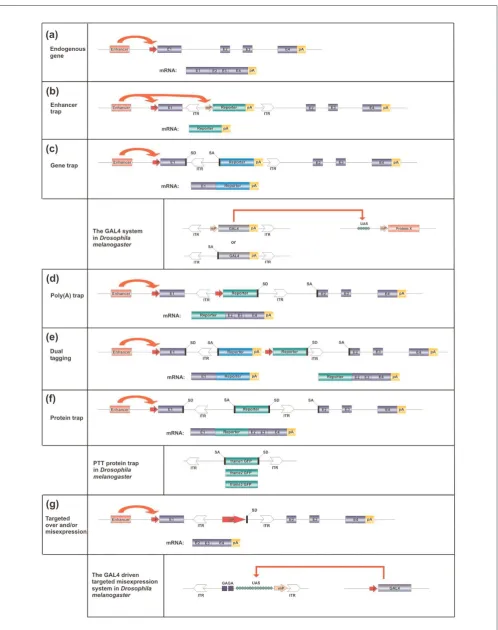
utilized vectors that harbor marker genes that are easy to screen such as white, and functional bacterial components (antibiotic resistance genes, origins of replication) that aid molecular analysis of the transposon insertion sites. Vectors of later generations were equipped with gene trapping features, representing an improvement to the basic design. The basic strategies employed to enhance the mutagenicity as well as reporting capabilities of insertional vectors by trapping transcription units are shown in Figure 2. Moreover, elements of binary systems for controlled gene expression such as the GAL4 DNA binding transcription factor (GAL4)/GAL4-upstream activator sequence (UAS) system, or for site-directed recombination such as the flip recombinase (FLP)/FLP recombinase target (FRT) system have also been incorporated into advanced vectors. Thus, a range of versatile experimental designs using P elements for insertional mutagenesis has been developed.
Enhancer trap screens are designed for the identification of enhancers by activating a reporter gene within the Pelement (Figure 2b). In early enhancer trap versions, the transposase promoter itself was utilized as a weak promoter to capture the enhancers in the genome [52]. Gene trapping is based on the activation of a promoterless reporter gene that is depen-dent on splicing between the exons of the trapped gene and a splice acceptor site carried by the transposon (Figure 2c). Thus, gene trap vectors both report the insertion of the transposon into an expressed gene, and have a mutagenic effect by truncating the transcript through imposed splicing.
Both enhancer and gene trap vectors have been combined with the yeast GAL4/UAS transcription activation system (Figure 2). For example, enhancer detection vectors that direct the expression of GAL4 in a genomic integration site dependent manner have been developed [53]. Therefore, such vectors report the expression pattern of trapped enhancer elements, and can also activate a cloned, UAS driven gene of interest in a tissue specific manner (specifically, in those cells in which GAL4 is expressed). The system proved to be highly useful for identifying genes that are involved in a variety of biological processes, and many GAL4 driver lines have been created and made available to the research community [54].
Protein trapping (Figure 2f), similar to the trapping systems described above, is also based on hybrid splicing events between an endogenous gene and the transgene cassette carried by the transposon; however, the vector is designed to ensure that the inserted reporter manifests at the protein level. A protein trap strategy to detect GFP tagged proteins expressed from their endogenous loci has been developed by Morin and coworkers [57]. The P element based PTT vector was constructed to tag proteins randomly with an enhanced GFP, without disrupting their subcellular localization. PTT carries an artificial exon that encodes GFP and is deprived of initiation and stop codons but flanked by splice acceptor and donor sequences. To enhance protein tagging efficiency, a series of constructs were created to allow reporter gene activation in each of the three reading frames (Figure 2). GFP chimeras typically retain the localization properties of the trapped proteins, except when GFP disrupts a domain necessary for subcellular targeting. Thus, transgenic lines exhibiting tissue specific GFP expression and targeting the GFP signal to virtually any compartment of the cell can be recovered. A disadvantage of the system is that it relies on the relatively rare intronic insertions of the Pelement. Other transposons such as piggyBacmay produce more intronic insertions, which may be better suited to the requirements of such a screen (Table 1; also see below).
Another way to manipulate a trapped transcription unit that has already been proven to be useful is the targeted over-expression and/or mis-over-expression system (Figure 2g). Using this method, one can bring about over-expression of the full length or truncated protein product (depending on the position of transposon insertion) of the targeted gene, thereby producing dominant phenotypes by overdosing the affected gene product. An improved version of this method is the modular mis-expression system developed by Rorth [58]. It allows directed mis-expression of Pelement targeted genes in any temporal or spatial pattern. It is practically the
reversal of the GAL4/UAS system. This modular mis-expression system benefits from the insertional preference of P element; specifically, it tends to insert upstream of the ATG codon of transcription units [58]. Therefore, the integrated transposon carrying UAS enhancer and promoter elements can frequently over-express the native full length protein. Such insertion screens can identify genes that, when over-expressed or mis-expressed in a pattern of interest, give a specific phenotype or modulate an existing mutant pheno-type. For example, in the first screen conducted by Rorth [58], when activated in the developing eye, 4% of insertions gave a dominant phenotype. The next study by Rorth and coworkers [59] demonstrated the usefulness of the system in genetic interaction screens. They identified many known and new genes involved in the migration of border cells in the ovary, by suppressing the cell migration defect on a mutant background.
An important consideration for the mutagenicity of any transposon is its insertional preferences. The insertion pattern of P elements (and that of all other TEs) is non-random (Table 1). Moreover, P element insertions have numerous ‘hotspots’ and ‘cold regions’ on a genome wide scale. Investigators at the Berkeley Drosophila Genome Project have created and analyzed large collections of insertions utilizing some of the vectors mentioned above [60]. They found that, interestingly, the observed hotspots can be divided to ‘common hotspots’ and ‘screen specific hotspots’. The first class is commonly hit by all Pelement vectors, whereas the second is preferentially hit only in a particular mutator strain [60]. Hotspots seen in local hopping are excluded from the second class. The existence of screen specific hotspots suggests that the specific parameters of the screen, such as the structure and location of the mutator transposon, can affect the spectrum of hotspots and the diversity of the targeted genes. This pheno-menon is poorly characterized, and the underlying cellular mechanisms remain unclear.
Figure 2 (see previous page)
Common hotspots represent the main obstacle to full genome coverage with P element vectors. It is estimated that about 150,000 P element insertions might need to be screened to obtain 87% saturation of the estimated 13,500
Drosophila genes [61]. To complement the use of P
elements, alternative transposon systems have successfully been contributing to large scale insertional mutagenesis of the Drosophila genome. For example, investigators at the Berkeley Drosophila Genome Project have already included
piggyBacand Minoselement based screens in the collec-tion. A large scale comparison of the insertion patterns of
piggyBacand Pelement vectors has already been reported [62]. It has been found that piggyBacexhibits an insertional preference that is distinct from that of Pelements. It does not share chromosomal hotspots that are associated with P
elements and, although piggyBacfavors genes as targets, it lacks the bias for 5’ regulatory sequences [62]. The target preference of Minosalso differs from both Pelements and
piggyBac, and appears to be similar to that of SB (Table 1). Therefore, these TEs are used as complementary tools for
Drosophilamutagenesis.
The combined use of different TEs is common in Drosophila. Practically all of the insertional mutagenesis screens have been established by the creation of ‘jump starter’ and ‘mutator’ Pelement lines, whose generation is facilitated by use of other TEs, generally the Hobo or Hermes elements. For some more sophisticated screening strategies, it is also important to have alternative TEs for effective insertional mutagenesis on a background already carrying P elements and possibly also Hobo or Hermes. Hacker and coworkers [63] used piggyBac for insertional mutagenesis on a chromo-some harboring Pelement inserted FRTsites for the genera-tion of mitotic recombinants. The FRTsites remained stably integrated, demonstrating that the two systems are compatible.
Chromosome rearrangements
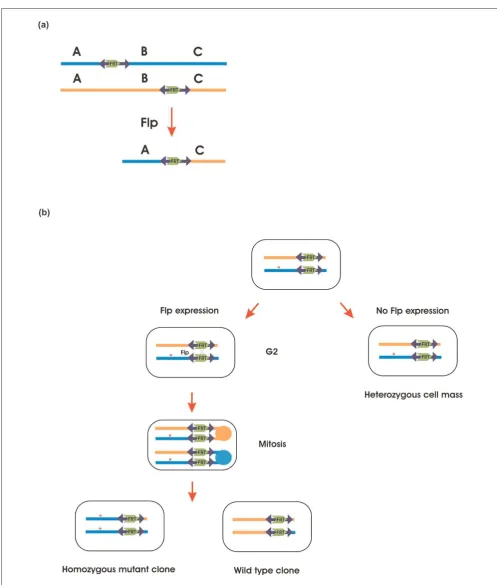
Chromosomal deletions in Drosophila are indispensable, classic genetic tools for mapping mutations, characterizing alleles, and identifying interacting loci. The P element based methods for creating deletions are extremely useful because the end-points of the deletions are molecularly marked. Furthermore, their positions can be designed, which is of particular importance in avoiding haplolethal or haplosterile loci. Two Pelement based methods are in predominant use to create chromosomal deletions [64]. One is based on the observation that Ptransposase often induces chromosomal aberrations that involve the sites of two distinctPelement insertions. The process behind this is called ‘hybrid element transposition’, in which the TE ends come from separate elements rather than a single element (the 5’ end of one element pairs with the 3’ end of another one at a different location) [65]. This results in different chromosomal rearrangements from which the deletions can be selected. An improved version of the transposon based method for creating deletions makes use of the FLP/FRT site specific
recombination system (Figure 3a). Transposon vectors, usually the P element, are used to facilitate single copy chromosomal integration of FRT sites. FLP mediated recombination between two of these Pelements can result in chromosomal rearrangements. With a sufficiently high density of starting insertions, even single gene deletions can be created. Progress is currently being made toward covering the genome of Drosophila with characterized deletions [64].
This technique can also create predesigned chromosomal translocations between the chromatids in flies with transgenic FRTsites at identical positions on the homolo-gous chromosomes [66]. Thus, FLP mediated recombination can be used to generate mitotic clones (Figure 3b), in which only clones of the cells of interest are homozygous for the studied mutation, whereas the rest of the organism is heterozygous. Spatially or temporally controlled expression of FLP recombinase can create homozygous clones in any tissue or developmental stage of interest.
Chromosomal inversions are also powerful tools in classical
Drosophila genetics. They have been applied in the majority of genetic screens in Drosophilaas balancer chromosomes, because they can block recombination within the region of the inversion. For practical reasons, the balancers carry visible markers, and are also designed to be recessive lethal. Most of them were isolated as spontaneous or induced chromosomal rearrangements having break points in vital genes. TEs have not been typically used to engineer balancers. The balancers greatly help to map and maintain mutations in the Drosophilagenome.
Vertebrates
Transposons have successfully been used in lower metazoan and plants for transgenesis and insertional mutagenesis, but until the reactivation of the SB transposon system in 1997 [67] there was no indication that any DNA based trans-posons in vertebrates were sufficiently active for these purposes. Subsequently, other elements were shown to catalyze efficient transposition in vertebrate model orga-nisms. For example, the insect TEs piggyBac and Minos
have proven to be useful in germline mutagenesis in verte-brates [68,69]. Moreover, the reconstructed endogenous amphibian element Frog Prince [70], the reconstructed human Hsmar1element [71], and the Tol2element isolated from the medaka fish [72] have been found to be active in vertebrates. We do not extensively review current trans-poson applications in vertebrate models here (other reviews in this supplement provide coverage of these areas). How-ever, we do discuss the general approaches that have been taken, and suggest further avenues for exploiting TEs in applications in vertebrates.
Figure 3
transposase proteins, owing to the fact that the majority of these TEs are not endogenous in the most important model organisms.
Transgenesis
Classic ways to induce expression of foreign genes in vertebrates rely on microinjection of nucleic acids into oocytes or fertilized eggs. Two main drawbacks of these approaches are the low rates of genomic integration and that the injected DNA generally integrates as a concatemer. Both drawbacks can be circumvented by utilizing transposition mediated gene delivery, because it can increase the efficiency of chromosomal integration and facilitates single copy insertion events. Single units of expression cassettes are presumably less prone to transgene silencing than are the concatemeric insertions created using classical methods. Retroviral vectors are also useful tools for the same purpose, but their integration pattern is potentially more mutagenic because of their preference for the 5’ end of transcription units (for review [14]). In case of transgenesis, a single copy insertion away from endogenous genes is clearly desired. The insertional spectrum of Tc1/mariner elements satisfies this need the best (Table 1), because these elements integrate randomly at the genome level, and do not exhibit pronounced bias for integration into genes. Another particular problem concerning transgenesis is that founders that develop from the injected oocytes or eggs are predominantly mosaic for the transgene, because integration generally occurs relatively late during embryonic development. Therefore, in order to promote successful transmission of the transgene through the germline to the next generation, it is necessary to shift the window of integration events to as early as possible. This can be facilitated by co-injection of engineered transposons with transposase mRNA. This method has been employed to generate transgenic zebrafish with Tc3[73], Mos1[74], Tol2[72] and SB [75]; transgenic Xenopus with SB [76] and Tol2 [77]; and transgenic mice with SB [78-80].
Transposon mediated forward genetic approaches
To carry out phenotype-driven forward genetic screens in vertebrates, one must achieve efficient germline muta-genesis. To date, the most efficient mutagen in the mouse germline is the chemical N-ethyl-N-nitrosourea (ENU). Mutagenesis rates using ENU are two to three orders of magnitude higher than those with insertional mutagens [81]. However, ENU is an ethylating agent that generally causes single base pair mutations. Therefore, the average pheno-typic effect of an insertional vector can be more dramatic, and the total number of insertions required to reach the same mutagenic effect is expected to be lower. Moreover, identification of the point mutations causing a phenotype requires positional cloning, which is time consuming and laborious work. Therefore, insertional mutagenesis is an attractive alternative to ENU screens.
Both TEs and retroviral vectors can successfully be applied to insertional mutagenesis. Cultured cells can be efficiently infected with viruses [82]. A pseudotyped retrovirus has also been applied to generate insertions in zebrafish via microinjection of virus particles into blastula stage embryos [83]. In this approach, however, the transgenic founder fish are mosaic and must be out-crossed to establish F1fish with retrovirus insertions. Therefore, one drawback of the appli-cation of retroviruses is that the convenient ‘jump starter’ and ‘mutator’ method is not applicable with these vectors. More-over, handling of such viruses may bring up safety issues.
Using TEs as tools for insertional mutagenesis is simpler, and the ‘jump starter’ and ‘mutator’ scheme can be applied. In Drosophila, transposon mediated insertional muta-genesis is predominantly carried out using such a scheme. This is also the preferred method in vertebrates, and it has successfully been adopted for germline mutagenesis in the mouse, but not in zebrafish, in which the screens are currently performed by co-injection of the transposon DNA and the transposase mRNA.
In zebrafish, SB and Tol2 were shown to be useful for insertional mutagenesis in co-injection experiments [84-88]. In the mouse, it has been demonstrated that SB, Minos, and piggyBac transposases can function in transgenic animals [17,18,68,78,89-92]. Recently, SB based insertional mutagenesis was also established in the rat [93,94]. In these experiments, chromosomally resident transposon vectors were mobilized in transgenic animals that either ubiqui-tously expressed the transposase or expressed the trans-posase in the male germline using the protamine 1 (Prm1) promoter. SB based insertional mutagenesis has successfully been applied in mice to recover a range of mutant pheno-types in a crossing scheme applying a balancer chromosome [95]. This and other studies [96] demonstrated that local saturation mutagenesis of a genomic region is a realistic goal using the SB transposon system with a chromosomally resident transposon donor site. The Minostransposase has also been shown to mobilize non-autonomous Minos
elements in mice by transposase expression in the oocytes using ZP3 [69] and in the lymphocytes using CD2 promoters [91]. PiggyBac has also been used in co-injection experiments in mice [68]. The activity of Tol2element has already been demonstrated in mouse ES cells [97] and in vivoin the mouse liver [98].
use, whereas in animal systems other reporters such as GFP are sufficient for this purpose. Similar to the GAL4/UAS system in Drosophila, a conditional, tetracycline regulated system has been shown to be applicable to TE mediated insertional mutagenesis in mice [99].
As an alternative to the loss of function approaches, targeted over-expression and/or mis-expression has been shown to be efficient in somatic tissues of mice using SB. Viral enhancer promoter elements incorporated into SB vectors were shown to be useful in inducing cancer in experimental animals [100,101]. These screens can also capitalize on TEs with an intronic preference for insertion, such as members of the Tc1 family. In order to devise customized screens for cancer development, a current approach is focusing on establishing mouse lines that conditionally express the transposase [102]. One approach is to express the transposase from tissue specific promoters. The second is to generate a Cre recombinase inducible transposase allele, and to take advantage of the many existing Cre strains to induce muta-genesis in specific tissues in mice [102].
Perspectives
Insertional mutagenesis
The parallel development and application of alternative transposon systems will be beneficial for insertional muta-genesis in vertebrates. As described above, P elements,
piggyBac, and Minoselements are already in use as comple-mentary transposon tools for large scale mutagenesis in
Drosophila[60,62]. The combined use of these TE systems makes full genome coverage with TE based insertional mutagenesis a realistic goal. Work to create comprehensive mutant collections is already underway in mice by the Knockout Mouse Project (National Institutes of Health, US) and by the European Conditional Mouse Mutagenesis project. The goal of these initiatives is to knock out every single gene in mouse ES cells using conditional gene trapping and gene targeting approaches. It is therefore likely that collections of transposon insertional mutants for reverse genetic purposes will prove even more useful in species that lack efficient homologous recombination based gene targeting techniques and ES cells, such as zebrafish, Xenopus tropicalis, and rats.
The ‘jump starter’ and ‘mutator’ experimental scheme is widely used in both Drosophila and mice. Even though microinjection does not appear to be a bottleneck in transposition based transgenesis in zebrafish, establishing a mutagenesis set-up based on breeding could be beneficial. With this method, the numerous injections of fertilized eggs could be eliminated, and transposition events segregated into offspring by simple crossing of founders. Moreover, local saturation mutagenesis would also be possible in this way in zebrafish. In mice, the existence of the mutator lines and the local hopping feature of the TE systems offers the possibility of using local saturation mutagenesis to screen
through chromosomal regions harboring as yet unidentified genes in which disease causing mutations occur.
Insertional mutagenesis with SB in both germline and somatic tissues of the mouse has been approached with mutator lines harboring transposon donor loci containing many copies of the transposon vector in the form of concatemeric arrays. The reason for this is that transposition rates out of multicopy concatemers is far more efficient than out of single copy donor sites. Consequently, Dupuy and coworkers [100] used founder lines with 148, 214, and 358 transposon copies in concatemeric donor sites, whereas Collier and colleagues [101] worked with animals containing approximately 25 copies of the mutagenic transposon in somatic mutagenesis studies. Similarly, a concatemeric donor site of approximately 30 transposon copies was used in a gene trap germline screen in mice [95]. However, trans-position out of multicopy donor loci may complicate assign-ment of a phenotype to a particular transposon insertion in at least two ways. First, a phenotype may be associated with multiple insertion events, and segregation of the insertions may lead to loss or change in the phenotype. Second, recombination between newly transposed transposon copies and the donor concatemer could lead to unwanted genomic rearrangements, as was observed by Geurts and coworkers [95]. The most likely explanation for the rearrangements is that transposition out of a concatemer generates new trans-posase binding sites linked incis(in case of local hops) or on other chromosomes. However, because transposon copies remain at the original donor locus, transposase can recombine chromosomal sequences that are located between the transposase binding sites by hybrid element trans-position (described in the section on Drosophila, above), leading to deletions and translocations. Alternatively, hybrid element transposition involving transposon copies in the donor concatemer could result in similar genomic rearrangements. Such chromosomal rearrangements are unlikely to occur (or would occur at a much reduced frequency) if a single copy donor was used. Thus, there is a great need for transposon systems that are sufficiently active for efficient transposition out of single copy donors in animal breeding schemes. Ongoing work in our laboratory aiming at the isolation of hyperactive transposases could potentially eliminate the need for concatemeric donor sites.
The use of single-copy donors would also enable the application of dosage-dependent color markers such as tyrosinase and agouti for phenotypic marking of transgenic animals. These markers could be exploited to confer a light brown or a much darker color to an albino coat, depending on whether they are present as single- or double-copy transgenes in the mouse genome, respectively. This would be helpful to identify homozygous transposon insertions.
of protein over-expression studies in mice as well. In two somatic mutagenesis studies in mice, the trapped genes were over-expressed from a viral long terminal repeat carried by the SB transposon [100,101]. In these experiments, trans-cription started from the viral enhancer promoter and the resulting pre-mRNA was spliced between a splice donor site carried by the transposon vector and the downstream exon of the trapped gene (Figure 2). However, translation of the hybrid mRNA (and generation of a sense protein product) is dependent on the fortuitous occurrence of an in-frame ATG codon in the downstream exons. This can clearly be a limitation to successful over-expression events. To circum-vent this problem, we propose that, similar to the PTT vectors applied in Drosophila(Figure 2), splice donor sites set to phases 0, 1, and 2 (according to the three possible reading frames) and built in behind a strong mammalian translation initiation consensus sequence could be used in over-expression studies. Because the intron phase distribu-tion of mouse genes is unequal [103], using only the phase 0 construct could result in a success rate of about 50% in terms of trapping potential.
In the over-expression experiments mentioned above, the transposase was continuously expressed in the soma. This could result in multiple rounds of transposition events of the same transposon copy. Therefore, for these and possibly other experimental set-ups, it would be beneficial to limit secondary jumps by transposon immobilization after transposition [104]. One possibility in this regard would be to use recombinase systems, where FRTor loxPsites could be inserted within the ITRs. This way, Cre or Flp mediated recombination would result in the partial loss of the ITR and a part of the internal transposon sequences, and so the resulting defective transposon would not be able to move again. The caveat of this strategy is that insertion of FRTor
loxP sites could negatively affect transposition of the modified element.
Chromosomal rearrangements
The most effective agent in terms of mutagenicity is the widely used chemical mutagen ENU. The application of ENU is an efficient method in mice, but the precise identification of the mutations in a screen requires a laborious positional cloning approach. Classical genetic tools similar to those extensively used in Drosophilacould facilitate this identifi-cation process. In this respect, both nested deletion sets and balancers over different loci could be especially useful in mouse forward genetics screens. One particularly interesting transposon based experimental system for insertional mutagenesis and chromosomal rearrangements, developed by Osborne and coworkers in Arabidopsis [105], could facilitate the creation of these genetic tools. Briefly, in this arrangement, the advantages of Ac/Dstransposition and the Cre-lox system were combined in Arabidopsis. The Dslox
transposon, carrying the phosphonothricin (Ppt) resistance gene and a loxP site just in front of a promoterless
gentamicin resistance (Gn) gene, jumps out of a donor locus harboring the chlorsulfuron (Cs) resistance gene and another loxPsite between a strong plant promoter and the
Cs coding sequence (Figure 4a). The excision and re-integration of the Dslox transposon may result in double
PptR and CsR phenotypes. Subsequent Cre mediated
recombination leads to two types of chromosomal rearrangement; deletions are associated with GnRphenotype
and clearance of PptR and CsR phenotypes (Figure 4b),
whereas inversions are associated with a GnRphenotype and
silencing of the Cs resistance gene (CsS; Figure 4c). The
other important key features of the system are the single copy donor sites at different chromosomal positions that make herbicide selection for coupled excision and re-insertion possible, and the local hopping feature of Ac
transposition that generates the dominantly useful arrangement of two loxP sites for inversions and deletions of intervening DNA of different length. The system results in inversions, deletions, and smaller numbers of trans-locations, creating different resistance palettes and different phenotypes and viability. This system can be used to map loci with nested deletions and to establish balancer chromo-somes from the inversions [106].
In case of vertebrates, composite arrangements of trans-posons carrying a loxP site embedded in another TE that carries the other loxPsite could facilitate the generation of allelic series of local hops out of single copy donor sites. The
Tol2and piggyBac systems, having larger cargo tolerance, appear to be suitable for the delivery of such a complex arrangement. Transposition of the inner element out of the donor locus would move one loxPaway, whereas the other
loxPwould stay at the original site. This system, based on the subsequent Cre-mediated chromosomal engineering between the transposed loxPsites, would greatly facilitate the creation of both of the two experimental tools in mice described above: viable balancer chromosomes and chromosomes bearing large deletions for establishing segmental haploidy.
Balancer chromosomes usually contain one or more inverted segments, and they suppress recombination within those segments. They are used as genetic tools to maintain recessive lethal mutations, providing an easy selection system for the heterozygous carrier animals. Balancer chromosomes are extensively used in Drosophilaand also proved to be very useful in mouse genetics [106,107]. In
with a visible marker, allowing the discrimination of animals that are heterozygous or homozygous for that marker [106]. This improvement permits discrimination of the embryonic lethal mutations generated in a screen from the mutation carried by the balancer, and it makes the creation of useful balancers without pre-defined end points possible. Such an improved mouse balancer chromosome has been reported by Nishijima and coworkers [108]. They used two coat color markers, tyrosinase and K14-agouti, and therefore the dosage of the inversion chromosome could be visually recognized.
Because of their usefulness, a current goal of the mouse community is to establish balancers that cover the entire mouse genome. Technologies based on transposition could be developed to create a series of viable inversions bridging over a genomic locus using an experimental scheme similar to the one developed by Osborne and coworkers [105] in
[image:15.609.56.555.87.508.2]Arabidopsis. The donor chromosome is generally favored for insertion over the other chromosomes in SB transposition about 60% of the time, with about 40% occurring in a 5 to 15 Mbp local hopping window and about 20% outside the typical local hopping range, but still chromosomally linked Figure 4
A transposition mediated system for creating chromosomal rearrangements in Arabidopsis.(a)Structure of the donor locus. (b)Creation and detection of chromosomal deletions. (c)Creation and detection of chromosomal inversions (for details, see text). Ac-ITR, Acelement inverted terminal repeat; CsRand CsS, chlorsulfuron resistance gene (active and silenced, respectively); GnRand GnS, gentamicin resistance gene (active and silenced, respectively); loxP, recognition site of the Cre recombinase; P, promoter; pA, poly(A); PptRand PptS, phosphonothricin resistance gene (active and silenced,
to the donor locus [95,96]. Thus, a large portion of trans-position events could yield potentially useful chromosomal rearrangements in mice.
Chromosomes harboring segmental haploidy can be used for deletion mapping of loci. An effective approach for mapping novel recessive mutations is based on a nested chromosomal deletion set, in which the deletions vary in size and have different end-points, but they partially overlap across the locus suspected of carrying the candidate gene affected by the mutation. After crossing these mice with a mouse strain carrying a novel recessive mutation, the recessive phenotype is observed when the deletion spans over the mutated gene on the other allele, and therefore no wild-type gene product is present.
The classical gene targeting approach to create these deletions would require two targeting steps for each deletion end-point (for review [109]). It is a laborious work, especially in the case of nested deletion sets, despite the fact that one end-point could be common for all of the deletions. Moreover, it is difficult to predict the viability of a given chromosomal rearrangement. To circumvent these difficul-ties, a deletion set has been made where the second end-points of the deletions were defined by a randomly integrating recombinant retrovirus that carried the second
loxPsite necessary for Cre mediated rearrangements [110]. Recently, this method has been further developed by delivering both of the loxPsites into the genome of mouse ES cells via retroviral gene transfer [111]. In this study, the authors created two recombinant retroviruses, one of which, referred to as ‘anchor virus’, introduced the first loxP site, whereas the other, referred to as ‘saturating virus’, introduced the second loxPsite into the genome of ES cells. The drug selection system applied by these authors was fairly similar to the one used by Osborne and coworkers in
Arabidopsis [105]. Although these methods based on the application of replication-defective retroviruses proved to be useful, one can predict that a transposon-based system that exploits local hopping of transposons, and guarantees single-copy insertion of the second loxP site, would represent an efficient and elegant approach to the creation of nested chromosomal deletion sets in mice.
Conclusion
Significant progress has recently been made toward the development of improved transposon based systems for genome manipulations in vertebrate model organisms, including transgenesis and insertional mutagenesis in both germline and somatic tissues. These efforts begin to pay dividends to the research community, as we witness an increasing interest in applying transposon tools for applications ranging from simple tissue culture setups to generate transgenic cell clones to experimental systems aiming to unravel genetic networks cooperating in
tumori-genesis using transposon mutatumori-genesis in living animals. Nevertheless, applications of transposons for vertebrate genetics are still lagging somewhat behind the sophisticated, transposon-based technology platform that has been established in invertebrate model systems, especially in
Drosophila. We highlighted in this article possible improve-ments, and new avenues for the use of transposons in vertebrates, based on the lessons that have been learned in invertebrates. This ‘technology transfer’ offers a possibility to expoit transposable elements as gene delivery agents to their full potential.
Competing interests
The authors declare that they have no competing interests.
Acknowledgement
This article has been published as part of Genome Biology Volume 8, Supplement 1, 2007: Transposons in vertebrate functional genomics. The full contents of the supplement are available online at http://genomebiology.com/supplements/8/S1.
References
1. Ostertag EM, Madison BB, Kano H: Mutagenesis in rodents using the L1 retrotransposon.Genome Biol2007, 8(Suppl 1):S16. 2. Plasterk RH, Izsvak Z, Ivics Z: Resident aliens: the Tc1/mariner
superfamily of transposable elements.Trends Genet 1999, 15: 326-332.
3. Zayed H, Izsvak Z, Walisko O, Ivics Z: Development of hyperac-tive sleeping beauty transposon vectors by mutational analysis.Mol Ther 2004, 9:292-304.
4. Baus J, Liu L, Heggestad AD, Sanz S, Fletcher BS: Hyperactive transposase mutants of the Sleeping Beauty transposon.Mol Ther 2005, 12:1148-1156.
5. Pledger DW, Coates CJ: Mutant Mos1 mariner transposons are hyperactive in Aedes aegypti. Insect Biochem Mol Biol 2005, 35: 1199-1207.
6. O’Brochta D A, Handler AM: Mobility of P elements in drosophilids and nondrosophilids.Proc Natl Acad Sci USA 1988, 85:6052-6056.
7. Sundararajan P, Atkinson PW, O’Brochta DA: Transposable element interactions in insects: crossmobilization of hobo and Hermes.Insect Mol Biol 1999, 8:359-368.
8. Ring BC, Bass HW, Garza D: Construction and transposition of a 100-kilobase extended P element in Drosophila.Genome Res 2000, 10:1605-1616.
9. Lohe AR, Hartl DL: Autoregulation of mariner transposase activity by overproduction and dominant-negative comple-mentation.Mol Biol Evol 1996, 13:549-555.
10. Wu SC, Meir YJ, Coates CJ, Handler AM, Pelczar P, Moisyadi S, Kaminski JM: piggyBac is a flexible and highly active transpo-son as compared to Sleeping Beauty, Tol2, and Mos1 in mammalian cells.Proc Natl Acad Sci USA 2006, 103:15008-15013. 11. Wilson MH, Coates CJ, George AL Jr: PiggyBac
transposon-mediated gene transfer in human cells.Mol Ther 2007, 15:139-145.
12. Vigdal TJ, Kaufman CD, Izsvak Z, Voytas DF, Ivics Z: Common physical properties of DNA affecting target site selection of sleeping beauty and other Tc1/mariner transposable ele-ments.J Mol Biol 2002, 323:441-452.
13. Liu G, Geurts AM, Yae K, Srinivasan AR, Fahrenkrug SC, Largaes-pada DA, Takeda J, Horie K, Olson WK, Hackett PB: Target-site preferences of Sleeping Beauty transposons. J Mol Biol 2005, 346:161-173.
15. Ciuffi A, Llano M, Poeschla E, Hoffmann C, Leipzig J, Shinn P, Ecker JR, Bushman F: A role for LEDGF/p75 in targeting HIV DNA integration.Nat Med 2005, 11:1287-1289.
16. Tower J, Karpen GH, Craig N, Spradling AC: Preferential trans-position of DrosophilaP elements to nearby chromosomal sites.Genetics 1993, 133:347-359.
17. Fischer SE, Wienholds E, Plasterk RH: Regulated transposition of a fish transposon in the mouse germ line. Proc Natl Acad Sci USA 2001, 98:6759-6764.
18. Carlson CM, Dupuy AJ, Fritz S, Roberg-Perez KJ, Fletcher CF, Largaespada DA: Transposon mutagenesis of the mouse germline.Genetics 2003, 165:243-256.
19. Luo G, Ivics Z, Izsvak Z, Bradley A: Chromosomal transposition of a Tc1/mariner-like element in mouse embryonic stem cells.Proc Natl Acad Sci USA 1998, 95:10769-10773.
20. Dooner HK, Belachew A, Burgess D, Harding S, Ralston M, Ralston E: Distribution of unlinked receptor sites for transposed Ac elements from the bz-m2(Ac) allele in maize.Genetics 1994, 136:261-279.
21. Chen J, Greenblatt IM, Dellaporta SL: Transposition of Ac from the P locus of maize into unreplicated chromosomal sites. Genetics 1987, 117:109-116.
22. Bancroft I, Dean C: Transposition pattern of the maize element Ds in Arabidopsis thaliana.Genetics 1993, 134:1221-1229. 23. Machida C, Onouchi H, Koizumi J, Hamada S, Semiarti E, Torikai S,
Machida Y: Characterization of the transposition pattern of the Ac element in Arabidopsis thalianausing endonuclease I-SceI.Proc Natl Acad Sci USA 1997, 94:8675-8680.
24. Dooner HK, Keller J, Harper E, Ralston E: Variable patterns of transposition of the maize element activator in tobacco. Plant Cell 1991, 3:473-482.
25. Belzile F, Yoder JI: Pattern of somatic transposition in a high copy Ac tomato line.Plant J 1992, 2:173-179.
26. Osborne BI, Corr CA, Prince JP, Hehl R, Tanksley SD, McCormick S, Baker B: Ac transposition from a T-DNA can generate linked and unlinked clusters of insertions in the tomato genome. Genetics 1991, 129:833-844.
27. Knapp S, Larondelle Y, Rossberg M, Furtek D, Theres K: Trans-genic tomato lines containing Ds elements at defined genomic positions as tools for targeted transposon tagging. Mol Gen Genet 1994, 243:666-673.
28. Kunze R, Weil CF: The hAT and CACTA superfamilies of plant transposons.In Mobile DNA II.Edited by Craig NL, Craigie R, Gellert M, Lambowitz AM. Washington, DC: ASM Press; 2002:565-610.
29. Emmons SW, Yesner L, Ruan KS, Katzenberg D: Evidence for a transposon in Caenorhabditis elegans.Cell 1983, 32:55-65. 30. Liao LW, Rosenzweig B, Hirsh D: Analysis of a transposable
element in Caenorhabditis elegans.Proc Natl Acad Sci USA 1983, 80:3585-3589.
31. Egilmez NK, Ebert RH, 2nd, Shmookler Reis RJ: Strain evolution in Caenorhabditis elegans: transposable elements as markers of interstrain evolutionary history.J Mol Evol 1995, 40:372-381. 32. Ketting RF, Plasterk RH: A genetic link between co-suppression and RNA interference in C. elegans.Nature 2000, 404:296-298. 33. Collins J, Saari B, Anderson P: Activation of a transposable
element in the germ line but not the soma of Caenorhabditis elegans.Nature 1987, 328:726-728.
34. Bessereau JL, Wright A, Williams DC, Schuske K, Davis MW, Jor-gensen EM: Mobilization of a Drosophila transposon in the Caenorhabditis elegansgerm line.Nature 2001, 413:70-74. 35. Bessereau JL: Insertional mutagenesis in C. elegansusing the
Drosophilatransposon Mos1: a method for the rapid identifi-cation of mutated genes.Methods Mol Biol 2006, 351:59-73. 36. Mello CC, Kramer JM, Stinchcomb D, Ambros V: Efficient gene
transfer in C. elegans: extrachromosomal maintenance and integration of transforming sequences.EMBO J 1991, 10:3959-3970.
37. Berezikov E, Bargmann CI, Plasterk RH: Homologous gene tar-geting in Caenorhabditis elegansby biolistic transformation. Nucleic Acids Res 2004, 32:e40.
38. Rushforth AM, Saari B, Anderson P: Site-selected insertion of the transposon Tc1 into a Caenorhabditis elegans myosin light chain gene.Mol Cell Biol 1993, 13:902-910.
39. Rushforth AM, Anderson P: Splicing removes the Caenorhabdi-tis eleganstransposon Tc1 from most mutant pre-mRNAs. Mol Cell Biol 1996, 16:422-429.
40. Zwaal RR, Broeks A, van Meurs J, Groenen JT, Plasterk RH: Target-selected gene inactivation in Caenorhabditis elegansby using a frozen transposon insertion mutant bank.Proc Natl Acad Sci USA 1993, 90:7431-7435.
41. Barrett PL, Fleming JT, Gobel V: Targeted gene alteration in Caenorhabditis elegansby gene conversion.Nat Genet 2004, 36: 1231-1237.
42. Robert V, Bessereau JL: Targeted engineering of the Caenorhab-ditis elegansgenome following Mos1-triggered chromosomal breaks.EMBO J 2007, 26:170-183.
43. Williams DC, Boulin T, Ruaud AF, Jorgensen EM, Bessereau JL: Characterization of Mos1-mediated mutagenesis in Caenorhabditis elegans: a method for the rapid identification of mutated genes.Genetics 2005, 169:1779-1785.
44. Rubin GM, Kidwell MG, Bingham PM: The molecular basis of P-M hybrid dysgenesis: the nature of induced mutations. Cell 1982, 29:987-994.
45. Bingham PM, Kidwell MG, Rubin GM: The molecular basis of P-M hybrid dysgenesis: the role of the P element, a P-strain-specific transposon family.Cell 1982, 29:995-1004.
46. Cooley L, Kelley R, Spradling A: Insertional mutagenesis of the Drosophilagenome with single P elements.Science 1988, 239: 1121-1128.
47. Spradling AC: P element-mediated transformation in Droso-phila.In Drosophila: A Practical Approach. Oxford-Washington, DC: IRL Press; 1986:175-198.
48. Kapetanaki MG, Loukeris TG, Livadaras I, Savakis C: High frequen-cies of Minos transposon mobilization are obtained in insects by using in vitro synthesized mRNA as a source of transposase.Nucleic Acids Res 2002, 30:3333-3340.
49. Sarkar A, Atapattu A, Belikoff EJ, Heinrich JC, Li X, Horn C, Wimmer EA, Scott MJ: Insulated piggyBac vectors for insect transgenesis.BMC Biotechnol 2006, 6:27.
50. Gloor GB, Nassif NA, Johnson-Schlitz DM, Preston CR, Engels WR: Targeted gene replacement in Drosophila via P element-induced gap repair.Science 1991, 253:1110-1117.
51. Tsubota S, Schedl P: Hybrid dysgenesis-induced revertants of insertions at the 5’ end of the rudimentary gene in Drosophila melanogaster: transposon-induced control muta-tions.Genetics 1986, 114:165-182.
52. Bier E, Vaessin H, Shepherd S, Lee K, McCall K, Barbel S, Ackerman L, Carretto R, Uemura T, Grell E,et al.: Searching for pattern and mutation in the Drosophila genome with a P-lacZ vector.Genes Dev 1989, 3:1273-1287.
53. Brand AH, Perrimon N: Targeted gene expression as a means of altering cell fates and generating dominant phenotypes. Development 1993, 118:401-415.
54. Hayashi S, Ito K, Sado Y, Taniguchi M, Akimoto A, Takeuchi H, Aigaki T, Matsuzaki F, Nakagoshi H, Tanimura T,et al.: GETDB, a database compiling expression patterns and molecular loca-tions of a collection of Gal4 enhancer traps.Genesis 2002, 34: 58-61.
55. Friedrich G, Soriano P: Promoter traps in embryonic stem cells: a genetic screen to identify and mutate developmental genes in mice.Genes Dev 1991, 5:1513-1523.
56. Lukacsovich T, Asztalos Z, Awano W, Baba K, Kondo S, Niwa S, Yamamoto D: Dual-tagging gene trap of novel genes in Drosophila melanogaster.Genetics 2001, 157:727-742.
57. Morin X, Daneman R, Zavortink M, Chia W: A protein trap strat-egy to detect GFP-tagged proteins expressed from their endogenous loci in Drosophila.Proc Natl Acad Sci USA 2001, 98: 15050-15055.
58. Rorth P: A modular misexpression screen in Drosophila detecting tissue-specific phenotypes. Proc Natl Acad Sci USA 1996, 93:12418-12422.
59. Rorth P, Szabo K, Bailey A, Laverty T, Rehm J, Rubin GM, Weigmann K, Milan M, Benes V, Ansorge W,et al.: Systematic gain-of-func-tion genetics in Drosophila.Development 1998, 125:1049-1057. 60. Bellen HJ, Levis RW, Liao G, He Y, Carlson JW, Tsang G,
Evans-Holm M, Hiesinger PR, Schulze KL, Rubin GM,et al.: The BDGP gene disruption project: single transposon insertions associ-ated with 40% of Drosophilagenes.Genetics 2004, 167:761-781. 61. Spradling AC, Stern D, Beaton A, Rhem EJ, Laverty T, Mozden N,