B r e a s t c o m p r e s si o n - a n
e x pl o r a ti o n of p r o bl e m s olvi n g
a n d d e ci sio n m a ki n g i n
m a m m o g r a p h y
N i g h ti n g a l e , JM, M u r p hy, FJ, Ro bi n s o n , L, N e w t o n-H u g h e s , AM a n d
H o g g , P
h t t p :// dx. d oi.o r g / 1 0 . 1 0 1 6 /j. r a di. 2 0 1 4 . 1 1 . 0 0 4
T i t l e B r e a s t c o m p r e s si o n - a n e x pl o r a ti o n of p r o b l e m s olvi n g a n d d e ci sio n m a k i n g in m a m m o g r a p h y
A u t h o r s N i g h ti n g al e, JM, M u r p hy, FJ, R o bi n s o n , L, N e w t o n-H u g h e s , AM a n d H o g g , P
Typ e Ar ticl e
U RL T hi s v e r si o n is a v ail a bl e a t :
h t t p :// u sir. s alfo r d . a c . u k /i d/ e p ri n t/ 3 3 2 6 1 /
P u b l i s h e d D a t e 2 0 1 5
U S IR is a d i gi t al c oll e c ti o n of t h e r e s e a r c h o u t p u t of t h e U n iv e r si ty of S alfo r d . W h e r e c o p y ri g h t p e r m i t s , f ull t e x t m a t e r i al h el d i n t h e r e p o si t o r y is m a d e f r e ely a v ail a bl e o nli n e a n d c a n b e r e a d , d o w nl o a d e d a n d c o pi e d fo r n o
n-c o m m e r n-ci al p r iv a t e s t u d y o r r e s e a r n-c h p u r p o s e s . Pl e a s e n-c h e n-c k t h e m a n u s n-c ri p t fo r a n y f u r t h e r c o p y ri g h t r e s t r i c ti o n s .
Breast compression – an exploration of problem solving and decision-making
in mammography
Julie M Nightingale
Fred Murphy
Leslie Robinson
Ann Newton-Hughes
Peter Hogg
Abstract
Objective: Mammography breast compression decreases radiation dose and reduces potential for motion and geometric unsharpness, yet there is variability in applied compression force within and between some centres. This article explores the problem solving process applied to the application of breast compression force from the mammography practitioners’ perspective.
Methods: A qualitative analysis was undertaken using an existing full data set of transcribed qualitative data collected in a phenomenological study of mammography practitioner values, behaviours and beliefs. The data emerged from focus groups conducted at six NHS breast screening centres in England (participant n=41), and semi-structured interviews with mammography educators (n=6). A researcher followed a thematic content analysis process to extract data related to
mammography compression problem solving, developing a series of categories, themes and sub-themes. Emerging themes were then peer-validated by two other researchers, and developed into a model of practice.
Conclusion: The application of compression should no longer be considered as one single task within mammography, but is now recognised as a seven stage problem solving continuum. This continuum model is the first to be applied to mammography, and is adaptable and transferable to other radiography practice settings. In searching for the ‘ideal’ compression scenario, practitioners choose between often imperfect options to gain an appropriate balance between compassion and technical
perfection. This decision is influenced by a range of factors and prior experiences.
Background
Breast compression decreases radiation dose and reduces the potential for motion artefact and geometric unsharpness.1,2 Insufficient compression may be detrimental to image quality3; compressing beyond an optimum level may have an effect on client discomfort.4,5 Imaging centres do not specify a desired target compression force,6 however most recommend a range and maximum.7 This can result in compression force variability between and within clients (consecutive screening).8-11 Murphy et al postulated that the application of compression force may require a high degree of problem solving and decision making,12 and our article explores this concept further. There is sparse evidence related to problem solving within radiography 13-15 and none within mammography.
A problem is a task requiring a response when no satisfactory solution is immediately evident.16 Problem solving is a complex process influenced by personal preferences, skills and experiences,17,18 and includes two opposing models:
behavioural, incorporating elements of ‘trial and error’ and habitual responses;
cognitive, using ‘heuristics’ (rules of thumb; judgements) to make decisions in the
presence of uncertainty.17 These problem solving models incorporate decision-making (choosing an alternative with the highest probability of success).18 Analytical
decision making requires conscious cognitive input, time and preparation,19 whereas
In situations with tight time pressures, high stakes or increased ambiguity, experts often use intuitive approaches.20-22 Intuition has been previously linked with
radiography practice.13,14 Conflicting demands between image quality, radiation dose and patient experience during the application of mammography compression may result in uncertainty and ambiguity, both challenges to problem solving.16 This conflict between the ‘process’ (patient experience) and the ‘product’ (the resultant image) has recently been recognised by Strudwick in an ethnographic study of radiography workplace culture23 and was noted as a ‘professional dilemma’ in a phenomenological study by Lundvall et al.24 To date no models of the mammography compression problem solving process have been developed, and an enhanced understanding may be valuable in identifying best practice and reducing variation. This research involves the analysis of existing qualitative research data,12 aiming to propose a problem solving model for compression force application with due regard to existing models of problem solving and decision making.
Method
two other researchers. None of the researchers were mammography practitioners by profession, potentially reducing bias and assumptions within the study. The study adopted the principles of rigorous 'trustworthiness' criteria.26,27
Findings
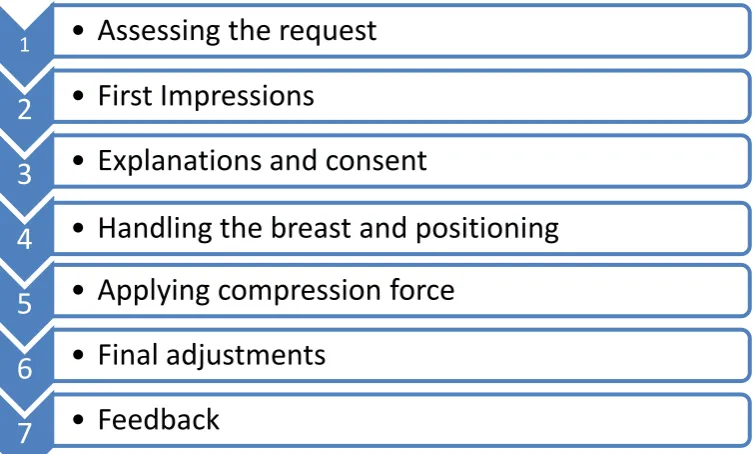
Seven consecutive stages in which the mammography compression problem solving process is informed emerged from the data (see Figure 1). Each of the stages will be explored using quotations from the participants (italicised) within the text.
Stage 1 - Assessing the Request
The mammography request is scrutinised and the participant’s initial opinion of the required compression force (low, normal, high) is formulated. Referral mechanism is influential; symptomatic patients often have greater compression tolerance ‘because they are in a different frame of mind aren’t they?’, whereas clients who have had previous surgery, radiotherapy, cysts or pacemakers ‘...you’re thinking the breast
may be a bit tender’. Breast compression with implants caused uncertainty for most practitioners who noted that guidance was sparse and conflicting. Breast screening attendance history is informative: ‘I think if it is their first time and they are quite nervous, you tend to go a bit easy on the compression, because I don’t want the lady not to come back for the second round’. Age and menopausal status influences the physical qualities of the breast; some participants note that they are ‘gentler’ with younger women, nevertheless one participated indicated ‘I think you just take more time to explain what you’re going to do’. Several participants noted that older clients appear to have a lot of breast pain.
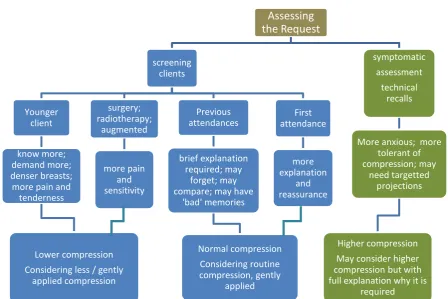
Many participants outlined their initial compression force ‘rules of thumb’ for each of the main categories of clients encountered, and these are illustrated diagrammatically in Figure 2.
Stage 2 – First Impressions
how well the patient can move, their actual movement, their whole body shape…’.
Participants discussed disabled clients ‘...it just takes longer, but we don’t
compromise... it is in their interest to get the best possible on them.’ Their admiration for these clients is clear: ‘...they are quite a lot more stoical...they are amazing actually’. In an attempt to maintain client dignity, first impressions of the client’s size and shape, prior to undressing, inform the choice of compression paddle device used: ‘I’d be looking at the size of her even before she took her clothes off and estimating whether I may need a larger paddle or not and so try and do that at that time rather than while she’s topless’.
Stage 3 – Explanation and Consent
Both compliance and empowerment of the client is important for a successful
examination, though tensions exist between these two goals. A rapid assessment of client anxiety is made: ‘As soon as the lady comes through the room, you do get a general feeling of how anxious or calm she is...’. One practitioner noted that at this
stage ‘I’m going into automatic pilot really’, although the main perspective was that
‘...every lady is an individual and each one can make you work in a different way’.
An extremely anxious client will alter the practitioner’s compression force ‘plan’, either reducing it: ‘...I’m going to go really soft’, or more commonly ‘I don’t think you’d alter your compression but you might alter your approach’. Participants had various
strategies to deal with clients who had a prior poor experience: ‘I might apply the compression differently…’, to ensure that the anxious client is ‘willing to work with you rather than against you’. A strategy employed by several practitioners is to tell a ‘white lie’ about equipment: ‘They put the words in your mouth, they are saying “oh is this a new machine?” You will say “oh yes...I am sure you will find it a lot easier”...it was a complete lie but it works very well.’
Some clients exhibit higher expectations, and this was anticipated by many participants as the mobile screening vans moved through more affluent areas: ‘There is definitely a difference…there is no doubt about it’; ‘certain ladies expect a slightly different type of treatment’. One participant indicated ‘I think they’re used to being in control more…they don’t sort of trust you to know what you’re doing’. They are
‘...asking you to compromise it [the procedure] on the way in’, and indeed a couple of
understanding of English also challenged the participants’ problem solving process, as they often appeared to have limited understanding of the purpose of the mammogram.
Stage 4 – Handling the breast and positioning
An experienced practitioner will gain insight into how much compression will be required, and how much discomfort may be felt, by the touch and feel of the breast: ‘I think it is when you get hold of the breast, you can tell what sort of breast you have got’. ‘Soft and floppy’ breasts were noted by participants to require more compression to reduce breast thickness, but also as an immobilisation aid to minimise ‘wobble’. Clients with dense breasts and those post radiotherapy were
noted to be more sensitive and less able to tolerate higher compression forces. Poor positioning makes the application of compression force very difficult. One of the mammography educators explained ‘...without good positioning, compression could be a total waste of time’.
Stage 5 – Applying Compression Force
The application of compression force is accompanied by visual, tactile, and client feedback. One educator explains: ‘I would like [students’] focus to be on what the woman can tolerate...I would like them to be able to tell by touch, by feel, by
observing the change in the skin and also keeping an eye on the woman herself,
both visually and in verbal feedback’. Participants unanimously describe touch as the
most important sensation related to compression, feeling for the tautness of the breast ‘like an orange type texture’. During positioning client feedback is very important: ‘...you’re watching the woman’s expression, you don’t want her to be wincing or be uncomfortable’, and they describe a ‘gentle coaxing’ to enable
sufficient compression to be applied. Participants explain the need to achieve an optimum breast thickness, but ‘...after that any more compression only adds pain’.
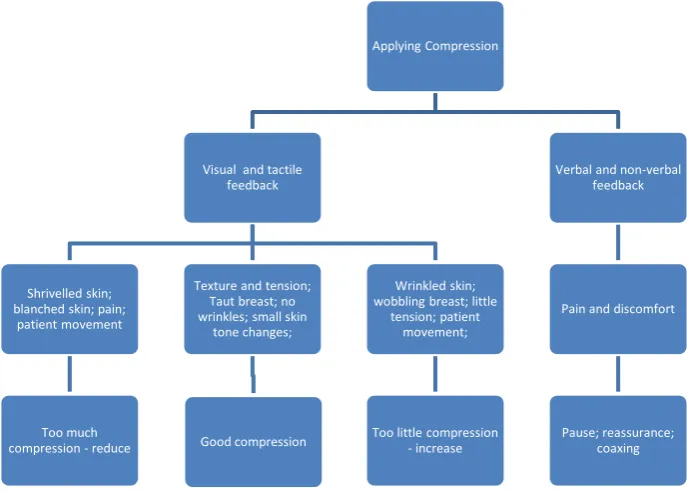
The visual, tactile and client feedback outlined above influenced compression force decision-making in a predictable manner as demonstrated in Figure 3.
Stage 6 – Final Adjustments
turning that knob, you can feel what the pressure’s like, you can feel the resistance.’ Where clients are in discomfort but require more compression, subtle approaches are used by many participants to gain compliance: ‘I find sometimes it tricks their mind a little bit, they think that it’s not as much, but it is, because you do it so, so slowly’. One educator recounted her distraction techniques: ‘I go into hairdresser mode, so you know, I’m talking about their hair, their nails, what they’re doing for the rest of the day...’.
Where a client has insufficient compression but is unwilling to accept any more, many participants discussed the ethical implications ‘...if you thought it wasn’t
sufficient to produce a good image then I don’t think it’s plausible to irradiate’ and ‘...once she withdraws her consent you have to stop’. A more comprehensive explanation strategy is used: ‘So once you’ve explained the radiation dose decreases as compression increases...they’re happy with it and they let you
compress a little more’.
Some participants check the numerical compression display values before exposure. This aspect of compression practice appears to completely divide the mammography community, with some participants valuing the additional numerical information: ‘We are kind of given an idea of a number to check’ and others being opposed to it: ‘I’d never look at a number, never.’ Educators recognise this polarising phenomenon as
they work with mammography students from many different breast imaging units: ‘Some people have numbers in their minds...I teach breast until it’s taut. I don’t say look at the number and stop when it reaches a particular number’. However several
participants do routinely check the display values, noting that ‘Sometimes it sort of takes you by surprise the amount of compression’. Some participants have a
minimum value in mind, and maximum values are also mentioned: ‘I don’t like it if I’ve gone above 13...but sometimes the ladies don’t flinch a bit, they seem fine with
it’.
Stage 7 – Feedback
Feedback at the end of the procedure is frequently positive: ‘Lots of ladies go out saying that was nowhere near as bad as I thought it was going to be’. Some
that the advent of digital mammography has ‘...brought into everybody’s consciousness creases and folds in the skin which is demonstrated really clearly on
a digital film but not necessarily in an analogue film...whether it has increased the
compression or not, I’m not sure’. However several participants believed that the technological changes had resulted in ‘compression creep’: ‘...we can’t see blurring on our monitors on the mobile unit, so we think we had better put more compression on because we don’t know whether that is blurred or not’.
Compression practice is influenced by audit. In some centres there appears to be a culture of fear of getting too many technical recalls (TR), and this may have adverse effects: ‘...sometimes I feel that maybe I do put a bit too much [compression] on so I’m not getting a TR’; ‘We are governed by the technical recall rate...so all the time in your head you are thinking this is really hard for this woman.’ Similarly, inadequate compression force resulting in false positive recalls is also a concern: ‘How many
people are going to be called for assessment if I don’t get the pressure on, unnecessarily, the extra worry?’.
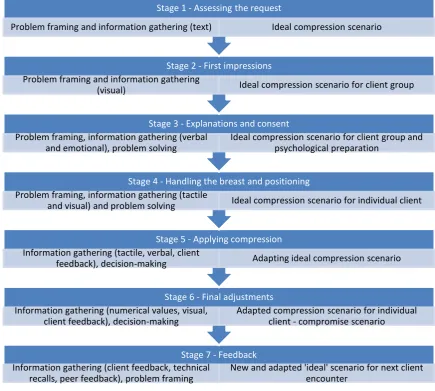
Summarising these seven successive stages, Figure 4 presents a model of compression problem solving and decision-making related to the mammography examination. Problem framing occurs in stages 1-2, with further information gathering in stages 3-4. An ‘ideal’ compression force for the client is applied at stage 5, but at stage 6 (final adjustments) the ‘ideal’ compression scenario may be challenged. Stage 7 involves subsequent feedback which may influence the practitioner’s baseline ‘ideal’ scenario. There is parity in participant behaviour within stages 1-5, however stage 6 appears to over-rule all the previous decisions and a degree of inconsistency between participants emerges.
Discussion
adapt and respond to key physical and emotional triggers during the examination to attempt to produce the desired compression outcome.
The seven stage problem solving model outlined in Figure 4 has parallels with a three stage radiography process described by Lundvall et al as planning, producing the image, and evaluation.24 The model has resonance with behavioural problem solving,17 using some ‘rules of thumb’ to guide the problem solving process. Decision making is largely intuitive as identified previously within studies of radiography ‘experts’; 13-15
mammography trainee decision models may differ as suggested by Benner’s novice to expert continuum.20
Many practitioners in our study do not routinely utilise any objective measures to assist in their selection of optimum compression force. The measures available to them include compression force and thickness values from the mammography machine, as well as values noted on previous mammogram imaging. Recent scientific developments 6 promise in the future to assist practitioners by reducing the subjectivity of compression force application, focussing upon the internal pressure within the breast, rather than the external force applied to it. However a lack of engagement by many participants with the objective measures currently available suggests that a culture shift may be required for these new ‘pressure controlled mammography protocols’ to be adopted. In the meantime it is reassuring that the application of an appropriate amount of compression force in a compassionate way is clearly emphasised within this study as the participants’ primary goal.
Conclusion
This research has demonstrated that the mammography compression process appears to be a combination of both art and science, with practitioner experience and specialisation helping to define the appropriate balance between compassion and technical perfection. We identified that a wide range of information is gathered by practitioners to inform decision making about compression force application. We have proposed a model of problem solving which will have value within routine breast screening practice and the training of practitioners. This seven stage continuum model is the first to be applied to mammography, and is adaptable and transferable to other radiography practice settings where a greater appreciation of complex problem solving and decision making within the radiographic process is required.
References
1. NHSBSP National Quality Assurance Coordinating Group. Quality Assurance Guidelines for mammography including radiographic quality control. NHSBSP Publication No 63, April 2006
3. Mercer CE (a), Hogg P, Cassidy S, Denton ERE. Does an increase in
compression force really improve visual image quality in mammography? - An initial investigation. Radiography 2013; 19: 363-365
4. Lee L, Strickland V, Wilson R, Evans A. Fundamentals of Mammography. 2003 2nd Edition. Churchill Livingstone
5. Hogg P, Taylor M, Szczepura K, Mercer C and Denton E, 2012. Pressure and breast thickness in mammography - an exploratory calibration study. British Journal of Radiology 2013 Jan;86(1021):20120222.DOI:
10.1259/bjr.20120222.
6. de Groot JE, Broeders JM, Branderhorst W, den Heeten GJ, Grimbergen CA. A novel approach to mammographic breast compression: Improved
standardization and reduced discomfort by controlling pressure instead of force. Medical Physics 2013 Aug; 40(8):081901. doi: 10.1118/1.4812418. 7. Perry N, Broeders M, de Wolf C, Törnberg S, Holland R, Von Karsa L.
European Guidelines for Quality Assurance in Breast Cancer Screening and Diagnosis, 4th ed. (Office for Official Publications of the European
Communities, Luxembourg, 2008).
8. Myklebust A, Seierstad T, Stranden E, Lerdal A. Level of satisfaction during mammography screening in relation to discomfort, service provided, level of pain and breast compression. European Journal of Radiography 2009; 1(2): 66-72
9. Mercer CE (b), Hogg P, Lawson R, Diffey J, Denton ERE. Practitioner compression force variability in mammography: a preliminary study British Journal of Radiology 2013;86: 20110596
10. Mercer CE (c), Hogg P, Szczepura K, Denton ERE. Practitioner compression force variation in mammography: A 6-year study Radiography 2013; 19:200-206
11. Mercer CE(d), Szczepura K, Kelly J, Millington SR, Denton ERE, Borgen R et al. A 6-year study of mammographic compression force: Practitioner variability within and between screening sites. Radiography 2014. Accepted and
available online ahead of print. DOI: 10.1016/j.radi.2014.07.004 12. Murphy F, Nightingale J, Robinson L, S.Mackay, D. Seddon, Hogg P.
Compression force behaviours: An exploration of the beliefs and values influencing the application of breast compression during screening mammography. Radiography 2014.Accepted and in press.
http://dx.doi.org/10.1016/j.radi.2014.05.009
13. Bowman S. Technical evaluation of radiographs: a case study in radiographic judgement and decision-making. In: Paterson A, Price R, eds. Current Topics In Radiography Number 3 1997: 69–86, 1st ed. London: W. B. Saunders
Company Ltd.
14. Prime MJ, Le Masurier SM. Defining how we think: an investigation of
decision making processes in diagnostic radiographers using the ‘think aloud’ technique. Radiography 2000; 6(3): 169–178
15. Larsson W, Lundberg N, Hillergård K. Use your good judgement –
Radiographers’ knowledge in image production work. Radiography 2009; 15(3):e11-e21
solving: Theory, research, and training (pp. 11-27). 2004. Washington, D.C.: American Psychology Association
17. Hardin LE. Problem-Solving Concepts and Theories. Journal of Veterinary Medical Education 2002; 30(3): 227–230
18. Newell A, Simon HA. Human problem solving. Englewood Cliffs, NJ:Prentice Hall,1972
http://shelf1.library.cmu.edu/cgibin/tiff2pdf/newell/box00018/fld01306/bdl0001/ doc0001/newell.pdf- accessed 12.12.10
19. Saaty TL. Decision making with the analytic hierarchy process. Int. J. Services Sciences 2008; 1(1):83–98.
20. Benner P. From novice to expert: excellence and power in clinical nursing practice, 1984.Menlo Park CA: Addison-Wesley.
21. Cioffi J. Decision making by emergency nurses in triage assessments.
Accident and Emergency Nursing 1998; 6(4): 184-191
22. Hall KH. Reviewing intuitive decision-making and uncertainty: the implications for medical education. Medical Education 2002:36: 216–224
doi: 10.1046/j.1365-2923.2002.01140.x
23. Strudwick RM. The radiographic image: A cultural artefact? Radiography
2014; 20:143-147
24. Lundvall L, Dahlgren MA, Wirell S. Professionals’ experiences of imaging in the radiography process – A phenomenological approach. Radiography
2014;20(2):48-52
25. Burnard P. A method of analysing interview transcripts in qualitative research.
Nurse Education Today 1991; 11:461-6
26. Lincoln YS, Guba EG. Naturalistic Enquiry. London: Sage; 1985. 27. Murphy FJ, Yielder J. Establishing rigour in qualitative radiography.
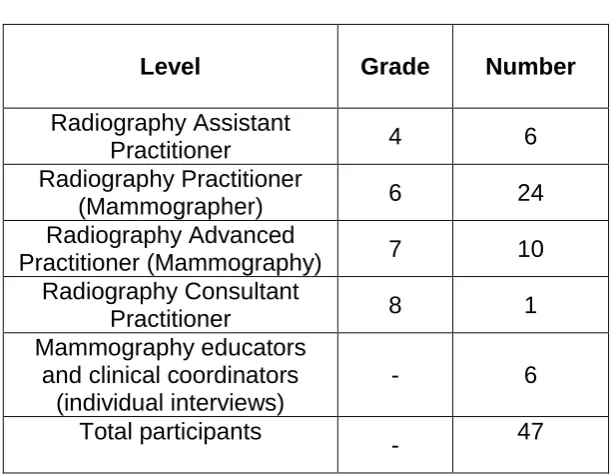
Table 1 Study Participants
Level Grade Number
Radiography Assistant
Practitioner 4 6
Radiography Practitioner
(Mammographer) 6 24
Radiography Advanced
Practitioner (Mammography) 7 10 Radiography Consultant
Practitioner 8 1
Mammography educators and clinical coordinators
(individual interviews)
- 6
Total participants
- 47
Table 2 Focus Group Questions
Mammography Practitioners Focus Group questions
1 Describe your decision making process when considering how much compression you will apply to the breast 2 At what point do you make a decision(s) about the amount of compression to be applied?
3 What factors influence your level of compression?
4 Under what circumstances would you use increased compression? 5 Under what circumstances would you use less compression?
Figure 1 The seven stages of the mammography examination that contribute towards compression force problem solving and decision-making
1
• Assessing the request
2
• First Impressions
3
• Explanations and consent
4
• Handling the breast and positioning
5
• Applying compression force
6
• Final adjustments
Figure 2 Assessing the Request –predictable compression force judgements (rules of thumb) for each of the main categories of clients encountered
Assessing the Request screening clients Younger client know more; demand more; denser breasts; more pain and tenderness
Lower compression Considering less / gently
applied compression surgery; radiotherapy; augmented more pain and sensitivity Previous attendances brief explanation required; may forget; may compare; may have
'bad' memories Normal compression Considering routine compression, gently applied First attendance more explanation and reassurance symptomatic assessment technical recalls
More anxious; more tolerant of compression; may
need targetted projections
Higher compression May consider higher compression but with full explanation why it is
Figure 3 – The influence of visual, tactile and client feedback on the decision making process during the application of compression force
Applying Compression
Visual and tactile feedback
Shrivelled skin; blanched skin; pain;
patient movement
Too much compression - reduce
Texture and tension; Taut breast; no wrinkles; small skin
tone changes;
Good compression
Wrinkled skin; wobbling breast; little
tension; patient movement;
Too little compression - increase
Verbal and non-verbal feedback
Pain and discomfort
Figure 4. The seven stage continuum mammography compression process model. The left hand column indicates where different elements of problem analysis occur (problem framing, information gathering, problem solving and decision making). The right hand column identifies how the stages of problem solving influence the ‘ideal’ compression scenario.
Stage 7 - Feedback
Information gathering (client feedback, technical recalls, peer feedback), problem framing
New and adapted 'ideal' scenario for next client encounter
Stage 6 - Final adjustments
Information gathering (numerical values, visual, client feedback), decision-making
Adapted compression scenario for individual client - compromise scenario
Stage 5 - Applying compression
Information gathering (tactile, verbal, client
feedback), decision-making Adapting ideal compression scenario
Stage 4 - Handling the breast and positioning
Problem framing, information gathering (tactile
and visual) and problem solving Ideal compression scenario for individual client
Stage 3 - Explanations and consent
Problem framing, information gathering (verbal and emotional), problem solving
Ideal compression scenario for client group and psychological preparation
Stage 2 - First impressions
Problem framing and information gathering
(visual) Ideal compression scenario for client group
Stage 1 - Assessing the request