R E S E A R C H
Open Access
An
S-type singular value inclusion set for
rectangular tensors
Caili Sang
**Correspondence: [email protected] College of Data Science and Information Engineering, Guizhou Minzu University, Guiyang, Guizhou 550025, P.R. China
Abstract
AnS-type singular value inclusion set for rectangular tensors is given. Based on the set, new upper and lower bounds for the largest singular value of nonnegative rectangular tensors are obtained and proved to be sharper than some existing results. Numerical examples are given to verify the theoretical results.
MSC: 15A18; 15A69
Keywords: rectangular tensors; nonnegative tensors; singular value; inclusion set
1 Introduction
LetR(C) be the real (complex) field,p,q,m,nbe positive integers,l=p+q,m,n≥ and
N={, , . . . ,n}. We callA= (ai···ipj···jq) a real (p,q)th orderm×ndimensional rectangular
tensor, or simply a real rectangular tensor, denoted byA∈R[p,q;m,n], if
ai···ipj···jq∈R, ≤i, . . . ,ip≤m, ≤j, . . . ,jq≤n.
Whenp=q= ,Ais simply a realm×nrectangular matrix. This justifies the word ‘rectan-gular’. We callAnonnegative, denoted byA∈R+[p,q;m,n], if each of its entriesai···ipj···jq≥.
For any vectorsx= (x,x, . . . ,xm)T,y= (y,y, . . . ,yn)Tand any real numberα, denote
x[α]= (xα
,xα, . . . ,xαm)Tandy[α]= (yα,yα, . . . ,yαn)T. LetAxp–yqbe a vector inRmsuch that
Axp–yqi=
m
i,...,ip= n
j,...,jq=
aii···ipj···jqxi· · ·xipyj· · ·yjq,
wherei= , . . . ,m. Similarly, letAxpyq–be a vector inRnsuch that
Axpyq–j=
m
i,...,ip= n
j,...,jq=
ai···ipjj···jqxi· · ·xipyj· · ·yjq,
wherej= , . . . ,n. If there are a numberλ∈C, vectorsx∈Cm\{}, andy∈Cn\{}such that
⎧ ⎨ ⎩
Axp–yq=λx[l–],
Axpyq–=λy[l–],
thenλis called the singular value ofA, and (x,y) is a pair of left and right eigenvectors of
A, associated withλ, respectively. Ifλ∈R,x∈Rm, andy∈Rn, then we say thatλis an H-singular value ofA, and (x,y) is a pair of left and right H-eigenvectors associated with
λ, respectively. If a singular value is not an H-singular value, we call it an N-singular value ofA[]. We call
λ=max
|λ|:λis a singular value ofA
the largest singular value [].
Note here that the definition of singular values for tensors was first proposed by Lim in []. Whenlis even, the definition in [] is the same as in []. Whenlis odd, the definition in [] is slightly different from that in [], but parallel to the definition of eigenvalues of square matrices []; see [] for details.
Whenm=n, such real rectangular tensors have a sound application background. For example, the elasticity tensor is a tensor withp=q= andm=n= or ; for details, see []. Due to the fact that singular values of rectangular tensors have a wide range of practical applications in the strong ellipticity condition problem in solid mechanics [, ] and the entanglement problem in quantum physics [, ], very recently, it has attracted attention of researchers [–]. Changet al. [] studied some properties of singular val-ues of rectangular tensors, which include the Perron-Frobenius theorem of nonnegative irreducible tensors. Yanget al. [] extended the Perron-Frobenius theorem of nonnegative irreducible tensors to nonnegative tensors, and gave the upper and lower bounds of the largest singular value of nonnegative rectangular tensors.
Our goal in this paper is to propose a singular value inclusion set for rectangular tensors and use the set to obtain new upper and lower bounds for the largest singular value of nonnegative rectangular tensors.
2 Main results
In this section, we begin with some notation. LetA∈R[p,q;n,n]. For∀i,j∈N,i=j, denote
Ri(A) =
i,...,ip,j,...,jq∈N
|aii···ipj···jq|,
rji(A) =
δji···ipj···jq=
|aii···ipj···jq|=Ri(A) –|aij···jj···j|,
Cj(A) =
i,...,ip,j,...,jq∈N
|ai···ipjj···jq|,
cij(A) =
δi···ipij···jq=
|ai···ipjj···jq|=Cj(A) –|ai···iji···i|,
where
δi···ipj···jq=
⎧ ⎨ ⎩
ifi=· · ·=ip=j=· · ·=jq,
Theorem LetA∈R[p,q;n,n],S be a nonempty proper subset of N,S be the complement of¯
S in N.Then
σ(A)⊆ϒS(A) =
i∈S,j∈¯S
ˆ
ϒi,j(A)∪ ˜ϒi,j(A)
∪ i∈¯S,j∈S
ˆ
ϒi,j(A)∪ ˜ϒi,j(A)
,
where
ˆ ϒi,j(A) =
z∈C:|z|–rji(A)|z| ≤ |aij···jj···j|max
Rj(A),Cj(A)
,
˜ ϒi,j(A) =
z∈C:|z|–cji(A)|z| ≤ |aj···jij···j|max
Rj(A),Cj(A)
.
Proof For anyλ∈σ(A), letx= (x,x, . . . ,xn)T∈Cn\{}andy= (y,y, . . . ,yn)T∈Cn\{}
be the associated left and right eigenvectors, that is,
A
xp–yq=λx[l–], ()
Axpyq–=λy[l–]. ()
Let
|xs|=max i∈S
|xi| , |xt|=max i∈¯S
|xi| , |yg|=max i∈S
|yi| , |yh|=max i∈¯S
|yi| ,
wi=max i∈N
|xi|,|yi| , wS=max
i∈S {wi}, wS¯=maxi∈¯S {
wi}.
Then, at least one of|xs|and|xt|is nonzero, and at least one of|yg|and|yh|is nonzero.
We divide the proof into four parts.
Case I: Suppose thatwS=|xs|,wS¯=|xt|, then|xs| ≥ |ys|,|xt| ≥ |yt|.
(i) If|xs| ≥ |xt|, then|xs|=maxi∈N{wi}. Thesth equality in () is
λxls–=
δti···ipj···jq=
asi···ipj···jqxi· · ·xipyj· · ·yjq+ast···tt···tx p–
t y q t.
Taking modulus in the above equation and using the triangle inequality give
|λ||xs|l–≤
δti···ipj···jq=
|asi···ipj···jq||xi| · · · |xip||yj| · · ·yjq|
+|ast···tt···t||xt|p–|yt|q
≤
δti···ipj···jq=
|asi···ipj···jq||xs| l–+|a
st···tt···t||xt|l–
=rts(A)|xs|l–+|ast···tt···t||xt|l–,
i.e.,
If|xt|= , then|λ|–rts(A)≤ as|xs|> , and it is obvious that
|λ|–rts(A)|λ| ≤≤ |ast···tt···t|Rt(A),
which implies thatλ∈ ˆϒs,t(A). Otherwise,|xt|> . Moreover, from thetth equality in (),
we can get
|λ||xt|l–≤
i,...ip,j,...,jq∈N
|ati···ipj···jq||xi| · · · |xip||yj| · · · |yjq|
≤Rt(A)|xs|l–. ()
Multiplying () by () and noting that|xs|l–|xt|l–> , we have
|λ|–rts(A)|λ| ≤ |ast···tt···t|Rt(A),
which also implies thatλ∈ ˆϒs,t(A)⊆
i∈S,j∈¯Sϒˆi,j(A).
(ii) If|xt| ≥ |xs|, then|xt|=maxi∈N{wi}. Similarly, we can get
|λ|–rst(A)|λ| ≤ |ats···ss···s|Rs(A),
andλ∈ ˆϒt,s(A)⊆i∈¯S,j∈Sϒˆi,j(A).
Case II: Suppose thatwS=|yg|,wS¯=|yh|, then|yg| ≥ |xg|,|yh| ≥ |xh|.
(i) If|yg| ≥ |yh|, then|yg|=maxi∈N{wi}. Thegth equality in () is
λylg–=
δi···iphj···jq=
ai···ipgj···jqxi· · ·xipyj· · ·yjq+ah···hgh···hx p hy
q–
h .
Taking modulus in the above equation and using the triangle inequality give
|λ||yg|l–≤
δi···iphj···jq=
|ai···ipgj···jq||xi| · · · |xip||yj| · · · |yjq|
+|ah···hgh···h||xh|p|yh|q–
≤
δi···iphj···jq=
|ai···ipgj···jq||yg| l–+|a
h···hgh···h||yh|l–
=chg(A)|yg|l–+|ah···hgh···h||yh|l–,
i.e.,
|λ|–chg(A)|yg|l–≤ |ah···hgh···h||yh|l–. ()
If|yh|= , then|λ|–chg(A)≤ as|yg|> , and furthermore
which implies thatλ∈ ˜ϒg,h(A). Otherwise,|yh|> . Moreover, from thehth equality in (),
we can get
|λ||yh|l–≤
i,...,ip,j,...,jq∈N
|ai···iphj···jq||xi| · · · |xip||yj| · · · |yjq|
≤Ch(A)|yg|l–. ()
Multiplying () by () and noting that|yg|l–|yh|l–> , we have
|λ|–chg(A)|λ| ≤ |ah···hgh···h|Ch(A),
which also implies thatλ∈ ˜ϒg,h(A)⊆
i∈S,j∈¯Sϒ˜i,j(A).
(ii) If|yh| ≥ |yg|, then|yh|=maxi∈N{wi}. Similarly, we can get
|λ|–cgh(A)|λ| ≤ |ag···ghg···g|Cg(A),
andλ∈ ˜ϒh,g(A)⊆
i∈¯S,j∈Sϒ˜i,j(A).
Case III: Suppose thatwS=|xs|,wS¯ =|yh|, then|xs| ≥ |ys|,|yh| ≥ |xh|. If|xs| ≥ |yh|, then |xs|=maxi∈N{wi}. Similar to the proof of () and (), we have
|λ|–rhs(A)|xs|l–≤ |ash···hh···h||yh|l–
and
|λ||yh|l–≤Ch(A)|xs|l–.
Furthermore, we have
|λ|–rhs(A)|λ| ≤ |ash···hh···h|Ch(A),
which implies thatλ∈ ˆϒs,h(A)⊆
i∈S,j∈¯Sϒˆi,j(A). And if|yh| ≥ |xs|, then|yh|=maxi∈N{wi}.
Similarly, we can get
|λ|–csh(A)|λ| ≤ |as···shs···s|Rs(A),
which implies thatλ∈ ˜ϒh,s(A)⊆
i∈¯S,j∈Sϒ˜i,j(A).
Case IV: Suppose thatwS=|yg|,wS¯ =|xt|, then|yg| ≥ |xg|,|xt| ≥ |yt|. If|yg| ≥ |xt|, then |yg|=maxi∈N{wi}. Similar to the proof of () and (), we have
|λ|–ctg(A)|yg|l–≤ |at···tgt···t||xt|l–
and
Furthermore, we have
|λ|–ct g(A)
|λ| ≤ |at···tgt···t|Rt(A),
which implies thatλ∈ ˜ϒg,t(A)⊆
i∈¯S,j∈Sϒ˜i,j(A). And if|xt| ≥ |yg|, then|xt|=maxi∈N{wi}.
Similarly, we can get
|λ|–rgt(A)
|λ| ≤ |atg···gg···g|Cg(A),
which implies thatλ∈ ˆϒt,g(A)⊆
i∈¯S,j∈Sϒˆi,j(A). The proof is completed.
Based on Theorem , bounds for the largest singular value of nonnegative rectangular tensors are given.
Theorem LetA= (ai···im)∈R
[p,q;n,n]
+ ,S be a nonempty proper subset of N,S be the com-¯
plement of S in N.Then
LS(A)≤λ≤US(A), ()
where
LS(A) =minLˆS(A),LˆS¯(A),L˜S(A),L˜S¯(A) ,
US(A) =maxUˆS(A),UˆS¯(A),U˜S(A),U˜S¯(A)
and
ˆ
LS(A) = min
i∈S,j∈¯S
rji(A) +rji(A)+ aij···jj···jmin
Rj(A),Cj(A)
,
˜
LS(A) = min
i∈S,j∈¯S
cji(A) +cji(A)+ aj···jij···jmin
Rj(A),Cj(A)
,
ˆ
US(A) = max i∈S,j∈¯S
rji(A) +rji(A)+ aij···jj···jmax
Rj(A),Cj(A)
,
˜
US(A) = max
i∈S,j∈¯S
cji(A) +cji(A)+ aj···jij···jmax
Rj(A),Cj(A)
.
Proof First, we prove that the second inequality in () holds. By Theorem in [], we know thatλis a singular value ofA. Hence, by Theorem ,λ∈ϒS(A), that is,
λ∈
i∈S,j∈¯S
ˆ
ϒi,j(A)∪ ˜ϒi,j(A)
or
λ∈
i∈¯S,j∈S
ˆ
ϒi,j(A)∪ ˜ϒi,j(A)
.
Ifλ∈
i∈S,j∈¯S(ϒˆi,j(A)∪ ˜ϒi,j(A)), then there arei∈S,j∈ ¯Ssuch thatλ∈ ˆϒi,j(A) orλ∈
˜
gives
λ≤
rij(A) +rij(A)+ aij···jj···jmax
Rj(A),Cj(A)
≤ max
i∈S,j∈¯S
rji(A) +rji(A)+ aij···jj···jmax
Rj(A),Cj(A)
=UˆS(A).
Whenλ∈ ˜ϒi,j(A), i.e., (λ–cji(A))λ≤aj···jij···jmax{Rj(A),Cj(A)}, then solvingλgives
λ≤
cji(A) +cji(A)+ aj···jij···jmax
Rj(A),Cj(A)
≤ max
i∈S,j∈¯S
cji(A) +cji(A)+ aj···jij···jmax
Rj(A),Cj(A)
=U˜S(A).
And ifλ∈
i∈¯S,j∈S(ϒˆi,j(A)∪ ˜ϒi,j(A)), similarly, we can obtain thatλ≤ ˆUS¯(A) andλ≤
˜
US¯(A).
Second, we prove that the first inequality in () holds. Assume thatAis an irreducible nonnegative rectangular tensor, by Theorem of [], thenλ> with two positive left and
right associated eigenvectorsx= (x,x, . . . ,xn)Tandy= (y,y, . . . ,yn)T. Let
xs=min
i∈S{xi}, xt=mini∈¯S{
xi}, yg=min
i∈S{yi}, yh=mini∈¯S{
yi},
wi=min
i∈N{xi,yi}, wS=mini∈S{wi}, wS¯=mini∈¯S{
wi}.
We divide the proof into four parts.
Case I: Suppose thatwS=xs,wS¯=xt, thenys≥xs,yt≥xt.
(i) Ifxt≥xs, thenxs=mini∈N{wi}. From thesth equality in (), we have
λxls–=
δti···ipj···jq=
asi···ipj···jqxi· · ·xipyj· · ·yjq+ast···tt···tx p–
t y q t
≥
δti···ipj···jq=
asi···ipj···jqx l–
s +ast···tt···txlt–
=rst(A)xls–+ast···tt···txlt–,
i.e.,
λ–rts(A)
xls–≥ast···tt···txlt–. ()
Moreover, from thetth equality in (), we can get
λxlt–=
i,...ip,j,...,jq∈N
ati···ipj···jqxi· · ·xipyj· · ·yjq≥Rt(A)x l–
Multiplying () by () and noting thatxl–
s xlt–> , we have
λ–rts(A)
λ≥ast···tt···tRt(A).
Then solving forλgives
λ(A)≥
rts(A) +rts(A)+ ast···tt···tRt(A)
≥ min
i∈S,j∈¯S
rij(A) +rij(A)+ aij···jj···jRj(A)
≥ ˆLS(A).
(ii) Ifxs≥xt, thenxt=mini∈N{wi}. Similarly, we can get
λ(A)≥
rst(A) +rst(A)+ ats···ss···sRs(A)
≥ min
i∈¯S,j∈S
rij(A) +rij(A)+ aij···jj···jRj(A)
≥ ˆLS¯(A).
Case II: Suppose thatwS=yg,wS¯=yh, thenxg≥yg,xh≥yh.
(i) Ifyh≥yg, thenyg=mini∈N{wi}. From thegth equality in (), we have λylg–=
δi···iphj···jq=
ai···ipgj···jqxi· · ·xipyj· · ·yjq+ah···hgh···hxphy q–
h
≥
δi···iphj···jq=
ai···ipgj···jqy l–
g +ah···hgh···hylh–
=chg(A)ylg–+ah···hgh···hylh–,
i.e.,
λ–chg(A)
ylg–≥ah···hgh···hylh–. ()
Moreover, from thehth equality in (), we can get
λylh–=
i,...,ip,j,...,jq∈N
ai···iphj···jqxi· · ·xipyj· · ·yjq≥Ch(A)ylg–. ()
Multiplying () by () and noting thatyl–
g ylh–> , we have
λ–chg(A)
λ≥ah···hgh···hCh(A),
which gives
λ≥
chg(A) +chg(A)+ ah···hgh···hCh(A)
≥ min
i∈S,j∈¯S
cji(A) +cji(A)+ aj···jij···jCj(A)
(ii) Ifyg≥yh, thenyh=mini∈N{wi}. Similarly, we can get
λ≥
cgh(A) +cgh(A)+ ag···ghg···gCg(A)
≥ min
i∈¯S,j∈S
cji(A) +cji(A)+ aj···jij···jCj(A)
≥ ˜LS¯(A).
Case III: Suppose that wS =xs,w¯S =yh, then ys ≥xs,xh ≥yh. If yh ≥xs, then xs=
mini∈N{wi}. Similar to the proof of () and (), we have
λ–rhs(A)
xls–≥ash···hh···hylh–
and
λylh–≥Ch(A)xls–.
Furthermore, we have
λ–rhs(A)
λ≥ash···hh···hCh(A)
and
λ≥
rsh(A) +rsh(A)+ ash···hh···hCh(A)
≥ min
i∈S,j∈¯S
rji(A) +rji(A)+ aij···jj···jCj(A)
≥ ˆLS(A).
And ifxs≥yh, thenyh=mini∈N{wi}. Similarly, we have
λ≥
csh(A) +csh(A)+ as···shs···sRs(A)
≥ min
i∈¯S,j∈S
cji(A) +cji(A)+ aj···jij···jRj(A)
≥ ˜LS¯(A).
Case IV: Suppose that wS =yg,wS¯ =xt, then xg ≥yg,yt ≥xt. If xt ≥yg, then yg =
mini∈N{wi}. Similar to the proof of () and (), we have
λ–ctg(A)
ylg–≥at···tgt···txlt–
and
Furthermore, we have
λ–ctg(A)
λ≥at···tgt···tRt(A)
and
λ≥
ctg(A) +ctg(A)+ at···tgt···tRt(A)
≥ min
i∈S,j∈¯S
cji(A) +cji(A)+ aj···jij···tRj(A)
≥ ˜LS(A).
And ifyg≥xt, thenxt=mini∈N{wi}. Similarly, we have
λ≥
rtg(A) +
rgt(A)
+ atg···gg···gCg(A)
≥ min
i∈¯S,j∈S
rji(A) +rji(A)+ aij···jj···jCj(A)
≥ ˆLS¯(A).
Assume thatAis a nonnegative rectangular tensor, then by Lemma of [] and similar to the proof of Theorem of [], we can prove that the first inequality in () holds. The
conclusion follows from what we have proved.
Next, a comparison theorem for these bounds in Theorem and Theorem of [] is given.
Theorem LetA= (ai···im)∈R
[p,q;n,n]
+ , S be a nonempty proper subset of N. Then the
bounds in Theoremare better than those in Theoremof[],that is,
min
≤i,j≤n
Ri(A),Cj(A) ≤LS(A)≤US(A)≤ max
≤i,j≤n
Ri(A),Cj(A) .
Proof Here, only LS(A) =min{ˆLS(A),LˆS¯(A),L˜S(A),L˜S¯(A)} ≥min
≤i,j≤n{Ri(A),Cj(A)} is
proved. Similarly, we can also prove thatUS(A)≤max≤i,j≤n{Ri(A),Cj(A)}. Without loss
of generality, assume thatLS(A) =LˆS(A), that is, there are two indexesi∈S,j∈ ¯Ssuch that
LS(A) =
rij(A) +rij(A)+ aij···jj···jmin
Rj(A),Cj(A)
(we can prove it similarly ifLS(A) =LˆS¯(A),L˜S(A),L˜S¯(A), respectively). Now, we divide the
proof into two cases as follows. Case I: Assume that
LS(A) =
rij(A) +rij(A)+ aij···jj···jRj(A)
.
(i) IfRi(A)≥Rj(A), thenaij···jj···j≥Rj(A) –rji(A). WhenRj(A) –rij(A) > , we have
LS(A)≥
rji(A) +rji(A)+ Rj(A) –r j i(A)
Rj(A)
=
rij(A) +Rj(A) –rji(A)
=
rij(A) + Rj(A) –rij(A)
=Rj(A) ≥min
j∈¯S Rj(A) ≥ min
≤i,j≤n
Ri(A),Cj(A) .
And whenRj(A) –rji(A)≤, i.e.,r j
i(A)≥Rj(A), we have
LS(A)≥
rji(A) +rji(A)
=rj
i(A)≥Rj(A)≥min j∈¯S Rj(A) ≥ min
≤i,j≤n
Ri(A),Cj(A) .
(ii) IfRi(A) <Rj(A), then
LS(A)≥
rji(A) +rji(A)+ aij···jj···jRi(A)
=
rij(A) +rij(A)+ aij···jj···j
rji(A) +aij···jj···j
=
rij(A) +rij(A) + aij···jj···j
=rij(A) +aij···jj···j
=Ri(A) ≥min
i∈S Ri(A) ≥ min
≤i,j≤n
Ri(A),Cj(A) .
Case II: Assume that
LS(A) =
rij(A) +rij(A)+ aij···jj···jCj(A)
.
Similar to the proof of Case I, we haveLS(A)≥min
≤i,j≤n{Ri(A),Cj(A)}. The conclusion
follows from what we have proved.
3 Numerical examples
In the following, two numerical examples are given to verify the theoretical results.
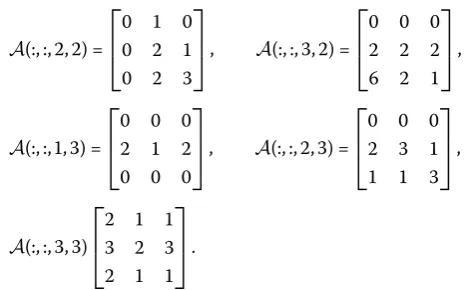
Example LetA∈R[,;,]+ with entries defined as follows:
A(:, :, , ) = ⎡ ⎢ ⎣ ⎤ ⎥
⎦, A(:, :, , ) = ⎡ ⎢ ⎣ ⎤ ⎥ ⎦,
A(:, :, , ) ⎡ ⎢ ⎣ ⎤ ⎥
Figure 1 The singular value inclusion setϒS(A) and the exact singular values.
A(:, :, , ) = ⎡ ⎢ ⎣
⎤ ⎥
⎦, A(:, :, , ) = ⎡ ⎢ ⎣
⎤ ⎥ ⎦,
A(:, :, , ) = ⎡ ⎢ ⎣
⎤ ⎥
⎦, A(:, :, , ) = ⎡ ⎢ ⎣
⎤ ⎥ ⎦,
A(:, :, , ) ⎡ ⎢ ⎣
⎤ ⎥ ⎦.
By computation, we get that all different singular values of A are –., –., –., –., , ., ., ., ., ., ., ., ., ., ., . and ..
(i) AnS-type singular value inclusion set.
LetS={}. Obviously,S¯={, }. By Theorem , theS-type singular inclusion set is
ϒS(A) =z∈C:|z| ≤. .
The singular value inclusion setϒS(A) and the exact singular values are drawn in Figure , where ϒS(A) is represented by black solid boundary and the exact singular values are plotted by red ‘+’. It is easy to see thatϒS(A) can capture all singular values ofAfrom
Figure .
(ii) The bounds of the largest singular value. By Theorem of [], we have
[image:12.595.133.370.354.499.2]Figure 2 The singular value inclusion setϒS(A) and the exact singular values.
LetS={},S¯={, }. By Theorem , we have
.≤λ≤..
In fact,λ= .. This example shows that the bounds in Theorem are better than
those in Theorem of [].
Example LetA∈R[,;,]
+ with entries defined as follows:
a=a=a=a=a=a= ,
otheraijkl= . By computation, we get that all different singular values ofAare , .,
, .
(i) AnS-type singular value inclusion set.
LetS={}. Obviously,S¯={, }. By Theorem , theS-type singular inclusion set is
ϒS(A) =z∈C:|z| ≤ .
The singular value inclusion setϒS(A) and the exact singular values are drawn in Figure ,
where ϒS(A) is represented by black solid boundary and the exact singular values are plotted by red ‘+’. It is easy to see thatϒS(A) captures exactly all singular values ofAfrom Figure .
(ii) The bounds of the largest singular value. By Theorem , we have
≤λ≤.
4 Conclusions
In this paper, we give anS-type singular value inclusion setϒS(A) for rectangular tensors.
As an application of this set, anS-type upper boundUS(A) and anS-type lower bound
LS(A) for the largest singular valueλof a nonnegative rectangular tensorAare obtained
and proved to be sharper than those in []. Then, an interesting problem is how to pickS
to makeϒS(A) as tight as possible. But it is difficult when the dimension of the tensorA
is large. We will continue to study this problem in the future.
Acknowledgements
The author is very indebted to the reviewers for their valuable comments and corrections, which improved the original manuscript of this paper. This work is supported by Foundation of Guizhou Science and Technology Department (Grant No. [2015]2073), National Natural Science Foundation of China (Grant No. 11501141) and Natural Science Programs of Education Department of Guizhou Province (Grant No. [2016]066).
Competing interests
The author declares that they have no competing interests.
Author’s contributions
All authors contributed equally to this work. All authors read and approved the final manuscript.
Publisher’s Note
Springer Nature remains neutral with regard to jurisdictional claims in published maps and institutional affiliations.
Received: 18 April 2017 Accepted: 7 June 2017
References
1. Chang, KC, Qi, LQ, Zhou, GL: Singular values of a real rectangular tensor. J. Math. Anal. Appl.370, 284-294 (2010) 2. Yang, YN, Yang, QZ: Singular values of nonnegative rectangular tensors. Front. Math. China6(2), 363-378 (2011) 3. Lim, LH: Singular values and eigenvalues of tensors: a variational approach. In: Proceedings of the IEEE International
Workshop on Computational Advances in Multi-Sensor Adaptive Processing (CAMSAP ’05), pp. 129-132 (2005) 4. Chang, KC, Pearson, K, Zhang, T: On eigenvalue problems of real symmetric tensors. J. Math. Anal. Appl.350, 416-422
(2009)
5. Knowles, JK, Sternberg, E: On the ellipticity of the equations of non-linear elastostatics for a special material. J. Elast.5, 341-361 (1975)
6. Wang, Y, Aron, M: A reformulation of the strong ellipticity conditions for unconstrained hyperelastic media. J. Elast.44, 89-96 (1996)
7. Dahl, D, Leinass, JM, Myrheim, J, Ovrum, E: A tensor product matrix approximation problem in quantum physics. Linear Algebra Appl.420, 711-725 (2007)
8. Einstein, A, Podolsky, B, Rosen, N: Can quantum-mechanical description of physical reality be considered complete? Phys. Rev.47, 777-780 (1935)
9. Li, HB, Huang, TZ, Liu, XP, Li, H: Singularity, Wielandt’s lemma and singular values. J. Comput. Appl. Math.234, 2943-2952 (2010)
10. Zhou, GL, Caccetta, L, Qi, LQ: Convergence of an algorithm for the largest singular value of a nonnegative rectangular tensor. Linear Algebra Appl.438, 959-968 (2013)
11. Chen, Z, Lu, LZ: A tensor singular values and its symmetric embedding eigenvalues. J. Comput. Appl. Math.250, 217-228 (2013)
12. Chen, ZM, Qi, LQ, Yang, QZ, Yang, YN: The solution methods for the largest eigenvalue (singular value) of nonnegative tensors and convergence analysis. Linear Algebra Appl.439, 3713-3733 (2013)
13. Li, CQ, Li, YT, Kong, X: New eigenvalue inclusion sets for tensors. Numer. Linear Algebra Appl.21, 39-50 (2014) 14. Li, CQ, Jiao, AQ, Li, YT: AnS-type eigenvalue location set for tensors. Linear Algebra Appl.493, 469-483 (2016) 15. He, J, Liu, YM, Ke, H, Tian, JK, Li, X: Bound for the largest singular value of nonnegative rectangular tensors. Open
Math.14, 761-766 (2016)
16. Zhao, JX, Sang, CL: AnS-type upper bound for the largest singular value of nonnegative rectangular tensors. Open Math.14, 925-933 (2016)