R E S E A R C H
Open Access
Three modified Polak-Ribière-Polyak
conjugate gradient methods with sufficient
descent property
Min Sun
1*and Jing Liu
2*Correspondence:
[email protected] 1School of Mathematics and
Statistics, Zaozhuang University, Beian Street, Zaozhuang, 277160, P.R. China
Full list of author information is available at the end of the article
Abstract
In this paper, three modified Polak-Ribière-Polyak (PRP) conjugate gradient methods for unconstrained optimization are proposed. They are based on the two-term PRP method proposed by Cheng (Numer. Funct. Anal. Optim. 28:1217-1230, 2007), the three-term PRP method proposed by Zhanget al.(IMA J. Numer. Anal. 26:629-640, 2006), and the descent PRP method proposed by Yuet al.(Optim. Methods Softw. 23:275-293, 2008). These modified methods possess the sufficient descent property without any line searches. Moreover, if the exact line search is used, they reduce to the classical PRP method. Under standard assumptions, we show that these three methods converge globally with a Wolfe line search. We also report some numerical results to show the efficiency of the proposed methods.
Keywords: conjugate gradient method; sufficient descent property; global convergence
1 Introduction
Consider the unconstrained optimization problem:
minf(x),x∈Rn, ()
wheref :Rn→Ris continuously differentiable, and its gradientg(x) is available. Con-jugate gradient methods are efficient for solving (), especially for large-scale problems. A conjugate gradient method generates an iterate sequence{xk}by
xk+=xk+αkdk, k= , , . . . , ()
wherexkis the current iterate,αk> is the step size and computed by certain line search, anddkis the search direction defined by
dk=
–gk, ifk= , –gk+βkdk–, ifk≥,
()
in whichβkis an important parameter. Generally, different conjugate gradient methods correspond to different choices of the parameterβk. Some well-known formulas forβk
include the Fletcher-Reeves (FR) [], the Polak-Ribière-Polyak (PRP) [, ], the Liu-Storey (LS) [], the Dai-Yuan (DY) [], the Hestenes-Stiefel (HS) [] and the conjugate descent (CD) [] formulas. In this paper, we focus our attention on the PRP method, in which the parameterβkis given by
βkPRP=g
k(gk–gk–)
gk–
, ()
where · is the -norm. In the convergence analysis and implementations of conjugate gradient methods, one often requires the line search to be an inexact line search such as a Wolfe line search, a strong Wolfe line search or an Armijo line search. The Wolfe line search is finding a step sizeαksatisfying
f(xk+αkdk)≤f(xk) +ραkgkdk,
g(xk+αkdk)dk≥σgkdk,
()
where <ρ<σ< . The strong Wolfe line search is computingαksuch that
f(xk+αkdk)≤f(xk) +ραkgkdk, |g(xk+αkdk)dk| ≤σ|gkdk|,
()
where <ρ < / and σ ∈ (ρ, ). The Armijo line search is finding a step size αk = max{ρj|j= , , . . .}satisfying
f(xk+αkdk)≤f(xk) +δαkgkdk, ()
whereδ∈(, ) andρ∈(, ) are two constants.
The PRP method is generally regarded to be one of the most efficient conjugate gradient methods and has been studied by many researchers [, , ]. Polak and Ribière [] proved that the PRP method with the exact line search is globally convergent under a strong con-vexity assumption for the objective functionf. Gilbert and Nocedal [] conducted an ele-gant analysis and showed that the PRP method is globally convergent ifβkPRPis restricted to be non-negative (denotedβkPRP+) andαkis determined by a line search step satisfying the sufficient descent condition
gkdk≤–cgk, c> , ()
in addition to the Wolfe line search condition (). Grippo and Lucidi [] proposed new line search conditions, which can ensure that the PRP method is globally convergent for nonconvex problems. However, the method given by Grippo and Lucidi [] does not per-form better than the PRP method, which employsβkPRP+and the Wolfe line search in the numerical computations. Therefore, great attention is given to the problem of finding the methods which not only have global convergence but also have nice numerical perfor-mance [–].
ZTPRP), have been proposed by Cheng [] and Zhanget al.[], respectively, in which the directiondkis given by
dkCTPRP= –
+βkPRPg
kdk– gk
gk+βkPRPdk–, ∀k≥
or
dkZTPRP= –gk+βkPRPdk––θkyk–, ∀k≥,
where
yk–=gk–gk–, θk=
gkdk–
gk–
.
An attractive feature of the CTPRP method and the ZTPRP method is that they satisfy
gkdk= –gk, which is independent of line search used. Moreover, these two methods are globally convergent if some kind of modified Armijo type line search or strong Wolfe line search is used, and the presented numerical results in [, ] show some potential advantages of the proposed methods. Moreover, Yuet al.[] proposed another type vari-ation of PRP method, denoted YTPRP, whose direction is defined by
dkYTPRP= –gk+βkYPRPdk–, ∀k≥,
where
βkYPRP=βkPRP–Cyk–
g
kdk–
gk–
and C> .
An attractive feature of thedYTPRPk is that it satisfiesgkdk≤–( – /C)gk, which is also independent of line search used.
Note that the global convergence of the above three methods is established under some Armijo type line search or strong Wolfe line search. It is well known that the step size generated by the Armijo line search maybe approaches zero, and thus the reduction of the objective function is very little. This slows down the optimization process. Obviously, the strong Wolfe line search can avoid this phenomenon when the parameterσ→+,
and in this case, the strong Wolfe line search is close to the exact line search. Thus, the computational load of the strong Wolfe line search increases heavily. In fact, the Wolfe line search can also avoid the above phenomenon. However, compared with the strong Wolfe line search, the Wolfe line search needs less computation to get a suitable step size at each iteration. Therefore, the Wolfe line search can enhance the efficiency of the conjugate gradient method.
In this paper, we shall investigate some variations of PRP method under a Wolfe line search. In fact, we take a little modification to theβkPRPand propose three modified PRP methods based on the iterate directions dCTPRPk ,dZTPRP
In Section , we propose the modified PRP methods and prove their convergence. In Sec-tion , we present some numerical results by using the test problems in []. SecSec-tion concludes the paper with final remarks.
2 Three modified PRP methods
First, we give the following basic assumption as regards the objection functionf(x). Assumptions
(H) The level setR={x|f(x)≤f(x)}is bounded.
(H) In some neighborhoodNofR, the gradientg(x)is Lipschitz continuous on an
open convex setBthat containsR,i.e., there exists a constantL> such that
g(x) –g(y)≤Lx–y, for anyx,y∈B.
Assumptions (H) and (H) imply that there exist positive constantsγ andBsuch that
g(x)≤γ, ∀x∈R ()
and
x–y ≤B, ∀x,y∈R. ()
Recently, Weiet al.[] proposed a variation of the FR method which we call the VFR method, in which the parameterβkis defined by
βkVFR= μgk
μ|gkdk–|+μgk–
,
whereμ∈(, +∞),μ∈(μ+ , +∞),μ∈(, +∞), and is any given positive constant.
An attractive feature of the VFR method is that the sufficient descent conditiongkdk≤ –( –μ
μ)gk
always holds which is independent of the line search used. The idea of Wei
et al.[] was further extended to the Wei-Yao-Liu method by Dai and Wen []. Here, motivated by the ideas of Weiet al.[] and Dai and Wen [], we construct two modified PRP methods, in which the parameterβkis specified as follows:
βkMPRP= g
k(gk–gk–) μ|gkdk–|+gk–
()
or
βkMPRP+=max
gk(gk–gk–)
μ|gkdk–|+gk–
,
, ()
whereμ≥ is a constant. Obviously, ifμ= or the line search is exact, the new parameter βMPRP
k orβkMPRP+reduces to the classical parameterβkPRPin [] orβkPRP+in []. First, using the parameterβkMPRPand the direction dCTPRP
TMPRP method(Two-term modified PRP method)
Step . Give an initial pointx∈Rn,μ≥, <ρ<σ< , and setd= –g,k:= .
Step . Ifgk= then stop; otherwise go to Step . Step . Computedkby
dk=
–gk, ifk= ,
–( +βkMPRPgkdk–
gk )gk+βkMPRPdk–, ifk≥.
()
Determine the step sizeαkby Wolfe line search (). Step . Setxk+=xk+αkdk, andk:=k+ ; go to Step .
Similarly, using the parameterβkMPRPand the directiondZTPRP
k , we present the following conjugate gradient method (denoted the TMPRP method).
TMPRP method(Three-term modified PRP method)
Step . Give an initial pointx∈Rn,μ≥, <ρ<σ< , and setd= –g,k:= .
Step . Ifgk= then stop; otherwise go to Step . Step . Computedkby
dk=
–gk, ifk= , –gk+βkMPRPdk––ϑkyk–, ifk≥,
()
whereϑk=gkdk–/(gk–+μ|gkdk–|). Determine the step sizeαkby Wolfe line search ().
Step . Setxk+=xk+αkdk, andk:=k+ ; go to Step .
Using a parameter similar toβkYPRP, we present the following conjugate gradient method (denoted the TMPRP method).
TMPRP method(Three-term descent PRP method)
Step . Give an initial pointx∈Rn,μ≥,t> , <ρ<σ< , and setd= –g,k:= .
Step . Ifgk= then stop; otherwise go to Step . Step . Computedkby
dk=
–gk, ifk= ,
–gk+βkVPRPdk–+νk(yk––sk–), ifk≥,
()
where
βkVPRP= g
k(gk–gk–)
μ|gkdk–|+gk–
–t yk–
g
kdk–
(μ|gkdk–|+gk–)
,
νk=
gkdk–
μ|gkdk–|+gk–
.
()
Remark . If the constantμ= , then the TMPRP method and TMPRP method re-duce to the methods proposed by Cheng [] and Zhanget al.[], respectively, and the TMPRP method reduces to a method similar to that proposed by Yuet al.[].
Remark . Obviously, if the line search is exact, then the direction generated by () or () or () reduces to () withβk=βkPRP. Therefore, in the following, we assume that μ> .
Remark . From () and (), we can easily obtain
gkdk= –gk and gk ≤ dk. () This indicates that the TMPRP method and the TMPRP method satisfy the sufficient descent property. In addition, from the following lemma, we can see that the TMPRP method also satisfies this property.
Lemma . Let{xk}and{dk}be generated by theTMPRP method,then we have
gkdk≤–
–
t
gk. ()
Proof We have from () and ()
gkdk = –gk+
gk(gk–gk–)
μ|gkdk–|+gk–
–t yk–
g
kdk–
(μ|gkdk–|+gk–)
gkdk–
+ g
kdk–
μ|gkdk–|+gk–
gkyk––gksk–
≤–gk+
gkyk–gkdk–
μ|gkdk–|+gk–
–t yk–
(g
kdk–)
(μ|gkdk–|+gk–)
– αk–(g
kdk–)
μ|gkdk–|+gk–
≤–gk+
√
tgk
√tg
kdk–
μ|gkdk–|+gk–
yk–
–t yk–
(g
kdk–)
(μ|gkdk–|+gk–)
≤–gk+
tgk
+t yk–(gkdk–)
(μ|gkdk–|+gk–)
–t yk–
(g
kdk–)
(μ|gkdk–|+gk–)
= –
–
t
gk,
which indicates that () holds by induction sinced= –gandt> . This completes the
proof.
Remark . From the proof of Lemma ., we can see that if the termsk–indkis deleted, then the above sufficient descent property still holds.
The following lemma, called the Zoutendijk condition, is often used to prove global convergence of conjugate gradient method. It was originally given by Zoutendijk in [].
Lemma . Suppose that xis a starting point for which assumptions(H)and(H)hold.
Consider any method in the form of(),where dkis a descent direction andαksatisfies the
Wolfe condition()or the strong Wolfe condition().Then we have
∞
k=
(gkdk) dk
< +∞.
This together with()shows that
∞
k=
gk dk
< +∞. ()
Definition . The functionf(x) is said to be uniformly convex onRn, if there is a positive constantmsuch that
d∇f(x)d≥md, ∀x,d∈Rn,
where∇f(x) is the Hessian matrix of the functionf(x).
Now we prove the strongly global convergence of TMPRP method for uniformly convex functions.
Lemma . Let the sequences{xk}and{dk}be generated byTMPRP method,and the
function f(x)be uniformly convex,then we have
cαkdk≤–gkdk, ()
where c= ( –ρ)–m/.
Proof See Lemma . in []. The proof of the following theorem is similar to that of Theorem . in []. For com-pleteness, we give the proof.
Theorem . Suppose that the assumptions(H)and(H)hold, and f(x)is uniformly convex,then we have
lim
k→∞gk= .
Proof From (), (), and (H), we have
βkMPRP≤g
k(gk–gk–) gk–
≤Lαk–gkdk–
–gk–dk–
≤ L
c
gk dk–
This together with () shows that
dk ≤ gk+βkMPRP
gkdk–
gk
gk+βkMPRPdk–
≤ gk+ L
c
gk
=
+L
c
gk.
Then, letting√A= +cL
, we getdk
≤Ag
k. So, by (), we get
lim k→∞gk
= lim
k→∞
gk gk ≤
Alim k→∞
gk dk
= .
This completes the proof.
We are going to investigate the global convergence of the TMPRP method with Wolfe line search () for nonconvex function. In the last part of this subsection, we useβMPRP+
k to replaceβkMPRPin ().
The next lemma corresponds to Lemma . in [] and Theorem . in [].
Lemma . Suppose that assumptions(H)and(H)hold.Let{xk}be the sequence
gen-erated byTMPRP method.If there exists a constantε> such thatgk ≥εfor all k≥,
then we have
∞
k=
uk+–uk< +∞, ()
where uk=dk/dk.
Proof From () andgk ≥εfor allk, we havedk> for allk. Therefore,uk is well defined. Define
rk= –
( +βMPRP+
k
gkdk– gk )
dk
gk and δk=βkMPRP+ dk–
dk .
Then we have
uk=rk+δuk–.
Sinceuk–andukare unit vectors, we can write rk=uk–δuk–=δuk–uk–.
Noting thatδk≥, we get
From (), (), and (H), we have
βkMPRP+|g
kdk–|
gk ≤
gkLB μ|gkdk–|
|gkdk–|
gk ≤
LB
εμ. ()
From (), (), and (), it follows that there exists a constantM≥ such that
–
+βkMPRP+g
kdk–
gk
gk
≤ gk+
LB
εμγ≤γ +
LB
εμγ .
=M. ()
Thus, from () and (), we get
∞
k=
rk≤
∞
k=
M
dk =
∞
k=
M
gk gk dk
≤M
ε
∞
k=
gk dk
< +∞,
which together with () completes the proof.
The following theorem establishes the global convergence of the TMPRP method with Wolfe line search () for general nonconvex functions. The proof is analogous to that of Theorem . in [].
Theorem . Let the assumptions(H)and(H)hold.Then the sequence{xk}generated
byTMPRP methodsatisfies
lim inf
k→∞ gk= . ()
Proof Assume that the conclusion () is not true. Then there exists a constantε> such that for all
gk ≥ε, ∀k≥.
The proof is divided into the following two steps.
Step I. A bound on the stepssk. We observe that for anyl≥k,
xl–xk= l–
j=k
(xj+–xj) =
l–
j=k
sjuj= l–
j=k
sjuk+ l–
j=k
sj(uj–uk), ()
wheresj=xj+–xjandukis defined in Lemma .. Using the triangle inequality anduk= , we can write () as
l–
j=k
sj ≤ xl–xk+ l–
j=k
sjuj–uk ≤B+ l–
j=k
sjuj–uk. ()
Letbe an arbitrary but fixed positive integer. It follows from Lemma . that there is an indexksuch that
i≥k
ui+–ui≤
Ifj>k≥kwithj–k≤, then by () and Cauchy-Schwarz inequality, we have
uj–uk ≤ j–
i=k
ui+–ui
≤
(j–k) j–
i=k
ui+–ui
≤
= .
Combining this with () yields
l–
j=k
sj ≤B, ()
wherel>k≥kwithl–k≤.
Step II. A bound on the directiondk. From () and (), we have
dk≤
–
+βkMPRP+g
kdk–
gk
gk
+βkMPRP+dk–
≤M+βkMPRP+dk–
≤M+ βkMPRP+ dk–
≤M+L
γs
k–
ε dk– .
By the use of the same argument of the Case III of Theorem . in [], we can get the conclusion (). This completes the proof.
Remark . From Theorem ., we can see that the TMPRP method possesses better
convergence properties than CTPRP method in []. Since the TMPRP method converges globally for nonconvex minimization problems with a Wolfe line search, while the CTPPR method converges globally for nonconvex minimization problems with a strong Wolfe line search. We also note that the termμ|gkdk–|in the denominator of () plays an important
role in the proof of Lemma ..
3 Numerical results
In this section, we present some numerical results to compare the performance of the TMPRP method, the CG_DESCENT method in [] and the DTPRP method in [].
• TMPRP: the TMPRP method with Wolfe line search (), withμ= –,ρ= .,
σ= .;
• CG_DESCENT: the CG_DESCENT method with Wolfe line search (), withρ= .,
σ= .;
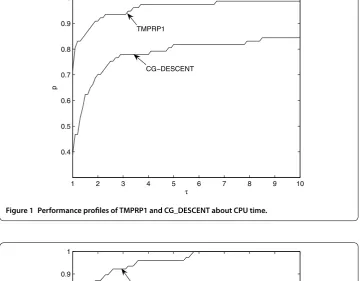
Figure 1 Performance profiles of TMPRP1 and CG_DESCENT about CPU time.
Figure 2 Performance profiles of TMPRP1 and DTPRP about CPU time.
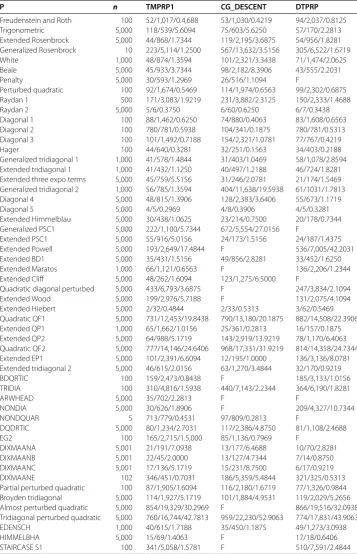
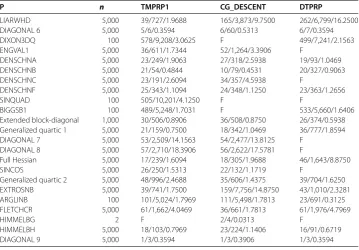
The top curve is the method that solved the most problems in a time that was within a factorτ of the best time. From Table and Figures and , we can see that the TMPRP method performs better than the CG_DESCENT method and the DTPRP method, thus the proposed TMPRP method is computationally efficient.
Table 1 The results for the methods on the tested problems
P n TMPRP1 CG_DESCENT DTPRP
Freudenstein and Roth 100 52/1,017/0.4,688 53/1,030/0.4219 94/2,037/0.8125
Trigonometric 5,000 118/539/5.6094 75/603/5.6250 57/170/2.2813
Extended Rosenbrock 5,000 44/868/1.7344 119/2,195/3.6875 54/956/1.8281
Generalized Rosenbrock 10 223/5,114/1.2500 567/13,632/3.5156 305/6,522/1.6719
White 1,000 48/874/1.3594 101/2,321/3.3438 71/1,474/2.0625
Beale 5,000 45/933/3.7344 98/2,182/8.3906 43/555/2.2031
Penalty 5,000 30/593/1.2969 26/516/1.1094 F
Perturbed quadratic 100 92/1,674/0.5469 114/1,974/0.6563 99/2,302/0.6875
Raydan 1 500 171/3,083/1.9219 231/3,882/2.3125 150/2,333/1.4688
Raydan 2 5,000 5/6/0.3750 6/60/0.6250 6/7/0.3438
Diagonal 1 100 88/1,462/0.6250 74/880/0.4063 83/1,608/0.6563
Diagonal 2 100 780/781/0.5938 104/341/0.1875 780/781/0.5313
Diagonal 3 100 101/1,492/0.7188 154/2,321/1.0781 77/767/0.4219
Hager 100 44/640/0.3281 32/251/0.1563 34/403/0.2188
Generalized tridiagonal 1 1,000 41/578/1.4844 31/403/1.0469 58/1,078/2.8594
Extended tridiagonal 1 1,000 41/432/1.1250 40/497/1.2188 46/724/1.8281
Extended three expo terms 5,000 45/759/5.5156 31/246/2.0781 21/174/1.5469 Generalized tridiagonal 2 1,000 56/785/1.3594 404/11,638/19.5938 61/1031/1.7813
Diagonal 4 5,000 48/815/1.3906 128/2,383/3.6406 55/673/1.1719
Diagonal 5 5,000 4/5/0.2969 4/8/0.3906 4/5/0.3281
Extended Himmelblau 5,000 30/438/1.0625 23/214/0.7500 20/178/0.7344
Generalized PSC1 5,000 222/1,100/5.7344 672/5,554/27.0156 F
Extended PSC1 5,000 55/916/5.0156 24/173/1.5156 24/187/1.4375
Extended Powell 5,000 193/2,649/17.4844 F 536/7,005/42.2031
Extended BD1 5,000 35/431/1.5156 49/856/2.8281 33/452/1.6250
Extended Maratos 1,000 66/1,121/0.6563 F 136/2,206/1.2344
Extended Cliff 5,000 48/262/1.6094 123/1,275/6.5000 F
Quadratic diagonal perturbed 5,000 433/6,793/3.6875 F 247/3,834/2.1094
Extended Wood 5,000 199/2,976/5.7188 F 131/2,075/4.1094
Extended Hiebert 5,000 2/32/0.4844 2/33/0.5313 3/62/0.5469
Quadratic QF1 5,000 731/12,453/19.8438 790/13,180/20.1875 882/14,508/22.3906
Extended QP1 1,000 65/1,662/1.0156 25/361/0.2813 16/157/0.1875
Extended QP2 5,000 64/988/5.1719 143/2,919/13.9219 78/1,170/6.4063
Quadratic QF2 5,000 777/14,146/24.6406 968/17,331/31.9219 814/14,358/24.7344
Extended EP1 5,000 101/2,391/6.6094 12/195/1.0000 136/3,136/8.0781
Extended tridiagonal 2 5,000 46/615/2.0156 63/1,270/3.4844 32/170/0.9219
BDQRTIC 100 159/2,473/0.8438 F 185/3,133/1.0156
TRIDIA 100 310/4,816/1.5938 440/7,143/2.2344 364/6,190/1.8281
ARWHEAD 5,000 35/702/2.2813 F F
NONDIA 5,000 30/626/1.8906 F 209/4,327/10.7344
NONDQUAR 5 713/779/0.4531 97/809/0.2813 F
DQDRTIC 5,000 80/1,234/2.7031 117/2,386/4.8750 81/1,108/2.4688
EG2 100 165/2,715/1.5,000 85/1,136/0.7969 F
DIXMAANA 5,001 21/191/7.0938 13/177/6.4688 10/70/2.8281
DIXMAANB 5,001 22/45/2.0000 13/127/4.7344 7/14/0.8750
DIXMAANC 5,001 17/136/5.1719 15/231/8.7500 6/17/0.9219
DIXMAANE 102 346/451/0.7031 186/5,359/5.4844 321/325/0.5313
Partial perturbed quadratic 100 87/1,905/1.6094 116/2,180/1.6719 77/1,326/0.9844 Broyden tridiagonal 5,000 114/1,927/5.1719 101/1,884/4.9531 119/2,029/5.2656
Almost perturbed quadratic 5,000 854/19,329/30.2969 F 866/19,516/32.0938
Tridiagonal perturbed quadratic 5,000 760/16,744/42.7813 959/22,230/52.9063 774/17,831/43.9063
EDENSCH 1,000 40/615/1.7188 35/450/1.1875 49/1,273/3.0938
HIMMELBHA 5,000 15/69/1.4063 F 17/18/0.6406
Table 1 (Continued)
P n TMPRP1 CG_DESCENT DTPRP
LIARWHD 5,000 39/727/1.9688 165/3,873/9.7500 262/6,799/16.2500
DIAGONAL 6 5,000 5/6/0.3594 6/60/0.5313 6/7/0.3594
DIXON3DQ 100 578/9,208/3.0625 F 499/7,241/2.1563
ENGVAL1 5,000 36/611/1.7344 52/1,264/3.3906 F
DENSCHNA 5,000 23/249/1.9063 27/318/2.5938 19/93/1.0469
DENSCHNB 5,000 21/54/0.4844 10/79/0.4531 20/327/0.9063
DENSCHNC 5,000 23/191/2.6094 34/357/4.5938 F
DENSCHNF 5,000 25/343/1.1094 24/348/1.1250 23/363/1.2656
SINQUAD 100 505/10,201/4.1250 F F
BIGGSB1 100 489/5,248/1.7031 F 533/5,660/1.6406
Extended block-diagonal 1,000 30/506/0.8906 36/508/0.8750 26/374/0.5938
Generalized quartic 1 5,000 21/159/0.7500 18/342/1.0469 36/777/1.8594
DIAGONAL 7 5,000 53/2,509/14.1563 54/2,477/13.8125 F
DIAGONAL 8 5,000 57/2,710/18.3906 56/2,622/17.5781 F
Full Hessian 5,000 17/239/1.6094 18/305/1.9688 46/1,643/8.8750
SINCOS 5,000 26/250/1.5313 22/132/1.1719 F
Generalized quartic 2 5,000 48/996/2.4688 35/606/1.4375 39/704/1.6250
EXTROSNB 5,000 39/741/1.7500 159/7,756/14.8750 43/1,010/2.3281
ARGLINB 100 101/5,024/1.7969 111/5,498/1.7813 23/691/0.3125
FLETCHCR 5,000 61/1,662/4.0469 36/661/1.7813 61/1,976/4.7969
HIMMELBG 2 F 2/4/0.0313 F
HIMMELBH 5,000 18/103/0.7969 23/224/1.1406 16/91/0.6719
DIAGONAL 9 5,000 1/3/0.3594 1/3/0.3906 1/3/0.3594
4 Conclusion
This paper proposed three modified PRP conjugate gradient methods, which are some improvements of recently proposed PRP conjugate gradient methods. The global conver-gence of the proposed methods are established under the Wolfe line search. The effective-ness of the proposed methods have been shown by some numerical examples. We find that the performance of the TMPRP method is related to the parameterμinβMPRP
k ; therefore, how to choose a suitable parameterτ deserves further investigation.
Competing interests
The authors declare that they have no competing interests.
Authors’ contributions
The first author has designed the three methods and the second author has refined them. Both authors have equally contributed in the numerical results. All authors read and approved the final manuscript.
Author details
1School of Mathematics and Statistics, Zaozhuang University, Beian Street, Zaozhuang, 277160, P.R. China.2School of
Mathematics and Statistics, Zhejiang University of Finance and Economics, Xueyuan Street, Hangzhou, 310018, P.R. China.
Acknowledgements
The authors gratefully acknowledge the helpful comments and suggestions of the anonymous reviewers. This work was partially supported by the domestic visiting scholar project funding of Shandong Province outstanding young teachers in higher schools, the foundation of Scientific Research Project of Shandong Universities (No. J13LI03), and the Shandong Province Statistical Research Project (No. 20143038).
Received: 3 December 2014 Accepted: 30 March 2015
References
1. Fletcher, R, Reeves, C: Function minimization by conjugate gradients. J. Comput.7, 149-154 (1964)
2. Polak, B, Ribière, G: Note sur la convergence des méthodes de directions conjuguées. Rev. Fr. Inform. Rech. Oper.16, 35-43 (1969)
3. Gilbert, JC, Nocedal, J: Global convergence properties of conjugate gradient methods for optimization. SIAM J. Optim.2, 21-42 (1992)
[image:13.595.118.478.96.346.2]5. Dai, YH, Yuan, YX: A nonlinear conjugate gradient method with a strong global convergence property. SIAM J. Optim.
10, 177-182 (2000)
6. Hestenes, MR, Stiefel, EL: Method of conjugate gradient for solving linear systems. J. Res. Natl. Bur. Stand.49, 409-432 (1952)
7. Fletcher, R: Practical Methods of Optimization. Volume 1: Unconstrained Optimization. Wiley, New York (1987) 8. Grippo, L, Luidi, S: A globally convergent version of the Polak-Ribière gradient method. Math. Program.78, 375-391
(1997)
9. Cheng, WY: A two-term PRP-based descent method. Numer. Funct. Anal. Optim.28, 1217-1230 (2007) 10. Zhang, L, Zhou, WJ, Li, DH: A descent modified Polak-Ribière-Polyak conjugate gradient method and its global
convergence. IMA J. Numer. Anal.26, 629-640 (2006)
11. Yu, GH, Guan, LT, Chen, WF: Spectral conjugate gradient methods with sufficient descent property for large-scale unconstrained optimization. Optim. Methods Softw.23, 275-293 (2008)
12. Dolan, ED, Moré, JJ: Benchmarking optimization software with performance profiles. Math. Program.91, 201-213 (2002)
13. Wei, ZX, Li, G, Qi, LQ: Global convergence of the Polak-Ribière-Polyak conjugate gradient method with inexact line searches for non-convex unconstrained optimization problems. Math. Comput.77, 2173-2193 (2008)
14. Li, G, Tang, CM, Wei, ZX: New conjugacy condition and related new conjugate gradient methods for unconstrained optimization. J. Comput. Appl. Math.202, 523-539 (2007)
15. Yu, G, Guan, L, Li, G: Global convergence of modified Polak-Ribière-Polyak conjugate gradient methods with sufficient descent property. J. Ind. Manag. Optim.3, 565-579 (2008)
16. Dai, YH, Kou, CX: A nonlinear conjugate gradient algorithm with an optimal property and an improved Wolfe line search. SIAM J. Optim.23, 296-320 (2013)
17. Neculai, A: Unconstrained optimization by direct searching (2007). http://camo.ici.ro/neculai/UNO/UNO.FOR 18. Wei, ZX, Yao, SW, Liu, LY: The convergence properties of some new conjugate gradient methods. Appl. Math.
Comput.183, 1341-1350 (2006)
19. Dai, ZF, Wen, FH: Another improved Wei-Yao-Liu nonlinear conjugate gradient method with sufficient descent property. Appl. Math. Comput.218, 7421-7430 (2012)
20. Yu, GH, Zhao, YL, Wei, ZX: A descent nonlinear conjugate gradient method for large-scale unconstrained optimization. Appl. Math. Comput.187, 636-643 (2007)
21. Zoutendijk, G: Nonlinear programming, computational methods. In: Abadie, J (ed.) Integer and Nonlinear Programming, pp. 37-86. North-Holland, Amsterdam (1970)
22. Dai, ZF, Tian, BS: Global convergence of some modified PRP nonlinear conjugate gradient methods. Optim. Lett.5(4), 615-630 (2011)
23. Dai, YH, Liao, LZ: New conjugacy conditions and related nonlinear conjugate gradient methods. Appl. Math. Optim.
43, 97-101 (2001)
24. Hager, WW, Zhang, HC: A survey of nonlinear conjugate gradient methods. Pac. J. Optim.2, 35-58 (2006) 25. Wu, QZ, Zheng, ZY, Deng, W: Operations Research and Optimization, MATLAB Programming, pp. 66-69. China