2018 International Conference on Computer, Communications and Mechatronics Engineering (CCME 2018) ISBN: 978-1-60595-611-4
An Implementation of the Nursing Education APP with Intelligent
Question Setting Schemes
Chen-Shie HO
*and Yu-Mei CHANG
58, Sihchuan Rd. Sec. 2, Pan-Chiao District, New Taipei City 22061, Taiwan
*Corresponding author
Keywords: Nursing education, Mobile phone, Learning system.
Abstract. The number of clinical nurse is insufficient which causes the nursing manpower in the hospital is short staffed in recent years. However, the burden of patient care did not decrease but increase on the contrary. Therefore, the way to build a small and strong medical team under the existing manpower is to start with the enhancement of basic skills and the strength of nursing education and training. With the increasing application of mobile APP, applying of them to education and training in various professional fields has become more and more popular. In this study, an intelligent learning APP for nursing students is established according to the actual needs of the nursing students and clinical staffs. In addition to the basic nursing education functions, in particular, it provides an intelligent learning situation analysis and exam questions selection model in order to allow users to obtain a more targeted and personalized training environment during the learning process. The experimental results show that the mobile nursing education and learning system established with the APP can promote students’ learning efficiency and outcomes by about 34%, and it also gets a good responses in terms of satisfaction.
Introduction
System Description
After user logins to the system, the user is distinguished as the student or the teacher. If the user is identified to the teacher, the following options will appear to be selected:
(1) Analysis of exam results. (2) Analysis of the questionnaire. (3) Data upload and update.
(4) Connection the hospital-side database.
If the user is identified to the student, the following functions will be presented: (1) Professional knowledge:
It is divided into internal medicine, surgery, gynecology, pediatrics, orthopedics, oncology and psychiatry. The content of each subject includes the key points of each nursing specialty, the grading and self-practice, and the professional knowledge part which is provided by the nursing department specialists in consideration of the teaching content of the nursing department and the national examination.
(2) Exam preparation:
Includes the school exam question bank, the upgrade exam question bank and the national exam question bank. The exam secret-book will be comprised of data collecting from the Internet and the experience of people who passed the exam.
(3) Situational simulation exercises:
This part is mainly designed to match the OSCE [7] nursing professional capability certification. At present, the Objective Structured Clinical Exclusion (OSCE) adopted by medical education belongs to the semi-simulated clinical situation mode test, and has been widely used in medical education, nursing, dentistry, psychology, etc. This component is designed by referring to the opinions from the professional teachers of the nursing department to design the situation simulation models.
(4) Questionnaire survey:
It includes functions such as user satisfaction survey and feedback. (5) Nursing new knowledge:
It includes test information, study information, certification information and new knowledge of domestic and international nursing technology.
Operation of Intelligent Question Setting System
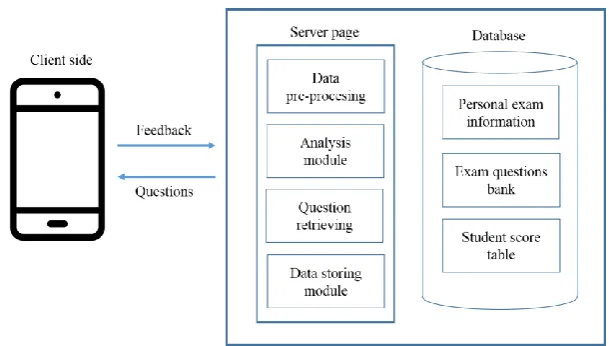
the adjustment of the problem set can be achieved for individual error-prone questions and question types, and hence achieves the personalized test mode.
Figure 1. The building block diagram of the proposed back-end system.
Experiment Results
Conclusion
The application of mobile phones in the education and training field has become increasingly common. This study adopts this kind of platform with its convenience, immediacy and interactivity to build a learning-oriented APP system, which brings practical benefits to the nursing students. The implemented APP provides an intelligent learning situation analysis and question selection module to enable users to obtain a more targeted and personalized training environment during the learning process. The experimental results show that the established nursing education mobile learning system APP can increase the learning efficiency by about 34%. The future research direction includes the combination and expansion of the APP and the nursing treatment guidance system, the design of home and long-term care applications and the automatic patient evaluation and nursing diagnosis system.
(a) (b)
[image:4.595.100.497.239.360.2]Figure 2. (a) Overall score improvement rate. (b) Hit rate of the test questions.
Figure 3. Statistics for usage time.
Reference
[1] Adeniran, R. K., Bhattacharya, A., & Adeniran, A. A, Professional excellence and career advancement in nursing: A conceptual framework for clinical leadership development. Nursing Administration Quarterly. 36(1) (2012) 41–51.
[2] Aiken, L. H., Clarke, S. P., Cheung, R. B., Sloane, D. M., & Silber, J. H. Educational levels of hospital nurses and surgical patient mortality. JAMA. 290(12) (2003) 1617–1623.
[3] Association of Community Health Nursing Educators, Essentials of baccalaureate nursing education for entry level community/public health nursing. Wheat Ridge, CO: Author. 2009.
[4] Aiken, L. H., Clarke, S. P., Cheung, R. B., Sloane, D. M., & Silber, J. H., Educational levels of hospital nurses and surgical patient mortality. JAMA. 290(12) (2003) 1617–1623.
[image:4.595.185.414.387.523.2][6] Geney, D, A., Inkpen, K.M., Lau, F., Shu, K., & Booth, K.S., Designing a Collaborative Activity for the Palm Handheld Computer. In Proceedings of CHI, Conference on Human Factors in Computing Systems. Seattle, USA. 2001.