2018 International Conference on Computer, Communications and Mechatronics Engineering (CCME 2018) ISBN: 978-1-60595-611-4
Research on Wireless Sensor Network Technology of Nuclear
Power Plant
Qiu ZHANG, Shuang ZHOU
and Xiao-hua WANG
Centre of Information Technology, CGN Power Co., Ltd., Shenzhen City, China
Keywords:Automation, Smart Nuclear Power, ZigBee, Wireless Sensor Network.
Abstract. With the increasing level of automation, the concept of "Smart Nuclear Power" has been put forward to further enhance the automation level of nuclear power plants. Building a wireless sensor network suitable for nuclear power plants and sensing all network node information is the basis for building "Smart Nuclear Power". For this reason, this paper starts with the analysis of the current situation of the nuclear power station network system and proposes a set of wireless sensor network construction scheme based on ZigBee in combination with the existing mainstream wireless sensor network technology.
Introduction
At present, the daily production and operation of nuclear power plants are mainly controlled by automatic systems. The effective application of information technology is of great value to improve the safety management level of nuclear power plants and ensure the stable operation of the units.
There is a lot of system equipment in the nuclear power plant, which needs real-time access to status information and operation data. Therefore, the construction of wireless sensor network is of far-reaching significance. How to connect these isolated nodes and achieve interconnection through wireless sensor network is a subject worth further research.
Status of Nuclear Power Station Network Construction
The production and operation of nuclear power plants have been automated and digitized at a high level. Based on safety considerations, nuclear power plants currently use wired networks as a means of network implementation for production and management of large regions.
The cable network runs stably and is not easily disturbed by other external factors, which can better meet the needs of production and office business. However, the deployment cost of the wired network is relatively high, and the cable network link construction needs special pipe trench and bridge, which is relatively difficult to be built, especially in some special areas, which is not convenient for the wired network deployment.
Wireless network construction is relatively flexible, does not need to place a large number of network cables, construction is convenient and quick. However, the system equipment of nuclear power plant is vulnerable to electromagnetic signal interference from wireless network, and there are some hidden dangers in the operation of the equipment.
Therefore, how to apply the wireless network safely in nuclear power plants and give full play to its advantages is a problem that needs further research.
Research of Wireless Sensor Network
Wireless sensor network is widely used in power system, which can be used for real-time monitoring of temperature, humidity, electromagnetic intensity and other data of surrounding environment. At the same time, the application of wireless sensor network is also helpful for remote control system, obtaining system running data and monitoring system running status. The application of wireless sensor network in power system can effectively improve the operating efficiency of the system and reduce the burden of manual maintenance.
self-organizing way. Monitoring data is transmitted to gateway node through "multi-hop relay", and the gateway node is connected to the upper computer, and the data uploaded by each detection node is aggregated to the upper computer for centralized processing.
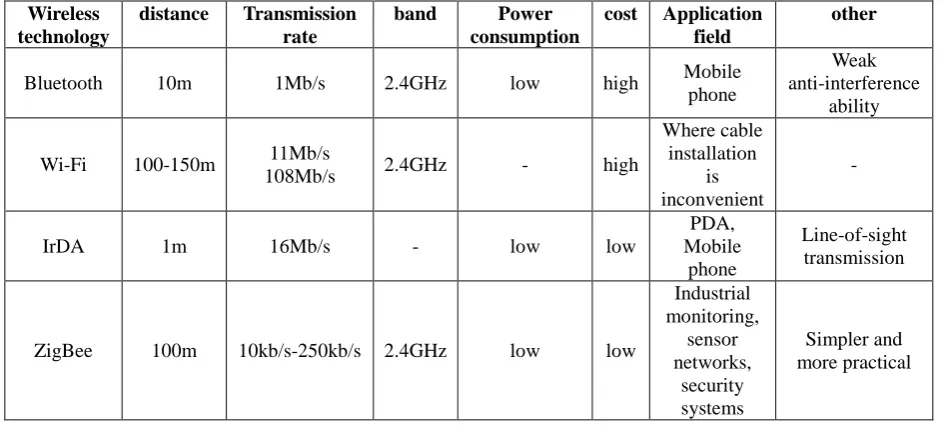
[image:2.595.63.535.177.390.2]In recent years, wireless network has been rapid development, appeared a variety of wireless network data transmission standards, such as Wi-Fi, Bluetooth, infrared, ZigBee, etc. The comparison of wireless communication network technology is shown in table 1.
Table 1. Wireless Communication Network Technology Comparison.
Wireless technology
distance Transmission rate
band Power
consumption
cost Application field
other
Bluetooth 10m 1Mb/s 2.4GHz low high Mobile
phone
Weak anti-interference
ability
Wi-Fi 100-150m 11Mb/s
108Mb/s 2.4GHz - high
Where cable installation
is inconvenient
-
IrDA 1m 16Mb/s - low low
PDA, Mobile
phone
Line-of-sight transmission
ZigBee 100m 10kb/s-250kb/s 2.4GHz low low
Industrial monitoring, sensor networks, security systems Simpler and more practical
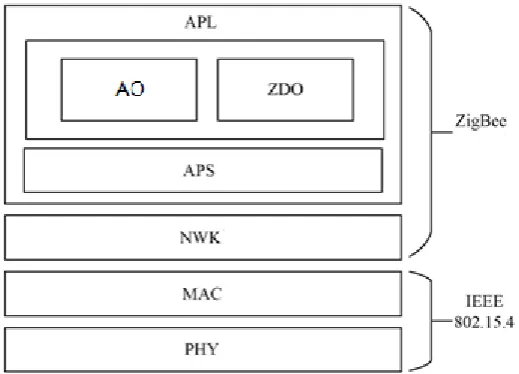
Wireless applications represented by sensors and self-organizing networks do not require high transmission bandwidth, but require low transmission delay and very low power consumption. Therefore, there is an urgent need for a special standard that conforms to the characteristics of sensors. The low-end, control oriented and simple application is simple, and the features of ZigBee protocol meet the above requirements. It can be perfectly combined with wireless sensor network.
Figure 1. ZigBee Protocol Architecture.
ZigBee protocol can support AD hoc network technology. Compared with conventional communication network, the biggest difference is that a mobile communication network can be built quickly without the support of existing information infrastructure at any time and any place. In wireless sensor network applications, nodes are usually placed in places without infrastructure, the location of nodes cannot be predicted, and the neighbor relationship between nodes cannot be predicted, and terminal devices are generally placed through random distribution. This requires the wireless sensor system to be self-organizing, capable of automatic configuration and management, and automatic construction of network systems.
Wireless Sensor Network Design of Nuclear Power Plant
Based on the comparative analysis of various wireless communication network technologies above, this paper designed a wireless sensor network system based on ZigBee technology. The monitoring node consists of four parts: sensor module, processor module, wireless communication module and power supply module. Sensor component is the part directly used for external perception. The processor module is responsible for controlling the operation of the entire node, storing and processing the data collected by it and the control instructions sent by the control unit. The wireless communication module is responsible for wireless communication with the primary node, exchanging control information and sending, receiving and collecting data. The power supply module provides the monitor node with the energy required for operation.
At the scene of the nuclear power plant monitoring, monitoring nodes can be divided into two kinds: one kind is to carry on the temperature and humidity or other auxiliary class parameters monitoring low-power node, the node due to the low power consumption, can be used in a battery, so you can according to need, the scene is placed at will very convenient, can be called a mobile node; One kind is to monitor radiation dose and other large complex instruments or all kinds of control devices, they generally can provide serial RS - 232 communication or other communication interface, so take advantage of these interfaces to connect to the wireless communication module, can send and receive data, due to its large size, power consumption is higher, usually fixed in place, the mains power supply directly, this class can be called a stationary nodes.
Monitoring device or
sensor
The power supply circuit 8051 processor
ZigBee protocol stack The MAC
layer
Rf transceiver
The physical layer
[image:4.595.90.506.69.207.2]Figure 2. Wireless Monitoring Node.
ZigBee alliance refers to the PAN coordinator, coordinator and general equipment defined in IEEE802.15.4 as: network coordinator, network router and network terminal equipment. The network coordinator is the central node of the network, mainly responsible for the establishment of the network, and network configuration; The router is mainly responsible for finding, establishing and repairing routing information of network messages and forwarding network messages. The network terminal has the function of joining and exiting the network, and can receive and send network messages, but the terminal equipment is not allowed to route and forward the messages.
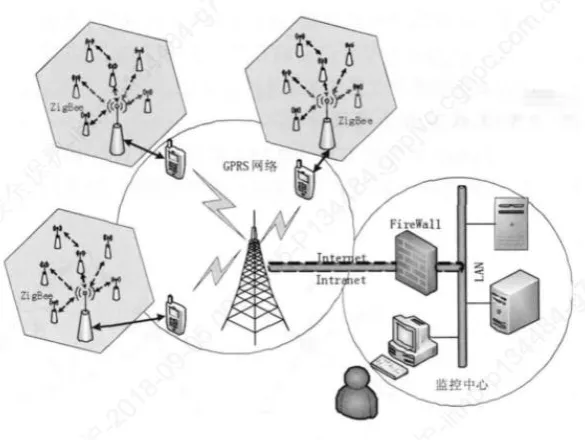
Because ZigBee are close range wireless communication, and according to the geographical location of multiple cellular subnet, in accordance with the principle of near due to nuclear power monitoring system of distribution, may far distance between different subnet, however these subnets center node (coordinator) are to gather data to the monitoring center, as a result, the center node and should adopt the way of long distance communication between the monitoring center. In order to avoid wiring problems, wireless communication should be preferred.
The wireless sensor network architecture designed in this paper is shown in figure 3.
Figure 3. Wireless Sensor Network Architecture.
[image:4.595.150.443.424.644.2]composed of GPRS long-distance communication technology constitute the wireless heterogeneous network, which integrates the advantages of the two wireless communication modes and complements each other to effectively meet the use demand of nuclear power station's wireless sensor network.
Conclusion
In specific industrial application field, wireless communication has its irreplaceable advantages. The intergration of the advanced wireless communication technology and wired network into the hybrid heterogeneous network system has great theoretical significance and industrial application prospect. Aiming at the monitoring system of nuclear power plant, this paper takes ZigBee network communication as the core, combines the advantages of cellular network structure and GPRS long-distance wireless communication, fully considers the cost factors and easiness of realization, and can reduce the signal collision and improve the efficiency and quality of wireless communication. This kind of wireless heterogeneous network can be extended and reconstructed without changing the original system structure and arrangement, which is of great application value to improve the current monitoring technology and information level of nuclear power plant.
Reference
[1] Gan Kejiang, Xu Pingping, application of wireless sensor network in power system, power system communication, Vol. 28, No. 171, 11-14.
[2] He Yunliang, Heng Shuqin, Wang Jinhui, design of air temperature and humidity monitoring system based on ZigBee wireless sensor, modern electronic technology, Vol. 38, No. 18, 133-136.