2019 International Conference on Artificial Intelligence and Computing Science (ICAICS 2019) ISBN: 978-1-60595-615-2
Various Higher-order Shear Deformation Theories for Vibration Analysis
of Functionally Graded Plates
Li-jie ZHAO
*, Ying-ying CHANG, Song XIANG and Meng-wei TIAN
Key Laboratory of General Aviation, Shenyang Aerospace University, Liaoning Shenyang 110136, China
Keywords: Vibration, Functionally graded plates, Higher-order theory,Analytical method.
Abstract. In the present paper, the four various higher-order shear deformation theories are used to analyze the free vibration of functionally graded plate. A navier-type analytical method is used to solve the governing differential equations[1]. Natural frequencies of simply supported functionally graded plates are calculated. The present results are compared with the available published results which verify the accuracy of various higher-order theories. The influences of side to thickness ratio and power law index on the fundamental frequencies of a simply supported square functionally graded plate are also studied.
Introduction
The material properties of the fiber-reinforced laminated composite materials are discontinuous across adjoining layers which result in the delaminating mode of failure. Functionally graded plates can overcome the delaminating mode due to their continuous variation of material properties from one surface to another[2]. The functionally graded material for high-temperature applications may be composed of ceramic and metal.
This paper uses various shear deformation theories of Touratier (1991), Mantari (2012), Karama (2003), Levinson (1980) to study the free vibration behavior of functionally graded plates. A navier-type analytical method is used to solve the governing differential equations. The present results are compared with those of Vel and Batra (2004) and Matsunaga (2008)[3,4].
Governing Equations and Boundary Conditions
Displacement Field
The displacement field of the higher order shear deformation theory is:
( , )
( , ) ( ) ( , )
( , )
( , ) ( ) ( , )
( , )
x
y
w x y
U u x y z f z x y
x w x y
V v x y z f z x y
y W w x y
φ
φ
∂
= − +
∂ ∂
= − +
∂
= (1)
where , , ,u v wφx and φy are the five unknown displacement functions of middle surface of the plate.
his the thickness of the plate.
The Transverse Shear Function
The transverse shear function in Touratier (1991) is:
( ) hsin( z)
f z
h
π
π
=1 cos( ) 2
( ) sin(
)
2
z h
z
f z
e
z
h
h
π
π
π
=
+
(3) The transverse shear function in Karama (2003) is:
2 2 ( / )
( )
z hf z
=
ze
−(4) The transverse shear function in Levinson (1980) is:
2 2
4 ( ) (1 )
3
z
f z z
h
= −
(5)
The Strain–Displacement Relationships
The strain–displacement relationships can be expressed in the form of
x
y
xy
yz
xz
U x V y
U V
y x
V W
z y
U W
z x
ε ε γ γ γ
∂
∂
∂
∂
∂ ∂
= +
∂ ∂
∂ ∂
+
∂ ∂
∂ ∂
+
∂ ∂
(6)
By the principle of virtual displacements, we can obtain the following Euler–Lagrange equations[5]:
1 , 4 , 2
,
φ
∂
∂
∂
+
=
+
−
∂
∂
∂
xy x
tt x tt
tt
N
N
w
I u
I
I
x
y
x
1 , 4 , 2
,
φ
∂
∂
∂
+
=
+
−
∂
∂
∂
y xy
tt y tt
tt
N
N
w
I v
I
I
y
x
y
2 2
2 2 2
2 2 1 , 3 5
2 2 2 2
, , , ,
2 φ φ
∂ ∂ ∂
∂ ∂ ∂ ∂ ∂ ∂
+ + = + + − + + +
∂ ∂ ∂ ∂ ∂ ∂ ∂ ∂ ∂ ∂
y xy y
x x
tt tt tt
tt tt
M M
M u v w w
I I I w I I
x y x y x y x y x y
4 , 6 , 5
,
φ
∂ ∂ ∂
+ − = + −
∂ ∂ ∂
f f
y xy f
y tt y tt
tt
M M w
Q I v I I
y x y
2 2
11 12 11 2 12 2 11 12
2 2
12 11 12 2 1 1 2 12 11
2
66 6 6 66
2 2
11 12 11 2 12 2 1
( ) 2 ( )
y x x y x y y x xy x
u v w w
N A A B B E E
x y x y x y
u v w w
N A A B B E E
x y x y x y
u v w
N A B E
y x x y y x
u v w w
M B B D D F
x y x y
φ φ φ φ φ φ ∂ ∂ ∂ ∂ ∂ ∂ = + − − + + ∂ ∂ ∂ ∂ ∂ ∂ ∂ ∂ ∂ ∂ ∂ ∂ = + − − + + ∂ ∂ ∂ ∂ ∂ ∂ ∂ ∂ ∂ ∂ ∂ = + − + + ∂ ∂ ∂ ∂ ∂ ∂ ∂ ∂ ∂ ∂ = + − − +
∂ ∂ ∂ ∂ 1 1 2
2 2
12 11 12 2 1 1 2 1 2 11
2
66 66 6 6
2 2
11 12 11 2 12 2 11 12
2
12 11 12
( ) 2 ( )
y x y x y y x xy y f x x f y F x y
u v w w
M B B D D F F
x y x y x y
u v w
M B D F
y x x y y x
u v w w
M E E F F H H
x y x y x y
u v
M E E F
x y φ φ φ φ φ φ φ φ ∂ ∂ + ∂ ∂ ∂ ∂ ∂ ∂ ∂ ∂ = + − − + + ∂ ∂ ∂ ∂ ∂ ∂ ∂ ∂ ∂ ∂ ∂ = + − + + ∂ ∂ ∂ ∂ ∂ ∂ ∂ ∂ ∂ ∂ ∂ ∂ = + − − + + ∂ ∂ ∂ ∂ ∂ ∂ ∂ ∂ ∂ = + − ∂ ∂ 2
1 1 12 11
2 2
2
6 6 66 66
4 4
55
( ) 2 ( )
y x y f x xy f y y f x x w w
F H H
x y x y
u v w
M E F H
y x x y y x
Q A Q A φ φ φ φ φ φ ∂ ∂ ∂ − + + ∂ ∂ ∂ ∂ ∂ ∂ ∂ ∂ ∂ = + − + + ∂ ∂ ∂ ∂ ∂ ∂ =
= (8)
2
2 2 2
1 2 3
2 2 2
2
2 2 2
4 5 6
2 2 2
, ,
( ) , ( ) , ( )
h h h
h h h
h h h
h h h
I dz I zdz I z dz
I f z dz I z f z dz I f z dz
ρ ρ ρ
ρ ρ ρ
− − − − − − = = = = = =
(9) 2 2 h h ij ijA Q dz
− =
, 2 2 h h ij ijB Q zdz
− =
, 2 2 2 h h ij ijD Q z dz
− =
, 2 2 ( ) h h ij ijE Q f z dz
− =
2 2 ( ) h h ij ijF Q zf z dz
− =
, 2 2 2 ( ) h h ij ijH Q f z dz
−
=
,
2 2
44 44 55 44
2 ( ) , − = =
hhdf z
A Q dz A A
dz (10)
11 2 12 2
( ) ( )
,
1 1
E z E z
Q Q υ
υ υ
= =
− − , 44 55 66
( )
2(1 )
E z
Q Q Q
υ = = = + 1 ( ) ( ) 2 p
c m m
z
E z E E E
h
= − + +
(11)
Discretization of the Governing Equations and Boundary Conditions
The simply supported boundary conditions and the governing equations are satisfied by the following displacement functions[6].
1 1
1 1
1 1
1 1
1 1
cos( ) sin( )
sin( ) cos( )
sin( ) sin( )
cos( ) sin( )
sin( ) cos( )
i t mn
m n
i t mn
m n
i t mn
m n
i t
x mn
m n
i t
y mn
m n
u U x y e
v V x y e
w W x y e
X x y e
Y x y e
ω
ω
ω
ω
ω
α β
α β
α β
φ α β
φ α β
∞ ∞
= =
∞ ∞
= =
∞ ∞
= =
∞ ∞
= =
∞ ∞
= =
=
=
=
=
=
(12)
where m
a π
α= , n
b π
β = , ω is the natural circular frequency. Substituting Eq. (12) into Eq. (8),and
collecting the coefficients, The following equation can be obtained:
{ } { } { }
{
}
2
[K−ω M] ∆ = 0 , ∆ T = Umn,Vmn,Wmn,Xmn,Ymn
(13) The natural circular frequency ω can be obtained by solving the eigenvalue equations (13).
Numerical Examples
A square functionally graded plate of side a and thickness h with simply supported edges is considered. The functionally graded plate comprised of Metal (Aluminum, Al) and Ceramic (Zirconia, ZrO2). The material properties of Al and ZrO2 are as follows:
Al: Em =70GPa, vm=0.3,
ρ
m=2702 kg/m3;ZrO2: Ec =200GPa, vc=0.3,
ρ
c=5700 kg/m3;In this study, the variation of Young’s modulus E is given by Eq. (11). The Poisson’s ratio is assumed to be a constant through the thickness. The density of functionally graded material is given by Eq. (14)[7].
1
( ) ( )
2
p
c m m
z z
h ρ = ρ −ρ + +ρ
(14)
Natural frequencies are non-dimensionalized by
2
(
a
/ )
h
m/
E
mω ω
=
ρ
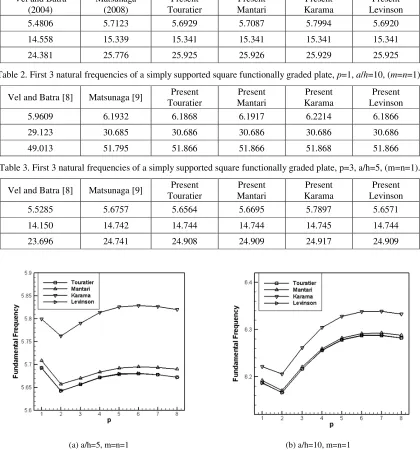
Figs. 1show the fundamental frequencies of a simply supported square functionally graded plate by the various theories (a/h=5,10, m=n=1). It can be seen from the Fig. 1 that results of Karama theory are greater than those of other theories. When the p=2, the fundamental frequencies reach to the minimum value.
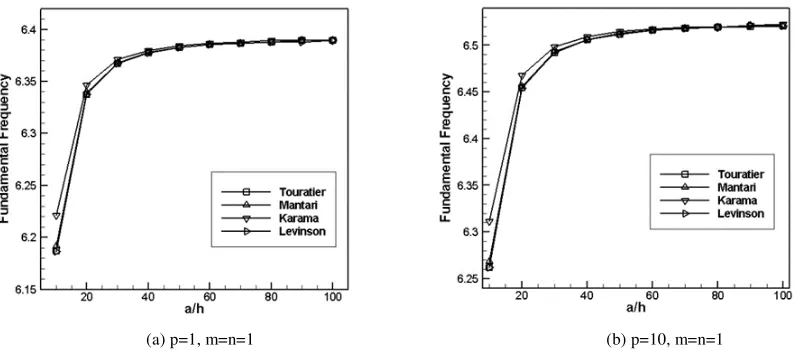
Figs. 2 show the fundamental frequencies of a simply supported square functionally graded plate by the various theories (p=1,10, m=n=1). According to the Figs. 2, results of Karama theory are greater than those of other theories. When the a/h>50, the fundamental frequencies vary slightly with the increase of a/h.
Table 1. First 3 natural frequencies of a simply supported square functionally graded plate, p=1, a/h=5, (m=n=1).
Vel and Batra (2004)
Matsunaga (2008)
Present Touratier
Present Mantari
Present Karama
Present Levinson
5.4806 5.7123 5.6929 5.7087 5.7994 5.6920
14.558 15.339 15.341 15.341 15.341 15.341
[image:5.612.96.516.203.653.2]24.381 25.776 25.925 25.926 25.929 25.925
Table 2. First 3 natural frequencies of a simply supported square functionally graded plate, p=1, a/h=10, (m=n=1).
Vel and Batra [8] Matsunaga [9] Present Touratier
Present Mantari
Present Karama
Present Levinson
5.9609 6.1932 6.1868 6.1917 6.2214 6.1866
29.123 30.685 30.686 30.686 30.686 30.686
49.013 51.795 51.866 51.866 51.868 51.866
Table 3. First 3 natural frequencies of a simply supported square functionally graded plate, p=3, a/h=5, (m=n=1).
Vel and Batra [8] Matsunaga [9] Present Touratier
Present Mantari
Present Karama
Present Levinson
5.5285 5.6757 5.6564 5.6695 5.7897 5.6571
14.150 14.742 14.744 14.744 14.745 14.744
23.696 24.741 24.908 24.909 24.917 24.909
(a) a/h=5, m=n=1 (b) a/h=10, m=n=1
[image:6.612.112.510.70.246.2]
(a) p=1, m=n=1 (b) p=10, m=n=1
Figure 2. Fundamental frequencies of a simply supported square functionally graded plate by the various theories.
Conclusions
The various higher-order shear deformation theories are used to analyze the free vibration of functionally graded plate. A navier-type analytical method is used to solve the governing differential equations. Natural frequencies of simply supported functionally graded plates are calculated. According to the comparison of the present results of various theories with available published results, results of Karama theory are greater than those of other theories.
References
[1] Akavci, S.S. (2014), “An efficient shear deformation theory for free vibration of functionally graded thick rectangular plates on elastic foundation”, Composite Structures, 108, 667-676.
[2] Chakraverty, S., (2014), P”radhan KK. Free vibration of exponential functionally graded rectangular plates in thermal environment with general boundary conditions”, Aerospace Science and Technology, 36, 132-156.
[3] Jha, D.K., Kant, T., Singh, R.K. (2013), “Free vibration response of functionally graded thick plates with shear and normal deformations effects”, Composite Structures, 96, 799-823.
[4] Karama, M., Afaq, K.S., Mistou, S., (2003), “Mechanical behaviour of laminated composite beam by new multi-layered laminated composite structures model with transverse shear stress continuity”, Int J Solids Struct, 40, 1525–46.
[5] Levinson, M., (1980), “An accurate simple theory of static and dynamics of elastic plates”, Mech Res Commun, 7, 343-350.
[6] Mantari, J.L., Oktem, A.S., Soares, C.G. (2012), “A new higher order shear deformation theory for sandwich and composite laminated plates”, Composites: Part B, 43, 1489–1499.