R E S E A R C H
Open Access
Certain inequalities associated with
Hadamard
k
-fractional integral operators
Muharrem Tomar
1, Shahid Mubeen
2and Junesang Choi
3**Correspondence:
3Department of Mathematics,
Dongguk University, Gyeongju, Republic of Korea
Full list of author information is available at the end of the article
Abstract
We aim to present some new Pólya-Szegö type inequalities associated with Hadamardk-fractional integral operators, which are also used to derive some Chebyshev type integral inequalities. Further we apply some of the results presented here to a function which is bounded by the Heaviside functions.
MSC: 26A33; 26D10; 26D15
1 Introduction and preliminaries
We begin by recalling the following Chebyshev functional which has been investigated by many authors (see,e.g., [–]):
T(f,g;a,b) =
b–a
b
a
f(x)g(x) dx– (b–a)
b
a
f(x) dx
b
a
g(x) dx, (.)
wheref,g: [a,b]→Rare integrable functions on [a,b]. Here and in the following, letR andR+be the set of real and positive real numbers, respectively, andR+
:=R+∪{}. Under
more conditionsn≤f(x)≤Nandm≤g(x)≤Mfor allx∈[a,b], wheren,m,N,Mare real constants, the Chebyshev functional (.) satisfies the following inequality, which is known as Grüss integral inequality (see []; see also [], p.):
T(f,g;a,b)≤
(M–m)(N–n), (.)
where the constant is sharp. In fact, the equality in (.) holds, for example, by taking
f(x) =g(x) =sgnx–a+b
x∈[a,b].
The Grüss inequality (.) has been investigated a lot and a number of its generalizations have been presented (see,e.g., [–]).
Letf andgbe two positive integrable functions on [a,b] such that
<m≤f(x)≤M<∞ and <n≤f(x)≤N<∞.
Pólya and Szegö [] established the following inequality:
b a f(x) dx
b a g(x) dx (abf(x)g(x) dx) ≤
MN mn +
mn MN
, (.)
which was used by Dragomir and Diamond [] who proved the following inequality:
T(f,g;a,b)≤ (M–m)(N–n) (b–a)√mMnN
b
a
f(x) dx
b
a
g(x) dx. (.)
Fractional calculus is a very helpful tool to perform differentiation and integration of real or complex number orders. This subject has earned much attention from researchers and mathematicians during the last few decades (see,e.g., [–]). Among a large number of the fractional integral operators developed, due to applications in many fields of sciences, the Riemann-Liouville fractional integral operator and Hadamard fractional integral op-erator have been extensively investigated.
Letf ∈L[a,b]. Then the left-sided and the right-sided Hadamard fractional integrals of orderα≥ anda> are defined, respectively, by
Haα+f(t) =
(α)
t
a
ln t
τ α–
f(τ)dτ
τ ( <a<t≤b) (.)
and
Hbα–f(t) =
(α)
b
t
lnτ
t
α– f(τ)dτ
τ ( <a≤t<b). (.)
The theory of k-functions has been investigated since, about a decade ago, Diaz and Pariguan [] introduced the following generalizations of the classical gamma and beta functions, with a new parameterk∈R+, which are calledk-gamma andk-beta functions,
respectively:
k(α) = ∞
tα–e–tkk dt (α) > (.)
and
Bk(α,β) =
k
tαk–( –t)
β
k–dt min (α), (β)> . (.)
The functionskdefined onR+andBk(x,y) on (, ) satisfy the following properties: () k(x+k) =xk(x);
() k(k) = ;
() k(x)is logarithmically convex; () Bk(x,y) =k(x)k(y)
k(x+y) .
typek-fractional integral:
Iα a,kf(t) =
kk(α) t
a
(t–x)αk–f(x) dx t∈[a,b]. (.)
Later, Romeroet al. [] also used thek-gamma functionk (.) to introduce the k -Riemann-Liouville fractional derivative whose properties including a relationship with the
k-fractional integral (.) were presented.
Using thek-gamma function with the parameterk, Mubeenet al.[] have introduced left-sided and right-sided Hadamardk-fractional integrals of orderα∈R+, respectively,
as follows: Forf ∈L[a,b] andk,a∈R+,
Hα
a+,k{f}(t) =
kk(α) t
a
ln t
τ
α
k–
f(τ)dτ
τ ( <a<t≤b) (.)
and
Hα
b–,k{f}(t) =
kk(α) b
t
lnτ
t
α
k–
f(τ)dτ
τ ( <a≤t<b). (.)
Using the Hadamardk-fractional integral and Proposition in [], we have
Hα
a+,k{}(t) =
(ln(t/a))αk
k(α+k)
<a<t≤b;k,α∈R+ (.)
and
Hα
+,k{}(t) =
(ln(t))αk
k(α+k)
<t≤b;k,α∈R+. (.)
2 Some Pólya-Szegö and Chebyshev type inequalities involving the Hadamard
k-fractional integrals
In this section, we derive some new Pólya-Szegö type inequalities associated with the Hadamardk-fractional integral operators which are also used to establish some Cheby-shev type integral inequalities.
Lemma . Let f and g be two positive real integrable functions defined on[a,∞).Also let
ϕ,ϕ,ψ,andψbe integrable functions on[a,∞)such that
<ϕ(τ)≤f(τ)≤ϕ(τ) and <ψ(τ)≤g(τ)≤ψ(τ) (.)
for allτ ∈[a,t] (t>a).Then,for k,α∈R+,and a∈R+,the following inequality holds true:
Hα
a+,k{ψψf}(t)Hαa+,k{ϕϕg}(t)
(Hα
a+,k{(ϕψ+ϕψ)fg}(t)) ≤
. (.)
Proof Under the given conditions, we find
f(τ)
g(τ)≤ ϕ(τ)
ψ(τ)
and ϕ(τ) ψ(τ)≤
f(τ)
g(τ)
from which we have
ϕ(τ)
ψ(τ)
–f(τ)
g(τ)
f(τ)
g(τ)– ϕ(τ)
ψ(τ)
≥,
and so
ϕ(τ)
ψ(τ)
+ϕ(τ) ψ(τ)
f(τ)
g(τ)≥
f(τ) g(τ)+
ϕ(τ)ϕ(τ)
ψ(τ)ψ(τ)
. (.)
The inequality (.) can also be written as follows:
ϕ(τ)ψ(τ) +ϕ(τ)ψ(τ)
f(τ)g(τ)≥ψ(τ)ψ(τ)f(τ) +ϕ(τ)ϕ(τ)g(τ). (.)
Here, multiplying each side of the inequality (.) by the following non-negative factor:
kk(α)
ln t
τ
α
k–
τ
τ∈[a,t] (t>a)
and integrating the resulting inequality with respective toτ on [a,t], we obtain
Hα a+,k
(ϕψ+ϕψ)fg
(t)≥Hαa+,k
ψψf
(t) +Hαa+,k
ϕϕg
(t). (.)
Applying the AM-GM (the arithmetic-geometric mean) inequality,
a+b≥√ab a,b∈R+ (.)
to the right-hand side of (.), we have
Hα a+,k
(ϕψ+ϕψ)fg
(t)≥
Hα a+,k
ψψf
(t)Hα
a+,k
ϕϕg
(t), (.)
which leads to
Hα a+,k
ψψf
(t)Hα
a+,k
ϕϕg
(t)≤
Hα a+,k
(ϕψ+ϕψ)fg
(t).
This completes the proof.
The following corollary is easily seen to be a special case of Lemma ..
Corollary Let f and g be two real positive integrable functions defined on[a,∞)such that
<m≤f(τ)≤M<∞ and <n≤g(τ)≤N<∞ τ∈[a,t] (t>a), (.)
where n,N,m,M are real constants.Then,for all t,k∈R+andα∈R+,we have
Hα
a+,k{f}(t)Haα+,k{g}(t)
(Hα
a+,k{fg}(t))
≤
mn MN +
MN nm
Lemma . Let f and g be two positive real integrable functions defined on[a,∞).Also let
ϕ,ϕ,ψ,andψbe integrable functions on[a,∞)satisfying the condition(.).Then,for t>a(a∈R+)and k,α,β∈R+,the following inequality holds true:
Hα
a+,k{ϕϕ}(t)Hβa+,k{ψψ}(t)Hαa+,k{f}(t)Haβ+,k{g}(t)
(Hα
a+,k{ϕf}(t)Haβ+,k{ψg}(t) +Hαa+,k{ϕf}(t)Hβa+,k{ψg}(t))
≤
. (.)
Proof We find from (.) that
ϕ(τ)
ψ(ρ)
–f(τ)
g(ρ) ≥ and
f(τ)
g(ρ)– ϕ(τ)
ψ(ρ)
≥ τ,ρ∈[a,t] (t>a),
which yields
ϕ(τ)
ψ(ρ)
+ ϕ(τ) ψ(ρ)
f(τ)
g(ρ)≥
f(τ)
g(ρ)+
ϕ(τ)ϕ(τ)
ψ(ρ)ψ(ρ)
. (.)
Multiplying each side of the inequality (.) byψ(ρ)ψ(ρ)g(ρ), we get
ϕ(τ)f(τ)ψ(ρ)g(ρ) +ϕ(τ)f(τ)ψ(ρ)g(ρ)≥ψ(ρ)ψ(ρ)f(τ) +ϕ(τ)ϕ(τ)g(ρ). (.)
Again multiplying each side of the inequality (.) by the following non-negative factor:
kk(α)k(β)
ln t
τ
α
k–
ln t
ρ
β
k–
τρ
τ,ρ∈[a,t](t>a)
and integrating the resulting inequality with respect toτandρon [a,t], we have
Hα
a+,k{ϕf}(t)Hβa+,k{ψg}(t) +Hαa+,k{ϕf}(t)Hβa+,k{ψg}(t)
≥Hα a+,k
f(t)Hβa+,k{ψψ}(t) +Haβ+,k{ϕϕ}(t)Hαa+,k
g(t). (.)
Applying the AM-GM inequality (.) to (.), we obtain
Hα
a+,k{ϕf}(t)H
β
a+,k{ψg}(t) +Hαa+,k{ϕf}(t)H
β
a+,k{ψg}(t)
≥
Hα a+,k
f(t)Hβ
a+,k{ψψ}(t)Hαa+,k{ϕϕ}(t)Hβa+,k
g(t), (.)
which is easily seen to yield the desired inequality (.). Hence the proof is complete.
Corollary Let f and g be two positive integrable functions on interval[a,∞)satisfying the conditions in(.).Then,for t> and k,α,β∈R+,we have
(lnt)α+kβ
k(α+k)k(β+k)
Hα
+,k{f(t)}H
β
+,k{g(t)}
(Hα
+,k{f(t)}+H
β
+,k{g(t)}) ≤
mn MN +
MN mn
. (.)
Lemma . Suppose that all assumptions of Lemma .are satisfied.Then,for t>a and
α,β∈R+,the following inequality holds true:
Hα a+,k
f(t)Hβa+,k
g(t)≤Hαa+,k
(ϕfg)/ψ
(t)Hβa+,k
(ψfg)/ϕ
Proof Using the conditions (.), we get
kk(α) t
a
ln t
τ
α
k–
f(τ)dτ τ ≤
kk(α) t
a
ln t
τ
α
k–ϕ
(τ)
ψ(τ)
f(τ)g(τ)dτ τ ,
which implies
Hα a+,k
f(t)≤Hαa+,k
(ϕfg)/ψ
(t). (.)
Similarly we have
kk(β) t
a
ln t
ρ
β
k–
g(ρ)dρ ρ ≤
kk(β) t
a
ln t
ρ
β
k–ψ(ρ)
ϕ(ρ)
f(ρ)g(ρ)dρ ρ
and so
Hβ a+,k
g(t)≤Hβa+,k
(ψfg)/ϕ
(t). (.)
Multiplying the inequalities (.) and (.) side by side and considering all the involved terms are non-negative real numbers, we obtain the desired inequality (.).
It is easy to see from Lemma . that the assertion in Corollary holds true.
Corollary Let f and g be two positive integrable functions on interval[a,∞)satisfying
the conditions in(.).Then,for t>a andα,β∈R+,we have
Hα
a+,k{f}(t)H
β
a+,k{g}(t) Hα
a+,k{fg}(t)H
β a+,k{fg}(t)
≤MN
mn. (.)
Theorem Let f and g be two positive integrable functions on interval[a,∞).Suppose that there exist four positive functionsϕ,ϕ,ψ, andψ satisfying the conditions(.). Then,for t>a and k,α,β∈R+,the following inequality holds true:
(ln(t/a))βk
k(β+k)H α
a+,k{fg}(t) +
(ln(t/a))αk
k(α+k)H β
a+,k{fg}(t)
–Hα
a+,k{f}(t)Haβ+,k{g}(t) –Hαa+,k{g}(t)Hβa+,k{f}(t)
≤M(f,ϕ,ϕ)(t) + M(f,ϕ,ϕ)(t)
×M(g,ψ,ψ)(t) + M(g,ψ,ψ)(t)
, (.)
where
M(u,v,w)(t) :=
(ln(t/a))βk
k(β+k) (Hα
a+,k{(v+w)u}(t)) Hα
a+,k{vw}(t)
and
M(u,v,w)(t) :=
(ln(t/a))αk
k(α+k)
(Haβ+,k{(v+w)u}(t)) Hβ
a+,k{vw}(t)
–Hα
a+,k{u}(t)Haβ+,k{u}(t).
Proof Let
H(τ,ρ) :=f(τ) –f(ρ)g(τ) –g(ρ),
or, equivalently,
H(τ,ρ) =f(τ)g(τ) +f(ρ)g(ρ) –f(τ)g(ρ) –f(ρ)g(τ). (.)
Upon multiplying each side of (.) by
kk(α)k(β)
lnx τ α k– ln x ρ β
k–
τρ
and integrating the resulting identity with respect toτandρon [a,t], we get
k
k(α)k(β) t a t a ln t τ α k– ln t ρ β k–
H(τ,ρ)dτ τ
dρ ρ
=(ln(t/a))
β
k
k(β+k)H α
a+,k{fg}(t) +
(ln(t/a))αk
k(α+k)H β a+,k{fg}(t)
–Hαa+,k{f}(t)Haβ+,k{g}(t) –H
β
a+,k{f}(t)Hαa+,k{g}(t). (.)
Making use of the weighted Cauchy-Schwarz inequality for double integrals in (.), we have
k
k(α)k(β) t a t a ln t τ α k– ln t ρ β k–
H(τ,ρ)dτ τ dρ ρ ≤
kk(α)k(β)
t a t a ln t τ α k– ln t ρ β k–
f(τ)dτ τ
dρ ρ
+
k
k(α)k(β) t a t a lnt τ α k– ln t ρ β k–
f(ρ)dτ τ
dρ ρ
–
kk(α)k(β)
t a t a ln t τ α k– ln t ρ β k–
f(τ)f(ρ)dτ τ dρ ρ × k
k(α)k(β) t a t a lnt τ α k– ln t ρ β k–
g(τ)dτ τ
dρ ρ
+
kk(α)k(β)
t a t a lnt τ α k– ln t ρ β k–
g(ρ)dτ τ
dρ ρ
–
k
k(α)k(β) t a t a ln t τ α k– ln t ρ β k–
Then, upon using the Hadamardk-fractional integrals, we get
kk(α) k(β)
t
a t
a
ln t
τ
α
k–
ln t
ρ
β
k–
H(τ,ρ)dτ τ
dρ ρ
≤
(ln(t/a))βk
k(β+k)
Hα a+,k
f(t) +(ln(t/a))
α
k
k(α+k)
Hβ a+,k
f(t) – Hαa+,k{f}(t)Hβa+,k{f}(t)
×
(ln(t/a))βk
k(β+k)H α a+,k
g(t) +(ln(t/a))
α
k
k(α+k)H β a+,k
g(t)
– Hαa+,k{g}(t)Hβa+,k{g}(t)
. (.)
Settingψ(t) =ψ(t) =g(t) = in Lemma ., we obtain
(ln(t/a))βk
k(β+k)H α a+,k
f(t)≤ (ln(t/a))
β
k
k(β+k) (Hα
a+,k{(ϕ+ϕ)f}(t)) Hα
a+,k{ϕϕ}(t)
,
which leads to
(ln(t/a))βk
k(β+k)
Hα a+,k
f(t) –Hαa+,k{f}(t)Hβa+,k{f}(t)
≤ (ln(t/a))
β
k
k(β+k) (Hα
a+,k{(ϕ+ϕ)f}(t)) Hα
a+,k{ϕϕ}(t)
–Hαa+,k{f}(t)Hβa+,k{f}(t)
= M(f,ϕ,ϕ)(t) (.)
and
(ln(t/a))αk
k(α+k)
Hβ a+,k
f(t) –Haα+,k{f}(t)Hβa+,k{f}(t)
≤ (ln(t/a))
α
k
k(α+k)
(Hβa+,k{(ϕ+ϕ)f}(t)) Hβ
a+,k{ϕϕ}(t)
–Hα
a+,k{f}(t)Haβ+,k{f}(t)
= M(f,ϕ,ϕ)(t). (.)
Similarly, takingϕ(t) =ϕ(t) =f(t) = in Lemma ., we get
(ln(t/a))βk
k(β+k)
Hα a+,k
g(t) –Hαa+,k{g}(t)Hβa+,k{g}(t)≤M(g,ψ,ψ)(t) (.)
and
(ln(t/a))αk
k(α+k)H β a+,k
g(t) –Hαa+,k{g}(t)Hβa+,k{g}(t)≤M(g,ψ,ψ)(t). (.)
Finally, by combining the inequalities (.)-(.), we can get the desired inequality (.). This completes the proof.
Theorem Suppose that the assumptions of Theorem are satisfied.Then,for t> and
α∈R+,the following inequality holds true:
(ln(t))
α
k
k(α+k)H α
a+,k{fg}(t) –Hαa+,k{f}(t)Haα+,k{g}(t)
≤M(f,ϕ,ϕ)(t)M(g,ϕ,ϕ)(t)
, (.)
where
M(u,v,w)(t) := (ln(t))
α
k
k(α+k) (Hα
a+,k{(v+w)u}(t)) Hα
a+,k{vw}(t)
–Hα a+,k{u}(t)
.
Remark . Settingϕ=m,ϕ=M,ψ=n,andψ=N,we have
M(f,m,M)(t) =(M–m)
mM
Hα a+,k{f}(t)
and
M(g,n,N)(t) =(N–n)
nN
Hα a+,k{g}(t)
.
Corollary Let f and g be two positive integrable functions on[a,∞)satisfying the con-dition(.).Then,for t>a andα∈R+,we have
(ln(t/a))
α
k
k(α+k)H α
a+,k{fg}(t) –Hαa+,k{f}(t)Hαa+,k{g}(t)
≤(M–m)(N–n)
√mMnN H
α
a+,k{f}(t)Hαa+,k{g}(t). (.)
3 Applications
In this section we apply Hadamardk-fractional integrals to a function which is bounded by the Heaviside functions.
The simplest piecewise continuous function is the unit step function, which is known as the Heaviside function, defined by
uc(t) =
ifu≥c, ifu<c.
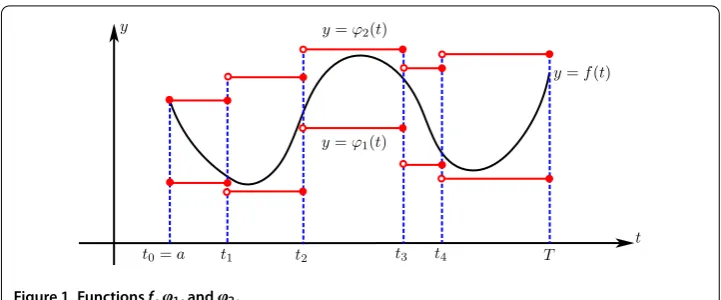
The unit step function is basically an on-off switch which is very useful in differential equations and piecewise functions when there is a large number of pieces, for example, Riemann sums as in Figure . Using Heaviside function, a piecewise continuous function ϕ(t) defined on an interval [a,T] can be written as follows:
ϕ(t) =m
ut(t) –ut(t)
+m
ut(t) –ut(t)
+m
ut(t) –ut(t)
+· · ·+mp+utp(t)
=mut+ (m–m)ut(t) + (m–m)ut(t) +· · ·+ (mp+–mp)utp(t)
= p
k=
Figure 1 Functionsf,ϕ1, andϕ2.
wherem= ,mi∈R(i= , , . . . ,p+ ) anda=t<t<t<· · ·<tp<tp+=T. Similarly
we define the functionsϕ,ψ, andψas follows:
ϕ(t) =
p
k=
(Mk+–Mk)utk(t), (.)
ψ(t) =
p
k=
(nk+–nk)utk(t), (.)
ψ(t) =
p
k=
(Nk+–Nk)utk(t), (.)
wheren=N=M= andni,Ni,Mi∈R(i= , , . . . ,p+ ).
Let f be an integrable function on [a,T] which satisfies the condition (.) with the functions ϕ, ϕ, ψ, and ψ in (.), (.), (.) and (.), respectively. Then we get mj+≤f(t)≤Mj+ for eacht∈(tj,tj+) (j= , , . . . ,p). For example, Figure represents
the casep= .
Then the Hadamardk-fractional integral off on [a,T] can be defined as follows:
Hα
a+,k{f}(T) =
p
j= Hα
tj,tj+,k{f}(t), (.)
where
Hα
tj,tj+,k{f}(t) :=
kk(α) tj+
tj
lnt
s
α
k–
f(s)ds
s (j= , , , . . . ,p). (.)
Proposition Let f and g be two positive integrable functions on[a,T]which satisfy the condition(.)with the functionsϕ,ϕ,ψ,andψin(.), (.), (.),and(.), respec-tively.Then,forα∈R+,the following inequality holds true:
p
j=
nj+Nj+Hαtj,tj+,k
f(T)
p
j=
mj+Mj+Hαtj,tj+,k
g(T)
≤
p
j=
(nj+Nj++mj+Mj+)
Hα
a+,k{fg}(T)
Proof Using the Hadamardk-fractional integral in (.), we get
Ha+,kψψf(T) =
p
j=
nj+Nj+Hαtj,tj+,k
f(T), (.)
Ha+,kϕϕg(T) =
p
j=
mj+Mj+Hαtj,tj+,k
g(T), (.)
and
Ha+,k(ϕψ+ϕψfg)(T) =
p
j=
(mj+nj++Mj+Nj+)Hαtj,tj+,k{fg}(T). (.)
Then substituting equalities (.), (.), and (.) for the result in Lemma . yields the
desired result (.).
Proposition Suppose that assumptions ofProposition are satisfied.Then,for k,α,β∈
R+,we have
(ln(t/a))
β
k
k(β+k)H α
a+,k{fg}(T) +
(ln(t/a))αk
k(α+k)H β
a+,k{fg}(T)
–Hα
a+,k{f}(t)Haβ+,k{g}(T) –H
β
a+,k{f}(t)Hαa+,k{f}(T)
≤M∗(f,mj+,Mj+)(t) + M∗(f,mj+,Mj+)(T)
×M∗(g,nj+,Nj+)(t) + M∗(g,nj+,Nj+)(T)
, (.)
where
M∗(u,v,w)(t) :=(ln(t/a))
β
kk(α+k)
k(β+k)
p
j=(v+w)(Hαtj,tj+,k{u}(t))
p
j=vw[(ln(t/tj)] α
k – [ln(t/tj+))αk]
–Hα
a+,k{u}(T)
Hβ
a+,k{u}(T)
,
M∗(u,v,w)(t) :=(ln(t/a))
α
kk(β+k)
k(α+k)
p
j=(v+w)(H
β
tj,tj+,k{u}(t))
p
j=vw[(ln(t/tj)] β
k – [ln(t/tj+))
β
k]
–Hβa+,k{u}(t)
Hα a+,k{u}(t)
.
Proof Since
Hα
tj,tj+,k{f}(T) =
kk(α) tj+
tj
lnt
s
α
k–
f(s)ds
s
=(ln(t/tj))
α
k – (ln(t/tj+))αk
we get
Ha+,k{ϕϕ}{T}=
p
j=
mj+Mj+
k(α+k)
ln(t/tj) α
k –ln(t/t
j+)
α
k
and
Ha+,k{ψψ}{T}=
p
j=
nj+Nj+
k(α+k)
ln(t/tj)αk –ln(t/t
j+)
α
k.
After some computations, we have
M(f,ϕ,ϕ)(T) =
(ln(t/a))βkk(α+k)
k(β+k)
p
j=(mj++Mj+)(Hαtj,tj+,k{f}(t))
p
j=mj+Mj+[(ln(t/tj)]
α
k – [ln(t/tj+))αk]
–Hα
a+,k{f}(T)
Hβ
a+,k{f}(T)
,
M(g,ψ,ψ)(T) =
(ln(t/a))βkk(α+k)
k(β+k)
p
j=(nj++Nj+)(Htαj,tj+,k{g}(t))
p
j=nj+Nj+[(ln(t/tj)] α
k – [ln(t/tj+))αk]
–Hαa+,k{g}(T)
Hβ
a+,k{g}(T)
,
M(f,ϕ,ϕ)(T) =
(ln(t/a))αkk(β+k)
k(α+k)
p
j=(mj++Mj+)(Hβtj,tj+,k{f}(t))
p
j=mj+Mj+[(ln(t/tj)]
β
k – [ln(t/tj+))
β
k]
–Haα+,k{g}(T)
Hβ
a+,k{g}(T)
,
and
M(g,ψ,ψ)(t) =
(ln(t/a))αkk(β+k)
k(α+k)
p
j=(nj++Nj+)(Htβj,tj+,k{g}(T))
p
j=nj+Nj+[(ln(t/tj)] β
k – [ln(t/tj+))
β
k]
–Hα
a+,k{g}(T)
Hβ
a+,k{g}(T)
.
By applying the results here to Theorem , we obtain the desired inequality (.). Hence
the proof is complete.
The special case of Proposition whenα=βis seen immediately to reduce to the result in Corollary .
Corollary Suppose that the assumptions of Proposition are satisfied.Then,for k,α∈
R+,the following inequality holds true:
(ln(t/a))
α
k
k(α+k)H α
a+,k{fg}(T) –Hαa+,k{f}(T)Hαa+,k{f}(T)
≤M∗(f,mj+,Mj+)(T)M∗(g,nj+,Nj+)(T)
where
M∗(u,v,w)(t) =(ln(t/a))
α
k
p
j=(v+w)(Hαtj,tj+,k{u}(t))
p
j=vw[(ln(t/tj)] α
k – [ln(t/tj+))αk]
–Hαa+,k{u}(t)
.
We conclude this paper by remarking that all the results presented in this paper can be converted into those for the right-sided Hadamardk-fractional integral.
Competing interests
The authors declare that they have no competing interests.
Authors’ contributions
The authors have contributed equally to this manuscript. They read and approved the final manuscript.
Author details
1Department of Mathematics, Faculty of Science and Arts, Ordu University, Ordu, Turkey.2Department of Mathematics,
University of Sargodha, Sargodha, Pakistan.3Department of Mathematics, Dongguk University, Gyeongju, Republic of
Korea.
Acknowledgements
This work was supported by Dongguk University Research Fund (Gyeongju). The authors would like to express their deep-felt thanks for the reviewers’ helpful comments.
Received: 30 June 2016 Accepted: 18 September 2016
References
1. Cerone, P, Dragomir, SS: New upper and lower bounds for the Chebyshev functional. J. Inequal. Pure Appl. Math.3(5), Article 77 (2002)
2. Dahmani, Z, Mechouar, O, Brahami, S: Certain inequalities related to the Chebyshev’s functional involving a Riemann-Liouville operator. Bull. Math. Anal. Appl.3(4), 38-44 (2011)
3. Peˇcari´c, J, Peri´c, I: Identities for the Chebyshev functional involving derivatives of arbitrary order and applications. J. Math. Anal. Appl.313, 475-483 (2006)
4. Purohit, SD, Kalla, SL: Certain inequalities related to the Chebyshev’s functional involving Erdélyi-Kober operators. Scientia, Ser. A, Math. Sci.25, 55-63 (2014)
5. Grüss, G: Über das maximum des absoluten betrages von 1 b–a
b
af(x)g(x)dx– 1 (b–a)2
b af(x)dx
b
ag(x)dx. Math. Z.39,
215-226 (1935)
6. Mitrinovi´c, DS, Peˇcari´c, JE, Fink, AM: Classical and New Inequalities in Analysis. Kluwer Academic, Dordrecht (1993) 7. Dragomir, SS: A generalization of Grüss inequality in inner product spaces and applications. J. Math. Anal. Appl.237,
74-82 (1999)
8. Elezovic, N, Marangunic, LJ, Pecaric, J: Some improvements of Grüss type inequality. J. Math. Inequal.1, 425-436 (2007)
9. Pachpatte, BG: On multidimensional Grüss type inequalities. J. Inequal. Pure Appl. Math.3(2), Article 27 (2002) 10. Li, X, Mohapatra, RN, Rodriguez, RS: Grüss-type inequalities. J. Math. Anal. Appl.267(2), 434-443 (2002) 11. Pólya, G, Szegö, G: Aufgaben und Lehrsatze aus der Analysis, vol. 1. Die Grundlehren der mathmatischen
Wissenschaften, vol. 19. Springer, Berlin (1925)
12. Dragomir, SS, Diamond, NT: Integral inequalities of Grüss type via Pólya-Szegö and Shisha-Mond results. East Asian Math. J.19(1), 27-39 (2003)
13. Belarbi, S, Dahmani, Z: On some new fractional integral inequalities. J. Inequal. Pure Appl. Math.10(3), Article 86 (2009)
14. Chebyshev, PL: Sur les expressions approximatives des integrales definies par les autres prises entre les mmes limites. Proc. Math. Soc. Charkov2, 93-98 (1882)
15. Dahmani, Z: New inequalities in fractional integrals. Int. J. Nonlinear Sci.9(4), 493-497 (2010)
16. Dahmani, Z, Tabharit, L: On weighted Grüss type inequalities via fractional integration. J. Adv. Res. Pure Math.2, 31-38 (2010)
17. Kiryakova, V: Generalized Fractional Calculus and Applications. Pitman Res. Notes Math. Ser., vol. 301. Longman, New York (1994)
18. Ntouyas, KS, Agarwal, P, Tariboon, J: On Pólya-Szegö and Chebyshev types inequalities involving the Riemann-Liouville fractional integral operators. J. Math. Inequal.10(2), 491-504 (2016)
19. Podlubny, I: Fractional Differential Equations. Academic Press, London (1999)
20. Sarıkaya, MZ, Dahmani, Z, Kiri¸s, ME, Ahmad, F: (k,s)-Riemann-Liouville fractional integral and applications. Hacet. J. Math. Stat.45(1), 77-89 (2016)
21. Set, E, Tomar, M, Sarıkaya, MZ: On generalized Grüss type inequalities fork-fractional integrals. Appl. Math. Comput.
269, 29-34 (2015)
22. Diaz, R, Pariguan, E: On hypergeometric functions and Pochhammerk-symbol. Divulg. Mat.15, 179-192 (2007) 23. Kokologiannaki, CG: Properties and inequalities of generalizedk-gamma, beta and zeta functions. Int. J. Contemp.
Math. Sci.5(14), 653-660 (2010)
25. Kokologiannaki, CG, Sourla, VD: Bounds fork-gamma andk-beta functions. J. Inequal. Spec. Funct.4(3), 1-5 (2013) 26. Krasniqi, V: Inequalities and monotonicity for the ratio ofk-gamma function. Sci. Magna6, 40-45 (2010) 27. Krasniqi, V: A limit for thek-gamma andk-beta function. Int. Math. Forum5, 1613-1617 (2010)
28. Suryanarayana, R, Rao, C: Some new inequalities for the generalized -gamma, beta and zeta functions. Int. J. Eng. Res. Technol.1(9), 1-4 (2012)
29. Zhang, J, Shi, HN: Two double inequalities fork-gamma andk-Riemann zeta functions. J. Inequal. Appl.2014, 191 (2014)
30. Mubeen, S, Habibullah, GM:k-Fractional integrals and application. Int. J. Contemp. Math. Sci.7, 89-94 (2012) 31. Romero, LG, Luque, LL, Dorrego, GA, Cerutti, RA: On thek-Riemann-Liouville fractional derivative. Int. J. Contemp.
Math. Sci.8(1), 41-51 (2013)