2019 International Conference on Artificial Intelligence, Control and Automation Engineering (AICAE 2019) ISBN: 978-1-60595-643-5
Development on ECU for the 32-bit High Pressure Common-rail Diesel
Engine Based on AUTOSAR ECU Software
Zhi-chao MA, Liang-kuan LI and Fei-fei LI
TianJin Maritime College, TianJin, China
Keywords: Diesel engine, ECU, AUTOSAR, Software architecture, Basic platform.
Abstract. In order to facilitate the development of the diesel engine ECU, based on AUTOSAR ECU software architecture and MPC554 microcontroller, the ECU basic platform which includes of diesel engine ECU hardware and ECU basic software library is established, as well as the overall common rail ECU is achieved. This ECU basic platform of the diesel engine provides reliable hardware system, drive module interface, two-stage injector configuration control waveform output and OBD system. It is convenient to ECU development which improves the developing efficiency, shortens the developing cycle and has a high practical value.
Introduction
With the implementation of the National III emission regulations, the use of electronic control systems for diesel engines has become a trend. A number of important ways can be utilized, such as electronic unit pumps, electronic injector nozzles, and electronic high pressure common rail, to achieve National III. However, for each technology and every manufacturer, it is necessary to design its own independent electronic control system, which increases the technical cost and extends the development cycle. Therefore, it is feasible to adopt a platform ECU design to improve the phenomenon.
The AUTOSAR ECU software is now popular all over the world, which defines the interface of each layer and each module of the software clearly via a clear functional level and modularization of the ECU software, and encapsulating each module as an independent functional unit to reduce the coupling between the software modules. The interchange and reuse of different company ECU software modules has become possible.
A set of electronically controlled diesel engine ECU basic platform is developed which is based on the AUTOSAR software architecture and 32-bit high-performance single-chip MPC554 produced by Infineon, including ECU hardware platform and ECU basic software library. On this platform, users only need to develop the control strategy of the corresponding diesel engine system to achieve the development of electronically controlled diesel engine ECU, which can save the development cost and time. The basic platform of the diesel engine ECU is suitable for the electric unit pump and the electronic high pressure common rail system.
Basic Platform Hardware Structure for Diesel Engine ECU
Brief Introduction on MPC554
The MPC5554 has two levels of hierarchical memory. The fastest access speed is 32KB cache. The secondary memory includes 64 KB of on-chip SRAM and 2 MB of internal flash memory. On-chip SRAM and internal flash memory can save instructions and data. The design of the external bus interface supports many standards of memories used by members of the MPC544.
Figure 1. Structure block diagram of MPC554.
Basic Platform Hardware Structure for Diesel Engine ECU
The hardware system application target of the diesel engine ECU basic platform is a 4-cylinder electronically controlled high-pressure common rail diesel engine. According to the function, the ECU hardware is divided into analog input interface, digital input interface, power module, single chip module, KWP bus interface, CAN bus interface, power drive module, etc., as shown in Figure 2.
Figure 2. Hardware structure block diagram of diesel engine ECU basic platform.
The analog input interface provides 12 channels of AD sensor signal input, which can collect signals such as accelerator pedal, intake air temperature, fuel temperature, coolant temperature, boost pressure, and boost temperature. The analog input interface filters and shapes the analog signal so that the signal of the sensor can be reliably collected by the single chip microcomputer.
[image:2.595.104.490.421.656.2]The function of the power module is to convert the battery voltage on the vehicle into the voltage required by the control unit, and provide two 5V power outputs to supply power to the external sensor. The control circuit of the power module can be achieved by the power supply of the power driving module and the power supply of the single chip module through the single chip program, thereby improving the safety of the ECU.
The KWP bus interface and the CAN bus interface are used to set up the vehicle bus and monitor the ECU.
The power drive module converts the TTL electrical level of the microprocessor into the control current of the actuator, such as injectors, EGR valves, glow plugs, and fault lights. Meanwhile, the power drive module can also achieve communication between the microprocessor and the power chip through the I/O port and synchronous serial communication for trouble shooting of the power drive module.
Basic Platform Software Architecture for Diesel Engine ECU
A Brief Introduction about AUTOSAR
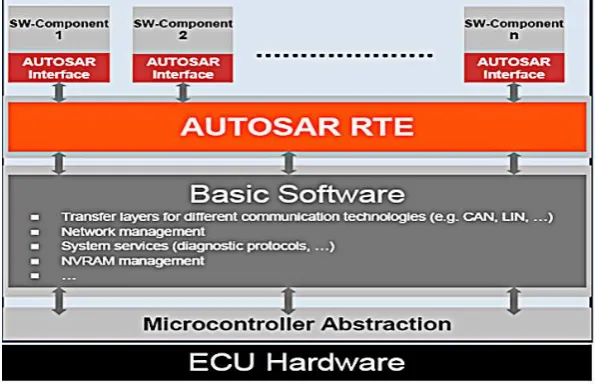
AUTOSAR (Automobile Open System Architecture) is an open automotive system architecture (organization). The AUTOSAR organization consists of automotive vehicle manufacturers, component suppliers and tool developers. Its goal is to realize the modularization, portability and interface standardization of ECU functions, and finally realize the standardization and cross-platform transportation of ECU software modules.
[image:3.595.148.448.576.768.2]The AUTOSAR software architecture is divided into four layers, the Application layer, the RTE (Runtime Environment) layer, the BSW (Basic Software) layer, and the MCU abstraction layer, as shown in Figure 3. The MCU abstraction layer encapsulates the microcontroller hardware driver. It converts the operation of the single-chip registers into the drive functions of the various hardware modules, freeing the ECU developers from the cumbersome operation of the single-chip registers. The BSW layer encapsulates drivers related to the ECU hardware, such as the engine crankshaft rotational position processing system, the injector drive waveform control system, the power module drive, the Flash drive, and the communication drive. The RTE layer is the interface layer between the application layer and the basic software layer. It separates the application layer from the basic software layer. The Application layer contains software programs for various engine control strategies. Each module of the Application layer has a strictly standardized software interface specification. For the application layer module of the same function, the internal processing mechanism can be completely different, but because of the strict unified interface, that is, the unified external characteristics, it can be completely interchanged, and the software transportation between different ECUs is realized.
ECU Platform Software Layered Structure Based on AUTOSAR
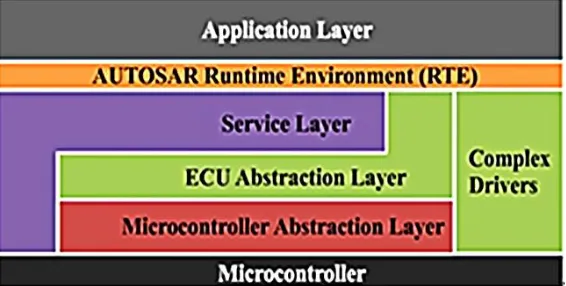
Based on the AUTOSAR idea, this paper divides the ECU software into four layers, they are the user application layer, the virtual operating environment, the ECU abstraction layer and the driver abstraction layer respectively, as shown in Figure 4. Among them, the virtual operating environment, the ECU abstraction layer and the driver abstraction layer are packaged into the ECU basic software library. The user only needs to perform secondary development based on the ECU basic software library in the user application layer to complete the development of a complete ECU software.
[image:4.595.157.440.416.559.2]The driver abstraction layer provides operations on the MPC554 microcontroller pins, ASC, SSC, CAN, Flash, RAM, and other external devices. It converts the operation of the register into an interface function for the upper layer software to transfer. The ECU abstraction layer provides various analog signal acquisition, digital signal acquisition, crankshaft camshaft signal analysis, configurable two-stage injector control waveform synthesis, relay operation, OBD, CCP calibration, KWP calibration and other functions required for diesel engine control. In addition, it can also provide interface functions for each module. The virtual running environment is the data communication area between the user application layer program and the ECU basic software. The virtual operating environment has a variety of data required by pre-defined diesel ECUs that are updated in real time by the basic software and user application layer programs at a designed frequency. The electrical signal changes on the ECU terminals are converted into original data signals in real time by the ECU hardware and ECU basic software and stored in the virtual operating environment. The user application layer program acquires the original data signal through the data exchange area, and saves the calculated control quantity in the virtual running environment through analysis and table look-up and other algorithms. The ECU basic software obtains the corresponding control quantity from the data exchange area, and controls the ECU hardware to generate corresponding actions to complete a control loop.
Figure 4. Software Framework of Diesel Engine ECU Foundation Platform.
The user application layer is developed secondarily by the user, mainly including modules such as working condition judgment, controlled quantity calculation, and advanced trouble shooting. The user application layer program only processes the data in the data exchange area and transfers the library functions provided by the ECU basic software library, which is completely separated from the operation of the specific ECU hardware. In this way, on the basic platform of the ECU, the electronic control system of different diesel engines can be accomplished by developing different control strategies and configuring different injector control waveforms.
Engine Application for ECU Basic Platform
traditional method is to write the code by hand according to the control strategy design, which takes a long time and the debugging workload is relatively large. This article uses Matlab automatic code generation tool to generate standard C code that can be directly used by the microcontroller, saving the time for manually writing C code.
The control strategy program code generated by Matlab is a separate c file. The Codewarry project file is created by the control strategy c file and the ECU basic software, and the control strategy function is called in the ECU main program to complete the code writing of the ECU software.
After completing the integration of the control strategy and the ECU basic software library, the entire ECU software can be compiled and downloaded to the ECU hardware platform to complete the preliminary development of the ECU. Then, the ECU's operation will be verified by the use of the hardware-in-the-loop simulation method. After the verification, the ECU enters the stage calibration experiment stage.
The ECU basic platform integrates a set of CCP-based monitoring standard modules. This module allows communication with CANApe for calibration based on CCP standards.
The experiment proves that the engine has good dynamic response speed under various working conditions, the engine can run under the serious fault of the camshaft or the crankshaft signal missing, OBD can monitor the working condition of the important components such as the injector in real time.
Conclusion
Through the development process of the four-cylinder single-pump diesel engine ECU, the common rail ECU has the following characteristics:
1. According to the AUTOSAR development method, the 32-bit high pressure common rail ECU is realized, which has good transportation.
2. The work condition is stable and reliable, and provides a variety of safety protection mechanisms to improve the robustness of the ECU.
3. Plenty of basic software interfaces of this ECU basic platform satisfy the requirements of 4-cylinder diesel engine control.
Reference
[1] Ju YuSheng, et al, Current Situation of High Speed Light Vehicle Diesel Engines in China and Technical Ways to Realize National III Emissions [J]. Modern Vehicle Power, 2006, 122(2):
[2] Dong YaoQing, et al, Technical Measures for Medium and Heavy Vehicle Diesel Engines to Meet Euro II Emission Regulations [J]. Internal Combustion Engine Engineering, 2004, 25(5):79-83.
[3] Xie Hui, et al, Software Layered Model and Real-time Multitask Mechanism of Common Rail Diesel Engine ECU [J]. Journal of Internal Combustion Engine, 2002, 20(1):31-34.
[4] Zhang Zhen, et al, 32-bit electronic control unit for high-pressure common rail diesel engine and its reliability design [J]. Journal of Internal Combustion Engine, 2002, 20(2):96-98.
[5] Heiko Dörr. AUTOSAR-An open standardized software architecture for the automotive industry. 2008