2018 International Conference on Computer, Communication and Network Technology (CCNT 2018) ISBN: 978-1-60595-561-2
Autonomous Car Simulating Based on Lego Ev3 and Android App
Qiang CHEN
1,2, Yi-nong CHEN
2,*,
Ran CHEN
3,
Peng TANG
1,
Yu ZHANG
3,
Er HU
3and
Nan XIAO
31
College of Computer and Information Science, Southwest University, Chongqing, China
2
School of Computing, Informatics and Decision Systems Engineering, Arizona State University, Tempe, AZ, USA
3
Chongqing Songshuqiao Middle School, Chongqing, China
*Corresponding author
Keywords: Autonomous car, Android app, Lego Ev3, Obstacle avoidance, Image processing.
Abstract. Autonomous car simulating is both safer and more economical than directly using real car for self-driving related research work. In this paper, we propose a framework that fully utilize the Lego Ev3’s sensor and Android App to simulate an autonomous car. First, the App receives sensor data from Lego Ev3 and images from Android phone, then using specified strategies to guide computing these data. Finally, when the computation is completed, App makes decisions to order Lego Ev3 avoiding obstacles in front of it. The computing process contains image process, simultaneous mapping construction and multi data fusing, which is highly related to autonomous car technology, but safer and more economical. Experimental results show that the proposed framework can be used for autonomous car simulating, so we can do more autonomous car related research works on this framework in the future.
Introduction
Autonomous car or self-driving car has become a hot research pot in recent years. However, it is so expensive to buy all the equipment for autonomous car driving and testing. In addition, it is unsafe to test an autonomous car in an open environment. Fortunately, the algorithms behind the autonomous car driving are the same, so we can use some other equipment to simulate the self-driving environment and equipment. Moreover, we have several Lego Ev3s in our laboratory, so we can use Lego to simulate an autonomous car.
Lego Ev3 provides several sensors, such as Ultra Sound Sensor, Gyro Sensor, Touch Sensor and Color Sensor, so it is very convenient for us doing research work. Unfortunately, due to the limitation of its computational efficiency, it cannot be used to deal with any images. Usually, image processing is a fundamental part of an autonomous car, thus we cannot directly use Lego Ev3 for simulating the autonomous car.
With the fast progress achieved in IT, especially in mobile computation environment, we can use mobile phone to deal with larger data than before. In addition, the camera is the basic component of a high-end mobile phone, and Android becomes the most popular OS in mobile phone field. So rather than simply using Lego Ev3 as the simulator, we can now use Android phone together with Lego Ev3 to simulating an autonomous car.
Radcliffe et al.[2] recently proposed a machine vision algorithm for orchard navigation. In their paper, Lego Ev3 is performed as the controller, and a laptop computer is used for image processing. Since the laptop is energy consuming, it could not work for a long time. In such a circumstance, Android phone is better than laptop. Chen et al.[3] proposed a graphical based programing language named VIPLE to control different robots, such as Lego Ev3, Raspberry PI, Intel Edison etc.. VIPLE is a well-developed IDE, so users can easily manipulate it. However, it is impossible to deal with the image in the latest version.
In this paper, we propose a new framework that can be used for autonomous car simulating. It contains three main parts. The first part deals with the connection problem between Lego Ev3 and the Android phone, the second part processes the information gathered by the Android phone camera. The last part fully utilizes the information gathered from Android phone and Lego Ev3 to guide Lego Ev3 as an autonomous car.
The rest of the paper is organized as follows. Section 2 gives the detail information of the proposed simulating framework. Section 3 analyses the experimental results. The last section concludes all.
Autonomous Car Simulating Based on Lego Ev3 and Android App
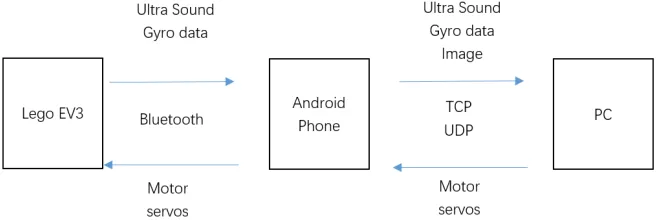
[image:2.612.140.473.379.489.2]Autonomous car must have three fundamental functions, sensor data inputting, information processing and action. Therefore, when we are trying to use Lego Ev3 and Android phone to simulate an autonomous car, the urgent problem we faced is that how to realize the three parts that are equivalent to the real autonomous cars’. In this section, we first talk about the information acquiring process, and then make some introductions on information processing, especially on image processing. Finally, we concern on the reaction of the Lego Ev3. The framework is shown in Figure 1.
Figure 1. Framework of the simulating system.
Sensor Data Inputting
We can use Ultra sound sensor to get the distance information between Lego Ev3 and the obstacle and turning angles from Gyro sensor. Meanwhile, we receive images from Android phone and try to use OpenCV[4] or other SDK to process these images in an Android App. In summary, there are three types of data will input into our framework.
Before we are going to talk the details of the inputting step, we will firstly introduce the proposed framework. In our framework, Lego Ev3 just plays a role as the actor and information provider, because we do not directly use any computation resource of Lego Ev3. The core of the framework is an APP that running on the Android phone. It connects to Lego Ev3 through Bluetooth and communicates with laptop through WIFI. The APP deals with all the sensor data including the images from Android phone, and then gives the orders that Lego Ev3 should turn into action.
addition, the sending frequency is limited by the receiving ability of Lego Ev3, that means you can send as much information as you want, but Lego Ev3 will not completely follow your orders. Therefore, we get sensor data only once for each second and send servos order five times each second.
Android App and Image Processing
We use Android Studio to build an APP to capture images from Android phone, and then send these images to PC. Meanwhile, PC will process these images received from Android phone and makes decisions upon these images. We capture five images per second, and then send them to PC via UDP channel. Since UDP is a stateless protocol, we are not sure about whether PC has received it or not. Therefore, we use TCP channel sending commands between PC and phone.
The purpose of capturing images is that we want to make Lego Ev3 avoid obstacle autonomously, so we use OpenCV a widely used computer vision SDK to detect these obstacles in the image. If there is an object in front of Lego Ev3, we will take some strategies to avoid it. The entire image processing progress is carried on PC, the commands will send to Android phone and Ev3 via TCP and Bluetooth.
Self-driving Car Simulating
In this section, we will discuss some basic strategies that make the self-driving car more intelligent. The key idea of autonomous car is that it is going to find out where the obstacle is and try to avoid it, then making step towards destination. There are three important modules in self-driving car simulating, data fusing, precise turning and simultaneous mapping.
First, camera and Ultra sound sensor provide data that used for obstacle avoidance calculating. Despite Ultra sound data can tell us the distance of obstacle ahead of Lego Ev3, there still are some blind area. For example, Ultra sound will not tell you a tiny thing ahead of you, moreover, it can only detect object at one direction each time, and any disturbance will lead a wrong reading. Therefore, we will fuse camera data together with the Ultra data in order to decide the correct moving direction. Eq.1 depicts the fusing schema.
d= α*d1+β*d2 (1)
where α and β are weights used for fusing. d1 represents the distance detected by Ultra sound sensor, d2 represents the distance calculated from image processing. We use obstacle’s area ratio to estimate d2, the larger obstacle in the image, the higher d2. We will manually set the weights in experiment in order to achieve best results.
Second, when facing an obstacle, Lego should follow some rules to making turning. Usually, it will make some 90 degrees turning, including turning 90 degrees to the right and 90 degrees to the left. However, it is impossible for Lego Ev3 to make precise 90 degrees turning. Without precise turning, the accumulative error will result in error routing. Therefore, we use Gyro sensor to guide turning process in order to achieve high precise turning. The algorithm is listed as follows.
Step1. Recording the initial reading of Gyro sensor as A1.
Step2. Turning left (right) for a fixed period. Usually, it will turn at least 1000ms, and the accurate value will be calculated in experimental step.
Step3. Recording the reading of Gyro sensor as A2.
Step4. If the absolute value of A2 minus A1 is less than predefined value ε, then stop. If not,
continuing turning a slightly degree, then repeating Step3 to Step4.
Finally, simultaneous mapping can provide location information to Lego Ev3, which is a key issue in real scene. We use the Gyro data and a fixed moving rate roughly to build a map, and then use Ultra sound data to refine it. The mapping process is listed as follows.
Step4. Using Ultra sound data to refine the moving distance that showing on the map. Jumping to Step2 until Lego Ev3 stopped.
Experimental Results
In this section, we talk about the parameters setting for autonomous car simulating and experimental results analysis. All the experiment is carried on a Lego Ev3, Android Phone (XiaoMi Mi5) with Android 6.0, Quad-core max 2.15Ghz,3G RAM,1,600M pixel camera and a laptop with 8G RAM, Core I3,240G SSD. Moreover, we use Android Studio 3.1 for APP developing and Visual Studio 2013 to build application that running on PC.
Experiment Setting
After exhaustively research, we empirically set α as 0.8, β as 0.2 for Eq.1, and then set the initial time for precise turning as 1000ms, then making εas 3 degrees in precise turning process. In simultaneous mapping process, we set the fixed rate as two pixels per 200ms.
Running Experiment
The hardware and the APP interface are listed in Figure 2. We fixed an Android Phone in front of the Lego Ev3 as shown in Figure 2 (b). Figure 2 (c) is the interface of Android APP.
[image:4.612.109.507.318.441.2]
(a)Initial status. (b)Android phone on Lego Ev3. (c) Interface of APP.
Figure 2. Hardware and App of the framework.
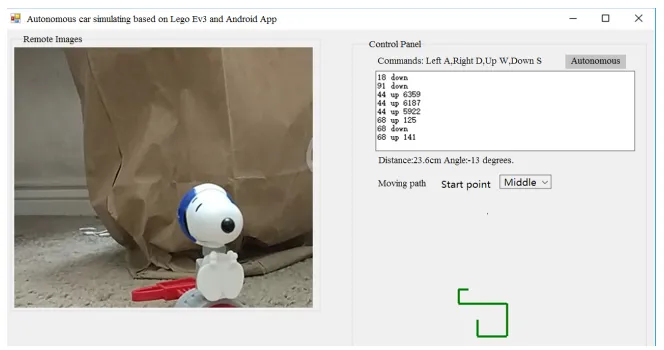
Figure 3. Mapping and Lego Ev3 Controlling.
[image:4.612.140.472.488.663.2]connect. If no error occurs, then APP can get data from Lego Ev3 and send commands to Lego Ev3. Figure 3 shows the running result and the mapping process.
Discussions
The one problem we have faced is that it is occasionally unstable for the APP to communicate with Lego Ev3. It might be the caused by the congestion in the Bluetooth communication channel. Once it happened, we need to reboot Lego to make it back to normal. On the other hand, we find it is hard to draw the map with high precise because we did not know the exact distance that Lego Ev3 has moved. Specifically, it is also hard to measure the distance between Lego Ev3 and the obstacle with mono camera.
In the future, we will try to improve the stability of the connection and try to use raspberry PI to realize high precise mapping construction. In addition, we will try to use some direct methods to estimate the 3D structure and the camera motion [5].
Summary
In this paper, we propose an autonomous car simulating based on Lego Ev3 and Android APP. Lego Ev3 provides Ultra sound data and Gyro data to Android App, and then Android App tackles these data from EV3 together with images from Android phone’s camera. Meanwhile, these images are sending to PC for further compute. After computing, the Android App will make decision to let Lego Ev3 avoid the obstacle in front of it. Experiments demonstrated the efficiency of the proposed framework.
Acknowledgement
This research was financially supported by the China Scholarship Council (CSC 201706995087), ChuYing Plan of Chongqing (CY170217) and the Education Reform Project in Southwest University (2017JY094).
References
[1]M. A. Abdullah, M. A. Azan, F. R. Ramli, and M. M. Nor, Autonomous vehicle convoy using Lego Mindstorms, In Proceedings of Mechanical Engineering Research Day 2015, pp.27-28.
[2]J. Radcliffe, J. Cox, D. M. Bulanon, Machine vision for orchard navigation, Computers in Industry. 98(2018) 165-171.
[3]Y. Chen, G. De Luca, VIPLE: Visual IoT/Robotics Programming Language Environment for Computer Science Education, In 2016 IEEE International Parallel and Distributed Processing Symposium Workshops (IPDPSW), 2016, pp. 963-971.
[4]Information on https://opencv.org/.