A Monthly Double-Blind Peer Reviewed Refereed Open Access International e-Journal - Included in the International Serial Directories
International Research Journal of Natural and Applied Sciences (IRJNAS)
Website: www.aarf.asia. Email: [email protected] , [email protected] Page 106
A COMPARATIVE STUDY OF VITAMIN D LEVELS IN INDIVIDUALS
WITH AND WITHOUT DEPRESSION
Lakshmi Ranganathan,
Department of Biochemistry, Vels University, Pallavaram, Chennai - 600117, Tamil Nadu, India
ABSTRACT
Aims
Depression is a universal health problem and its outcomes are physical, psychological
and social. Several studies have shown that depression results in decreased Vitamin D
values. The purpose of this study is to find out the association between the levels of
depression and 25-hydroxyvitamin D levels in individuals and to compare the same
between individuals with and without depression.
Methods
This prospective study was carried out as part of a doctoral research from January 2012
to February 2014. Both males and females in the age group 25 – 35 years were included
in the study. Beck’s depression inventory (BDI) was used to assess depression.
Individuals, who scored greater than 14 points with BDI, comprised the Study group. The
normal group comprised of individuals who scored less than 14 points with BDI. Vitamin
D levels were evaluated in both the group.
Results
A total of 65 individuals were included in the study group. (33 Males/32 Females). Their
mean Beck’s score was 24.5±4.79. There were 63 in the normal group (51Males/12
Females). Their mean BDI score was 3.52±2.35. Mean Vitamin D3 value in the
depressed group was 10.7±3.09 whereas in the normal group, it was 15.07±7.99. The
A Monthly Double-Blind Peer Reviewed Refereed Open Access International e-Journal - Included in the International Serial Directories
International Research Journal of Natural and Applied Sciences (IRJNAS)
Website: www.aarf.asia. Email: [email protected] , [email protected] Page 107 Conclusion
This study shows that Vitamin D levels are significantly low in depression. The negative
correlation in the study group reveals that the Vitamin D levels decrease as depression
increases.
Key words - Depression, Vitamin D, mental health, Beck’s Score
Introduction
The human body responds to the way, a person thinks, feels and acts. This is called the “mind - body connection”. When an individual is depressed, stressed or anxious, the same may be indicated by physical symptoms - back pain, change in appetite, bowel disturbance, extreme tiredness, high blood pressure, troubled sleep, palpitations, weight gain or loss – to name a few.
Depression is one important health issue; however, many people with depression go undiagnosed (1,2). According to the World Health Organization (WHO), Depression is a mental disorder, characterized by sadness, loss of interest or pleasure, feelings of guilt or low self-worth, disturbed sleep or appetite, feelings of tiredness and poor concentration. (3) The depressive disorders are grouped under a category in the DSM-IV (Diagnostic and Statistical Manual of Mental Disorders - Fourth Edition) called Mood Disorders (4). It is estimated by 2020, if current trends for demographic and epidemiological transition continue, the burden of depression will increase to 5.7% of the total burden of disease and it would be the second leading cause of disability-adjusted life years (DALYs), second only to ischemic heart disease (5). In view of the morbidity, depression has always been a focus of attention of researchers in India. Various authors have tried to study its prevalence, nosological issues, psychosocial risk factors including life events, symptomatology in the cultural context, comorbidity, psychoneurobiology, treatment, outcome, prevention, disability and burden.
A Monthly Double-Blind Peer Reviewed Refereed Open Access International e-Journal - Included in the International Serial Directories
International Research Journal of Natural and Applied Sciences (IRJNAS)
Website: www.aarf.asia. Email: [email protected] , [email protected] Page 108 Biochemical correlates of Depression
Biological causes of clinical depression continue to be studied extensively. The exact etiology of depression is yet to be determined; however, it has been proposed that multiple factors, including biological, psychological, and environmental factors are involved in the presentation of depression. Many biochemicals have been linked to depression like Vitamin D, Cortisol, cholesterol, thyroid hormones, norepinephrine, dopamine etc.
Increasing research is being done on Vitamin D deficiency over the past decade. Intensive research on vitamin D is being performed in all areas of medicine (7).
Several studies have shown that low Vitamin D levels are associated with depression (8,9).
The objective of the study was to investigate the association between depression and Vitamin D levels and to compare the levels between individuals with or without depression.
Methods
This study was an open, parallel, prospective, concurrent-control group study conducted as part of a doctoral research work. Individuals for the study group were recruited from a prominent yoga centre in Chennai. The study was conducted from January 2012 to February 2014. Approval from Institutional Ethics Committee was obtained before the commencement of recruitment. The study was explained in detail to all the prospective participants. Following this, the individual was requested to give written informed consent. Throughout the conduct of the study, the privacy of participants was protected. All data were only identified by a unique identification number and initials.
A Monthly Double-Blind Peer Reviewed Refereed Open Access International e-Journal - Included in the International Serial Directories
International Research Journal of Natural and Applied Sciences (IRJNAS)
Website: www.aarf.asia. Email: [email protected] , [email protected] Page 109 The Normal group comprised of willing individuals who were ‘not depressed’ as assessed by Beck’s inventory (Beck’s scores < 14). Both the groups, after completing the Beck’s inventory, underwent blood test for Vitamin D evaluation.
Blood samples were collected after overnight fasting, centrifuged and Vitamin D was estimated using chemiluminescent immunoassay technology.
Beck’s Depression Inventory (BDI)
BDI was created by Aaron T. Beck. It is a 21-question multiple-choiceself-report inventory, one of the most widely used instruments for measuring the severity of depression. The questionnaire is designed for individuals aged 13 and over, and is composed of items relating to symptoms of depression such as hopelessness and irritability, cognitions such as guilt or feelings of being punished, as well as physical symptoms such as fatigue, weight loss, and lack of interest in sex (10). Each question has a set of at least four possible answer choices, ranging in intensity. A BDI total score of ≤ 13 is considered to be within normal range, a score of 14–19 shows mild depressive state, a score of 20-28 is moderate and 29-63 is severe depression (11,12)
Results were analyzed for changes in Vitamin D levels with respect to depression. Student's independent sample t-test was used to compare the differences in scores between two groups. Data were analyzed using SPSS v.17.0.
Results
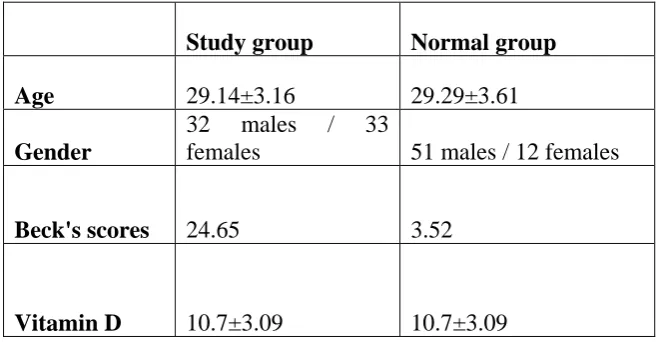
There were 65 individuals in the study (depressed) group, out of which 32 were males and 33 were females. Their mean Becks Score was 24.65±5.69.
There were 63 individuals in the normal group out of which 51 were males and 12 were females. Mean age was 29.67±3.22. Their mean Becks Score was 3.52±2.34 (Figure 1).
Relative to men, women demonstrated higher depression scores, though the difference was not statistically significant (p=0.19).
A Monthly Double-Blind Peer Reviewed Refereed Open Access International e-Journal - Included in the International Serial Directories
International Research Journal of Natural and Applied Sciences (IRJNAS)
Website: www.aarf.asia. Email: [email protected] , [email protected] Page 110 Figure 1: Comparison of Depression scores between Study Group and Normal Group
[image:5.595.65.432.118.337.2]Levels of Vitamin D in the normal group was 15.07±7.99, whereas in the the depressed group it was 10.7±3.09 ng/ml. The difference was extremely significant. Students t test revealed a p value of p<0.0001.
Table 1: Demographics of Study participants
Study group Normal group Age 29.14±3.16 29.29±3.61 Gender
32 males / 33
females 51 males / 12 females
Beck's scores 24.65 3.52
Vitamin D 10.7±3.09 10.7±3.09 24.65
3.52
0 5 10 15 20 25 30
[image:5.595.62.392.533.704.2]A Monthly Double-Blind Peer Reviewed Refereed Open Access International e-Journal - Included in the International Serial Directories
International Research Journal of Natural and Applied Sciences (IRJNAS)
[image:6.595.65.498.100.389.2]Website: www.aarf.asia. Email: [email protected] , [email protected] Page 111 Figure 2: Depression scores vs Vitamin D levels in both the groups
Discussion
Depression is a multi-dimensional disorder. It has biological components based in genetics, neurochemistry and physical health, it has psychological components that involve many individual factors such as cognitive style, coping style, and qualities of personal behavior. Unravelling the mechanisms behind depression is both difficult and exciting.
Studies of brain chemistry and of mechanisms of action of antidepressant medications continue to inform the development of new and better medical and psychotherapy treatments. There is a high degree of variation among people with depression in terms of symptoms, course of illness, and response to treatment, indicating that depression may have a number of complex and interacting causes. This variability poses a major challenge to researchers attempting to understand and treat the disorder. However, recent advances in research technology are bringing scientists closer to characterize the biology and physiology of depression in its different forms and to the possibility of identifying effective treatments for individuals based on symptom presentation. (13)
0 5 10 15 20 25 30
Study group Normal group
Beck's scores
A Monthly Double-Blind Peer Reviewed Refereed Open Access International e-Journal - Included in the International Serial Directories
International Research Journal of Natural and Applied Sciences (IRJNAS)
Website: www.aarf.asia. Email: [email protected] , [email protected] Page 112 Studies have shown that low Vitamin D levels are associated with depression and improvement in depression is significantly associated with increased Vitamin D levels (8,9). Similarly in our study, we found that Vitamin D3 was less in the study (depressed) group compared to the normal group.
In a case report series presented at The Endocrine Society's 94th Annual Meeting in Houston, authors concluded that correction of the patients' underlying shortage of vitamin D might be responsible for the beneficial effect on depression. Vitamin D may have an effect on mood, and its deficiency may exacerbate depression (14).
A research, completed by UT Southwestern Medical Center in 2011, (15) positively confirmed the previous studies’ outcomes on association between low levels of vitamin D and depression. People with the lowest levels of vitamin D were more likely to report symptoms of depression, compared to people with higher blood levels of vitamin D.
It is also likely that depressed people may spend more time indoors, and are less likely to eat a healthy diet and take care of themselves, all of which could affect vitamin D levels. On the other hand, there are vitamin D receptors everywhere in the body, including the brain. These receptors need vitamin D to do their job.
Based on the proposed explanations, Vitamin D may affect neurotransmitters, inflammatory markers and other factors, which could help explain the relationship with depression. Vitamin D also may reduce the production of cytokines. Cytokines are proteins that increase inflammation and have been shown to be a possible risk factor for depression. One of the effects that vitamin D has on the brain is to improve serotonin levels, which is the same chemical that many antidepressants act on. Vitamin D is believed to play a role in maintaining the brain’s signaling pathways and reducing inflammation. Not enough D and inflammation degrades brain cells in a way that leads to depression symptoms (16)
A Monthly Double-Blind Peer Reviewed Refereed Open Access International e-Journal - Included in the International Serial Directories
International Research Journal of Natural and Applied Sciences (IRJNAS)
Website: www.aarf.asia. Email: [email protected] , [email protected] Page 113 Conclusions
Findings of this study show that Vitamin D3 levels were low in depression. This study provides information on an important biochemical parameter as marker for depression, thereby providing inputs to guide clinical practice for Depression.
References
1. Epstein RM, Duberstein PR, Feldman MD, Rochlen AB, Bell RA, Kravitz RL, et al. “I didn’t know what was wrong:” how people with undiagnosed depression recognize, name and explain their distress. J Gen Intern Med [Internet]. 2010 Sep [cited 2015 Apr 19];25(9):954–61. Available from: http://www.pubmedcentral.nih.gov/articlerender.fcgi?artid=2917673&tool=pmcentrez& rendertype=abstract
2. “Severity” of depression [Internet]. [cited 2015 Apr 19]. Available from: http://depressionet.org.au/what-is-depression/types/
3. WHO | Depression. World Health Organization; [cited 2015 Feb 2]; Available from: http://www.who.int/topics/depression/en/
4. DSM IV: DSM Library [Internet]. [cited 2015 Apr 11]. Available from: http://psychiatryonline.org/doi/book/10.1176/appi.books.9780890420614.dsm-iv
5. Grover S, Dutt A, Avasthi A. An overview of Indian research in depression. Indian J Psychiatry. India; 2010 Jan;52(Suppl 1):S178–88.
6. Rapaport MH, Clary C, Fayyad R, Endicott J. Quality-of-life impairment in depressive and anxiety disorders. Am J Psychiatry. United States; 2005 Jun;162(6):1171–8.
7. Holick MF. High prevalence of vitamin D inadequacy and implications for health. Mayo Clin Proc [Internet]. 2006 Mar [cited 2015 Feb 21];81(3):353–73. Available from: http://www.ncbi.nlm.nih.gov/pubmed/16529140
8. Gloth FM 3rd, Alam W, Hollis B. Vitamin D vs broad spectrum phototherapy in the treatment of seasonal affective disorder. J Nutr Health Aging. FRANCE; 1999;3(1):5–7.
9. Cizza G, Mistry S, Nguyen VT, Eskandari F, Martinez P, Torvik S, et al. Do premenopausal women with major depression have low bone mineral density? A 36-month prospective study. PLoS One. United States; 2012;7(7):e40894.
A Monthly Double-Blind Peer Reviewed Refereed Open Access International e-Journal - Included in the International Serial Directories
International Research Journal of Natural and Applied Sciences (IRJNAS)
Website: www.aarf.asia. Email: [email protected] , [email protected] Page 114 11. Beck AT, Steer RA, Ball R, Ranieri W. Comparison of Beck Depression Inventories -IA and -II in psychiatric outpatients. J Pers Assess. UNITED STATES; 1996 Dec;67(3):588–97.
12. Beck Depression Inventory [Internet]. [cited 2015 Feb 18]. Available from: http://academicdepartments.musc.edu/family_medicine/rcmar/beck.htm
13. Depression Research - Psych Central [Internet]. [cited 2015 Mar 28]. Available from: http://psychcentral.com/disorders/depressionresearch.htm
14. Vitamin D Can Help Curb Depression | Grauhirn [Internet]. [cited 2015 Mar 29]. Available from: http://grauhirn.org/vitamin-d-can-help-curb-depression/
15. Hoang MT, DeFina LF, Willis BL, Leonard DS, Weiner MF, Brown ES. Association Between Low Serum 25-Hydroxyvitamin D and Depression in a Large Sample of Healthy Adults: The Cooper Center Longitudinal Study. Mayo Clinic Proceedings. 2011. p. 1050–5.
16. Clinical Depression: Symptoms and Treatment: Vitamin D and Clinical Depression [Internet]. [cited 2015 Mar 29]. Available from: http://depressivedisorder.blogspot.in/2012/05/vitamin-d-and-clinical-depression.html