Caused by OXA-48-Producing
Enterobacteriaceae
in a Neonatal
Intensive Care Unit in Jerusalem, Israel
Amos Adler,aEster Solter,aSamira Masarwa,aTamar Miller-Roll,aBassam Abu-Libdeh,bHatem Khammash,bKhalil Najem,b Susan Dekadek,bChen Stein-Zamir,cNafez Nubani,cAmin Kunbar,cMarc Victor Assous,dYehuda Carmeli,aMitchell J. Schwabera
National Center for Infection Control, Ministry of Health, Tel-Aviv, Israela; Makassed Hospital, Jerusalem, Israelb; Jerusalem District Health Office, Ministry of Health, Jerusalem, Israelc; Shaare Zedek Medical Center, Microbiology and Immunology Laboratory, Jerusalem, Israeld
This study describes the course of an OXA-48-producingEnterobacteriaceae(OPE) outbreak that started in March 2012 in a neonatal intensive care unit (NICU) in Jerusalem, Israel. During the peak of the outbreak (January to August 2012), there were 49 patients who had proven or suspected acquisition of OPE in the NICU, including 16 with invasive infections, out of a total of 156 patients who were hospitalized during that period. Three children hospitalized in the pediatric ICU were identified as carriers of OPE. Three patients with a previous stay in the affected NICU were identified as OPE carriers upon admission to another hospital. The Ministry of Health was notified and then intervened in July 2012. Intervention included cohorting colonized patients, conducting frequent rectal-culture surveillance, and improving the implementation of infec-tion control practices. As a result, the incidence of OPE acquisiinfec-tion declined to 5 cases in the first 4 months, followed by no new cases in the next 3 months. Thirty-one patient-unique isolates were available for analysis: 29Klebsiella pneumoniae isolates, all belonging to a single clone (sequence type 39 [ST39]), and 2 isolates fromEnterobacter cloacae. All isolates pos-sessed theblaOXA-48andblaCTX-M-14genes, which are located on the same plasmid. This plasmid, similar to the global blaOXA-48-harboring vector, has now acquiredblaCTX-M-14, leading to resistance to all-lactam agents.
T
he OXA-48 carbapenemase was first discovered in variousEnterobacteriaceae species isolated in Turkey and other
countries in the Middle East (1). Within years, several sporadic
cases of OXA-48-producing Enterobacteriaceae (OPE)
infec-tions have been reported across Europe. Most of these cases were related to patients with previous exposure to health care
facilities in the Middle East and northern Africa (2). In Israel,
the first cases of OPE were described in patients coming from the Palestinian Authority (PA) or from neighboring countries
(3). AsKlebsiella pneumoniaecarbapenemase
(KPC)-produc-ingEnterobacteriaceaewere already endemic to Israel at that
time (4), OPE isolates were suspected to be present based on
their susceptibility to expanded-spectrum cephalosporins,
which is a unique feature of OPE (5). Another unique feature of
OPE in Israel and worldwide is the location ofblaOXA-48inside
a Tn1999transposon, harbored by a unique 62-kb IncL/M
plas-mid that is capable of interspecies self-conjugation (3, 6). In
recent years, outbreaks of OPE were reported in several
Euro-pean countries (7–10). These outbreaks were caused mainly by
the monoclonal spread ofK. pneumoniae strains that
copro-duce CTX-M-15, conferring resistance also to all
cephalospo-rins.blaCTX-M-15was located on a separate plasmid in the
out-break isolates and was found inside the same transposon in a
single case report (11). All of these outbreaks, as well as other
sporadic cases, were reported in adults only. In the present study, we describe the first case of a large-scale OPE outbreak in a neonatal intensive care unit (NICU), the intervention, and its results. The outbreak was propagated by a combination of the
monoclonal spread of a singleK. pneumoniaestrain and
hori-zontal transfer of the modifiedblaOXA-48-harboring plasmid
that cocarries theblaCTX-M-14gene.
MATERIALS AND METHODS
Setup and design.Makassed Hospital (MH) is a 250-bed hospital
affili-ated with the School of Medicine of Al-Quds University and is its main teaching hospital. Located in east Jerusalem, it provides secondary and tertiary medical services for the local Palestinian population and functions as a referral center for patients from the Palestinian Authority and the Gaza Strip. The neonatal intensive care unit (NICU) is a 27-bed unit that cares for premature (including very-low-birth-weight babies) and sick babies who were born there or transferred from other hospitals in the Palestinian territories. It contains intensive care (15 beds) and intermedi-ate care (12 beds) sections.
The intervention team of the Israeli Ministry of Health (MoH) was composed of personnel from the offices of the National Center for Infec-tion Control (NCIC) and the Jerusalem District Health Office (JDHO). Data were collected prospectively from the initiation of intervention (June 2012) and retrospectively from that point back to the time the first cases were identified (March 2012).
General overview of the OPE outbreak and infection control
prac-tices at Makassed Hospital.Prior to the OPE outbreak, infection control
practices that included hand hygiene and isolation procedures were im-plemented in the NICU and throughout the hospital but with suboptimal compliance. Surveillance for carbapenem-resistant Enterobacteriaceae
(CRE) was performed on admission in all high-risk patients (defined as patients who either were transferred from another medical center or
ar-Received19 April 2013Returned for modification10 May 2013 Accepted21 June 2013
Published ahead of print26 June 2013
Address correspondence to Amos Adler, [email protected].
A.A. and E.S. contributed equally to the study.
Copyright © 2013, American Society for Microbiology. All Rights Reserved.
doi:10.1128/JCM.01049-13
on May 16, 2020 by guest
http://jcm.asm.org/
rived from the Palestinian territories) and as part of the contact investi-gation.
The OPE NICU outbreak lasted from March 2012 until the last case of OPE carriage identified in December 2012, resulting in a total of 57 af-fected patients, including 16 with invasive infections. Aside from this out-break, the incidence of CRE at MH during this period was low; between July 2012 and April 2013, 5 new cases were identified upon admission, and only 1 case was detected in a hospitalized patient.
Rectal carbapenem-resistantEnterobacteriaceaesurveillance
cul-tures and phenotypic characterization of isolates.In the MH lab, rectal
CRE surveillance culture swabs were streaked onto MacConkey agar plates supplemented with either cefotaxime (10 mg/liter) or meropenem (0.5 mg/liter), per the local protocol. Pink colonies that grew around the disks were picked and processed. Bacterial identification was done by manual biochemical tests, and antimicrobial susceptibility testing was done by disk diffusion (12). Complete phenotypic and molecular charac-terizations were performed by the NCIC lab on available isolates as part of the investigation, but these were not available before the intervention.
In the NCIC lab, rectal CRE surveillance cultures were transported within 4 h to the NCIC lab. Swabs were inoculated into brain heart infu-sion (BHI) broth and incubated overnight prior to subculture onto Mac-Conkey agar with imipenem (1 mg/liter) (13). Suspicious (pink) colonies were selected for further evaluation. Identification and antimicrobial sus-ceptibility testing were performed by the Vitek2 system (bioMérieux, Marcy-l’Etoile, France). Ertapenem, imipenem, and meropenem MICs were verified by the agar dilution assay (14). Phenotypic characterization included the modified Hodge test (MHT) and synergy testing of ertap-enem with and without EDTA (EDTAST) (15).
Molecular characterization of isolates.Isolates were screened by PCR
for the presence ofblaKPC(16),blaNDM-1, andblaOXA-48(5).blaCTX-M,
blaTEM, andblaSHVwere identified by PCR and sequencing (26, 27). Pulsed-field gel electrophoresis (PFGE) was performed forK. pneumoniae
andEnterobacter cloacaeisolates as previously described (18). Multilocus sequence typing (MLST) was performed for representative PFGE types of theK. pneumoniae(19) isolates. Since only 29/57 patient-unique isolates were available for molecular and phenotypic analyses (from the latter part of the outbreak), we referred to the isolates as either OPE or CRE, depend-ing on whether full characterization was done or not, respectively.
Plasmid analysis.Plasmid DNA that was purified from a
representa-tiveK. pneumoniaeisolate and the 2E. cloacaeisolates was transformed intoEscherichia colistrain DH10B. Transformants were selected on LB agar supplemented with cefazolin (8 mg/liter) and confirmed byblaOXA-48 PCR. Determinations of plasmid size and restriction fragment length polymorphism (RFLP) were done as previously described (20). The ge-netic environment ofblaOXA-48was studied by PCR and sequencing (1). The presence of therepA,parA, andtraUgenes was tested by PCR (6). The genetic environments up- and downstream toblaCTX-M-14were studied by sequencing of theblaOXA-48/blaCTX-M-14-carrying plasmid, using primers directed to the 5=and 3=ends ofblaCTX-M-14, respectively. The sequence was analyzed using the ISfinder website (https://www-is.biotoul.fr/) (21).
RESULTS
Epidemiological features of the outbreak.The first clinical cases of CRE in the NICU were noted in mid-March 2012. Two babies
had CRE bacteremia, one withKlebsiellaspp. and one with
Serra-tia marcescens, in both cases⬎72 h from admission. In the second case, the baby was admitted following a short stay in a Palestinian
Authority hospital. Subsequently,Klebsiellaspp. were isolated in
CRE surveillance cultures in 6 babies. In the following 17 weeks until the beginning of the NCIC intervention, 27 new cases were
identified (Fig. 1a), with the incidence reaching 9 cases/week. All
isolates were identified as eitherKlebsiellaspp. orK. pneumoniae,
except for 1 isolate fromE. coliand 2 fromE. cloacae(Table 1; also
see below).
Intervention and outcome.The NCIC and the JDHO were notified of the outbreak in early July 2012, and an intervention was launched. The measures taken included (i) cohorting colonized patients in a completely separate interim location, with complete separation of staff and equipment from the unaffected babies, (ii) closing the NICU to new admissions (this was done for 3 weeks), (iii) reinforcing infection control practices (including hand hy-giene, equipment and environmental cleaning, injection safety, and standard and isolation precautions), (iv) conducting frequent rectal surveillance cultures of all CRE-negative babies in the NICU (at least once a week), (v) conducting CRE surveillance of exposed patients hospitalized in other pediatric wards in the hospital, (vi)
FIG 1Temporal and spatial analyses of the OXA-48-producing Enterobacte-riaceae(OPE) outbreak in the NICU. (A) Incidence of suspected and proven OPE infections (surveillance and clinical cultures). Cases initially identified in the MH NICU (gray bars) and in other MH wards and additional hospitals (black lines) are included. (B) Spatial dissemination of the OPE outbreak out-side the NICU. The OPE outbreak was ongoing in the NICU from March 2012 until July 2012 (solid lines), and the NICU was opened to new admissions only after 3 weeks (dashed lines). Filled and open black circles, acquisition of OPE during the initial NICU outbreak (March to July 2012), with the first detection during or following the NICU stay, respectively; gray circles, acquisition of OPE outside the initial NICU outbreak; dashed arrow, home stay prior to readmission; solid arrow, transmission of the outbreak strain.
on May 16, 2020 by guest
http://jcm.asm.org/
[image:2.585.330.513.67.456.2]conducting CRE surveillance and close monitoring of admissions of exposed infants to other hospitals (via the MoH reporting sys-tem), and (vii) submitting all available CRE isolates for molecular studies at the NCIC lab. Implementation of the intervention was overseen in frequent site visits to the hospital undertaken by staff of the NCIC and JDHO. Surveillance of the hospital staff and mothers of the NICU babies was not performed, as colonization among them was not believed to be related to the propagation of the outbreak.
During the first week of the intervention, 8 new cases were identified in the NICU (7 surveillance, 1 clinical). Two additional new carriers were identified in the next month who were all
pre-viously exposed (Fig. 1a). The NICU was reopened for new
admis-sions after 3 weeks, with the previously identified carriers co-horted in a separate location. A previously exposed infant readmitted to the pediatric intensive care unit was found to be a
carrier of OXA-48-producingK. pneumoniae, and a survey of that
unit identified 2 additional carriers, with the infant presumably serving as the index case in that unit. Three previously exposed infants admitted to another hospital were found to be carriers of
OPE (Fig. 1b). During the peak of the outbreak (January to August
2012), 49 patients were identified with proven or suspected acqui-sition of OPE in the NICU out of a total of 156 patients hospital-ized in the NICU during that period (31%). Invasive infections (blood and/or cerebrospinal fluid [CSF]) were detected in 16 pa-tients, and 4 of these patients died within 14 days of isolation of the
pathogen. One patient carrying the outbreakK. pneumoniaeclone
who had no known exposure to other carriers or core staff mem-bers (i.e., nurses and physicians) was identified in the pediatrics ward. Following reopening of the NICU, 5 additional patients
carrying the epidemicK. pneumoniaeclone were identified (Fig. 1b).
Additional site visits by the MoH teams were conducted, and these patients were cohorted in separate rooms with dedicated nursing
staff. Weekly CRE surveillance was continued in the NICU until the present, with no new cases of OPE identified since then.
In addition to the OPE outbreak in the NICU, 5 additional
isolates of carbapenem-resistantK. pneumoniaewere detected in
the pediatrics ward and the pediatric intensive care unit (PICU) of MH: 3 isolates of OPE were detected by surveillance culture upon admission from Gaza and the PA, all presenting a different PFGE pattern than that of the epidemic strain (data not shown), and 1
isolate of KPC-producingK. pneumoniaewas detected by
surveil-lance culture upon admission to the PICU of a patient transferred from a hospital in central Israel; an additional isolate was later discovered in another patient in that unit.
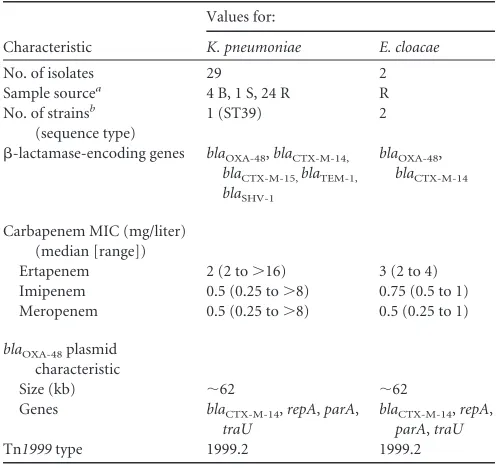
Microbiological and molecular features of OXA-48-produc-ingEnterobacteriaceaeisolates.A total of 31 outbreak-related isolates from 29 patients were submitted for analysis to the NCIC
laboratory.K. pneumoniaewas isolated from all patients, and all
isolates belonged to a single PFGE type identified as sequence type
39 (ST39) (Table 1). Two patients also carried OXA-48-producing
E. cloacae, belonging to two different PFGE types. All isolates were resistant to ampicillin, cefazolin, piperacillin-tazobactam,
ceftri-axone, and ertapenem but had MIC values of⬍1 mg/liter for
imipenem and meropenem (Table 1). TheE. coliDH10B
trans-formant isolates from both theK. pneumoniaeandE. cloacae
do-nor strains had similar resistance patterns for carbapenems and were also resistant to ampicillin, cefazolin, piperacillin-tazobac-tam, and ceftriaxone, but not to any other class of antimicrobials.
All isolates tested positive by MHT and carriedblaOXA-48 and
blaCTX-14, and they tested negative by the EDTAST andblaKPC
-andblaNDM-based PCR. TheK. pneumoniaeisolates also carried
blaCTX-15,blaTEM-1, andblaSHV-1. TheblaOXA-48-harboring
plas-mids were⬃62 kb in size and carried therepA,parA, andtraU
genes, as did our previously describedblaOXA-48-harboring
plas-mids (3). Unlike these plasmids, they also carriedblaCTX-14and
had an identical restriction fragment length polymorphism pat-tern that differed from the patpat-tern(s) of these plasmids (data not
shown).blaCTX-14was surrounded by ISEcp1(GenBank
acces-sion no.AJ242809) (Fig. 2). The entire 3.1-kb structure was
inserted in position 26950, corresponding to the pOXA-48a
plasmid (GenBank accession no.JN626286.1) (6).
DISCUSSION
In the present study, we describe the first case of OPE in the neonatal and pediatric population. Moreover, this is the first report of an outbreak caused by CRE of any kind in this pop-ulation. This population has not been spared from nosocomial outbreaks caused by other types of antimicrobial-resistant
bac-teria, e.g., extended-spectrum-lactamase-producing
[image:3.585.39.287.86.320.2]Entero-bacteriaceae(22), corresponding with the occurrences in other patient populations. It is noteworthy, however, that although
TABLE 1Microbiological and molecular characteristics of OXA-48-producingEnterobacteriaceaeisolates
Characteristic
Values for:
K. pneumoniae E. cloacae
No. of isolates 29 2
Sample sourcea 4 B, 1 S, 24 R R
No. of strainsb
(sequence type)
1 (ST39) 2
-lactamase-encoding genes blaOXA-48,blaCTX-M-14,
blaCTX-M-15,blaTEM-1,
blaSHV-1
blaOXA-48,
blaCTX-M-14
Carbapenem MIC (mg/liter) (median [range])
Ertapenem 2 (2 to⬎16) 3 (2 to 4) Imipenem 0.5 (0.25 to⬎8) 0.75 (0.5 to 1) Meropenem 0.5 (0.25 to⬎8) 0.5 (0.25 to 1)
blaOXA-48plasmid
characteristic
Size (kb) ⬃62 ⬃62
Genes blaCTX-M-14,repA,parA,
traU
blaCTX-M-14,repA,
parA,traU
Tn1999type 1999.2 1999.2
aB, blood; S, sputum; R, rectum. b
Typing was done by PFGE and MLST forK. pneumoniaeand by PFGE forE. cloacae.
FIG 2Schematic structure of theblaCTXM-14-containing insert. The
orienta-tion of the insert is presented in relaorienta-tion to the pOXA-48a plasmid (GenBank accession no.JN626286.1).
on May 16, 2020 by guest
http://jcm.asm.org/
[image:3.585.301.544.628.695.2]sporadic cases of OPE in adults have been described in Israel
(3), the first and so far the only OPE outbreak in Israel occurred
in the pediatric population. The data regarding the prevalence of OPE in the PA and Gaza are limited, but based on this study
and our previous report (3), it appears likely that OPE is
en-demic to these areas, similar to the situation in other Middle
Eastern countries (1,17).
Due to the fact that several months elapsed between onset of the outbreak and the involvement of the MoH, we were unable to obtain the microbiological data necessary to determine the origin of the outbreak. During the investigation of this outbreak, we identified carriers of additional unrelated OPE who were admitted to other pediatric wards from the PA or Gaza. It is therefore likely that the outbreak strain was introduced in a similar way, following an admission of an unrecognized carrier either directly to the NICU or to one of the other pediatric service facilities. The mono-clonal nature of the outbreak and the spread of the outbreak strain to other wards led to the conclusion that although the introduc-tion of the strain via maternal carriage cannot be excluded, this mechanism is unlikely to have played a role in the subsequent propagation of the outbreak.
The epidemic strain presumably spread initially through the NICU, leading to colonization of at least 49 patients with 16 inva-sive infections. From there, we were able to trace its spread to the PICU following the readmission of a former NICU-exposed baby that led to the transmission of the strain to two additional chil-dren. Following intervention, the incidence of new colonization or infection significantly declined. However, despite cohorting the OPE carriers and the allocation of a dedicated nursing staff to care for them, the epidemic strain reappeared in the reopened NICU, presumably due to a single exposed infant who had previously tested negative and then transmitted the strain to 4 additional infants. The strain was also detected in one patient in the pediat-rics ward who was not known to be exposed to any of the carriers (Fig. 1b), suggesting transmission via either contaminated equip-ment or other hospital staff. Surveillance of OPE colonization among hospital staff was not performed, as staff carriage has not been shown to be an important factor in the nosocomial
transmis-sion of multidrug-resistantEnterobacteriaceae(23). Indeed, the
implementation of proper infection control policies, including hand hygiene and ongoing surveillance of patients at risk, proved to be sufficient to contain the resurgence of the outbreak.
One of the dreaded threats to public health in any local out-break is the organism’s potential to spread via unrecognized
car-riers to other health care centers (24). The establishment of our
nationally coordinated registry of CRE (4) enabled us to alert and
communicate with neighboring hospitals, allowing for the detec-tion of carriers upon admission and their prompt isoladetec-tion, result-ing in outbreak containment.
Similar to previous reports from Europe (7–10), the main
mechanism of this outbreak was the monoclonal spread ofK.
pneumoniae. The epidemic clone, ST39, was previously reported
as a VIM-producing strain in a nosocomial outbreak in Spain (25)
but has never been associated with OPE outbreaks. In addition, we identified two cases of presumed horizontal plasmid transfer in
two patients who carried OXA-48-producingE. cloacaein
addi-tion to the epidemic strain. TheblaOXA-48-harboring plasmid in
these isolates was similar in size to the pOXA-48a plasmid and
possesses its characteristic genes (6) but differed from it by
the presence ofblaCTX-M-14carried along the ISEcp1transposon.
Although additional -lactamase-encoding genes, including
blaCTX-M-15, were also present in the outbreak strain as in previous
reports (10), this is only the second report describing the
integra-tion of an addiintegra-tional resistance gene into the pOXA-48a plasmid
(11). This unique characteristic allowed us to track the route of
horizontal plasmid transfer and to differentiate the outbreak strain from nonrelated OPE strains that were introduced to the hospital during the outbreak. The addition of another resistance element to this plasmid is an ominous finding due to the plasmid’s
demonstrated high degree of transmissibility (1, 3); the added
resistance gene in this case renders all recipient strains resistant to cephalosporins, thus limiting therapeutic options even further.
In conclusion, the study of this outbreak teaches us that while standard infection control measures are effective for initial con-tainment, continuous vigilant monitoring is essential in order to detect and respond to a resurgence of the outbreak. It also dem-onstrates the value of a centralized coordinating body, allowing for the prompt identification of unidentified carriers on admis-sion to other hospitals. In areas where CRE of various types are endemic, a thorough molecular analysis that includes the identi-fication of resistance genes, clones, and plasmids is of paramount importance in an outbreak setting for the accurate assessment of the outbreak’s course, containment, and, should it occur, resur-gence.
REFERENCES
1.Carrër A, Poirel L, Yilmaz M, Akan OA, Feriha C, Cuzon G, Matar G, Honderlick P, Nordmann P.2010. Spread of OXA-48-encoding plasmid in Turkey and beyond. Antimicrob. Agents Chemother.54:1369 –1373. 2.Tzouvelekis LS, Markogiannakis A, Psichogiou M, Tassios PT, Daikos
GL.2012. Carbapenemases inKlebsiella pneumoniaeand other Enterobac-teriaceae: an evolving crisis of global dimensions. Clin. Microbiol. Rev.
25:682–707.
3.Adler A, Shklyar M, Schwaber MJ, Navon-Venezia S, Dhaher Y, Edgar R, Solter E, Benenson S, Masarwa S, Carmeli Y.2011. Introduction of OXA-48-producing Enterobacteriaceaeto Israeli hospitals by medical tourism. J. Antimicrob. Chemother.66:2763–2766.
4.Schwaber MJ, Lev B, Israeli A, Solter E, Smollan G, Rubinovitch B, Shalit I, Carmeli Y, Israel Carbapenem-Resistant Enterobacteriaceae
Working Group.2011. Containment of a country-wide outbreak of car-bapenem-resistantKlebsiella pneumoniaein Israeli hospitals via a nation-ally implemented intervention. Clin. Infect. Dis.52:848 – 855.
5.Poirel L, Héritier C, Tolün V, Nordmann P.2004. Emergence of oxa-cillinase-mediated resistance to imipenem inKlebsiella pneumoniae. Antimicrob. Agents Chemother.48:15–22.
6.Poirel L, Bonnin RA, Nordmann P.2012. Genetic features of the wide-spread plasmid coding for the carbapenemase OXA-48. Antimicrob. Agents Chemother.56:559 –562.
7.Cuzon G, Ouanich J, Gondret R, Naas T, Nordmann P.2011. Outbreak of OXA-48-positive carbapenem-resistantKlebsiella pneumoniaeisolates in France. Antimicrob. Agents Chemother.55:2420 –2423.
8.Paño-Pardo JR, Ruiz-Carrascoso G, Navarro-San Francisco C, Gómez-Gil R, Mora-Rillo M, Romero-Gómez MP, Fernández-Romero N, García-Rodríguez J, Pérez-Blanco V, Moreno-Ramos F, Mingorance J.
2013. Infections caused by OXA-48-producingKlebsiella pneumoniaein a tertiary hospital in Spain in the setting of a prolonged, hospital-wide out-break. J. Antimicrob. Chemother.68:89 –96.
9.Potron A, Kalpoe J, Poirel L, Nordmann P.2011. European dissemina-tion of a single OXA-48-producingKlebsiella pneumoniaeclone. Clin. Microbiol. Infect.17:E24 –E26. doi:10.1111/j.1469-0691.2011.03669.x. 10. Voulgari E, Zarkotou O, Ranellou K, Karageorgopoulos DE, Vrioni G,
Mamali V, Themeli-Digalaki K, Tsakris A.2013. Outbreak of OXA-48 carbapenemase-producingKlebsiella pneumoniaein Greece involving an ST11 clone. J. Antimicrob. Chemother.68:84 – 88.
11. Potron A, Nordmann P, Rondinaud E, Jaureguy F, Poirel L.2013. A mosaic transposon encoding OXA-48 and CTX-M-15: towards pan-resistance. J. Antimicrob. Chemother.68:476 – 477.
on May 16, 2020 by guest
http://jcm.asm.org/
12. Clinical and Laboratory Standards Institute.2011. Performance stan-dards for antimicrobial susceptibility testing; 21st informational supple-ment. Approved standard MS100-S20. Clinical and Laboratory Standards Institute, Wayne, PA.
13. Adler A, Navon-Venezia S, Moran-Gilad J, Marcos E, Schwartz D, Carmeli Y.2011. Laboratory and clinical evaluation of screening agar plates for detection of carbapenem-resistantEnterobacteriaceaefrom sur-veillance rectal swabs. J. Clin. Microbiol.49:2239 –2242.
14. Clinical and Laboratory Standards Institute.2012. Methods for dilution antimicrobial susceptibility tests for bacteria that grow aerobically; Ap-proved standard—ninth edition. CLSI document M07-A9. Clinical and Laboratory Standards Institute, Wayne, PA.
15. Giske CG, Gezelius L, Samuelsen Ø, Warner M, Sundsfjord A, Wood-ford N.2011. A sensitive and specific phenotypic assay for detection of metallo--lactamases and KPC inKlebsiella pneumoniaewith the use of meropenem disks supplemented with aminophenylboronic acid, dipico-linic acid and cloxacillin. Clin. Microbiol. Infect.17:552–556.
16. Schechner V, Straus-Robinson K, Schwartz D, Pfeffer I, Tarabeia J, Moskovich R, Chmelnitsky I, Schwaber MJ, Carmeli Y, Navon-Venezia S. 2009. Evaluation of PCR-based testing for surveillance of KPC-producing carbapenem-resistant members of theEnterobacteriaceae fam-ily. J. Clin. Microbiol.47:3261–3265.
17. Matar GM, Dandache I, Carrër A, Khairallah MT, Nordmann P, Sabra A, Araj GF.2010. Spread of OXA-48-mediated resistance to carbapenems in LebaneseKlebsiella pneumoniaeandEscherichia colithat produce ex-tended spectrum beta-lactamase. Ann. Trop. Med. Parasitol.104:271– 274.
18. Leavitt A, Carmeli Y, Chmelnitsky I, Goren MG, Ofek I, Navon-Venezia S.2010. Molecular epidemiology, sequence types, and plasmid analyses of KPC-producingKlebsiella pneumoniaestrains in Israel. Anti-microb. Agents Chemother.54:3002–3006.
19. Diancourt L, Passet V, Verhoef J, Grimont PAD, Brisse S.2005. Mul-tilocus sequence typing ofKlebsiella pneumoniaenosocomial isolates. J. Clin. Microbiol.43:4178 – 4182.
20. Goren MG, Carmeli Y, Schwaber MJ, Chmelnitsky I, Schechner V,
Navon-Venezia S.2010. Transfer of carbapenem-resistant plasmid from
Klebsiella pneumoniaeST258 toEscherichia coliin patient. Emerg. Infect. Dis.16:1014 –1017.
21. Siguier P, Perochon J, Lestrade L, Mahillon J, Chandler M. 2006. ISfinder: the reference centre for bacterial insertion sequences. Nucleic Acids Res.34:D32–D36. doi:10.1093/nar/gkj014.
22. Paterson DL, Bonomo RA.2005. Extended-spectrum-lactamases: a clinical update. Clin. Microbiol. Rev.18:657– 686.
23. Adler A, Gniadkowski M, Baraniak A, Izdebski R, Fiett J, Salvia A, Samso JV, Lawrence C, Salomon J, Paul M, Schwartzberg Y, Mor-dechai E, Rossini A, Fierro J, Lammens C, Malhotra-Kumar S, Goossens H, Hryniewicz W, Brun-Buisson YC C2013. A multina-tional study of colonisation with extended-spectrum beta-lactamases (ESBL)-producingEnterobacteriaceae in healthcare personnel and family members of patients admitted to rehabilitation centres. 23rd European Congress of Clinical Microbiology and Infectious Diseases (ECCMID), Berlin, Germany.
24. Lopez JA, Correa A, Navon-Venezia S, Correa AL, Torres JA, Briceño DF, Montealegre MC, Quinn JP, Carmeli Y, Villegas MV.2011. Inter-continental spread from Israel to Colombia of a KPC-3-producing Kleb-siella pneumoniaestrain. Clin. Microbiol. Infect.17:52–56.
25. Valverde A, Ruiz-Garbajosa P, Curiao T, Tato M, Gijón D, Baquero F, Coque TM, Cantón R.2011.Klebsiella pneumoniaesequence types orig-inally associated with specific ESBLs might act as substrates for recently emerged metallo-beta-lactamases or KPC enzymes. 21st European Con-gress of Clinical Microbiology and Infectious Diseases (ECCMID), Milan, Italy.
26. Navon-Venezia S, Chmelnitsky I, Leavitt A, Carmeli Y.2008. Dissem-ination of the CTX-M-25 family beta-lactamases amongKlebsiella pneu-moniae,Escherichia coliandEnterobacter cloacaeand identification of the novel enzyme CTX-M-41 inProteus mirabilisin Israel. J. Antimicrob. Chemother.62:289 –295.
27. Woodford N, Fagan EJ, Ellington MJ.2006. Multiplex PCR for rapid detection of genes encoding CTX-M extended-spectrum (beta)-lactamases. J. Antimicrob. Chemother.57:154 –155.