Subtype in the United States
Yaoyu Feng,aNarry Tiao,bNa Li,aMichele Hlavsa,bLihua Xiaob
State Key Laboratory of Bioreactor Engineering, School of Resources and Environmental Engineering, East China University of Science and Technology, Shanghai, Chinaa; Division of Foodborne, Waterborne, and Environmental Diseases, National Center for Emerging and Zoonotic Infectious Diseases, Centers for Disease Control and Prevention, Atlanta, Georgia, USAb
The United States has experienced a substantial increase in the reported incidence of cryptosporidiosis since 2005. Accompany-ing this is the emergence of a new subtype ofCryptosporidium hominisbased on variation at the 60-kDa glycoprotein (gp60) locus, IaA28R4, which has become a frequently identified subtype in both sporadic and outbreak-related cases. In this study, using multilocus sequence typing (MLST) at eight genetic loci, we characterized 62 specimens of IaA28R4 and 33 specimens of three other gp60 subtypes ofC. hominisfrom four U.S. states with increased cryptosporidiosis incidences during the summer of 2008. Extensive genetic heterogeneity was seen within the gp60 subtype IaA28R4, but specimens from Ohio and southwestern states formed two distinct subpopulations, suggesting that there were at least two origins of IaA28R4 within the United States. Discordance in typing results was observed between gp60 and other genetic markers, especially DZ-HRGP, and this discordance was largely the result of genetic recombination within the gp60 subtype IaA28R4. The results of population genetic analyses sup-ported the presence of two subpopulations of IaA28R4 and the occurrence of genetic recombination within this gp60 subtype. Thus, the IaA28R4 subtype at gp60 is likely a fitness marker forC. hominis, and genetic recombination is potentially a driving force in the emergence of the virulent IaA28R4 subtype in the United States. A rapid evolution of IaA28R4 was indicated by the observation of multiple MLST subtypes of IaA28R4 within two large outbreaks that lasted for extended periods and involved multiple swimming pools.
C
ryptosporidiosis is one of the most important causes of mod-erate to severe diarrhea and diarrhea-associated deaths among children in developing countries (1) and a major cause of water-borne outbreaks of human illness in industrialized nations (2,3). In addition, it was a major cause of chronic diarrhea and deaths among immunocompromised persons such as HIV/AIDS pa-tients prior to the introduction of highly active antiretroviral ther-apy (4). In the United States, the number of annually reported cases of cryptosporidiosis has more than doubled since 2005 (5– 8). Cryptosporidiosis incidence has a very seasonal distribution, with peak transmission occurring during summer months, largely as a result of outbreaks associated with recreational water use (9). Currently, it is estimated that⬃750,000 cases of cryptosporidiosis occur in the United States each year (3).Genotyping and subtyping tools have been used widely to in-vestigateCryptosporidiumtransmission patterns. The results of these studies have shown that, among the many established Cryp-tosporidiumspecies and genotypes,Cryptosporidium hominisis re-sponsible for most human cryptosporidiosis cases in most coun-tries. This species is largely human specific and thus is transmitted anthroponotically (10). WithinC. hominis, nucleotide sequence analysis of the 60-kDa glycoprotein (gp60) gene has identified many subtype families, such as Ia, Ib, Id, and Ie. Among them, subtype IbA10G2 is a dominant subtype responsible forC. homi-nis-associated outbreaks of cryptosporidiosis in the United States, Europe, and Australia (10–15). Since 2005, a new subtype within the Ia subtype family, IaA28R4, has become a frequently identified subtype for waterborne outbreaks of cryptosporidiosis in the United States. It was first detected during an investigation of a swimming pool-associated outbreak in Ohio in 2005 but has since been detected in Pennsylvania, Missouri, South Carolina, Texas, New Mexico, Colorado, Utah, and Idaho (16–20). It is unclear
whether the increased cryptosporidiosis incidence in the United States is partially attributable to the emergence of this new subtype ofC. hominis. In this study, we conducted multilocus sequence typing (MLST) of IaA28R4 and multiple otherC. hominis sub-types circulating in four states in the United States, where crypto-sporidiosis incidence increased during the summer of 2008.
MATERIALS AND METHODS
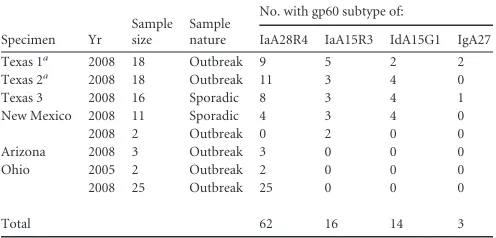
Specimens and subtype determination.Ninety-fiveC. hominis speci-mens from humans were used in this study. They were from outbreak-related and sporadic cases that occurred in three southwestern states (Texas, New Mexico, and Arizona) and Ohio in 2008, except for two specimens from an outbreak in Ohio in 2005 (Table 1). The Texas speci-mens included 16 specispeci-mens from sporadic cases and 36 from a prolonged cryptosporidiosis outbreak in two neighboring counties. The outbreak affected⬎2,000 persons, was associated with a man-made chlorinated lake (17) and multiple other recreational water venues (e.g., swimming pools and interactive fountains), and probably spread via poor swimmer hygiene (e.g., swimming when ill with diarrhea and swallowing the water) (7). The 13 New Mexico specimens were from 11 sporadic cases and 1 day care-associated outbreak. The three Arizona specimens were from a swimming pool-associated outbreak. The 27 Ohio specimens were from
Received23 October 2013Returned for modification20 November 2013
Accepted26 November 2013
Published ahead of print4 December 2013
Editor:G. V. Doern
Address correspondence to Yaoyu Feng, [email protected], or Lihua Xiao, [email protected].
Copyright © 2014, American Society for Microbiology. All Rights Reserved. doi:10.1128/JCM.02973-13
on May 16, 2020 by guest
http://jcm.asm.org/
two outbreaks associated with swimming pools in 2005 (2 specimens) and 2008 (25 specimens).
DNA was extracted from 200l ofCryptosporidium-positive speci-mens using the FastDNA SPIN kit for soil (MP Biomedicals, Irvine, CA). Cryptosporidium hominisin the specimens was subtyped by DNA se-quence analysis of the gp60 gene (21). The 95C. hominisspecimens used belonged to four subtypes based on variation at the gp60 locus, i.e., IaA28R4 (n⫽62), IaA15R3 (n⫽16), IdA15G1 (n⫽14), and IgA27 (n⫽ 3) (Table 1).
MLST analysis.In addition to gp60, each specimen was analyzed at seven other polymorphic loci, including 47-kDa protein (CP47), 56-kDa transmembrane protein (CP56), hydroxyproline-rich glycoprotein (DZ-HRGP), 70-kDa heat shock protein (HSP70), serine repeat antigen (MSC6-7), mucin protein (Mucin1), and retinitis pigmentosa GTPase regulator (RPGR), using PCR primers and conditions described previ-ously (20,22–24). All PCR analyses were done in duplicate, using 1l of extracted DNA per PCR and 400 ng/l of nonacetylated bovine serum albumin (Sigma-Aldrich, St. Louis, MO) in the primary PCR. The second-ary PCR products were sequenced in both directions using the ABI BigDye Terminator v3.1 cycle sequencing kit (Applied Biosystems, Foster City, CA) and an ABI3130 genetic analyzer (Applied Biosystems). The nucleo-tide sequences obtained were aligned with reference sequences down-loaded from GenBank by using ClustalX (http://www.clustal.org).
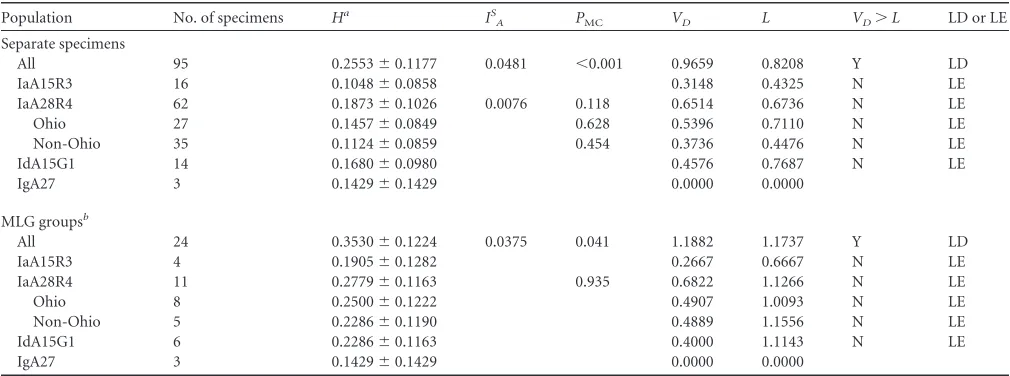
Population genetic analysis.Because gp60 had far more segregation (single-nucleotide polymorphism [SNP]) sites than other genetic loci, multilocus analyses were mostly conducted with allelic data. Multilo-cus linkage disequilibrium (LD) in allelic data with and without gp60 was assessed by calculating the standardized index of association (IS
A) using LIAN 3.5 (http://pubmlst.org/cgi-bin/mlstanalyse/mlstanalyse.pl ?site⫽pubmlst&page⫽lian&referer⫽pubmlst.og). LD would be indi-cated by a positive value and linkage equilibrium (LE) by 0 or a negative value. In addition, the variance of pairwise differences (VD) and the 95% critical value (L) forVDwere calculated to assess the population structure. If theVDis less thanL, then the population is in LE, with a panmictic population structure; otherwise, the population is nonpanmictic and a degree of LD exists. To determine whether there was population differen-tiation withinC. hominisand subtype IaA28R4, we used the Bayesian tool Structure v2.3 (http://pritchardlab.stanford.edu/structure.html) to ana-lyze the allelic data. Several analyses of the data were performed usingK values (likely populations) ranging from 2 to 6, with 50,000 iterations after a burn-in of 50,000 iterations. The output at aKvalue of 5 provided the best fit to the MLST data and thus was used in further analyses. The population substructure was further supported by eBURST analysis (http: //eburst.mlst.net) of the MLST data. To assess the robustness of the sub-structuring, Wright’s fixation index (FST) was calculated between sub-populations using Arlequin (http://cmpg.unibe.ch/software/arlequin35). LD and recombination rates also were compared across subpopulations.
Multilocus LD (as indicated byⱍD=ⱍ[LD whereyis the LD value andxis the nucleotide distance in kb]) and recombination analyses were further con-ducted on concatenated sequences excluding gp60 by using DnaSP 5.10.1 (http://www.ub.es/dnasp).
Nucleotide sequence accession numbers. Unique nucleotide se-quences obtained during the study were deposited in the GenBank data-base under accession numbersKF682371toKF682391.
RESULTS
Sequence polymorphisms at MLST loci.All specimens were suc-cessfully subtyped at the CP47, CP56, DZ-HRGP, HSP70, Mucin1, MSC6-7, and RPGR loci. The Mucin1 and RPGR loci were monomorphic, while most other loci had 2 or 3 subtypes, except for CP47, which had 5 subtypes (data not shown). Genetic heterogeneity was seen in each of the four gp60 subtypes at other loci. Although there was general agreement in subtyping results between g60 and CP47, DZ-HRGP and MSC6-7 showed discor-dant typing results. Altogether, 24 MLST types were seen among the 95C. hominis specimens. Most of the sequence polymor-phisms in these loci were variations in the numbers of insertions and deletions in the microsatellite and minisatellite regions. CP56, MSC6-7, and HSP70, however, each had 1 or 2 SNPs, far fewer than the values seen for the three subtype families (Ia, Id, and Ig) based on variation at the gp60 locus. As a result, most of the mul-tilocus analyses were performed with allelic data, including all loci or concatenated sequences except gp60.
Overall population genetic structure.Initially, multilocus LD was assessed by calculatingISAbetween alleles for all pairwise
com-binations of all loci including gp60, using LIAN. In the analysis of allelic data from 95 specimens, the value ofIS
A(0.1005) was
positive and the VD (1.7013) was more than L (1.0951). A
Monte Carlo analysis was further used to test the significance of LD, leading to the generation of a significantPvalue of⬍0.001
(Table 2). Thus, results of the analysis indicated an overall
nonpanmictic population structure with a high level of LD. The LD was maintained when the interlocusIS
Aand variance
anal-yses treated each group of specimens with the same multilocus genotype (MLG) as one individual (Table 2). As gp60 contrib-uted more genetic heterogeneity than other loci, an interlocus LD analysis was also conducted on allelic data excluding gp60, but similar observations of LD were obtained (Table 3). Fur-thermore, a strong but incomplete LD (ⱍD=ⱍofy⫽0.6618⫹ 0.0464x) was detected in the analysis of concatenated nucleo-tide sequences excluding gp60 by DnaSP (Table 4). Thus, re-combination might exist because of the incomplete LD. This was confirmed by an intergenic recombination test, which identified three potential recombination events (Table 4).
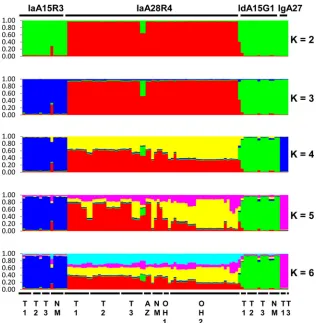
Two subpopulations of IaA28R4.The genetic relationship be-tween IaA28R4 and otherC. hominissubtypes was inferred with Bayesian Structure analysis. At allKvalues used in the analysis, there was a clear separation of the 62 specimens of IaA28R4 from the 33 specimens of otherC. hominissubtypes, including IaA15R3, which belongs to the same gp60 subtype family as IaA28R4 (Fig. 1). The best separation of gp60 subtype groups was seen at aKvalue of 5, with which all fourC. hominissubtypes formed their own clusters. PairwiseFSTanalysis of these groups
revealed the presence of highly significant population differentia-tion (FST ⫽0.172 to 0.300; P⬍0.00001 for all comparisons)
(Table 5). No genetic heterogeneity was seen in non-IaA28R4
sub-types at any of theKvalues (2 to 6) used. Admixed colors,
how-TABLE 1Sources and gp60 subtype identities of 95Cryptosporidium hominisspecimens used in this study
Specimen Yr
Sample size
Sample nature
No. with gp60 subtype of:
IaA28R4 IaA15R3 IdA15G1 IgA27 Texas 1a 2008 18 Outbreak 9 5 2 2
Texas 2a
2008 18 Outbreak 11 3 4 0 Texas 3 2008 16 Sporadic 8 3 4 1 New Mexico 2008 11 Sporadic 4 3 4 0 2008 2 Outbreak 0 2 0 0 Arizona 2008 3 Outbreak 3 0 0 0 Ohio 2005 2 Outbreak 2 0 0 0 2008 25 Outbreak 25 0 0 0
Total 62 16 14 3
a
Texas 1 and Texas 2 are specimens from the same outbreak in two neighboring counties.
on May 16, 2020 by guest
http://jcm.asm.org/
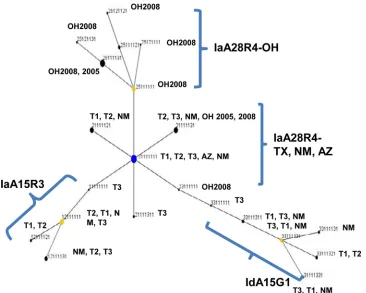
[image:2.585.40.288.88.207.2]ever, were seen in IaA28R4 atKvalues of 4 to 6, and IaA28R4 specimens from Ohio showed a color pattern that was clearly dif-ferent from that of IaA28R4 specimens from other areas, espe-cially at aKvalue of 5 (Fig. 1). The admixed elements in IaA28R4 were not seen in any other gp60 subtypes. In eBURST analysis, there was also clear separation of IaA28R4 specimens from Ohio and IaA28R4 specimens from the southwestern states, with the IaA28R4 MLST subtypes from Ohio descending from the IaA28R4 MLST subtypes from the southwestern states (Fig. 2).
The results of theFSTanalysis supported the presence of
signif-icant population differentiation between the IaA28R4 specimens from Ohio and the IaA28R4 specimens from other areas (FST⫽
0.271,P⬍0.00001). The two IaA28R4 subpopulations had differ-ent sequences mostly at the CP47 locus.
Genetic recombination within IaA28R4. We analyzed the gp60 subtype-specific population structure. In multilocus LD analyses of allelic data including and excluding gp60, we observed less LD within each of the gp60 subtypes than inC. hominisas a whole. In most cases, noIS
Avalues were obtained, the
Monte-CarloPvalue was⬎0.05, and theVDwas less thanLregardless of
[image:3.585.39.547.79.274.2]whether the analysis included all allelic data (Table 2) or data from each unique multilocus subtype (considering each group of specimens with the same multilocus subtype as one individ-ual) (Table 3). In multilocus LD analysis of concatenated nu-cleotide sequences excluding gp60, however, we obtained com-plete LD for IaA15R3 and incomcom-plete LD for IaA28R4. The numbers of segregation sites in the sequences for IdA15G1 and IgA27 were too few for LD analysis. The negative slopes in the LD equations
TABLE 2Multilocus linkage disequilibrium analysis of allelic data at eight MLST loci (including gp60)
Population
No. of
specimens Ha IS
A PMC VD L VD⬎L LD or LE
Separate specimens
All 95 0.2895⫾0.1075 0.1005 ⬍0.001 1.7013 1.0951 Y LD
IaA15R3 16 0.0917⫾0.0754 0.3148 0.4325 N LE
IaA28R4 62 0.1639⫾0.0919 0.0065 0.151 0.6514 0.6810 N LE
Ohio 27 0.1275⫾0.0757 0.639 0.5396 0.7110 N LE
Non-Ohio 35 0.0983⫾0.0757 0.426 0.3736 0.4476 N LE
IdA15G1 14 0.1470⫾0.0875 0.4576 0.7687 N LE
IgA27 3 0.1250⫾0.1250 0.0000 0.0000
MLG groupsb
All 24 0.3981⫾0.1152 0.0738 ⬍0.001 1.7803 1.3948 Y LD
IaA15R3 4 0.1667⫾0.1136 0.2667 0.6667 N LE
IaA28R4 11 0.2432⫾0.1065 0.938 0.6822 1.1266 N LE
Ohio 8 0.2187⫾0.1104 0.4907 0.9352 N LE
Non-Ohio 5 0.2000⫾0.1069 0.4889 1.1556 N LE
IdA15G1 6 0.2000⫾0.1047 0.4000 1.1143 N LE
IgA27 3 0.1250⫾0.1250 0.0000 0.0000
a
H, mean genetic diversity;IS
A, standardized index of association;PMC, significance of obtaining this value in 1,000 Monte Carlo simulations;VD, variance of pairwise differences; L, 95% critical value forVD;VD⬎Lindicates linkage disequilibrium; Y, yes; N, no.
b
Considering each group of specimens with the same multilocus genotype (MLG) as one individual.
TABLE 3Multilocus linkage disequilibrium analysis of allelic data at seven MLST loci (excluding gp60)
Population No. of specimens Ha IS
A PMC VD L VD⬎L LD or LE
Separate specimens
All 95 0.2553⫾0.1177 0.0481 ⬍0.001 0.9659 0.8208 Y LD
IaA15R3 16 0.1048⫾0.0858 0.3148 0.4325 N LE
IaA28R4 62 0.1873⫾0.1026 0.0076 0.118 0.6514 0.6736 N LE
Ohio 27 0.1457⫾0.0849 0.628 0.5396 0.7110 N LE
Non-Ohio 35 0.1124⫾0.0859 0.454 0.3736 0.4476 N LE
IdA15G1 14 0.1680⫾0.0980 0.4576 0.7687 N LE
IgA27 3 0.1429⫾0.1429 0.0000 0.0000
MLG groupsb
All 24 0.3530⫾0.1224 0.0375 0.041 1.1882 1.1737 Y LD
IaA15R3 4 0.1905⫾0.1282 0.2667 0.6667 N LE
IaA28R4 11 0.2779⫾0.1163 0.935 0.6822 1.1266 N LE
Ohio 8 0.2500⫾0.1222 0.4907 1.0093 N LE
Non-Ohio 5 0.2286⫾0.1190 0.4889 1.1556 N LE
IdA15G1 6 0.2286⫾0.1163 0.4000 1.1143 N LE
IgA27 3 0.1429⫾0.1429 0.0000 0.0000
aH, mean genetic diversity;IS
A, standardized index of association;PMC, significance of obtaining this value in 1,000 Monte Carlo simulations;VD, variance of pairwise differences; L, 95% critical value forVD;VD⬎Lindicates linkage disequilibrium; Y, yes; N, no.
bConsidering each group of specimens with the same multilocus genotype (MLG) as one individual.
on May 16, 2020 by guest
http://jcm.asm.org/
[image:3.585.40.545.509.697.2]for all IaA28R4 specimens and the IaA28R4 specimens from Ohio indicated decreased linkage with increased nucleotide distance
(Table 4), evidence of the occurrence of some genetic
recombina-tion. A recombination test revealed a minimum of 2 potential recombination events within IaA28R4. This genetic recombina-tion was seen in both Ohio and non-Ohio IaA28R4 specimens
(Table 4).
DISCUSSION
[image:4.585.39.552.78.186.2]Data from this study clearly show that, despite the genetic identity of the IaA28R4 subtype at the gp60 locus, specimens of this sub-type differed from each other at other genetic loci, especially DZ-HRGP, which showed discordant subtyping results with respect to gp60. Although CP47 generally produced concordant subtyping results with respect to the nearby gp60 locus, it did further divide
TABLE 4Multilocus linkage disequilibrium analysis of concatenated sequences at seven MLST loci (excluding gp60)
Population
No. of specimens
No. of segregating sites
No. of pairwise comparisons
No. of significant comparisons
No. of significant comparisons after Bonferroni correction ZnS
a |D
=| LD
Minimum no. of recombination events
All 95 8 28 11 11 0.3684 y⫽0.6618⫹0.0464x Incomplete 3
IaA15R3 16 3 3 3 3 0.7229 y⫽1.0000⫹0.0000x Complete 0
IaA28R4 62 4 6 3 1 0.0985 y⫽0.9397⫺0.1182x Incomplete 2
Ohio 27 4 6 1 1 0.1004 y⫽1.0147⫺0.1959x Incomplete 1
Non-Ohio 35 3 3 1 0 0.0982 y⫽0.5827⫹0.1516x Incomplete 1
IdA15G1 14 2 1 0 0 0.4000 0
IgA27 3 2 1 0 0 0.2500 0
a
ZnS, interlocus genetic association; |D=|, LD whereyis the LD value andxis the nucleotide distance (in kb).
FIG 1Population substructure of 95 specimens ofC. hominisfrom Ohio, Texas, New Mexico, and Arizona in the United States by Bayesian analyses of the MLST allelic data. Subpopulation patterns are shown forKvalues of 2 to 6 used in the analysis. Colored regions indicate major ancestral contributions. Mixed subtypes are indicated by the pattern of color combinations. Subtype identities of the specimens at the gp60 locus are shown above the color patterns, and the geographic origins of the specimens are shown below the color patterns. T1 and T2, specimens from an outbreak in two neighboring northeastern counties in Texas; T3, specimens from sporadic cases in a central Texas city; NM, specimens from sporadic cases (except for two IaA15R3 specimens) from New Mexico; AZ, specimens from an outbreak in Arizona; OH1 and OH2, specimens from two outbreaks in central Ohio. All specimens are from 2008, except for OH1, which represents two specimens from 2005.
on May 16, 2020 by guest
http://jcm.asm.org/
[image:4.585.134.453.332.655.2]IaA28R4 into two geographic subpopulations of IaA28R4, i.e., Ohio and southwestern states. This separation was supported by the results of Structure, eBURST, andFST analyses. Because all
three DZ-HRGP subtypes were found within each subpopulation, each subpopulation had multiple MLST subtypes. In fact, the three DZ-HRGP subtypes were also found in the three other gp60 subtypes in the MLST analysis, even though only a small number of specimens with these gp60 subtypes were used in the study. Because the two IaA28R4 subpopulations had sequences as diver-gent at other genetic loci as other gp60 subtypes, IaA28R4 at gp60 apparently represents a fitness marker forC. hominis; the wide-spread distribution of this gp60 subtype in the United States in recent years is independent of the sequence characteristics at other
genetic loci examined in this study. The common detection of this subtype in the United States, where cryptosporidiosis is severely underdiagnosed (3), and its propensity to cause statewide out-breaks (18) suggest its high virulence in humans. Recently, in an outbreak investigation in China, it was shown that the gp60 subtype IaA14R4, a subtype almost identical to IaA28R4 at the gp60 locus, was significantly more virulent than the IdA19 sub-type (25).
There are at least two origins of IaA28R4 in the United States. Although this gp60 subtype was first identified in a cryptosporidi-osis outbreak in Ohio in 2005 and was the cause of another out-break in the same area in 2008, Structure analysis clearly indicated that IaA28R4 circulating in Ohio was genetically different from IaA28R4 in southwestern states in the 2008 outbreak season. The results of eBURST analysis further suggested that the Ohio IaA28R4 subpopulation was actually a descendant of IaA28R4 in southwestern states. Therefore, IaA28R4 was probably present in the United States before 2005. Both Structure and eBURST anal-yses have failed to provide any clue regarding the initial source of IaA28R4 in the United States.
Regardless of the initial source of IaA28R4, it appears that ge-netic recombination has played a major role in the emergence and transmission of this gp60 subtype in the United States. Although the overall population ofC. hominisspecimens had a clonal pop-ulation structure, genetic recombination was seen in IaA28R4 and probably played an important role in the emergence of the dom-inant IaA28R4 subtype at the gp60 locus. The occurrence of
ge-TABLE 5Population differentiation among gp60 subtypes ofC. hominis in pairwiseFSTanalysis
Parameter and
subtype IaA15R3 IaA28R4 IdA15G1
Population pairwise
FST
IaA28R4 0.21403
IdA15G1 0.24477 0.17231
IgA27 0.30047 0.20569 0.22100
FSTPvalues
IaA28R4 0.00000⫾0.0000
IdA15G1 0.00000⫾0.0000 0.00000⫾0.0000
IgA27 0.00000⫾0.0000 0.00000⫾0.0000 0.00000⫾0.0000
FIG 2Patterns of evolutionary descent among multilocus sequence typing (MLST) types ofCryptosporidium hominis, as revealed by eBURST analysis of allelic data. The numbers for each MLST type represent the sequence type at each of the eight MLST loci, in the following order: gp60, CP47, Mucin1, CP56, RPGR, MSC6-7, DZ-HRGP, and HSP70. Blue dot, primary founder; yellow dots, subgroup founders. The size of each dot is proportional to the number of specimens of the sequence type. The three MLST types of the gp60 IgA27 subtype did not cluster in this diagram. SeeFig. 1legend for the origins of the specimens.
on May 16, 2020 by guest
http://jcm.asm.org/
[image:5.585.40.287.87.199.2] [image:5.585.111.477.389.682.2]netic recombination was identified by LD analysis of both allelic data and concatenated multilocus sequences and by Bayesian Structure analysis. The gp60 locus appears to be the site of genetic recombination, as many MLST subtypes differed from each other only at gp60 and the neighboring CP47, adding support for the theory that genetic recombination is a driving force in the emer-gence of the gp60 IaA28R4 subtype. Genetic exchange within an overall clonal population ofCryptosporidium parvumhas been reported in Italy recently (26), and genetic recombination has been identified as a driving force in the emergence of the virulent epidemicC. hominisgp60 subtype IbA10G2 and theC. parvum subtype IIaA15G2R1 (27,28). Comparative genomic studies are needed to confirm the role of genetic recombination in the evolu-tion of hyperinfectious or virulentCryptosporidiumsubtypes.
Results of this study have been useful for understanding the transmission ofCryptosporidiumin the United States. Texas, New Mexico, Arizona, and Ohio all experienced increased cryptospo-ridiosis incidence in the summer of 2008 (7), and the increases in Texas and Ohio were largely due to two large prolonged outbreaks of cryptosporidiosis in major metropolitan areas, each associated with multiple recreational water venues. Although IaA28R4 was the dominant gp60 subtype in the two outbreaks, MLST analysis clearly indicated that the outbreaks were not related to each other. In fact, each outbreak was caused by multiple MLST subtypes, although they all belonged to the IaA28R4 subtype at the gp60 locus. As these two outbreaks were each associated with multiple recreational water venues, the MLST subtype results point to the complicated nature of these outbreaks and the complex epidemi-ology of IaA28R4 in the United States. Further studies are needed to understand the evolution and transmission of this virulent par-asite and its role in the recent increase in the reported incidence of cryptosporidiosis in the United States.
ACKNOWLEDGMENTS
This work was supported by the Centers for Disease Control and Preven-tion and the NaPreven-tional Natural Science FoundaPreven-tion of China (grants 31229005 and 31110103901). N.T. was the recipient of an APHL/CDC Emerging Infectious Disease Fellowship.
We are grateful to the state and local public health epidemiologists and laboratory staff members for providing specimens used in this study.
The findings and conclusions in this report are those of the authors and do not necessarily represent the views of the Centers for Disease Control and Prevention.
REFERENCES
1.Kotloff KL, Nataro JP, Blackwelder WC, Nasrin D, Farag TH, Pan-chalingam S, Wu Y, Sow SO, Sur D, Breiman RF, Faruque AS, Zaidi AK, Saha D, Alonso PL, Tamboura B, Sanogo D, Onwuchekwa U, Manna B, Ramamurthy T, Kanungo S, Ochieng JB, Omore R, Oundo JO, Hossain A, Das SK, Ahmed S, Qureshi S, Quadri F, Adegbola RA, Antonio M, Hossain MJ, Akinsola A, Mandomando I, Nhampossa T, Acacio S, Biswas K, O’Reilly CE, Mintz ED, Berkeley LY, Muhsen K, Sommerfelt H, Robins-Browne RM, Levine MM. 2013. Burden and aetiology of diarrhoeal disease in infants and young children in developing countries (the Global Enteric Multicenter Study, GEMS): a prospective, case-control study. Lancet382:209 –222.http://dx.doi.org/10.1016/S0140 -6736(13)60844-2.
2.Baldursson S, Karanis P.2011. Waterborne transmission of protozoan parasites: review of worldwide outbreaks: an update 2004 –2010. Water Res.45:6603– 6614.http://dx.doi.org/10.1016/j.watres.2011.10.013. 3.Scallan E, Hoekstra RM, Angulo FJ, Tauxe RV, Widdowson MA, Roy
SL, Jones JL, Griffin PM.2011. Foodborne illness acquired in the United States: major pathogens. Emerg. Infect. Dis.17:7–15.http://dx.doi.org/10 .3201/eid1701.091101p1.
4.Brady MT, Oleske JM, Williams PL, Elgie C, Mofenson LM, Dankner WM, Van Dyke RB, Pediatric AIDS Clinical Trials Group 219/219C Team.2010. Declines in mortality rates and changes in causes of death in HIV-1-infected children during the HAART era. J. Acquir. Immune Defic. Syndr.53:86 –94.http://dx.doi.org/10.1097/QAI.0b013e3181b9869f. 5. Yoder JS, Beach MJ. 2007. Cryptosporidiosis surveillance—United
States, 2003–2005. MMWR Surveill. Summ.56(SS-7):1–10.
6.Hlavsa MC, Watson JC, Beach MJ. 2005. Cryptosporidiosis surveil-lance—United States 1999 –2002. MMWR Surveill. Summ.54(SS-1):1– 8. 7.Yoder JS, Harral C, Beach MJ.2010. Cryptosporidiosis surveillance—
United States, 2006 –2008. MMWR Surveill. Summ.59(SS-6):1–14. 8.Yoder JS, Wallace RM, Collier SA, Beach MJ, Hlavsa MC.2012.
Cryp-tosporidiosis surveillance—United States, 2009 –2010. MMWR Surveill. Summ.61(SS-5):1–12.
9.Yoder JS, Beach MJ.2010.Cryptosporidiumsurveillance and risk factors in the United States. Exp. Parasitol.124:31–39.http://dx.doi.org/10.1016 /j.exppara.2009.09.020.
10. Xiao L.2010. Molecular epidemiology of cryptosporidiosis: an update. Exp. Parasitol. 124:80 – 89. http://dx.doi.org/10.1016/j.exppara.2009.03 .018.
11. Chalmers RM, Robinson G, Elwin K, Hadfield SJ, Thomas E, Watkins J, Casemore D, Kay D.2010. Detection ofCryptosporidiumspecies and sources of contamination withCryptosporidium hominisduring a water-borne outbreak in north west Wales. J. Water Health8:311–325.http://dx .doi.org/10.2166/wh.2009.185.
12. Mayne DJ, Ressler KA, Smith D, Hockey G, Botham SJ, Ferson MJ. 2011. A community outbreak of cryptosporidiosis in Sydney associated with a public swimming facility: a case-control study. Interdiscip. Per-spect. Infect. Dis.2011:341065.http://dx.doi.org/10.1155/2011/341065. 13. Ng JS, Pingault N, Gibbs R, Koehler A, Ryan U. 2010. Molecular
characterisation ofCryptosporidiumoutbreaks in western and south Aus-tralia. Exp. Parasitol.125:325–328.http://dx.doi.org/10.1016/j.exppara .2010.02.012.
14. Waldron LS, Ferrari BC, Cheung-Kwok-Sang C, Beggs PJ, Stephens N, Power ML.2011. Molecular epidemiology and spatial distribution of a waterborne cryptosporidiosis outbreak in Australia. Appl. Environ. Mi-crobiol.77:7766 –7771.http://dx.doi.org/10.1128/AEM.00616-11. 15. Fournet N, Deege MP, Urbanus AT, Nichols G, Rosner BM, Chalmers
RM, Gorton R, Pollock KG, van der Giessen JW, Wever PC, Dorigo-Zetsma JW, Mulder B, Mank TG, Overdevest I, Kusters JG, van Pelt W, Kortbeek LM.2013. Simultaneous increase ofCryptosporidiuminfections in the Netherlands, the United Kingdom and Germany in late summer season, 2012. Euro Surveill.18:pii⫽20348.http://www.eurosurveillance .org/ViewArticle.aspx?ArticleId⫽20348.
16. Xiao L, Hlavsa MC, Yoder J, Ewers C, Dearen T, Yang W, Nett R, Harris S, Brend SM, Harris M, Onischuk L, Valderrama AL, Cosgrove S, Xavier K, Hall N, Romero S, Young S, Johnston SP, Arrowood M, Roy S, Beach MJ.2009. Subtype analysis ofCryptosporidiumspecimens from sporadic cases in Colorado, Idaho, New Mexico, and Iowa in 2007: widespread occurrence of oneCryptosporidium hominissubtype and case history of an infection with theCryptosporidiumhorse genotype. J. Clin. Microbiol.47:3017–3020.http://dx.doi.org/10.1128/JCM.00226-09. 17. Cantey PT, Kurian AK, Jefferson D, Moerbe MM, Marshall K,
Blan-kenship WR, Rothbarth GR, Hwang J, Hall R, Yoder J, Brunkard J, Johnston S, Xiao L, Hill VR, Sarisky J, Zarate-Bermudez MA, Otto C, Hlavsa MC.2012. Outbreak of cryptosporidiosis associated with a man-made chlorinated lake—Tarrant County, Texas, 2008. J. Environ. Health 75:14 –19.
18. Valderrama AL, Hlavsa MC, Cronquist A, Cosgrove S, Johnston SP, Roberts JM, Stock ML, Xiao L, Xavier K, Beach MJ.2009. Multiple risk factors associated with a large statewide increase in cryptosporidiosis. Epidemiol. Infect. 137:1781–1788. http://dx.doi.org/10.1017/S0950268 809002842.
19. Centers for Disease Control and Prevention.2009. Outbreak of crypto-sporidiosis associated with a splash park—Idaho, 2007. MMWR Morb. Mortal. Wkly. Rep.58:615– 618.
20. Xiao L, Ryan UM.2008. Molecular epidemiology, p 119 –171.InFayer R, Xiao L (ed),Cryptosporidiumand cryptosporidiosis, 2nd ed. CRC Press, Boca Raton, FL.
21. Alves M, Xiao L, Sulaiman I, Lal AA, Matos O, Antunes F. 2003. Subgenotype analysis ofCryptosporidiumisolates from humans, cattle, and zoo ruminants in Portugal. J. Clin. Microbiol.41:2744 –2747.http: //dx.doi.org/10.1128/JCM.41.6.2744-2747.2003.
on May 16, 2020 by guest
http://jcm.asm.org/
22. Gatei W, Das P, Dutta P, Sen A, Cama V, Lal AA, Xiao L. 2007. Multilocus sequence typing and genetic structure ofCryptosporidium hominisfrom children in Kolkata, India. Infect. Genet. Evol.7:197–205. http://dx.doi.org/10.1016/j.meegid.2006.08.006.
23. Gatei W, Hart CA, Gilman RH, Das P, Cama V, Xiao L.2006. Devel-opment of a multilocus sequence typing tool forCryptosporidium hominis. J. Eukaryot. Microbiol.53(Suppl 1):S43–S48.http://dx.doi.org/10.1111/j .1550-7408.2006.00169.x.
24. Cama VA, Arrowood MJ, Ortega YR, Xiao L.2006. Molecular charac-terization of theCryptosporidium parvumIOWA isolate kept in different laboratories. J. Eukaryot. Microbiol.53(Suppl 1):S40 –S42.http://dx.doi .org/10.1111/j.1550-7408.2006.00168.x.
25. Feng Y, Wang L, Duan L, Gomez-Puerta LA, Zhang L, Zhao X, Hu J, Zhang N, Xiao L.2012. Extended outbreak of cryptosporidiosis in a
pediatric hospital, China. Emerg. Infect. Dis.18:312–314.http://dx.doi .org/10.3201/eid1802.110666.
26. Drumo R, Widmer G, Morrison LJ, Tait A, Grelloni V, D’Avino N, Pozio E, Caccio SM.2012. Evidence of host-associated populations of Cryptosporidium parvumin Italy. Appl. Environ. Microbiol.78:3523– 3529.http://dx.doi.org/10.1128/AEM.07686-11.
27. Li N, Xiao L, Cama VA, Ortega Y, Gilman RH, Guo M, Feng Y.2013. Genetic recombination andCryptosporidium hominisvirulent subtype IbA10G2. Emerg. Infect. Dis.19:1573–1582.http://dx.doi.org/10.3201 /eid1910.121361.
28. Feng Y, Torres E, Li N, Wang L, Bowman D, Xiao L.2013. Population genetic characterisation of dominantCryptosporidium parvumsubtype IIaA15G2R1. Int. J. Parasitol.43:1141–1147.http://dx.doi.org/10.1016/j .ijpara.2013.09.002.