www.impactjournals.com/oncotarget/ Oncotarget, Vol. 6, No.6
Plasmid DNA-coding p62 as a bone effective anti-inflammatory/
anabolic agent
Maria Giovanna Sabbieti1,*, Dimitrios Agas1,*, Melania Capitani1, Luigi Marchetti1,
Antonio Concetti1, Cecilia Vullo1, Giuseppe Catone1, Vladimir Gabai2, Victor Shifrin2,
Michael Y Sherman3, Alexander Shneider2, Franco M Venanzi1 1School of Biosciences and Veterinary Medicine, University of Camerino, Camerino (Italy) 2CureLab Oncology Inc, 43 Rubury Hillway Needham MA (USA)
3Dept. Biochem, Boston University School of Medicine, Boston MA (USA) *These authors have contributed equally to this work
Correspondence to:
Alexander Shneider, e-mail: [email protected] Franco M Venanzi, e-mail: [email protected]
Keywords: p62/SQSTM1, chronic inflammation, osteoporosis, immunotherapy
Received: November 04, 2014 Accepted: December 09, 2014 Published: February 12, 2015
ABSTRACT
We recently reported that a DNA plasmid coding p62-SQSTM1 acts as an effective anti tumor vaccine against both transplantable mouse tumors and canine spontaneous mammary neoplasms. Here we report the unexpected finding that intramuscular delivery of p62 DNA exerts a powerful anti-osteoporotic activity in a mouse model of inflammatory bone loss (i.e, ovariectomy) by combining bone-sparing and osteo-synthetic effects. Notably, the suppression of osteoporosis by p62DNA was associated with a sharp down-regulation of master inflammatory cytokines, and up-regulation of endogenous p62 protein by bone-marrow stromal cells. The present data provide a solid rational to apply p62 DNA vaccine as a safe, new therapeutic for treatment of inflammatory related bone loss diseases.
INTRODUCTION
The adapter protein p62 (also known as seq uestosome1/SQSTM1) is a multifunctional molecule involved in a myriad of cellular processes that modulate
proliferation, cell death, inflammation and immune res
ponse [1]. Further studies demonstrated that p62 plays an important role in pathophysiology of human diseases including neurodegenerative diseases, lung disease, obesity, insulin resistance, cancer, and Paget’s disease of bone [2]. Since p62 holds a key role in innate immunity
by regulating inflammatory signaling cascades, the
hypothesis that deregulated p62 is linked to the chronic
allostasis that foster dreadful inflammatory disorders
is gaining ground [3, 4]. Accordingly, p62 has been envisaged as a potential target in cancer, infectious and
inflammatory diseases [5].
We first reported that p62 could be a target for
cancer immunotherapy. Indeed, we provide evidence that DNA plasmidencoded human p62 triggered effective anti tumor/antimetastatic activities in four models of allogenic mouse tumors (i.e. melanoma, lung carcinoma, sarcoma,
and breast cancer) [6]. We also demonstrated that p62 DNA plasmid when administered in neoadjuvant (pre operative) setting decreased and/or stabilized growth of advanced lesions in canine mammary tumors [7].
Although there are no in vivo data regarding the
role of exogenous p62 in inflammation, there are some in vitro evidence suggesting that p62 may act as an important regulator of cytokine expression [8–11]. In example, in activated macrophages p62 overexpression and underexpression clearly lead to opposite effects pointing to the inhibitory role of p62 in cytokine expression, thus providing a mechanism by which
p62 controls excessive inflammatory responses [11].
Of much interest, is a recent report that highlights the
antiinflammatory tumor suppressor potential of p62,
as its downregulation in the tumor stroma fosters an
inflammatory response that enhances tumorigenesis both in vitro and in vivo [12].
The existence of a causal link between inflammation
and p62 is further supported by the observation that the lack of a p62 (or macroautophagy) contributes to
coined at the beginning of this century by Franceschi et al.
[13] to refer to a lowgrade proinflammatory phenotypes
which accompany aging in mammals and that predispose the organism to develop several agerelated diseases.
Osteoporosis is, by far, the leading agerelated disease affecting mostly women after onset of menopause. Because estrogens contribute to bonesparing activity by inhibition of bone remodeling (coupled with a balancing effect on bone formation and resorption), decreased levels of circulating estrogen at menopause results in a rapid bone loss [14]. Further observations indicate
that the estroprivic bone loss reflects increased number
of T cells, that in concert with macrophages and bone marrowderived stromal cells promote the release of pro
inflammatory cytokines (e.g TNFα and IL1β beta, IL6, and RANKL) that propel osteoclastogenesis, and thereby bone erosion [15] (See Supplementary Figure 1). Finally, the strong link between inflammation and osteoporosis is
further evidenced by clinical studies showing that chronic
inflammatory diseases of almost any cause, are associated
with bone loss (osteopenia) [16].
Based on the putative antiinflammatory role of
p62, together with the fact that p62 physiologically con trols osteoclastogenesis and bone remodeling [17], we hypo thesized that p62 DNA vaccine could compensate for osteoporosis. To test the hypothesis we carried out experiments by injecting p62 DNA in ovariectomized (OVX) mice. Since ovariectomy induces chronic
inflam mation in mice and in humans [18], this animal
model is widely utilized to study premature aging [19], and to test experimental antiosteoporotic drugs and biologicals [20].
The results shown below are representative of those obtained by in independent trials carried out both in preventive and therapeutic settings.
RESULTS AND DISCUSSION
p62 DNA administration prevents osteoporosis in OVX mice
To evaluate whether p62 vaccine was able to
prevent osteoporosis, groups of mice were first injected
either with experimental (p62DNA) or reference plasmids (pcDNA 3.1) and then ovariectomized (OVX). For each trial a control group of sham operated (SO) mice was included (see M&M for details). Two months
after surgery mice were sacrificed, and the collected long
bones subjected to histological examination. As expected, the metaphyseal regions of the distal femurs from pcDNA3.1OVX mice displayed classical osteoporotic
features characterized by significant bone loss and
thinned disconnected trabecular structure (Figure 1B, 1E). On the other hand, p62OVX bones (Figure 1C, 1F) showed a microarchitecture essentially indistinguishable to that seen in SO mice (Figure 1A, 1D). Moreover,
examination of cross sections femur diaphysis from p62DNAOVX mice revealed (at variance of those obtained from reference plasmids treated mice) an enhanced anabolic osteoblastic activity as evidenced by new cortical bone apposition suggesting an anabolic
action of p62 treatment. (Figure 1G−1L).
Fully consistent with the morphological findings are
the biochemical results obtained by utilizing bone marrow stromal cells (BMCs) retrieved from plasmids pretreated
mice. In these experiments BMCs were flushed from
the bone cavities, and cultured for 3 days. Afterwards, both supernatants and cells were collected and analyzed
respectively either for the release of inflammatory
cytokines, or for expression of osteogenic markers. As illustrated in Figure 2, we observed that the marked up
regulation and release of proinflammatory cytokines
by BMCs from OVX compare to SO operated mice was drastically suppressed by p62DNA pretreatment. The inhibitory effect of p62 DNA extended to an array of
cytokines such as TNFα, IL6, IL1b IL17, all known to be essential inducers of inflammatory diseases and
bone loss [21]. As far as the capability of p62DNA to induce new bone formation is concerned, western blotting analysis of p62OVX BMCs extracts indicated a strong and selective increase of osteogenic markers, such as Runx2 and Osterix transcription factors [22]. An increase of Runx2 and Osterix, although weaker, was also found in p62 SO mice (Figure 3).
p62 DNA as an anti-osteoporosis therapeutic
After establishing that p62 DNA vaccine demonstrates robust effects not only in preventing osteoporosis but also in inducing new bone formation, we assessed the therapeutic potential of p62 DNA in case of established osteoporosis. In these trials, mice were ovariectomized and, after two months, injected either with p62DNA or reference plasmids (see M&M for details). Two months after last plasmids injections, bones were collected and histologically evaluated. In this set of experiments we reproducibly found that OVXp62 treated mice group (at variance of control groups) showed a restored trabecular microarchitecture at metaphyseal regions of the distal femurs and a decreased
porosity in cortical bone (Figure 4A−4H). In addition,
p62DNA treatment proved to increase both bone mineral density (BMD) and content (BMC) as judged by DEXA
analysis (Figure 5A−5B). Finally, coupled with marked
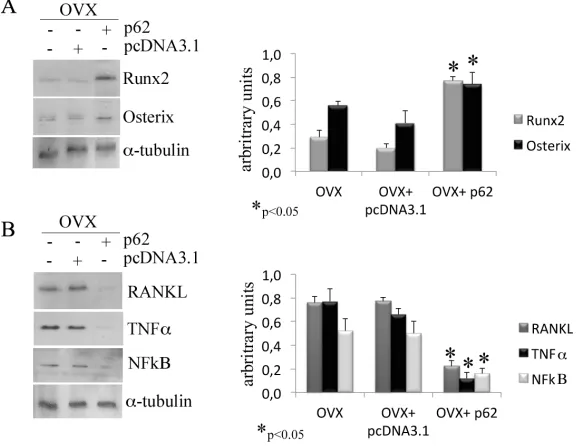
upregulation of osteoblastogenic Runx2 and Osterix (Figure 6A), a strong inhibition of two majors bone
resorptive factors such as TNFα and RANKL was also
observed in BMCs from OVXp62 mice. It is worth
noting that RANKL is a key mediator of inflammation
downregulation of NFkB in OVXp62 BMCs was also observed (Figure 6B).
A unexpected ring: exo-p62 up-regulates endo-p62 expression
As anticipated, although there are reports in the literature suggesting that in vitro overexpression of p62
may dull the production of inflammatory cytokines [11],
there are no in vivo data about a putative role of exogenous
p62 DNA in inflammation. While not wishing to be held
by theory, we evaluated the expression levels of p62 in
BMCs retrieved from plasmids injected in mice before ovariectomy. With much of our surprise, we found that while p62 expression in BMCs was downregulated by ovariectomy, BMCs from p62 DNA preinjected mice demonstrated a sturdy and selective upregulation of p62 (Figure 7A). Consistently, an increased p62immune labeling was observed at the epiphyseal region of femurs of p62OVX mice (Figure 7B).
[image:3.612.105.507.53.494.2]Next we asked whether this enhanced p62 immunereactivity refers to exogenous human p62DNA or to endogenous mouse p62. In order to distinguish between these two possibilities we utilized two types
of antip62 antibodies for western blotting analysis of
BMCs extracts: a polyclonal rabbit Ab that recognized
both human and mouse p62, and a monoclonal Ab that recognize only human p62 [24]. A human p62 recombinant protein was loaded as positive control. As depicted in (Figure 7C), we found that p62DNA administration clearly upregulates endogenous p62 protein in bone marrow resident cells.
A growing understanding of the bone remodeling
processes suggest that factor involved in inflammation
are linked with those critical for bone physiology and
remodeling, supporting the theory that inflammation significantly contributes to the aetiopathogenesis of osteoporosis. Indeed, our results provide for the first time evidences that in this model (OVX) of inflammation
mediated osteopenia, p62DNA, by exerting powerful
antiinflammatory effects, counteracts bone loss, and as consequence, promotes new bone formation [25].
Importantly, the dramatic effects of p62 DNA on bone homeostasis were not associated with any side effects as demonstrated by previous longterm toxicological studies [26]. In this context it has to be underlined that the major pharmacological interventions for osteoporosis, so far proposed, evidenced a long list of worrisome side effects [27, 28].
Taken together, our data can be viewed as proof of concept for preclinical and clinical development of an unprecedented strategy based on p62DNA to counteract osteoporosis [29]. More broadly, we hypothesize that the administration of p62 DNA may quench chronic
inflammatory reactions underpinning a variety of age
[image:4.612.70.552.52.286.2]related diseases.
Figure 2: p62 DNA pretreatment decreases pro-inflammatory cytokines and chemokines release in OVX mice. Cytokines and chemokines release was analyzed in medium from bone marrow cultures obtained by sham operated, p62 or pcDNA 3.1 pretreated OVX mice. (*p < 0.05).
[image:4.612.112.505.369.484.2]Figure 4: p62 DNA rescues osteoporosis. Representative reconstructions of metaphyseal regions of distal femurs from OVX pcDNA3.1 (A, C) and OVXp62DNA mice (B, D). Arrows indicated the trabecular bone loss (C) and the restored trabecular microarchitecture
(D) Representative sections of femur mid diaphysis from OVXpcDNA3.1 (E, G) and OVXp62 DNA mice (F, H). Note the expansion of the medullary cavity and the resorption cavities within the cortex (Arrow, G). Arrows indicated the reconstitute cortical bone structure (H)
Figure 5: BMD and BMC evaluation after p62 treatment. Bone mineral density (A) and bone mineral content (B) were increased in OVX mice treated with p62encoding plasmid. (*p < 0.05).
Figure 6: p62 vaccine decreases pro-inflammatory markers. Total bone marrow cell population was obtained from long bones of
OVX, OVXpcDNA3.1 and OVXp62 DNA. Note the statistically significant increase of Runx2 and osterix (A) as well as the decrease of
[image:6.612.163.456.459.682.2]MATERIALS & METHODS
DNA Plasmids
Human p62 (SQSTM, isoform 1) was cloned in
pcDNA3.1 (InVitrogene) vector as previously described
[6]. Large scale preparations of the endotoxinfree
plasmids were routinely performed by alkaline lysis using either Endo Free Plasmid Kit (Qiagen) or
Gen Elute HPSelect Plasmid Giga Prep columns
(SIGMA # NA0800). For intramuscular injections (femoral quadriceps), mice were anesthetized and
injected with 100 μg DNA (1 mg/ml) in saline
solutions. All groups were subjected to three injections at one week intervals.
Animals and treatments
Theemonth old female FVB and Balb/c mice
(Harlan Italy SrL, Correzzana Milano, Italy) were used. Mice were kept in laminarflow cage in a standardized
environmental condition. In prevention trials mice were randomly distributed in three groups (G1–G3) and injected intramuscularly at week 0, 1, 2 with only saline (G1,
n = 12), with pcDNA3.1 (G2, n = 12), or with hp62 DNA (G3 n = 12). At day fortyfive after the last injection, mice
from each group were randomly divided in two subgroups and were sham operated (SO; n = 6) or ovariectomized (OVX n = 6). After two months mice were sacrificed by
[image:7.612.57.555.79.453.2]CO2 narcosis according to the recommendation of the Italian Ethical Committee. For therapeutic trials mice were
Figure 7: p62 encoding plasmid up-regulates the endogenous p62 protein synthesis. p62 protein levels were detected in total bone marrow population (A) and in the epiphyseal areas of femur sections (B) by Western blotting and immunofluorescence, respectively. Note the increase of p62 synthesis in samples from p62OVX mice. Evaluation of p62 levels in BMCs by a specific mouse/human antibody or by a specific human antibody. Note the lack of human p62 detection, and the increase of mouse p62 protein in BMCs from p62OVX
ovariectomized (OVX) and left untreated for 2 months. Afterwards, mice were randomized in 3 groups, and injected with plasmids as described above. After 2 months
mice were sacrificed for analysis.
Histological bone analysis and immuflourescence Femurs, dissected of adhering tissue, were fixed in 4% paraformaldehyde (PFA) for 24 h, decalcified in 14%
EDTA solution for 3 days and soaked in 30% sucrose overnight. Samples, embedded with TissueTek OCT
compound, were sectioned (8 μm thick sections) by a rotatory −30°C microtome cryostat (Ames Cryostat Miles)
and stained with toluidine blue.
Other sections, after permeabilization with 0.3% Triton X100 were incubated with rabbit antip62 diluted
1: 800 (Enzo Life Sciences; VinciBiochem s.r.l., Firenze, Italy) diluted 1:400. After rinsing, sections were incubated
with chicken antirabbit IgG Alexa Fluor 488 conjugated (Molecular Probes; Invitrogen, Milano Italy) diluted
1:100. Control experiments were performed by omitting
the appropriate primary antibody or by neutralizing the primary antibodies with the relative blocking peptide.
Slides were imaged using a Leica DM 2500 fluorescent
microscopy. Fluorescence analysis was performed by a
fluorimeter Tecan Infinite [30].
Ex vivo dual-energy X-ray absorptiometry (DEXA) analyses
Femurs were dissected and fixed as above described.
Bone mineral density (BMD) and bone mineral content (BMC) were measured using a PIXImus DEXA [31].
Bone marrow cell (BMCs) preparation
Long bones (femurs, tibiae and humeri) from the
above mouse groups were dissected free of adhering tissue.
The ends were removed and the marrow cavity was flushed
and cultured in DMEM as previously described [32].
Cytokines and chemokines assay
The cytokine/chemokine profiles of BMCs super natants were assessed by ELISAbased cytokine array
by using Mouse Cytokine Array Panel A kit (R&D Systems, Milano, Italy) accordingly to the manufacturer’s instructions. Immunoreactive dots were visualized using
LiteAblot Turbo luminol reagents (Euroclone, Milano, Italy) and HyperfilmECL film (Euroclone, Milano, Italy)
and quantitated densitometrically.
Western blotting
Proteins from total bone marrow cells population
were extracted in Cell Lysis Buffer (Cell Signaling Euroclone, Milano, Italy) immediately after flushing
the bone marrow cavity, and the concentration was determined by the BCA protein assay reagent (Pierce, Euroclone Milano, Italy). Western blotting was performed
as previously described [33]. Human recombinant p62 was purchased from Enzo Life Sciences; VinciBiochem
s.r.l., Firenze, Italy. Membranes were immunoblotted
in blocking buffer with specific antibodies: rabbit anti mouse p62 (1: 800 dilution, Enzo Life Sciences; Vinci
Biochem s.r.l., Firenze, Italy); mouse antihuman p62
(1:800 dilution, BD Transduction Laboratories, Milano, Italy); mouse antiReceptor activator of NFκB ligand (RANKL) antibody (1:250 dilution, Abcam, Prodotti
Gianni, Milano, Italy); rabbit antiRunx2 antibody
(1:800 dilution, Cell Signaling, Euroclone, Milano, Italy); rabbit antiOsterix antibody (1:600 dilution, Santa Cruz Biotechnology, Italy); rabbit antiNFkB (1:500 dilution, BioLegend, Microtech Srl, Napoli, Italy).
After washing blots were incubated with horseradish
peroxidase (HRP)conjugated donkey antirabbit IgG or with HRPconjugated rabbit antimouse IgG (Cell
Signaling, Euroclone Milano, Italy). Immunoreactive
bands were visualized using luminol reagents/ECL film as described above. To normalize the bands, filters were stripped and re probed with a monoclonal antiαtubulin
(SigmaAldrich, Milano, Italy). Bands density was
quantified densitometrically.
Statistical analysis
All in vitro and in vivo experiments were repeated at least three times. tstudent was used to test for significant
differences between two groups, and differences were
considered significant at (*p < 0.05).
ACKNOWLEDGMENTS
This work was partially supported by Pharma 2020 Technology Transfer grant to A.S., by Strategic University FAR Project (Unicam) Grant to FM.V, and by FAR (Unicam) to M.G.S.
REFERENCES
1. Moscat J, DiazMeco MT. p62: a versatile multitasker takes on cancer. Trends Biochem. Scie. 2012; 37:230–236.
2. Geetha T, Vishwaprakash N, Sycheva M, Babu JR. Sequestosome 1/p62: across diseases. Biomarkers. 2012; 17:99–103.
3. Park S, Ha SD, Coleman M, Meshkibaf S, Kim SO. p62/
SQSTM1 Enhances NOD2mediated signaling and cyto kine production through stabilizing NOD2 oligomerization.
PLoS ONE. 2013; 8:1–11.
5. Yu HB, Kielczewska A, Rozek A, Takenaka S, Li Y, Thorson L, Hancock RE, Guarna MM, North JR, Foster LJ,
Donini O, Finlay BB. Sequestosome1/p62 is the key intra
cellular target of innate defense regulator peptide. J. Biol. Chem. 2009; 284:36007–36011.
6. Venanzi F, Shifrin V, Sherman M, Gabai V, Kiselev O, Komissarov A, Grudinin M, Shartukova M, Romanovskaya
Romanko EA, Kudryavets Y, Bezdenezhnykh N, Lykhova O,
Semesyuk N, Concetti A, Tsyb A, Filimonova M, Makarchuk V, Yakubovsky R, Chursov A, Shcherbinina V, Shneider A. Broadspectrum antitumor and antimetastatic DNA vaccine
based on p62encoding vector. Oncotarget. 2013; 4:1829–1835.
7. Gabai V, Venanzi FM, Bagashova E, Rud O, Mariotti F, Vullo C, Catone G, Sherman MY, Concetti A, Chursov A,
Latanova A, Shcherbinina V, Shifrin V, Shneider A. Pilot
study of p62 DNA vaccine in dogs with mammary tumors.
Oncotarget. 2014; 25[Epub ahead of print].
8. Yip KHM, Feng H, Pavlos NJ, Zheng MH, Xu J. p62
Ubiquitin bindingassociated domain mediated the recep tor activator of nuclear factorB ligandinduced osteoclast formation a new insight into the pathogenesis of Paget’s
disease of bone. Amer. J. Pathology. 2006; 169:503–514.
9. Rea SL, Walsh JP, Ward L, Yip K, Ward BK, Kent GN, Steer JH, Xu J, Ratajczak T. A novel mutation (K378X) in
the sequestosome 1 gene associated with increased NFB signaling and Paget’s disease of bone with severe pheno
type. J. Bone Miner. Res. 2006; 21:1136–1145.
10. Najat DE, Thomas T, Hagen T, Shaw B, Sheppard PW, Falchetti A, Marini F, Brandi ML, Long JE, Cavey JR, Searle MS, Layfield R. Characterization of a nonUBA
domain missense mutation of sequestosome 1 (SQSTM1) in
Paget’s disease of bone J. Bone Min. Res. 2009; 24:632–642.
11. Kim JY, Ozato K. The Sequestosome 1/p62 Attenuates
Cytokine Gene Expression in Activated Macrophagesby Inhibiting IFN Regulatory Factor 8 and TNF Receptor
Associated Factor 6/NFkB. J. Immunol. 2009; 182:
2131–2140.
12. Valencia T, Kim JY, AbuBaker S, MoscatPardos J,
Ahn CS, ReinaCampos M, Duran A, Castilla EA,
Metallo CM, DiazMeco MT, Moscat J. Metabolic repro
gramming of stromal fibroblasts through p62mTORC1 signaling promotes inflammation and tumorigenesis. Cancer Cell. 2014; 26:121–135.
13. Franceschi C, Bonafe M, Valensin S, Olivieri F, De Luca M, Ottaviani E, De Benedictis G. Inflammaging. An evolu tionary perspective on immunosenescence. Ann. NY. Acad.
Sci. 2000; 908:244–254.
14. Riggs BL, Khosla S, Melton LJ. Sex steroids and the con struction and conservation of the adult skeleton. Endocr.
Rev. 2002; 23:279–302.
15. Nakashima T, Takayanagi H. Osteoimmunology: crosstalk between the immune and bone systems. J. Clin. Immunol. 2009; 29:555–67.
16. Pacifici R. Role of T Cells in Ovariectomy Induced Bone LossRevisited. J. Bone Min. Res. 2012; 27:231–239.
17. Duran A, Serrano M, Leitges M, Flores JM, Picard S, Brown JP, Moscat J, DiazMeco MT. The atypical PKC
interacting protein p62 is an important mediator of RANK
activated osteoclastogenesis. Dev. Cell. 2004; 6:303–309.
18. AbuTaha M1, Rius C, Hermenegildo C, Noguera I, Cerda Nicolas JM, Issekutz AC, Jose PJ, Cortijo J, Morcillo EJ, Sanz MJ. Menopause and ovariectomy cause a low grade of systemic inflammation that may be prevented by chronic treatment with low doses of estrogen or losartan. J Immunol. 2009; 183:1393–402.
19. Baeza I, De Castro NM, GiménezLlort L, De la Fuente M.
Ovariectomy, a model of menopause in rodents, causes a premature aging of the nervous and immune systems.
J. Neuroimmunol. 2010; 219:90–99.
20. Jee WSS, Yao W. Overview: animal models of osteope nia and osteoporosis. Musculoskel. Neuron. Interact. 2001;
1:193–207.
21. Goswami J, HernándezSantos N, Zuniga LA, Gaffen SL. A boneprotective role for IL17 receptor signaling in ovariectomyinduced bone loss. Eur. J. Immunol. 2009; 39:2831–2839.
22. Sabbieti MG, Agas D, Marchetti L, Coffin JD, Xiao L, Hurley MM. BMP2 differentially modulates FGF2 iso form effects in osteoblasts from newborn transgenic mice.
Endocrinology. 2013; 154:2723–33.
23. Yu M, Qi X, Moreno JL, Farber DL, Keegan AD. NFκB signaling participates in both RANKL and IL4−induced macrophage fusion: receptor cross talk leads to alterations in NFκB pathways. J. Immunol. 2011; 187:1797–806.
24. Seibenhener ML, Zhao T, Du Y, CalderillaBarbosa L, Yan J, Jiang J, Wooten MW, Wooten MC. Behavioral effects of SQSTM1/p62 overexpression in mice: support
for a mitochondrial role in depression and anxiety. Behav
Brain Res. 2013; 248:94–103.
25. Nishikawa K, Nakashima T, Takeda S, Isogai M,
Hamada M, Kimura A, Kodama T, Yamaguchi A, Owen MJ, Takahashi S, Takayanagi H. Maf promotes
osteoblast differentiation in mice by mediating the agerelated switch in mesenchymal cell differentiation.
J. Clin. Invest. 2010; 120:3455–65.
26. Gabai VL, Shifrin VI. Feasibility analysis of p62
(SQSTM1)encoding DNA vaccine as a novel cancer
immunotherapy. Int. Rev. Immunol. 2014; 33:375–82.
27. Martino S, Cauley JA, BarrettConnor E, Powles TJ, Mershon J, Disch D, Secrest RJ Cummings SR; CORE Investigators . Continuing outcomes relevant to Evista:
breast cancer incidence in postmenopausal osteoporotic
women in a randomized trial of raloxifene. J. Natl. Cancer Inst. 2004; 96:1751–61.
28. BarrettConnor E, Mosca L, Collins P, Geiger MJ, Grady D,
of raloxifene on cardiovascular events and breast
cancer in postmenopausal women. N. Engl. J. Med. 2006; 355:125–37.
29. Lippuner K. The future of osteoporosis treatment a research update. Swiss Med Wkly. 2012; 142:w13624.
30. Sabbieti MG, Agas D, Marchetti L, Santoni G, Amantini C, Xiao L, Menghi G, Hurley MM. Signaling pathways impli
cated in PGF2α effects on Fgf 2+/+ and Fgf 2/ osteoblasts J. Cell. Physiol. 2010; 224:465–474.
31. Lopez Franco GE, Tyriina TK, Litscher SJ, UrbanPiette M,
Robert D, Blank RD. Accuracy and Precision of PIXImus
Densitometry for Ex Vivo Mouse Long Bones. J. Clin. Dens. 2004; 7:326–333.
32. Montero A, Okada Y, Tomita M, Ito M, Tsurukami H, Nakamura T, Doetschman T, Coffin JD, Hurley MM. Disruption of the fibroblast growth factor2 gene results in decreased bone mass and bone formation. J. Clin. Invest. 2000; 105:1085–1093.
33. Agas D, Sabbieti MG, Marchetti L, Xiao L, Hurley MM.
FGF2 enhances Runx2/Smads nuclear localization in