Journal of Criminal Law and Criminology
Volume 69
Issue 4
Winter
Article 19
Winter 1978
Socialization Patterns and Social Roles: A
Replication
Robert G. Leger
Follow this and additional works at:
https://scholarlycommons.law.northwestern.edu/jclc
Part of the
Criminal Law Commons
,
Criminology Commons
, and the
Criminology and Criminal
Justice Commons
This Criminology is brought to you for free and open access by Northwestern University School of Law Scholarly Commons. It has been accepted for inclusion in Journal of Criminal Law and Criminology by an authorized editor of Northwestern University School of Law Scholarly Commons.
Recommended Citation
THE JOURNAL OF CRIMINAL LAW & CRIMINOLOGY Vol. 69, No. 4 Copyright @ 1978 by Northwestern University School of Law Printed in U.SA.
SOCIALIZATION PATTERNS AND SOCIAL ROLES: A REPICATION*
ROBERT G. LEGER"
INTRODUCTION
Patterns of individualized adaptations to envi-ronments of custodial organizations-known col-lectively as inmate social types-have been impor-tant foci of a wide variety of research efforts. These efforts have ranged from descriptive case studies of high custody organizations' to more sophisticated analyses concerned with the relationship of these role types to a variety of factors (e.g., such as parole performance, socialization patterns' and back-ground analyses). Studies in this latter category have given rise to a set of generalizations centered around the construct of inmate social type. Many of these generalizations are based on research ef-forts which have focused, not on role incumbents who achieve a given status in the inmate group by virtue of their behavior, but upon individuals whose background characteristics are consistent with typologies of role types or whose attitudinal predispositions are congruent with those which actual role incumbents are believed to maintain. All too frequently, researchers employ these indi-rect identification schemes with little concern as to
the validity of the location procedure. This paper attempts to replicate and critique one of these research efforts: Garabedian's analysis of sociali-zation patterns of various role types.
2
In considering Garabedian's analysis, this paper has three principal purposes. First, as Garabedian's research constitutes a logical extension of Wheeler's analysis of socialization patterns of members of the general inmate population to incumbents of var-ious social roles, a principal task is to replicate the more important findings of the Wheeler study3
* This research was supported by NSF grant P351628-000. The author is indebted to John R. Stratton for his comments on an earlier version of this paper. This is a
revised version of a paper presented at the 1976 Annual Meeting of the American Sociological Association, New
York.
** Assistant Professor of Sociology, Eastern Tennessee
State University; Ph.D. (Sociology), 1974, University of Iowa.
I
D. CLEMMER, THE PRISON COMMUNITY (1958); E.GOFFMAN, ASYLUMS (1961); G. SYKES, THE SOCIETY OF
CAPTIVES (1958).
' Garabedian, Social Roles and Processes of Socialization in
the Prison Community, 11 Soc. PROD. 139 (1963).
' Wheeler, Socialization in Correctional Communities, 26
AM. Soc. REV. 697 (1961).
Garabedian replicated Wheeler and furnished strong support for the anticipatory socialization hypothesis4 However, Wheeler and Garabedian were concerned with only one dimension of the inmate normative system- "Conformity to staff norms." Consequently, the present research effort extends that of Wheeler by considering not only two other distinct dimensions of inmate society-"Solidarity with others" and "Isolation from others"--but also two measures of criminal reference group orientation.
A second intention of this research is to replicate the Garabedian study. This analysis parallels that outlined above for the Wheeler study. Finally, the present effort offers a critique of Garabedian's study by concentrating primarily on the indirect nomination procedure employed to locate social type role incumbents. This critique reveals that Garabedian's attitudinal nominators lack validity since they do not locate actual role incumbents. Additionally, Garabedian's nominating instrument itself is inadequate in a theoretical sense as the attitude items employed to locate social types do not measure the specifically hypothesized theoret-ical dimensions.
PROCEDURE
All residents (N = 410) of a medium security institution located in a midwestern state were in-vited to take a questionnaire on "inmate attitudes" for which they were paid a sum of two dollars. The questionnaires were administered at the institu-tional school during six evening sessions spanning a period of two weeks. Out of the 410 inmates, 364 took the questionnaire for a response rate of 88%.
Demographically, the average age of the sample was 22.6 years; modal length of sentence was 8 to 10 years with over one-half the sample receiving sentences in this category. The average socio-eco-nomic status, using an inmate's father's occupation coded into an ordinal scale following Reisss was
4
Garabedian, supra note 2. The present replication is warranted by contradictory evidence developed by Atch-ley and McCabe. See AtchAtch-ley & McCabe, Socialization in
Correctional Communities: a Replication, 33 AM. Soc. REv. 774 (1968).
5 A. J. REasS, OCCUP'TnoNS AND SOCIAL STATUS 263-75
ROBERT G. LEGER
57.5. Two-thirds of the sample were convicted for one of the following crimes-breaking and enter-ing, robbery, larceny, forgery or auto-theft. Slightly more than one-third of the sample (34%) was non-white.
Socialization Measures
Both Garabedian and Wheeler employed as a socialization measure a series of five hypothetical conflict situations in which inmates were asked to agree or disagree with the actions of a fictional character.6 As all of these items reflected high staff consensus,7 the inmates' agreement or disagree-ment with the items determined their degree of "conformity to staff role expectations." Garabe-dian's original socialization measure, herein desig-nated "conformity to staff norms," is retained in-tact for this research.
As Kassebaum, Ward and Wilner have indi-cated, however, Garabedian's attitude set repre-sents only a single dimension of the inmate code.8 Another important dimension which should also vary according to duration of confinement is in-mates' "expressed solidarity with others." There-fore, a series of items was developed in the present research to measure this factor. Finally, a third important dimension is the inmates' degree of "iso-lation from others." Accordingly, items were in-cluded to assess this factor. Thus, this research extends the analyses of Wheeler and Garabedian by examining socialization patterns of inmates and role types for two other dimensions of involvement in the inmate group.
These latter two scales were constructed as fol-lows: A series of 18 items of a Likert format de-signed to measure various dimensions of the inmate code were subjected to factor analysis. Initially, the principal component method with iterations was employed. A total of five factors were isolated. Employing Varimax rotation, the factors were ro-tated so as to maximize the item-factor correlations while simultaneously insuring orthogonality of fac-tors. The first three factors were judged to be
6
Garabedian, supra note 2, at 141; Wheeler, supra note
3 at 699-700.
7 To meet validity requirements, Wheeler selected
"staff" as a criterion group and used only attitude items
with which this group expressed strong agreement. Sub-sequent analyses revealed that the resulting "conformity to staff norms" measure was exceptionally efficient in discriminating between inmate and staff attitudes.
8
G. KASSEBAUM, D. WARD & D. WILNER, PRISON TREATMENT AND PAROLE SURVIVAL 153-59 (1971).
theoretically interpretable accounting for 83% of the common factor variance.9
Reference Group Measures
Central to Wheeler's investigation and an im-portant determinant for Garabedian of socializa-tion patterns for certain social types, is the concept. of anticipatory socialization. As this concept is based upon inmates' reference group orientation, it is theoretically relevant to determine the impact of career phase and the number of months spent in prison on the inmates' identification with "general criminal others."'0 Additionally, it is important to question whether these factors affect inmates' as-sociational preferences with other criminals. Two scales, "criminal identification" and "associational preference," were thus included to investigate these lines of inquiry." On all five scales used in this
9 The first factor contained 6 solidarity items.
Item-factor correlations are found in parentheses. Percent of variance explained equals 42%. Sample items are: 1. "You have to do what you can to help other inmates even when it might get you into trouble." (.49). 2. "When inmates stick together it is a lot easier to do time." (.53). 3. "In prison a good rule to follow is to share any extra
goods with your friends." (.49).
The five items comprising factor 2 were all of the hypothetical conflict situation variety (percent of
vari-ance explained equaled 27%). All of these items appeared to indicate respondents' degree of anti-authority
atti-tudes. Interestingly, items used in Garabedian's
sociali-zation measure were shared by this factor and factors 4
and 5. However, for comparative purposes, Garabedian's
measure is retained for this research.
The 4 items comprising factor 3 were identical to those used by Kassebaum, Ward, and Wilner to measure iso-lation from others. Percent of variance explained equaled 14%. Sample items are: 1. "In prison I try to keep pretty
much to myself." (.48). 2. "The best way to do time is to mind your own business and have as little to do as possible with other inmates." (.59). All items were of a Likert format with five responses available ranging from
"strongly agree" to "strongly disagree." On all items the
most pro-inmate response received five points. The most pro-authority response received one point.
"0 Stratton, Differential Identification and Attitudes Toward
the Law, 46 Soc. FORcES 256 (1967).
"Glaser and Stratton discuss these scales. See D.
GLASER, THE EFFECrIVENESS OF A PRISON AND PAROLE
SYSTEM (1964); Stratton, supra note 10. While Glaser and Stratton never specifically tested their scales for validity against a criterion group such as staff, they did test these indices against factors which should relate strongly to "criminal identification" such as number of prior
com-mitments. They found that the greater the number of prior institutional commitments, the stronger the
individ-ual's identification with "general criminal others." For
other variables tested, see GLASER, id. at 562-75.
SOCIALIZATION PA7TERNS
research, the higher the mean score, the more pro-inmate the response.
Career Phase and Length of Time Served
Inmates' "career phase" was determined by ask-ing two questions on the questionnaire-"How long have you been in this institution?" and "How much time do you have remaining to be served?" The initial career phase is represented by all in-mates who have been in the institution six months or less. The late career phase includes all inmates who have six months or less remaining to be served. All other inmates were considered to be in the middle career phase. "Career phase" is important because the concept of anticipatory socialization is based on the inmates' perception of which partic-ular phase of their institutional career they are .in. "Length of time served" is operationalized by calculating the number of months the inmate has been in prison. This is important from the perspec-tive of the concept of prisonization because it has been hypothesized that the longer the period of time the inmate spends in the institution, the greater the impact of prison culture upon that individual.
SOCIALIZATION IN CORRECTIONAL COMMUNITIES:
THE WHEELER SrTuM
Wheeler detected two socialization patterns op-erating in a "western state reformatory." The first approximated Clemmer's prisonization
hypothe-sis.12 Clemmer believed that the norms of inmate
society were designed to require loyalty to other inmates as well as induce in these individuals opposition to the values of the staff-a group which represented a "rejecting society." "The conse-quences of exposure to the inmate society were
summed up by the concept of prisonization ... the
taking on in greater or lesser degree of the folkways, mores, customs and general culture of the peniten-tiary.',13 Under the hypothesis, the process ofassim-ilation of these norms was seen as directly related to the length of time served in the institution. Furthermore, prisonization allegedly affected all inmates, even the "Square Johns" who maintained a pro-staff value orientation.
Wheeler demonstrated that while prisonization processes operate within the institution, a second socialization pattern, the anticipatory socialization or U-shaped curve, also existed. When they arrive
12 D. CLF-,,mrE, supra note .
'3Wheeler, supra note 3, at 697.
at the institution, inmates still maintain an
essen-tially conventional normative orientation. After
exposure to the institutional culture over a length
of time, however, their value orientation begins to
reflect that of the group which is now most
impor-tant to them-the inmate society. This result is
exactly what Clemmer hypothesized.
The crucial phase occurs when the inmate begins to become aware of his imminent release. Accord-ing to the anticipatory socialization hypothesis, the individual begins to anticipate his release back into conventional society. As a result of this anticipa-tion, his reference group orientation shifts from the group within the walls to the group which he now considers to be most important-the conventional society. This change in reference group orientation is accompanied by a corresponding change in the individual's normative orientation.
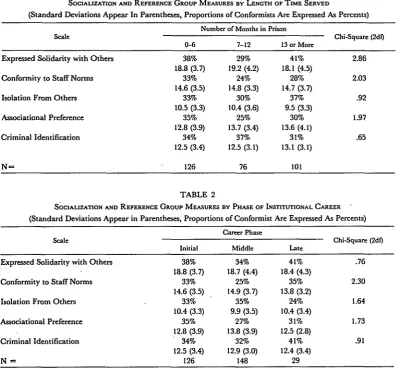
Table 1 presents proportions of conformists and mean scores for all inmates by number of months spent in prison."' Wheeler found support for the prisonization hypothesis in the decline of the
pro-14On Tables I and 2, fifty-nine inmates who were
nominated as social type role incumbents were deleted. Also deleted were 2 inmates who failed to indicate num-ber of months spent in prison. "Proportions of conform-ists" for all scales were determined by following the procedure outlined by Garabedian. Garabedian arbitrar-ily deemed the 33% of the sample evidencing the highest degree of endorsement ofstaff norms as conformists (those scoring between 6 and 10 on his scale). He then proceeded to examine fluctuations in the proportions of respondents in this high conformist category alone. This procedure is insufficient to draw conclusions about socialization pat-terns. A basic assumption of Clemmer and Wheeler is that inmate normative orientation varies according to duration of confinement and anticipatory socialization respectively. We must assume this implies that for each career phase, the group mean must fluctuate also. Gara-bedian and Wheeler obviously believe that if the propor-tion of conformists varies, then there should be a corre-sponding variation in the mean score for that particular group. This is an invalid assumption since a decline in proportions of conformists over career phase may simply indicate a narrowing of the range of scores with no actual effect on the group average. This is theoretically signifi-cant in itself as a narrowing of the range would indicate greater consensus on the part of the group. To remedy this situation, group means should be reported as well as proportions of conformists. For this research, "conform-ists" were those inmates scoring 7 or less on the isolation from others scale, II or less on associational preference, 11 or less on criminal identification, 17 or less on ex-pressed solidarity with others and 12 or less on the confbrmity to staff norms measure. Therefore, the means reported in tables 1-3 are broken down by career phase or length of time served for those conformist groupings
TABLE 1
SOCIALIZATION AND REFERENCE GROUP MEASURES BY LENGTH OF TIME SERVED
(Standard Deviations Appear In Parentheses, Proportions of Conformists Are Expressed As Percents)
Number of Months in Prison
Scale Chi-Square (2df
0-6 7-12 13 or More
Expressed Solidarity with Others 38% 29% 41% 2.86
18.8 (3.7) 19.2 (4.2) 18.1 (4.5)
Conformity to Staff Norms 33% 24% 28% 2.03
14.6 (3.5) 14.8 (3.3) 14.7 (3.7)
Isolation From Others 33% 30% 37% .92
10.5 (3.3) 10.4 (3.6) 9.5 (3.3)
Associational Preference 35% 25% 30% 1.97
12.8 (3.9) 13.7 (3.4) 13.6 (4.1)
Criminal Identification 34% 37% 31% .65
12.5 (3.4) 12.5 (3.1) 13.1 (3.1)
N= 126 76 101
TABLE 2
SOCIALIZATION AND REFERENCE GROUP MEASURES BY PHASE OF INSTITUTIONAL CAREER
(Standard Deviations Appear in Parentheses, Proportions of Conformist Are Expressed As Percents)
Career Phase
Scale Chi-Square (2dO
Initial Middle Late
Expressed Solidarity with Others 38% 34% 41% .76
18.8 (3.7) 18.7 (4.4) 18.4 (4.3)
Conformity to Staff Norms 33% 25% 35% 2.30
14.6 (3.5) 14.9 (3.7) 13.8 (3.2)
Isolation From Others 33% 35% 24% 1.64
10.4 (3.3) 9.9 (3.5) 10.4 (3.4)
Associational Preference 35% 27% 31% 1.73
12.8 (3.9) 13.8 (3.9) 12.5 (2.8)
Criminal Identification 34% 32% 41% .91
12.5 (3.4) 12.9 (3.0) 12.4 (3.4)
N 126 148 29
portions of conformists as time served in the insti-tution increased. As Table 1 indicates, however, the strongest tendency for respondents to demon-strate pro-inmate orientations occurs 7 to 12 months after arrival at the institution. Among inmates who have been in the institution for the longest time, there is an apparent trend toward a more conventional orientation-high proportions of conformists, lower mean scores. This pattern is weakest for the conformity to staff norms scale as there are slight differences among means. Addi-tionally, the criminal identification scale does deed approximate the prisonization pattern as in-dividuals who have served the greatest amount of time tend to identify with criminals to a greater extent than those prisoners in the initial career phase. Nonetheless, differences in means are slight.
It appears that at least for this research, the prison-ization socialprison-ization pattern generally does not
op-erate.15
i5 On the chance that the time span for the middle phase was too brief (7 to 12 months), "time served in prison" was recorded as follows: 0 to 6 months, 7 to 24 months and 25 months and over. Sample sizes for each group were: initial group-126; middle group-138; last group- 39. The computations in Table I were then repeated. No change occured in the patterns presented in Table 1. Additionally, the sample was dichotomized into recidivists (N = 125) and non-recidivists (N = 129).
(Institutional records were incomplete or not available for 49 inmates.) Recidivists were those inmates who had prior confinements either in juvenile or adult institutions. For non-recidivists, the patterning of mean scores and proportions of conformists were identical to those in Table 1. For recidivists, patterns were similar except for the associational preference and criminal identification
[image:5.454.24.422.50.424.2]Table 2, which breaks the inmate population down according to phase of institutional career, provides strong support for Wheeler's anticipatory socialization hypothesis. As the pattern of propor-tions of conformists and mean scores reveals, there are strong tendencies for inmates to hold more conventional orientations during the initial and late phases of their institutional careers. The most pro-inmate responses occur in the middle career phase. Only one scale, isolation from others, is exceptional to the overall trend. This latter distri-bution of scores is representative of Wheeler's counter-adaptive pattern since the highest involve-ment occurs during the initial and late phases with a tendency towards isolation in the middle phase.16
SOCIAL ROLES AND SOCIALIZATION PROCESSES: THE
GARABEDIAN STUDY
From Wheeler's examination of socialization patterns of members of the general inmate popu-lation, it is a logical step to consider socialization patterns of various inmate role types. In his research, Garabedian considered five social types-Politicians, Square Johns, Outlaws, Right Guys and Dings, a residual category for unclassi-fiable inmates.17
Because incumbents of each of these role types supposedly maintain certain atti-tudes which set them apart from other inmates, Garabedian decided to employ these attitudes as a means of identification. Accordingly, he con-structed five sets of Likert format attitude items with three items per set, each of which was to identify one of the role types above.'8 All inmates
scales. Duration of confinement had practically no effect on these dimensions. As expected, on all scales recidivists reflected a more pro-inmate orientation (high mean scores) than did first-timers.
16 See Wheeler, supra note 3, at 709, for a discussion of counter-adaptive and other socialization patterns.
17 Garabedian, supra note 2, at 144.
Is Items used by Garabedian to identify incumbents of various social roles are: Politician Items: 1. "You've got to have confidence in yourself if you're going to be success-ful." 2. "There's a little larceny in everybody, if you're really honest about it." 3. "Who you know is more important than what you know, and brains are more important than brawn." Square John Items: 4. "1 generally
fecl guilty when I do wrong." 5. "The only criminals I really know are the ones here in the institution." 6. "Most people try to be law-abiding and true." Outlaw Items: 7. "'Might is right' and 'every man for himself' are the main rules of living regardless of what people say." 8. "You have to take care of yourself because nobody else is going to take care of you." 9. "It makes me sore to have people tell me what to do." Right Guy Items: 10. "The biggest criminals are protected by society and rarely get
responding to his questionnaire then received a score for each of the five sets. Those scoring highest on a particular set were classified as incumbents of the role described by the set. Ties were handled by "classifying the inmate in favor of the score which was furthest from the absolute mean of its distri-bution."'19 For the present research, ties were con-sidered to be unclassifiable as these individuals endorsed attitudes indexing two or more social types. Ninety-five inmates were omitted because of ties, leaving a sample of 269. Additionally, because the social type "Ding" was used by Garabedian as a residual category, it was felt that the heteroge-neity of individuals in this category would make any analysis meaningless. Therefore, this role type was dropped.
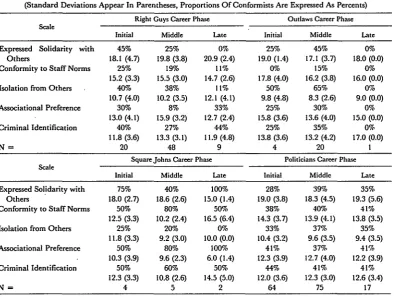
Garabedian detected several socialization pat-terns.20 For Right Guys and Square Johns the adaptive, U-shaped curve pattern prevailed; for Outlaws, it was the prisonization pattern; for Pol-iticians it was the stable conformity pattern. Table 3 reveals the results of the present replication for four social types. Note that the Conformity to Staff Norms measure is the one employed in Garabe-dian's original research.
As Table 3 reveals, the replication was markedly unsuccessful. For two social types, Outlaws and Square Johns, there is virtually no relationship between Garabedian's findings and those of the present study. For the social type of Right Guy, although the socialization measures clearly re-flected prisonization, there is also a trend in the distribution of scores for the criminal identification and associational preference scales toward the adaptive, U-shaped curve socialization pattern. Fi-nally, socialization patterns for Politicians pro-vided the highest degree of agreement between the two studies. Even in this instance however, the patterns were not identical as the scores in the present research begin high (pro-inmate response) and end low (more conventional responses). Gara-bedian's findings were completely opposite.2'
The failure of this replication can be directly linked to inadequacies inherent in the attitudinal nominators used by Garabedian to locate social type role incumbents. Criticism of Garabedian's
to prison." 11. "Inmates can trust me to be honest and loyal in my dealings with them." 12. "Police, judges, prosecutors and politicians are just as crooked as most of thepeople they send to prison."
"'Garabedian supra note 2, at 145.
20
Id
at 146.21 Id
ROBERT . LEGER
TABLE 3
SOCIALIZATION AND REFERENCE GROUP MEASURES BY PHASE OF INSTITUTIONAL CAREER FOR GARABEDIAN SOCIAL TYPES
(Standard Deviations Appear In Parentheses, Proportions Of Conformists Are Expressed As Percents)
Right Guys Career Phase Outlaws Career Phase Scale
Initial Middle Late Initial Middle Late
Expressed Solidarity with 45% 25% 0% 25% 45% 0%
Others 18.1 (4.7) 19.8 (3.8) 20.9 (2.4) 19.0 (1.4) 17.1 (3.7) 18.0 (0.0)
Conformity to Staff Norms 25% 19% 11% 0% 15% 0%
15.2 (3.3) 15.5 (3.0) 14.7 (2.6) 17.8 (4.0) 16.2 (3.8) 16.0 (0.0)
Isolation from Others 40% 38% 11% 50% 65% 0%
10.7 (4.0) 10.2 (3.5) 12.1 (4.1) 9.8 (4.8) 8.3 (2.6) 9.0 (0.0)
Associational Preference 30% 8% 33% 25% 30% 0%
13.0 (4.1) 15.9 (3.2) 12.7 (2.4) 15.8 (3.6) 13.6 (4.0) 15.0 (0.0)
Criminal Identification 40% 27% 44% 25% 35% 0%
11.8 (3.6) 13.3 (3.1) 11.9 (4.8) 13.8 (3.6) 13.2 (4.2) 17.0 (0.0)
N 20 48 9 4 20 1
Square Johns Career Phase Politicians Career Phase Scale
Initial Middle Late Initial Middle Late
Expressed Solidarity with 75% 40% 100% 28% 39% 35%
Others 18.0 (2.7) 18.6 (2.6) 15.0 (1.4) 19.0 (3.8) 18.3 (4.5) 19.3 (5.6)
Conformity to Staff Norms 50% 80% 50% 38% 40% 41%
12.5 (3.3) 10.2 (2.4) 16.5 (6.4) 14.3 (3.7) 13.9 (4.1) 13.8 (3.5)
Isolation from Others 25% 20% 0% 33% 37% 35%
11.8 (3.3) 9.2 (3.0) 10.0 (0.0) 10.4 (3.2) 9.6 (3.5) 9.4 (3.5)
Associational Preference 50% 80% 100% 41% 37% 41%
10.3 (3.9) 9.6 (2.3) 6.0 (1.4) 12.3 (3.9) 12.7 (4.0) 12.2 (3.9)
Criminal Identification 50% 60% 50% 44% 41% 41%
12.3 (3.3) 10.8 (2.6) 14.5 (5.0) 12.0 (3.6) 12.3 (3.0) 12.6 (3.4)
N= 4 5 2 64 75 17
indirect nomination procedure will focus on two general areas-as well as on the fact that the attitude items used in the nominations are inade-quate indices of the hypothesized theoretical di-mensions. Garabedian claimed he was able to clas-sify 73% of his sample into the five social type categories. Yet, this figure is far too high to present a realistic picture of the proportion of the inmate population who are in fact, social type role incum-bents. Rather, it appears that Garabedian was attempting to identify individuals who simply had attitudinal predispositions toward the various be-haviors associated with the social types. Logically we would assume that among these predisposed individuals we would find the actual role bents. Thus, a comparison of actual role incum-bents to those identified through Garabedian's at-titudinal nominators would provide an excellent source of validity for the latter technique. Table 4 presents the number of behaviorally nominated social types who are also identified through Gara-bedian's attitudinal nominators.22
2 Only two social roles are common to the present research site and that of Garabedian's. These are the role
As Table 4 reveals, there is little correspondence between the attitudinal indicators and the behav-ioral nominations for Right Guys and Outlaws. There is, however, a relatively high degree of cor-respondence between the two sets of indicators for the social type of Politician-Wheeler-Dealer. This
types "Right Guy" and "Outlaw." Additionally, as Garabedian's identification items for the "Politician" reflect a pragmatic, manipulative self-orientation, these items should successfully locate incumbents of a third role, the "Wheeler Dealer," who engage in loan-sharking and manipulation of scarce goods and commodities.
Incumbents of these roles were identified as follows: a sample of 13 correctional officers who were in continuous contact with inmates were asked to name individuals who were known to the inmate group as actual role incumbents. These nominations were validated by two inmates with whom the researcher had become ac-quainted during the course of the study. Inmate ques-tionnaires were secretly coded to allow individual iden-tification. However, respondents were assured that no one connected with the institution would be allowed access to the questionnaires and this guarantee was met. Response rates were: 19 out of 21 "Outlaws" took the questionnaire for a response rate of 90%; "Right Guys," 4 out of 4 for a rate 100%; "Wheeler Dealers," 15 out of 19 for a rate 79%.
[image:7.454.30.425.61.358.2]SOCIALIZATION PATTERNS
TABLE 4
NUMBER OF BEHAVIORALLY NOMINATED SOCIAL TYPES WHICH CORRESPOND TO GARABEDIAN'$ ATTITUDINAL
SOCIAL TYPE INDICATORS
(The Proportion of Behaviorally Identified Social Types Also Identified Attitudinally is Expressed in Percentages)
Number of Behaviorally Number Identified Number of Behavioraly Nominated Social Types Nominated Individuals Through Attitudinal Individuals Who Were Identified
Indicators Through Attitudinal Indicators
Outlaw 19 25 5 (20%)
Right Guy 4 77 0 (0%)
Politician-Wheeler- 15 156 11 (7%)
Dealer
TABLE 5
CORRELATION MATRIcES OF ATtTUDE ITEMS INDEXING SOCIAL TYPESi
Politicians (N = 156) Square Johns (N - 11) Outlaws (N - 25) Right Guys (N - 77)
Items 1 2 3 Items 4 5 6 Items 7 8 9 Items 10 11 12
1 1.00 .07 .09 4 1.00 .28 .24 7 1.00 -. 10 .15 10 1.00 .29 .18
2 1.00 .20 5 1.00 .32 8 1.00 .08 11 1.00 .25
3 1.00 6 1.00 9 1.00 12 1.00
t Item numbers correspond to those found in footnote 18. These analyses were repeated using the entire sample for each of the four sets of items. Inter-item correlations were slightly lower on the average for each role type.
is possibly due to the fact that 156 individuals were classified as Politicians. This large sample size may contain a high proportion of Wheeler-Dealers sim-ply by chance. But, it is noteworthy that the rep-lication of socialization patterns was most success-ful for this role type. It appears, with perhaps a single exception, that the indirect nomination pro-cedure employed by Garabedian fails to include individuals known to the inmate group behav-iorally as role incumbents.
Additionally, if attitudinal items are used as indicators of specific behavioral dimensions, then they should meet certain criteria. Obviously, ifeach item in a set reflects "a component of the attitu-dinal organization of a given role type,"23 then it
may safely be assumed that these items should be highly correlated with one another. Table 5 reveals, however, that inter-item correlations are generally low for all social types. It is important to note also that attitude items which purportedly reflect com-ponents of specific attitudinal dimensions should, when factor analyzed, load on the same factors. The twelve items were subjected to factor analysis using the principal component method with itera-tions. Four factors were isolated. These four factors (Varimax rotation) are presented in Table 6.
The only items which load on a single factor are those indexing the social type of Square John. Items 4, 5 and 6 load uniquely on factor 3. Factor
23 Garabedian, supra note 2, at 144.
TABLE 6
VA~msx ROTATED FACTOR MATRIx FOR 12 ATrITUDE
ITEMS USED TO NOMINATE INCUMBENTS OF FOUR SOCIAL TYPES
Variable Factor I Factor 2 Factor 3 Factor 4 Number'
1 .20 .24 -. 09 -. 29
2 .48 .04 -. 16 -. 14
3 .16 .23 -. 12 -. 20
4 -. 22 .02 .23 -. 06
5 .07 -. 18 .68 .10
6 -. 19 .19 .27 -. 17
7 .48 -. 23 .03 .25
8 .40 .05 .06 .04
9 .19 -. 01 -. 05 .51
10 .54 .11 -. 10 .02
11 .01 .77 -. 02 .00
12 A8 .06 -. 20 .29
'Variable numbers correspond to attitude items in footnote 18. Percent of variance explained by each factor
is as follows: factor 1, 44%; factor 2, 30%; factor 3, 15%; factor 4, 11%.
3 appears to be constituted only of these three attitude items. As such, this factor has a theoreti-cally interpretable meaning. It represents attitudes which reflect conventional, law-abiding values.
ROBERT G. LEGER
shared by factors 1 and 4 only. Finally, Right Guy attitude items, (10, 11 and 12) appear to load most highly on factors 1 and 2.2
The inter-item correlations and the factor anal-ysis indicate that, except for the social type of Square John, attitude items representing the re-maining social types appear to index dimensions quite apart from one another.25 This reduces to the fact that researchers employing these attitudinal nominators are examining socialization patterns of
individuals who simply score highest on a set of
attitude items. These items are essentially non-related in most instances and are theoretically meaningless from the perspective of the identifica-tion of social type role incumbents.
CONCLUSION
While many research efforts have employed var-ious indirect measures of behavior to locate inmate social types such as background characteristicss or the use of attitude items,27 none have demonstrated
24 It is interesting to note that factor 1 (Table 6) does appear to have a theoretically interpretable meaning in that the five items which load most strongly on this factor all appear to measure a cynical orientation, especially concerning one's orientation towards life and conditions in society. Agreement with these items would indicate that the criminal has internalized a set of rationalizations which allow him to commit criminal acts. Items loading on the remaining factors, 2 and 4, however, do not convincingly present any clear theoretical interpreta-tions.
' Of course, if this factor analysis had been performed
on Garabedian's sample, the resulting factors might have contained only items indexing the particular attitudinal dimensions under concern. Unfortunately, Garabedian fails to report any form of item analysis or more basically any attempt at ascertaining the validity of his nomination procedure.
' D. GARRITY, THE EFFECTS OF LENGTH OF
INCARCER-ATION UPON PAROLE ADJUSTMENT AND ESTIMINCARCER-ATION OF OPTIMAL SENTENCE: WASHINGTON STATE CORRECTIONAL INSTITUTIONS (1956); G. KASSEBAUA, D. WARD & D.
WIn-NER, supra note 8; Wellford, Factors Associated with Adoption of the Inmate Code: A Study of Normative Socialization, 58 J.
CRM. L. C. & P. S. 197-203 (1967).
2 Garabedian, supra note 2; Glaser, supra note 11;
any concern as to whether these techniques are successful in locating actual role incumbents. The present research has illustrated the dangers inher-ent in the use of indirect nomination procedures through an unsuccessful replication of Garabe-dian's analysis of socialization patterns of various social types. As has been noted, this failure was directly attributable to inadequacies in Garabe-dian's nominating instrument: the three item nom-inating sets do not locate actual role incumbents or even index the various theoretical dimensions which underline the behavior of the role types. Garabedian's study is thus reduced to an assess-ment of socialization patterns of individuals who simply scored high on the largely non-related items. This has ramifications for the theoretical rationale used to explain the various socialization patterns he found in his research. Since Garabedian's theo-retical rationale was based on the questionable assumption that the nominating instrument accu-rately located role incumbents, any explanation of socialization patterns by linking the pattern to the behavior of a certain social type becomes meaning-less.
The present study furnishes strong support for Wheeler's anticipatory socialization hypothesis.s The period of highest involvement in the inmate group, the middle career phase, was also the point at which responses to the various scales were most pro-inmate. The middle career phase was also the period of inmates' highest identification with crim-inal others and preferences for associating with these individuals. This is important in that these two dimensions are reflective of inmates' reference group orientation. As the anticipatory socialization hypothesis is based on the concept of anticipating memberships in reference groups, it is significant that these two measures supported the U-shaped curve socialization pattern.
Zingraff, Prisonization as an Inhibitor of Effective
Resocializa-lion, 13 CRIMINOLOGY 366-88 (1975).
2 Wheeler, supra note 3.