Malaysian Journal of Library &Information Science, Vol.9, no.l, July 2004: 1-16
UNDERGRADUATES
IN COMPUTER SCIENCE AND INFORMATION
TECHNOLOGY
USING THE INTERNET AS A RESOURCE'
Mohd. Sharif Mohd Saad land A.N. Zainab
2'University Teknologi Mara, Shah Alam, Selangor, Malaysia
2Faculty of Computer Science & Information Technology
University of Malaya, Kuala Lumpur, Malaysia e-mail: [email protected];[email protected]
ABSTRACT
The study explores the use of the Internet by final year undergraduates at the
Faculty of Computer Science and Information Technology during the initial stages
of their Final
Year Project. A total of 360 survey returns
indicate
that
undergraduates heavily use the Internet
(98%).Other sources, which the students
use is also listed. The students seem to exhibit high level of information literacy.
They utilize various search strategies while searching the Internet, able to locate
and retrieve information, able to analyse and evaluate information gathered. They
use various methods to validate the authenticity of the information obtained and
able to synthesize what they have read to shape the initial chapters of their final
year report. The students are also aware of ethical issues surrounding the use of
Internet resources. A focus group of
14
undergraduates who kept a diary of their
information seeking and use behaviour, provide a clearer picture of the students
behaviour and the approaches adopted when using the Internet. The outcome of the
approaches
isalso explained.
Keywords: Information literacy; Internet use; Internet resources; Information seeking behaviour; Undergraduates in Computer Science; Undergraduates in Information technology; Modeling behaviour
INTRODUCTION
Mohd. Shari/M.S. &ZabulbA.N.
electronic environment to search for infonnation andhow the infonnation is actually
used.
Fortin (2000) for example, develop Internet infonnation seeking behaviour model to describe how Faculty members at Angelo State University seeks infonnation on the Internet. Four stages of infonnation seeking behaviour are identified and these are seeking, validating, linking and monitoring. Fortin's "Internet Infonnation Seeking Model" reveals that academics place more emphasis on validating infonnation retrieved fromthe
Internet. His subjects' otherrelated
behaviours conform to Ellis's model (1986, 1989, 1993) of eight behaviours of research activities comprising starting, chaining, browsing, differentiating, monitoring, extracting, verifyingand
ending. Catledgeand
Pitkow (1995) identify two types of users, those who browse would spend less time looking at a web pageand
those who are searchers would usually bookmark popular websites. They also found that only2
percent of web pages looked at are either saved or printed. This is also verified by Taucherand
Greenberg (1997a, 1997b),that
web users often revisit web pages (60% once and 19% twice) and they tend to browse small clusters of pages. Holsher and Strube (2000) indicatethat
participants who have both domainand
web knowledge would achieve overall more successful searches. Those with strong domain knowledge but lack in web searching knowledge tend to rely heavily on terminology and avoided using search operatorsand
modifiers. Those with lower domain knowledge use less flexible search sttategiesand
tend to return to earlier stages oftheir
searchesrather
than
try new approaches. Cockburn and McKenzie (2001) analyse "four months of user actions with Netscape Navigatorand
found that users revisit web pages often, the pages are visited for a short time period, and large numbers of web pages are book marked. Kimand
Allen (2002) study 160 completed search logs by 80 individuals and find that successful search activities and outcomes are strongly influenced by the type oftask,
techniques useand
the ability to formulate search sttategies. The above-mentionedinformation
seeking studies therefore demonstrate users' behavioursas
they progress through the different stages ofrecognizing
and
articulatingtheir information
needs.Undergrtulllates inComputet' Science tIIIdInfortlUltion Teclutology
This
study explores the use of the Internet by undergraduates in their fmal year at the Faculty of Computer Science and Infonnation Technology, University of Malaya These undergraduates are required to write anine
credit final year project report based on the development of a working system. The types of Internet use, the search strategies formulated, the problems faced and how this behaviour are reflected in the information searching and use skills of undergraduates is the focus of this paper.COMPUTER
SCIENCE
AND
INFORMATION
TECHNOLOGY
UNDERGRADUATES
All third year students enrolled in the Bachelor of Computer Science (CS) and Bachelor of Information Technology (IT) at the University of Malaya are required to fulfill a 4 credit part I of their Final Year Project This is part of a nine-credit course, which extends over two semesters. The first
half
(4 credit) requires the students to choose a project title, carry out an extensive literature review as well as identify similar systems in the domain they are developing, interview clients, understand their project scope, analyse their project objectives as well as requirements and write these in the first four chapters of their report. Before they began to actually start detailing the proposed design and coding, they also need to identify the most suitable platform, the system architecture and appropriate hardware and software to effectively develop the proposed system. It isat this stage that the students need to know how to locate, obtain and use information.A total of 470 third year undergraduates were given a questionnaire each and this comprises 70.3% of a total of 669 undergraduates. These students were chosen for the following reason: they form a group faced with a definite problem situation, which requires them to obtain information; they are expected to be computer
and
Internet literate by virtue of being adequately exposed to the CSand
IT programmes for at least 2 years; and they are expected to be information skilled as they have taken a l-credit course in "Informationskill"
offered by the University Library in their first year. The undergraduates have also been briefed by the coordinator of the Final Year Project Committee of what is expected in the firsthalf
of their reportand
the Faculty web portal also provide similar details for those who did not attend the briefing session.Mohd. Sharif M.S. &ZtUnabA.N.
. posed by
the
researcher through emails and from the 'transcriptions of interview sessions.The results obtained from a total of 360 (76.5%) usable returned questionnaires and the diary -interview sessions form the basis of this paper to describe the extent of use undergraduates made of the Internet when searching for information in a particular context, so as to be able to write the first four chapters of the final year project report The respondents comprise 209 in
the
Bachelor of Computer Science and 151in
the
Bachelor of Information Technology programmes. Majority of respondents are female (232, 64.4%) and comes from urban home background (248, 68.1%).THE INTERNET AS AN INFORMATION CHANNEL
The majority of undergraduates spent a great deal of time surfing the Internet The undergraduates confirm using the Internet for educational purposes (332, 994110)and for email (327, 98%). Undergraduates recorded high level of satisfaction
in
using the Internet for these purposes. About 98% (261) of undergraduates contirm downloading files from the Internet. They also use the Internet for chatting (247, 73%) and to play computer games (208, 66%). Emails are mainly used for educationaland
leisure purposes. Those undergraduates with CGPA of 3.5 and above recordedthe
highest usage of the Internet. The responses confirm that undergraduatesin
Computer Science and Information Technology are heavy users of Internet, are satisfied with it, uses it heavily to obtain information and for downloading files.SOURCES OF INFORMATION USED
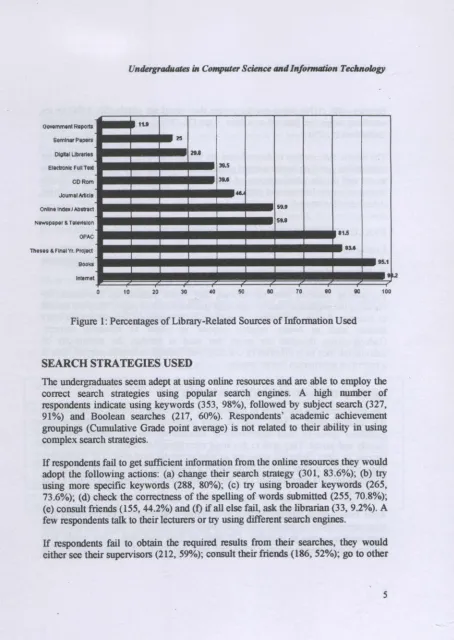
The undergraduates use a variety of sources and the most heavily used is the Internet. A total of 325 undergraduates (98.2%) indicated heavy usage of the Internet to obtain information (Figure 1). This is expected as undergraduates exhibit basic characteristics of e-geners or e-generation or "homo zappiens" (Wim Veen, 2002; Wim Veen et al, 2003). They are also heavy users of books, which they bought either from bookstores or through the Internet.
UndergrtUlllatesinCompute, Science and Injomuztion Technology
OPAC
11.1 25
2U ""S 3U
,
...
SU SU
81.5
11. 95.1
I
II
Govemment Reports
Semlnor Papers
Digital UbrarilS
Elldronlt FUll TIlII
CD Rom
Joumal Miele OnKnt IndexIAIlstraet
Newspaper 80Talevlslon
11I0"S 80Final Yr. Project
BoOkS
Inteme
[image:5.471.13.467.20.660.2]to 20 30 40 so 70 80 100
Figure 1: Percentages of Library-Related Sources of Information Used
SEARCH STRATEGIES USED
The undergraduates seem adept at using online resources
and
are able to employ the correct search strategies using popular search engines. A high number of respondents indicate using keywords (353, 98%), followed by subject search (327, 91%) and Boolean searches (217, 60%). Respondents' academic achievement groupings (Cumulative Grade point average) is not related to their ability in using complex search strategies.Ifrespondents fail to get sufficient information from the online resources they would adopt the following actions: (a) change their search strategy (301, 83.6%); (b) tty using more specific keywords (288, 80%); (c) tty using broader keywords (265, 73.6%); (d) check the correctness of the spelling of words submitted (255, 70.8%); (e) consult friends (155, 44.2%)
and
(f) ifall
else fail,ask
the librarian (33, 9.2%). A few respondents talk to their lecturers or try using different search engines.Mohd. Sharif M.S.
&
Ztlbulb AN.libraries (185, 51%); leave out the source they could not obtain (53, 15%) or tty
searching again the Internet at a later stage (36, 10%) or buy the needed books themselves (6, 2%).
The
results indicate that undergraduates are versatile as well as resourcefulin
their information gathering behaviour andpossess basic information literacy skills, able to locateand
decide which sources of information to use, able to formulate Search strategies on the Internetand
able to use a variety of infonnation sources to obtain the information needed.EVALUATING THE INFORMATION OBTAINED
Undergraduates seem able to evaluate information obtained Only the correct and timely infonnation are utilized as undergraduates are pressured for time to complete the first part of their report within 3 months.
For sources obtained from the Internet, they would validate the correctness by checking the publication date or copyright statement on web pages. They are careful to ascertain that the information is not bias by comparing information with other sources such as books, articles, experts, or check in reference sources. Undergraduates therefore are aware that need to validate the authenticity of information they have obtained by checking with multiple reference sources. This is a trait of an information literate person.
ORGANIZING INFORMATION GATHERED
The undergraduates seem able
to
organize the information obtained, shaping it into the required report. They organize their proposal chapters according to the guidelines given by their supervisors or instructions that they obtain from the Faculty web portal. They tend to download everything they found relevant from the Internet or other electronic resources in their computer hard disk (137 responses). They also keep a copy of all infonnation in a journalllog book, folders, special ftle or note book (104 responses) or they keep all bibliographic details in a diskette (103 responses).Ulldergrfllluates
in
Computer Science tIIId /IIjomutdoll Teclutologyduplicate references (173, 48%) or when they obtain more than 10 references (69,
194'10)
or when time is running outand they
have to start writing the report. Over 79% of undergraduates learn how to shape their report by looking at other reports kept at the Faculty libnuy.The
results indicate that undergraduates are skilled in organizing the infonnationthey have gathered and shaping it out into a coherent report. Even when
they
are in doubt, they know where to locate infonnation, which would provide them with the answers.The
only problems undergraduates mention facing are deciding, which database to use in their searches, varying the references obtained, interpreting ideas gleaned from the various resources and writing in the English Language.UNDERSTANDING ETHICAL ISSUES
From a list of five ethical issue statements, undergraduates are asked to give their ratings about ethical issues that accompany the use of infonnation (Table 1). In
[image:7.455.4.450.19.597.2]general undergraduates agree with the statements listed and
understand
as well as accept that citing sources isa way of according recognition to an author.Table 1: Level of Agreement amongst Respondents on Infonnation Use
and
Ethical IssuesI
Agreeable1
Fairly Agreeable1
DoNot Agree1__
---'
Count
I~
Count1
%1
CountI~
Mean1
I-In-fOl1D--ati-'OO-from--th-e-In-tern-e-t--...JI~~·
~~_:j~~
can be used ifthe sources are listed 230 64.6 107 30.1 19 5.3 2.59' in the references
Infonnatioo Use and Ethical Issue
1_~..;.~;;.;;.:;;;;;;can.;;.;::;;;.;;:~.;;;.e_!o_th_S~_dered_'an_n_~w_ysed_an_d--,I~~~~~~~
_U=Sin::lg2..,;intl==..;0I1D=a~tioo:...:::..v=erb=a=1l=·m::::W1~·_th_Ou_t_J1186
I
52.2I
117I
32.9I
53I
14.9I
2.37I
listing the source is unethical__j
__::::_j ~--.::..:.:....J __:___j...:.:.:J ~
_T__ak="-in_;;;g;;_intl.;;;;;OI1D=;;.;;.all;;;.;;·oo;;;....;.;.<c;;.:ut""'&..__Past_e>_ __,1 98
I
27.2I
141I
39.6I
117I
32.9I
1.95I
from the Internet is wrong_:___j~_:::__j~~~~
Mohd. Sharif M.S. &ZaimIb AN.
. the references". Respondents are agreeable or fairly agreeable that information on the Internet could be used in their writing if
the
sources are listed in their list of references at the end of their report (95%). Over 90% of respondents agreethat
information gathered, analysedand
used would bring about new information. A total of 66% of the undergraduates agree that taking information' from the Internet verbatim is wrongand
that cutting and pasting information from the Internet is wrong.mE
FOURTEEN CASE STUDIES
Part of this study involves closely studying 14 undergraduates, 9 who majored in Computer Science (CS)
and
5 in Information Technology (IT). All 14 undergraduates indicate using the Internet, They use the Internet at the initial stage to familiarize themselves with the project titleand
also use it as a source of information besides conferring with their friends and lecturers. None of them utilize the services available in the University library, or are aware of the inter-library loan or document delivery services. They are unaware of how librarians could help them or doubtthat
librarians have the ability to help them.The 14 undergraduates use
the
Internet because it is a quick way of getting informationand
it is accessible readily to them. The undergraduates indicate that they are often pressed for time with both academic and non-academic commitments that makes searching in the Internet for information a convenient option The Internet could be searched between classes, in the eveningsand
over the weekends. Searches could be carried out on campus, their hostels,and
their homesand
at cyber cafes. The information obtained could also be saved and read later.U"dergrtulMates in Computer Science and /nfontUltion Technology
Information Search Subject System
Use of Search Engines Approach/Methodology
I
I
I
I
Subjects Keywords Wildcards
;1=
:
I
1 st Page Display 5-10 Pages All Pages
:
:
SelectionlEvaluation
I
.edu, .org, .ac sites Compare infonnationl Authority IUp to dateness; Check for BiasnessILecturersIFriends
Outcome Needs Met Partiall Met
.>
Further Action
Continue Seeking and Evaluating
Problems 1. Information Overload 2. Lack ofInfonnation 3. Wrong Keyword or Search Terms 4. Verify & Evaluate Information
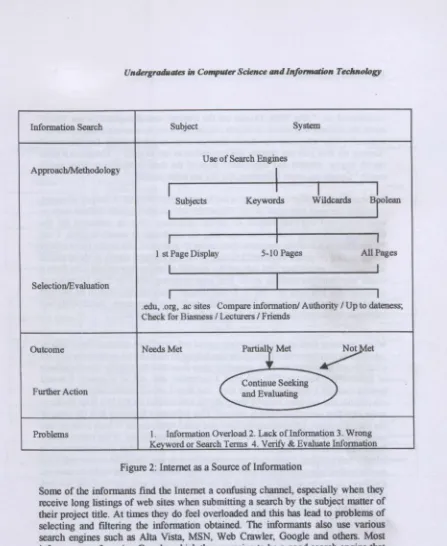
Figure 2.: Internet as a Source of Infonnation
[image:9.467.10.457.18.564.2]Mohd Shfll'iJ M.S. &Zainab A.N.
volunteered are: "Alta Vista, Google are the frequent search engines for me. 1 have
learnt the concept
and
theory of search engines from my e-commerce
and
cyber law
courses";
"My resources are found through long searches using Googles.com"
"During my first year our lecturer
has
exposed us to use Google"; "Google is a good
search engine, reliable and dependable most of the time compared to other major
ones"; "Google
has
more references, the hits are more precise".
Informants also appear to be at ease when searching the Internet. A variety of search
strategies are
used
and most of
theinformants use advance search options such as
wild
cardsand
keyword/subject
or phrase searching.
This is indicated by the
following comments, "when 1 am searching the databases or search engines, 1 use
**.
1 seldom use Boolean operators since using
**
is easier"; "Enter the keywords or
phrase
in
this (+"phraselkeyword")
format or use the advance search in those search
engines". The informants also indicate the number of pages they would scan from a
single hit, from just looking at the
firstpage to going down to 5 to 10 pages or
stopping after scanning
the
first50 to 100 listings. They do not seem to be worried
about getting more hits as they feel that that would give them more choice. Only one
informant considered herself to be overloaded with information.
When browsing through web pages they would only use those obtained from .edu or
.K
sites, as
theyknow that these addresses belong to educational institutions that are
credible
and
authoritative. They volunteer clues as to how they verify the correctness
of information,
such as,
"Donot trust a particular web site at a glance. 1 would
browse through a collection of web sites,
andthen I would decide which web sites
are reliable
and
not bias. 1 would compare the information on the Net with books to
make sure that the information is correct". One informant feels that it is the
01DlSof
1. lniIiIIion
2. Selection
4.Fonnul.ion
(offocuI)
3.Exploralion 5. Cot,c!ion Qn\l8ltigation (gather
Info on lhe Info on g.nlral Ttl, Topic) foCUI Topic) 6.Exploration 7. Alsesamenl (ofoutcornelproceas)
Undergraduates inComputer Science and lnjonnation Technology
EIH rWBenewtr
lrrIorrna Proble ... SaM ..
(IlIeBit' Sklill
1. Choo ... broadlopic
B
1---1 Defining
[image:11.464.10.456.14.573.2]2. GIlInCII08I'IIiew ofthe Ttl. topic
B
B
EJ
I-I
EJ
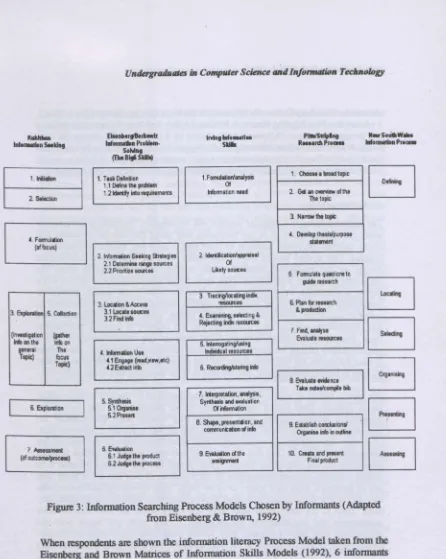
Figure 3: Infonnation Searching Process Models Chosen by Infonnants (Adapted from Eisenberg
&
Brown, 1992)1. Task Dlfin~ion
1.1Definetheproblem
1.21den1ifyintorequinlments
When respondents are shown theinformation literacy Process Model taken from
the
Eisenbergand
Brown Matrices of Information Skills Models (1992), 6 infonnants2.Informllion Seel<ing Smlgies 2.1 Determine range sources 2.2 Prioritize scuees
3.L.oc.ion LAcee .. 3.1 L.ocIl18011Ces 3.2FindInfo
4. IrtonnIIion U••
4.1 Englgt (read,view,elc) 4.2eJtract info
5. SynIhtsis
5.1Organise
5.2Pr ...
6. Evaluation 6.1 Judge theproduct
6.2Judgetheproc ...
4. Develop thesi"purposl 1.Fomuillion'lIIIIysis
01
Information ne.d
1 N.~ the tope ".lInInt
2.Idtnliicelion'apprai ••1 01
likelySOUIC88
5. FOllllulate questionato
guide reuareh 3. Tracinglloclling indif.
mourees 6. Plln for ,"ureh
4.Examining, selecling 8. 8. production
Rejecting indit resOUltes
7. Find, anllys. 5. lnt~ogatinglU8ing Evaluataresoure ••
indMdull resource.
6. RecOlding/sloring info
8 Evaluate Mlenca 7. Interpretation, analysis,
I
Tile. ndwcompill bib.Synthesis and ... Iultion
OfinIormation
B. Shape, present.ion, and 9. ESllblish con:iu8ion" communication 01info Ora... infoin D.-line 9. Evilullion ofthe 10. Cre•• and prealnt
Molad Slaflrij M.S. &Zainob A.N.
choose the EisenberglBerkowitz Information Problem Solving Model (Big 6 Skills); 3 choose the Pitts Stipling Research Process Model. Kuhlthau Information Seeking
and Irving Information Skills were each chosen by 2 persons and 1 choose the New South Wales
Information
Process Model (Figure 3). The informants believed thatthese models resemble their
information
search process. They feel that these models of their choice describe clearly what they had undergone for their final year project.CONCLUSIONS
The undergraduates in Computer Science and Information Technology are adept at using computers. Hence it is not surprising that using the Internet to locate and
obtain information comes naturally to them and is their first choice of information channel. This is also true of the 14 informants who are interviewed and studied closely by the researcher, most of whom indicate being exposed to using the computers since they were fifteen. They aptly fit the characteristics of Wim Veen's (2003) e-generation or N-geners. They use the e-mail and mobile phones to communicate, are skilled at using the Internet, actively involving themselves in online communities,
skillful
at downloading videos, music as well as free softwareand programmes over to their computers and are capable of locating information from electronic or virtual libraries. This rampant use of teclmologies would unquestionably change the nature of their use of the library for learning. They seems to have developed the following skills; (a) fast scanning skills; (b) able to multi-task; (c) able to handle discontinuity; and (d) able to learn through a non-linear approach.
Undergraduates in Computer Science and lnfotmlllion Technology
concurs with the findings of Cmor and Lippold (2001) who observe that students use the Web for "everything" and would spend hours searching or just a few minutes.
The most popular search engine they use is Google and Alta Vista because they have been exposed to using these search engines in one of their course. 'This is similar to the findings by Griffth and Brophy (2002) where 45% of
the
students studied uses Google. They are adept at searching, able to formulate searches by subjects, wildcardsand
Boolean operators. Navarro-Prieto et al (1999) observethat
Computer Science students are able to describe the workings of search engines but few know how search engines use the queries to search for information, The 14 informants from the current study use the top-down strategy (Narro-Prieto, 1999) where they would submit general terms first and then narrow down the search from linksprovided until what they are looking for is found. They are discriminate in their selection
and
evaluation behaviour. Some would just look at first page displays, while others would browse though up to 10 pages. This result indicates that the undergraduates have a higher "staying power" compared to other studies which indicate users do not view morethan
10 results (Hoelscher, 1998; Silverstein et al, 1999). Everything they find would either be book marked or downloaded either on to their harddisk, diskette or CD-ROM. They would also print what ever they find to read these at leisure. Every information are studiedand
analysed, They would verify the authenticity of the formation obtained by either checking in books, see ifsimilar information are referenced in other web pages, email the author or the publisher of the information or seek advice from their supervisors. Their subsequent course of action depends on whether they perceive to have gathered all that they need. They would know when they have collected enough information when they start to retrieve duplicate information or when they are close to the submission date.
Ifthey feel that the information they have gathered are not sufficient, they would .continue searching
and
evaluating information. Before they begin to start writing their report, they would check for instructions from the Faculty portal concerning "Final Year Project Report" or "Latihan Ilmiah" as well as look at other project reports in the Faculty Library. Some respondents would follow the instructions given by their supervisors in the hope that they would be able to obtain better grades. They respondents are aware that they should make a reference to sources of information they obtain from the Internet or other electronic resources. They generally know that it is wrong to "cutand
paste".Mohd. Shflri/ M.S. &Zainab A.N.
reassuring. This is clearly indicated by infonnants understanding of life long learning, that places emphasis not on the amount of infonnation but rather
the
ability to interpretand
usethe
information obtained.This
sums up their literacy skill. However, their lack of faithin
the library or the librarians' ability to help them whenin
problematic situations needto
be addressedin
order to acquirethe
necessary quantity and quality information needed for their academic writing.REFERENCES
Catledge, L.D. and Pitkow, lE. 1995. Characterizing browsing strategies inthe World Wide Web. Available at: www.igd.ibg.delwww/www95/papersl801 userpatternsl user Patterns. Paper4.fonnatted.html.
Cmor, D. and Lippold, K. 2001. Surfing vs. searching: the Web as a research tool. Presented at the 21"t Annual Conference of the Society for Teaching and
Learning in Higher Education Available at:
http://www.muncalhbrary/research_help/qeii/stlhe/
Cockburn, A and McKenzie, B. 2001. What do Web users do? An empirical analysis of Web use. International Journal of Human Computer Studies, Vol. 54, no.6: 903-922.
Dee, C. and Blazek, R. 1993. Information needs of the rural physician: a descriptive study. Bulletin of the Medical Library Association, Vol. 81, nO.3: 259-264. Dorsch, lL. 2000. Information needs of rural health professionals: a review of
literature, Bulletin of Medical Library Association, Vol. 88, no. 4:346-353. Ellis, D. 1986. Social science infonnation research. Journal of the American Society
for Information Science, Vol. 37: 86-88
Ellis, D. 1989. A behavioural approach
to
infonnation retrieval system design Journal of Documentation. Vol. 45: 171-212u"dergrtulMlltes illComputei' Science and 1"/omtlllio,, Teclut%gy
Eisenberg, M. B. and Brown, M. K. (1992). Current themes regarding library and information skills instruction: research supporting and research
lacking.
School
Library Media Quarterly,
Vol. 22, no. 2: 103-109.Fortin,M.G. 2000.
Faculty use of the World Wide Web: modeling information
seeking behaviour in a digital environment.
Ph.D. thesis: University of NorthTexas.
Griffth, J.R and Brophy, P. 2002. Student behaviour
in
thensc
infonnation environmentAriadne,
Vol. 33: 13p.Hoe1schr, C. 1998. How Internet experts search for infonnation on the Web. World Conference of the World Wide Web, Internet and Intranet, Orlando, Fl. 1998 organised by the Association for the Advancement of Computing
inEducation
Hollander, S.M. 2000. Providing health information to the general public: a survey of current practices
in
academic health sciences libraries.Bulletin of the
Medical Library Association,
Vol. 88, no.l: 62-69.Holsher, C. and Strube, G. 2000. Web search behaviour of Internet experts and
newbies.
Computer Networks,
Vol. 33: 337-346.Hsieh-Yee, I. 1993. Effects of search experience and subject knowledge on search tactics of novice and experienced searchers.
Journal of the American Society
for Information Science and Technology,
Vol. 44, no.3: 161-174.Kim,
K.S. and Allen, B. 2002. Cognitive and task influence on Web searching behaviour.Journal
of American
Society for
Information
Science
and
Technology,
Vol. 53, no.2: 109-119.Lyman, P and Hal, R.V. 2003. How much information 20031 Available at:
http://www.sims.
Berkeley.edulhow-much-info-2003.
Mohd Shari/M.S. &ZtUnabAN.
Navarro-Prieto, R.et al. 1999. Cognitive strategies in web searching. Proceeding of
the
Sth conference of Human Factors andthe
Web. Available at: http://zing. ncsl.nist.gov/hfweb /proceedingslnavarro-prieto/index.html.Silverstein, C. et al. 1999. Analysis of a vel)' large web search engine query log.
SIGIR Forum,
Vol. 33, no.l: 6-12.Tausche, L. and Greenberg, S. 1997a. How people revisit WebPages: empirical findings
and
implications for the design of history systems.International
Journal of Human Computer Studies,
Vol. 47: 97-137Tausche, L. and Greenberg, S. 1997b. Revisiting patterns in World Wide Web navigation In, Pemberton, S.
Human Factors in Computing Systems,
Alanta, GA: 399-406.Wim Veen, 2002. Celebrating homo zappiens: adapting to new ways of learning using ICT. Available at: http://www.britishcouncil.orgleducation!conference/ 2002/ seminar_doc.
Wim Veen, et al. 2003. The new generation working force: the homo zappiens. Available at: http://didamatic2003.itd.cnr.itldownloads.panelveendoc.