
Untangling the web of data : a critical analysis of the Archaeological Semantic Web
464
0
0
Full text
(2)
(3) Table of contents LIST OF TABLES ...................................................................................................... VI LIST OF FIGURES .................................................................................................. VIII DECLARATION ..................................................................................................... XIII SUMMARY .......................................................................................................... XIV ACKNOWLEDGEMENTS ....................................................................................... XVI CHAPTER 1 – THE PROBLEM WITH ARCHAEOLOGICAL INFORMATION SYSTEMS ..... 1 Introduction ........................................................................................................................................ 1 Thesis structure .........................................................................................................................................................6 Digital practice within the humanities and archaeology ................................................................... 6 What are the digital humanities? .............................................................................................................................6 The three waves model ............................................................................................................................................8 A model of the digital humanist .......................................................................................................................... 13 DHer 1 – the baseline digital humanist......................................................................................................... 14 DHer 2 – the tool specialist ............................................................................................................................ 14 DHer 3 – the builder ....................................................................................................................................... 15 DHer 4 – the project manager ....................................................................................................................... 16 DHer 5 – the domain knowledge specialist ................................................................................................. 16 Digital archaeology and Archaeological Information Systems ....................................................................... 17 Archaeological data conceptualisation and data terminology ......................................................... 21 My ideal reader ................................................................................................................................. 25 Thesis conventions and online resources ......................................................................................... 26 Conclusions ...................................................................................................................................... 27. CHAPTER 2 – PROPOSING A SOLUTION................................................................. 29 Introduction ...................................................................................................................................... 29 A history of Linked Open Data and the Semantic Web ................................................................... 29 The birth of the document web........................................................................................................................... 29 Web 2.0 .................................................................................................................................................................... 32 Open Access, Open Data and the politics and ethics of web access ............................................................ 33 On the problem of publishing data to the document web .............................................................................. 35 Introducing Linked Data and the Semantic Web ............................................................................................. 38 Is Semantic Web data Big Data?.......................................................................................................................... 43 A note on terminology and trends ...................................................................................................................... 45 A technical primer on Linked Open Data and SPARQL ................................................................. 47 Linked Open Data and RDF broken down ...................................................................................................... 48 RDF triplestores and the SPARQL way ............................................................................................................ 56 The Archaeological Semantic Web .................................................................................................. 63. i.
(4) Early investigations into archaeological digital semantics ............................................................................... 64 A new millennium, a new paradigm .................................................................................................................... 66 Bringing archaeological concepts into the CRM fold ...................................................................................... 68 Conclusions ...................................................................................................................................... 70. CHAPTER 3 – DATA TRANSPARENCY AND RE-USE ................................................. 73 Introduction ...................................................................................................................................... 73 Why the philosophical perspective? ................................................................................................. 74 Where to begin? ................................................................................................................................................ 75 Platonic and Aristotelian ontological models............................................................................................... 78 The European Enlightenment........................................................................................................................ 81 Knowledge Representation’s appropriation of the ontology............................................................ 85 On the importance of Set Theory ....................................................................................................................... 86 Implementing the Guarino KR ontology model for archaeology.................................................................. 86 KR ontologies in the Semantic Web ................................................................................................. 90 Ontology authoring using OWL ......................................................................................................................... 91 Applying a Semantic Web ontology ................................................................................................. 94 On advanced machine reasoning ..................................................................................................... 96 Semantic Web controlled vocabularies and SKOS ........................................................................... 99 Archaeological Semantic Web ontologies ....................................................................................... 102 The CIDOC CRM ............................................................................................................................................... 102 The basic design philosophy ......................................................................................................................... 103 Archaeological extensions of the CRM ............................................................................................................ 106 CRM-EH ......................................................................................................................................................... 107 CRMarchaeo.................................................................................................................................................... 109 Conclusions ..................................................................................................................................... 111. CHAPTER 4 – LINKEDARC.NET ............................................................................. 113 Introduction ..................................................................................................................................... 113 Linked Open Data and archaeology: the trend setters ................................................................... 113 The Numishare framework, Nomisma and the Online Coins of the Roman Empire ............................. 114 PeriodO ................................................................................................................................................................. 116 Pleiades and Pelagios ........................................................................................................................................... 119 The Getty Linked Open Data resources .......................................................................................................... 121 Europeana ............................................................................................................................................................. 126 Open Context ....................................................................................................................................................... 130 British Museum .................................................................................................................................................... 133 Seneschal ............................................................................................................................................................... 135 CLAROS ............................................................................................................................................................... 139 Linked Open Data archaeological resource patterns ..................................................................................... 140 linkedarc.net .................................................................................................................................... 143 linkedarc.net version 1 – native RDF Turtle file system ............................................................................... 144 linkedarc.net version 2 – a hybrid triplestore using a MySQL backend ...................................................... 147 linkedarc.net version 3 – Apache Jena Fuseki ................................................................................................. 149 Serving SPARQL queries .............................................................................................................................. 150 Serving URI requests ..................................................................................................................................... 151. ii.
(5) Serving web service requests ........................................................................................................................ 152 Client types ...................................................................................................................................................... 154 The linkedarc.net web app ................................................................................................................................. 156 What is a web app? ......................................................................................................................................... 156 Consuming linkedarc.net web services ....................................................................................................... 158 The basic design ............................................................................................................................................. 158 Home page ...................................................................................................................................................... 160 Project page ..................................................................................................................................................... 162 Datatable page and display schemata .......................................................................................................... 163 Record page ..................................................................................................................................................... 166 Faceted search page ....................................................................................................................................... 173 SPARQL query editor ................................................................................................................................... 175 Conclusions ..................................................................................................................................... 176. CHAPTER 5 – POPULATING LINKEDARC.NET ....................................................... 177 Introduction ..................................................................................................................................... 177 The Priniatikos Pyrgos Project ........................................................................................................ 178 Geographical, historical and research contexts ............................................................................................... 178 The archaeological recording systems used at Priniatikos Pyrgos................................................................ 179 The Priniatikos Pyrgos paper record ................................................................................................................ 181 Building an Archaeological Information System ............................................................................ 188 Data gathering and archaeological schools of thought .................................................................................. 188 Assessing the user needs at Priniatikos Pyrgos ............................................................................................... 190 The first digitization phase ................................................................................................................................. 191 Migrating to the Archaeological Semantic Web ............................................................................. 193 Choosing an ontology for the mapping ........................................................................................................... 194 Mapping the Priniatikos Pyrgos dataset to linkedarc.net ............................................................................... 198 Messy data and data field types .......................................................................................................................... 199 Data cleaning using Open Refine ...................................................................................................................... 201 Processing number values using RDF Data Utilities ..................................................................................... 205 Processing periods using RDF Data Utilities .................................................................................................. 208 Creating vocabulary lists out of messy data ..................................................................................................... 210 Geocoding the context and locus data ............................................................................................................. 214 Processing image data ......................................................................................................................................... 217 Outputting the project data as RDF using RDF Refine ................................................................................ 220 Serialising as RDF triples .................................................................................................................................... 223 Test and deployment servers.............................................................................................................................. 224 On inferences ....................................................................................................................................................... 226 Digitally reassembling the Priniatikos Pyrgos team ........................................................................................ 227 Conclusions .................................................................................................................................... 229. CHAPTER 6 – MINING THE ARCHAEOLOGICAL SEMANTIC WEB ........................... 233 Introduction .................................................................................................................................... 233 Returning to Priniatikos Pyrgos ..................................................................................................... 234 Asking questions of Priniatikos Pyrgos on linkedarc.net .............................................................................. 234 Visualising the stratigraphy of Priniatikos Pyrgos ......................................................................... 240 Context .................................................................................................................................................................. 240 Research question ................................................................................................................................................ 242 Methodology ......................................................................................................................................................... 242 Research findings ................................................................................................................................................. 254. iii.
(6) The loomweights of Priniatikos Pyrgos ......................................................................................... 255 Research question ................................................................................................................................................ 256 Context .................................................................................................................................................................. 256 The loomweight form and their use within the production of textiles .................................................. 258 Methodology ......................................................................................................................................................... 261 Recording the Priniatikos Pyrgos loomweights ......................................................................................... 261 Querying the loomweight data using SPARQL ......................................................................................... 265 The PPTextiles web app ................................................................................................................................ 266 Research findings ................................................................................................................................................. 272 Interpreting the British Museum cuneiform collection ................................................................. 274 Context .................................................................................................................................................................. 274 Research question ................................................................................................................................................ 277 Methodology ......................................................................................................................................................... 277 Getting a sense of the British Museum’s cuneiform Linked Open Data .............................................. 277 Cleaning the data ............................................................................................................................................ 282 Mapping the collection’s cuneiform ............................................................................................................ 283 Focussing in on the contributors ................................................................................................................. 284 The cuneiform transliterations and translations ........................................................................................ 287 Research findings ................................................................................................................................................. 292 Conclusions .................................................................................................................................... 293. CHAPTER 7 – A CRITICAL ANALYSIS OF THE ARCHAEOLOGICAL SEMANTIC WEB .. 297 Introduction .................................................................................................................................... 297 Comparing the Semantic Web to the alternatives .......................................................................... 298 FileMaker Pro and offline Archaeological Information Systems ................................................................. 300 MySQL and the closed online Archaeological Information System ............................................................ 302 NoSQL and Big Data Archaeological Information Systems ........................................................................ 307 Alternatives in review .......................................................................................................................................... 308 A sociological perspective of the Archaeological Semantic Web ................................................... 309 Existing scholarship on the social Archaeological Semantic Web ............................................................... 311 The linkedarc.net ‘Attitudes to Digital Data Sharing within Archaeology’ survey results ....................... 314 Finding patterns in the ARIADNE and linkedarc.net survey results .......................................................... 319 Semantic Web workshops in review ................................................................................................................. 319 The Archaeological Semantic Web user model............................................................................................... 325 ASWer 1 – baseline Archaeological Semantic Web user .......................................................................... 327 ASWer 2 – advanced Archaeological Semantic Web tool user ............................................................... 328 ASWer 3 – Archaeological Semantic Web maker ..................................................................................... 329 The epistemological implications of the ASW user model ............................................................ 330 What is classical epistemology? .......................................................................................................................... 330 What is digital epistemology? ............................................................................................................................. 332 Accommodating the ASWer model within digital epistemology ................................................................. 336 On the possibilities and challenges of the Archaeological Semantic Web .................................................. 337 Data linking and dynamic knowledge systems........................................................................................... 338 On finding data on the Archaeological Semantic Web and data myopia .............................................. 339 Epistemological determinism ....................................................................................................................... 340 Accommodating different archaeological philosophies within the Archaeological Semantic Web ......................................................................................................................................................... 342 Conclusions .................................................................................................................................... 345. iv.
(7) CHAPTER 8 – CONCLUSIONS, CONTRIBUTIONS AND FUTURE WORK ................... 348 Introduction .................................................................................................................................... 348 Chapter review ................................................................................................................................ 348 Summary of conclusions and contributions ................................................................................... 355 Amplification ........................................................................................................................................................ 355 Obsolescence ........................................................................................................................................................ 359 Retrieval ................................................................................................................................................................. 360 Reversal ................................................................................................................................................................. 361 The future of the Archaeological Semantic Web............................................................................. 361 SPARQL changes ................................................................................................................................................ 361 Reduce data repetition using SPARQL engine linking ............................................................................. 361 Semantic Web search engines ....................................................................................................................... 363 Natural language to SPARQL query translations ...................................................................................... 364 Encouraging the building of more Archaeological Semantic Web tools .................................................... 365 Promoting the right institutional climate ......................................................................................................... 367 A final word ..................................................................................................................................... 367. APPENDICES ....................................................................................................... 369 Appendix A – Priniatikos Pyrgos RDF mappings using Open Refine and RDF Refine .............. 369 Mapping the image data ...................................................................................................................................... 369 Mapping the catalogued ceramic and object data ........................................................................................... 371 Mapping the context data ................................................................................................................................... 373 Mapping the sub-context data ........................................................................................................................... 376 Mapping the locus data ....................................................................................................................................... 378 Mapping the pail data .......................................................................................................................................... 379 Mapping the period data ..................................................................................................................................... 380 Mapping the controlled vocabulary data .......................................................................................................... 381 Mapping the team data ........................................................................................................................................ 382 Appendix B – Attitudes to digital data sharing within archaeology survey ................................... 384 The basics .............................................................................................................................................................. 384 Your thoughts on digital archaeology ............................................................................................................... 385 On digital data sharing ........................................................................................................................................ 386 Appendix C – Semantic Web specialised user workshop .............................................................. 389 Participant survey ................................................................................................................................................. 389 Exercise 1 – Did Frank Lynam excavate a lot of pottery while working at Priniatikos Pyrgos?............. 390 Objective .......................................................................................................................................................... 390 Guidelines ........................................................................................................................................................ 390 Review of exercise 1 ....................................................................................................................................... 390 Exercise 2 - Create a timeline of the Priniatikos Pyrgos excavation ............................................................ 391 Objective .......................................................................................................................................................... 391 Guidelines ........................................................................................................................................................ 391 Resources ......................................................................................................................................................... 392 Review of exercise 2 ....................................................................................................................................... 392 Appendix D – Glossary of terms ..................................................................................................... 394. BIBLIOGRAPHY ................................................................................................... 401. v.
(8) List of tables Table 1: an N-Triple example ..................................................................................................... 52 Table 2: an example RDF Turtle serialisation.......................................................................... 54 Table 3: an example RDF Turtle serialisation.......................................................................... 57 Table 4: a simple SPARQL SELECT query ............................................................................ 60 Table 5: a SPARQL SELECT query with constants .............................................................. 61 Table 6: chaining criteria within a SPARQL SELECT query ............................................... 62 Table 7: specifying an archaeological conceptualisation using natural language ................ 87 Table 8: specifying an archaeological conceptualisation using natural language ................ 88 Table 9: an OWL ontology for an archaeological site ............................................................ 92 Table 10: instantiating the archaeological site ontology ......................................................... 95 Table 11: a SPARQL query addressed at the archaeological site RDF dataset .................. 95 Table 12: combining two ontologies using OWL ................................................................... 98 Table 13: a Getty AAT SKOS declaration for its silver metal concept ............................. 101 Table 14: matching free text data to thesaurus terms by the Seneschal project (Binding 2014b) ................................................................................................................................. 137 Table 15: the linkedarc.net SPARQL endpoint parameter list ............................................ 150 Table 16: a SPARQL SELECT query to get the first 10 RDF triples in the triplestore . 150 Table 17: linkedarc.net v3.0.0 web service methods ............................................................. 154 Table 18: an example linkedarc.net display schema file ....................................................... 164 Table 19: using the GREP replace function .......................................................................... 203 Table 20: cleaning dates using GREL ..................................................................................... 204 Table 21: adding inferencing support to a Priniatikos Pyrgos image resource ................. 226 Table 22: a SPARQL SELECT query used to generate a list of the Priniatikos Pyrgos team members.................................................................................................................... 228 Table 23: a SPARQL SELECT query asking for all contexts and loci containing human bones ................................................................................................................................... 237 Table 24: a SPARQL SELECT query asking for contexts/loci with human bone and carbon remains .................................................................................................................. 239 Table 25: retrieving the stratigraphic sequence of Priniatikos Pyrgos Trench 2 using SPARQL ............................................................................................................................. 244 Table 26: finding the more materially significant contexts in Priniatikos Pyrgos Trench 2 using SPARQL .................................................................................................................. 253 Table 27: Priniatikos Pyrgos loomweight type groupings and their artefact counts........ 262 Table 28: finding Priniatikos Pyrgos’s discoid loomweights using SPARQL ................... 265 Table 29: finding the Classical loomweights at Priniatikos Pyrgos using SPARQL ........ 266 Table 30: locating the Greek loomweights in the British Museum using SPARQL........ 273 Table 31: counting up all of the artefacts in the British Museum using SPARQL .......... 278 Table 32: retrieving the first 100 British Museum artefacts with visual representations using SPARQL .................................................................................................................. 278 Table 33: retrieving the first 100 British Museum artefacts with inscriptions using SPARQL ............................................................................................................................. 280 Table 34: retrieving the first 100 British Museum artefacts with cuneiform inscriptions using SPARQL .................................................................................................................. 281 Table 35: retrieving contextual information about the British Museum cuneiform inscriptions using SPARQL............................................................................................. 282 Table 36: getting the birth and death dates of Dr Hall from the British Museum using SPARQL ............................................................................................................................. 286 vi.
(9) Table 37: retrieving images of people from DBpedia using SPARQL .............................. 287 Table 38: retrieving the transliterations of the British Museum’s cuneiform inscriptions using SPARQL .................................................................................................................. 288 Table 39: results of running the cuneiform notes through the Stanford Named Entity Recognizer tool .................................................................................................................. 290 Table 40: a simple SQL statement example ........................................................................... 303 Table 41: posing a multi-table query to a SQL database ...................................................... 306 Table 42: Semantic Web workshop 3 – exercise 1 instructions .......................................... 324 Table 43: Semantic Web workshop 3 – exercise 2 instructions .......................................... 325. vii.
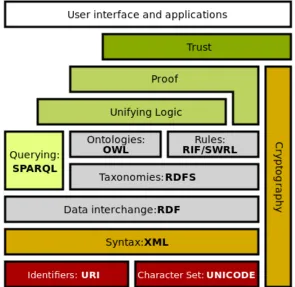
(10) List of figures Figure 1: the growth of internet users (created with Plotly, after internet Live Stats (2015)) ................................................................................................................................... 33 Figure 2: the Linked Open Data cloud as of 30 August 2014............................................... 41 Figure 3: the frequency of Google searches related to Linked Open Data and the Semantic Web since 2004 (Google 2015b) ..................................................................... 45 Figure 4: Spivack’s visual interpretation of the web’s development as iterations (Spivack 2007) ...................................................................................................................................... 46 Figure 5: the frequency of Google searches for ‘Web 2.0’ and ‘Web 3.0’ since 2004 (Google 2015b) .................................................................................................................... 46 Figure 6: an RDF triple’s structure ............................................................................................ 50 Figure 7: the Context 101 example as an RDF triple ............................................................. 50 Figure 8: the Context 101 example as an RDF triple using URIs ........................................ 51 Figure 9: a more complicated meaning rendered using RDF triples.................................... 51 Figure 10: the Context 101 RDF triple example including a literal ...................................... 52 Figure 11: different RDF serialisations all encoding the same meaning.............................. 53 Figure 12: the updated Semantic Web 'layer cake' (Wikipedia 2015) ................................... 58 Figure 13: the Apache Jena Fuseki SPARQL query interface ............................................... 59 Figure 14: the results of running the first SPARQL query against the Context 101 dataset ................................................................................................................................................ 61 Figure 15: the results of running the second SPARQL query against the Context 101 dataset ................................................................................................................................... 61 Figure 16: the results of running the third SPARQL query against the Context 101 dataset ................................................................................................................................... 62 Figure 17: the RDF graph crawled by the third SPARQL query.......................................... 62 Figure 18: a histogram showing the dates of Linked Open Data-related resources selected by LODLAM ....................................................................................................................... 71 Figure 19: a conceptualisation of the archaeological site knowledge domain .................... 87 Figure 20: the journey of real phenomena from reality to ontologies (after Guarino et al. (2009 fig. 2)) ......................................................................................................................... 89 Figure 21: defining an ontology relation using OWL ............................................................. 93 Figure 22: the results of running the aforementioned SPARQL query against the archaeological site dataset .................................................................................................. 96 Figure 23: interrogating multiple ontologies using logical reasoning ................................... 97 Figure 24: Ramon Llull's Tree of Science (Lima 2011 fig. 11) .............................................. 99 Figure 25: relations between the core CRM classes (Doerr 2003 fig. 3)............................ 104 Figure 26: a graph modelling the signing of the Yalta Agreement using the CRM (Sinclair 2015) .................................................................................................................................... 105 Figure 27: a graph describing the structure of the CRM-EH model (Binding 2011) ...... 107 Figure 28: an example showing the mapping of the CRMarchaeo classes onto archaeological phenomena (Cripps et al. 2014 fig. 4) .................................................. 110 Figure 29: a distribution map showing the find spots and mint locations for the OCRE coins .................................................................................................................................... 115 Figure 30: the Nomisma record for Carian mint, Apollonia Salbace, represented as RDF Turtle ................................................................................................................................... 115 Figure 31: period assertions related to the 'Iron Age' concept for the Levant region (Rabinowitz 2014 fig. 3) ................................................................................................... 118 Figure 32: the Pleiades data model .......................................................................................... 120 Figure 33: Arthur Evans as represented by the Getty ULAN data service ....................... 122 Figure 34: the semantics of the Getty Vocabulary Program ontology............................... 124 viii.
(11) Figure 35: an HTML view of the Getty Kamares concept (Harpring et al. 2015)........... 125 Figure 36: a view of the Europeana digital object related to the site of Newgrange, Ireland (Europeana Project 2015c)................................................................................. 126 Figure 37: an object-centric modelling of Da Vinci’s Mona Lisa by Europeana (Isaac 2013 fig. 7) .......................................................................................................................... 128 Figure 38: an event-centric modelling of Da Vinci’s Mona Lisa by Europeana (Isaac 2013 fig. 10) ................................................................................................................................. 128 Figure 39: a graph view of the Europeana Newgrange resource ........................................ 129 Figure 40: a map showing the locations of the projects published by Open Context .... 131 Figure 41: a trench record from the Kenan Tepe project on the Open Context system132 Figure 42: an HTML view of 26th Dynasty Egyptian sarcophagus found using the British Museum's SPARQL endpoint ......................................................................................... 134 Figure 43: an English Heritage crop mark concept as viewed on the Seneschal system 138 Figure 44: a coin record displayed on the CLAROS system ............................................... 140 Figure 45: archaeological Linked Open Data service providers categorised by type ...... 141 Figure 46: linkedarc.net ver1 server framework .................................................................... 144 Figure 47: the linkedarc.net data hierarchy............................................................................. 145 Figure 48: linkedarc.net ver2 server framework .................................................................... 147 Figure 49: linkedarc.net ver2 bridging RDF and MySQL .................................................... 148 Figure 50: linkedarc.net ver3 server framework .................................................................... 149 Figure 51: linkedarc.net ver3 SPARQL bridge ...................................................................... 149 Figure 52: linkedarc.net ver3.0.0 processing a URI request ................................................ 151 Figure 53: the processing of a web service call by linkedarc.net v3.0.0 ............................. 152 Figure 54: a web app linkedarc.net client ............................................................................... 154 Figure 55: an iOS linkedarc.net client ..................................................................................... 155 Figure 56: a data mining linkedarc.net client.......................................................................... 155 Figure 57: the conceptual difference between client-side and server-side web apps....... 157 Figure 58: linkedarc.net making an AJAX web service call ................................................. 158 Figure 59: the linkedarc.net web app's responsive layout .................................................... 159 Figure 60: linkedarc.net web app header menu ..................................................................... 160 Figure 61: the linkedarc.net web app home page .................................................................. 161 Figure 62: navigating the linkedarc.net web app's home page map ................................... 161 Figure 63: the linkedarc.net web app project page ................................................................ 161 Figure 64: the linkedarc.net web app datatable page ............................................................ 163 Figure 65: resolving a linkedarc.net display schema placeholder ........................................ 165 Figure 66: the linkedarc.net record page ................................................................................. 167 Figure 67: placement of the display schema HTML in a linkedarc.net web app record page...................................................................................................................................... 167 Figure 68: RDF graph data with multiple objects linked via the same predicate ............. 168 Figure 69: processing a linkedarc.net display schema file .................................................... 168 Figure 70: SKOS concepts as object values in the linkedarc.net web app ........................ 169 Figure 71: linking to similar Semantic Web resources using SKOS concepts .................. 170 Figure 72: using the linkedarc.net web app Workbench ...................................................... 170 Figure 73: searching within the linkedarc.net web app's record page ................................ 171 Figure 74: the linkedarc.net faceted search interface ............................................................ 173 Figure 75: adding criteria to the linkedarc.net search interface ........................................... 173 Figure 76: linkedarc.net search results .................................................................................... 174 Figure 77: the linkedarc.net SPARQL query editor .............................................................. 175 Figure 78: the linkedarc.net SPARQL query editor options................................................ 176 Figure 79: the location of Priniatikos Pyrgos (after (Molloy et al. 2014 fig. 1)) ............... 178. ix.
(12) Figure 80: a cross-section describing the Locus-Pail system of excavation and recording .............................................................................................................................................. 180 Figure 81: the types of paper record created by the Priniatikos Pyrgos project ............... 181 Figure 82: the Priniatikos Pyrgos C676 context sheet .......................................................... 182 Figure 83: the Priniatikos Pyrgos 002-1038 sub-context sheet ........................................... 184 Figure 84: the Priniatikos Pyrgos sample #3 sheet ............................................................... 185 Figure 85: a Priniatikos Pyrgos section drawing including C128, C792, C852 ................. 186 Figure 86: the Priniatikos Pyrgos 14-7852 catalogue sheet .................................................. 187 Figure 87: a bubble chart showing the relative sizes of the various Priniatikos Pyrgos FileMaker tables................................................................................................................. 192 Figure 88: the linkedarc.net system ontology......................................................................... 195 Figure 89: the Priniatikos Pyrgos ontology’s hierarchy of classes ...................................... 196 Figure 90: mapping data from FileMaker to linkedarc.net .................................................. 199 Figure 91: the data structure spectrum ................................................................................... 200 Figure 92: messy data in Open Refine .................................................................................... 202 Figure 93: the results of processing the 'Excavator(s)' field in the contexts table ........... 203 Figure 94: converting messy date values into RDF date format using Open Refine ...... 204 Figure 95: the distribution of fine-grade pottery weights across all Priniatikos Pyrgos pail records................................................................................................................................. 205 Figure 96: the RDF Data Utilities application displaying a summary of the contents of a number column ................................................................................................................. 206 Figure 97: the results of a RDF Data Utilities number unit alignment.............................. 207 Figure 98: a sample RDF Data Utilities value mapping plan for periods.......................... 209 Figure 99: the hierarchy of Priniatikos Pyrgos periods ........................................................ 210 Figure 100: Priniatikos Pyrgos FileMaker fields mapping onto vocabulary values .......... 211 Figure 101: the Priniatikos Pyrgos custom vocabulary value groupings ........................... 212 Figure 102: the Open Refine vocabulary extraction method .............................................. 213 Figure 103: the Priniatikos Pyrgos Trench 2 contexts as represented by QGIS .............. 215 Figure 104: a screenshot showing the KML data for context 1 in Open Refine ............. 216 Figure 105: a photograph with the identifier 05-1006-01 of the object 05-1006, a pyramidal loomweight ...................................................................................................... 218 Figure 106: a FileMaker images table record.......................................................................... 218 Figure 107: the Priniatikos Pyrgos images hosted by Flickr ................................................ 219 Figure 108: the FileMaker images table export workflow .................................................... 220 Figure 109: the merged images data in Open Refine ............................................................ 220 Figure 110: the RDF 'skeleton' for the Priniatikos Pyrgos images table ........................... 221 Figure 111: the mapping of Open Refine table data to an RDF Turtle serialisation....... 222 Figure 112: the outputted RDF Turtle file for the contexts table ...................................... 223 Figure 113: a visualisation of the network created by 100,000 of the 5,985,261 triples in the Priniatikos Pyrgos dataset ......................................................................................... 224 Figure 114: locating all of the human bones in the Priniatikos Pyrgos dataset ................ 236 Figure 115: the linkedarc.net web app search workflow ...................................................... 236 Figure 116: the contexts and locus entities containing human bone ................................. 238 Figure 117: the resultant Gephi nodes datatable after running a linkedarc.net SPARQL query using the Semantic Web Import plugin .............................................................. 246 Figure 118: the corresponding Gephi edges datatable ......................................................... 246 Figure 119: a Gephi generated network graph describing the stratigraphic relationships between the Priniatikos Pyrgos Trench 2 contexts ...................................................... 247 Figure 120: periods and notes included in a Harris Matrix (Harris 1989 fig. 51) ............. 248 Figure 121: applying bands of colour, categorised by period, to the graph shown in Figure 119 ........................................................................................................................... 249. x.
(13) Figure 122: a Gephi generated network graph describing the stratigraphic relationships between the Priniatikos Pyrgos Trench 2 contexts (colour-coded by period) ........ 249 Figure 123: the Trench 2 stratigraphic network with Early Minoan contexts brought to the fore ................................................................................................................................ 250 Figure 124: a close-up of the network shown in Figure 122 ............................................... 251 Figure 125: a close-up of the Priniatikos Pyrgos Trench 2 stratigraphy including relative ceramic weights ................................................................................................................. 253 Figure 126: 1st Millennium early Han Dynasty bronze figurine showing a weaver (Barber 1991 fig. 3.1)....................................................................................................................... 258 Figure 127: a loom reconstruction, Gordion Terrace Building (Burke 2007 fig. 10.6) ... 259 Figure 128: a distribution of loomweight types found at Priniatikos Pyrgos.................... 262 Figure 129: the range of loomweight types identified at Priniatikos Pyrgos ..................... 263 Figure 130: screenshot of a Priniatikos Pyrgos biconical loomweight taken in Autodesk 123D Catch ........................................................................................................................ 263 Figure 131: an RDF representing the loomweight 05-1035 ................................................ 264 Figure 132: the PPTextiles web app ........................................................................................ 267 Figure 133: a heatmap showing the distribution of all Priniatikos Pyrgos loomweight finds in the PPTextiles web app ..................................................................................... 267 Figure 134: filtering the loomweight distribution by type.................................................... 268 Figure 135: a PPTextiles query response report .................................................................... 268 Figure 136: the distribution of discoid loomweight finds at Priniatikos Pyrgos .............. 269 Figure 137: the distribution of the Bronze Age loomweights found at Priniatikos Pyrgos .............................................................................................................................................. 270 Figure 138: querying a Priniatikos Pyrgos loomweight find spot ....................................... 270 Figure 139: the distribution of the Archaic and Classical loomweights found at Priniatikos Pyrgos.............................................................................................................. 271 Figure 140: the distribution of the Hellenistic and Roman loomweights found at Priniatikos Pyrgos.............................................................................................................. 271 Figure 141: the CIDOC CRM's guidelines on the use of the ecrm:P65_shows_visual_item predicate ........................................................................ 278 Figure 142: a portion of the CIDOC CRM's class hierarchy .............................................. 279 Figure 143: the British Museum’s representation of the cartouche of Malonaqan inscription RDF resource................................................................................................. 281 Figure 144: the results of the cuneiform SPARQL query displayed in Excel................... 282 Figure 145: map showing the distribution of the find spots for the British Museum's cuneiform inscriptions ...................................................................................................... 283 Figure 146: a popup window providing more information about the site of Nineveh on the cuneiform distribution map ...................................................................................... 283 Figure 147: the British Museum's cuneiform inscription collection by discovering nation .............................................................................................................................................. 284 Figure 148: the top ten contributors to the British Museum's cuneiform inscription collection ............................................................................................................................ 285 Figure 149: a timeline of the British Museum's cuneiform inscription contributors....... 286 Figure 150: a Wordle visualisation showing the relative frequencies of the transliterated words in the British Museum's cuneiform collection .................................................. 289 Figure 151: a Wordle visualisation showing the relative frequencies of words in the cuneiform notes identified by the Stanford NER application as being of the PERSON class ................................................................................................................... 290 Figure 152: a Wordle visualisation showing the relative frequencies of words in the cuneiform notes identified by the Stanford NER application as being of the LOCATION class ............................................................................................................. 291. xi.
(14) Figure 153: the Semantic Web broken down into processing layers.................................. 299 Figure 154: a screenshot of the FileMaker Pro ver. 10 application showing a custom layout ................................................................................................................................... 300 Figure 155: the nature of the MySQL data infrastructure ................................................... 304 Figure 156: an example MySQL archaeological database .................................................... 305 Figure 157: alternative information systems rated by Berners-Lee's 5 stars of Open Data .............................................................................................................................................. 308 Figure 158: outcomes of the ARIADNE D2.1 report on user needs (ARIADNE 2015a p. 155) ................................................................................................................................. 310 Figure 159: the ‘Russian Doll’ model of archaeological data sharing................................. 311 Figure 160: the location of the ‘Attitudes to Digital Data Sharing within Archaeology’ survey respondents............................................................................................................ 315 Figure 161: ‘Attitudes to Digital Data Sharing within Archaeology’ survey demographics .............................................................................................................................................. 316 Figure 162: ‘Attitudes to Digital Data Sharing within Archaeology’ relevance and familiarity ............................................................................................................................ 316 Figure 163: ‘Attitudes to Digital Data Sharing within Archaeology’ data sharing responses .............................................................................................................................................. 318 Figure 164: the three Archaeological Semantic Web user types ......................................... 327 Figure 165: knowledge pyramid (Kitchin 2014 fig. 1.1) ....................................................... 330 Figure 166: a representation of Liu's 'flat' model for digital epistemology ....................... 336 Figure 167: missing potentially relevant data using the current Archaeological Semantic Web search model ............................................................................................................. 340 Figure 168: modelling multivocality using RDF triples and the CIDOC CRM ............... 344 Figure 169: an example of SPARQL's inability to query across datasets – note the inaccessible data................................................................................................................. 362 Figure 170: linkedarc.net displaying the results of the question ‘Where is Context 1?’ .. 364 Figure 171: the LodLive tool representing the associations of the Priniatikos Pyrgos Context 1 resource ............................................................................................................ 365 Figure 172: LodLive displaying associated image resources ................................................ 366 Figure 173: LodLive locating resources on a map ................................................................ 366 Figure 174: the organisation of the RDF classes employed to map the Priniatikos Pyrgos images table ........................................................................................................................ 369 Figure 175: the organisation of the RDF classes employed to map the Priniatikos Pyrgos catalogue tables .................................................................................................................. 371 Figure 176: the organisation of the RDF classes employed to map the Priniatikos Pyrgos contexts table ..................................................................................................................... 374 Figure 177: the organisation of the RDF classes employed to map the Priniatikos Pyrgos sub-contexts table ............................................................................................................. 376 Figure 178: the organisation of the RDF classes employed to map the Priniatikos Pyrgos loci table .............................................................................................................................. 378 Figure 179: the organisation of the RDF classes employed to map the Priniatikos Pyrgos pails table ............................................................................................................................ 379 Figure 180: the organisation of the RDF classes employed to map the Priniatikos Pyrgos periods table ....................................................................................................................... 380 Figure 181: the organisation of the RDF classes employed to map the Priniatikos Pyrgos vocabulary table ................................................................................................................. 381 Figure 182: the organisation of the RDF classes employed to map the Priniatikos Pyrgos actors table ......................................................................................................................... 382 Figure 183: a timeline showing the history of excavation at Priniatikos Pyrgos .............. 391. xii.
(15) Declaration. I declare that this thesis has not been submitted as an exercise for a degree at this or any other university and it is entirely my own work.. I agree to deposit this thesis in the University’s open access institutional repository or allow the library to do so on my behalf, subject to Irish Copyright Legislation and Trinity College Library conditions of use and acknowledgement.. Frank Lynam. xiii.
(16) Summary This thesis begins with the idea that the archaeological data exchange system is fundamentally broken. Archaeologists are now producing more raw data than has ever been the case in the history of the discipline. Not only are archaeological datasets growing in size but their form is expanding in variety as well. It is now not uncommon for even the most modest archaeological project to produce gigabytes of digital data as an output of its labour, and an evolving set of digital practices is at the beating heart of this invention. 3D models, digital field photography, geophysical survey data and digital databases are redefining the very nature of the archaeological record, and, increasingly, we are seeing this digital creation move closer to the trowel’s edge. From the outside looking in, these changes predict an exciting future for the field. All of this new source material must surely lead archaeology into a stimulating new era of discovery. I argue in this work, however, that the current reality strays far from this ideal. The central problem is that very little of this valuable digital data is allowed to flow freely around the epistemological channels of the discipline. This results in a number of negative outcomes, from the duplication of effort to the creation of badly structured datasets. Ultimately, this creates a propensity within the field towards ‘small question’ research. This thesis argues that archaeology has yet to take the final step on its road to digital adoption. If the intention is really to establish a new paradigm for its research based on this digital opportunity, then it must be prepared to open up its datasets and to establish a more networked epistemological environment. To realise this dream, I advocate the adoption of Semantic Web methodologies in all aspects of the field’s work that are applicable, in an effort to establish an Archaeological Semantic Web. I argue that, despite its shortcomings, the Archaeological Semantic Web represents a workable middle ground between archaeological knowledge liberalism on the one hand and overly prescriptive standards-based epistemology on the other. I approach this subject from a digital humanities perspective, and in that context, Chapter 1 provides a history of this field. Chapter 2 continues in this historical vein by recounting the story of the web from its document web beginnings to the proposal and refinement of the Semantic Web model by Tim Berners-Lee and others. This history. xiv.
(17) concludes with an account of how the archaeological field has been influenced by Semantic Web practices over the course of the last two decades. Chapter 2 also introduces the technologies that provide the baseline functionality for the Semantic Web: RDF and SPARQL. Chapter 3 turns its attention to ontologies, which serve to inject meaning into Semantic Web data. Chapter 3 begins by charting the course of the ontological idea from its Greek Presocratic origins to its role as a tool of Knowledge Representation with the advent of computers in the 20th century. Chapter 3 concludes with an introduction to the CIDOC CRM and its archaeological extensions, which are referenced widely throughout the remainder of the work. Chapters 4-6 present an account of the Archaeological Semantic Web in practice. The first of these chapters presents linkedarc.net, which is the chief practical contribution of this research project. linkedarc.net is an RDF-based system designed to allow archaeological projects publish their content to the Archaeological Semantic Web. Chapter 5 recounts how the data of the Priniatikos Pyrgos Project was imported into the linkedarc.net system. Chapter 6 then describes three separate case studies that illustrate how the Archaeological Semantic Web can be used as a research tool. This emphasis on the consumer side of the model is another significant contribution of this work. Chapter 7 adopts a more critical perspective of the Archaeological Semantic Web. It begins by comparing the model against the leading alternatives, which might conceivably be employed to address the same underlying challenge. None of these systems were found to be entirely satisfactory. Chapter 7 goes on to consider the Archaeological Semantic Web as a sociological concern. Its analysis of the findings of sociological research on the subjects of digital method adoption and data sharing within archaeology and of a series of workshops undertaken as part of this project culminate in the formulation of a tripartite model for Archaeological Semantic Web use. The ASWer model outlines the requirements, work practices and output types that characterise engagement with the Archaeological Semantic Web. Chapter 7 lastly addresses the epistemological implications of the ASWer model. It concludes that the Archaeological Semantic Web is mostly consistent with a classical epistemological view. Chapter 8 completes the thesis by looking to the future of the field. It makes a number of suggestions as to how the Archaeological Semantic Web model might be improved upon to increase its popularity among the research community.. xv.
(18) Acknowledgements It is one of the great ironies of the humanities doctoral thesis that only one name can ever be placed alongside the final draft when in reality it is nothing if not a work of great collaboration. Some of this collaboration takes the form of traditional academic discourse and debate, while still more of it is of the pastoral variety. At this remove, I am still too close to say which dominates the other but I am certain that both are absolutely necessary, if the effort is to have a chance of a favourable outcome. I want to begin by thanking my supervisor, Dr Christine Morris, who has over the last four years always made herself available to thrash out whatever idea that happened to be occupying my mind at the time. Through those numerous conversations I came to mould, sculpt, break down and build anew those arguments that now form the basis of the text that you hold in your hands. Thank you Christine and to Martine Cuypers, Hugh Denard, Winifred Ryan, Hazel Dodge, Anna Chahoud, Brian McGing, Ashley Clements and to all of the other staff of the Department of Classics at Trinity College Dublin. I have yet to meet a more welcoming and supportive department than Trinity Classics. It is truly a testament to all that is good about the institution. I was also a student of the Digital Arts and Humanities programme during the writing of this thesis. Thank you to all involved in the project. It is an extremely worthwhile and forward-thinking endeavour, and I hope that my colleagues and I are the first of a long line of doctoral students to exit its gates. One of the most pleasing aspects of working with the DAH has been the opportunity that it gave me to work with some amazingly talented people. I enjoyed the many chats about subjects that I once knew very little of and now perhaps know something more. Thank you Bilu, Dara, Emily, Roman, Catherine, Karolina, Radek, Toma and all the other DAH researchers. When you finish reading this thesis, you will realise just how important the Priniatikos Pyrgos Project has been to its creation. I want to acknowledge the enormous support that all of the team at Priniatikos Pyrgos, but particularly Barry Molloy, Jo Day and Vera Klontza-Jaklova, have given me ever since I first joined its ranks in the summer of 2007. I have learnt a huge amount about life and archaeology from all of you, and I will be forever grateful for that gift.. xvi.
(19) As this project neared its end, I was blessed to be able to call upon a small army of proofreaders to help highlight my errors. Thank you Harry, Caroline, Una, Henry, Ron, Lena, and of course Christine for suppressing any natural ambivalence you might have held towards the Archaeological Semantic Web. Ron, as one, who has navigated these byways before me, your guidance and humour helped pull me out of many a blind alley of investigation. I want to end by acknowledging the constant support of those closest to me: my father Harry, mother Caroline, siblings Una, Henry, Garrett, Stephen and all the extended family. And in time honoured fashion of saving the best till last, thank you Lena for being you and for making this last lap a strangely enjoyable experience. I dedicate this project to the memory of Laurence Berry who so tragically left us during the final stages of its writing. Too young, brilliant and too soon.. xvii.
(20) Chapter 1 – The problem with Archaeological Information Systems Outlining the project research questions and intellectual precedents. ‘Introspective Digital Archaeology, therefore, seeks to understand the nature of the computational turn in archaeology and its effect on every stage of knowledge creation – from the theories we develop and use to the recognition of archaeological features on and in the ground, from the definition and capture of archaeological data through to the methods of structuring and recording those data, from their manipulation and analysis through to the presentation and synthesis of those data, and, ultimately, through to the construction, management, and publication of the resultant knowledge.’ (Huggett 2014) ‘Today, we need to understand the process of technical evolution given that we are experiencing the deep opacity of contemporary technics; we do not immediately understand what is being played out in technics, nor what is being profoundly transformed therein, even though we unceasingly have to make decisions regarding technics, the consequences of which are felt to escape us more and more.’ (Stiegler 1998 p. 21). Introduction I invite you to think about the following research scenario. If you are an archaeologist, the details should sound familiar and if you are not, you may be reminded of an analogous practice within your own field. Let us envisage a situation in which you are a researcher that is interested in finding out about a particular type of ceramic vessel. For convenience, let us call it a Type IIA vessel. For the experiment, it does not really matter what the nature of the physical appearance of this vessel type is, what the vessel was used for or indeed when and where it was used. These details are, of course, vitally important in any real archaeological investigation but for now they are incidental to our exercise. The challenge that I want you to think about is conceptually very simple. You must find ways of retrieving all of the information relating to these Type IIA vessels, which have been recorded by archaeologists working at two separate archaeological sites (Site A and Site B).. 1.
Figure




+7




Related documents
on deeply held misconceptions and fears of people who hold different beliefs, strategies of conceptual change theory, most often found in science education, were
Regurgitation Area Segmentation Using the Particle Swarm Optimization and Multilevel Threshold Selection.. Kalpana Chauhan 1*
The national health priority areas are disease prevention, mitigation and control; health education, promotion, environmental health and nutrition; governance, coord-
These data, the first to examine several critical aspects of how providers experience, view and make decisions about unconventional reproductive arrangements, sug- gest that
This section describes how to plan the parameters of the external alarms and complete the data configuration according to the external alarm requirements, through an example...
Most of the steps of TOPSIS can be easily generalized to a fuzzy environment, except max and min operations in finding the ideal solution and negative ideal solution1. Thus we
Nevertheless, all the analyzed papers showed that the photoprotective effect of plant extracts rich in polyphenols, especially flavonoids and their additive and synergistic
The scattergram represents the distribution with age of 69 determinations of concentration of potassium in serum of 39 premature infants with respiratory distress syndrome (Table
