Towards Efficient Abstractions for Concurrent
Consensus
?Carlo Spaccasassi?? and Vasileios Koutavas? ? ?
Trinity College Dublin, Ireland
{spaccasc,Vasileios.Koutavas}@scss.tcd.ie
Abstract. Consensus is an often occurring problem in concurrent and distributed programming. We present a programming language with sim-ple semantics and build-in support for consensus in the form of commu-nicating transactions. We motivate the need for such a construct with a characteristic example of generalized consensus which can be naturally encoded in our language. We then focus on the challenges in achieving an implementation that can efficiently run such programs. We setup an architecture to evaluate different implementation alternatives and use it to experimentally evaluate runtime heuristics. This is the basis for a re-search project on realistic programming language support for consensus.
Keywords: Concurrent programming, consensus, communicating trans-actions
1
Introduction
Achieving consensus between concurrent processes is a ubiquitous problem in multicore and distributed programming [8, 6]. Among the classic instances of consensus is leader election and synchronous multi-process communication. Pro-gramming language support for consensus, however, has been limited. For ex-ample, CML’s first-class communication primitives provide a programming lan-guage abstraction to implement two-party consensus. However, they cannot be used to abstractly implement consensus between three or more processes [11, Thm. 6.1]—this needs to be implemented in a case-by-case basis.
Let us consider a hypothetical scenario of generalized consensus, which we will call the Saturday Night Out (SNO) problem. In this scenario a number of friends are seeking partners for various activities on Saturday night. Each has a list of desired activities to attend in a certain order, and will only agree for a night out if there is a partner for each activity. Alice, for example, is looking for company to go out for dinner and then a movie (not necessarily with the same person). To find partners for these events in this order she may attempt to synchronize on the “handshake” channelsdinnerandmovie:
?Student project paper (primarily the work of the first author). ??
Supported by MSR (MRL 2011-039) ? ? ?
Alice def= sync dinner; sync movie
Heresyncis a two-party synchronization operator, similar to CSP synchroniza-tion.Bob, on the other hand, wants to go for dinner and then for dancing:
Bob def= sync dinner; sync dancing
Alice and Bob can agree on dinner but they need partners for a movie and dancing, respectively, to commit to the night out. Their agreement istentative. LetCarol be another friend in this group who is only interested in dancing:
Carol def= sync dancing
Once BobandCarol agree on dancing they are both happy to commit to going out. However,Alicehas no movie partner and she can still cancel her agreement with Bob. If this happens, Bob and Carol need to be notified to cancel their agreement and everyone starts over their search of partners. An implementation of the SNO scenario between concurrent processes would need to have a special-ized way of reversing the effect of this synchronization. Suppose Davidis also a participant in this set of friends.
David def= sync dancing; sync movie
After the partial agreement between Alice, Bob, and Carol is canceled, David together with the first two can synchronize ondinner,dancing, andmovieand agree to go out (leaving Carolat home).
Notice that whenAliceraised an objection to the partial agreement between her,Bob, and Carol, all three participants had to restart. However, if Carolwas taken out of the agreement (even after she andBobwere happy to commit their plans), Davidwould have been able to take Carol’s place and the work of Alice andBobuntil the point whenCarol joined in would not need to be repeated.
Programming SNO between an arbitrary number of processes (which can form multiple agreement groups) in CML is complicated. Especially if we con-sider that the participants are allowed to perform arbitrary computations be-tween synchronizations affecting control flow, and can communicate with other parties not directly involved in the SNO. For example, Bob may want to go dancing only if he can agree with the babysitter to stay late:
Bob def= sync dinner; if babysitter() then sync dancing
In this caseBob’s computation has side-effects outside of the SNO group of pro-cesses. To implement this would require code for dealing with the SNO protocol to be written in theBabysitter (or any other) process, breaking modularity.
This paper shows thatcommunicating transactions, a recently proposed mech-anism for automatic error recovery in CCS processes [13], is a useful mechmech-anism for modularly implementing the SNO and other generalized consensus scenar-ios. They provide a construct for non-isolated (communicating), all-or-nothing
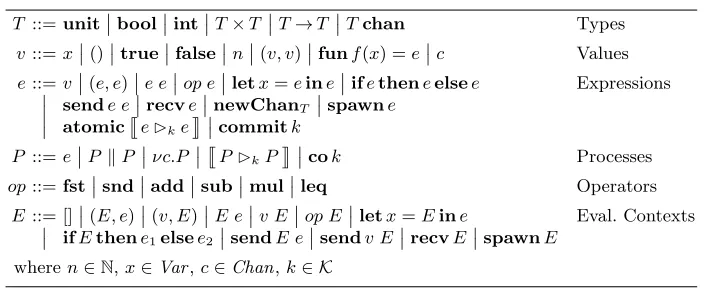
T ::=unitbool int
T×T
T→T
Tchan Types
v::=x () true false n (v, v)
funf(x) =e
c Values
e::=v(e, e) e e
op e
letx=eine
ifetheneelsee Expressions
sende e recve newChanT spawne atomic q
eBkey
commitk
P ::=ePkP νc.P
q
PBkPy
cok Processes
op::=fstsnd add sub mul leq Operators
E ::= [](E, e) (v, E)
E e v E op E
letx=Eine Eval. Contexts
ifEthene1elsee2
sendE e
sendv E recvE
[image:3.612.132.484.111.259.2]
spawnE wheren∈N,x∈Var,c∈Chan,k∈ K
Fig. 1.TCML syntax.
SNO participants that resemble the above pseudocode. Previous work on com-municating transactions focused on behavioral theory with respect tosafety and
liveness[13, 14]. However, the effectiveness of this construct in a pragmatic pro-gramming language has yet to be proven. One of the main milestones to achieve on this direction is the invention of efficient runtime implementations of com-municating transactions. Here we describe the challenges and our first results in a recently started project to investigate this direction.
In particular, we equip a simple concurrent functional language with com-municating transactions and use it to discuss the challenges in making an effi-cient implementation of such languages (Sect. 2). This language contains a novel combination of sequential evaluation and communicating transactions, making it more appropriate for programming compared to the CCS-based calculus of previous work [13, 14]. In this language we give a modular implementation of consensus scenarios such as the SNO example, where participants are oblivious of their environment and can communicate with arbitrary processes (such as the Babysitter process) without the need to add code for the SNO protocol in those processes. Moreover, the above more efficient, partially aborting strategy is captured in this semantics.
Our semantics of this language is non-deterministic, allowing different run-time scheduling strategies of processes, some more efficient than others. To study their relative efficiency we have developed a skeleton implementation of the lan-guage which allows us to plug in and evaluate such runtime strategies (Sect. 3). We describe several such strategies (Sect. 4) and report the results of our evalu-ations (Sect. 5). Finally, we summarize related work in this area and the future directions of this project (Sect. 6).
2
The TCML Language
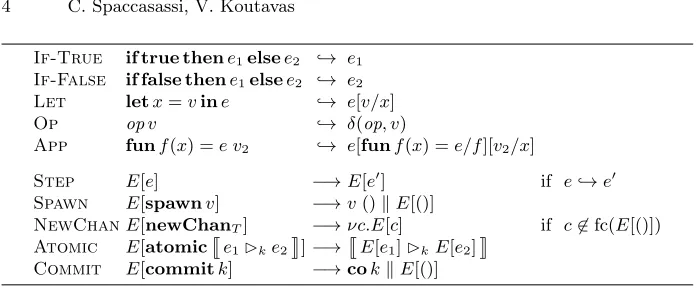
If-True if true thene1elsee2 ,→ e1
If-False if false thene1elsee2 ,→ e2
Let letx=vine ,→ e[v/x]
Op opv ,→ δ(op, v)
App funf(x) =e v2 ,→ e[funf(x) =e/f][v2/x]
Step E[e] −→E[e0] if e ,→e0
Spawn E[spawnv] −→v()kE[()]
NewChanE[newChanT] −→νc.E[c] if c6∈fc(E[()])
Atomic E[atomicqe1Bke2
y ]−→q
E[e1]BkE[e2]
y
[image:4.612.134.484.94.238.2]Commit E[commitk] −→cokkE[()]
Fig. 2.Sequential reductions
Values in TCML are either constants of base type (unit,bool, andint), pairs of values (of type T×T), recursive functions (T→T), and channels carrying values of typeT (Tchan). A simple type system (with appropriate progress and preservation theorems) can be found in an accompanying technical report [12].
Source TCML programs are expressions in the functional core of the lan-guage, ranged over by e, whereas running programs are processes derived from the syntax of P. Besides standard lambda calculus expressions, the functional core contains the constructssendc eand recvcto synchronously send and re-ceive a value on channelc, respectively, andnewChanT to create a new channel of typechanT. The constructsspawnandatomic, when executed, respectively spawn a new process and transaction;commitkcommits transactionk—we will shortly describe these constructs in detail.
A simple running process can be just an expression e. It can also be con-structed by the parallel composition ofP andQ(P kQ). We treat free channels as in theπ-calculus, considering them to beglobal. Thus if a channelcis free in both P and Q, it can be used for communication between these processes. The constructνc.P encodesπ-calculus restriction of the scope ofcto processP. We use the Barendregt convention for bound variables and channels and identify terms up to alpha conversion. We also write fc(P) for the free channels inP.
Process qP1 Bk P2 y
encodes a communicating transaction. This can be thought of as the processP1, thedefaultof the transaction, which runs until the
transactioncommits. If, however, the transactionabortsthenP1is discarded and
the entire transaction is replaced by itsalternative processP2. Intuitively,P2 is
the continuation of the transaction in the case of an abort. TCML provides a mechanism forP1 to communicate with its environment. This mechanism
guar-antees that P1 has an all-or-nothing behavioral semantics (see [14]). Hence the
name communicating transactions. As we will see, commits are asynchronous, requiring the process cok in the language. The name k of the transaction is bound in P1. Thus only the default of the transaction can potentially spawn a
cok. The meta-function ftn(P) gives us the free transaction names inP. Processes with no free variables can reduce using transitions of the form
eager, left-to-right evaluation contextsEwhose grammar is given in Fig. 1. Due to a unique decomposition lemma, an expression e can be decomposed to an evaluation context and a redex expression in only one way. Here we use e[u/x] for the standard capture-avoiding substitution, andδ(op, v) for a meta-function returning the result of the operatorop onv, when this is defined.
RuleStep lifts functional reductions to process reductions. The rest of the
reduction rules of Fig. 2 deal with the concurrent and transactional side-effects of expressions. RuleSpawnreduces a spawnv expression at evaluation position
to the unit value, creating a new process running the applicationv(). The type system of the language guarantees that valuev here is a thunk. With this rule we can derive the reductions:
spawn(λ().sendc1);recvc−→(λ().sendc1) ()krecvc−→sendc1krecvc
The resulting processes of these reductions can then communicate on channelc. As we previously mentioned, the free channelccan also be used to communicate with any other parallel process. Rule NewChan gives processes the ability to create new, locally scoped channels. Thus, the following expression will result in an input and an output process that canonly communicate with each other:
letx=newChanintin(spawn(λ().sendx1);recvx)
−→νc.(spawn(λ().sendc1);recvc)−→∗νc.(sendc1krecvc)
Rule Atomic is a novel rule that deals with the combination of
communi-cating transactions and sequential computations. This rule applies when a new transaction is started from within the current (expression-only) process, engulf-ing the entire process in it, and storengulf-ing the abort continuation in the alternative of the transaction. RuleCommitspawns an asynchronous commit. Transactions can be arbitrarily nested, thus we can write:
atomicqspawn(λ().recvc;commitk)Bk()
y
; atomicqrecvd;commitlBl()
y
−→q
spawn(λ().recvc;commitk); atomicqrecvd;commitlBl()
y
Bk(); atomic
q
recvd;commitlBl()
y y
−→∗q
(recvc;commitk)kqrecvd;commitlBl()
y
Bk ();atomic
q
recvd;commitlBl()
y y
This process will commit the k-transaction after an input on channel c and the inner l-transaction after an input ond. As we will see, if thek transaction aborts then the inner l-transaction will be discarded (even if it has performed the input on d) and the resulting process (the alternative of k) will restart l: ();atomicqrecvd;commitlBl()
y
. The effect of this abort will be the rollback of the communication ondreverting the program to a consistent state.
Sync
E1[recvc]kE2[sendc v]−→E1[v]kE2[()]
Eq
P≡P0−→Q0≡Q P−→Q
Par
P1−→P10
P1kP2−→P10kP2
Chan
P−→P0 νc.P−→νc.P0
Emb
P1kqP2BkP3y−→q(P1kP2)Bk(P1kP3)y
Step
P−→P0
q
P BkP2y−→qP0BkP2y
Co
P1≡cokkP10
q
P1BkP2
y
−→P10/k
Abort
q
P1BkP2
y −→P2
Fig. 3.Concurrent and Transactional reductions (omitting symmetric rules).
structural equivalence (≡) to identify terms up to the reordering of parallel pro-cesses and the extrusion of the scope of restricted channels, in the spirit of the
π-calculus semantics. RuleSteppropagates reductions of default processes over their respective transactions. The remaining rules are taken from TransCCS [13]. Rule Emb encodes the embedding of a process P1 in a parallel transaction q
P2BkP3 y
. This enables the communication ofP1 withP2, the default ofk. It
also keeps the current continuation ofP1in the alternative ofkin case it aborts.
To illustrate the mechanics of the embed rule, let us consider the above nested transaction running in parallel with the processP =sendd();sendc():
q
(recvc;commitk)kq
recvd;commitlBl()
y
Bk ();atomic
q
recvd;commitlBl()
y y
k P
After two embedding transitions we will have
q
(recvc;commitk) k qP krecvd;commitl Bl Pk()
y
Bk P k. . .
y
NowP can communicate ondwith the inner transaction:
q
(recvc;commitk) k q
sendc()kcommitl Bl Pk()
y
Bk P k. . .
y
Next, there are (at least) two options: either commitl spawns a col process which causes the commit of thel-transaction, or the input ondis embedded in thel-transaction. Let us assume that the latter occurs:
q q
(recvc;commitk) k sendc() k commitl
Bl(recvc;commitk) k P k ()
y
Bk Pk. . .
y
−→∗q q
cokkcolBl. . .
y
Bk . . .
y
This also has the important consequence of making the following three pro-cesses behaviorally indistinguishable:
q
P1BkP2 y
kq
Q1BlQ2 y
q P1k
q
Q1BlQ2 y
BkP2k q
Q1BlQ2 y y
q q
P1BkP2 y
kQ1Bl
q
P1Bk P2 y
kQ2 y
Therefore, an implementation of TCML, when dealing with the first of the three processes can pick any of the alternative, non-deterministic mutual embeddings of the k and l transactions without affecting the observable outcomes of the program. In fact, when one of the transactions has no possibility of committing or when the two transactions never communicate, an implementation can decide
never to embed the two transactions in each-other. This is crucial in creating implementations that will only embed processes (and other transactions) only when necessary for communication, and pick the most efficient of the avail-able embeddings. The development of implementations with efficient embedding strategies is one of the main challenges of our project for scaling communicating transactions to pragmatic programming languages.
Similarly, aborts are entirely non-deterministic (Abort) and are left to the
discretion of the underlying implementation. Thus in the above example any transaction can abort at any stage, discarding part of the computation. In such examples there is usually a multitude of transactions that can be aborted, and in cases where a “forward” reduction is not possible (due to deadlock) aborts are necessary. Making the TCML programmer in charge of aborts (as we do with commits) is not desirable since the purpose of communicating transactions is to lift the burden of manual error prediction and handling. Minimizing the number aborts and picking aborts that rewind the program minimally but sufficiently to reach a successful outcome is another major challenge in our project.
The SNO scenario can be simply implemented in TCML using restarting transactions. A restarting transaction uses recursion to re-initiate an identical transaction in the case of an abort:
atomicrec k
q
ey def= funr() =atomicqeBkr()
y
A transactional implementation of the SNO participants we discussed in the introduction simply wraps their code in restating transactions:
letalice =atomicrec k
q
sync dinner; sync movie; commitkyin letbob =atomicrec k
q
sync dinner; sync dancing; commitkyin letcarol =atomicrec k
q
sync dancing; commitkyin letdavid =atomicrec k
q
sync dancing; sync movie; commitkyin spawnalice; spawnbob; spawncarol; spawndavid
Sched. Transaction Gath. trie
e1 e2 . . . en
abort, embed, commit
[image:8.612.133.485.91.202.2]side-effect notif. & ack
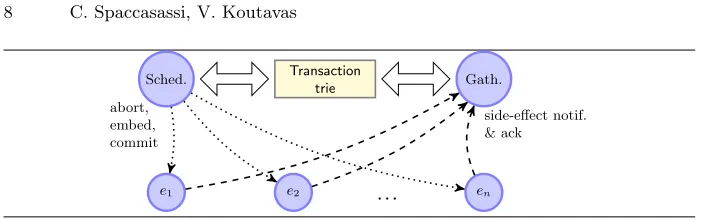
Fig. 4.TCML runtime architecture.
code is evident (the version of Bobcommunicating with theBabysitter is just as simple). However, as we discuss in Sect. 5, this simplicity comes with a severe performance penalty, at least for straightforward implementations of TCML. In essence, the above code asks from the underlying transactional implementa-tion to solve an NP-complete satisfiability problem. Leveraging existing useful heuristics for such problems is something we intend to pursue in future work.
In the following we describe an implementation where these transactional scheduling decisions can be plugged in, and a number of heuristic transactional schedulers we have developed and evaluated. Our work shows that advanced heuristics bring measurable performance benefits but the exponential number of runtime choices require innovative compilation and execution techniques to make communicating transactions a realistic solution for programmers.
3
An Extensible Implementation Architecture
We have developed an interpreter for the TCML semantics in Concurrent Haskell [7, 10] to which we can plug-in different decisions about the non-deterministic transitions of our semantics with the runtime architecture in Fig. 4.
The main Haskell threads are shown as round nodes in the figure. Each concurrent functional expression ei is interpreted in its own thread according to the sequential reduction rules in Fig. 2 of the previous section. Side-effects in an expression are handled by the interpreting thread, creating new channels, spawning new threads, and starting new transactions. Our implementation of synchronous, dynamically created channels is on top of Haskell’s MVars, and guarantees that only processes within the same transactions can communicate.
Except for channel creation, the evaluation of all other side-effects in an expression will cause a notification (shown as dashed arrows in Fig. 2) to be sent to thegatherer process (Gath.). This process is responsible for maintaining a global view of the state of the running program in aTrie data-structure. This data-structure essentially represents the transactional structure of the program; i.e., the logical nesting of transactions and processes inside running transactions:
data TTrie = TTrie { threads :: Set ThreadID,
children :: Map TransactionID TTrie, ... }
has its own associated TTrie node. An invariant of the data-structure is that each thread and transaction identifier appears only once in it. For example the complex program we saw on page 6:
q
(recvc;commitk)tid1 kq(recvd;commitl)tid2 B l()
y
Bk();atomic
q
recvd;commitlBl()
y y
kPtidP
will have an associated trie:
TTrie{threads = {tidP},
children = {k7→TTrie{threads = {tid1},
children = {l7→TTrie{threads = {tid2},
children = ∅}}}}}
The last ingredient of the runtime implementation is the scheduler thread (Sched. in Fig. 4). This makes decisions about the commit, embed and abort transitions to be performed by the expression threads, based on the information in the trie. Once such a decision is made by the scheduler, appropriate signals (implemented using Haskell asynchronous exceptions [10]) are sent to the running threads, shown as dotted lines in Fig. 4. Our implementation is parametric to the precise algorithm that makes scheduler decisions, and in the following section we describe a number of such algorithms we have tried and evaluated.
A scheduler signal received by a thread will cause the update of the local transactional state of the thread, affecting the future execution of the thread. The local state of a thread is an object of theTProcessdata-type:
data TProcess = TP { expr :: Expression, ctx :: Context,
tr :: [Alternative] }
data Alternative = A { tname :: TransactionID, pr :: TProcess }
The local state maintains the expression (expr) and evaluation context (ctx) currently interpreted by the thread and a list of alternative processes (repre-sented by objects of theAlternativedata-type). This list contains the contin-uations stored when the thread was embedded in transactions. The nesting of transactions in this list mirrors the transactional nesting in the global trie and is thus compatible with the transactional nesting of other expression threads. Let us go back to the example of page 6:
q
(recvc;commitk)tid1 kq(recvd;commitl)tid2 B l()
y
Bk();atomic
q
recvd;commitlBl()
y y
kPtidP
whereP =sendd();sendc(). WhenP is embedded in bothkandl, the thread evaluatingP will have the local state object
TP{expr = P, tr = [A{tname = l, pr = P}, A{tname = k, pr = P}]}
the thread will rollback toP, and the list of alternatives will be appropriately updated (the aborted transaction will be removed).
Once a transactional reconfiguration is performed by a thread, an acknowl-edgment is sent back to the gatherer, who, as we discussed, is responsible for up-dating the global transactional structure in the trie. This closes a cycle of transac-tional reconfigurations initiated from the process (by starting a new transaction or thread) or the scheduler (by issuing a commit, embed, or abort).
What we described so far is a simple prototype architecture for an interpreter of TCML. Improvements are possible; for example, the gatherer is a message bottleneck, and together with the scheduler they are single points of failure in a potential distributed setting. But such concerns are beyond the scope of this paper. In the following section we discuss various policies for the scheduler which we then evaluate experimentally.
4
Transactional Scheduling Policies
Our goal here is to investigate schedulers that make decisions on transactional reconfiguration based only on runtime heuristics. We are currently working on more advanced schedulers, including schedulers that take advantage of static information extracted from the program, which we leave for future work.
An important consideration when designing a scheduler is adequacy [15, Sec. 11.4]. For a given program, an adequate scheduler can produceall outcomes
that the non-deterministic operational semantics give for that program. How-ever, this does not mean that the scheduler should be able to produceall traces
of the non-deterministic semantics. Many of these traces will unnecessarily abort and restart the computations. Previous work on the behavioral theory of com-municating transactions has shown that all program outcomes can be reached with traces thatnever restart a computation [13]. Thus a goal for schedulers is to minimize re-computations by minimizing aborts.
Moreover, as we discussed at the end of Sect. 2, many of the exponential number of embeddings can be avoided without altering the observable behavior of a program. This can be done by embedding a process inside a transaction only when this embedding is necessary to enable communication between the process and the transaction. We take advantage of this in a communication-driven scheduler we describe in this section.
However, the probabilistic approach is theoretically fair. Every finite trace leading to a program outcome has a non-zero probability. Diverging traces due to sequential reductions also have non-zero probability to occur. The only traces with zero probability are those in the reduction semantics that have an infinite number of non-deterministic reductions. Intuitively, these are unfair traces that abort and restart transactionsad infinitum, even if other options are possible.
Random Scheduler (R). The first scheduler we consider is the random sched-uler, whose policy at each point is to simply select one of all available non-deterministic choices with equal probability, with no exception. Any available abort, embed, or commit actions are equally likely to happen. For example, this scheduler might decide at any time to embed Bob into Carol’s transaction, or abort David. As one would expect, this is not particularly efficient; it is, how-ever, obviously adequate and fair according to the discussion above. If a reduction transition is available infinitely often, schedulerRwill eventually select it.
There is much room for improvement. Suppose transaction k can commit:
q
PkcokBkQ
y
. SinceRmakes no distinction between the choices of commit-ting and aborcommit-tingk, it will often unnecessarily abortk. All processes embedded in this transaction will have to roll back and re-execute; if k was a transaction that restarts, the transaction will also re-execute. This results to a consider-able performance penalty. Similarly, scheduler R might preemptively abort a long-running transaction that could have committed, given enough time and embeddings.
Staged Scheduler (S). The staged scheduler partially addresses these issues by prioritizing its available choices. Whenever a transaction is ready to commit, scheduler S will always decide to send a commit signal to that transaction be-fore aborting it or embedding another process in it. This does not violate ade-quacy; before continuing with the algorithm of S, let us examine the adequacy of prioritizing commits over other transactional actions with an example.
Example 1 Consider the following program in which k is ready to commit:
q
P kcokBk Q
y
k R. If embedding R in k leads to a program outcome, then that outcome can also be reached after committingk from the residual P kR.
Alternatively, a program outcome could be reachable by abortingk (from the process QkR). However, thecokwas spawned from one of the previous states of the program in the current trace. In that state, transactionk necessarily had the form:qP0kE[commitk]Bk Q
y
, and the abort ofkwas enabled. Therefore, the staged interpreter indeed allows a trace leading to the program state QkR
from which the outcome in question is reachable. ut
This heuristic greatly improves performance by minimizing unnecessary aborts. Its drawback is that it does not abort transactions often, thus program outcomes reachable only from transactional alternatives are less likely to appear. Moreover, this scheduler does not avoidunnecessary embeddings.
Communication-Driven Scheduler (CD). To avoid spurious embeddings, sched-ulerCDimproves overRby performing an embed transition only if it isnecessary
for an imminent communication. For example, at the very start of the SNO ex-ample theCDscheduler can only choose to embedAliceintoBob’s transaction or vice versa, because they are the only processes ready to synchronize on dinner. Because of the equivalence qP Bk Q
y
k R≡cxt q
P kR Bk QkR
y
which we previously discussed, this scheduler is adequate.
For the implementation of this scheduler we augment the information in the trie data-structure (Sect. 3) with channels with a pending communication opera-tion (if any). In Sect. 5 we show that this heuristic noticeably boosts performance because it greatly reduces the exponential number of embedding choices.
Delayed-Aborts Scheduler (DA). The final scheduler we report isDA, which adds a minor improvement upon schedulerCD. This scheduler keeps a timer for each running transactionkin the trie, and resets it whenever a non-sequential opera-tion happens insidek. Transactionkcan be aborted only when its timer expires. This strategy benefits transactions that perform multiple communications before committing. TheCDscheduler is adequate because it only adds time delays.
5
Evaluation of the Interpreters
We now report the experimental evaluation of interpreters using the preceding scheduling policies. The interpreters were compiled with GHC 7.0.3, and the experiments were performed on a Windows 7 machine with IntelR CoreTM
i5-2520M (2.50 GHz) and 8GB of RAM. We run several versions of two programs:
1. The three-way rendezvous (3WR) in which a number of processes compete to synchronize on a channel with two other processes, forming groups of three which then exchange values. This is a standard example of multi-party agreement [11, 3, 5]. In the TCML implementation of this example each pro-cess nondeterministically chooses between being aleader orfollowerwithin a communicating transaction. If a leader and two followers communicate, they can all exchange values and commit; any other situation leads to deadlock and eventually to an abort of some of the transactions involved.
2. The SNO example of the introduction, as implemented in Sect. 2, with mul-tiple instances of theAlice,Bob,Carol, andDavidprocesses.
5 10 15 10−3
10−2
10−1
100
101
102
Number of concurrent processes
Committed
ops/second
Three-Way Rendezvous
5 10 15 20
10−1
100
101
102
Number of concurrent processes SNO Example
[image:13.612.138.482.114.264.2]R S CD DA ID
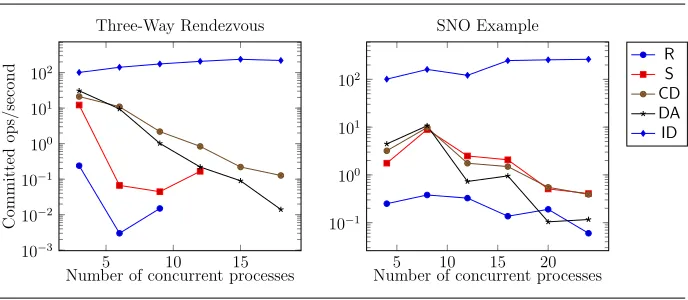
Fig. 5.Experimental Results.
to measure the number of operations in a given period, from which we compute themean throughput of successful operations. The results are shown in Fig. 5.
Each graph in the figure contains the mean throughput of operations (in logarithmic scale) as a function of the number of competing concurrent TCML processes. The graphs contain runs with each scheduler we discussed (random R, stagedS, communication-driven,CD, and communication-driven with delayed aborts DA) as well as with an ideal non-transactional program (ID). The ideal program in the case of 3WR is similar to the TCML, non-abstract implemen-tation [11]. The ideal version of the SNO is running a simpler instance of the scenario, without anyCarolprocesses—this instance has no deadlocks and there-fore needs no error handling. Ideal programs give us a performance upper bound. As predictable, the random scheduler (R)’s performance is the worst; in many casesRcould not perform any operations in the window of measurements (30sec). The other schedulers perform better thanRby an order of magnitude. Even just prioritizing the transactional reconfiguration choices significantly cuts down the exponential number of inefficient traces. However, none of the schedulers scale to programs with more processes; their performance deteriorates exponen-tially. In fact, when we go from the communication-driven (CD) to the delayed aborts (DA) scheduler we see worst throughput in larger process pools. This is because with many competing processes there is more possibility to enter a path to deadlock; in these cases the results suggest that it is better to abort early.
The upper bound in the performance, as shown by the throughput of ID is one order of magnitude above that of the best interpreter, when there are few concurrent processes, and (within the range of our experiments) two orders when there are many concurrent processes. The performance of IDis increasing with more processes due to better utilization of the processor cores.
6
Related Work and Conclusions
Consensus is common problem in concurrent and distributed programming. The need for developing programming language support for consensus has already been identified in previous work on transactional events (TE) [3], communi-cating memory transactions (CMT) [9], transactors [4] and cJoin [1]. These approaches propose forms of communicating transactions, similar to those de-scribed in Sect. 2. All approaches can be used to an extent to implement general-ized consensus scenarios, such as the instance of the Saturday Night Out (SNO) example in this paper. Without such constructs the programmer needs to devise and implement complex low-level protocols for consensus. Stabilizers [16] add transactional support for fault-tolerance in the presence of transient faults but do not directly address consensus scenarios such as the SNO example. Our work here is based oncommunicating transactions which is the only construct to date with a provably intuitive behavioral theory [13, 14].
TE extends CML events with a transactional sequencing operator; transac-tional communication is resolved at runtime by search threads which exhaus-tively explore all possibilities of synchronization. CMT extends STM with asyn-chronous communication, maintaining a directed dependency graph mirroring communication between transactions; STM abort triggers cascading aborts to transactions that have received values from aborting transactions. Transactors extend actor semantics with fault-tolerance primitives, enabling the composition of systems with consistent distributed state via distributed checkpointing. The cJoin calculus extends the Join calculus with isolated transactions which can merge at runtime; merging and aborting are managed by the programmer, offer-ing a manual alternative to TCML’s nondeterministic transactional operations. Reference implementations have been developed for TE, CMT, and cJoin (in JoCaml). The discovery of efficient implementations for communicating trans-actions can be equally beneficial for all approaches.
This paper presented TCML, a simple functional language with build-in sup-port for consensus via communicating transactions. This is a construct with a robust behavioral theory supporting its use as a programming language ab-straction for automatic error recovery [13, 14]. TCML has a simple operational semantics and can simplify the programming of advanced consensus scenarios; we introduced such an example (SNO) which has a natural encoding in TCML. We have motivated this construct as a programming language solution to the problem of programming consensus. To our knowledge, this is the most intri-cate and general application of such constructs in a concurrent and distributed setting. However, communicating transactions could address challenges in other application domains, such as speculative computing[2].
some of them improve upon the performance of a naive randomized implementa-tion but do not scale to programs with significant contenimplementa-tion, where exponential numbers of computation paths lead to necessary rollbacks. It is clear that purely dynamic strategies do not lead to sustainable performance improvements.
In future work we intend to explore the extraction of information from the source code to guide the language runtime. This information can include an abstract model of the communication behavior of processes in order to predict their future communication pattern. A promising approach is the development of technology in type and effect systems and static analysis. Although scheduling communicating transactions is theoretically computationally expensive, realistic performance in many programming scenarios could be achievable.
References
[1] Bruni, R., Melgratti, H., Montanari, U.: Nested commits for mobile calculi: Ex-tending join. In: Levy, J.J., Mayr, E.W., Mitchell, J.C. (eds.) Expl. New Frontiers of Theor. Informatics, IFIP, vol. 155, pp. 563–576. Springer, Heidelberg (2004) [2] Bruni, R., Melgratti, H., Montanari, U.: Theoretical foundations for
compensa-tions in flow composition languages. In: POPL. pp. 209–220. ACM, NY (2005) [3] Donnelly, K., Fluet, M.: Transactional Events. In: ICFP. pp. 124–135. ACM, NY
(2006)
[4] Field, J., Varela, C.A.: Transactors: a programming model for maintaining globally consistent distributed state in unreliable environments. In: POPL. pp. 195–208. ACM, NY (2005)
[5] Harris, T., Marlow, S., Jones, S.P.L., Herlihy, M.: Composable memory transac-tions. Commun. ACM pp. 91–100 (2008)
[6] Herlihy, M., Shavit, N.: The art of multiprocessor programming. Kaufmann (2008) [7] Jones, S.P.L., Gordon, A.D., Finne, S.: Concurrent Haskell. In: POPL. pp. 295–
308. ACM, NY (1996)
[8] Kshemkalyani, A.D., Singhal, M.: Distributed Computing: Principles, Algorithms, and Systems. Cambridge University Press (2008)
[9] Lesani, M., Palsberg, J.: Communicating memory transactions. In: PPoPP 2011. pp. 157–168. ACM, NY (2011)
[10] Marlow, S., Jones, S.P.L., Moran, A., Reppy, J.H.: Asynchronous exceptions in Haskell. In: PLDI 2001. pp. 274–285. ACM, NY (2001)
[11] Reppy, J.H.: Concurrent programming in ML. Cambridge University Press (1999) [12] Spaccasassi, C.: Transactional Concurrent ML. Tech. Rep. TCD-CS-2013-01,
Trin-ity College Dublin (2013)
[13] de Vries, E., Koutavas, V., Hennessy, M.: Communicating Transactions. In: Gastin, P., Laroussinie, F. (eds.) CONCUR 2010. LNCS, vol. 6269, pp. 569–583. Springer, Heidelberg (2010)
[14] de Vries, E., Koutavas, V., Hennessy, M.: Liveness of Communicating Transac-tions. In: Ueda, K. (ed.) APLAS 2010. LNCS, vol. 6461, pp. 392–407. Springer, Heidelberg (2010)
[15] Winskel, G.: The Formal Semantics of Programming Languages: An Introduction. Foundations of computing, MIT Press (1993)