Munich Personal RePEc Archive
Long-run growth patterns within Asian
NIEs: Empirical analysis based on the
panel unit root test, allowing the
heterogeneity of time trend and
endogenous multiple structural breaks
Matsuki, Takashi and Usami, Ryoichi
2008
Long-run growth patterns within Asian NIEs: Empirical analysis based on the panel unit root test, allowing the heterogeneity of time trend and endogenous
multiple structural breaks
Takashi Matsuki* and Ryoichi Usami
Department of Economics, Osaka Gakuin University,
2-36-1 Kishibeminami, Suita- City, Osaka, 564-8511, Japan
ABSTRACT
This study examines whether or not the convergence of per capita output—which is
categorized as catching-up and long-run convergence, defined by Oxley and Greasley
(1995)—exists within Asian newly industrializing economies (Asian NIEs), namely,
Hong Kong, Singapore, South Korea, and Taiwan. The newly developed panel unit root
test, which can allow for multiple structural breaks at various unknown break dates for
each time series, is applied to the panels for 1960–2004, which includes the period of
the Asian financial crisis. Moreover, in order to confirm the coexistence of the different
growth patterns within the Asian NIEs, the heterogeneity—in terms ofthe inclusion or
exclusion of a linear time trend and the types of breaks (in level or slope)—is allowed
for each series in the test. The empirical results show that Hong Kong and Singapore
have long-run convergence, whereas Korea and Taiwan are yet to converge with Hong
Kong.
*
I. INTRODUCTION
Hong Kong, Singapore, South Korea, and Taiwan are referred to as the newly
industrializing or industrialized economies in Asia (Asian NIEs).1 The Asian financial
crisis damaged each of the four economies to different extents. Korea was the most
severely depressed in terms of economic growth (e.g. Asian Development Bank, 1998,
1999). Thus, we need to examine whether the shocks of the financial crisis were severe
enough to change the growth strategies of the Asian NIEs or whether they continued to
adopt the same strategies even after the crisis. The concept of convergence of per capita
output would help us in answering this question.
Lots of empirical studies on convergence have appeared since the work of Barro
(1991). Some of the earlier ones are Bernard and Durlauf (1995), Oxley and Greasley
(1995), Evans and Karras (1996), Lee, Pesaran, and Smith (1997), and Evans (1998).In
recent times, Lim and McAleer (2004) and Kim (2001) have conducted research along
these lines, focusing on the economies in Asia.2 Lim and McAleer (2004) applied some
non-stationary time series methods to per capita real GDPs from 1960 to 1992 for the
ASEAN-5 countries, namely, Indonesia, Malaysia, the Philippines, Thailand, and
Singapore. Overall, they found no evidence of income convergence. Kim (2001) used
the panel-based t-ratio and F-ratio tests that relied on the formulation by Evans and
Karras (1996) for 17 Asian countries and regions including the Asian NIEs for the
period 1960–1992, and presented evidence for conditional convergence among them.
The present paper investigates the long-run growth patterns of the Asian NIEs,
which may have changed after the crisis.3 Thus, this paper applies the panel unit root
specifications in terms of the presence or absence of a linear time trend and the types of
structural breaks (in level or slope) for each series. In the next section, the data
generating process and the regression model are first introduced; then, the convergence
of per capita real output is defined, and the test procedure is explained. The empirical
results are discussed in Section 3, and the conclusion is provided in Section 4.
II. ECONOMETRIC METHODOLOGY II-1. MODEL
There are M economies numbered 1, 2, …, M, as an index, and each of these possesses
the time series data of size T. Denote the logarithm of the output or the per capita
income of economy m and economy j (m < j) at period t as ymt and yjt respectively.
Then, arranging the difference between ymt and yjt, ymt −yjt (m = 1, …, M – 1, j =
m + 1, …, M) in lexicographic increasing order, denote it as y~it (=ymt −yjt). This
study assumes that the series y~it is generated by the following data generating process
(DGP).
Under Null: ~yit =αi+y~it−1+εit (1)
Under Alternative:
it h
hit hi it
i i i
it t y D
y =α +β +ρ +
∑
δ +ε =−
2
1 1
' ~
~ , <1 i
ρ (2)
i=1,K,N, t=1,K,T
where N ≡M(M −1) 2, and εit is independently and identically distributed across i
and t with a zero mean and a finite variance. Under the stationarity alternative
hypothesis (2), the DGP has up to two time shifts in the level or slope in the trend
that represents the hth break; Dhit =DUhit, the shift in the level; and Dhit =DThit, the
shift in the slope. DUhit =1 for t>τhiT or zero otherwise, and DThit =t−τhiT for
T
t>τhi or zero otherwise, where τhi denotes the fraction of the hth break defined as
T TBhi hi =
τ (h=1, 2) for all T, in which 0<τ1i <τ2i <1, where TBhi denotes the
date of the hth break.
The regression model nests the DGPs (1) and (2) as follows:
error y a D y t y i l l l it il h hit hi it i i i
it = + + + + ∆ +
∆
∑
∑
= − = − 1 2 1 1 ~ ˆ ˆ ~ ˆ ˆ ˆ~ α β φ δ (3)
where ∆~yit =~yit −~yit−1, φˆi =ρˆi−1. li denotes a lag order parameter and is specified by
following the ‘general-to-specific’ procedure suggested in Ng and Perron (1995).4
Let ti denote the t-statistic for the parameter φˆi in Equation (3) for the null
hypothesis φi =0 and δ1i =δ2i =0 against the alternative hypothesis φi ≠0 and
0
1i ≠
δ , δ2i ≠0 for each i. The break dates {TB1i, TB2i} are endogenously determined
to exist where the one-sided ti-statistic is minimized in sequential estimations over all
possible break dates within the range 0<τ1i <τ2i <1, as employed in Zivot and
Andrews (1992) and Lumsdaine and Papell (1997). Since T →∞ for fixed i, the
limiting distributions of the minimum ti-test for the cases of one-time and two-time
breaks are provided by Zivot and Andrews (1992) and Lumsdaine and Papell (1997)
respectively.
II-2. DEFINITION OF CONVERGENCE
This paper adopts the definition of convergence proposed by Oxley and Greasley (1995)
1 < i
ρ and βi ≠0 in Equation (2). This category suggests that the difference in the
logarithm of per capita output between the two economies is narrowing over time; in
other words, the relatively less developed economy is heading towards convergence.5
Long-run convergence implies that ~yit is level-stationary, i.e. ρi <1 and βi =0 in
Equation (2). This implies that the two economies have already converged in terms of
growth rate and are possibly on the steady-state path. On the other hand, if y~it has a random walk component, i.e. ρi =1 in Equation (2), the difference in the logarithm of
per capita output between the two economies will diverge over time.
II-3. TEST PROCEDURE
Matsuki and Usami (2008) proposed the panel-based unit root test that permits multiple
shifts in the level of the trend function at various unknown dates for each
cross-sectional unit. It is the extended version of the test based on Fisher’s (1932) sum
of log p-values approach, such as the test proposed by Maddala and Wu (1999)
(hereafter, the MW test).6 It is defined as follows:
∑
= − = N i i p B Fisher 1 log 2_ (4)
where pi denotes a p-value associated with the minimum ti-test. As shown in Fisher
(1932), when there are N continuous tests, and they are independent, the p-value
corresponding to each of the tests has an independent and uniform (0, 1) distribution;
then, the statistic of
∑
=
− N
i1logpi
2 has a chi-square distribution with 2N degrees of
freedom. Based on this fact, the Fisher_B test also has a chi-square distribution with 2N
In order to calculate pi that constitutes the Fisher_B statistic, the empirical
distribution of the minimum ti -test needs to be calculated using Monte Carlo
simulations with the actual sample size; this is because the minimum ti-test has a
non-standard distribution under the null hypothesis. In the simulation, the following two
DGPs are assumed under the null hypothesis:
it it it y
y = ~−1+ε
~ (5)
* 1
* * ˆ ˆ ~
~ it k k k it ik i it i i y y =α + γ ∆ +ε
∆
∑
= −
(6)
In Equation (5), y~it is generated by a driftless random walk process for each i, where εit denotes an i.i.d. N(0,1) error across i and t. In Equation (6), εit* is obtained
by the residual bootstrap method with the SUR residuals of Equation (6), which retains
the cross-sectional dependency structure in panels; then, ~*
it
y
∆ is generated by Equation
(6) with the series of *
it
ε and the estimated parameters
i
ik
γˆ and αˆi in the SUR
estimation, where αˆi is set at 0 when a time trend is not contained in Equation (3) (for
additional details, see Wu and Wu, 2001).7
III. EMPIRICAL ANALYSIS
The data are obtained from the Penn World Table (PWT) 6.2.8 The series of real GDP
per capita adjusted for terms of trade changes (RGDPTT) is employed from 1960 to
2004, since economic relations with foreign countries have played a vital role for the
Asian NIEs; similar to the case for the ASEAN-5 countries analysed in Lim and
McAleer (2004). All the series used in this study are taken in natural logarithms.
Fisher_B test in the case of one-time and two-time breaks in level. Two out of eight tests
show significant rejections at the 10% significance level. However, this represents
rather weak evidence of convergence; therefore, it is insufficient to confirm the growth
patterns of the Asian NIEs.
The evidence is weak possibly due to the homogeneity assumption on the presence
of a time trend and the types of structural breaks in Equation (3) for all i. Therefore, for
each i, the series ~ is regressed in the following three different specifications of yit
Equation (3): (1) without a time trend but with level shifts, (2) with a time trend and
level shifts, and (3) with a time trend and slope shifts. Each of these specifications
expresses a unique growth pattern.
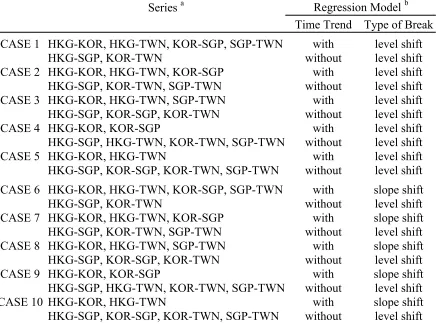
In Equation (3), we consider 10 cases. These are listed in Table 2. The results of
the Fisher_B test in those cases are presented in Table 3. The results obtained under
Equation (6) are mainly discussed below. The Fisher_B test can significantly reject the
null hypothesis in nine cases under the assumption of one break and in three cases under
the assumption of two breaks. Taking into consideration these significant results does
not reveal the apparent difference in the growth patterns across the economies; therefore,
consistent implications can be obtained from the most reliable results among them in
terms of the rejections at the lowest significant level, which are CASE 8 and CASE 10
under the one-break assumption. The common growth strategies examined in both cases
imply that the pair-wise growth experiences of Hong Kong–Korea and Hong
Kong–Taiwan represent a catching-up process; those of Hong Kong–Singapore and
Korea–Taiwan represent long-run convergence. In other words, Hong Kong and
state of long-run convergence between them, both Korea and Taiwan have been chasing
Hong Kong by narrowing the relative gaps in their per capita real outputs over the
sample period. With regard to the relationships between Hong Kong–Korea and Hong
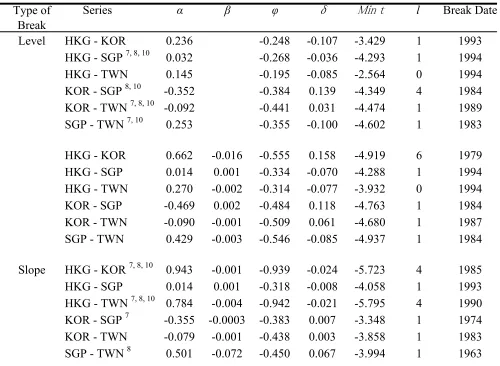
Kong–Taiwan, if the estimates of the coefficients obtained from individual regression
(shown in Appendix (Table 2A)) are evaluated with respect to their signs and values, the
existence of the catching-up phenomenon is also supported for these pairs of
economies.9 With regard to the case of a one-time slope shift, each of the difference
series, calculated by subtracting Korea or Taiwan’s logarithm of per capita real output
from that of Hong Kong, has the positive estimate of a constant (α ) and the negative
estimate of the slope of a time trend (β). The signs of these estimates imply that there
exists the initial gap of outputs between the two economies; however, this gap has been
decreasing at a constant speed over time. In other words, the gap suggests the existence
of the catching-up phenomenon. In addition, in the difference series for each pair of
economies, the estimate of δ —which is the coefficient of the dummy variable for the
slope shift—is also negative and its absolute value is much larger than that of β. This
suggests that the speed of catching-up was dramatically accelerated at a break date. In
other words, Korea and Taiwan have been catching-up with Hong Kong at a speed that
was accelerated after 1985 and 1990 respectively.
The fact that both CASE 8 and CASE 10 also imply long-run convergence between
Korea and Singapore is inconsistent with the findings described above. Moreover, the
categorization of the bilateral relations between Singapore and Taiwan is different in
these cases. The discussion under Equation (6) is also supported in the case of Equation
level for the one-break model under this DGP. This additional case suggests the
existence of a catching-up process between Korea and Singapore; however, this is not
conclusive.10
IV. CONCLUSION
This paper has examined the convergence hypothesis of per capita real output in the
Asian NIEs by applying the panel-based unit root test permitting multiple shifts in level
or slope at various unknown dates for each time series. Since the test also allows for
flexible specifications in terms of the presence or absence of a linear time trend and the
types of breaks (shifts in level or slope) for each series, different growth patterns across
economies have been investigated simultaneously.
The empirical analysis revealed the following facts: Although the long-run growth
paths of the Asian NIEs were shifted due to one or two external shocks, Hong Kong and
Singapore have been on the path of long-run convergence, while Korea and Taiwan
have been catching-up with Hong Kong, maintaining their bilateral relations,
characterized by long-run convergence. For the pairs of Korea–Singapore and
REFERENCES
Asian Development Bank (1998) Asian Development Outlook 1998, Manila: Asian
Development Bank.
Asian Development Bank (1999) Rising the Challenge in Asia: A Study of Financial
Markets: Volume 1 – An Overview, Manila: Asian Development Bank.
Barro, R. J. (1991) Economic growth in a cross section of countries, The Quarterly
Journal of Economics, 106, 407-443.
Bernard, A. B. and Durlauf, S. (1995) Convergence in International Output, Journal of
Applied Econometrics, 10, 2, 97-108.
Evans, P. (1998) Using Panel Data to Evaluate Growth Theories, International
Economic Review, 39, 2, 297-309.
Evans, P. and Karras, G. (1996) Convergence revisited, Journal of Monetary Economics,
37, 249-65.
Fisher, R. A. (1932) Statistical Methods for Research Workers, Oliver & Boyd,
Edinburgh, 4th Edition.
Hooi, L. H. and Smyth, R. (2007) Are Asian real exchange rates mean reverting?
Evidence from univariate and panel LM unit root tests with one and two structural
breaks, Applied Economics, 39, 2109-20.
Kim, J. U. (2001) Empirics for Economic Growth and Convergence in Asian
Economies: A Panel Data Approach, Journal of Economic Development, 26, 49-59. Kim, J.-I. and Lau, L. J. (1996) The Sources of Asian Pacific Economic Growth, The
Canadian Journal of Economics, 29, S448-54.
Lee, K., Pesaran, M. H. and Smith, R. (1997) Growth and convergence in a
multi-country empirical stochastic Solow model, Journal of Applied Econometrics,
12, 357-392.
Li, Q. and Papell, D. (1999) Convergence of international output: Time series evidence
for 16 OECD countries, International Review of Economics and Finance, 8, 267-80.
Lim, L. K. and McAleer, M. (2004) Convergence and Catching Up in ASEAN: A
Comparative Analysis, Applied Economics, 36, 137-53.
Lumsdaine, R. L. and Papell, D. H. (1997) Multiple Trend Breaks and the Unit-Root
Hypothesis, The Review of Economics and Statistics, 79, 212-8.
Maddala, G. S. and Wu, S. (1999) A Comparative Study of Unit Root Tests with Panel
Data and a New Simple Test, Oxford Bulletin of Economics and Statistics, Special
Issue, 631-52.
Matsuki, T. and Usami, R. (2008) China’s Regional Convergence in Panels with
Multiple Structural Breaks, Applied Economics, forthcoming.
McCoskey, S. K. (2002) Convergence in Sub-Saharan Africa: a nonstationary panel data
approach, Applied Economics, 34, 819-29.
Ng, S. and Perron, P. (1995) Unit root tests in ARMA models with data-dependent
methods for the selection of the truncation lag, Journal of American Statistical
Association, 90, 268-281.
Oxley, L. and Greasley, D. (1995) A Time-Series Prospective on Convergence: Australia,
UK and US since 1987, The Economic Record, 71, 259-70.
Credit, and Banking, 33, 804-12.
Young, A. (1995) The Tyranny of Numbers: Confronting the Statistical Realities of the
East Asian Growth Experience, Quarterly Journal of Economics, 110, 641-80. Zivot, E. and Andrews, D. W. K. (1992) Further Evidence on the Great Crash, the
Oil-Price Shock, and the Unit-Root Hypothesis, Journal of Business & Economic
FOOTNOTES
1. Krugman (1994), Young (1995), Kim and Lau (1996), and others discussed the
sources of their rapid economic growth from the 1980s to the mid 1990s.
2. For income convergence among countries, Li and Papell (1999) examined the
existence of convergence among 16 OECD countries by applying the univariate unit
root test with one endogenous trend break; using the panel unit root tests and panel
cointegration tests, McCoskey (2002) investigated whether a convergence club is
formed in sub-Saharan African countries.
3. Hooi and Smyth (2007) used the univariate and panel versions of Lagrange multiplier
(LM) unit root test that can treat two structural breaks in investigating the validity of
the purchasing power parity hypothesis in 15 Asian countries.
4. Beginning with li =8, the value of li is reduced one by one until aˆ is estimated il
to be different from zero at the 10% significance level.
5. Catching-up is intuitively comprehensible if the signs of αˆi and βˆi are opposing,
0 ˆi >
α and βˆi <0 or αˆi <0 and βˆi >0, although a particular account has not been
provided in Oxley and Greasley (1995) and Lim and McAleer (2004).
6. The MW test is built by applying Fisher’s p-value combination method to N
augmented Dickey-Fuller t-tests; therefore, it does not allow for breaks.
7. When error terms are correlated in DGP across a cross-sectional unit i, the Fisher_B
test does not have a chi-square distribution under the null because the minimum
i
t -tests are also correlated across i. Thus, without any correction, the test might
possess biases towards over- or under-rejections of the null. In order to correct these
(2001) resampling scheme, the empirical distribution function of the Fisher_B test is
generated through simulation. The simulation provides the appropriate small-sample
critical values for the test; these will be shown in Table 1A. Based on these critical
values, the test is conducted in an appropriate manner.
8. Formally, Alan Heston, Robert Summers and Bettina Aten, Penn World Table Version
6.2, Center for International Comparisons of Production, Income and Prices at the
University of Pennsylvania, September 2006.
9. The estimation results for each series in the case of two-time breaks are available on
request.
10.Under Equation (6), if CASE 6 and CASE 7, which are significant at the 5%
significance level in the case of one-break model, are added to facilitate the
interpretation, the relation between Korea and Singapore may also be traced to the
DGP Model Regression Model
(5) constant & trend 16.477 16.357 20.407 * constant 16.893 17.969 15.208
(6) a constant & trend 17.062 14.736 15.209 constant 19.060 21.225 * 18.231
* denotes statistical significance at the 10% level.
a
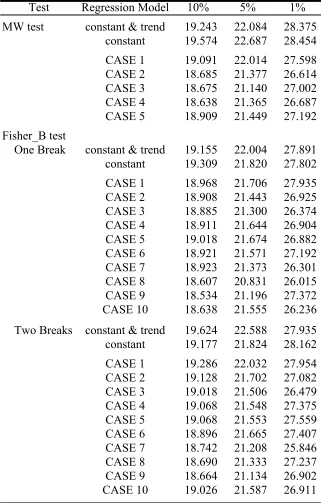
[image:16.595.118.534.355.465.2]In the case of cross-sectionally dependent errors in the DGP, the critical values of the MW test and the Fisher_B test are tabulated in Table 1A in Appendix.
Table 1. The results for the Maddala and Wu (1999) test and the Fisher_B test in the case of shifts in level
MW test Fisher_B test
Series a
Time Trend Type of Break
CASE 1 HKG-KOR, HKG-TWN, KOR-SGP, SGP-TWN with level shift
HKG-SGP, KOR-TWN without level shift
CASE 2 HKG-KOR, HKG-TWN, KOR-SGP with level shift
HKG-SGP, KOR-TWN, SGP-TWN without level shift
CASE 3 HKG-KOR, HKG-TWN, SGP-TWN with level shift
HKG-SGP, KOR-SGP, KOR-TWN without level shift
CASE 4 HKG-KOR, KOR-SGP with level shift
HKG-SGP, HKG-TWN, KOR-TWN, SGP-TWN without level shift
CASE 5 HKG-KOR, HKG-TWN with level shift
HKG-SGP, KOR-SGP, KOR-TWN, SGP-TWN without level shift
CASE 6 HKG-KOR, HKG-TWN, KOR-SGP, SGP-TWN with slope shift
HKG-SGP, KOR-TWN without level shift
CASE 7 HKG-KOR, HKG-TWN, KOR-SGP with slope shift
HKG-SGP, KOR-TWN, SGP-TWN without level shift
CASE 8 HKG-KOR, HKG-TWN, SGP-TWN with slope shift
HKG-SGP, KOR-SGP, KOR-TWN without level shift
CASE 9 HKG-KOR, KOR-SGP with slope shift
HKG-SGP, HKG-TWN, KOR-TWN, SGP-TWN without level shift
CASE 10 HKG-KOR, HKG-TWN with slope shift
[image:17.595.125.562.185.512.2]HKG-SGP, KOR-SGP, KOR-TWN, SGP-TWN without level shift
Table 2. The cases of the series and the regression models
Regression Model b
a
HKG, KOR, TWN, and SGP denote Hong Kong, Korea, Taiwan, and Singapore, respectively.
b
DGP Model CASE a
(5) 1 23.539 ** 19.394 * 23.836 **
2 19.964 * 20.362 * 23.707 ** 3 20.060 * 20.060 * 24.733 ** 4 18.773 * 19.550 * 15.971
5 17.957 21.028 * 24.604 **
6 - 23.859 ** 16.479
7 - 27.084 *** 17.395
8 - 27.168 *** 16.945
9 - 20.166 * 14.450
10 - 30.393 *** 17.860
(6) b 1 24.367 ** 18.390 18.987
2 21.132 * 19.797 * 19.171 * 3 22.697 ** 19.675 * 20.733 * 4 20.435 * 19.614 * 14.226 5 19.746 * 21.479 * 20.825 *
6 - 22.074 ** 15.194
7 - 26.055 ** 16.680
8 - 26.406 *** 15.649
9 - 20.283 * 14.365
[image:18.595.137.517.213.564.2]10 - 30.122 *** 17.163
Table 3. The results for the Maddala and Wu (1999) test and the Fisher_B test in the ten cases
***, **, and * denote statistical significance at the 1%, 5%, and 10% levels, respectively.
b
In the case of cross-sectionally dependent errors in the DGP, the critical values of the MW test and the Fisher_B test are tabulated in Table 1A in Appendix.
a
See the cases of the series and the regression models in Table 2.
One Break Two Breaks Fisher_B test
Test Regression Model 10% 5% 1%
MW test constant & trend 19.243 22.084 28.375
constant 19.574 22.687 28.454
CASE 1 19.091 22.014 27.598
CASE 2 18.685 21.377 26.614
CASE 3 18.675 21.140 27.002
CASE 4 18.638 21.365 26.687
CASE 5 18.909 21.449 27.192
Fisher_B test
One Break constant & trend 19.155 22.004 27.891
constant 19.309 21.820 27.802
CASE 1 18.968 21.706 27.935
CASE 2 18.908 21.443 26.925
CASE 3 18.885 21.300 26.374
CASE 4 18.911 21.644 26.904
CASE 5 19.018 21.674 26.882
CASE 6 18.921 21.571 27.192
CASE 7 18.923 21.373 26.301
CASE 8 18.607 20.831 26.015
CASE 9 18.534 21.196 27.372
CASE 10 18.638 21.555 26.236
Two Breaks constant & trend 19.624 22.588 27.935
constant 19.177 21.824 28.162
CASE 1 19.286 22.032 27.954
CASE 2 19.128 21.702 27.082
CASE 3 19.018 21.506 26.479
CASE 4 19.068 21.548 27.375
CASE 5 19.068 21.553 27.559
CASE 6 18.896 21.665 27.407
CASE 7 18.742 21.208 25.846
CASE 8 18.690 21.333 27.237
CASE 9 18.664 21.134 26.902
[image:19.595.136.457.193.696.2]CASE 10 19.026 21.587 26.911
Series α β φ δ Min t l Break Date
Level HKG - KOR 0.236 -0.248 -0.107 -3.429 1 1993
HKG - SGP 7, 8, 10 0.032 -0.268 -0.036 -4.293 1 1994
HKG - TWN 0.145 -0.195 -0.085 -2.564 0 1994
KOR - SGP 8, 10 -0.352 -0.384 0.139 -4.349 4 1984
KOR - TWN 7, 8, 10 -0.092 -0.441 0.031 -4.474 1 1989
SGP - TWN 7, 10 0.253 -0.355 -0.100 -4.602 1 1983
HKG - KOR 0.662 -0.016 -0.555 0.158 -4.919 6 1979
HKG - SGP 0.014 0.001 -0.334 -0.070 -4.288 1 1994
HKG - TWN 0.270 -0.002 -0.314 -0.077 -3.932 0 1994
KOR - SGP -0.469 0.002 -0.484 0.118 -4.763 1 1984
KOR - TWN -0.090 -0.001 -0.509 0.061 -4.680 1 1987
SGP - TWN 0.429 -0.003 -0.546 -0.085 -4.937 1 1984
Slope HKG - KOR 7, 8, 10 0.943 -0.001 -0.939 -0.024 -5.723 4 1985
HKG - SGP 0.014 0.001 -0.318 -0.008 -4.058 1 1993
HKG - TWN 7, 8, 10 0.784 -0.004 -0.942 -0.021 -5.795 4 1990
KOR - SGP 7 -0.355 -0.0003 -0.383 0.007 -3.348 1 1974
KOR - TWN -0.079 -0.001 -0.438 0.003 -3.858 1 1983
SGP - TWN 8 0.501 -0.072 -0.450 0.067 -3.994 1 1963
7, 8, and 10 denote the series used in CASE 7, CASE 8, and CASE 10, respectively. Type of
[image:20.842.172.672.91.457.2]Break