Lancaster University Management School
Working Paper
2006/002
Bootstrapping long memory tests: some Monte Carlo results
Anthony Murphy and Marwan Izzeldin
The Department of Economics
Lancaster University Management School
Lancaster LA1 4YX
UK
© Anthony Murphy and Marwan Izzeldin All rights reserved. Short sections of text, not to exceed two paragraphs, may be quoted without explicit permission,
provided that full acknowledgement is given.
Bootstrapping Long Memory Tests: Some Monte Carlo Results
Anthony Murphy1
Department of Economics, University of Oxford
Marwan Izzeldin
Lancaster University Management School
August 2007
Abstract: We investigate the bootstrapped size and power properties of five common
long memory tests - the modified R/S, KPSS, V/S, GPH and Robinson’s H tests.
Even in samples of size 100, the moving block bootstrap controls the empirical size of
the tests in the DGPs examined. The H test appears to be the most powerful.
Moreover, the bootstrapped tests suffer little loss of power against fractionally
integrated processes vis á vis asymptotic tests with samples of 250 or more
observations. This is true both for distributions with heavy tails and with stochastic
volatility (SV).
Keywords: Moving block bootstrap, long memory, fractional integration.
JEL Code: C10, C12
1. Introduction
Long memory processes, especially fractionally integrated processes, describe
many financial time series as well as some macroeconomic series rather well. It is
important to distinguish long memory processes from more common I(0) and I(1)
processes as they imply different long run predictions and responses to shocks
(Baillie, 1996). A range of tests for long memory are available. Unfortunately, the
evidence is that tests based on asymptotic critical values are often badly sized.
In this paper we report the results of a series of Monte Carlo experiments used
to examine the size and power properties of five, commonly used, long memory tests
using asymptotic and bootstrapped critical values. The five tests are Lo's modified
rescaled range or R/S statistic (Lo, 1991), the KPSS statistic (Kwiatkowski et al.,
1992), the rescaled variance or V/S statistic (Giraitis et al., 2003), the GPH statistic
(Geweke and Porter-Hudak, 1983) and the H statistic in Robinson (1995) and
Robinson and Henry (1999). The set of tests considered is broader than in other
papers.
We use the moving block bootstrap (MBB) to mimic the dependence in the
data. All the test statistics are asymptotically pivotal. This means that, for dependent
stationary data satisfying reasonable regularity conditions, bootstrapped critical values
should provide a higher order of accuracy than asymptotic critical values. We found
this when we used the post-blackened MBB to examine the size and power of the
modified R/S statistic (Izzeldin and Murphy, 2000).
For the data generation processes we consider, we find that we can control the
size of all five tests using the moving block bootstrap even in small samples with as
few as 100 observations. We also find that bootstrapped tests suffer little loss of
power against fractionally integrated (FI) processes vis á vis asymptotic tests with
tails (log-normal random errors) and with stochastic volatility (SV). We also show
that all of the tests lack power against a particular type of fractionally integrated
process, the sum of a FI and a SV process as opposed to a FI process with a SV error.
The outline of this paper is as follows. We discuss the five tests of long
memory in next section. We briefly review the relevant empirical literature on the size
and power of these tests, as well as bootstrapped long memory tests, in Section 3. We
discuss the moving block bootstrap in Section 4 and discuss the Monte Carlo
experiments and our findings in Sections 5 and 6. We present a financial application
in Section 7 and conclude in Section 8.
2. Tests of Long Memory
We consider five tests of long memory – the modified rescaled range or R/S
statistic, the KPSS statistic, the rescaled variance or V/S statistic, the GPH statistic
and the H statistic. The modified R/S, KPSS and V/S statistics for a time series {
t x }
may be expressed in term of the partial sum of the standardized series
(
)
1
( ) t ( ) /
T s s
S t =
∑
= x −x Tσ∞ , where 1 T1 tt
x x
T =
=
∑
is the sample mean, σ2∞ is anestimate of the long run variance of { }xt and Tis the sample size. Then:
1/ 2
0 0
/ max ( ) min ( )
t T t T
T− R S S t S t
≤ ≤ ≤ ≤
= − (1)
2 1 1 ( ) T T t
KPSS S t
T =
=
∑
(2)2
1
1
/ T ( ( )T T)
t
V S S t S
T =
=
∑
− (3)When {xt} is stationary and under suitable regularity conditions:
1/ 2
1 0 1 1 0 1
/ max ( ) min ( )
r r
T− R S W r W r
≤ ≤ ≤ ≤
1 2 1 0 ( )
KPSS⇒
∫
W r dr (5)(
)
21 2 1 2
1 1
0 0
/ ( ) ( )
V S⇒
∫
W r dr−∫
W r dr (6)where ⇒ denotes convergence in distribution, W r1( )=W r( )−rW(1) is a standard
first order Brownian bridge process and W r( ) is a standard Brownian motion
process.
Giraitis et al. (2003), inter alia, derive the asymptotic distribution of the R/S,
KPSS and V/S statistics under short and long memory assumptions. All three tests are
consistent against fractionally integrated alternatives. In addition, all three tests are
asymptotically pivotal, so appropriate bootstrap critical values should outperform
asymptotic critical values in smaller samples.
Geweke and Porter-Hudak (1983) show how to consistently estimate the
fractional integration parameter d in an ARFIMA model using a semi-nonparametric,
frequency domain procedure and derived its asymptotic distribution. For frequencies
near zero, d can be estimated from the least squares regression:
2
ln( ( ))I wj = −c dln{(4sin (wj/ 2)}+ηj, j=1,...n (7)
where ( )I wj is the periodogram of the {xt} series at the n frequencies wj =2π j T/ .
Often the setting n=[ T] is chosen, where [ ] denotes the integer part. With a proper
choice of n, the asymptotic distribution of d does not depend on either the order of the
ARMA process or on the distribution of the error term in the ARFIMA process {xt}.
Asymptotically d is normally distributed with varianceπ2/ 6.
Robinson (1995) derives a semi-parametric, frequency domain estimator of the
fractional integration parameter d which is closely related to the trimmed Whittle
estimator in Kunsch (1987). He refers to it as a Gaussian or local Whittle estimator.
weak conditions. Moreover, the asymptotic variance of this estimator is free of
unknown parameters. Robinson also shows that it dominates the Geweke and
Porter-Hudak (1983) estimator. Robinson and Henry (1999) show that, under weak
conditions, these results continue to hold under common forms of conditional
heteroscedasticity of both the long and short memory kind.
For the sort of long memory processes usually estimated using financial time
series data, the Sk ⌢
test of Harris, McCabe and Leybourne (2006) appears to have
fairly similar size and power properties to the H test in Robinson (1995), so we have
not examined its performance here.
3. A Review of Previous Monte Carlo Studies
In this section we briefly review some of the more recent Monte Carlo results
in the literature on testing long memory. Lee and Schmidt (1996) show that the power
of the KPSS test against basic fractionally integrated (FI) alternatives in sample sizes
ranging from 50 to 500 is comparable to that of the modified R/S test. However, they
argue that rather larger sample sizes, such as T = 500 or T = 1000, are required to
distinguish reliably between a long memory process and a short memory process with
comparable short-term autocorrelation. Their results show that both tests are sensitive
to the choice of lag truncation i.e. the number of covariance terms used to calculate
the long run variance σ2∞.
Hauser (1997) investigates the size and power properties of the GPH test, the
modified R/S test, a semi-parametric frequency domain test due to Robinson (1994)
and a test based on the trimmed Whittle likelihood (Kunsch, 1987), inter alia. He
examines IID, AR(1), MA(1), FI, ARFIMA, GARCH and IGARCH data generation
performs satisfactorily for all of the models considered. He suggests that the R/S
statistic is generally robust with the disadvantage of relatively small power. The
trimmed Whittle likelihood has high power in general and is robust except for large
short run effects.
Teverovsky et. al. (1999) also show that the value of Lo's (1991) modified R/S
statistic is sensitive to the choice of the truncation lag used to estimateσ2∞. As the
truncation lag increases, the test statistic has a strong bias towards accepting the null
of no long run dependence, even when the DGP is a basic FI process.
Giraitis et. al. (2003) examined the size and power of the modified R/S, KPSS
and V/S statistics using sample sizes of 500 and 1000 using AR(1), FI and long and
short memory linear ARCH (Robinson, 1991) DGPs. They find that the V/S statistic
achieves a somewhat better balance of size and power than the R/S and KPSS test.
They also highlight the sensitivity of the test to the choice of the truncation lag when
estimatingσ2∞.
Robinson and Henry (1999) report an extensive range of Monte Carlo results.
They consider IID, ARCH, FI, nearly integrated GARCH, EGARCH and long
memory linear ARCH models and three sample sizes (T = 64, 128 and 256). Their
estimator H= −dɵ 1/ 2 appears to perform reasonably well except in the nearly
integrated GARCH case.
We now consider Monte Carlo studies using bootstrap methods. Hiemstra and
Jones (1997) use the original non-parametric bootstrap of Efron (1979), designed for
IID observations, to test for long memory in stock returns using the modified R/S
statistic. Anderson and Gredenhoff (1998) use the AR-sieve bootstrap in a Monte
Carlo experiment looking at the size and power of the modified R/S and GPH tests, as
integration using sample sizes of 750 and 1000 observations. They use four bootstrap
resampling procedures. Their basic sieve or residual based bootstrap involves re
-sampling (with replacement) the residuals from an estimated AR model, the maximal
order of which is selected using the Bayesian information criterion of Schwartz
(1978). They extend this procedure to incorporate ARCH(1) dependence in the
residuals. They find that the sieve bootstrap works well in controlling the size of the
tests.
Izzeldin and Murphy (2000) use the post-blackened moving block bootstrap to
examine the size and power of the modified R/S statistic. They consider IID, AR(1),
MA(1), ARCH(1), GARCH(1,1), MA(1) plus GARCH(1,1) and fractionally
integrated data generation processes with both normal and log-normal random errors.
The post-blackened MBB works well. Compared to the asymptotic critical values in
Lo (1991), the MBB controls the empirical size of the test well without reducing the
power against FI alternatives much.
De Peretti (2003) examines the size and power of the R/S, modified R/S, GPH
and two other test statistics using an AR model to pre-whiten the data and various
parametric and non-parametric bootstrap procedures. He does not use the MBB. He
presents his results using a variety of P value plots and size-power curves using AR(p)
and FI DGPs. He suggests that the proposed bootstrap procedure controls the
empirical size of the various tests reasonably well without any loss of power.
Finally, Grau-Carles (2005) follows Izzeldin and Murphy (2000) and uses the
post-blackened moving block bootstrap to examine the size and power of the R/S,
modified R/S, Robinson’s H and one other test of long memory. He looks at
relatively small samples (T = 100 and 300) and considers a range of DGPs - IID
uniform, normal and log-normal; AR(1) and MA(1); ARCH(1) and AR(1) plus
blackening MBB is generally good although the tests are not very powerful. However,
this may because he used a small block length of 5 for the MBB. In our Monte Carlo
experiments, the modified R/S test statistic, and to some extent the H statistic, is a
good deal more powerful than in Grau-Carles (2005).
4. The Moving Block Bootstrap
The two most common bootstrap procedures for time series are the moving
block bootstrap (MBB) and the AR-sieve bootstrap for stationary linear time series
(Buhlmann, 2002). Both procedures are easy to implement, at least in principle.
However the MBB bootstrap is the more general procedure so we use it in our Monte
Carlo experiments. In the most common version of the MBB, introduced by Kunsch
(1989) and Liu and Singh (1992), the bootstrap sample is obtained by resampling
fixed size blocks of observations rather than the individual observations themselves.
The blocks may overlap. We experiment with the post blackening bootstrap suggested
by Davison and Hinkley (1997), which combines the MBB and AR-sieve methods,
and obtained no better results than the ones reported below.
Of course, there are some practical and other problems with the MBB
(Maddala and Kim, 1998, p. 329-330). For example, the pseudo-time series generated
by the moving block method is not stationary even if the original series {xt} is
stationary. The choice of block length may be problematic, so the cross-validation and
plug-in procedures in Hall, Horowitz and Jing (1995) and Lahirir, Furukawa and Lee
(2007), as well as the frequency domain bootstrapping procedures in Hidalgo (2003),
may be worth investigating. However, in practice, we did not find this to be the case.
5. The Monte Carlo Experiments
We consider a range of data generation processes (DGPs) in our Monte Carlo
experiments. Here we present representative results for five DGPs:- (i) the IID case;
(ii) the first order autoregressive AR(1) case; (iii) the AR(1) with stochastic volatility
(SV) case; (iv) the fractionally integrated (FI) case and (v) the fractionally integrated
(FI) with stochastic volatility (SV) case. These five cases seem relevant when
considering financial data.
In the AR(1) case, we set ρ = 0.5 which is definitely on the high side for
financial data. However if the MBB bootstrap works well with ρ = 0.5, it will also
work well when the level of autocorrelation is lower. Conditional heteroscedasticity is
common in financial data, so we consider a range of GARCH and SV DGPs. The two
DGPs generated similar results so we only present the SV results here.
The DGP in (iii) is (1 0.5 )1
t t
x = − L − u where ut =exp( / 2)ht εt with
1
0.95
t t t
h = h− +η . The 0.95 coefficient on ht−1 means that the SV conditional
heteroscedasticity is slow to decay. The random errors εt and ηt are mean zero,
independent normal random variables with variances equal to 1 10. For the
fractionally integrated DGPs, we set the FI parameter d equal to 1 3, a reasonable
value given the range of results in many empirical papers. In the case of (i), (ii) and
(iv), we look at normal and log normal random errors. We also consider to variants of
cases (iii) and (v) involving the sum of an AR(1) or FI process and a SV process
Many of the Monte Carlo results summarized in the previous section are based
on either rather large or quite small sample sizes. We use four sample sizes - T = 100,
or more observations are the norm in most economic applications. Much larger
sample sizes are common in financial applications.
The Monte Carlo results are based on 1000 replications. A 100 observation
"burn in" period is used. The bootstrap results are based on 999 bootstrap replications
using the moving block bootstrap with a block length of 10. In general, the results are
not sensitive to the choice of block length, as long as it is not too short.
The long-run variance σ2∞ in the R/S, KPSS and V/S statistics is calculated
using 84T 100
estimated covariance terms - the midpoint of the two settings
considered by Lee and Schmidt (1999). We use the standard Newey and West (1987)
estimator of σ2∞. When calculating the GPH and H test statistics, we use T
frequency domain terms. All the calculations are carried out in Ox (Doornik, 1999).
6. The Monte Carlo Results
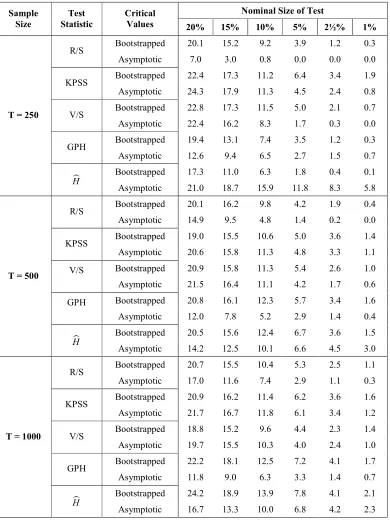
The Monte Carlo results in Table 1 for the IID case show that, in line with
other results in the literature, the MBB is reasonably successful in controlling the size
of all five tests, especially in small samples (T = 100 or 250). This is true for both the
normal and heavy-tailed, lognormal error cases. The empirical and nominal sizes of
the asymptotic tests can differ quite a lot, especially for the modified R/S and H test
in small samples. Similar results are obtained in Table 2 using the AR(1) DGP.
We report the results for the AR(1) model with a stochastic volatility random
error term in Table 3. The SV random error with ht =0.95ht−1+ηt adds a slowly
decaying conditional heteroscedastic error, similar to a GARCH (1,1) error, to the
AR(1) model. The sizes of the asymptotic tests can be poor, whereas the nominal and
results are in line with the ARCH and GARCH results in Izzeldin and Murphy (2000)
and Grau-Carles (2005).
We report the power of the tests against the fractional integrated FI(d)
alternative, with d = 1/3, in Table 4. The power of the tests is higher when the
random error is log-normal than when it is normal. Unsurprisingly, the asymptotic
tests are generally more powerful than the bootstrapped tests, since we are reporting
power as opposed to size adjusted power. However, for moderate samples sizes (T ≥
250), the difference in power is generally small, the exception being the H test when
T = 250. When T ≥ 250, the power ranking of the bootstrapped tests appears to be H,
GPH, V/S followed jointly by the KPSS and the modified R/S tests. In smaller
samples, the power of all of the tests, apart from the asymptotic H test, is low and the
H test is not the most powerful one. Similar results are obtained for other values of d
in the range 0.1 to 0.4.
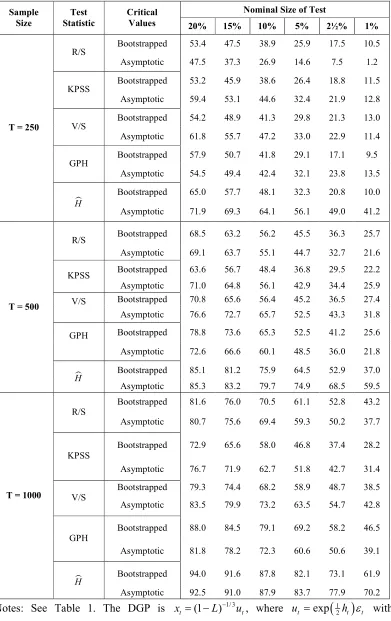
The power of the five tests against the FI alternative with a stochastic
volatility error term is set out in Table 5. The introduction of the SV error term only
results in a small reduction in power. The asymptotic tests are somewhat more
powerful when T = 250. The power ranking of the tests is much the same as in Table
4. The H test is the most powerful, followed by either the GPH or V/S test.
Finally we present some Monte Carlo results in Tables 6 for DGPs obtained
by summing an AR(1) or FI(d) process and a stochastic volatility process.
Unfortunately, in the FI-SV composite error case, none of the bootstrapped or
asymptotic tests has much power. In most cases, there is little difference in power
between the bootstrapped and asymptotic tests. The low power of the tests continues
to hold when, for example, ht =0.5ht−1+ηt is used to generate the SV component of
7. Financial Application
We apply the R/S, KPSS, V/S, GPH and H long memory tests to daily
Standard and Poor’s (SP500) returns, absolute returns and squared returns. We use the
data in Tsay (2005). We select the seven year sample period from January 1993 to
December 1999, a total of 1768 trading days. We also use a smaller, two year sample
from January 1997 to December 1998, a total of 505 days.
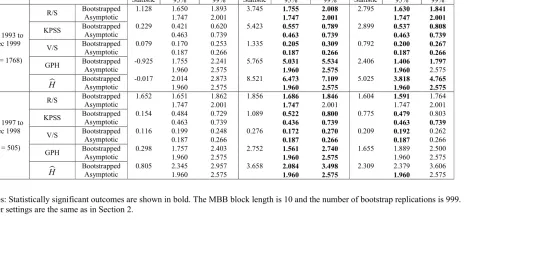
The long memory test results are shown in Table 7. Statistically significant
outcomes are shown in bold. In line with the literature, using the larger sample, we
cannot reject the null hypothesis of short memory in daily returns and we generally
reject the null hypothesis of short memory in absolute and squared daily returns.
However, in the smaller sample, we cannot always reject the null hypothesis of short
memory in the squared daily returns. These results are consistent with our Monte
Carlo results regarding the power of the tests.
In this example, the asymptotic and bootstrapped tests produce similar results.
However, even in the case of actual returns, the bootstrapped and asymptotic critical
values (and any corresponding P values) can differ quite a lot so it is worthwhile
bootstrapping the test statistics.
8. Summary and Conclusion
We use Monte Carlo methods to examine the size and power properties of five
widely used long memory tests – the modified R/S statistic, the KPSS statistic, the
rescaled variance or V/S statistic, the GPH statistic and Robinson’s H statistic. The
set of tests considered is broader than in other papers. We use the moving block
bootstrap to mimic the dependence in the data. All the test statistics are asymptotically
For all of the data generation processes we consider, we find that we can
control the size of all five tests using the moving block bootstrap even in small
samples with as few as 100 observations. We also find that bootstrapped tests suffer
little loss of power against fractionally integrated (FI) processes vis á vis asymptotic
tests with samples of 250 or more observations. This is true both for distributions with
heavy tails (log-normal random errors) and with stochastic volatility (SV). We also
show that all of the tests lack power against a particular type of fractionally integrated
References
Agiakloglou, C. and Newbold, P. (1994), “Lagrange Multiplier Tests for Fractional
Differences”, Journal of Time Series Analysis, 15(3), 253-262.
Andersen, M. and Gredenhoff, M. (1998), “Robust Testing for Fractional
Integration”, Working Paper 218 in Economics and Finance, Stockholm School of
Economics.
Baillie, R. T. (1996), “Long Memory Processes and Fractional Integration in
Econometrics”, Journal of Econometrics, 73, 5-59.
Buhlmann, P. (2002), “Bootstrap for Time Series”, Statistical Science, 17(1), 52-72.
Davison, A. C. and Hinkley, D. V. (1997), Bootstrap Methods and Their Application,
Cambridge University Press.
De Peretti, C. (2003), “Bilateral Bootstrap Tests for Long Memory: An Application to
the Silver Market”, Computational Economics, 22, 187-212.
Doornik, J. A. (1999), Object-Oriented Matrix Programming Using Ox, 3rd Edition,
Timberlake Consultants Press.
Efron, B. (1979), “Bootstrap Methods: Another Look at the Jackknife”, Annals of
Statistics, 7, 1-26.
Geweke, J. and Porter-Hudak, S. (1983), “The Estimation and Application of Long
Memory Time Series Models”, Journal of Time Series Analysis, 4(4), 221-238.
Giraitis, L., Kokoskva, P. Leipus, R. and Teyssire, G. (2003), “Rescaled Variance and
Related Tests for Long Memory in Volatility and Levels”, Journal of
Econometrics, 112(2), 265-294.
Grau-Carles, P. (2005), “Tests of Long memory: A Bootstrap Approach”,
Computational Economics, 25, 103-133.
Hall, P., Horowitz J. and Jing, B. (1995), “On Blocking Rules for the Bootstrap with
Harris, D., McCabe, B. and Leybourne, S. (2006), “Testing for Long Memory”,
Econometric Theory, forthcoming.
Hauser, M. (1997), “Semiparametric and Nonparametric Testing for Long Memory: A
Monte Carlo Study”, Empirical Economics, 22, 247-271.
Hidalgo, J. (2003), “An Alternative Bootstrap to Moving Blocks for Time Series
Regression Models”, Journal of Econometrics, 117, 369-399.
Hiemstra, C. and Jones, J. (2003), “Another Look at Long Memory in Common Stock
Returns”, Journal of Empirical Finance, 4(12), 373-401.
Hosking, J. (1981), “Fractional Differencing”, Biometrika, 68, 165-176.
Izzeldin, M. and A. Murphy (2000), “Bootstrapping the Small Sample Critical Values
of the Rescaled Range Statistic”, The Economic and Social Review, 31(4),
351-359.
Kunsch, H. R. (1987), “Statistical Aspects of Similar Processes”, in Prohorov, Y. and
Sazanon, V. V. (eds), Proceedings of the First World Congress of the Bernoulli
Society, VNU Science Press, Utrecht.
Kunsch, H. R. (1989), “The Jackknife and the Bootstrap for General Stationary
Observations”, Annals of Statistics, 17, 1217-1241.
Kwiatkowski, D., Phillips, P. C. B., Schmidt, P. and Shin, Y. (1992), “Testing the
Null Hypothesis of Stationarity Against the Alternative of a Unit Root: How Sure
are We That Economic Time Series Have a Unit Root?”, Journal of Econometrics,
54, 159-178.
Lahirir, S. N., Furukawa, K.and Lee, Y.-D. (2007), “A Non-Parametric Plug-In Rule
for Selecting Optimal Block Lengths for Block Bootstrap Methods”, Statistical
Lee, D. and Schmidt, P. (1996), “On the Power of the KPSS Test of Stationarity
against Fractionally-Integrated Alternatives”, Journal of Econometrics, 73,
285-302.
Liu, R. Y. and Singh, K. (1992), “Moving Block Bootstrap and Jackknife Capture
Weak Dependence”, in Le Page, R. and Billard, L. (eds), Exploring the Limits of
the Bootstrap, Wiley, NewYork.
Lo, A. (1991), “Long Term Memory in Stock Market Prices”, Econometrica, 59(5),
1297-1331.
Maddala, G. S. and Kim, I. M. (1998), Unit Roots, Cointegration and Structural
Change, Cambridge University Press, Cambridge.
Robinson, P. M. (1994), “Semiparametric Analysis of Long memory Time Series”,
The Annals of Statistics, 22, 515-539.
Robinson, P. M. (1995), “Gaussian Semiparametric Estimation of Long Range
Dependence”, The Annals of Statistics, 23, 1630-1661.
Robinson, P. M. and Henry, M. (1999), “Long and Short Memory Conditional
Heterskedasticity in Estimating the Memory Parameter of Levels”, Econometric
Theory, 15, 299-336.
Schwartz, G. (1978), “Estimating the Order of a Model”, The Annals of Statistics, 2,
461-464.
Teverovsky, V., Taqqu, M. and Willinger, W. (1999), “A Critical Look at Lo's
Modified R/S Statistic”, Journal of Statistical Planning and Inference, 80,
211-227.
17
Notes: The DGP is xt =εt with εt ∼n i d. . (0,1) or, before demeaning, lnεt ∼n i d. . (0,1). The Monte Carlo results are based on 1000 replications
using a 100 observation “burn-in” period. The bootstrap results are based on 999 bootstrap replications using the moving block bootstrap with a
block length of 10. The long run variance in the R/S, KPSS and V/S statistics is calculated using [84T/100] estimated covariance terms. [√T]
[image:18.612.59.718.76.413.2]frequency domain terms are used to calculate the GPH and H test statistics.
Table 1: Size of Long Memory Tests for IID Models
Normal Random Error Demeaned Log-Normal Error Sample
Size
Test Statistic
Critical
Values 20% 15% 10% 5% 2½% 1% 20% 15% 10% 5% 2½% 1%
Bootstrapped 20.1 13.9 8.6 3.3 1.4 0.4 19.2 13.4 6.4 2.9 0.9 0.2
R/S
Asymptotic 7.1 2.8 0.4 0.1 0.0 0.0 4.3 1.5 0.2 0.0 0.0 0.0
Bootstrapped 21.2 15.8 10.4 5.0 3.3 1.2 22.1 16.3 10.4 5.1 2.6 1.1
KPSS
Asymptotic 21.7 15.3 9.4 3.8 1.0 0.0 23.4 16.7 10.0 2.8 1.10 0.0
Bootstrapped 20.5 14.7 8.5 3.4 1.4 0.5 20.3 14.2 8.7 4.9 2.0 0.7
V/S
Asymptotic 19.5 12.0 3.8 0.5 0.0 0.0 20.9 12.0 4.6 0.5 0.0 0.0
Bootstrapped 16.3 10.6 5.9 3.2 1.4 0.4 18.0 12.1 7.0 2.9 1.0 0.4
GPH
Asymptotic 6.7 5.5 3.7 1.5 0.7 0.2 8.9 6.8 2.9 1.3 0.3 0.3
Bootstrapped 13.5 8.5 5.5 2.6 1.0 0.1 15.6 10.1 5.3 2.1 0.6 0.1
T = 100
H
Asymptotic 16.3 13.1 10.4 6.9 5.0 3.2 16.9 14.8 10.9 7.1 5.0 2.4
Bootstrapped 21.1 15.0 10.3 5.4 3.4 1.2 19.2 13.5 8.5 4.3 2.2 0.5
R/S
Asymptotic 12.8 8.5 5.0 1.4 0.4 0.0 9.4 5.9 2.6 0.2 0.1 0.0
Bootstrapped 20.5 14.8 10.2 3.8 1.7 0.8 21.5 15.8 10.3 5.3 2.3 0.9
KPSS
Asymptotic 20.6 15.5 9.6 3.5 1.2 0.4 21.4 16.0 10.3 4.2 1.4 0.3
Bootstrapped 19.5 13.9 9.5 5.3 2.6 1.0 19.9 14.7 9.4 4.7 2.8 1.5
V/S
Asymptotic 18.7 13.1 8.0 3.5 1.1 0.4 20.1 14.0 7.9 3.5 1.2 0.2
Bootstrapped 19.9 14.6 10.5 5.1 2.4 1.1 18.8 13.7 9.2 4.8 2.2 0.9
GPH
Asymptotic 10.3 7.9 5.1 2.3 0.9 0.3 8.8 6.9 4.3 2.4 1.2 0.4
Bootstrapped 19.8 14.6 9.5 4.4 2.0 1.0 18.5 13.2 8.7 4.1 1.5 0.5
T = 250
H
18 Notes: See first part of Table.
Table 1 (Continued): Size of Long Memory Tests for IID Models
Normal Random Error Demeaned Log-Normal Error Sample
Size
Test Statistic
Nominal
Size 20% 15% 10% 5% 2½% 1% 20% 15% 10% 5% 2½% 1%
Bootstrapped 21.4 15.7 10.2 5.6 2.6 1.3 20.2 14.6 9.8 4.4 2.1 0.9
R/S
Asymptotic 15.7 11.2 7.1 2.6 0.9 0.2 11.9 9.1 4.3 1.4 0.6 0.2
Bootstrapped 19.6 14.8 10.1 5.2 3.2 1.5 21.3 15.6 11.0 5.7 3.0 1.3
KPSS
Asymptotic 19.7 14.8 10.2 5.0 2.8 1.1 21.9 15.8 10.5 5.1 2.8 0.7
Bootstrapped 20.4 15.9 10.5 5.2 2.9 1.0 21.4 15.1 9.5 4.6 2.6 1.3
V/S
Asymptotic 20.2 16.0 9.3 4.9 1.9 0.5 20.2 14.6 9.5 3.5 1.9 0.6
Bootstrapped 19.5 15.3 9.7 4.5 2.2 1.1 18.9 13.7 9.3 5.4 2.8 1.2
GPH
Asymptotic 9.5 6.8 3.9 2.0 0.8 0.3 8.2 7.0 4.9 2.4 0.9 0.6
Bootstrapped 21.2 16.4 10.9 4.7 1.8 0.7 18.5 13.9 9.1 4.8 2.8 1.0
T = 500
H
Asymptotic 15.3 11.9 9.0 5.0 2.7 1.0 11.9 9.6 7.2 5.2 2.8 1.7
Bootstrapped 18.7 13.5 9.3 4.2 2.1 0.9 18.4 13.3 9.0 4.0 1.9 0.6
R/S
Asymptotic 14.6 10.6 6.3 3.1 1.3 0.2 13.1 9.4 5.4 1.9 0.8 0.1
Bootstrapped 19.0 15.2 9.8 4.3 2.0 0.7 19.8 14.9 10.7 5.1 2.9 1.4
KPSS
Asymptotic 19.1 15.0 9.5 4.0 1.8 0.7 19.4 14.8 10.6 5.1 2.4 1.0
Bootstrapped 18.9 14.5 9.2 3.9 1.8 1.1 19.3 13.9 8.8 4.7 2.8 1.5
V/S
Asymptotic 18.2 14.2 9.0 4.0 1.5 0.7 18.8 13.8 8.6 4.3 2.7 0.8
Bootstrapped 20.0 15.5 10.4 4.7 2.2 0.9 21.6 15.9 9.9 4.9 2.0 0.8
GPH
Asymptotic 10.2 7.1 4.2 1.6 0.7 0.2 8.9 6.3 4.3 1.4 0.9 0.4
Bootstrapped 18.7 13.9 8.6 4.7 1.8 0.9 20.7 16.2 11.1 4.7 1.7 0.5
T = 1000
H
[image:19.612.58.716.73.415.2]19
[image:20.612.58.718.76.416.2]Notes: See Table 1. The DGP is xt =0.5xt−1+εt with εt ∼n i d. . .(0,1) or, before demeaning, lnεt ∼n i d. . .(0,1)
Table 2: Size of Long Memory Tests for AR(1) Model with ρ = 0.5
Normal Random Error Demeaned Log-Normal Error Sample
Size
Test Statistic
Critical
Values 20% 15% 10% 5% 2½% 1% 20% 15% 10% 5% 2½% 1%
Bootstrapped 17.5 12.6 8.3 3.2 1.1 0.5 17.6 11.8 5.7 2.7 0.6 0.2
R/S
Asymptotic 4.0 1.1 0.2 0.0 0.0 0.0 2.9 0.6 0.2 0.0 0.0 0.0
Bootstrapped 21.4 14.7 10.7 5.5 2.9 0.8 22.4 16.3 10.3 5.1 2.7 1.1
KPSS
Asymptotic 26.4 19.6 12.6 5.0 2.0 0.0 27.7 21.2 13.1 4.5 1.6 0.2
Bootstrapped 21.4 15.1 9.4 3.4 1.6 0.6 21.5 15.4 9.4 5.0 2.1 0.6
V/S
Asymptotic 25.5 17.2 7.2 1.0 0.0 0.0 26.4 17.4 7.7 1.1 0.1 0.0
Bootstrapped 21.1 14.5 7.6 4.0 1.4 0.7 22.1 15.1 9.2 3.6 1.5 0.5
GPH
Asymptotic 17.6 12.3 7.3 4.1 1.9 1.1 18.6 13.7 9.9 4.6 1.6 0.5
Bootstrapped 18.5 12.0 6.9 3.3 0.7 0.4 19.6 13.5 7.3 2.9 0.8 0.0
T = 100
H
Asymptotic 34.5 30.4 25.2 17.8 13.5 8.3 31.5 27.2 23.7 17.8 13.3 8.6
Bootstrapped 20.7 15.4 10.3 5.6 3.3 1.4 19.0 13.4 8.7 4.7 2.0 0.7
R/S
Asymptotic 13.7 8.7 5.1 1.7 0.4 0.1 11.2 6.9 3.4 0.7 0.2 0.0
Bootstrapped 21.3 15.7 10.0 4.4 1.9 0.6 22.2 16.3 11.1 5.2 2.2 0.8
KPSS
Asymptotic 24.5 19.2 12.0 5.4 1.9 0.6 26.1 19.9 13.4 6.1 2.5 0.8
Bootstrapped 20.7 14.4 10.1 5.6 3.2 1.2 20.7 15.7 10.6 5.2 2.9 1.6
V/S
Asymptotic 26.4 17.5 11.4 5.5 2.5 0.6 25.4 19.5 12.2 5.3 2.5 0.6
Bootstrapped 22.7 16.0 11.1 5.8 2.3 1.3 21.2 15.4 10.6 4.9 2.6 1.0
GPH
Asymptotic 15.3 11.8 8.1 3.9 1.9 0.7 12.5 9.8 7.1 3.4 2.1 0.9
Bootstrapped 23.5 16.4 10.6 5.3 2.5 1.1 20.8 14.7 9.7 4.0 1.6 0.6
T = 250
H
20
Notes: See Table 1. The DGP is xt =0.5xt−1+εt with εt ∼n i d. . .(0,1) or, before demeaning, lnεt ∼n i d. . .(0,1)
Table 2 (Continued): Size of Long Memory Tests for AR(1) Model with ρ = 0.5
Normal Random Error Demeaned Log-Normal Error Sample
Size
Test Statistic
Critical
Values 20% 15% 10% 5% 2½% 1% 20% 15% 10% 5% 2½% 1%
Bootstrapped 21.1 16.2 11.3 6.2 2.6 1.2 21.3 15.2 9.9 5.0 2.5 0.8
R/S
Asymptotic 19.0 13.7 9.2 3.6 1.7 0.3 16.1 10.9 6.4 2.8 1.0 0.3
Bootstrapped 20.3 15.2 10.5 5.4 3.3 1.4 22.0 16.3 11.3 6.2 3.3 1.5
KPSS
Asymptotic 24.4 18.6 12.2 6.8 3.8 1.8 24.7 20.3 14.2 7.5 4.1 1.5
Bootstrapped 22.0 16.7 11.9 6.3 3.3 1.2 22.2 17.0 10.7 4.8 3.0 1.6
V/S
Asymptotic 26.0 20.6 14.4 7.1 3.7 1.1 26.4 20.4 13.4 6.3 3.2 1.1
Bootstrapped 20.9 16.0 10.3 5.2 2.3 0.9 19.9 15.3 10.6 6.2 3.1 1.3
GPH
Asymptotic 11.3 9.0 5.5 2.5 1.2 0.4 10.6 8.4 6.1 3.2 1.7 0.7
Bootstrapped 21.9 18.0 12.1 5.8 2.0 0.8 20.3 15.1 10.2 5.1 2.9 1.3
T = 500
H
Asymptotic 19.6 16.2 12.1 7.9 4.9 2.1 15.6 12.6 9.9 6.3 4.8 2.4
Bootstrapped 20.2 14.2 9.9 4.6 2.5 1.1 19.4 14.0 9.5 4.5 2.1 0.8
R/S
Asymptotic 20.3 13.9 9.6 4.4 2.1 0.6 18.2 12.5 8.8 3.8 1.3 0.5
Bootstrapped 19.5 15.3 10.4 5.1 1.9 0.8 20.0 15.4 11.1 6.0 3.1 1.3
KPSS
Asymptotic 23.3 17.7 13.1 6.6 2.9 1.1 23.6 18.6 12.7 6.7 3.5 1.6
Bootstrapped 20.3 15.1 10.0 4.4 2.1 1.1 20.5 14.4 9.7 4.9 3.2 1.5
V/S
Asymptotic 25.8 18.5 13.3 5.7 3.0 1.1 24.3 19.5 12.5 6.7 3.5 2.0
Bootstrapped 20.9 16.1 11.0 5.8 2.7 1.3 21.5 16.4 10.6 5.4 2.6 0.7
GPH
Asymptotic 11.3 8.5 6.0 2.3 1.2 0.2 10.6 7.6 5.2 2.2 0.9 0.5
Bootstrapped 19.6 14.2 9.7 4.9 2.3 1.0 21.8 16.7 11.9 5.3 2.0 0.7
T = 1000
H
[image:21.612.53.714.103.443.2]Notes: See Table 1. The DGP is (1 0.5 )1
t t
x = − L−u , where ut =exp
( )
21ht εt with 10.95
t t t
h = h− +η . εt and ηt are mean zero, independent normal random variables with
[image:22.612.110.500.93.615.2]variances equal to 0.1
Table 3: Size of Long Memory Tests for AR(1) Model with Stochastic Volatility Error (ρ = 0.5 and γ = 0.95)
Nominal Size of Test Sample
Size
Test Statistic
Critical
Values 20% 15% 10% 5% 2½% 1%
Bootstrapped 20.1 15.2 9.2 3.9 1.2 0.3
R/S
Asymptotic 7.0 3.0 0.8 0.0 0.0 0.0
Bootstrapped 22.4 17.3 11.2 6.4 3.4 1.9
KPSS
Asymptotic 24.3 17.9 11.3 4.5 2.4 0.8
Bootstrapped 22.8 17.3 11.5 5.0 2.1 0.7
V/S
Asymptotic 22.4 16.2 8.3 1.7 0.3 0.0
Bootstrapped 19.4 13.1 7.4 3.5 1.2 0.3
GPH
Asymptotic 12.6 9.4 6.5 2.7 1.5 0.7
Bootstrapped 17.3 11.0 6.3 1.8 0.4 0.1
T = 250
H
Asymptotic 21.0 18.7 15.9 11.8 8.3 5.8
Bootstrapped 20.1 16.2 9.8 4.2 1.9 0.4
R/S
Asymptotic 14.9 9.5 4.8 1.4 0.2 0.0
Bootstrapped 19.0 15.5 10.6 5.0 3.6 1.4
KPSS
Asymptotic 20.6 15.8 11.3 4.8 3.3 1.1
Bootstrapped 20.9 15.8 11.3 5.4 2.6 1.0
V/S
Asymptotic 21.5 16.4 11.1 4.2 1.7 0.6
Bootstrapped 20.8 16.1 12.3 5.7 3.4 1.6
GPH
Asymptotic 12.0 7.8 5.2 2.9 1.4 0.4
Bootstrapped 20.5 15.6 12.4 6.7 3.6 1.5
T = 500
H
Asymptotic 14.2 12.5 10.1 6.6 4.5 3.0
Bootstrapped 20.7 15.5 10.4 5.3 2.5 1.1
R/S
Asymptotic 17.0 11.6 7.4 2.9 1.1 0.3
Bootstrapped 20.9 16.2 11.4 6.2 3.6 1.6
KPSS
Asymptotic 21.7 16.7 11.8 6.1 3.4 1.2
Bootstrapped 18.8 15.2 9.6 4.4 2.3 1.4
V/S
Asymptotic 19.7 15.5 10.3 4.0 2.4 1.0
Bootstrapped 22.2 18.1 12.5 7.2 4.1 1.7
GPH
Asymptotic 11.8 9.0 6.3 3.3 1.4 0.7
Bootstrapped 24.2 18.9 13.9 7.8 4.1 2.1
T = 1000
H
22
Notes: See Table 1. The DGP is (1 )1/ 3
t t
[image:23.612.57.714.73.414.2]x = −L − ε with εt ∼n i d. . .(0,1) or, before demeaning lnεt ∼n i d. . .(0,1)
Table 4: Power of Long Memory Tests for Fractionally Integrated Model (d = 1/3)
Normal Random Error Demeaned Log-Normal Error Sample
Size
Test Statistic
Critical
Values 20% 15% 10% 5% 2½% 1% 20% 15% 10% 5% 2½% 1%
Bootstrapped 27.9 19.9 11.4 5.0 2.5 1.1 30.2 20.5 12.7 6.2 1.8 0.4
R/S
Asymptotic 7.1 3.0 0.5 0.0 0.0 0.0 7.3 2.1 0.2 0.0 0.0 0.0
Bootstrapped 38.6 33.3 27.0 16.7 10.7 6.0 41.8 35.7 28.9 17.9 11.2 6.1 KPSS
Asymptotic 46.9 39.1 32.0 19.0 10.3 2.3 49.6 43.1 34.0 20.5 10.7 1.9 Bootstrapped 40.5 33.0 24.0 12.9 6.7 2.3 44.0 36.3 26.2 14.2 7.2 2.8 V/S
Asymptotic 48.1 39.5 24.3 6.7 0.7 0.0 53.3 42.2 26.1 6.4 0.5 0.0
Bootstrapped 41.0 31.0 20.0 8.9 4.2 1.6 40.6 30.7 18.7 8.3 3.7 1.3
GPH
Asymptotic 47.8 40.4 31.1 20.3 11.3 5.5 46.7 39.9 30.9 20.5 12.7 6.7
Bootstrapped 42.6 30.6 18.2 8.3 3.9 1.1 43.0 29.2 17.2 7.5 3.2 0.9
T = 100
H
Asymptotic 67.6 63.1 58.6 51.0 44.6 36.0 69.9 66.4 62.8 51.6 44.6 35.1 Bootstrapped 53.4 47.4 39.6 27.6 18.2 11.4 55.1 47.8 40.1 28.4 19.7 11.5 R/S
Asymptotic 48.5 41.9 30.8 16.3 7.9 2.4 47.2 39.8 31.0 16.6 8.0 2.8
Bootstrapped 52.2 44.8 36.8 25.7 18.9 12.5 53.9 47.1 37.9 27.4 20.9 13.4 KPSS
Asymptotic 60.9 53.4 43.8 30.7 23.1 14.4 58.1 52.4 44.1 32.8 24.2 16.5 Bootstrapped 57.2 51.2 41.7 30.3 22.8 15.4 62.2 56.2 47.1 33.6 23.5 15.9 V/S
Asymptotic 66.2 59.4 50.3 37.0 25.0 14.8 58.1 52.4 44.1 32.8 24.2 16.5 Bootstrapped 66.1 58.8 48.4 32.4 21.1 11.9 67.4 60.3 51.5 37.7 27.2 15.9 GPH
Asymptotic 65.4 58.3 50.8 39.4 27.1 17.5 67.5 61.3 47.9 30.5 18.6 9.8 Bootstrapped 75.8 68.4 56.4 37.6 24.8 11.8 77.8 69.5 57.5 35.3 20.5 8.7
T = 250
H
23
Notes: See Table 1. The DGP is (1 )1/ 3
t t
x = −L − ε with εt ∼n i d. . .(0,1) or, before demeaning lnεt ∼n i d. . .(0,1)
Table 4 (Continued): Power of Long Memory Tests for a Fractionally Integrated Model (d = 1/3)
Normal Random Error Demeaned Log-Normal Error Sample
Size
Test Statistic
Critical
Values 20% 15% 10% 5% 2½% 1% 20% 15% 10% 5% 2½% 1%
Bootstrapped 72.1 67.0 59.9 49.7 40.0 29.2 74.6 69.0 61.7 50.0 40.3 32.1 R/S
Asymptotic 73.1 67.9 60.3 49.3 38.5 25.1 73.9 67.6 60.4 46.8 37.7 26.7 Bootstrapped 66.6 59.9 51.3 37.9 30.9 23.6 66.5 60.5 52.4 40.3 31.2 24.1 KPSS
Asymptotic 74.6 68.6 59.5 46.2 36.6 27.8 74.5 68.6 60.5 47.1 38.1 28.0 Bootstrapped 73.7 68.1 60.1 49.9 40.7 31.0 74.6 68.7 61.2 49.5 40.7 31.8 V/S
Asymptotic 82.0 76.0 70.4 58.1 47.8 37.0 82.6 76.9 69.4 56.6 47.3 36.1 Bootstrapped 81.5 77.0 69.9 55.3 43.4 31.0 84.2 78.6 68.9 56.0 42.8 28.6 GPH
Asymptotic 77.1 72.6 64.4 51.2 40.0 27.5 77.9 71.6 64.7 51.8 39.3 26.1 Bootstrapped 89.0 85.2 80.3 67.8 55.9 40.5 90.9 86.9 81.0 68.5 53.9 39.1
T = 500
H
Asymptotic 89.8 87.7 84.4 78.2 71.6 63.0 91.7 89.7 85.0 79.1 70.7 62.3 Bootstrapped 87.0 82.9 77.1 67.5 60.5 50.9 88.6 86.0 80.0 71.2 63.3 53.8 R/S
Asymptotic 90.0 86.6 81.7 72.6 64.1 55.2 90.8 87.7 83.2 74.0 66.7 55.7 Bootstrapped 78.5 72.7 65.4 53.5 44.6 34.7 79.8 72.6 64.9 53.5 43.3 34.3 KPSS
Asymptotic 85.3 80.1 72.8 61.6 53.0 42.7 86.4 81.1 73.3 61.6 52.5 40.9 Bootstrapped 85.2 81.0 75.5 66.1 56.6 46.3 86.3 83.3 78.0 68.3 59.6 51.0 V/S
Asymptotic 91.4 87.8 82.7 75.1 66.7 55.9 92.0 89.1 84.0 76.5 68.8 58.8 Bootstrapped 92.9 90.0 85.8 78.1 69.1 55.4 93.4 91.2 87.0 79.4 70.1 56.4 GPH
Asymptotic 88.4 85.1 80.6 72.6 61.7 48.3 89.9 87.2 81.8 72.9 63.2 48.1 Bootstrapped 97.0 95.9 93.8 89.8 83.1 75.0 97.7 96.4 94.7 89.4 83.7 74.0
T = 1000
H
[image:24.612.57.715.73.414.2]Notes: See Table 1. The DGP is (1 ) 1/ 3
t t
x = −L − u , where ut =exp
( )
21ht εt with1
0.95
t t t
h = h− +η . εt and ηtare mean zero, independent normal random variables with
[image:25.612.108.499.83.704.2]variances equal to 1/10.
Table 5: Power of Long Memory Tests for a Fractionally Integrated Model with Stochastic Volatility Error (d = 1/3 and γ = 0.95)
Nominal Size of Test Sample
Size
Test Statistic
Critical
Values 20% 15% 10% 5% 2½% 1%
Bootstrapped 53.4 47.5 38.9 25.9 17.5 10.5 R/S
Asymptotic 47.5 37.3 26.9 14.6 7.5 1.2
Bootstrapped 53.2 45.9 38.6 26.4 18.8 11.5 KPSS
Asymptotic 59.4 53.1 44.6 32.4 21.9 12.8
Bootstrapped 54.2 48.9 41.3 29.8 21.3 13.0 V/S
Asymptotic 61.8 55.7 47.2 33.0 22.9 11.4
Bootstrapped 57.9 50.7 41.8 29.1 17.1 9.5 GPH
Asymptotic 54.5 49.4 42.4 32.1 23.8 13.5
Bootstrapped 65.0 57.7 48.1 32.3 20.8 10.0
T = 250
H
Asymptotic 71.9 69.3 64.1 56.1 49.0 41.2
Bootstrapped 68.5 63.2 56.2 45.5 36.3 25.7 R/S
Asymptotic 69.1 63.7 55.1 44.7 32.7 21.6 Bootstrapped 63.6 56.7 48.4 36.8 29.5 22.2 KPSS
Asymptotic 71.0 64.8 56.1 42.9 34.4 25.9 Bootstrapped 70.8 65.6 56.4 45.2 36.5 27.4 V/S
Asymptotic 76.6 72.7 65.7 52.5 43.3 31.8
Bootstrapped 78.8 73.6 65.3 52.5 41.2 25.6 GPH
Asymptotic 72.6 66.6 60.1 48.5 36.0 21.8
Bootstrapped 85.1 81.2 75.9 64.5 52.9 37.0
T = 500
H
Asymptotic 85.3 83.2 79.7 74.9 68.5 59.5 Bootstrapped 81.6 76.0 70.5 61.1 52.8 43.2 R/S
Asymptotic 80.7 75.6 69.4 59.3 50.2 37.7
Bootstrapped 72.9 65.6 58.0 46.8 37.4 28.2 KPSS
Asymptotic 76.7 71.9 62.7 51.8 42.7 31.4
Bootstrapped 79.3 74.4 68.2 58.9 48.7 38.5 V/S
Asymptotic 83.5 79.9 73.2 63.5 54.7 42.8
Bootstrapped 88.0 84.5 79.1 69.2 58.2 46.5 GPH
Asymptotic 81.8 78.2 72.3 60.6 50.6 39.1
Bootstrapped 94.0 91.6 87.8 82.1 73.1 61.9
T = 1000
H
25
Table 6: Size or Power of Long Memory Tests for Various Models with Stochastic Volatility Errors
Nominal Size Data Generation Process Test
Statistic
Critical
Values 20% 15% 10% 5% 2½% 1%
Bootstrapped 20.9 15.8 11.3 5.4 2.6 1.0
V/S
Asymptotic 21.5 16.4 11.1 4.2 1.7 0.6
Bootstrapped 20.5 15.6 12.4 6.7 3.6 1.5
AR(1) with SV Error
H
Asymptotic 14.2 12.5 10.1 6.6 4.5 3.0
Bootstrapped 20.5 15.8 10.4 5.5 2.6 1.0
V/S
Asymptotic 20.7 15.8 9.9 4.6 1.9 0.6
Bootstrapped 23.9 19.0 11.6 6.6 3.6 1.9
Sum of AR(1) and SV Errors
H
Asymptotic 16.8 13.4 10.3 7.2 4.3 2.5
Bootstrapped 70.8 65.6 56.4 45.2 36.5 27.4
V/S
Asymptotic 76.6 72.7 65.7 52.5 43.3 31.8
Bootstrapped 85.1 81.2 75.9 64.5 52.9 37.0
FI with SV Error
H
Asymptotic 85.3 83.2 79.7 74.9 68.5 59.5
Bootstrapped 35.8 28.7 22.7 15.2 9.2 4.1
V/S
Asymptotic 36.7 29.6 23.2 14.4 7.8 3.7
Bootstrapped 38.8 31.8 24.0 15.5 8.7 3.8
Sum of FI and SV Errors
H
Asymptotic 31.4 27.4 23.4 17.1 12.0 7.1
Notes: Sample size T = 500. DGPs (i) and (iii) are the same as in Tables 3 and 5. DGP (ii) is 1 1
2
(1 0.5 ) exp( )
t t t t
x = − L − u + h ε with
1
0.95
t t t
h = h− +η . DGP (iv) is xt = −(1 L)−1/ 3ut+exp(12ht)εt withht =0.95ht−1+ηt. The random errors ,ut εt and ηt are mean zero,
26
Table 7: Tests of Long Memory – Standard and Poor’s 500 (SP 500) Returns, Absolute Returns and Squared Returns
t
r rt rt2
Critical Values Critical Values Critical Values
Period Test Test
Statistic 95% 99%
Test
Statistic 95% 99%
Test
Statistic 95% 99%
1.650 1.893 1.755 2.008 1.630 1.841
R/S Bootstrapped Asymptotic 1.128
1.747 2.001
3.745
1.747 2.001
2.795
1.747 2.001
0.421 0.620 0.557 0.789 0.537 0.808
KPSS Bootstrapped Asymptotic 0.229
0.463 0.739
5.423
0.463 0.739
2.899
0.463 0.739
0.170 0.253 0.205 0.309 0.200 0.267
V/S Bootstrapped Asymptotic 0.079 0.187 0.266 1.335
0.187 0.266
0.792
0.187 0.266
1.755 2.241 5.031 5.534 1.406 1.797
GPH Bootstrapped Asymptotic -0.925 1.960 2.575 5.765
1.960 2.575
2.406
1.960 2.575
2.014 2.873 6.473 7.109 3.818 4.765
Jan 1993 to Dec 1999 (T = 1768)
H Bootstrapped Asymptotic -0.017 1.960 2.575 8.521 1.960 2.575 5.025 1.960 2.575
1.651 1.862 1.686 1.846 1.591 1.764
R/S Bootstrapped Asymptotic 1.652
1.747 2.001
1.856
1.747 2.001
1.604
1.747 2.001
0.484 0.729 0.522 0.800 0.479 0.803
KPSS Bootstrapped Asymptotic 0.154
0.463 0.739
1.089
0.436 0.739
0.775
0.463 0.739
0.199 0.248 0.172 0.270 0.192 0.262
V/S Bootstrapped Asymptotic 0.116
0.187 0.266
0.276
0.187 0.266
0.209
0.187 0.266
1.757 2.403 1.561 2.740 1.889 2.500
GPH Bootstrapped Asymptotic 0.298
1.960 2.575
2.752
1.960 2.575
1.655
1.960 2.575
2.345 2.957 2.084 3.498 2.379 3.606
Jan 1997 to Dec 1998 (T = 505)
H Bootstrapped Asymptotic 0.805 1.960 2.575 3.658 1.960 2.575 2.309 1.960 2.575