Munich Personal RePEc Archive
Indirect Network Effects and the Impact
of Trade Liberalization: A Note
Kazumichi, Iwasa and Kikuchi, Toru
Kobe University, Kobe University
2008
Online at
https://mpra.ub.uni-muenchen.de/8662/
Indirect Network E ects and
the Impact of Trade Liberalization: A Note
Kazumichi Iwasa and Toru Kikuchi
yzApril 10, 2008
Abstract
Indirect network e ects exist when the utility of consumers is increas-ing in the variety of complementary software products available for use with an electronic hardware device. In this note, we examine how trade liberalization a ects production structure in the presence of indirect network e ects. For these purposes we construct a simple
Graduate School of Economics, Kobe University, Japan
yGraduate School of Economics, Kobe University, Japan, e-mail:
zWe are grateful to Jota Ishikawa, Eiji Ogawa, Takatoshi Tabuchi, Makoto Tawada,
two-country model of trade with two incompatible hardware technolo-gies. It is shown that, given that both types of hardware exist before trade liberalization, liberalization mayreduce the variety of hardware
technology via intensi ed network e ects. It is also shown that, con-trary to the ndings of previous studies, some consumers may become worse o as the result of trade. In other words, trade liberalization, which forms the basis for a greater variety of software products, may work as a catalyst for Pareto inferior outcomes.
Key Words: Indirect network e ects; hardware/software systems; trade liberalization; Pareto inferior trade
1
Introduction
The proliferation of trade liberalization through both economic integration
(e.g., the European Union) and preferential trade agreements (e.g., NAFTA)
has spawned a vast literature on the implications of trade liberalization. Since
liberalization often provides an opportunity to acquire varieties of products
not available from domestic producers, welfare gains via increased product
diversi cation are emphasized in the literatue.1 As yet, however, the cases
of \hardware/software" systems (i.e., hardware devices and the varieties of
complementary software products) are downplayed in the trade literature.
In other words, little attention has been paid to the implications of trade
liberalization in the presence of products with indirect (or virtual) network
e ects.
Indirect network e ects exist when the utility of consumers is increasing
in the variety of complementary products available for an electronic
hard-ware device. Examples of such devices include personal computers, video
casette recorders, and consumer electronics products. In systems that pair
hardware with software, an indirect network e ect arises because increases in
1One of the seminal contributions on the gains from variety is Krugman (1979). In a
recent empirical study, Broda and Weinstein (2006) nd that the value to U.S. consumers
the number of users of hardware increase the demand for compatible software
and hence the supply of software varieties. Since larger and more integrated
markets often provide greater product variation, these characteristics a ect
the degree to which indirect network e ects exist.
Despite the fact that many industries have indirect network e ects that
are supported by trade liberalization, the literature on indirect network
ef-fects is almost exclusively focused on a closed economy.2 Because the role of
indirect network e ects is ampli ed in the globalized world,3 it seems
impor-tant to explore the impact of trade liberalization in the presence of products
with indirect network e ects.
As our primary contribution, we examine how trade liberalization a ects
production structure in the presence of indirect network e ects. For these
2The seminal contributions on the role of a \hardware/software" system are Chou and
Shy (1990, 1996), Church and Gandal (1992, 1996) and Desruelle et al. (1996). See
Economides (1996), Shy (2001) and Gandal (2002) for surveys of the relevant literature.
In the international context, Gandal and Shy (2001) analyze governments' incentives to
recognize foreign standards when there are network e ects. See, also, Kikuchi (2007) for
the analysis of trade liberalization in the presence of network e ects.
3Gandal and Shy (2001, p. 364) note that, in 1992, it was estimated that seventy-two
percent of all personal computers throughout the world were IBM-compatibles. That is,
they ran the MS-DOS operating system and were compatible with applications software
purposes we construct a simple, two-country model of trade with two
incom-patible hardware technologies which is an extension of Church and Gandal's
(1992) closed economy model.4 We modify their approach to include
as-pects of trading economies such as two-way trade ow of complementary
software products and gains/losses from trade. Also, to provide a better
un-derstanding of Church and Gandal's (1992) model, we present a new
graphi-cal exposition for equilibrium con guration. It is shown that, given that two
incompatible hardware devices exist before trade liberalization, trade
liber-alization may reduce the variety of hardware devices. It is also shown that,
if the variety of hardware devices is reduced by trade liberalization, some
consumers are made worse o by trade. In other words, trade liberalization,
which forms the basis for a greater variety of software products (i.e.,
inten-si ed indirect network e ects), may work as a catalyst for Pareto inferior
outcomes.
The rest of this note is organized as follows. Section 2 describes both
consumer preferences and technologies. Section 3 describes the basic model
and derives an autarky equilibrium. Section 4 considers the impact of trade
liberalization. Section 5 contains concluding remarks.
4In order to analyze the possibility of coalition formation among suppliers of retail
services, Henkel et al. (2000) adapt the work of Church and Gandal (1992) to a spatial
2
Consumer Preferences and Technology
Suppose that there are two countries, Home and Foreign, and that they are
identical in regard to tastes, size, and technology.5 In each country there are
three types of goods: hardware, a large variety of software products, and the
outside good. We assume that there are two hardware technologies in both
countries: Hardware 0 and Hardware 1. We also assume that the hardware
technologies are incompatible: software written for one hardware will not
work with the other's. The characterization of the two hardware technologies
is exogenous: each is located at the end point of the unit line: let Hardware
0's technology be at the left end point and Hardware 1's technology at the
right end point. We denote the marginal cost of each hardware production
byc. We further assume that the hardware technologies are non-proprietary
and that they will be o ered at marginal cost. In this and next sections, we
consider the Home autarky situation.
Following Church and Gandal (1992), consumer preferences over the
com-bination of hardware and software are modelled as a Dixit-Stiglitz (1977)
CES utility function. We assume that the distribution of the tastes of Home
(Foreign) consumers is uniform along a line of unit length t 2 [0;1]. We
normalize the total number of consumers in each country to 1.
The preferences of a consumer of type t for system h are:
U(t) = [
nh
X
i=1
(xhi) ]
(1= )
+ kjt hj; 1=2< <1; (1)
where nh is the number of software products written for Hardware h (h =
0;1),xh
i is the level of consumption of software productiwritten for Hardware h, 1=(1 ) > 2 is the elasticity of substitution between every pair of
software products, and we assume that > k. k is a measure of the degree
of product di erentiation between the hardware technologies: the greater k,
the greater the degree of di erentiation
The representative consumer who purchases Hardware h will maximize
(1) subject to the following budget constraint:
nh
X
i
phixhi =e c; (2)
where ph
i is the price of software variety i for Hardware h, e is the total
expenditure allocated to hardware and software, and cis the price (i.e., cost)
of a unit of Hardware h.
The solution to this problem consists of the following demand functions:
xhi = (e c)(Ph) 1=(phi) ; (3)
where
Ph = [ nh
X
j=1
(ph j)
1
]
1=(1 )
The indirect utility of a type-t consumer who purchases a system h is
V(t) = nh1=( 1)(e c)=ph+ kjt hj: (5)
The indirect utility function is concave innh: the marginal bene t of another
software variety is decreasing.
Now, turn to the cost structure of software provision. The technology
for the production of software is characterized by increasing returns to scale,
since software creation typically involves xed costs. We denote the constant
marginal cost of software production for every product byb, and the software
development cost by f.
We assume that software rms are monopolistic competitors, and thus,
each product is priced at a markup over marginal cost b:6
p=b =( 1): (6)
3
The Model
In this section, we specify a simple game in which the strategy of each
soft-ware rm in a decision to provide softsoft-ware for either hardsoft-ware, 0 or 1. The
timing of the game is as follows:7 In the rst stage software rms enter the
6Hereafter, we drop the superscripth.
industry. There is free entry into the software industry and software rms
have rational expectations. Although there may be more than one
equilib-rium software con guration, we show that the free-entry number of software
rms, N = n0 +n1, is unique, where nh is the number of rms providing
software for Hardware h. In the second stage, software rms simultaneously
choose which platform to provide software for. In the nal stage, each
con-sumer purchases either a Hardware 0 or a Hardware 1 system and some of the
compatible software. We solve this problem backward. To obtain a better
understanding of the model, we extensively use a new graphical exposition
for equilibrium con guration.
3.1
Final Stage
Since we assume the marginal costs (prices) of hardware and software are
equal for both systems, consumers determine which hardware to purchase
considering only their tastes and the amount of software available for each
system. From (5), a consumer located at t purchases Hardware 0 if the
following inequality holds:
n10=( 1)(e c)=p+ kt >(N n0)1=( 1)(e c)=p+ k(1 t); (7)
where use has been made of the equation n0 +n1 = N. Therefore, the
function of n0, that is,
t(n0) = [n10=( 1) (N n0)1=( 1)](e c)( 1)=2kb + 1=2: (8)
And the rst derivative oft(n0) is positive:
t0(n
0)
dt(n0)
dn0
= [n
(2 )=( 1)
0 + (N n0)(2 )=( 1)](e c)
2kb >0: (9)
This means that the share of Hardware 0 is increasing in the amount of
software for it. It can also be shown that
t(0) 0 and t(N) 1 () N1=( 1) kb =[(e c)( 1)] (10)
and
t0(N=2) 1=N () N1=( 1) 21=( 1)kb =2(e c): (11)
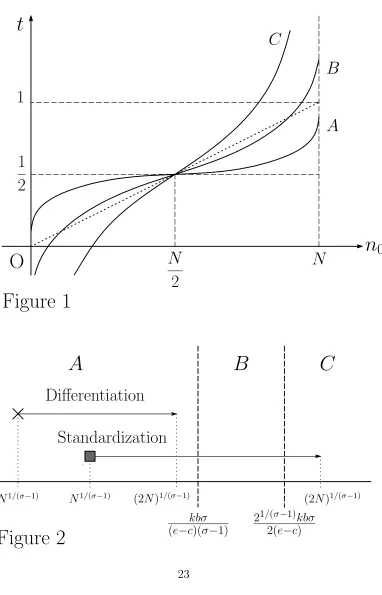
Based on the above, we can draw the function t(n0) as shown in Figure 1,8
where curves A, B, and C correspond to the graph of t(n0) under each of
the following three cases: in caseA,N1=( 1) kb =[(e c)( 1)]; in case
B, kb =[(e c)( 1)] < N1=( 1) < 21=( 1)kb =2(e c); and in case C,
N1=( 1) 21=( 1)kb =2(e c).9
8The second derivative of t(n0) is negative (positive) if n0 is smaller (greater) than
N=2, since
d2t(n0) dn2
0
= [n
(3 2 )=( 1)
0 (N n0)
(3 2 )=( 1)
]( 2)(e c)
2kb ( 1) ;
where >2 from the assumption >1=2.
Note that in cases B and C, t(n0) can reach 0 or 1, even if there are still
two types of software. Since the market is of unit length, that is, 0 t 1,
there exists a critical number of software rms for each type of hardware such
that if the number of software rms for one technology exceeds the critical
number, then all consumers purchase the dominant hardware. On the other
hand, in case A, there are two types of consumers unless one hardware is
standardized; no software for the other hardware exists.10
3.2
Second Stage
In the second stage, software rms simultaneously select the network for
which to supply software are. Given the marginal consumer, t, and the
number of competing software rms (n0 orn1), the pro t of a software rm
writing software for Hardware 0 is
0(t; n
0) =t(p b)x0 f =t(e c)=n0 f; (12)
and that for Hardware 1 is
1(t; n
1) = (1 t)(p b)x1 f = (1 t)(e c)=n1 f; (13)
10Since we assume that hardware only facilitates the consumption of software and
pro-vides no stand-alone bene ts, in caseA, the marginal consumer,t, changes discontinuously
where x1 = (e c)=n
1p. From these equations, it is easily derived that
0(t; n 0)
> <
1(t; n
1) () t
> <
n0
N: (14)
Based on the latter inequality, each rm considers whether t(n0) is greater
than n0=N or not, and then chooses the network to supply.
3.3
First Stage
At any equilibrium where two networks coexist, 0(t; n
0) = 1(t; n1) must
be satis ed. Therefore, t=n0=N holds at the equilibrium and
0 = 1 = (e c)=N f: (15)
On the other hand, if all software rms provide software for one network at
equilibrium, then (t; n0) = (1; N) or (t; n1) = (0; N) hold and
0 = (e c)=N f or 1 = (e c)=N f: (16)
Thus, the pro t of each rm is independent of equilibrium software
con-gurations, and the free-entry number of rms, N, is uniquely given by
N = (e c)=f from the zero-pro t condition.
Based on the foregoing argument, we can conclude that 0 = 1 = 0
holds for any pair (t; n0) on the dotted line in Figure 1, 0 = 0 at (1; N),
and 1 = 0 at (0;0), while 0 ( 1) is positive (negative) at any pair above
3.4
Nash Equilibrium Con gurations
Based on the foregoing argument, we obtain the Nash equilibrium con
gu-rations as follows: In order for a con guration to be a Nash equilibrium, it
must be impossible for a software rm to switch networks and increase its
pro t.
In case A, the graph of t(n0) is drawn as curve A in Figure 1. So, there
are three equilibrium candidates; (n0 = n1 = N=2), (n0 = N; n1 = 0), and
(n0 = 0; n1 =N). Since
t(n0)
8 > > < > > :
> n0=N if n0 < N=2;
< n0=N if n0 > N=2;
(17)
we can conclude that only symmetric equilibrium (n0 =n1 =N=2) is stable
in the sense of a Nash equilibrium.
On the other hand, in case C, the graph is drawn as curve C and
t(n0)
8 > > < > > :
< n0=N if n0 < N=2;
> n0=N if n0 > N=2:
(18)
Therefore, only two equilibria, (n0 = N; n1 = 0) and (n0 = 0; n1 = N), are
stable.11
Finally, in caseB, the graph oft(n) is drawn as curveB and it is apparent
from the discussion above that all three of the equilibria, (n0 = n1 =N=2),
11In the interval ofnwheret(n0) is greater than 1 (smaller than 0), the actual marginal
(n0 =N; n1 = 0), and (n0 = 0; n1 =N), are stable. So, we have the following
lemma:
Lemma: Depending on the parameter values, the following three cases
emerge:
Case A: If N1=( 1) kb =[(e c)( 1)], a unique symmetric equilibrium
exists, (n0 =n1 =N=2).
Case B: If kb =[(e c)( 1)] < N1=( 1) < 21=( 1)kb =2(e c), three
equilibria, (n0 =n1 =N=2), (n0 =N; n1 = 0), and (n0 = 0; n1 =N), exist.
CaseC: IfN1=( 1) 21=( 1)kb =2(e c), only two equilibria,(n
0 =N; n1 =
0) and (n0 = 0; n1 =N), exist.
Although the present result is the same as that stated in Church and
Gandal's (1992) closed economy model, we believe that our graphical
exo-postion provides better understanding of the equilibrium con guration. Also,
one major advantage of our graphical exposition is that it makes it easier to
extend the analysis to the case of unequal preference distribution.
4
The Impact of Trade Liberalization
Now let us turn to the impact of trade liberalization. Trade liberalization
consumers becomes 2. This implies that the integrated market can support
a larger number of software products: the total number of complementary
software products changes from N to 2N. Since we have assumed away
Ricardian comparative advantage, there is no incentive for inter-industry
trade. Still, since each software rm specializes in di erent range of products,
an incentive for two-way trade of software products remains. Since consumers
prefer to consume a wide variety of software products, trade liberalization
might result in gains from product diversi cation. However, we have to check
the changes in the variety of hardware. Depending on parameter values,
several possible cases emerge. In order to highlight the interaction between
indirect network e ects and trade liberalization, let us examine the following
two representative cases (these cases are summarized in Figure 2).
4.1
The Case of Hardware Di erentiation
First, let us assume that the following condition is satis ed:
(2N)1=( 1) kb =[(e c)( 1)]: (19)
Note that this condition holds when the degree of hardware di erentiation
(k) is relatively large (or the degree to which indirect network e ects exist
is relatively low). In this case, two types of hardware exist both before and
and trade liberalization induces twice as many software varieties for each
type of hardware: n0 becomes 2n0 and n1 becomes 2n1. From (5), this
clearly increases every consumer's utility.
Proposition 1: Given that condition (19) holds, both types of hardware
remain in the equilibrium and both countries gain from trade liberalization.
Note that these gains correspond to those obtained from the \love-of-variety"
approach to trade gains (e.g., Helpman and Krugman, 1985). Through trade
liberalization, consumers in each country can obtain a wider variety of
prod-ucts, which results in mutual gains.
4.2
The Case of Hardware Standardization
Next, let us assume that the following condition is satis ed:12
kb =[2(e c)] N1=( 1) kb =[(e c)( 1)]: (20)
In this case, while both types of hardware exist before trade liberalization,
only one type of hardware remains after liberalization. In other words,
inten-si ed indirect network e ects result in areducednumber of hardware varieties
(2 rather than 1). For simplicity, let us suppose that only Hardware 1
re-mains after trade liberalization. In this case, some consumers have to switch
from Hardware 0 to Hardware 1. While there are gains from the increased
diversity of software available, there are losses from switching to the other
network. The change in the indirect utility of a type-tconsumer who switches
to the other network is:13
V(t) = [(41=( 1) 1)(N=2)1=( 1)(e c)( 1)]=(b ) k(1 2t): (21)
Note that the rst term on the RHS represents the gains from software
diver-si cation while the second term on the RHS represents costs from increased
disutility. Let us de ne a type-~t consumer who is indi erent to switching
hardware as follows:
~
t = (1=2) [(41=( 1) 1)(N=2)1=( 1)(e c)( 1)]=2kb : (22)
Let us de ne the solution of 21=( 1) 41=( 1) + 1 = 0 as ~. Then we can
show that ~t >0 holds when >~:
~
t (1=2) (41=( 1) 1)=21+1=( 1)
= (21=( 1) 41=( 1)+ 1)=2 =( 1)
8 > > < > > :
<0 if 2< < ~
>0 if >~
Now we can state the possibility of losses from trade.
13Note that, in the case of hardware standardization, the number of software varieties
Proposition 2: If condition (20) and ~ 3 are satis ed and
Hard-ware 1 (resp. 0) dominates the integrated market, both countries' consumers
who located at t 2 [0;t~] (resp. t 2 [1 ~t;1]) are made worse o by trade
liberalization.
This implies that trade liberalization leads some consumers to \switch"
to an other-dominated brand, thereby increasing disutility. Note that this
case is highly contrasted with the cases of universal gains from trade, which
are emphasized in the literature.14 We would like to emphasize that trade
liberalization, which forms a basis for a greater variety of software products
(i.e., intensi ed indirect network e ects), may work as a catalyst for Pareto
inferior outcome.
5
Conclusions
Indirect network e ects exist when the utility of consumers is increasing
in the variety of complementary software products available for a hardware
device. In this note, we examine how trade liberalization a ects production
structure in the presence of indirect network e ects. For these purposes we
14See, for example, Helpman and Krugman (1985). Related to the present result, Chou
and Shy (1991) considered the case where the variety of non-traded domestic products is
construct a simple, two-country model of trade with incompatible hardware
technologies. It is shown that, given that both hardware devices remain
after liberalization, every consumer gains from trade (Proposition 1). It is
also shown that, if the number of hardware varieties is reduced by trade
liberalization, some consumers may be made worse o by trade (Proposition
2). It must be noted that competition in the integrated market is likely to
lead to standardization on a single hardware/software system.
The present analysis must be regarded as tentative. Hopefully it
pro-vides a useful paradigm for considering how indirect network e ects (or
hard-ware/software systems) a ect both the structure of production and the gains
References
[1] Broda, C., and D. Weinstein (2006) `Globalizations and the Gains from
Variety,' Quarterly Journal of Economics, Vol. 121, pp. 541{585.
[2] Chou, C., and Shy, O. (1990) `Network E ects without Network
Exter-nalities,' International Journal of Industrial Organization, Vol. 8, pp.
259{270.
[3] Chou, C., and Shy, O. (1991) `Intra-industry Trade and Variety of Home
Products,' Canadian Journal of Economics, Vol. 24, pp. 405{416.
[4] Chou, C., and Shy, O. (1996) `Do Consumers Gain or Lose when More
People Buy the Same Brand?' European Journal of Political Economy,
Vol. 12, pp. 309{330.
[5] Church, N., and Gandal, N. (1992) `Network E ects, Software Provision
and Standardization,'Journal of Industrial Economics, Vol. 40, pp. 85{
104.
[6] Church, N., and Gandal, N. (1996) `Strategic Entry Deterrence:
Com-plementary Products as Installed Base,' European Journal of Political
[7] Desruelle, D., G. Gaudet and Y. Richelle (1996) `Complementarity,
Co-ordination and Compatibility: the Role of Fixed Costs in the Economics
of Systems,' International Journal of Industrial Organization, Vol. 14,
pp. 747{768.
[8] Dixit, A. K., and J. Stiglitz (1977) `Monopolistic Competition and
Opti-mum Product Diversity,'American Economic Review,Vol. 67, pp. 297{
308.
[9] Economides, N. (1996) `The Economics of Networks,' International
Journal of Industrial Organization, Vol. 14, pp. 673{699.
[10] Gandal, N. (2002) `Compatibility, Standardization, and Network E ects:
Some Policy Implications,' Oxford Review of Economic Policy, Vol. 18,
pp. 80{91.
[11] Gandal, N., and O. Shy (2001) `Standardization Policy and International
Trade,' Journal of International Economics, Vol. 53, pp. 363{383.
[12] Helpman, E., and P. R. Krugman (1985) Market Structure and Foreign
Trade, MIT Press.
[13] Henkel, J., K. Stahl and U. Walz (2000) `Coalition Building in a Spatial
[14] Kikuchi, T. (2007) `Network Externalities and Comparative Advantage,'
Bulletin of Economic Research, Vol. 59, pp. 327{337.
[15] Krugman, P. R. (1979) `Increasing Returns, Monopolistic Competition,
and International Trade,' Journal of International Economics, Vol. 9,
pp. 469{479.
[16] Shy, O. (2001) The Economics of Network Industries, Cambridge
N
2
O
n
0
N
t
1
2
1
[image:24.595.122.504.120.715.2]A
B
C
Figure 1
21/(σ−1)kbσ 2(e−c)
(2N)1/(σ−1)
A
Differentiation
B
C
Figure 2
kbσ (e−c)(σ−1)
Standardization
(2N)1/(σ−1)
N1/(σ−1)
N1/(σ−1)