Munich Personal RePEc Archive
The model of the linear city under a
triangular distribution of consumers: an
empirical analysis on price and location
of beverage kiosks in Catania
Torrisi, Gianpiero
University of Catania, Faculty of Economics
January 2008
Online at
https://mpra.ub.uni-muenchen.de/12694/
The model of the linear city under a triangular
distribution of consumers: an empirical
analysis on price and location of beverage
kiosks in Catania
Gianpiero Torrisi*
This Version January 2008
Abstract
This paper presents a model of oligopolistic competition under horizontal differentiation of products and a triangular distribution of consumers. The triangular distribution aims to represent a case of concentration of consumers around the central location. The main result is that a good deal of differentiation among products is achieved also under such assumption concerning the consumers’ distribution. This means that the incentive to differentiate – to some extent - prevails on the incentive to the central location, although consumers are concentrated in the central location. The analysis on an original empirical case-study is presented, concerning the choice of beverage retails in a town. The empirical evidence is consistent with the theoretical model.
The model of the linear city under a triangular
distribution of consumers: an empirical
analysis on price and location of beverage
kiosks in Catania
Gianpiero Torrisi
This version January, 2009
Abstract - This paper presents a model of oligopolistic competition under horizontal differentiation of products and a triangular distribution of consumers. The triangular distribution aims to represent a case of concentration of consumers around the central location. The main result is that a good deal of differentiation among products is achieved also under such assumption concerning the consumers’ distribution. This means that the incentive to differentiate – to some extent - prevails on the incentive to the central location, although consumers are concentrated in the central location. The analysis on an original empirical case-study is presented, concerning the choice of beverage retails in a town. The empirical evidence is consistent with the theoretical model.
1. Introduction
This paper considers a duopoly under endogenous horizontal differentiation.
An intuitive approach to this problem is represented by location models
which starts from Hotelling’s contribute in 1929. In his model, Hotelling (1929) argues that the utility function may assume different levels among consumers according to their location over the [0,l] delimited linear space. Hotelling’s result, achieved under uniform distribution of consumers, is as follows: in a game where firms choose product varieties simultaneously and non-cooperatively, expecting to receive the equilibrium profits as pay-off, similar products are produced. This phenomenon is the so-called "Principle of Minimum Differentiation".
this literature shows that the game equilibrium as defined by Hotelling is weak because firms, for some given locations, find more profitable adopting
undercutting strategies.
A significant contribute to Hotelling (1929)'s model in that sense is given by D’Aspremont, Gabszewicz and Thisse (1979). They show that, within such a market, the problem of non-existence of a non-cooperative equilibrium in the price stage arises from the fact that consumers located – basing on their most preferred variety – close to one of market’s edges are captured by their closest firm for a large range of prices but not for every price. Indeed, at some (low) level of price, these consumers are “lured” by the distant firm. This circumstance creates incentives to expel from the market the opponent firm in order to be monopolist and, in turns, makes impossible a price equilibrium.
D’Aspremont, Gabszewicz e Thisse (1979), by means of the introduction of a quadratic transportation cost function, solved this problem achieving the “Maximum Differentiation Principle”: firms fix their product’s specification at the opposite side of the market.
Economides (1986) - defining a zero relocation tendencies area - enounces more general conditions concerning the effects of the transportation cost function on market equilibrium.
The purpose of this paper consists in empirically investigate the robustness of the “Maximum Differentiation Principle”, using a different consumers’ distribution. Indeed, in Hotelling (1929)’s model consumers are assumed to be uniformly distributed, but in the real world often consumers tastes are gathered around a central value of a specific product characteristic. In addition, thinking to location purely in a geographical sense, we expect to observe people concentrated toward the central location1.
A triangular consumers distribution is introduced in order to stress this occurrence. The analysis shows that, even if consumers are gathered around the central location, minimum differentiation is not profitable. 2
1 For a general exposure of some of these models see: Carraro and Graziano (1993), Garella and Lambertini (2000) and in an optics related to the problems of urban geography Cori et al. (1993)
The final part of this paper presents empirical evidence concerning location-choice and price-choice of beverage retail in Catania (Italy). The analysis focuses on a refreshing drink, made using water, lemon and mandarin which is a traditional commodity of Catania’s folk culture. Since the productive process is very simple, two drinks may differ for their sale location only, just as assumed by models here considered. This analysis shows that central location might coexist with high price, differently by standard model prediction.
The paper is organized as follows. In section 2 preliminary results are summarized pointing out the relevance of transportation cost function to the equilibrium existence. Section 3 introduces a model under triangular distribution of consumers presented as a particular parameter restriction of a set of trapezoidal distribution. Section 4 briefly shows data concerning empirical evidence about beverage retails in Catania. Some comments and concluding remarks are provided in section 5.
2. Some points of the relevant literature.
This section describes the analytical framework of the basic model of location under uniform distribution of consumers referring to various authors.
First, the linear transportation cost function case is analysed. Then I will show some result about quadratic transportation cost. Some general conditions concerning equilibrium existence are also enounced at the end of this section.
To begin with, let consider a linear city in the [0,1] interval delimited space. Within this city is assumed existing a continuum of individuals differing in one dimension only: their location according to the type of commodity they prefer most. These individuals are uniformly distributed and each consumer takes at most one unit of the product which are produced at zero marginal costs.
Each consumer prefers to buy their good exactly where he is localised, so that, if a consumer has to go from his location to a different location in order to purchase the good, he pays an additional transportation cost. Hence, a consumer of type m, 0<m<1,has an utility function expressed in monetary terms as follows:
) (d f p s
Um = − − [2.1]
where s index the “gross” benefit by consuming the good (i.e. if provided exactly in the consumer’s location and regardless of the price paid for it) p is the price, d
is the distance between m and the sell point xi, that is, d = xi−m , and f(d) is an
increasing function of this distance. Moreover, p+ f(d) is the so-called delivered price.
This utility function may assume different forms; however it shows a peak when p and d are equal to zero and this peak value is s. This means that each consumer gains the same satisfaction if we ignore prices and transportation cost.
Economides (1986) propose to express this transport cost in the following form
2 1
, 0 ; )
(d =t⋅ x −mδ t > ≤δ ≤
f i [2.2]
where the parameter t can be interpreted as a sensibility index of the importance of consumers’ preferred specification for consumers them self, or, in a spatial way, it may seen like a consumer’s “idleness” index.
Note that if t is the same among consumers, this means that each consumer presents an identical sense of distance.
The parameterδ is used to introduce different form of transportation cost function. For example, a linear transportation cost can be obtained if δ =1, and also a quadratic function might be achieved by fixing δ =2.
Note that from [2.1] arise a condition, depending both on price and distance, that must be verified if m-th individual decide to purchase the commodity
) ( 0 s p f d
Thus, the m-th consumer gains an utility which is at least equal to total purchase cost. This condition has a crucial role within this market3.
Before developing formal analysis, I will provide an intuitive approach to these issues. Intuition behind the formal analysis may be explained as follows. We have to answer to these questions: if two firms cover this market producing homogeneous goods, central location is profitable for both firm? Or, by contrast, is it more profitable to maintain a certain distance from the rival one? And, finally, what we can say about prices fixed within this market?
Obviously, a central location not only provides an higher number of consumers (that is the so-called demand-effect), but also implies a strong price-competition (so-called strategic-effect). Thus, central location has two opposite effects. This simple argument shows the most important characteristic of this market: firm’s behaviours are interdependent both in price-stage and location-stage.
Hotelling (1929) was the first to use a spatial approach to this issue. Here I refer to Hay e Morris (1979)’s version of Hotelling’s “Main Street” model.
According to considerations about interdependence mentioned above the competition between firms is described by mean of a two-stage, perfect information game. While in the second stage each firm use price as strategic variable, in the first stage firms choose their product specifications (location) expecting to receive the payoff that corresponds to the Nash equilibrium in prices strategies (i.e. given the second stage result).
In order to investigate the Nash equilibrium in the second stage of the game we need to the express the demand function for each firm. Clearly, this demand depends on firms’ location. Let a and 1−b (a,b≥0) be the firms’ distance
from 0, thus firm’ location in [0,1] space will be x1 =a, x2 =1−b, x1≤x2 .
Note that if a+b=0 we have the maximum degree of differentiation. If, instead, a+b=1 firms are localised in the same point. Thus, on the first case we have a soft strategic effect and, by contrast, in the second one, firms face the maximum degree of price competition. In particular, if firms choose the same location, their profit collapse to zero due to an à la Bertrand competition.
3
Given x1,x2 we are able to individuate the consumer who is indifferent
between buying from firm 1 at price p1 or from firm 2 at price p2, because he gains the same utility. In fact, if both prices respect condition expressed in [2.3] in this market consumers have to choose between two possibility arising from two prices and two transport costs; nevertheless, it will be a consumer who is indifferent between the two possibilities. Let m* be the indifferent consumer as defined by following [2.4]
* 2 2 * 1
1 t x m p t x m
p + ⋅ − = + ⋅ − [2.4]
Hence, all consumers on the left side of m* prefer (buying from) firm 1 and, all consumers on the right side of m* prefer firm 2, moreover we obtain the demand of firm 1 and firm 2 by solving with respect to m* equation [2.4] and substituting x1=a x2 =1−b.
The demand function for the two firms are respectively:
t p p b a a p p D
2 2
1 ) ,
( 1 2 1 2
1
− − − − +
= [2.5a]
t p p b a b p p D
2 2
1 ) ,
( 2 1 2 1
2
− − − − +
= [2.5b]
Note that each demand is constituted not only by a positive term which represents exactly its location (plus a term equal to the half of consumers who are contained between the two firms) but also by a negative term which shows the effect of the price differential. If considered in absolute value, this last term is increasing on the “new” price-variable defined as p'j = pj−pi with j≠i.
By observing the two [2.5] the parameter t can viewed as unity of measurement of price differential:the higher is 2t the less will be p'j/(2t) .
A possible strategy for every enterprise is then that to move the price downward thin arriving to such level that allows to serve alone the whole market (this level of price is well known as price of exclusion).
In the case a firm decides to cohabit with the other firm, it will be fixed a price higher than the exclusion price. Between the two possible (exclusion or not exclusion) strategies it will exist a price which acts as threshold, that once achieved collapses the market into a monopoly.
This threshold conceptually corresponds to the case in which the indifferent consumer exactly coincides with the rival firm location. To easily realize this, it is enough to consider that if, let us say, the enterprise 1 fixed the price according to the rule:
) 1
(
2
1 p t a b
p = − − − [2.6]
the indifferent consumer would be exactly the consumer located in x2. So, if the enterprise 1 sets a price that more than compensates the cost of transport, that is,
) 1
(
2
1 p t a b
p < − − − [2.7]
then any consumer would purchase from the enterprise 2.
Hence, through an opportune price strategy, the enterprise 1 will become monopolist.
The consequence is that to continue the oligopoly analysis the following condition must be set on the prices
) 1 ( )
1
( a b p2 p1 t a b
t − − ≤ − ≤+ − −
− [2.8]
Hence, equilibrium prices (p1*,p*2) of oligopoly game may exist only in the dominion defined by [2.8], in which both enterprises have a positive market share.
Each firm aim to maximize profit function represented by a function of the type Πi(a,b)= pi(a,b)Di(a,b,pi(a,b).pj(a,b)) that depends on the decisions on location and price of both the enterprises.
By differentiating the firms' profit functions and solving the first order condition with respect toprices, we find the well known reaction functions:
⎪
⎩
⎪
⎨
⎧
+ + − = ⇒ = ∂ Π ∂ + − + = ⇒ = ∂ Π ∂ 1 2 1 ) 1 ( 2 2 0 2 2 2 1 ) 1 ( 2 1 0 1 1 2 p b a t p p p b a t p p [2.9]The Nash equilibrium in prices is therefore:
⎟ ⎠ ⎞ ⎜ ⎝ ⎛ − + = 3 1 ) , ( * 1 b a t b a
p [2.10a]
⎟ ⎠ ⎞ ⎜ ⎝ ⎛ − − = 3 1 ) , ( * 2 b a t b a
p [2.10b]
equilibrium prices have the following property: they are increasing on t, coherently with the circumstance that higher levels of t "damp" the price effect on the demand function: if the distance is relatively less important than the price, prices are pushed upward and vice versa; they decrease, instead, when the enterprises are close, because this involves a sourer price competition
By substituting equilibrium prices into profit functions we obtain the following equilibrium profits.
2 *
1
3 1
2 ⎟⎠
⎞ ⎜
⎝
⎛ + − =
Π t a b [2.11a]
2 *
1
3 1
2 ⎟⎠
⎞ ⎜ ⎝ ⎛ − − =
in order that the couple ( * *
,p
p1 2) constitutes a Nash equilibrium, it is not sufficient that it assures the profit maximization within the interval defined by [2.9], but it has to generate a level of profit higher than the profit that firm would get in monopoly, excluding the rival one. Thus, the following conditions must be verified: m b a t p b a t p
p1* *2 2 *2 1
1 ) ( (1 ) )
3 1 ( 2 ) ,
( = + − ≥ − − − − =Π
Π ε [2.12a]
With respect to firm 1 and
m b a t p b a t p
p1* 2* 2 1* 2
2 ) ( (1 ) )
3 1 ( 2 ) ,
( = − − ≥ − − − − =Π
Π ε [2.12b]
With respect to firm 2.
Clearly, until both firms are present in the market, it does not exist a reciprocally best choice which is different to the couple ( * *
,p
p1 2); the unique
alternative credible strategy would consist in expelling from the market the rival firm, and it is exactly the convenience of this strategy that we have to study.
Undoubtedly, each firm is interested in serving the whole market, by practicing the highest price. Thus, we evaluate what happens forε →0, studying the system of the following conditions
) 2 ( 3 4 3 1 2 b a b a + ≥ ⎟ ⎠ ⎞ ⎜ ⎝ ⎛ + − [2.13a] ) 2 ( 3 4 3 1 2 a b a b + ≥ ⎟ ⎠ ⎞ ⎜ ⎝ ⎛ + − [2.13b]
Conditions [2.13a,b] imply that the couple (p*,p* 2
1 ) represents a situation of
Note that conditions [2.13a,b] on the location are necessary and sufficient for the existence of the equilibrium in oligopoly, since if they are satisfied, condition [2.8] will be also satisfied.
The conclusion driven in literature is that prices ( * *
,p
p1 2) that bring the market into an equilibrium with positive profits for both enterprises, do not induce tendencies to eliminate the competitors from the market, only for a subset of the first-stage select positions.
In order to answer to the question on the location stage, it will be enough to solve the profit maximisation first order condition with respect to a and b
respectively. In fact, a and b are the strategic variables of the decisional node here considered. In this way we obtain
0 3
1 3
*
1 ⎟>
⎠ ⎞ ⎜
⎝ ⎛ + − =
∂ Π
∂ t a b
a [2.14a]
0 3
1 3
*
2 ⎟>
⎠ ⎞ ⎜
⎝
⎛ −
− = ∂ Π
∂ t a b
b [2.14b]
At a first glance, it could seem that in this market a natural tendency exists, leading firms to converge toward the centre, up to place both firms exactly in the central position. But, it has already been noticed that the profit function is not continuous in a and b, since it presents a discontinuity for a+b=1: in such a case profits are null.
This circumstance implicates the existence of a tension among the two enterprises that are pushed to estrange from the centre to have positive profits. But they do not move at all toward an equilibrium: in fact, either they get further in such way that conditions [2.13] is satisfied, and then it becomes convenient for both to move once more toward the centre, following the rule drawn by [2.14], or they get further without [2.13] conditions are respected and in that case we have already shown that an equilibrium does not exist.
A possible way to operate consists in removing the hypothesis of linearity of the transport function, simply setting δ =2 into equation [2.2]. The transportation cost function so modified assumes the form
2 ) ( )
(d t x m
f = i− [2.15]
The argument proposed by D’Aspremont, Gabszewicz and Thisse (1979) can be summarised in the following terms: given that the equilibrium problem comes from the fact that when firms are close to the centre, small reductions of prices allow them to serve the whole market acting as monopolist, then the solution is to eliminate this discontinuity in profit function.
This change imposes to reconsider both stages of the game. New indifference condition becomes4:
(
)
(
)
22 2
1 t m a p t1 b m
p + − = + − − [2.16]
Solving with respect to m the new demand functions we obtain the modified equilibrium conditions. Focusing the attention to the first stage where firms choose their position, the following [2.17] shows that if 0≤a≤1−b≤1is hold, then profit function derivative are negative on a and b for both firm 1 and firm 2. Or rather, in the second stage of the game both oligopolists are interested to get further and to place themselves into the two opposite edges of the market, because the profit function is decreasing in a and b respectively.
2 0 2 1 1 * 1 1 < ⎟⎟ ⎠ ⎞ ⎜⎜ ⎝ ⎛ ∂ ∂ ∂ ∂ + ∂ ∂ = ∂ Π ∂ a p p D a D p
a [2.17a]
0 1 1 2 2 * 2 2 < ⎟⎟ ⎠ ⎞ ⎜⎜ ⎝ ⎛ ∂ ∂ ∂ ∂ + ∂ ∂ = ∂ Π ∂ b p p D b D p
The existence of equilibrium strategies for both stages of the game assures, in turn, also the existence of a sub-game perfect equilibrium in the whole game. It emerges, therefore, in an enough predictable way, the role of the transportation function as element which is able to influence the existence itself of the equilibrium.
Economides (1986) shows, in fact, that from different values assumed by δ into the [1,2] interval, it arises the existence or inexistence of equilibrium strategies, according to the following rule:
• If δ∈[1; 1,26] perfect equilibrium doesn't exist in the pure strategies of the game;
• ifδ∈[5/3; 2] a subgame perfect equilibrium exists in which
) , , ( ) , ,
( 2
1 abδ ,p a bδ
p* * are a Nash equilibrium in the price-stage, and, in the location-stage the principle of the maximum differentiation is verified.
• ifδ∈[1,26; 5/3], finally, we can find a sub-game perfect equilibrium. Equilibrium locations defined by ;
4 3 5 ) ( * 1
δ δ = −
x
4 1 3 ) ( 1 ) ( 1* *
2
− = −
= δ δ
δ x
x .
Thus, in the third case,x1*>0 x2*<1, it is an open question whether we
observe a weak demonstration of the maximum or minimum differentiation principle.
Until this point the hypothesis of uniform distribution of consumer along the linear segment representing the market has been maintained. Nevertheless, it is easy to check that this kind of distribution it is not a very likely one.
Therefore, next section proposes to modify the model considering a different (and more realistic) consumers’ distribution. A quadratic transportation cost hypothesis is maintained.
3. The basic-model under triangular consumers’ distribution
This section introduces a model under the hypothesis of triangular distribution of consumers.
Indeed, in the real world often we observe distributions which have a peak around their central value, also when they refer - as in Benassi Chirco (2008) - to preferences around one determined product characteristic.
The distribution that I introduce is triangular and does not change total market dimension; even referring to the normal distribution, it does not exactly reproduce its form because it is more angular; nevertheless, it is evident that this difference regarding the form of the two distribution, does not change the underlying intuition: triangular distribution, with a great degree of analytical simplicity, represents a population "thickened" around the central location5.
A distribution with this form has as density function as the following [3.1]
⎪ ⎩ ⎪ ⎨ ⎧ ≤ < − ≤ ≤ = 1 2 1 4 4 2 1 0 4 ) ( m per m m per m x
f [3.1]
therefore, the corresponding distribution function is
⎪ ⎩ ⎪ ⎨ ⎧ ≤ < − + − ≤ ≤ = 1 2 1 1 4 2 2 1 0 2 ) ( 2 2 m per m m m per m m
F [3.2]
In what follows, I focus on a precise research questions: does this different consumers distribution imply some effect on equilibrium? Rather: should we expect that the two firms will certainly place themselves in the central position, where a great density is observed, or by contrast it exists a possibility that a certain degree of differentiation inside this market is maintained?
Preliminarily, as noticed by Scrimitore (2003), it is worthwhile observing that [3.1] represents a particular case of a whole set of density functions that
5
describes trapezoidal distributions reporting an elevated degree of concentration around the central position up to collapse into a triangle6.
Distributions of this type are defined by the following [3.3]
2
2
4 1
,
1 2
2 1 1
( , ) ,
1 2 2
4 1
,
1 2
m m
f m m m
m m
ϕ ϕ
ϕ ϕ
ϕ
ϕ
ϕ ϕ
⎧ < −
⎪ −
⎪ ⎪
⎪ − +
⎪
= ⎨ < <
+ ⎪ ⎪ ⎪
+
⎪ <
⎪ −
⎩
[3.3]
Hence, consumers, indexed with m, are distributed over the interval [0;1] according to a density function f
(
m,ϕ)
where the parameter ϕ can be interpreted as a concentration index of the consumers' tastes, or simply as a consumers concentration index. If ϕ is equal to 1, then [3.3] describes a uniform distribution. If, by contrast, ϕ is equal to zero the function collapses into a triangle. And, also, as ϕ decreases, tending to zero, the distribution function concentrates toward the centre.Therefore, under the distribution described by equation [3.3] the number of consumers contained into an interval varies depending on this interval’s extremes.
In order to define the "new" demand function it is necessary taking into account this circumstance. Therefore, let a and b denote respectively the distance of the firm 1 and 2 from the origin. Consequently,
a a b a b
p p
m + − +
− −
= [ ]
2
1 2 1
* [3.4]
is the location of the indifferent consumer (and supposing as above that this consumer is localised between the two firms) the demand functions become
) , (
1 F mϕ
D = and D2 =1−F(m,ϕ), which can be written in the following way
6
Note that this density is a trapezoid, with longest base equal to 1, shortest base equal to
b] 5 . 3 [ 1 ) 1 ( 2 1 1 a] 5 . 3 [ 1 ) 1 ( 2 1 1 2 2 1 2 1 ϕ ϕ ϕ ϕ + − + + + − − − = + − + + + − − = a b a b p p D a b a b p p D
Notice that it is possible to see a strategic effect and a demand effect in this market, by observing that D1 not only has a positive term which represents location of firm 1 (“a”), but also has a positive term which represents the price differential (p2−p1) discounted by a factor that expresses the intervening distance
between them (b-a).
A last comment on(ϕ−1): it can be interpreted as an index of the divergence from the uniform distribution that directly acts to modify the demand function.
Once obtained the demand functions, in order to obtain the profit functions it is sufficient multiplying them for the price
ϕ ϕ π + − + + + − − = 1 ) 1 ( 2 1 1 2 1 1 a b a b p p
p [3.6a]
] 1 ) 1 ( 2 1 1 [ 1 2 2 2 ϕ ϕ π + − + + + − − −
= b a b a
p p
p [3.6b]
from them the following reaction functions can be computed
))] ( ( 2 1 [ 2
1 2 2
2
1 p b a a b b a
p = + − − + +ϕ − [3.7a]
))] ( ) ( 3 ( 2 1 [ 2
1 2 2
1
2 p b a a b b a
p = − + − + +ϕ − [3.7b]
) ( 2 1 ) ( 6 1 ) ( 3
1 2 2 *
1 b a b a b a
p = − + − + ϕ − [3.8a]
) ( 2 1 ) ( 6 5 ) ( 3
1 2 2 *
2 a b b a b a
p = − + − + ϕ − [3.8b]
The reaction functions and the consequent equilibrium prices gives rise to an interesting point: as consumers distribution differs from the uniform one, prices register a downward tendency. To easily check this circumstance, it is sufficient noting that ϕ only compares in the term ( )
2 1
a b−
ϕ - representing the distance
between enterprises damped from ϕ - and that, in turn, ( ) 2
1
a b−
ϕ decreases as ϕpasses from 0 - i.e. uniform distribution – to 1 representing the triangular distribution case.
In the location-stage we need to find the positions that reciprocally constitute the best answer to the rival firm’s profit maximizing behaviour given prices (p1*,p2*).
Since profit functions, given (p1*,p*2), are the following [3.9]
ϕ ϕ ϕ π + + + + − + − + − = 1 3 1 ) ( 2 )] ( 2 1 ) ( 6 1 ) ( 3 1 [ 6
1 2 2
* 1 a b a b a b a
b [3.9a]
ϕ ϕ ϕ π + + − + − − − + − = 1 ) ( 2 3 5 )] ( 3 1 ) ( 2 1 ) ( 6 5 [ 6
1 2 2
* 2 b a b a a b a
b [3.9b]
reaction functions with respect to location are represented by
6 1 2 1 3 1
* = b− ϕ−
a [3.10a]
6 5 2 1 3 1
* = a+ ϕ+
Note that a tendency to differentiation in the uniform distribution (ϕ=1) case is hold, while if the degree of concentration increases, a tendency toward the center arises. The optimal location for firms results in:
ϕ
8 3 8 1
* = −
a [3.11a]
ϕ
8 3 8 7
*= +
b [3.11b]
Nevertheless, it is worth to stress the circumstance that the choice of central position does not emerge as (reciprocal) optimal strategy (i.e.
2 / 1 *
*≠b ≠
a ). Thus we have forces that leading duopolists to maintain product differentiation.
For completeness, the equilibrium prices can be computed as follow
2 *
2 * 1
8 3 4 3 8
3 ϕ ϕ
+ + = = p
p [3.12]
The indifferent consumer is, finally, located in m = ½.
So, even in the limit-case ϕ =0 that describes the triangular distribution, firms have not convenience to take the central position; indeed, the equilibrium involves location on the tails of the market.
This result is rather counterintuitive: high central density would make profitable to localize around the middle in a way to exploit in a maximum measures the demand effect; what is recorded, instead, is a light movement toward the centre; this firm’s behaviour implies that an high degree of differentiation inside this market is preserved despite central consumers “high mass”.
Can we affirm that the central location will never be chosen? In reality it is necessary to underline the hypothesis that firm are not able to collude, still hold in the analysis developed above. Nevertheless, it is evident, that this is a very strong hypothesis which represents a debatable point.
hence, once neutralized the strategic effect, the central position is preferred (reciprocal convenient).
4. An empirical analysis on the kiosks in Catania
Similarly to Liarte and Forgues (2008) with respect to hamburger restaurants in Paris, this section proposes an empirical analysis concerning the most important drink kiosks in Catania7.
While theoretical models distinguish the location stage from the price stage, in
the real world, only the final outcome can be observed. Thus, I will try to “photograph"
this result trying also to reconstruct the underlying dynamics.
At this end location and prices of more diffused products have been recorded.
Locations are situated (in very precise way) on two axis: Via Umberto-axis and
Via Etnea-axis. On the first axis insists the kiosks of Piazza Iolanda, Via Umberto, and
Piazza Trento. On the Via Etnea-axis we found those of Piazza Santo Spirito, Piazza
Carlo Alberto, Piazza Borsa, and Via Santa Maddalena. The goods for which prices have
been recorded are: "Mandarin and Lemon" (ML), " Almond Milk " (LM) and the folk
drink "Soda, Lemon and Salt" (SL).
Data are presented in the following Table 1.
7 Kiosks here considered are located in some points that clearly hold different activities
Table 1 - Prices of drink kiosks in the city of Catania.
Via Umberto-axis
DRINK
LOCATION FIRM
Mandarin and
Lemon
Soda
Lemon
and Salt
Almond
Milk
Piazza Iolanda Giammona 0,90 0,70 1,20
Piazza
Umberto
Vezzosi 1,00 0,75 1,20
Giammona 1,00 0,75 1,50
Piazza Trento Sava
0,90
0,70
1,30
Via Etnea-axis
DRINK
LOCATION FIRM
Mandarin and
Lemon
Soda
Lemon
and Salt
Almond
Milk
Piazza Borsa Cremino 1,00 0,80 1,35
Piazza Carlo
Alberto
Guarrera 0,90 0,70 1,30
Tappeti 0,80 0,65 1,00
Piazza S.Spirito
Via Santa
Maddalena
Costa
S. Agata La
Vetere
0,90
0,80
0,70
0,60
1,20
1,00
Prices are in euros, recorded in May 2005.
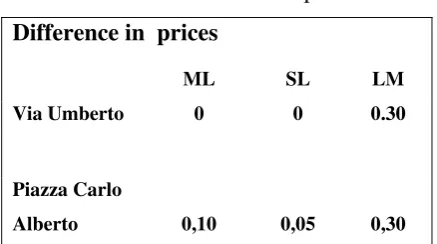
one product of three products here considered), is less intense than the one along the Via Etnea-axis (see Table 2).
Table 2.- Difference in prices
Difference in prices
ML SL LM
Via Umberto 0 0 0.30
Piazza Carlo
Alberto 0,10 0,05 0,30
Could we find some relation among the theory just exposed and the empirical evidence here reported? Could we reconcile the cohabitation into the centre connected to the highest levels of price recorded in Via Umberto, with the situation in Piazza Carlo Alberto, in which the central location is associated with the lowest level of recorded prices?
These two situations seem in contradiction each other, but both situations can be explained in light of theoretical framework introduce above. Indeed, central location has a polarizing effect on prices that became higher if a collusive agreement is done, as argued by Jehiel (1992), or equal to marginal costs because of a à la Bertrand competition.
Hence, what happens in Via Umberto can be interpreted as the result of a collusive agreement that pushes prices upward and leads both firms to the central location. The other situation can be interpreted instead, as the outcome of a market in which both stages are played and, since it is evident that in the real world location choice is more binding than that the one involving price, competitive tensions affects this last stage.
Why collusion is possible along Via Umberto is an open matter. Obviously, it depends on behavioural parameters that cannot be inserted into the simple model introduced above.
However, it reasonable the assumption that environmental factors conditioning firms behaviour is uniform “across axis” of the same town.
price. While the situation regarding “Piazza Carlo Alberto”, is very similar to the hypothesis of uniform distribution as nearly "uniform" is the position of the stands there located, therefore being affected by a smaller incentive to collude.
In other words and on extreme synthesis, the “funny” empirical evidence related to the drink kiosks, could be interpreted in the sense that consumers distribution with a central peak does not imply the realisation of minimum differentiation strategy unless firms collude. Nevertheless, it could interpreted as a meaningful incentive to the adoption of collusive behaviours on prices.
5. Conclusions
This paper analysed the effects of the consumers concentration towards the central localization in the space of product characteristics, in a model of horizontal differentiation with quadratic transportation costs.
From the vast body of literature developed in this field it is well known the importance both of transportation cost function and consumers distribution on market equilibrium.
This paper pointed to the effects of consumer distribution, considering a distribution function nearer to the real world than uniform distribution which is generally considered. Indeed, usually in the real world, "extreme positions" have a smaller relative weight.
Hypothesizing a consumers distribution not already uniform, but with a central peak, the strength of the minimum differentiation principle was verified in a different way. I shown, in particular, that even in the case of (symmetrical) triangular distribution with central peak, if firms compete in both the price stage and in the location stage, they will not adopt central-location strategy. Indeed, they will maintain a location next to the market edges. Put differently, firms optimal behaviour consists in pushing the indifferent consumer to the centre of the unitary segment.
The economic interpretation of results is based, not only on models of differentiation and competition, but also on the possibility that the duopolist conclude collusive agreement on price.
Observed behaviours characterized either by central location-elevated prices or central location–low prices can be explained, in particular, observing the polarizing (upward or downward) effect that the central location exerts on prices.
References
Anderson, S. P. – J. K. Goeree,– R. Ramer, 1997, “Location, location, location”, Journal of Economic Theory, vol. 77, pp. 102–127.
Benassi, C. – R. Cellini – A. Chirco, 1999, “Market Power under Income Polarization”, Journal of Economics, vol. 3, pp. 289-298.
Benassi, C. – A. Chirco, 2008, “An elasticity approach to equilibrium and preference concentration in the Hotelling game”, Journal of Economics, vol.94, pp. 125-141.
Bertrand, J., 1883, “Théorie mathématique de la richesse sociale”, Journal des Savants, vol. 48, pp. 499-508.
Calvò-Armengol, A.- Y. Zenou, 2001, “The importance of the distribution of consumers in horizontal product differentiation”, dattiloscritto.
Carraro, C. – C. Graziano, 1993, “Mercati oligopolistici e strategie dell’impresa”, il Mulino, Bologna.
Cori, B. – G. Corna - Pellegrini - G. Dematteis - P. Pierotti, 1998, “Geografia Urbana”,Utet, Torino.
d’Aspremont,C. – J. J. Gabszewicz - J. F. Thisse, 1979, “On Hotelling’s Stability in Competition”, Econometrica, vol. 17, pp.1145-1151.
Economides, N., 1986, “Minimal and Maximal Differentiation in Hotelling’s Duopoly”, Economic Letters, vol. 21, pp.160-172.
Economides, N., 1989, “Symmetric Equilibrium Existence and Optimality in Differentiated Products Markets”, Journal of Economic Theory, vol. 47, pp. 178-194.
Gabszewicz, J. - J. F. Thisse, 1986, “On the Nature of Competition with Differentiated Products”,
Economic Journal, vol. 96, pp.160-172.
Gabszewicz, J. - J. F. Thisse, 1979, “Price Competition, Quality and Income Disparities”, Journal of Economic Theory” , vol. 20, pp. 340-359.
Garella, P. - L. Lambertini, 2001, Organizzazione Industriale, Carocci, Roma.
Hotelling, H., 1929, “Stability in Competition”, Economic Journal, , vol.39, pp. 41-57.
Jehiel, P., 1992, “Product Differentiation and Price Collusion”, International Journal of Industrial Organisation, vol.10, pp. 633-642.
Liarte, S – B. Forgues, 2008, “Location strategies of multiunit service businesses: spatial differentiation and agglomeration among hamburger restaurants in Paris, 1984–2004”, Service Business, vol.2, pp. 233-248.
Neven, J., 1986, “On Hotelling’s Competition with Non-Uniform Customer Distributions”,
Economics Letters, vol. 21, pp. 121-126.
Robinson, J., 1933, “The Economics of Imperfect Competition”, Macmillan, London.
Salop, S., 1979, “Monopolistic Competition with Outside Goods”, Bell Journal of Economics, vol.10, pp. 141-156.
Scrimitore, M., 2003, “Symmetric and Asymmetric Equilibria in a Spatial Duopoly”, dattiloscritto, Lecce.
Selten, R., 1975, “Re-examination of the Perfectness Concept for Equilibrium Points in Extensive Games”, International Journal of Game Theory ,vol. 4, pp. 25-55.
Shaked, A. - J. Sutton, 1982, “Relaxing Price Competition Thought Product Differentiation”,