Munich Personal RePEc Archive
The Economic Reunification of Korea: A
Dynamic General Equilibrium Model
Bradford, Scott C. and Phillips, Kerk L.
Brigham Young University
February 2008
Online at
https://mpra.ub.uni-muenchen.de/23550/
The Economic Reunification of Korea:
A Dynamic General Equilibrium Model
Scott C. Bradford
Department of Economics
P.O. Box 22363
Brigham Young University
Provo, UT 84602-2363
phone: (801) 422-8358
fax: (801) 422-0194
email: [email protected]
Kerk L. Phillips* Department of Economics
P.O. Box 22363
Brigham Young University
Provo, UT 84602-2363
phone: (801) 422-5928
fax: (801) 422-0194
email: [email protected]
February 2008
Keywords: factor mobility, dynamic general equilibrium, specific-factors, Korea
JEL codes: F15, F22, F42
*
Abstract
This paper constructs a dynamic specific factors model to examine the impact of the
economic reunification of North and South Korea. The model is a compromise between the
highly stylized neoclassical models of trade found in the theoretical trade literature, and the
highly aggregated models used in dynamic macroeconomics. We find that the policies with the
biggest effects on aggregate output are changes in government tax and spending rates,
particularly spending on infrastructure. In contrast, we find that both skilled and unskilled wages
are much more responsive to the particulars of trade policy, particularly openness to intra-Korea
trade and intra-Korea labor mobility. The location of production in a fully integrated Korean
1 Introduction
When World War II ended on August 15, 1945, Japanese forces occupying Korea south of
the 38th parallel were directed to surrender to US forces. Those in the North surrendered to
Soviet forces and Korea was effectively divided. Ideological differences led to the establishment
of two separate governments in 1947 and 1948. In June of 1950 war broke out and the ensuing
stalemate has left Korea divided ever since.
Recent political events have made the prospects for Korean reunification quite dim. Despite
this, Koreans on both sides of the border express strong desires to reunite. There seems little
doubt that given the right political climate reunification will occur.
In the six decades since Korea was divided much has changed. The economic miracle in
South Korea is well documented and widely studied. Following the Japanese model of export
oriented growth, output grew rapidly in the 1970’s and 1980’s and the South still maintains a
relatively high annual average real growth rate. South Korea today enjoys a robust, healthy
economy.
The Japanese occupation left the North with greater industrial capacity, but much of this
was destroyed by the Korean War. During the Cold War, the North nimbly played on
animosities between its two main benefactors, China and the Soviet Union, and made remarkable
progress in standards of living. However, things have changed since the demise of the Soviet
Union. Markets for North Korean manufactures have all but disappeared. While China does
supply some aid, it is nowhere near the levels the Soviet Union used to provide. Famines have
repeatedly swept through the country in recent years due to a combination of poor agricultural
management policies and unfortunate weather conditions.
While the South has continued to grow and now enjoys per capita GDP on par with those of
many developed nations, the North has slowly slid into poverty. South Korea trades heavily with
the rest of the world. North Korea is isolated and its economy bears a remarkable resemblance to
old Korea, which was often called the Hermit Kingdom for its closed borders and reluctance to
deal with outsiders.
If reunification occurs anytime in the near future the huge differences in standards of living
are likely to cause radical adjustments. With 22 million people in the North and another 47
million in the South the problems will be at least as daunting as those that confronted East and
West Germany over a decade ago. Indeed, given the larger difference in standards of living and
This paper focuses on the likely consequences of the reunification of the two Koreas. We are
interested in several questions. There is little doubt that North Korea will benefit from almost
any change in economic policy. We examine the effects of various kinds of reform on the North
Korean economy. These range from internal reforms that encourage the establishment of
markets to complete economic integration with the South. While happenings in the North are of
vital importance to the lives of millions, the questions facing the South are more subtle, and
hence have less obvious answers. Will the South benefit on net from reunification? Who will
gain and who will be harmed? South Korea is already an open economy. How large can the
benefits of preferential trade with an economy as backward as the North be? How much will
South Korean wages and standards of living be lowered due to competition from workers in the
North? We attempt to address these questions using a calibrated dynamic general equilibrium
model of the North and South Korean economies.
Of course, we are not the first researchers to examine the economic consequences of reform
and reunification on the Korean peninsula. For obvious reasons, researchers in Korea have
examined this issue for many years. Shim (1993) is a good example; it focuses on the optimal
timing of various reform and unification policies. Most work in this literature has concentrated
on the politics of reunification, however, and the economics have not kept pace with
developments in macroeconomic and international trade modeling.
Notable exceptions to this generalization are Noland, Robinson & Liu (1999) and Funke &
Strulik (2005). The first paper calibrates a multi-sectoral computable general equilibrium model
(CGE) for North and South Korea for 1990. Funke & Strulik (2005) set up an endogenous
growth model and examine the dynamics of reunification. They consider the role of
interregional transfer payments and government budgets, issues which we ignore in this paper.
The biggest area of difference between our model and these is in the dynamics. Our model is
based on discrete-time dynamic programming tools used widely in dynamic stochastic general
equilibrium (DSGE) macroeconomic models, albeit the simulations we perform are
non-stochastic. Noland, Robinson & Liu (1999) impose calibrated reduced-form dynamic equations,
while Funke & Strulik (2005) calibrate continuous time structural dynamic equations. Our
characterization of technology and its evolution over time also differs. Our model focuses on
implementation of the current best worldwide technology and the role of infrastructure.
Our choice of a modeling framework is not entirely new, though its application to Korean
unification certainly is. Both Eaton (1987) and Roldos (1991) presented early work on dynamic
as optimally acquired financial assets. Using labor as the mobile factor, he focuses on the
conditions under which the dynamic model displays behavioral properties similar to the static
model. Roldos used a model conceptually very similar to ours to examine the effects of various
types of tariffs on the current account. More recent uses include: Kose (2002), which uses a
similar model to find the proportion of business cycle movements in developing economies
attributable to international price fluctuations; and Albert & Meckl (1998), which examines the
role of qualitatively rational expectations in capital accumulation.
Our choice of a model is motivated by the simple and well-understood properties of the
specific factors model along with a desire to build a model that can be calibrated to reasonably
mimic the actual North and South economies.
We model skilled labor as specific factors and capital and unskilled labor as mobile factors.
We also model defense considerations by having a government that invests in military capital
and conscripts workers to provide some chosen level of defense.
Once this model is calibrated we can examine a variety of reforms and types of reunification.
We first derive and calibrate a baseline model in sections 2 and 3. This baseline model assumes
profit maximizing firms and utility maximizing consumers. For this reason it does not
correspond to the current situation in North Korea. We interpret this baseline as the situation
that would prevail if the North were to adopt internal economic market reforms, while remaining
closed to trade and maintaining defense parity with the South. Section 4 examines the impact of
trade liberalization, defense reduction, a free trade arrangement, coordination of common
macroeconomic policies and full integration. It also considers a scenario where these reforms
are phased in over time. Section 5 concludes with a summary of the results and suggestions for
further research.
2 A Dynamic General Equilibrium Model
We build a model with infinitely-lived households that maximize discounted lifetime utility.
They derive utility from consumption of a single non-traded final good, which can also be used
to form capital of various types. This final good is produced using a set of J intermediate goods.
We treat this good as non-traded because we consider the production of final consumption and
capital goods as something that must be done on site. To build a factory, a firm may purchase all
the necessary materials, but it still needs to assemble the parts – it cannot import the factory
completely preassembled. Assuming non-traded capital means that the capital account is always
Intermediate goods are produced using three factors: capital, unskilled labor, and skilled
labor. We choose these three factors based on data from the Global Trade Analysis Project
(GTAP) which reports payments to five different factors. Two of these, natural resources and
land, are not used in the manufacture of all goods and together contribute less than five percent
of national income. We ignore these two and build a model around the remaining three factors.
Skilled labor is assumed to be specific to the industry in which it is used; that is, it cannot be
used to produce any other intermediate good. Both capital and unskilled labor are mobile across
all J sectors. Skilled and unskilled labor are assumed to be fixed by endowment, while capital is
accumulated optimally over time. Capital and both kinds of labor are non-traded. Intermediate
goods can be traded or non-traded and we calibrate the model accordingly once we identify each
of these sectors.
Conceptually, it might seem more natural to think of capital as a specific factor; capital goods
are certainly more specialized for specific tasks than skilled labor is. However, capital is
accumulated and depreciates over time making it a de facto mobile factor. If we were to model
capital as having J different types, each specific to a particular intermediate good, the only
substantive difference between that model and ours would be a non-negativity constraint on
investment for each type of capital. Since skills are generally task specific, skilled labor is more
likely than unskilled labor to be immobile across sectors.
The government engages in two activities, accumulation of infrastructure capital and
provision of national defense. We assume it imposes lump-sum taxes each period to provide
public investment in infrastructure and military capital. It also imposes conscription on unskilled
labor which is used along with military capital to provide a desired level of national defense. We
impose conscription on unskilled labor only as this seems closest to what is actually done. Most
soldiers are conscripted at relatively young ages before they have acquired any special job skills.
In the long-run the economy grows because of exogenous technical progress. Since both
countries are small, the progress comes primarily from overseas and we impose a constant
growth rate for this external process. Domestic productivity levels are assumed to be influenced
by the level of infrastructure, however, and changes in the stock of infrastructure can therefore
have short-run effects on the growth of domestic productivity.
We now proceed to formally setup and solve the model for a single economy.
Households are infinitely-lived and maximize the discounted sum of all lifetime utility. We
write this optimization as a standard dynamic programming problem using the following
Bellman equation: )} ' , ' ( { ) ( Max ) , (
' + Θ
=
Θ U C E V K K
V
K β (2.1)
where C is the household’s consumption, β is the rate of time preference, K is capital stock,
Θ is its information set used to take expectations, and the primes indicate values of variables next period.
Consumption is income from skilled labor (L), unskilled labor (N), and capital, less
depreciation, investment in new capital, and lump-sum taxes (T) as below.
T K K r N f v L w C i i
i + − + + − − −
=
∑
(1 ) (1 δ) ' (2.2)where wi is the wage rate for skilled labor in sector i, v is the wage for unskilled labor, r is the
rental rate for capital, δ is the depreciation rate, and f is the government conscription rate.
We assume a constant elasticity of substitution utility function of the following form:
σ σ − − = 1 1 1 )
(C C
U (2.3)
Hence, the Euler equation associated with this optimization problem is:
)} ' 1 ( ' { δ β σ
σ = − + − −
r C
E
C (2.5)
Final Goods Producers
The final goods sector is perfectly competitive with free entry and zero profits. Firms
therefore solve the following profit maximization each period:
∏
−∑
∑
= = Π j j j j j j a j FF F PF a
j j 1 ; Max }
{ (2.6)
where Fj is the amount of good j used in production of the final goods and Pj is its price.
The first-order conditions reduce to the following J conditions:
Y a F
Pj j = j ; ≡
∏
∀j a j j
F
Y j (2.7)
Intermediate Goods Producers
Intermediate goods are also competitively produced and the firms solve the following
problem: j j j j c b j c j b j j j N L
Kj j j PK ZN ZL rK w L vN
− −
− =
Π 1− −
,
, ( ) ( )
where Z is an economy-wide level of domestic productivity which is driven by external
productivity and domestic infrastructure.
The first-order conditions reduce to the following 3J conditions:
j j j bPY
rK = ; Y K ZN ZLj b c j
c j b j
j ≡ ∀
− − 1 ) ( )
( (2.9)
j Y cP
vNj = j j ∀ (2.10)
j Y P c b L
wj j =(1− − ) j j ∀ (2.11)
Government
The government imposes taxes to build up the domestic stock of military capital (M) and
infrastructure (I). Gross investment in these two capital stocks is indicated by a preceding Δ. The government’s budget constraint is:
I M
T =Δ +Δ (2.12)
Military capital and infrastructure evolve over time according the following two laws of
motion:
M M
M'=(1−δ) +Δ (2.13)
I I
I'=(1−δ) +Δ (2.14)
The government also conscripts soldiers from the ranks of unskilled labor. It combines these
soldiers with the military capital to produce a level of national defense as shown below:
d d
ZfN M
D= ( )1− (2.15)
Technology
There are many ways that infrastructure may influence technology1. We assume the
economy-wide technology level, Z, evolves over time as a function of the external level of
technology and the domestic level of infrastructure per unskilled worker:
h h
N I z
Z = ( / )1− (2.16)
where z is the world technology level.
This formulation is intended to capture movements in total factor productivity (TFP) that are
unrelated to technology, per se. It explains how, even though the North has access to the same
technology internationally, it has generally lower total factor productivity than the South. Using
1
infrastructure per unskilled worker assumes that infrastructure is primarily rival in nature and
that greater amounts are needed for a larger population. We use unskilled workers rather than
the sum of skilled and unskilled labor for analytical ease in simulations with internationally
mobile factors. As a result, when skilled labor is mobile between the North & South, these
movements will not generate congestion effects, but mobility of unskilled workers will.
External technology grows at a predetermined constant rate of gz each period.
z g
z'=(1+ z) (2.17)
Combining (2.16) and (2.17) gives a law of motion for Z that depends on last period’s level
and the growth rate of the infrastructure stock.
Z g g
Z'=(1+ z)h(1+ I)1−h ; II I
g '
1+ ≡ (2.18)
Aggregation and Market-Clearing
The final goods market and the markets for capital and both kinds of labor are closed to
imports, so domestic supply must equal domestic demand. Intermediate goods may be either
closed or open to trade. We adopt notation that allows for all intermediate goods to be traded,
but will impose zero export restrictions in the appropriate industries.
The aggregation and market-clearing conditions are:
capital stock aggregation,
∑
=
j j
K
K (2.19)
unskilled labor market clearing,
∑
= −
j j
N N
f) 1
( (2.20)
skilled labor market clearing,
j L
Lj = j ∀ (2.21)
intermediate goods market clearing,
j X F
Yj = j + j ∀ (2.22)
and final goods aggregation
I M K C K
Y+(1−δ) = + '+Δ +Δ (2.23)
The above sections define a model with growth. Some variables - such as, consumption,
capital stocks and production - grow at the rate gz in the steady state. Others, such as goods
prices, remain constant. In order to solve the household’s dynamic programming problem we
rewrite the system in a stationary form by dividing all growing variables by Z. This yields a
steady state where all values are constant and where the off-steady-state dynamics are
characterized by convergence to these constant values. We solve this altered set of equations,
but then readjust once we are done so that all growing variables have the appropriate growth
component added back in our simulations.
The model as a whole has three endogenous state variables, K, M & I. It also has three
exogenous policy variables which should also be viewed as state variables. These are the
conscription rate, f, and decisions about the accumulation of infrastructure and military capital.
We choose to characterize government policy as the percent of Y that will be allocated as
investment in these two stocks. We define the following i≡ΔI/Y and m≡ΔM /Y and model
the government as setting these exogenously. Hence, the exogenous state variables are f, i & m.
We solve the model first by searching for a set of prices that yield steady state exports and
imports equal to the averages observed in the GTAP dataset. We treat the prices for sectors the
traded intermediate goods as fixed international prices and use these constant relative values for
all simulations. The prices in the non-traded sectors are autarky prices and are part of the
solution for each simulation.
As long as the North and South have no unique trading relations, we can treat each as an
economy in isolation2 and solve a one-economy model for each country. We treat production
capital, K, and infrastructure I, as our endogenous state variables. We also solve for the
non-traded intermediate goods prices as endogenous non-state variables. We impose the stationary
versions of (2.5) and (2.18) along with four restrictions of zero imports for the non-traded sectors,
three restrictions on relative prices for the traded sectors, and one price aggregation constraint
relating intermediate good prices to the price of final output (our numeraire) to give us a system
of ten equations in ten unknowns which describes the steady state.
In the scenarios where there is a free trade arrangement or intra-Korea mobility of labor, we
solve a two-country version of the model. In this case we have capital and infrastructure in both
regions as endogenous state variables and prices as endogenous non-state variables. We impose
the North and South versions of (2.5) and (2.18) as above. For the non-traded sectors we impose
2
the constraint that the sum of exports from both regions must be zero. All other conditions are
the same as the one-country case. This yields a system of 12 equations in 12 unknowns.
In addition to the steady states, we are also interested in transition dynamics. The numerical
techniques for solving these types of dynamic problems are well-known.3 They require the use
of the same system of equations used to find the steady state. We use the method of
undetermined coefficients to solve for a linear approximation to the intertemporal decision rules
for capital and infrastructure about their steady state values. With these rules in hand, we are
able to examine the path of key macroeconomic variables from some initial state to the steady
state that are implied by a variety of policies.
3 Baseline Model Calibration & Simulation
We calibrate our model by choosing a baseline scenario where both the North and South are
open to trade. From this baseline we consider various degrees of economic cooperation and
integration between the North and South. We base much of our calibration on data from South
Korea. Where possible we use the limited data on the North Korean economy. In many cases,
however, we are forced to assume that the North looks similar to the South and calibrate using
data from South Korea.
Our first task is to aggregate the 57 industries in the GTAP dataset into a smaller and more
manageable number. We distinguish between foods, processing, manufactured goods, utilities
and other services. We examine the GTAP data for South Korea and discover that foods and
services have a great deal of variation of total trade as a percentage of output across the various
GTAP industries. We divided each of these sectors into traded and non-traded sectors using a
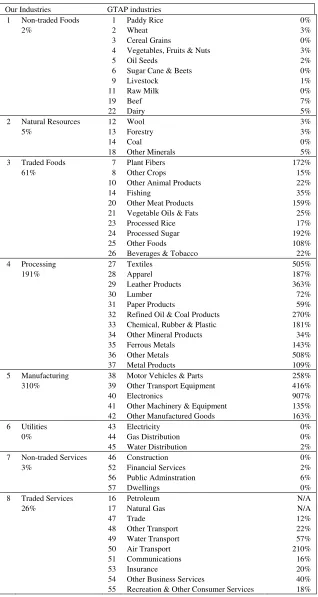
cutoff of 10% of output as the criterion for a traded good. Non-traded foods include grains and
other staples. While North Korea trades very little, these foodstuffs are a large portion of that
trade. Since these foods are non-traded in the South due to trade barriers, we will continue to
treat them as non-traded in the North Korean case, under the assumption that the North will
impose similar agricultural protection. GTAP does not report imports and exports of oil and
natural gas which are not produced in Korea. We assume that our last industry, traded services,
includes imports and exports of oil, natural gas. Table 1 summarizes this information.
For calibration purposes our time-period is one year and we choose our parameter values
accordingly. We need to set the following parameter values for both countries:
3
z i b c h g
a}, , , , , , ,
{ β δ σ . In addition we need to pick values for labor endowments,{Li}&N, and
world prices, {Pi}, for traded intermediate goods.
β, the time discount factor is set to .975, implying a subjective discount rate of 2.56%; δ, the depreciation rate is set to .10, and gz, the international trend growth rate of technology is set
to .015. The steady state version of equation (2.5), written below as (3.5), is used to choose the
value of σ, the intertemporal elasticity of substition.
)} 1
( ) 1 (
1=β +gz −σ +r−δ (3.1)
We set the user cost of capital, r −δ , equal to 3% and solve to get σ =.087. All these values apply to both the North and South.
We use data from GTAP (version 5) to find the share of capital and unskilled labor in GDP
for South Korea. These values are b=.4414 and c=.3943.
The values for the ai’s come from aggregating the 57 industries in the GTAP dataset into
eight and finding their output shares as a percent of total output. Again, this is done for South
Korea.
The GTAP data show that total compensation for skilled workers is about 40% of the total
compensation of unskilled workers. Since wages should be higher for skilled workers this is an
upper bound on their number. We assume an unskilled labor force of 300 and a skilled labor
force of 100. To calibrate the distribution of skilled labor over our eight industries we assume a
common real wage and make each labor endowment proportional to total compensation. When
we calibrate North Korea we will choose different values for the Li’s, using this baseline as a
reference.
For 2002 – 2004, the Republic of Korea spent 2.21% of GDP on “social infrastructure and
housing” and “information technology” and another 2.45% on defense. We therefore set
m=.0245 and i=.0221. The population aged 15 or older is 33 million and the non-military labor
force is 22 million. Figures for the military are harder to document, but most sources indicate it
has roughly three-quarters of a million men under arms. Since we have already assumed that
three-fourths of the labor force is unskilled, the conscription rate on unskilled workers is either
2.92% of the population or 4.18% of the labor force. We use the latter value.
For North Korea we keep the same values for b, c, h, gz, β, δ & σ. The total population in
North Korea is around 23 million versus South Korea’s 48 million. We set overall labor to 180;
difficult to pin down. For lack of defensibly better numbers, we assume that the percent of the
total labor force that is skilled is half the value we use for South Korea. That is 12.5%, rather
than 25%. This gives N=157.5 and Li’s that sum to 22.5. The allocation of skilled labor across
industries is calibrated using data on similar industrial classifications from South Korea’s
Ministry of Unification. When this data does not match our 8 industries exactly we impose
ratios similar to those observed in South Korea. The exact distribution of skilled labor is shown
in the first panel of Table 2.
For policy variables we take a military force of one million and divide by 87.5% of the 9.2
million labor force and round to get f=.124. Determining the values of military and
infrastructure parameters is the most problematic of all. The value of m=.25 is chosen to give the
North and the South roughly equal levels of defense in the steady state for our baseline. i is set
to half the value of the South. We note that our simulation is for a case where reforms have been
instituted in North Korea and need not reflect exactly current economic policy.
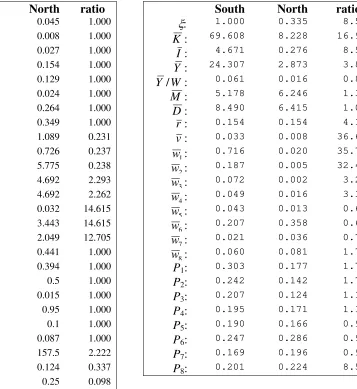
The values of all the parameters and the steady state values for this baseline model are also
reported in table 2.
We assume that initially neither the South nor the North is in the steady state. This means we
need to choose starting values for five values: capital stocks in both countries, infrastructure in
both countries, and the relative level of technology in the North.4
South Korean growth rates per capita are greater than our steady state value of 1.5% per year,
and have a gradual downward trend. We constrain the initial ratio of private capital to
infrastructure to be equal to the steady state ratio and then choose initial values for the capital
stock and infrastructure so that the initial growth rate in the South is 5% per annum, roughly the
average real growth rate over the last five years.
We need to know the difference between technology in North and South Korea. We use
(2.16) and define the relative technology measure, ξ ≡ZN /ZS to get h
N S
S N
N I
N
I −
⎟⎟ ⎠ ⎞ ⎜⎜
⎝ ⎛ =
1
ξ (3.2)
4
Choosing a value for the initial infrastructure in the North also determines the initial level of
technology. We assume that infrastructure in the North begins 15% below its steady state value.
We assume capital is also 15% below steady state.
These assumptions yield an initial per capita income level in the North that is 16% of the
South’s. The baseline model assumes that North Korea is characterized by agents responding
optimally to market signals. Since this is obviously not the case now, we must interpret this
model as a scenario where the North has already engaged in some kind of market reform. Our
starting values give GDP in the South that is almost fourteen times that in the North. However,
the Ministry of Reunification estimates that South Korea’s GDP was actually 26.8 times that of
North Korea in 2001. This implies that internal reform in the North would result in efficiency
gains that roughly double output.5
We wish to remphasize that the values used in our simulations are very rough approximations.
As a result we have little confidence in the exactness of the numbers from our simulations.
Particularly for the North our numbers can serve only as very rough guides as to the general
direction and magnitude of changes.
Given these starting values we proceed to simulate the model economies.
4 Scenarios
With the model solved, calibrated and simulated for a baseline case, we now proceed to
consider various steps on the road to unification. These steps include changes in international
trade policy and in other economic polices. We consider the steady states of six scenarios in
addition to the baseline. Some scenarios are unlikely. Our baseline where the North institutes
market reforms but does not open to international trade, for example. We present them
nonetheless to isolate the effects of each of the various policy changes.
These are as follows:
• Scenario 2 –Baseline, plus North opens to world trade.
• Scenario 3 – Scenario 2, plus both North and South reduce defense.
• Scenario 4 – Scenario 3, plus North and South form a free trade area
• Scenario 5 – Scenario 4, plus North and South adopt identical government policies.
• Scenario 6 – Scenario 5, plus North and South allow skilled laborers to migrate across the border. We show that in the steady state this is identical to a fully integrated economy
5
where all goods are tradable and all factors are mobile between the North and the South.
Away from the steady state however, the dynamics will differ from a fully integrated
economy. We discuss this in more detail below.
We also present a final simulation with off-steady-state dynamics that illustrates the phased
implementation of each of the policies above.
Scenario 2 – The North Opens to World Trade
In this case we maintain the baseline model for the South and have the North trade
intermediate goods, 3, 4, 5 and 8 at the same relative prices as the South. Table 3 shows the
steady state values for this scenario and compares them with the baseline.
In the North, output, production capital, military capital and infrastructure rise by 29% in the
steady state. The level of defense rises by 20% due to the higher level of military capital.
Unskilled wages rise by 29%. Skilled wages fall by an average of 23%. However, skilled wages
in specific sectors vary dramatically6. In processing they rise by 349%. In traded services they
fall by 90% and they fall by between 54% and 57% in the other six industries.
Scenario 3 – Defense Reductions
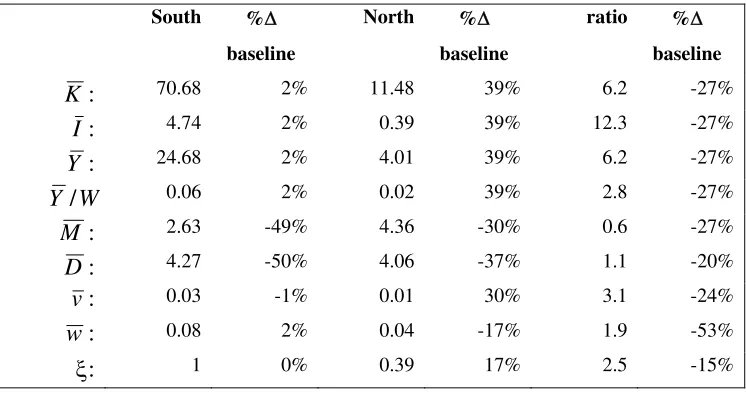
In this case we have both the North and South reduce their conscription rates and military
investment rates by 50%. This frees up both capital and workers for employment in the
production of goods and services. Table 4 shows the steady state values.
Increases are modest in the South. Output, production capital, military capital and
infrastructure rise by 2%. Unskilled wages fall by 1% and skilled wages rise by 2% across the
board
In the North output, production capital, military capital and infrastructure rise and become
39% higher than the baseline. Unskilled wages rise to 30% higher than the baseline while skilled
wages recover, though they still remain 17% below the baseline.
The steady state level of defense falls 50% in the South, but only 37% in the North. The
difference is due to the fact that there are much larger gains in productivity in the North than in
the South in the long-run, leading to relatively more military capital there.
6
Scenario 4 – A Free Trade Arrangement
In this scenario both the North and South retain their new lower levels of defense, but also
allow free trade in all intermediate goods with each other. Intermediate goods 1, 2, 6 & 7 are
still non-traded outside Korea. Prices of these goods must now adjust each period to ensure that
what is exported from one half the country is imported by the other half. Table 5 shows the
steady state values for this scenario.
Again, the gains from a free trade area are small, but nontrivial, in the South. Output,
production capital, military capital and infrastructure are 2% higher than the baseline. Skilled
wages, however, drop by an average of 24%. Given the South has a relative abundance of
skilled labor, the drop is not too surprising, but the size of the drop is quite large. A closer looks
shows that skilled wages in non-traded foods and natural resource extraction fall by over 60% of
their baseline values. These are the industries where the North actually has more skilled labor
and where the goods are not internationally traded, giving the North a comparative advantage
vis-à-vis the South. In the other two non-traded industries, utilities and non-traded services, the
South has a higher endowment of skilled labor and these wages rise to 17% above the baseline.
Skilled wages in the traded industries rise less than 1%. Unskilled wages also remain virtually
unchanged.
In the North we observe a symmetrical pattern with huge increases in skilled wages in
industries 1 & 2 (140% above baseline), and large declines in industries 5 & 6 (87% below
baseline). The movements in other skilled wages are smaller, but still large with a falling wage
in industries 4, 5 & 8 and a rising wage in industry 3. Output, production capital, military capital
and infrastructure rise an additional 21%. Unskilled wages rise 19%
Scenario 5 – Common Economic Policy
This scenario requires a great deal more political cooperation than previous ones. It is hard
to imagine this occurring without some sort of political unification. We assume that the South
keeps its economic policies unchanged, but the North lowers its conscription rates and military
investment rates to the same levels as the South, while simultaneously raising the infrastructure
investment rate to also match the South. Table 6 show steady state values.
Not surprisingly, there are only small changes in the South’s steady state values. The only
substantial change is further movements in skilled wages. Falling in industries 1 & 2, and rising
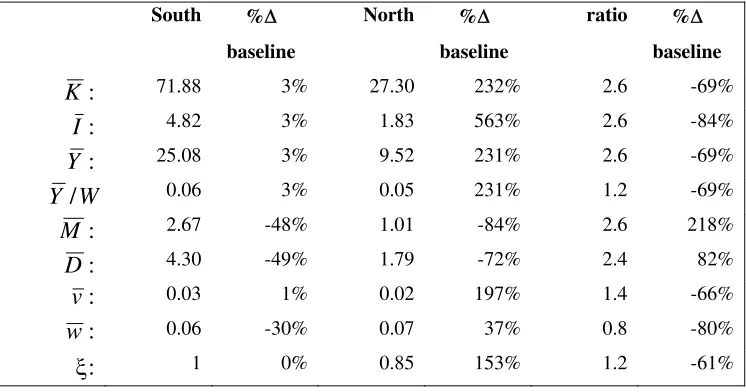
There are huge movements in the North, however. Infrastructure quadruples, while output,
production capital and military capital double. Unskilled wages rise to 391% of the baseline and
the average skilled wage is 24% higher than the baseline..
The policy with the biggest effect, by far, is this one where the North reduces defense
spending and puts more into infrastructure.
Scenario 6 – Mobility for Skilled Labor or a Fully Integrated Economy
There is only one specific factor, skilled labor, for each intermediate good. If skilled labor is
allowed to migrate between the North and the South it will do so based upon the relative levels
of skilled wages in these two regions.
It is straightforward to show that the return on any particular type of skilled labor does not
depend on the amount of skilled labor employed as long as each sector is small. Intuitively, this
is because skilled labor is the unique factor which defines the industry. Capital and unskilled
labor are mobile across industries and the market will allocate them optimally across the
available skilled labor. If skilled labor were to expand in one small sector only, the market
would allocate a proportional increase in capital and unskilled labor to that sector. This would
have only an infinitesimal effect on the capital and unskilled labor in other sectors. Since we
have assumed constant returns-to-scale production this would lead to only infinitesimal changes
in marginal products of the factors leaving the equilibrium factor prices unchanged.
This means that allowing mobility of one kind of skilled labor only will not result in an
equalization of its wages between the North and South. Rather, all the skilled labor in that
particular industry would migrate from the low wage country to the high wage country, and the
skilled wage would remain unchanged.
If skilled labor of all types is allowed to migrate then factor prices will be effected since the
reallocation of capital and unskilled labor will no longer be infinitesimal. This means the
amount of skilled labor migration in any particular industry is indeterminate, but the total
migration of skilled labor of all types is uniquely determined. To resolve this indeterminacy we
assume that the percent of the total skilled labor endowment for the North and South actually
present in the South is the same for all industries. That is
i L L L
L L
L N
i S i N
i N i S i S
i =μ( + ); =(1−μ)( + ) ∀ (4.1)
c b c N N S S c b b N S c b b N S N f N f K K Z
Z + + +
− ⎟⎟ ⎠ ⎞ ⎜⎜ ⎝ ⎛ − − ⎟⎟ ⎠ ⎞ ⎜⎜ ⎝ ⎛ ⎟⎟ ⎠ ⎞ ⎜⎜ ⎝ ⎛ ≡ + = ) 1 ( ) 1 ( ; 1 1 ν ν ν
μ (4.2)
which is identical for all industries.
In the case where economic policy is the same in both the North and the South, technology
levels will be equal in the steady state. Both capital and skilled labor will be present in both
regions in the same proportion as the endowment of unskilled labor and all prices will be the
same as well. Thus, skilled labor mobility with identical economic policies amounts to the same
thing as a fully integrated economy, at least in the steady state.
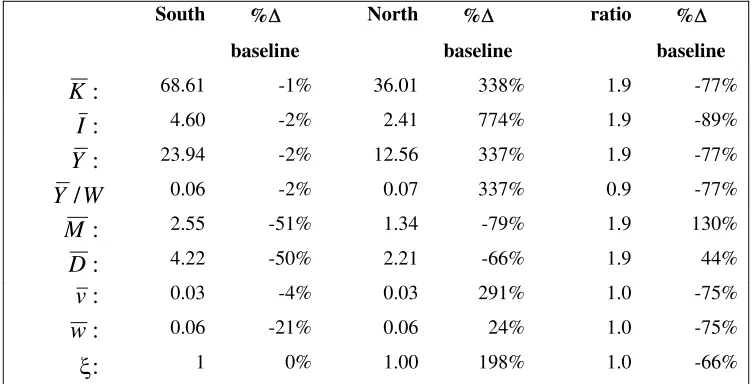
Table 7 shows a fully integrated economy. The location of production is indeterminate if
both types of labor are freely mobile across regions. For this table we assume skilled labor is
mobile, but that unskilled labor is not7. In this case, skilled labor will migrate out of the South
and into the North. We observe small drops in output, capital and infrastructure in the South. In
the North, we have increases in output, capital and infrastructure (on the order of 30%). The
average skilled wage falls by a third, and the unskilled wage almost doubles.
A Timed Phase-in of Reforms and Openness
Given currently political realities, it is difficult to predict what form unification of North and
South Korea would take. Unification could happen suddenly, as in the German case, with a
collapse of the political system in the North. It could also take the form of a military invasion.
We focus on a more gradual transition.
We imagine each of the previous scenarios occurring in succession with delays of five years.
Hence, we begin the simulation under the assumption of market reforms in the North. After five
years the North opens to trade with the rest of the world imposing tariff and non-tariff barriers
identical to those imposed by the South. After a further five years both the North and South
agree to cut military spending and conscription by half. In year 16, the North and South adopt a
free trade arrangement where intermediate goods from all sectors are freely traded across the
border, including those that are not currently traded internationally. Five years after this the
North adopts the same economic policy as the South. In year 26, migration of skilled laborers is
allowed, though unskilled laborers are not allowed to migrate. Finally, in year 31 we allow
unskilled workers to migrate as well. This leads to movements in technology levels through
7
congestion effects. As unskilled workers migrate from one region to the other, the effective level
of technology falls in the immigrant region and rises in the emigrant region such that unskilled
wages and technology are the same.
It is tedious, but straightforward to solve for the unique level of unskilled migration that
equalizes unskilled wage rates, which turns out to be the same as the migration rate for skilled
labor, μ.
) (
); )(
1
( N S S N S
N N N N N N
N = −μ + =μ + (4.3)
b h b b N S b h b h b N S K K I
I − − + − − − +
− − − ⎟⎟ ⎠ ⎞ ⎜⎜ ⎝ ⎛ ⎟⎟ ⎠ ⎞ ⎜⎜ ⎝ ⎛ ≡ +
= (1 )(1 ) (1 )(1 )
) 1 )( 1 ( ; 1 1 ν ν
μ (4.4)
Since the capital to infrastructure ratio is not the same in both regions, the economy is not
fully integrated in the sense that the North and the South are not simply scaled versions of each
other. This is because capital and infrastructure accrue historically at different rates. However,
it is possible for the government to engage in infrastructure investment that equalizes the capital
to infrastructure ratios. Even if infrastructure investment is irreversible, this can be
accomplished via depreciation of the stock in one region and putting all new investment in the
other region. Since we are dealing with a single government (or at the very least, two highly
cooperative ones) we assume the government does this at the same time it allows unskilled labor
mobility. This gives us a fully integrated economy starting in period 31. We note that the
permanent sizes of the South and North will depend on the sizes of their respective capital stocks
in this period. This can be seen by reexamining (4.4) when the capital to infrastructure ratio is
the same in both regions.
) / ( 1 ) / ( N S N S K K K K + =
μ (4.5)
In our simulation this leads to large amounts of migration. This migration pressure could be
relieved by waiting longer to allow labor mobility which would lower the KS /KN ratio. Also,
the government could introduce taxes and subsidies in prior periods designed to encourage larger
capital buildup in the North and less capital buildup in the South.
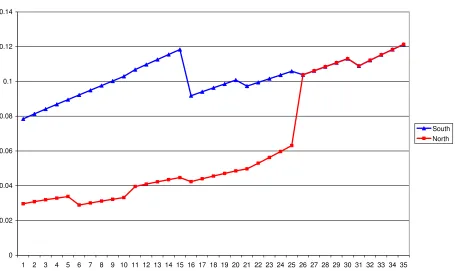
Figures 1 though 7 show the time path of various macroeconomic variables in the North and
South under this scenario.
Average skilled wages in the two regions equalize when skilled labor is allowed to migrate.
There is a large jump in skilled wages in the North when this happens. Skilled wages in the
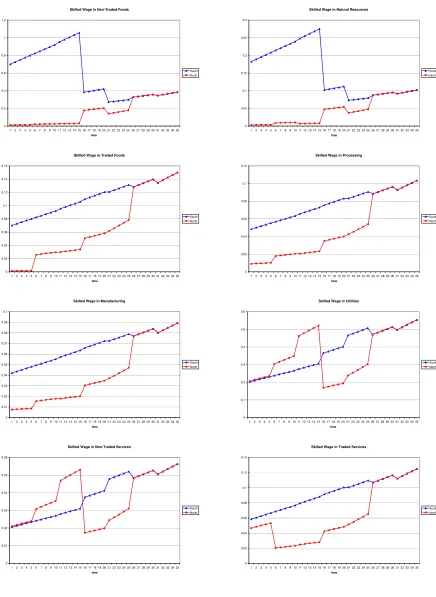
trade area. Figure 2 shows that the movements on specific skilled wages are very different from
the averages. For non-traded foods and natural resources (categories 1 & 2) the most dramatic
movements come with the free trade area, but skilled wages in the South remain higher than
those in the North until skilled labor migration is allowed. For utilities and non-traded services,
the drop in skilled wages associated with the free trade area occurs in the North, driving them
from levels above those in the South to levels well below those in the South. They rise
dramatically again when skilled labor migration is allowed. For all other industries (those where
there is significant trade with the rest of the world) skilled wages in the South respond very little.
In the North, they tend to rise with the implementation of the free trade area and again with
migration of skilled labor.
Figure 3 shows that unskilled wages rise in the South when skilled labor is allowed to
migrate. This is due to an influx of skilled workers into the South from the North which raises
the marginal product of unskilled labor. Equalization of unskilled wages due to migration of
unskilled labor then drives this wage down in the South and up dramatically in the North.
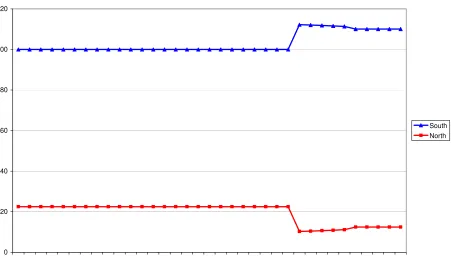
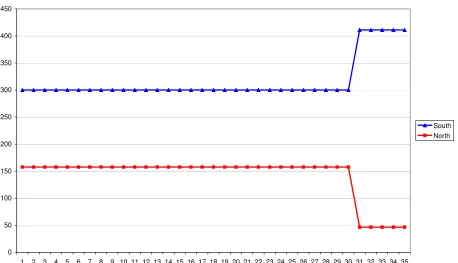
Figures 4 through 6 show that the movements in unskilled wages are driven primarily by
movements in levels of technology which are, in turn, driven by infrastructure congestion. When
unskilled labor is free to migrate, large numbers of unskilled workers migrate from the North to
the South, causing a drop in unskilled wages in the South and a rise in unskilled wages in the
North. This migration leads to infrastructure congestion in the South, lowering aggregate
productivity. The reverse is true in the North and aggregate productivity rises dramatically.
We assume in the scenario illustrated that there is no adjustment of the level of infrastructure
across regions. Instead, infrastructure per unskilled worker adjusts solely via unskilled labor
migration. The implied movements in unskilled labor are huge; more than two-thirds of the
North’s unskilled labor force moves to the South. This result is somewhat arbitrary. Since both
regions are simply scaled versions of each other, the government could just as easily choose to
invest more in the North’s infrastructure at the expense of the South’s. The amount of unskilled
labor migration needed to equalize unskilled wages would be smaller in this case.
Finally, table 7 shows that output per capita drops in the South and rises dramatically in the
North when unskilled labor is free to migrate. Again, this is due to technology jumps.
5 Conclusions
Our simulations indicate that the potential gains to North Korea from economic integration
great deal of uncertainty associated with our simulations. First, the parameterization of our
model (for North Korea in particular) is based on educated guess and assumption rather than
hard data. There is little that can be done about this other than to note the problem and perform
sensitivity analysis. Secondly, the timing of various reforms is speculative. We have no way of
knowing how much time would elapse between the North opening to international trade and
defense reductions, for example. They could well happen simultaneously. Policy makers are not
debating specific policies on infrastructure investment by the South in the North. Even the most
basic reforms we model seem unlikely in the near future.
With this important caveat, there is still a great deal of interesting behavior in the simulations.
We concentrate our attention on a few of the most important results.
First, adjustments to complete integration are likely to be large even with preparatory stages.
As we show, if there is no attempt made to equalize the levels of infrastructure per unskilled
worker, a majority of the North’s workers will want to migrate to the South. Undoubtedly much
of this is due to the simplicity of our model. There is no cost of migrating and the level of
technology depends strongly on the level of infrastructure per unskilled worker. Nonetheless, it
seems likely that unless the costs of migration were very high or technology was only very
weakly dependent on infrastructure per worker the amount of labor migration would still be very
high.
Second, the biggest long-run effects on output in the North come from changing government
policies. While movements in the direction of freer trade raise output per capita in the steady
state, the biggest gains come from raising infrastructure investment and lowering the defense
burden.
Third, the biggest effects on both skilled and unskilled wages in the North and South come
from allowing freer trade. This is either in the form of trade in goods or in the form of labor
migration. Hence, while overall welfare in the North is most strongly influenced by government
tax and spending policies, the biggest effects on owners of particular factors comes from the
References
Agénor, Pierre-Richard & Blanco Moreno-Dodson (2006) “Public Infrastructure and Growth: New Channels and Policy Implications,” World Bank Policy Research Working Paper 4064.
Albert, Max & Jurgen Meckl (1998) “Qualitatively Rational Expectations and Adjustment in the Specific-Factors Model,” Review of International Economics, vol. 6 no. 4, pp. 670-82.
Christiano, Lawrence J. (2002), “Solving Dynamic Equilibrium Models by a Method of
UndeterminedCoefficients,” Computational Economics, vol. 20, no. 1-2, pp. 21-55.
Eaton, Jonathan (1987) “A Dynamic Specific-Factors Model of International Trade,” Review of Economic Studies, vol. 54, no. 2, pp. 325-38.
Funke, Michael & Holger Strulik (2005) “Growth and Convergence in a Two-Region Model: The Hypothetical Case of Korean Unification,” Journal of Asian Economics, vol. 16 no. 2. pp. 255-79.
Kose, M. Ayhan (2002) “Explaining Business Cycles in Small Open Economies: 'How Much Do World Prices Matter?'”, Journal of International Economics, vol. 56 no. 2, pp. 299-327.
Noland, Marcus, Sherman Robinson & Ligang Liu (1999) “The Economics of Korean Reunification”, The Journal of Policy Reform, vol. 3 no. 3, pp. 255-299.
Noland, Marcus (2000) Avoiding the Apocalypse - The Future of the Two Koreas, Institute for International Economics: Washington, DC.
Roldos, Jorge E. (1991) “Tariffs, Investment and the Current Account,” International Economic Review, vol. 32, no. 1, pp. 175-94.
Shim, Ki R. (1993) “An Economic Model of Korean Reunification,” International Journal of Social Economics, vol. 20 no. 10, pp. 13-22.
Table 1
Total Trade as a Fraction of Sectoral Output, South Korea
Our Industries GTAP industries
1 Non-traded Foods 1 Paddy Rice 0%
2% 2 Wheat 3%
3 Cereal Grains 0%
4 Vegetables, Fruits & Nuts 3%
5 Oil Seeds 2%
6 Sugar Cane & Beets 0%
9 Livestock 1%
11 Raw Milk 0%
19 Beef 7%
22 Dairy 5%
2 Natural Resources 12 Wool 3%
5% 13 Forestry 3%
14 Coal 0%
18 Other Minerals 5%
3 Traded Foods 7 Plant Fibers 172%
61% 8 Other Crops 15%
10 Other Animal Products 22%
14 Fishing 35%
20 Other Meat Products 159% 21 Vegetable Oils & Fats 25%
23 Processed Rice 17%
24 Processed Sugar 192%
25 Other Foods 108%
26 Beverages & Tobacco 22%
4 Processing 27 Textiles 505%
191% 28 Apparel 187%
29 Leather Products 363%
30 Lumber 72%
31 Paper Products 59%
32 Refined Oil & Coal Products 270% 33 Chemical, Rubber & Plastic 181% 34 Other Mineral Products 34%
35 Ferrous Metals 143%
36 Other Metals 508%
37 Metal Products 109%
5 Manufacturing 38 Motor Vehicles & Parts 258% 310% 39 Other Transport Equipment 416%
40 Electronics 907%
41 Other Machinery & Equipment 135%
42 Other Manufactured Goods 163%
6 Utilities 43 Electricity 0%
0% 44 Gas Distribution 0%
45 Water Distribution 2%
7 Non-traded Services 46 Construction 0%
3% 52 Financial Services 2%
56 Public Adminstration 6%
57 Dwellings 0%
8 Traded Services 16 Petroleum N/A
26% 17 Natural Gas N/A
47 Trade 12%
48 Other Transport 22%
49 Water Transport 57%
50 Air Transport 210%
51 Communications 16%
53 Insurance 20%
Table 2
Parameterizations & Steady State for Baseline Model
Parameters
South North ratio
a1: 0.045 0.045 1.000
a2: 0.008 0.008 1.000
a3: 0.027 0.027 1.000
a4: 0.154 0.154 1.000
a5: 0.129 0.129 1.000
a6: 0.024 0.024 1.000
a7: 0.264 0.264 1.000
a8: 0.349 0.349 1.000
L1: 0.252 1.089 0.231
L2: 0.172 0.726 0.237
L3: 1.374 5.775 0.238
L4: 10.759 4.692 2.293
L5: 10.616 4.692 2.262
L6: 0.465 0.032 14.615
L7: 50.325 3.443 14.615
L8: 26.037 2.049 12.705
b: 0.441 0.441 1.000
c: 0.394 0.394 1.000
h: 0.5 0.5 1.000
gz: 0.015 0.015 1.000
β: 0.95 0.95 1.000
δ: 0.1 0.1 1.000
σ: 0.087 0.087 1.000
N: 300 157.5 2.222
f: 0.0418 0.124 0.337
m: 0.0245 0.25 0.098
i: 0.0221 0.01105 2.000
Steady State Values
South North ratio
ξ: 1.000 0.335 8.5
K : 69.608 8.228 16.9
I : 4.671 0.276 8.5
Y : 24.307 2.873 3.8
W
Y / : 0.061 0.016 0.8
M : 5.178 6.246 1.3
D: 8.490 6.415 1.0
r : 0.154 0.154 4.1
v: 0.033 0.008 36.6
1
w : 0.716 0.020 35.7
2
w : 0.187 0.005 32.4
3
w : 0.072 0.002 3.2
4
w : 0.049 0.016 3.3
5
w : 0.043 0.013 0.6
6
w : 0.207 0.358 0.6
7
w : 0.021 0.036 0.7
8
w : 0.060 0.081 1.7
P1: 0.303 0.177 1.7
P2: 0.242 0.142 1.7
P3: 0.207 0.124 1.1
P4: 0.195 0.171 1.1
P5: 0.190 0.166 0.9
P6: 0.247 0.286 0.9
P7: 0.169 0.196 0.9
Table 3
Steady State values for Scenario 2 - North Opens to International Trade
South %Δ
baseline
North %Δ
baseline
ratio %Δ
baseline
K : 69.61 0% 10.58 29% 6.6 -22%
I : 4.67 0% 0.36 29% 13.2 -22%
Y : 24.31 0% 3.70 29% 6.6 -22%
W
Y / 0.06 0% 0.02 29% 3.0 -22%
M : 5.18 0% 8.03 29% 0.6 -22%
D: 8.49 0% 7.69 20% 1.1 -17%
v: 0.03 0% 0.01 29% 3.2 -22%
w: 0.08 0% 0.04 -23% 2.0 -50%
ξ: 1 0% 0.38 13% 2.6 -12%
Table 4
Steady State values for Scenario 3 - Both North & South Lower Defense
South %Δ
baseline
North %Δ
baseline
ratio %Δ
baseline
K : 70.68 2% 11.48 39% 6.2 -27%
I : 4.74 2% 0.39 39% 12.3 -27%
Y : 24.68 2% 4.01 39% 6.2 -27%
W
Y / 0.06 2% 0.02 39% 2.8 -27%
M : 2.63 -49% 4.36 -30% 0.6 -27%
D: 4.27 -50% 4.06 -37% 1.1 -20%
v: 0.03 -1% 0.01 30% 3.1 -24%
w: 0.08 2% 0.04 -17% 1.9 -53%
[image:26.612.120.493.348.545.2]Table 5
Steady State values for Scenario 4 – North-South Free Trade Area
South %Δ
baseline
North %Δ
baseline
ratio %Δ
baseline
K : 71.34 2% 13.68 66% 5.2 -38%
I : 4.78 2% 0.46 66% 10.4 -38%
Y : 24.89 2% 4.77 66% 5.2 -38%
W
Y / 0.06 2% 0.03 66% 2.3 -38%
M : 2.65 -49% 5.19 -17% 0.5 -38%
D: 4.29 -49% 4.59 -28% 0.9 -29%
v: 0.03 0% 0.01 55% 2.6 -35%
w: 0.06 -25% 0.03 -34% 1.8 -56%
ξ: 1 0% 0.43 27% 2.3 -21%
Table 6
Steady State values for Scenario 5 - Free Trade Area with Common Policies
South %Δ
baseline
North %Δ
baseline
ratio %Δ
baseline
K : 71.88 3% 27.30 232% 2.6 -69%
I : 4.82 3% 1.83 563% 2.6 -84%
Y : 25.08 3% 9.52 231% 2.6 -69%
W
Y / 0.06 3% 0.05 231% 1.2 -69%
M : 2.67 -48% 1.01 -84% 2.6 218%
D: 4.30 -49% 1.79 -72% 2.4 82%
v: 0.03 1% 0.02 197% 1.4 -66%
w: 0.06 -30% 0.07 37% 0.8 -80%
[image:27.612.120.493.349.545.2]Table 7
Steady State values for Scenario 6 - Mobile Skilled Labor or Fully Integrated Economy
South %Δ
baseline
North %Δ
baseline
ratio %Δ
baseline
K : 68.61 -1% 36.01 338% 1.9 -77%
I : 4.60 -2% 2.41 774% 1.9 -89%
Y : 23.94 -2% 12.56 337% 1.9 -77%
W
Y / 0.06 -2% 0.07 337% 0.9 -77%
M : 2.55 -51% 1.34 -79% 1.9 130%
D: 4.22 -50% 2.21 -66% 1.9 44%
v: 0.03 -4% 0.03 291% 1.0 -75%
w: 0.06 -21% 0.06 24% 1.0 -75%
Figure 1
Average Skilled Wage
0 0.02 0.04 0.06 0.08 0.1 0.12 0.14
1 2 3 4 5 6 7 8 9 10 11 12 13 14 15 16 17 18 19 20 21 22 23 24 25 26 27 28 29 30 31 32 33 34 35
time
Figure 2
Skilled Wage in Non-Traded Foods
0 0.2 0.4 0.6 0.8 1 1.2
12 345 678 910 11 12 13 14 15 16 17 18 19 20 21 22 23 24 25 26 27 28 29 30 31 32 33 34 35
time
South North
Skilled Wage in Natural Resources
0 0.05 0.1 0.15 0.2 0.25 0.3
1 2345 678 910 11 12 13 14 15 16 17 18 19 20 21 22 23 24 25 26 27 28 29 30 31 32 33 34 35
time
South North
Skilled Wage in Traded Foods
0 0.02 0.04 0.06 0.08 0.1 0.12 0.14 0.16
1 2345 678 910 11 12 13 14 15 16 17 18 19 20 21 22 23 24 25 26 27 28 29 30 31 32 33 34 35
time
South North
Skilled Wage in Processing
0 0.02 0.04 0.06 0.08 0.1 0.12
1 2345 678 910 11 12 13 14 15 16 17 18 19 20 21 22 23 24 25 26 27 28 29 30 31 32 33 34 35
time
South North
Skilled Wage in Manufacturing
0 0.01 0.02 0.03 0.04 0.05 0.06 0.07 0.08 0.09 0.1
1 2345 678 910 11 12 13 14 15 16 17 18 19 20 21 22 23 24 25 26 27 28 29 30 31 32 33 34 35
time
South North
Skilled Wage in Utilities
0 0.1 0.2 0.3 0.4 0.5 0.6
12 345 678 910 11 12 13 14 15 16 17 18 19 20 21 22 23 24 25 26 27 28 29 30 31 32 33 34 35
time
South North
Skilled Wage in Non-Traded Services
0 0.01 0.02 0.03 0.04 0.05 0.06
1 2345 678 910 11 12 13 14 15 16 17 18 19 20 21 22 23 24 25 26 27 28 29 30 31 32 33 34 35
time
South North
Skilled Wage in Traded Services
0 0.02 0.04 0.06 0.08 0.1 0.12 0.14
1 2345 678 910 11 12 13 14 15 16 17 18 19 20 21 22 23 24 25 26 27 28 29 30 31 32 33 34 35
time
Figure 3
Unskilled Wage
0 0.01 0.02 0.03 0.04 0.05 0.06 0.07 0.08 0.09
1 2 3 4 5 6 7 8 9 10 11 12 13 14 15 16 17 18 19 20 21 22 23 24 25 26 27 28 29 30 31 32 33 34 35
time
Figure 4
Skilled Workers
0 20 40 60 80 100 120
1 2 3 4 5 6 7 8 9 10 11 12 13 14 15 16 17 18 19 20 21 22 23 24 25 26 27 28 29 30 31 32 33 34 35
time
Figure 5
Unskilled Workers
0 50 100 150 200 250 300 350 400 450
1 2 3 4 5 6 7 8 9 10 11 12 13 14 15 16 17 18 19 20 21 22 23 24 25 26 27 28 29 30 31 32 33 34 35
time
Figure 6
Technology
0 0.5 1 1.5 2 2.5
1 2 3 4 5 6 7 8 9 10 11 12 13 14 15 16 17 18 19 20 21 22 23 24 25 26 27 28 29 30 31 32 33 34 35
time
Figure 7
GDP per capita
0 0.02 0.04 0.06 0.08 0.1 0.12 0.14
1 2 3 4 5 6 7 8 9 10 11 12 13 14 15 16 17 18 19 20 21 22 23 24 25 26 27 28 29 30 31 32 33 34 35
time