Munich Personal RePEc Archive
Pattern Formation, Spatial Externalities
and Regulation in Coupled
Economic-Ecological Systems
Brock, William and Xepapadeas, Anastasios
Athens University of Economics and Business
11 June 2008
Online at
https://mpra.ub.uni-muenchen.de/9105/
Pattern Formation, Spatial Externalities and
Regulation in Coupled Economic-Ecological
Systems
William Brock
1and Anastasios Xepapadeas
2May 17, 2008
1Department of Economics, University of Wisconsin, 1180 Observatory Drive,
Madison Wisconsin, and Beijer Fellow. e-mail: [email protected]. William Brock thanks the National Science Foundation and the Vilas Trust.
2Athens University of Economics and Business, Department of International
Abstract
We develop a novel theoretical framework for studying ecosystems in which interacting state variables which are affected by management decisions dif-fuse in space. We identify (i) mechanisms creating spatial patterns when economic agents maximize profit at each site by ignoring the impact of their actions on other sites and (ii) a diffusion induced externality. Pattern forma-tion mechanisms and externalities create a divergence in the spatiotemporal structures emerging under private or social objectives We develop optimal regulation which internalize the spatiotemporal externalities. Our theory is applied to the management and regulation of a semi-arid system. Support-ing numerical simulations are also presented.
Keywords: Economic-Ecological Systems, Pattern Formation, Reaction-Diffusion, Diffusion Instability, Spatial Externalities, Regulation.
1
Introduction
The importance of ecosystems to human well-being has been directly related to the provision of services such as food, fuel,fiber, climate regulation or dis-ease control (e.g. Millennium Ecosystem Assessment 2005). An important element of most ecological theories seeking to understand ecosystems is the spatial and temporal structure of ecosystems. Spatial heterogeneity involv-ing spatial structures such as patches or gradients seems to prevail in nature, in contrast to spatial homogeneity, and has a central role in the analysis of issues such as theories of competition, succession, evolution and adaptations, maintenance of species diversity, parasitism, population genetics, population growth, and predator-prey interactions (Legendre and Fortin 1989). Empir-ical evidence suggests that disturbances in an ecosystem caused by human actions can either increase or decrease landscape heterogeneity depending on the parameter and spatial scale examined (e.g. Mladenoff et al. 1993). This implies that the spatial and temporal structure of ecosystems which are harvested for their services could be important for the human populations benefited by these services.
Arid and semi-arid lands are regarded as a classic example of a sys-tem with reaction/diffusion-activator/inhibitor characteristics where strik-ing spatial heterogeneities regardstrik-ing vegetation patterns emerge (e.g. Tong-way and Ludwig 2007). Arid and semi-arid lands, or grazing lands, cover nearly 30% of the earth’s land surface and they support both subsistence and commercial grazing.1 Thus the efficient management of these ecosystems in order to prevent collapse and secure long-term sustainable productivity is an important management issue.
In this context the present paper develops a novel methodological frame-work which could be helpful in analyzing the formation of spatiotemporal patterns which result from the interactions between decisions taken by eco-nomic agents about the management of an ecosystem’s resources which gen-erate useful services, and the natural processes which govern the movements of these resources in time and space.
The study of the emergence and the properties of regular spatial or
spa-1
tiotemporal patterns which can be found in abundance in nature, such as for example stripes or spots on animal coats, ripples in sandy desserts, veg-etation patterns in arid grazing systems or spatial patterns of fish species, has drawn much attention in natural sciences.2 Reaction-diffusion systems,
that is dynamical systems where the state variables interact among each either and at the same time diffuse3 in space, have been among the main
analytical tools for analyzing pattern formation in this context. A classical example is the so-called Turing mechanism (Turing 1952) which provides a framework predicting the emergence of heterogeneous spatial patterns in reaction-diffusion systems. The Turing mechanism explains pattern forma-tion with reference to local instability of a stable spatially homogeneous steady state to spatially heterogeneous perturbations. This mechanism is referred to as diffusion induced instability.
In economics, pattern formation has been associated with the spatial aspects of the economy and concentrates mainly on the study of economic agglomerations at different spatial scales. The analysis of different types of economic agglomerations includes issues such as North-South dualism, pat-terns of regional growth, the emergence of cities, or the emergence of com-mercial districts within cities.4 On the other hand, and given the arguments put forward earlier, the study of the economic management of ecosystems can also be regarded as an area where it seems natural to analyze mech-anisms causing spatiotemporal patterns to arise. The analysis of pattern formation in these cases might be useful for the introduction of regulatory policies with spatial characteristics. Although spatial analysis in this con-text has provided useful insights in areas such asfishery management, spatial pollution, or water pricing, it seems that a unified and systematic analysis of (a) the mechanisms governing the emergence of patterns in ecosystems where spatial diffusion of interacting resources takes place and at the same time resources are managed for economic objectives, and (b) the associated implications for the design of regulatory policies, is still lacking.5
2See for example Okubo and Levin (2001), Murray (2003), and Hoyle (2006).
3In this context diffusion is a proccess through which the microscopic irregular motion
of an assemplance of particles such as cells, chemicals, or animals results in a macroscopic regular motion of the group. This classical approach to diffusion implies that diffusion has local or short range effects.
4See for example Krugman (1996), Fujita, Krugman and Venables (2001), Fugita and
Thisse (2002).
5In
Thus in this paper we study the general problem of pattern formation emerging from the interaction of economic objectives, such as the maxi-mization of benefits in a given spatial domain, with natural resources with reaction-diffusion characteristics which evolve in the same spatial domain, and provide (e.g. through harvesting) the benefits that the economic agents seek to maximize. In pursuing this objective we provide what we believe is a novel theoretical treatment for analyzing pattern formation for recursive infinite horizon intertemporal optimization problems where the evolution of state variables is described by a reaction-difusion system. 6
We structure the interactions between economic management and the natural system in two levels. At the first level we assume that economic agents located at different spatial points (or sites)7 harvest an ecosystem
with reaction-diffusion characteristics, by maximizing private benefits with-out taking into account the reaction-diffusion characteristics of the natural system. By doing so an externality is generated from agents at each site onto agents at other sites. We call this type of management a private op-timization management problem (POMP) and the associated externality a diffusion induced spatial externality (DISE). The natural system’s response to a harvesting rule which stems from the POMP could be the emergence of a spatial pattern through the classic Turing mechanism. Alternatively, behavior associated with the POMP could neutralize the Turing mechanism and result in a spatially homogenous situation. Thus private optimizing be-havior could create or break patterns. We identify sufficient conditions for pattern formation through the classic Turing mechanism for the POMP. If, in addition, the private agents do not take into account the dynamics of the problem and they act myopically by maximizing current objectives then the
Sanchirico and Wilen, 2005). In pollution management the concept of a spatial distribution of pollution is used and then a two stage optimal control problem is solved (see for example Goetz and Zilberman 2000, Xabadia et al. 2004).
6
The problem we analyze is a different and more general problem from the one studied by Brock and Xepapadeas (2008) where optimization was constrained by only one state variable. In problems with one state variable, reaction-diffusion features are not possible and thus the uncontrolled single state variable system cannot generate patterns.As shown in Brock and Xepapadeas (2008), patterns in this case are generated by economic forces and are realized in the quantity-price (or state-costate) space-time domain. However, since reaction-diffusion systems which are of dimension higher than one can generate patterns even without the impact of economic forces, they are much more suitable not only for analyzing real ecosystems but also for allowing the study of the interplay between natural forces and economic forces in pattern formation.
usual temporal externality is also emerging since agents ignore the scarcity costs of the harvested resources.8
At a second level we examine the problem of a social planner who seeks to internalize both the difusion induced spatial externality and the temporal externality by maximizing discounted benefits over all sites, subject to the constraints imposed by the reaction-diffusion natural system. We call this problem the social optimization management problem (SOMP). We identify conditions for pattern formation associated with the SOMP. However, the emergence of patterns in this case is not the result of the Turing mechanism alone, but the result of interactions between the optimizing behavior and reaction-diffusion. In our recursive optimal control problem which corre-sponds to the SOMP, pattern formation is associated with the instability to spatially heterogeneous perturbations of a flat optimal steady state with the local saddle point property. We call this type of instability optimal reaction-diffusion instability (ORDI). This instability is identified for a class of problems with two state variables and we believe that it represents a new result.
Comparison of the solutions at the POMP and the SOMP, which could be spatially homogeneous or heterogenous, provides the information about the size and the spatiotemporal structure of spatial and temporal external-ities. This information can be used for the design of optimal spatiotempo-ral regulation, in the sense of determining policy instruments such that a decentralized solution of the POMP under these instruments converges to the SOMP solution. In this context another contribution of our paper is the identification of the reaction-diffusion spatially externality in resource management, and the development of a conceptual framework for designing optimal regulation of reaction-diffusion systems. Given the importance of these systems (such as arid or semi-arid systems) in the real world, such a result provides new insights to regulatory policies.
We apply our theory to a model with the structure of a semi-arid grazing system where we study pattern formation for the POMP, the SOMP, and the design of optimal spatiotemporal regulation.
8Private agents could take into account dynamics. However because of the well known
2
Pattern Formation and Private Optimization
We consider a reaction-diffusion system consisting of two state variables which react among themselves and diffuse in space. Space is assumed to be a circle offixed lengthL.Diffusion is modelled by the classical approach which implies that the concentration of the ‘material’ (e.g. resource biomass, stock of water in an aquifer) represented by a state variable moves into the spatial domain, from areas of high concentration to areas of low concentration.9 The
reaction diffusion system has activator-inhibitor characteristics. This means that the state variable which is the activator promotes growth in the other variable, while the state variable which is the inhibitor induces depletion of the other state variable. We assume that the evolution of the reaction-difusion system in space-time can be affected by the choice of paths for a vector of control variables which belong to afixed control set which is inde-pendent of the state and control variables. Letx(t, z) = (x1(t, z), x2(t, z))
andu(t, z) = (u1(t, z), ..., um(t, z)), m≥1,denote the vectors of state and
control variables respectively, at timet∈[0,∞)and spatial pointz∈[0, L].
The reaction-diffusion system can be written as:
∂x1(t, z)
∂t = f1(x1(t, z), x2(t, z),u(t, z)) +Dx1
∂x21(t, z)
∂z (1) ∂x2(t, z)
∂t = f2(x1(t, z), x2(t, z),u(t, z)) +Dx2 ∂x2
2(t, z)
∂z (2)
with boundary conditions
x1(0, z) , x2(0, z) given (3)
x(t,0) = x(t, L) =x¯(t), ∀t, the space is a circle (4)
The functionsfi(x(t, z),u(t, z)), i= 1,2are smooth functions of the state and the control variables and describe the kinetics of the reaction-diffusion system, while the diffusion of the state variables is modelled by the terms
Dx1 ∂x2
1(t,z) ∂z , Dx2
∂x2 2(t,z)
∂z ,with(Dx1, Dx2)>0 being the diffusion coefficients. If∂f1/∂x2 >0then x2 is an activator forx1,while if ∂f2/∂x1 <0 thenx1
is an inhibitor forx2.
Assume that an economic agent is located at each spatial pointz. Each agent has a benefit function U(x(t, z),u(t, z)) defined over the state and the control variables.The benefit function is assumed to be increasing and
9In more technical terminology the
strictly concave in the controls. Each economic agent considers herself/himself to be small in relation to the spatiotemporal evolution of the state variables and thus chooses controls to maximize an objective at each instant of time for the given spatial site, by treating the values of the state variables as exogenous parameters. Thus each agent ignores the impacts of his/her ac-tions on other sites. However, these impacts emerge because of the diffusion of the state variables and this is the source of a diffusion induced spatial externality.
The private controls can be defined in terms of two assumptions which are associated with the type of property rights prevailing in the spatial domain.
If each agent owns enforceable property rights for her/his site the optimal private controls are defined as:
u0j(z, t) = arg max uj
U(x(t, z),u(t, z)) , j= 1, ..., m (PR)
Assume that the optimal private control is interior10 so u0j(z, t) is defined implicitly by thefirst-order conditions ∂U(x(t,z∂u),u(t,z))
j = 0, j = 1, ..., m.
Solu-tion of the system of thefirst-order conditions defines the short-run private optimal controls as feedback rules for given values of the state variables.
u0j(z, t) =h0j(x(t, z)) , j= 1, ..., m (5)
The derivatives ∂u0j(z, t)/∂xi can in principle be determined by using the implicit function theorem as ∂∂ux0 =B−uu1·[−Uux], whereB−uu1 is the inverse
of the Hessian matrix of the benefit function and [−Uux]the vector of the
second-order mixed partials of the benefit function.11 It is clear that the im-pacts of the state variables on the optimal private choices are determined by the assumptions regarding the impacts of the state variables on the benefit function, the so called ‘stock effects’.
Under open access, controls are chosen so that rents are dissipated on each site or
ˆ
u(z, t) :U(x(t, z),ˆu(t, z)) = 0for all s. (OA)
1 0Interior solutions can be obtained by assumingU
uj(0)→ +∞, Uuj(∞) →0, j =
1, ..., m.
1 1To simplify notation we occasionally use subscripts to denote partial derivatives of a
The open access controls are determined from (OA) in a feedback form as:
ˆ
uj(z, t) = ˆhj(x(t, z)) , j= 1, ..., m (6)
The derivatives ∂uˆj(z, t)/∂xi can in principle be determined as in the (5) case by using the implicit function theorem as: ∂ˆu
∂x = ˆBu−1 ·[−Ux], where
ˆ
Bu−1 is the inverse of the Jacobian matrix of the benefit function and −Ux
is the vector of the partial derivatives with respect to the state variables. If the private feedback controls (5) or (6) are substituted into (1) and (2), then the reaction-diffusion system determines the spatiotemporal paths of the state variables at the POMP.
To analyze pattern formation we define first a spatially homogeneous or
flat steady state (FSS) which is defined from (1) and (2) forDx1 =Dx2 = 0, as:12
x0 =¡x01, x02¢:f1¡x01, x02,h0
¡
x0¢¢= 0 (7)
f2¡x01, x02,h0
¡
x0¢¢= 0
h0(x) =¡h01(x), ..., h0m(x)¢
Let¯x(t) =¡x1(t)−x01, x2(t)−x02
¢0
= (¯x1(t),x¯2(t))
0
denote deviations around this FSS and define the linearization
¯
xt(t) =JPx¯(t) , x¯t(t) =
à d¯x1(t) dt d¯x2(t)
dt !
, JP = Ã
b11 b12
b21 b22
!
(8)
where the elements of the Jacobian matrix, evaluated at the FSS, are defined as:
b11 =
∂f1 ∂x1 + m X j=1 ∂f1 ∂uj ∂uj ∂x1
, b12=
∂f1 ∂x2 + m X j=1 ∂f1 ∂uj ∂uj ∂x2 (9)
b21 =
∂f2 ∂x1 + m X j=1 ∂f2 ∂uj ∂uj ∂x1
, b22=
∂f2 ∂x2 + m X j=1 ∂f2 ∂uj ∂uj ∂x2 (10)
Assume that trJP =b11+b22<0 and detJP =b11b22−b12b21>0.13 This
1 2We use the controls derived from the private optimization problem under full property
rights at each site. The approach would have been the same if we were to use the controls derived under open access. The different implications between full property rights and open access will be clarified more when we analyze the semi-arid systems.
implies that the FSS is locally stable to spatially homogeneous perturba-tions. To analyze pattern formations we proceed, as for example in Murray (2003), by considering the linearization of the full reaction diffusion system, which is:
¯
xt(t, z) =JP¯x(t, z)+D¯xzz(t, z) , x¯zz(t, z) = Ã ∂2
¯
x1(t,z)
∂z2 ∂2
¯
x2(t,z)
∂z2 !
, D= Ã
Dx1 0
0 Dx2
!
(11)
Spatial patterns emerge if the FSS is unstable to spatially heterogeneous
perturbations which take the form of spatially varying solutions of (11), defined as:
¯
xi(t, z) = X
k
cikeσtcos (kz), i= 1,2, k=
2nπ
L , n=±1,±2, ... (12)
wherek= 2nπ/L,and 1/k=L/2nπ is a measure of the wave-like pattern.
k is called the wavenumber and 1/k is proportional to the wavelength ω :
ω = 2π/k = L/n, while σ is the eigenvalue which determines temporal
growth andcik, i= 1,2 are constants determined by initial conditions and the eigenspace ofσ. Substituting (12) into (11) and noting that they satisfy circle boundary conditions at z = 0 and z = L, we obtain the following result:
Theorem 1 Private optimizing behavior, as implied by choosing controls according to (5) or (6) in the management of a reaction-diffusion system, generates spatial patterns if
b22Dx1+b11Dx2 2Dx1Dx2
> 0 (13)
−(b22Dx1+b11Dx2) 2
4Dx1Dx2
+ detJP < 0 (14)
For proof see Appendix 1.
approximated as:
¯
x(t, z)∼ n2 X
n1
cnexp£σ¡k2¢¤cos (kz) , k=
2nπ
L (15)
where the vector cn is determined by initial conditions at date t = 0 and
σ¡k2¢>0 fork2 ∈¡k12, k22¢. n1 is the smallest integer greater than or equal
toLk1/2πandn2is the largest integer less than or equal toLk2/2π,and the
wavenumbers k1 and k2 are such that the so-called dispersion relationship
satisfies
φ¡k2¢=Dx1Dx2k4−(b22Dx1 +b11Dx2)k2+ detJP <0 (16)
fork2∈¡k21, k22¢.The dispersion relationship is central to this type of analy-sis. A negative dispersion relationship implies that when solutions (12) are substituted into(11) then, as shown in Appendix 1, one of the eigenvalues of the system’s Jacobian matrix becomes positive for given diffusion coeffi -cients and allk2 ∈¡k12, k22¢.As time tincreases, the dominant contribution to the spatiotemporal path x¯(t, z) approximated by (15) will come from unstable modes for which the eigenvalueσ¡k2¢of(11)that determines tem-poral growth is positive.Modes with σ¡k2¢<0 will fade away in influence as t increases and thus a spatial pattern is generated, provided that the lengthL of space allows the existence of these unstable modes. As noted in Murray (2003) if the exponentially growing solution (15) were valid for all time it would imply thatx(t, z)→ ∞ast→ ∞.It is hypothesized that the kinetics of the system (1), (2) bound the solution x(t, z) which eventually settles to a spatial pattern. A spatially heterogeneous steady state (HSS) can be obtained as the solution of the second-order system in the spatial variablez.
0 = f1¡x(z),h0(z)¢+Dx1
∂2x 1(z)
∂z2 (17)
0 = f2¡x(z),h0(z)¢+Dx2
∂2x 2(z)
∂z2 (18)
This second order system (17), (18) can be either solved numerically or be transformed to a (4×4) first-order system by the transformation X = ∂x
∂z and then solved given appropriate boundary conditions.
creation or destruction of spatial patterns through the impact of termsξij= Pm
j=1∂u∂fij
∂uj
∂xi, i = 1,2 which embody the influence on the state variables
resulting from profit-maximizing choices of the controls, when diffusion of the state variables and interdependences among them are ignored when these controls are chosen. If patterns emerge in this set up, their creation is a result of the Turing mechanism. Patterns can of course emerge through the same mechanism when the system is uncontrolled. This is the case of ‘undisturbed Nature’ where the conditions for the emergence of patterns are similar to (13) and (14) but the termsbij do not contain the impacts ξij which come from the private optimizing behavior. These arguments suggest that spatial patterns formed by a reaction diffusion system in the state of undisturbed Nature will be in general different from those emerging when the system is controlled under private optimization objectives. Given this result it might be of importance to analyze the type of spatiotemporal patterns emerging from a behavior that seeks to attain the socially optimal management of the reaction diffusion system. This is the problem examined in the next section.
3
Pattern Formation and Social Optimization
Using the same structure of the reaction diffusion systems described by (1)-(4), we introduce a social planner who has as objective the maximization of discounted benefits over the whole spatial domain subject to the constraints imposed by (1)-(4). By explicitly taking into account these constraints the social planner internalizes spatial and temporal externalities which were not taken into account at the private optimum. The problem of the social plan-ner can be stated as:
max
{u(z,t)}
Z ∞
0
Z L
0
e−ρt[U(x(t, z),u(t, z))]dzdt (19) subject to (1)−(4)
To use the maximum principle under spatial diffusion for problem (19), we follow Derzko et al. (1984, pp. 95-96) and Brock and Xepapadeas (2008), and we introduce the Hamiltonian function:
H(x(t, z),u(t, z),p(t, z)) =U(x(t, z),u(t, z)) (20)
+ X
i=1,2
pi(t, z) ∙
fi(x(t, z),u(t, z)) +Dxi
∂x2i(t, z)
∂z2
¸
which is a generalization of the ‘flat’ Hamiltonian function
H=U(x,u) + X i=1,2
pifi(x,u) (22)
wherep(t, z) = (p1(t, z), p2(t, z))is the vector of the costate variables. The
first-order conditions for the optimal control vectoru∗(t, z)implyu∗j(t, z) = arg maxujH(x(t, z),u(t, z),p(t, z)). For interior solutions u∗j(t, z) is de-fined by
∂H
∂uj
= ∂U(x(t, z),u(t, z))
∂uj
+X
i=1,2
pi(t, z)
∂fi(x(t, z),u(t, z))
∂uj
= 0, j = 1, ...m
(23)
Solving the above system,14 optimal short-run controls are defined in terms of the state and the costate variable
u∗j(t, z) =g∗j(x(t, z),p(t, z)) , j = 1, ...m (24)
The costate variables need to satisfy:
∂pi(t, z)
∂t =ρ−Hxi(x(t, z),p(t, z),g∗x(t, z))−Dxi
∂2pi(t, z)
∂z2 , i= 1,2 (25)
whereg∗(x(t, z),p(t, z))is the vector of the optimal control functions
de-fined by (24). Finally the following temporal and spatial transversality con-ditions should be satisfied at the optimum:
lim T→∞e
−ρTZ L
0
pi(T, z)xi(T, z)dz = 0, i= 1,2 (26)
pi(t,0) =pi(t, L) , i= 1,2 (27)
The system of (1) and (2) withureplaced by the optimal short-run controls
g∗(x(t, z),p(t, z))and the system of (25) constitute a system of four par-tial differential equations. This is the modified Hamiltonian system (MHS), which along with the initial conditions (3), (4) and the transversality con-ditions (26), (27) determine the spatiotemporal evolution of the state and costate variables along the socially optimal path.
To analyze pattern formation at the social optimum we again examine
1 4
the stability of theflat optimal steady state (FOSS) of the MHS to spatially heterogeneous perturbations. The MHS can be written in a compact way, using subscripts to denote derivatives in order to simplify notation, as:
x1t = Hp1 +Dx1x1zz (28)
x2t = Hp2 +Dx2x2zz (29)
p1t = ρp1−Hx1−Dx1p1zz (30)
p2t = ρp2−Hx2−Dx2p2zz (31)
A FOSS is defined, from the MHS (28)-(31), as a quadruple(x∗1, x∗2, p∗1, p∗2) :
x1t =x2t = p1t = p2t = 0 for Dx1 = Dx2 = 0. It is known from the work
of Kurz (1968) that such a FOSS will be either unstable or will have the saddle point property. Furthermore as shown by Dockner (1985), by explicit calculation of the eigenvalues of the(4×4)Jacobian matrix (28)-(31) at the
FOSS, a FOSS could: (i) be complete unstable with all eigenvalues having positive real parts, (ii) be unstable, except for a one-dimensional manifold, with three eigenvalues with positive real parts and one with a negative real part, or (iii) have the saddle point property with two eigenvalues with pos-itive real parts and two eigenvalues with negative real parts. In the infinite horizon optimal control problems withnstate variables studied in economics the saddle point property is of particular interest. The combination of the saddle point property with a transversality condition at infinity, allows us to set the n constants, which correspond to eigenvalues with positive real parts of the solution of the 2n-dimensional MHS, equal to zero, and then determine the remaining constants, so that for any initial state vector in the neighborhood of the FOSS, there is an initial costate vector such that the system converges on then-dimensional stable manifold to the FOSS.
Thus to study pattern formation we will concentrate on the case of a FOSS with the saddle point property. Let
¯
x(t, z) = (x1(t, z)−x∗1, x2(t, z)−x∗2)
0
= (¯x1(t, z),x¯2(t, z))
0
¯
p(t, z) = (p1(t, z)−p∗1, p2(t, z)−p∗2)
0
= (¯p1(t, z),p¯2(t, z))
0
(28)-(31) Ã
¯ xt(t, z) ¯ pt(t, z)
!
=J0
à ¯ x(t, z)
¯ p(t, z)
!
+D
à ¯
xzz(t, z) ¯
pzz(t, z) !
(32)
J0 = Ã
Hpx Hpp
−Hxx ρI2−Hxp
!
, D= Ã
Dx1 0
0 Dx2
!
(33)
where Hpp, Hxx, Hpx = Hxp are (2×2) matrices of second derivatives of
the Hamiltonian calculated from (28)-(31) with u = g∗(x,p), I2 is the
(2×2)identity matrix, and J0 is the Jacobian of the MHS of the spatially
homogeneous, that isDx1 =Dx2 = 0,system. All derivatives are evaluated at the FOSS.
Consider spatially heterogeneous perturbations of the FOSS of the form
¯
xi(t, z) = X
k
cxikeσtcos (kz), p¯i(t, z) = X
k
cpikeσtcos (kz) , k= 2nπ
L , n=±1,±2, ...
(34)
which are substituted as trial solutions into the linearization (32) and define the following:
Ki = ¯ ¯ ¯ ¯ ¯
Hpixi−Dxik2 Hpipi
−Hxixi ρ−Hxipi+Dxik
2
¯ ¯ ¯ ¯
¯ , i= 1,2 (35)
K3 ¯ ¯ ¯ ¯ ¯=
Hp1x2 Hp1p2
−Hx1x2 Hx1p2 ¯ ¯ ¯ ¯ ¯ , K
¡
k2¢=K1+K2+ 2K3 (36)
K0=K1+K2+ 2K3 for Dx1 =Dx2 = 0, i= 1,2 (37)
K0= X i=1,2
[(ρ−Hxipi)Hpixi +HxixiHpipi] (38)
+ [−Hp1x2Hx1p2 +Hx1x2Hp1p2] (39)
K¡k2¢=−¡D2x1 +D
2
x2 ¢
k4+
⎡ ⎣X
i=1,2
Dxi(2Hxipi−ρ)
⎤
⎦k2+K0(40)
JS = Ã
Hpx−Dk2I2 Hpp
−Hxx ρI2−Hxp+Dk2
!
=JS¡k2¢ (41)
Then the following theorem can be stated.
(x∗1, x∗2, p1∗, p∗2) associated with the Jacobian matrix J0 has the local saddle point property with either two positive and two negative real roots, or with complex roots with two of them having negative real parts. Then there is a
(Dx1, Dx2)>0 and wave numbers k∈(k1, k2)>0 such that, if: (a)
hP
i=1,2Dxi(2Hxipi−ρ)
i
2¡D2
x1+Dx22
¢ >0 (42)
hP
i=1,2Dxi(2Hxipi−ρ)
i2
4¡D2
x1 +D2x2
¢ +K0>0 (43)
0<detJS¡k2¢≤(K/2)2
then all the eigenvalues of the linearization matrix (41) of the system (32) are real and positive. (b)
detJS¡k2¢<0 (44)
then the linearization matrix (41) of the system (32) has one negative real eigenvalue, while all the other eigenvalues have positive real parts. (c)
K2−4 detJS¡k2¢<0 (45)
detJS¡k2¢ < (K/2)2+ρ2(K/2)
then all the eigenvalues of the linearization matrix (41) of the system (32) are complex with positive real parts. In all cases above the optimal dynamics associated with the reaction-diffusion system are unstable in the neighborhood of the FOSS, in the time-space domain.
For proof see Appendix 2.
Theorem 2 states that when spatial perturbations are introduced, then if any of the (a),(b) or (c) are satisfied, the two negative eigenvalues associated with the linearization matrix J0 of the FOSS become either both positive (cases a and c), or one remains negative while the other are positive. In all cases a patterned solution emerges for the state and costate paths in the neighborhood of the FOSS.
that for any initial valuesx(0)for the state variables in the neighborhood of the FOSS there exist initial valuesp(0)for the costate variables, such that the system paths(x(t),p(t))converge to the FOSS ast→ ∞.Furthermore, if the curvature condition on the maximized Hamiltonian is satisfied, then this manifold is globally stable (Brock and Scheinkman 1976). In the neigh-borhood of the FOSS the nonlinear stable manifold can be approximated by the tangent linear subspace which is spanned by the negative eigenvalues of the linearization around the FOSS.
When conditions (a) of theorem 2 are satisfied, then the dispersion rela-tionship (40) becomes positive for a range of positive wave numbers. Denote by ¡σ3¡k2¢, σ4¡k2¢¢ > 0, k2 ∈ ¡k12, k22
¢
the eigenvalues that turn positive under spatial perturbation, then the patterned state and costate paths can be approximated as:
à ¯ x(t, z)
¯ p(t, z)
!
∼
n2 X
n1
c3nexp£σ3¡k2¢¤cos (kz)+
n2 X
n1
c4nexp£σ4¡k2¢¤cos (kz) , k=
2nπ
L
(46)
It should be noted that the two constants which correspond to eigenvalues
σ1, σ2 with positive real parts should be set equal to zero, so that the use
of the temporal transversality condition at infinity will allow for any initial state x to choose initial costates p. This choice will set the system on the
spatially heterogeneous - spatiotemporally unstable, ‘optimal’ manifold. The
x components of the vectors (c3n,c4n) are determined by initial values on x, while the p components are determined by the eigenspace spanned by the two eigenvalues σ3,4. Furthermore, as in the previous section,n1 is the
smallest integer greater than or equal toLk1/2πandn2is the largest integer
less than or equal toLk2/2π,and the wavenumbersk1 and k2 are such that
fork2 ∈ ¡k2 1, k22
¢
the dispersion relationship (40) is positive. The length L
of space should be sufficient to allow the existence of these unstable modes. In case (b) the dispersion relationshipdetJS¡k2¢,withJS¡k2¢given by (41), becomes negative for a range of positive wave numbers. Letσ3¡k2¢<
0, σ4¡k2¢>0, k2 ∈¡k12, k22
¢
then the patterned state and costate paths can be approximated again by (46) withσ3 <0, σ4 >0. The fact that one real
out. This is because if the constants of the solution of the Hamiltonian system associated with the three negative eigenvalues are set equal to zero, then there is one constant to be determined and two independent initial values for the state variable. In this case a constant that satisfies both initial conditions cannot be determined. To put it another way, for any two independent - that is no proportional to each other - initial states and a transversality condition at infinity, an initial costate vector cannot be chosen such that the system converges on the one dimensional stable manifold to the FOSS. In this case initial states on x and the eigenspace associated with the eigenvalues σ3¡k2¢ < 0, σ4¡k2¢ > 0 can be used to determine
c3n and c4n.As time increases patterns associated withσ3¡k2¢will die out
while patterns associated with σ4¡k2¢ will grow. Thus optimal dynamics
are unstable and a spatial pattern emerges.
In case (c) the dispersion relationship is in the form of the system of inequalities (45). For wavenumbers k2 ∈ ¡k2
1, k22
¢
such that (45) are sat-isfied, the complex eigenvalues with positive real parts will be σc3,4¡k2¢ =
u¡k2¢±iv¡k2¢, u¡k2¢>0. The patterned state and costate paths can be
approximated as in (46) withσreplaced byσc.In this case we have temporal fluctuations as the spatial patterns are emerging.
Patterned spatiotemporal paths as described above grow exponentially around the FOSS; this, however, cannot be valid for allt, since then expo-nential growth would imply that (x,p) → ∞ at t → ∞. However, the ki-netics of the Hamiltonian system (28)-(31) and the transversality condition at infinity (26) should bound the solution. This suggests that the growing solution of the MHS might settle to a certain spatial pattern as t → ∞15
and a spatially Heterogeneous Optimal Steady-State solution (HOSS) for the optimally controlled system will emerge. This HOSS will satisfy the system of second-order differential equations in the space variablez,defined by (28)-(31) for x1t=x2t=p1t=p2t= 0,or,
0 = Hp+Dx
0
zz (47)
0 = ρp0−Hx−Dp
0
zz (48)
This second order(4×4)system can either be solved numerically with
ap-propriate boundary conditions, or can be transformed to an (8×8) fi
order system by the transformationX= ∂x
∂z,P= ∂p
∂z and then solved given the spatial boundary conditions on the circle.
To obtain more insights into the structure of spatial instability implied by theorem 2 we consider briefly the problem of the optimal linear regulator under spatial diffusion.
3.1
Optimal Linear Regulator under Spatial Di
ff
usion
The problem of a deterministic optimal linear regulator under spatial diff u-sion (LR-SD) can be defined as:16
max
{u(t,z)}−
Z ∞
0
Z L
0
e−ρt£x0Rx+u0Qu¤dzdt
subject to:
xt=−Ax+Bu+Dxzz
x(0, z) given , x(t,0) =x(t, L) =¯x(t), ∀t
whereR, Qare (2×2)positive definite matrices, A, B are given(2×2)
matrices and D is the matrix of the difussion coefficients. The maximum principle under spatial diffusion implies
H =−¡x0Rx+u0Qu¢+λ0[−Ax+Bu+Dxzz] (49)
u∗maximizes H, oru∗ = 2Q−1B0λ (50)
xt=Hp+Dxzz =−Ax+2BQ−1B0λ+Dxzz (51) λt=ρI2−Hx−Dλzz =¡ρI2+A0¢λ+2Rx−Dλzz (52)
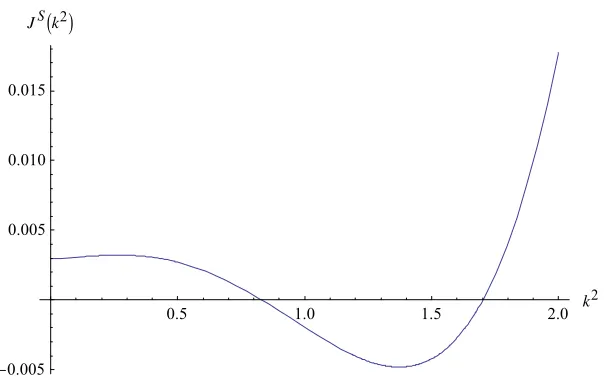
Figure 1 presents a dispersion relationship associated with part (b) of theo-rem 2 derived from a numerical simulation of the LR-SD problem.17
From the Hamiltonian system (51),(52),the FOSS obtained forDx1 =
Dx2 = 0,is a saddle point with complex roots. For k2 ∈(0.831,1.702),the Jacobian of the system (51),(52) under the spatial perturbation, which is the dispersion relationship, has two complex eigenvalues with positive real parts and two real eigenvalues, one positive and one negative. This is part
1 6Cross products betweenx anducan be eliminated by suitable transformations ofx
andu(Hansen and Sargent 2007).
1 7The parameters are R
11 = 0.5, R12 = −0.07; R21 = 0.07, R22 = 0.5, Q11 =
−0.1, Q12= 0.08,Q21=−0.08, Q22=−0.1, A11=−0.1, A12= 0, A210,
A22 = −0.1, B11 = 0.01, B12 =−0.01, B21 = 0.01; B22 = 0.01, ρ= 0.01, Dx
1 = 0.1,
0.5 1.0 1.5 2.0
k2
-0.005 0.005 0.010 0.015
[image:21.595.148.451.122.314.2]JSIk2M
Figure 1: Dispersion relationship for the linear regulator. Dx1 = 0.1, Dx2 = 1
(b) of theorem 2 implying that a pattern emerges in the neighborhood of the FOSS.
4
Optimal Di
ff
usion Induced Instability,
External-ities and Regulation
in economic systems. Under this structure, pattern formation is governed by the curvature of the Hamiltonian function and the size of the discount rate as indicated by the conditions of theorem 2. Spatial instability in this case is emerging because the optimized system attains a higher value at the optimal spatially heterogenous state relative to the spatially homogeneous state. In this sense the spatial instability associated with the SOMP is an optimal diffusion-induced instability (ODI).
The different sources of spatial instability are expected to generate in general different spatial patterns. By comparing the solutions obtained in the two previous sections it is clear that the spatiotemporal patterns emerg-ing at the ‘undisturbed Nature’ - the POMP and the SOMP - will in general be different from each other. It should be noted that one system, say the POMP, could exhibit a spatially heterogeneous pattern while the other, the SOMP, a spatially homogenous pattern, since spatial patterns can be formed but can also be eliminated by the change in parameters and the dimension-ality induced by alternative behavioral assumptions regarding the choices of the control variables. On the other hand the diffusion induced spatial externality is present at the reaction-diffusion system, because agents ig-nore the impact of their decisions on the concentration of the state variables which are located on the sites of other agents. If we assume that in human managed systems the desired solution is the one associated with the SOMP, then the need for regulation arises.
Some broad features of regulatory schemes become clearer if we consider the system at a temporal steady state (which could be spatially homogeneous or heterogeneous), in which case only diffusion, and not temporal growth, affects the concentration of the state variables. The first-order conditions for selecting controls for the POMP and SOMP at a temporal steady state, are respectively
∂U(x(z),u(z))
∂uj
= 0, j= 1, ..., m (53)
∂U(x(z),u(z))
∂uj
+ X
i=1,2
pi(z)
∂fi(x(z),u(z))
∂uj
= 0 (54)
The fact that the shadow value of the state variables at each site,
decen-tralized regulatory scheme should be based on introducing these spatially heterogeneous shadow values into the private agent’s maximization prob-lem. Therefore regulation will be characterized by spatial heterogeneity.18 To make a simple case assume that the functions fi are separable in the states and the controls, and linear in the controls. Then (54) will be of the general form
∂U(x,u)
∂uj
+γ1jp1(z) +γ2jp1(z) = 0 , j= 1, ..., m
where γij, i= 1,2 are constants. Let p∗i (z) be optimal steady state spatial paths for the costate variables obtained as a solution of (47), (48). Then if site dependent taxes τ(z) = γijpi∗(z) per unit of uj(z) are introduced the private optimization problem will be
max
u(t,z)U(x(z),u(z))−
m X
j=1
X
i=1,2
£
γijp∗i (z)¤uj(t, z)
and thefirst order conditions will be identical to (54). Thus the conditions for choosing controls optimally are the same for the SOMP and for the regu-lated POMP. If in the same set up we consider the full spatiotemporal paths, where both spatial and temporal externalities are present at the unregulated POMP, then the taxes will be site and time dependent and will have the formτ(t, z) =γijp∗i (t, z)per unit ofuj(t, z),wherep∗i(t, z) are the optimal spatiotemporal paths for the costate variables obtained as a solution of (19). In a similar way quantity instruments can be introduced. Let the spatial paths for the optimal controls which correspond to the SOMP be(u∗1(z), u∗2(z)).
These paths can be set as quantity constraints to the private agents. If the constraints are binding then control paths between the SOMP and the reg-ulated POMP are identical. The quantity constraints can be implemented either by command and control methods or by setting up markets for trad-able quotas across markets.
The structure of regulation will became clearer in the application which follows.
1 8This concept is similar to the time dependent zonal taxes, zonal permits, and zonal
5
Management of Arid or Semi-arid Grazing
Sys-tems
Arid or semi-arid grazing systems are a typical example of natural sys-tems where pattern formation regarding vegetation emerges in the set up discussed above. A semi-arid system can be described in terms of spatiotem-poral dynamics of three state variables: surface water, soil water, and plant biomass (e.g. HilleRisLambers et al. 2001, van de Koppel et al. 2002). We assume, in order to simplify the structure of our model without loss of generality with respect to the issues that we want to explore, that space is a circle, in contrast to the two-dimensional space of the relevant literature, and that surface water is fixed by rainfall and uniformly distributed along the circle. To introduce economic behavior in the management of these sys-tems we assume that plant biomass is consumed in the process of producing cattle products. Cattle products are produced by a conventional production function with two inputs, plant biomass and grazing effort. The model of a semi-arid grazing system can be written as:
Pt(t, z) =G(W(t, z), P(t, z))−b(P)−T H(t, z) +DPPzz(t, z) (55)
Wt(t, z) =F(P(t, z), R)−V (W(t, z), P(t, z))−rWW(t, z) +DWWzz(t, z)
P(0, z), W (0, z) given
P(t,0) =P(t, L) = ¯P(t), ∀t
W(t,0) =W(t, L) = ¯W(t), ∀t
where P(t, z) which denotes plant density or plant biomass, and W(t, z) which denotes soil water at timet∈[0,∞) and sitez∈[0, L],are the state variables. Rainfall R is fixed and T H(t, z) denotes total harvesting of the plant biomass through grazing. Thus total biomass consumption at time
(plant dispersal) and soil water.19
To make the procedure more precise and suitable for numerical simula-tions, we follow van de Koppel et al. (2002) in choosing specific functional forms.
G(W, P) = gW Pη+1 , b(P) =d(1 +δP)P, η ≥0, d, δ >0
F(P, R) = (β+ζP)R , V (W, P) =uW P , β, ζ, u >0
In the system described by (55) grazing could occur naturally by herbi-vores at a state where the given semi-arid system is not disturbed by human actions. In this case harvesting at the state of ‘undisturbed nature’ can be approximated as
T Hun(t, z) =cavgP(t, z) (56)
where cavg can be regarded as a constant defined as c(HERBavg) where
HERBavg is average local herbivore abundance and c is a consumption
constant.
5.1
Pattern Formation in a semi-arid System under Private
Objectives
We consider now the case where the system is managed by economic agents located at each site, whose objective is maximization of private profit from cattle products. To obtain the cattle products the economic agents harvest plant biomass by exercising costly grazing or harvesting effort. Total har-vesting is determined by a Cobb-Douglas function with constant returns to scale in plant biomass and grazing effort, defined as:
T H(t, z) = [P(t, z)]α[E(t, z)]1−α (57)
We assume that the cost per unit of grazing effort is constant and indepen-dent of site, that cattle products are proportional to harvesting and that
1 9
Extension to a two-dimensional (z1, z2) space is straightforward. In the
two-dimensional space the diffusion terms are defined as DP(Pz1z1+Pz1z1) and
DW(Wz1z1+Wz1z1).Spatial heterogeneous perturbation in this case will take the general
the price of cattle products is exogenous to the system.20 Then the grazing
effort which maximizes profits from cattle products maximizes also profits from harvesting, with the price per unit harvest expressed in terms of the exogenous price per unit of cattle products. Profits from harvesting are defined asp[P(t, z)]α[E(t, z)]1−α−cE(t, z).
Using the results of section 2, effort and harvesting at the POMP are determined, for the case of full property rights, as:
E0(t, z) =γP(t, z), T H0(t, z) =AP(t, z), γ= µ
c p(1−a)
¶−1
a
, A=γ1−a
(58)
For the case of open access, effort and harvesting are determined as:
ˆ
E(t, z) = ˆγP(t, z), THˆ(t, z) = ˆAP(t, z),γˆ= µ
c p
¶−1
a
,Aˆ= ˆγ1−a (59)
Thus in both cases harvesting at each site is proportional to plant bio-mass at the same site. If we make the usual assumptions that p > c > 0 and 0 < a < 1, then A > Aˆ and, as expected, for any given level of plant biomass harvesting under open access is higher relative to the profit max-imizing harvesting under enforceable property rights at each site. Substi-tuting H0(t, z)21 into (55) we obtain the dynamic system that describes
the spatiotemporal evolution of the plant biomass and the soil water when private agents maximize profits from cattle production at each site. The dynamical system is:
Pt = [gW Pη−d(1 +δP)−A]P+DPPzz =f(P, W) +DPPzz(60)
Wt = (β+ζP)R−uW P −rWW +DWWzz =g(P, W) +DWW(61)zz
It should be noted that the system (60), (61) can also describe spatiotem-poral evolution at the ‘undisturbed Nature’ case, if A is replaced by cavg. Thus differences between the ‘undisturbed Nature’ and the the two types of POMP (enforceable property rights or open access) can be analyzed in
2 0These simplifying assumptions are useful for providing a structure that helps to
de-velop simulations which support our theoreticalfindings, without affecting the main char-acteristics of the problem.
2 1Alternatively we could substitute open access harvestingH.ˆ The analysis would be
terms of differences between natural parameters such ascavg,and economic parameters such as(p, c, a).
To explore the formation of spatial patterns we apply the theory de-veloped in section 2. The FSS ¡P0, W0¢ is defined by the solution of the
system
W = A+d(1 +δP)
gPη , P =
rWW −βR
ζP uW (62)
Thus¡P0, W0¢depends on the economic variables throughA.
Using the Jacobian of theflat system (where DP =DW = 0) evaluated at the FSS, the stability of this FSS requires
Trace conditions:
ηgW0¡P0¢η−1−dδ >022
trJP =³ηgW0¡P0¢η−1−dδ´P −¡uP0+rW ¢
<0 Determinant conditions:
ζR−uW0 <0
detJF =−
³
ηgW0¡P0¢η−1−dδ´ ¡uP0+r
W¢−¡ζR−uW0¢>0
JP F = Ã
fP fW
gW gW !
= Ã ³
ηgW0¡P0¢η−1−dδ´P gPη
¡
ζR−uW0¢ −¡uP0+rW¢ !
If local stability conditions are satisfied, then both eigenvalues ofJF are positive.
Pattern formation through the Turing mechanism requires, according to the conditions of theorem 1:
ηgW0¡P0¢η−1−dδ > DP DW
¡
uP0+rW¢ (63)
−
h
−¡uP0+r
W¢DP + ³
ηgW0¡P0¢η−1−dδ´D
W i2
4DPDW
(64)
+ detJP <0
wavenum-bers one eigenvalue of the Jacobian matrix23
JP S= Ã
fP −k2DP fW
gW gW −k2DW !
becomes positive. Thus the FSS is unstable to spatial perturbations and a spatial pattern is formed around the FSS.
It should be noted that the emergence or not of patterns depends, apart from the parameters of the natural system, on economic variables which are summarized by A. For example, it is clear from (62) that a change in A
will affect the FSS values ¡P0, W0¢ and the pattern formation conditions
(63), (64). Thus changes in economic parameters such as cost per unit of grazing effort, elasticities of the production function for cattle products, or the market price of cattle products, might create or break spatial patterns in the semi-arid grazing system.
Pattern formation can be explored in more detail by using numeri-cal values for the economic parameters and the parameters of the nat-ural system. For the natnat-ural system we use the parameter values:24 g =
0.001, η = 0.5, d = 0.03, δ = 0.005, Dw = 1, β = 0.9, ζ = 0.001, R =
50, u= 0.01, rw = 0.1, Dp = 0.02.For the economic parameterA we assume
c= 1, p= 1.1, a= 0.3,which implies A= 0.543.The reaction-diffusion sys-tem has twoflat steady states under enforceable property rights and profit maximization, which are shown infigure 2.
The steady states are S10 = ¡P10, W10¢ = (44.053,87.327) and S20 = ¡
P0 2, W20
¢
= (2.53781,359.927). Calculations of the eigenvalues for the
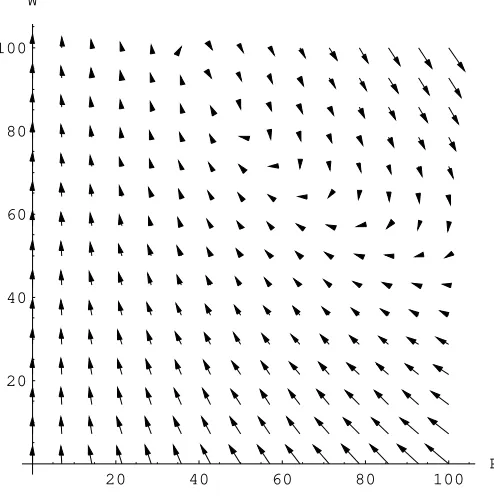
lin-earization matrix for each FSS reveal thatS10 is locally stable, whileS20 has the saddle point property.25 The vector field in the neghborhood of S10 is shown infigure 3.
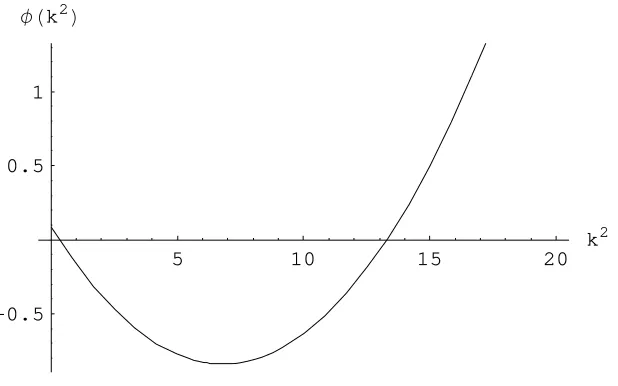
When spatially heterogeneous perturbations are introduced, the corre-sponding dispersion relation is: φ¡k2¢= 0.02k4−0.272k2+0.0876.As shown infigure 4 the dispersion relation becomes negative for positive values of the wave number k and thus the FSS is destabilized by spatial perturbations. Turing diffusion induced instability emerges under profit maximization and a spatial pattern is formed in the semi-arid system with the characteristics
2 3See also Appendix 1, (78).
2 4These values are in line with those used by van de Koppel et al. (2002). 2 5The eigenvalues are: S0
1 →(−0.128667±0.266616i),S 0
50 100 150 200 P 100
[image:29.595.146.448.102.362.2]200 300 400 500 600 700 W
Figure 2: Flat Steady States at the POMP
20 40 60 80 100
P 20
40 60 80 100 W
[image:29.595.172.419.422.673.2]of our numerical example.
5 10 15 20
k2
-0.5 0.5 1
[image:30.595.145.454.154.347.2]φHk2L
Figure 4: The dispersion relationship
In the dispersion relationship of figure 4 k2
min = 6.81. The eigenvalue
σ¡kmin2 ¢= 0.114757is the eigenvalue which determines the fastest temporal
growth of the spatial perturbation. Thus the spatial perturbation does not die out as time passes but grows to form a spatial pattern. To obtain a picture of the growing spatial instability on the neighborhood of the FSS we assume that the size of the spatial domain is L = 3 so that the range of unstable wave numbers admits only the wave numbern= 1.26 Then the
growing spatial instability for the plant biomass and soil water is propor-tional toexpσ¡k2min¢cos (2πz/3)and is given approximately by
P(t, z) ∼ 44.053 +Bpv1exp(0.114757t) cos
µ
2πz
3 
, v1= 0.99
P(t, z) ∼ 87.327 +Bwv2exp(0.114757t) cos
µ
2πz
3 
, v2=−0.11
where vj, j = 1,2 is the first and the second component of the eigenvector which corresponds to the eigenvalueσ¡kmin2 ¢= 0.114757and B0sare
deter-2 6The size of the spatial domain satis
fies in this casen1≥(Lk1/2π)andn2≤(Lk2/2π),
wherek1=
√
0.3297, k2 =
√
13.2895. k2 1andk
2
2are the zeroes of the dispersion relationship
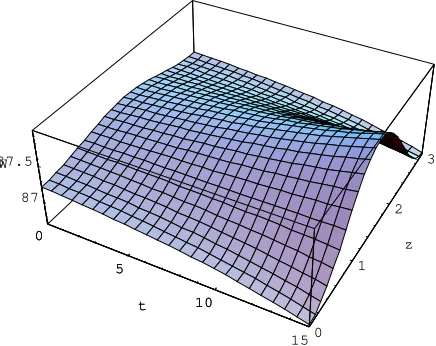
mined by initial conditions. The approximate evolution of the two growing instabilities are shown infigures 5 and 6.
0
5
10
15
20 t
0 1
2 3
z 35
40 45 50 P
0
5
10
[image:31.595.187.406.168.333.2]15 t
Figure 5: Spatial instability:Plant biomass
0
5
10
15 t
0 1
2 3
z 87
87.5W
0
5
10 t
Figure 6: Spatial instability: Soil water
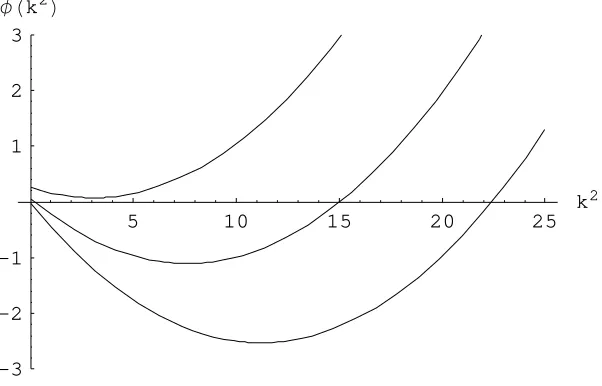
To obtain an idea about the impact of the economic parameters on pat-tern formation we show dispersion relations corresponding to different values ofA infigure 7.
[image:31.595.189.407.398.571.2]5 10 15 20 25 k2
-3 -2 -1 1 2 3
[image:32.595.147.448.130.323.2]φHk2L
Figure 7: Dispersion relationships and changes in harvesting
perturbations. Thus a spatial pattern does not emerge and plant vegetation isspatially homogeneous in the given space domain. This result leads us, in the context of the specific model used, to the following proposition:
Proposition 1 Let harvesting at all sites of the semi-arid system be pro-portional to plant biomass at the site, orH(t, z) =ΦP(t, z),whereΦis de-termined (i) by herbivore abundance and specific consumption in undisturbed Nature or (ii) by economic parameters in profit maximizing equilibrium with full property rights, or in an open access equilibrium. The higher Φ is, the more likely that spatial patterns will emerge.
and other losses. Because thresholds have to be crossed by soil water and other soil nutrients to get any growth at all on a patch, Nature “designs” heterogeneity patterns to “optimize” plant production.
If we add now ‘graziers’ private agents which harvest plant biomass„ these graziers can be treated like “evaporators” on a patch and also a bit like “nutrient/soil water” removers too (hoof compactification of the soil causes it to infill water more slowly, etc.). Assume, to simplify things in the analysis of the graziers impacts, that we have a discrete two patch model and assume that Nature optimizes plant production in the sense of the paragraph above by having vegetation only on one patch. When grazing is introduced a grazier on patch 1 may impede Nature’s transport of water to patch 2 so both patches die, not just one. If we allow for a continuum of patches as we do in our model, then heterogeneity patterns will emerge with diff er-ent concer-entration of plant biomass in different sites. It is most likely that patches of vegetation smaller in size and less in number emerge when gra-ziers are introduced. Thus under grazing, the spatial pattern of vegetation is expected to be coarser relative to pattern emerging in the state of undis-turbed Nature. It could be the case, in a seasonal model with wet and dry seasons, that without graziers vegetation is spatially homogenous in the wet season, since there is plenty of water to support vegetation in all patches, but ‘patchiness’ emerges in the wet season when graziers are introduced. In our model this process is captured by the downward movements of the dispersion relationship as the harvesting parameter Φ increases under the influence of graziers. Under open access grazing pressure is even higher, rel-ative to profit maximization under enforceable property rights, which means that probably more patches will die out and the pattern of vegetation will be even coarser. Thus forces inducing spatial patterns and patchiness in the semi-arid system are expected to be the strongest under open access conditions.
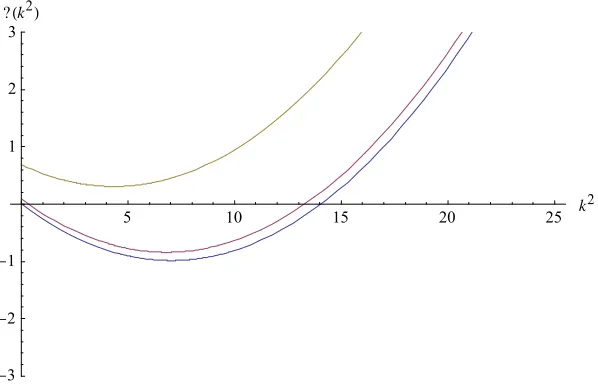
Following the argument of the above paragraph the impact of changes in rainfall, which is an important driver of the system, on pattern formation can be traced through changes inR.Changes in rainfall in semi-arid systems introduce seasonality and our model can be used to study pattern formation in ‘dry’ or ‘wet’ seasons by studying solutions under parametric changes in R. Figure 8 shows three dispersion relationships resulting from setting
5 10 15 20 25 k
2
[image:34.595.149.448.127.319.2]-3 -2 -1 1 2 3 ?Hk2L
Figure 8: Dispersion relationships and changes in rainfall
The dispersion relation shifts upward as rainfall increases. Thus a ‘wet’ period withR= 100will result in spatially homogeneous plant vegetation.27
Combined with Proposition 1, this result suggests that aggressive harvest-ing could result in spatially heterogeneous plant vegetation even in ‘wet’ systems.
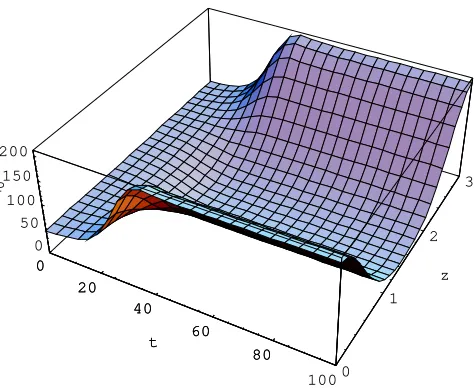
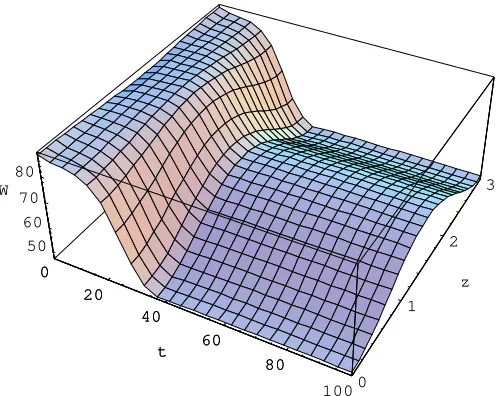
Having established that a spatial pattern is emerging in the neighbor-hood of the FSS, due to the spatial perturbation, we seek to explore the structure of a spatially heterogeneous steady state. As noticed in section 2, although the state variables grow exponentially in the neighborhood of the FSS due to the spatial perturbation, the kinetics of the system (60), (61) could bound the solution (P(t, z), W(t, z)) which eventually would settle to a spatial pattern. Thus we need to examine whether in our nu-merical example the kinetics of the system (60), (61), bound the solu-tion (P(t, z), W(t, z)) as t grows. Figures 9 and 10 depict the solution (P(t, z), W(t, z))obtained by numerically solving the system of partial dif-ferential equations corresponding to (60), (61).28
The behavior of the solution confirms the hypothesis that there is
tem-2 7This result is in line with results obtained by Vishwesha Guttal and Jayaprakash
(2007).
2 8
We use as boundary conditions,P(0, z) = 44.053 + cos (2πz/3),W(0, z) = 87.3266 + cos (2πz/3)which correspond to the growing spatial instability offigures 5 and 6 fort= 0
0
20 40
60
80
100 t
0 1
2 3
z 0
50 100 150 200
P
0
20 40
60
[image:35.595.180.417.126.320.2]80 t
Figure 9: Long-term spatiotemporal evolution of plant biomass
poral growth near the FSS but then the kinetics confine the solution which settle to a clearly spatially heterogeneous steady state, with P(100,0) =
P(100,3) = 210.523, P(100,1.5) = 5.54, W(100,0) =W(100,3) = 48.489,
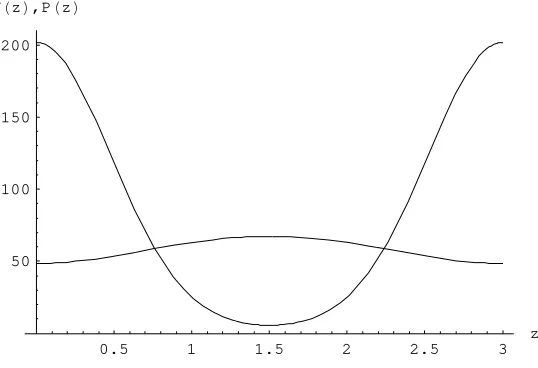
W(100,1.5) = 67.344.Thus there is high concentration of plant biomass in
a one point and low concentration in the middle of the circle. Water con-centration follows the opposite pattern. The spatially heterogeneous steady state can also be obtained by solving the second-order system (60), (61) in the spatial variablez forPt=Wt= 0, or
d2P(z)
dz2 = −
1
DP
[gW Pη−d(1 +δP)−A]P (65)
d2W(z)
dz2 = −
1
DW
[(β+ζP)R−uW P−rWW] (66)
with initial spatial conditions (P(0), W(0)) = (210.523,48.489).29 The so-lution is shown infigure 11.
The plant biomass follows the U pattern, while the water stock follows the opposite pattern.
2 9We use arbitrary initial conditions forP0(0), W0(0)and multiple shooting in order
0
20 40
60
80
100 t
0 1
2 3
z 50
60 70 80 W
0
20 40
60
[image:36.595.174.422.128.326.2]80 t
Figure 10: Long-term spatiotemporal evolution of soil water
5.2
Pattern Formation in a Semi-arid System under Social
Objectives
We consider now the management of a semi-arid system under a social plan-ner that takes into account both the dynamics of the system and the spatial externality. The Hamiltonian for the SOMP is
H = pPαE1−α−cE+λ[(gW Pη −d(1 +δP))P−T H+DPPzz]
+μ[(β+ζP)R−uW P −rWW +DWWzz]
and the maximum principle implies:
(1−α)pPαE−α−c−λ= 0⇒Es(t, z) =γSP(t, z) (67)
γS =
∙
c
(p−λ) (1−a)
¸−1
a
, T HS(t, z) =A∗P(t, z), A∗=¡γS¢(68)1−a
Pt= (gW Pη−d(1 +δP)−A∗)P+DPPzz (69)
Wt= (β+ζP)R−uW P−rWW+DWWzz (70)
λt= [ρ−(1 +η)gW Pη+d(1−2δP) +A∗]λ− (71)
μ(ζR−uW)−αpPα−1¡ES¢1−α−DPPzz
0.5 1 1.5 2 2.5 3 z 50
[image:37.595.164.433.128.312.2]100 150 200 WHzL,PHzL
Figure 11: The Spatially Heterogeneous Steady State
Assume that a FOSS(P∗, W∗, λ∗, μ∗) : (Pt=Wt=λt=μt= 0;DP =DW = 0) exists and that it has the saddle point property with a two-dimensional sta-ble manifold. Using (69) - (72), the linearization of the MHS around the FOSS under heterogeneous spatial perturbations of the form defined in (34) is
¯
qt = JS·¯q ,JS = Ã
Hpx−Dk2 Hpp
−Hxx ρI2−Hxp+Dk2
!
, D= Ã
Dp 0
0 Dw
!
¯
qt = ¡P¯t,W¯t,λ¯t,μ¯t ¢0
,q= (P, W, λ, μ),x= (P, W),p= (λ, μ)
exam-ine for the emergence of pattern formation the quantities which are central are the dispersion relationships K¡k2¢ and JS¡k2¢ and the constant K0,
which are defined as:
K0= [(ρ−HP λ)HλP +HP PHλλ] + (73)
[(ρ−HW μ)HμW +HW WHμμ]−HλWHP μ (74)
K¡k2¢=−¡DP2 +D2W¢k4+ (75)
[DP(2HP λ−ρ) +DW (2HW μ−ρ)]k2+K0 (76)
JS¡k2¢= ¯ ¯ ¯ ¯ ¯
Hpx−Dk2 Hpp
−Hxx ρI2−Hxp+Dk2
¯ ¯ ¯ ¯
¯ (77)
It turns out that for the parameter values used before, and also for a set of parameter values in the neighborhood of the original set, the conditions of theorem 2 are not satisfied. K0 <0by the saddle point property of the FOSS and for the relevant parameter set DP(2HP λ−ρ) +DW(2HW μ−ρ) < 0. Thus the dispersion relationship (75) attains the maximum fork2<0which means that the conditions of part (a) of theorem 2 are not satisfied. For the dispersion relationship (77), JS(0)>0 by the saddle point property of the FOSS.JS¡k2¢is monotonically increasing ink2 for the relevant parameter set. Thus the conditions of part (b) of theorem 2 are not satisfied. Similarly the conditions of part (c) of theorem 2 are not satisfied for the relevant parameter set.
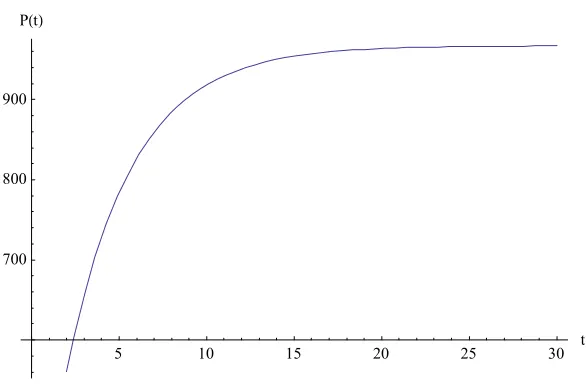
This result suggests that, for our example, optimal management by tak-ing into account both the dynamics and the spatial externality tends to produce aflat system and break the patterns in plant biomass created un-der private optimization objectives. Thus the POMP generates patchiness in vegetation while the SOMP with the same water resources, but less ag-gressive harvesting relative to the POMP, generates homogenous vegetation on the spatial domain. Linear approximation of the optimal time paths for the state and costate variables under the assumption that the initial state for plant biomass and ground water coincides with the FSS under private optimization are
5 10 15 20 25 30 t 700
800 900
[image:39.595.150.443.121.313.2]PHtL
Figure 12: Optimal path for the plant biomass
The time paths are shown in figures 12, 13, and 14 .
To examine conditions under which a spatial pattern might emerge at the SOMP we consider the case of an extremely dry system by settingR= 5.
The FOSS is(P∗, W∗, λ∗, μ∗) = (20.907,14.898,0.76049,0.21441) with har-vesting parameterA∗ = 0.035.This FOSS is a saddle point with real eigen-values σ= (0.256528,−0.226528,0.120913,−0.0909126),so the flat system can be controlled to converge at the FOSS.
When a spatial perturbation characterized by high soil water diffusion (Dw= 10, DP = 0.05)is introduced into the dry system, the FOSS is desta-bilized in the sense of part (b) of theorem 2. The dispersion relationship is shown infigure 15.
For k2 ∈ (0.0213,2.118), JS¡k2¢ < 0. Using k2 = 1, the eigenvalues
of the linearization matrix of the system under the spatial perturbation is
σ= (10.3377,−10.3077,0.015±0.0807i), which implies destabilization
ac-cording to part (b) of theorem 2. Using the eigenspace of the two real eigenvalues and setting L= 7so that only one wavenumber exists, the
0 1 2 3 4 5 t 20
40 60 80 100
[image:40.595.155.444.95.676.2]WHtL
Figure 13: Optimal path for soil water
0.0 0.5 1.0 1.5 2.0 2.5 3.0
t 0.5
1.0 1.5 2.0 2.5 3.0
λHtL,μHtL
[image:40.595.148.445.373.652.2]0.5 1.0 1.5 2.0 2.5 3.0
k2
-1.5 -1.0 -0.5 0.5 1.0 1.5
[image:41.595.152.446.125.306.2]JSIk2M
Figure 15: Dispersion relationship at the SOMP for a dry system.
approximated as:
P(t, z) ∼ 20.907−0.00679 exp(10.3377t) cos(2πz/7)
+0.00943 exp(−10.3077t) cos(2πz/7)
W(t, z) ∼ 14.898 + 0.000047 exp(10.3377t) cos(2πz/7)
−0.99995 exp(−10.3077t) cos(2πz/7)
The spatiotemporal paths in the neighborhood of the FOSS are shown infigures 16 and 17.
To examine the long-run behavior of this extremely ‘dry’ system under spatial diffusion we explore the numerical solution of the MHS which consists of the four partial differential equations (69) - (72).30 The results indicate
that the system is not converging to a HOSS but instead it breaks down in a short period of time. It seems that the combination of spatiotemporal
fluctuations induced by the high diffusion rates and the extremely dry condi-tions make the system collapse. This breakdown is approximatelly depicted infigures 18 and 19.
3 0We use as boundary conditions, the equations for the growing spatial instability in
Figure 16: Spatial instability at the SOMP: Plant biomass
[image:42.595.174.438.443.651.2]Figure 18: Collapse of plant biomass
[image:43.595.183.428.469.641.2]