Solid sample introduction in inductively coupled plasma
emission spectrometry.
CLARKE, Philip A.
Available from Sheffield Hallam University Research Archive (SHURA) at:
http://shura.shu.ac.uk/19472/
This document is the author deposited version. You are advised to consult the publisher's version if you wish to cite from it.
Published version
CLARKE, Philip A. (1988). Solid sample introduction in inductively coupled plasma emission spectrometry. Doctoral, Sheffield Hallam University (United Kingdom)..
Copyright and re-use policy
. / g® 'i'J "a ® lisaa ie n £ \*. 4f% J\ C\\
Sassi
Hi
ProQuest Number: 10694353
All rights reserved
INFORMATION TO ALL USERS
The quality of this reproduction is dependent upon the quality of the copy submitted.
In the unlikely event that the author did not send a com plete manuscript and there are missing pages, these will be noted. Also, if material had to be removed,
a note will indicate the deletion.
uest
ProQuest 10694353
Published by ProQuest LLC(2017). Copyright of the Dissertation is held by the Author.
All rights reserved.
This work is protected against unauthorized copying under Title 17, United States C ode Microform Edition © ProQuest LLC.
ProQuest LLC.
789 East Eisenhower Parkway P.O. Box 1346
A The sis Entitled:
SOLID SAMPLE INTRODUCTION IN INDUCTIVELY COUPLED PLASMA EMISSION SPECTROMETRY.
Presen Led. by
PHILIP ALEXANDER CLARKE, DSc(UONS).
in part; fu 11 j I men t of the requirements for: the decree o f Doctor of Philosophy
of the
Council Cor National Academic Awards.
Sponsor i rig Establi shmen t;: Department of Chemistry Sheffield City Polytechnic Pond St.
Shef f Leld SL 1WB.
CollaboratiEstablishment: RAR.DE
Eort Halstead Sevenoaks
Abstract.
Thesis Title: Solid Sample Introduction In Inductively Coupled Plasma Emission Spectroscopy.
Author: Philip Alexander Clarke BSc. (HONS).
This Thesis describes the progress made in the area of solid sample introduction in Inductively Coupled Plasma Emission Spectrometry (ICP-ES). As an alternative to
solution nebulisation two methods of introducing samples to the ICP are investigated. The first of these uses the direct insertion probe technique first described by
Horlick and Salin (63). The assembly utilised an
electrically operated graphite rod system. This could be used equally well with small volumes of solution sample
(5jul) or small masses of solid sample (Ca.bmg). The variables of cup dimensions and material were
investigated along with volume and masses of sample used. Results of calibration of both solution residues and
solid samples are presented along with details of Limit of Detection and sample Relative Standard Deviation
(RSD). The comparative data were found to be in good agreement and it was established that solutions derived calibration data could be used for the analysis of
Ni~base samples. Other solid matrices, elemental and alloyed were investigated. These materials divided into two groups, (1) low volatility matrix, from which trace elements were released and only minimal emission from matrix elements was detected and there were no spectral
interference effects, (2) volatile matrix in which the matrix vaporized in the same temperature range as the trace elements, giving rise to substantial matrix emission and spectral interferences. It was concluded that DI-ICP-ES is at its most useful when dealing with easily volatilized trace elements in a relatively
involatile matrix.
Answers are a perilous grip upon the Universe. They can appear sensible yet explain nothing.
CONTENTS.
CHAPTER 1. INTRODUCTION.
1.1. Basic Theory and Principles of Emission
Spectrometry.
1.2. Excitation Sources for Emission Spectrometry. 1.2.1. B’lame Excitation.
1.2.2. Discharge Tubes. 1.2.3. Laser Sources.
1.2.4. Electric Arcs and Sparks. 1.2.3. Plasma Excitation.
1.3. The InductiveJ.y Coupled Plasma.
1.3.1. History and Development.
L.4. Sample Introduction Techniques in ICP-Emission
Spectrometry.
1.4.1. Nebulization of Liquids. 1.4.2. Vapour Introduction.
1.4.3. Solids Techniques.
1.4.4. Direct Sample Insertion.
1.4.3. Separate Sampling and Excitation. 1.4.6. Electrothermal Vaporization.
1..5. Nickel Based Alloys.
1.6. Aims and Scope of this Work.
CHAPTER 2. EXPERIMENTAL. 2.1.1. Plasma Sources.
2.1.2. Spectrometers and Measurement Systems.
2.2. The Direct Sample Insertion Device.
2.3.1. Interface of the ETV to the ICP. 2.3.2. The Vaporization Cell.
2.3.3. Cuvette and Electrode Design. 2.4. Materials and Reagents.
2.5. Experimental Procedures. 2.6. Preliminary Experiments.
2.7. Safety Warning.
CHAPTER 3. DIRECT SAMPLE INSERTION: TRACE ELEMENT DETERMINATION.
3.1. Introduction.
3.2. Studies on Solutions Residues.
3.2.1. Experimental Procedures* 3.2.2. initial Experiments. 3.2.3. Sample Cup Dimensions.
3.2.4. Effect of Forward RF Power. 3.2.5. Position of the Sample Cup 3.2.6. Effect of Viewing Height.
3.2.7. Calibration and Performance Data.
3.3. Studies on Solid Samples.
3.3.1. Experimental Procedures. 3.3.2. Initial Experiments.
3.3.3. Effect of Forward RF Power on Solid Samples. 3.3.4. Calibration and Analysis of Nickel Base Alloys. 3.3.5. Limits of Detection for Trace Elements from Sol
Samples.
CHAPTER 4. DIRECT SAMPLE INSERTION: MAJOR ELEMENT
DETERMINATION.
4.1. Introduction.
4.2. Experimental. 4.2.1. Wavelength Scans. 4.3. Non-Volatile Matrix.
4.3.1. Chromium, Cobalt, Iron and Nickel.
4.3.2. Non-Volatile Matrix: Minor Constituents.
4.4. Voiatile Matrix.
4.4.1. Aluminium, Gallium, Gunmetal and Silver. 4.4.2. Volatile Matrix: Minor Constituents.
4.5. Conclusion.
CHAPTER 5. ELECTROTHERMAL VAP0R1ZATION: TRACE ELEMENT DETERMINATION.
5.1. introduction.
5.2. Studies on Solution Samples. 5.2.1. Experimental Procedures. 5.3. Analyte Vaporization.
5.3.1. Drying Time and Temperature. 5.3.2. The Ash Stage.
5.3.3. The Vaporization Stage.
5.4. Plasma Operating Parameters.
5.4.1. Effect of Forward RF Power. 5.4.2. Effect of Viewing Height. 5.4.3. Effect of Carrier Gas Flow.
5.4.4. Effect of Coolant and Auxiliary Gas Flow R<ites
5.5. Calibration and Analytical Performance Data.
5.6.1. Experimental Procedures.
5.7. Heating Characteristics of Solids.
5.7.1. Stepped Heating. 5.7.2. Ramped Heating. 5.7.3. Split Heating.
5.8. Analysis of Nickel Based Material. 5.8.1. Experimental Procedures.
5.8.2. Analytical Data for Nickel Based Alloys.
5.9. Conclusion.
LIST OF TABLES.
CHAPTER 1.
1.1. Limits of Detection for selected elements by Nitrous Oxide - Acetylene Flame Emission Spectroscopy.
1.2. Limits of Detection for selected elements by Hot Hollow Cathode Emission Spectroscopy. 1.3. Analytical Range of a Typical Polychromator
System.
1.4. Limits of Detection for Solutions Nebulization and Hydride Generation ICP-ES.
CHAPTER 2.
2.1. Analytical Wavelengths and Spectrochemical Data. 2.2. Elemental Composition of Nickel Base Materials. 2.3. Melting and Boiling Points of Selected Elements.
CHAPTER 3.
3.1. Effect of Cup Volume on SBR.
3.2. Effect of Forward (RF) Power on SBR. 3.3. Effect of Cup Position on SBR.
3.4. Effect of Viewing Height on SBR.
3.5. Compromise Operating Conditions for Direct Insertion ICP-ES.
3.6. Precision Data for Solution Samples.
3.7. Correlation Coefficient and Slope Values for Solution Samples.
3.10. Limits of Detection for Solid Samples.
CHAPTER 4.
4.1. Details of Sample Composition and Melting Ranges.
4.2. Analyte Elements and Wavelengths of Interfering Elements.
CHAPTER 5.
5.1. Working Conditions of ETV-ICP Equipment. 5.2. Effect of Vaporization Setting on SBR. 5.3. Effect of Forward (RF) Power on SBR. 5.4. Effect of Viewing Height on SBR.
5.5. Effect of Carrier Gas Flow Rate on SBR. 5.6. Effect of Coolant Gas Flow Rate on SBR. 5.7. Precision Data for ETV-ICP-ES.
LIST OF FIGURES.
CHAPTER 1.
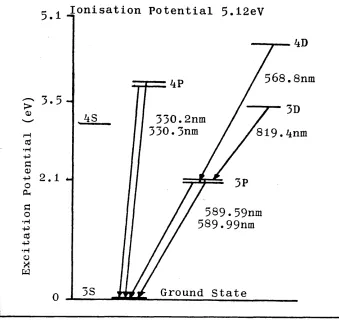
1.1. Grotrian Diagram for Sodium.
1.2. Characteristic Atomic Emission Calibration Curve. 1.3. Nebulizer and Burner System used in FAES.
1.4. Schematic Diagram of Glow Discharge Lamp. 1.5. Schematic Diagram of Laser Microprobe. 1.6. The DC Plasma.
1.7. Schematic Diagram of a Plasma Torch of the Greenfield Design.
1.8. Schematic Diagram of Direct Insertion Device. 1.9. The Remote Sampling and Excitation Equipment of
Hemsalech and Wattenville.
1.10. ICP Emission Spectra for Nickel Based Alloy and Distilled Water.
1.11. Schematic Diagram of Various Types of Background Interferences.
CHAPTER 2.
2.1. Resolution of Jarrel Ash Polychromator System. 2.2. Refractor Plate Location in Light Path of
Spectrometer.
2.3. The Sample Insertion Probe Assembly.
2.4. Schematic Diagram of Probe/Torch Assembly.
2.5. Schematic Diagram of Plasma Torch, Switching Valve and ETV Furnace.
2.6. S w i t c h i n g valve and ETV Furnace.
CHAPTER 3.
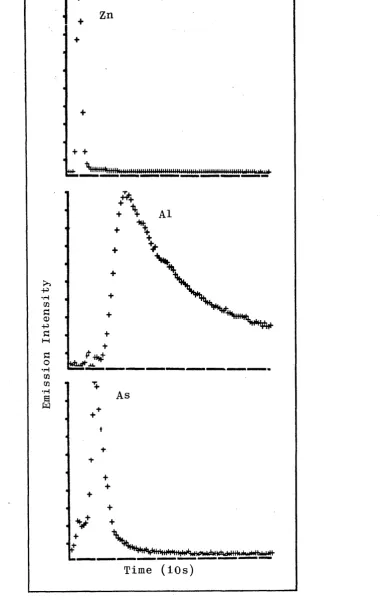
3.1. Emision Time Profiles for Selected Elements from Solution Residues.
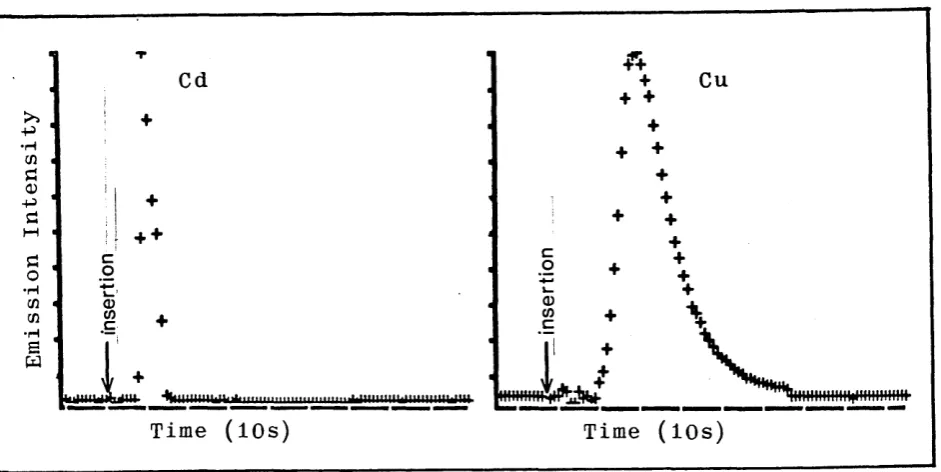
3.2. Comparison of Emission Time Profiles for Cadmium and Copper.
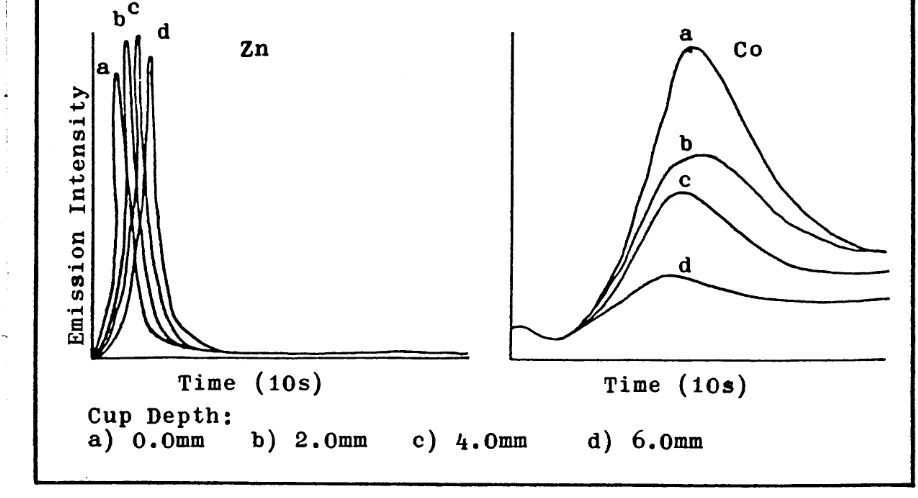
3.3. Emission Time Profiles of Zinc and Cobalt for Different Cup Volumes.
3.4. Effect of Forward (RF) Power on Peak Shape for Copper.
3.5. Diagram of Cup Position.
3.6. Effect of Viewing Height on SBR for Lead.
3.7. Emission Time Profiles of Magnesium and Lead at a Range of Forward (RF) Power.
3.8. Schematic Diagram of Effect of Melting/Vaporization on Peak Shape.
3.9. Emission Time Profiles for Matrix Elements.
3.10. Variation of SBR with Forward Power for Zinc from Solution Residue and Solid Samples.
3.11. Calibration Curves for Cadmium, Magnesium, Lead and Zinc.
CHAPTER 4.
4.1. Examples of Background Shifts Caused by Gallium Matrix.
4.2. Emission Time Profiles for Major Elements from Involatile Sample Matrices.
4.3. Graphs of Emission Intensity versus Sample Mass for Major Elements.
4.5. Emission Time Profiles for Major Elements from Volatile Sample Matrices.
CHAPTER 5.
5.1. Overlay of Emission Time Profiles for ETV at Vaporization Setting of 7V.
5.2. Effect of Carrier Gas Flow Rate on Emission-Time Behaviour of Magnesium.
5.3. Emission Time Profiles for STEPPED Heating. 5.4. Emission Time Profiles for RAMPED Heating. 5.5. Emission Time Profiles for SPLIT Heating. 5.6. Emission Intensity versus Analyte Mass for
1.1. BASIC THEORY AND PRINCIPLES OF EMISSION SPECTROMETRY.
The practice of analytical spectroscopy preceded the development of theories concerning the origin of spectra by at least 300 years and was first described by Georgius Agricola in 1556 when he wrote in his De Re Metallica, about the "colour of fumes" from various metal ores (1). It was several hundred years later that interest in the subject was rekindled. In 1826 Talbot (2) observed an orange colour in an alcohol flame in which he had placed a strontium salt, the anion being different from that used by Herschel several years earlier (3). Talbot correctly ascribed the colour as being due to the strontium and not to the compound which contained the strontium. Later Herschel stated that "the colours
communicated by different bases to flames, afford in many cases, a ready and neat way of detecting extremely minute quantities of them" (4).
■temperature equilibrium with their radiations" . This statement is known as Kirchhoff*s Law and summarizes the basis for modern atomic emission and atomic absorption spectrometry.
During the late 1800*s, after the work of Bunsen and Kirchhoff many line spectra of elements were identified and recorded- Spectra were classified by element,
wavelength,line intensities and by series, depending on line characteristics. Four series were described for alkaline metals and called Sharp, Principal, Diffuse and Fundamental- The influence of this terminology is still retained in modern spectroscopic notation as S, P, D and
F to identify different atomic energy levels.
In 1928 Grotrian developed a method for presenting
5
± Ionisation Potential 5.12eV589.59nm 589.99nm
Ground State
568.8nm
C* 3.5 -> 3D
hS
819.4nm
cd •H -P
o
Qh
o •H -P cd •H
[image:18.615.129.468.13.340.2]O
Figure 1.1 Grotrian Diagram for Sodium.
The probability of transitions from a given energy level of a fixed atomic population was expressed by Einstein in the form of three coefficients. These are termed
Transition Probabilities, given as Aji, Bij and Bji, Which refer to spontaneous emission, spontaneous
absorption and stimulated emission respectively. They can be considered as representing the ratio of the number of atoms undergoing a transition to the number of atoms in the initial level. The intensity, Iem of a spontaneous emission line is related to Aji by the expression:
When a system is in -thermodynamic equilibrium, "the level population, ie. the number of atoms, Nj in the excited
state, is given by the Boltzmann Distribution Law:
Nj = No gi exp[-(Ej/kT)] 1.2.
go
Where:
No is the number of atoms in the ground (unexcited) state with energy Eo = 0.
gj and go are the statistical weights of the jth and ground states respectively, where (g = 2J + 1), J is the third quantum number,
k is a constant. Thus:
Nj = gi exp[-(Ej/kT)] 1.3.
No go exp[-(Eo/kT)]
If the total number of atoms present, N is expressed as the sum of the population of all levels, ie. N = 2 J
Nj = gj exP[-(Ej/kT)] EH E’jgj exp[-(Ej/kT) J
Nj = gj exp[-(E/kT)J 1.4.
N F(T)
where F(T) is known as the partition function. If self absorption is neglected for a system in thermodynamic equilibrium:
Iem = Aji hvji Ngi exp[-(Ej/kT)] 1.5.
In practice the ratio of Nj to N is very small and it is possible to assume that nearly all the atoms remain in the ground state. Thus, N, the total number of atoms which is directly related to the concentration in
solution, is approximately equal to No. Thus equation 1.2. becomes:
Nj = Ngi exp[-(Ej/kT)] 1.6.
go
and equation 1.1. becomes:
Iem = Aji hvji Ngj exp[-(Ej/kT)] 1.7.
go
Thus the intensity of atomic emission is critically dependant on temperature. It also follows that when the
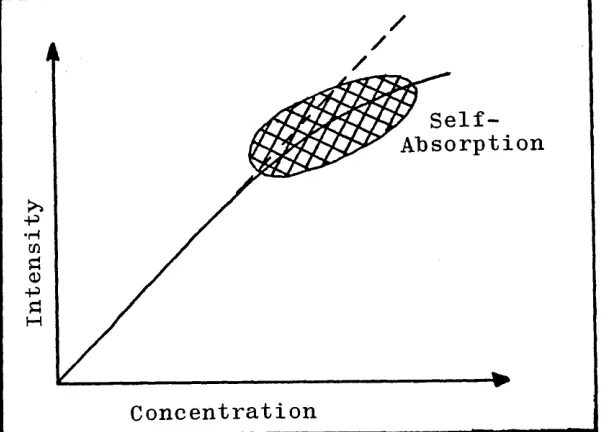
light path is through an optically thin medium and self absorption is negligible the plot of emission intensity against sample concentration is a straight line. As the concentration of atoms in the hot region in the centre of the discharge (viewing zone) increases, the possibility increases that photons emitted by excited atoms in the hot region in the centre will encounter atoms in the cooler, outer region of the discharge, and thus be
/
•H
M
[image:21.623.153.454.26.242.2]Concentration
Figure 1.2. A Characteristic Atomic Emission Calibration Curve.
1.2. EXCITATION SOURCES FOR EMISSION SPECTROMETRY.
Any excitation source for analytical atomic emission spectroscopy must accomplish the following processes:
i) the sample must be vaporized,
ii) the sample must be dissociated into constituent atoms/ions,
iii) electrons in the atoms/ions must be excited to energy levels above the ground state.
1.2.1. FLAME EXCITATION.
The early use of the flame as an excitation source for analytical emission spectrometry dates back to Herschel
(3) and Talbot (2) who identified alkali metals by flame excitation. The work of Kirchhoff and Bunsen (5,6,7) was also basic to the establishment of this technique of atomic excitation. One of the earliest uses of flame excitation was for the determination of sodium in plant ash by Champion, Pellet and Grenier (9) in 1873. The
technique has developed continuously since then and today some fifty elements may be determined by the use of flame excitation procedures.
In flame emission spectroscopy the sample is presented to the spectrometer as a solution. This solution is drawn up the intake pipe of the nebulizer and sprayed into the expansion/mixing chamber as an aerosol. In the mixing chamber the sample aerosol, fuel and oxidant combine to form an inflammable mist which passes to the burner where the mixture is ignited. Desolvation is the first process the sample encounters as it enters the pre-heating zone of the flame followed quickly by evaporation of the
solvent and dissociation of the sample into atoms. These atoms are excited by collisional activation and
The flame is required not only to atomise the analyte, but also to break down any refractory compounds which might react with or physically entrap the analyte.
Atomisation occurs both because of the high enthalpy and temperature of the flame, and through chemical effects. Raising the oxygen content of the flame above the
approximately 20% normally present in air, whilst raising the flame temperature does not necessarily enhance
atomisation because more refractory oxides may be produced. Making the flame more fuel-rich lowers the temperature, but by making the flame more reducing,
increases the atomisation of elements such as molybdenum and aluminium. The nitrous oxide-acetylene flame is both hot and reducing. The "red feather" seen in the
interconal region of this flame is due to emission by the cyanogen radical. This radical is a very efficient
scavenger for oxygen, and in the case of:
MO ^ M + 0
moves the equilibrium in favour of atomisation. This is a vital addition to the high temperature which also
promotes dissociation. The elements which are best
determined by nitrous oxide-acetylene includes a range of representative and transition elements and also the
m e roie
01
m e name in m e s e procesbes is vorjrcomplicated. By using different mixtures of gases in the flame, atomisation conditions may be tailored to
particular classes of elements ie. air-natural gas, and air-propane (which are 'cool* mixtures), may be used to determine the easily ionisable elements (EIE's). The air-acetylene flame is the most widely used. It is stable, simple to operate and produces sufficient
atomisation to enable good sensitivity and freedom from interelement interferences for many elements. Higher
temperatures may be obtained by the use of nitrous oxide-acetylene or even the use of dicyanogen-oxygen or even ozone for temperatures approaching 5000K.
V a p o ris a tio n and dissociation U n vap o tised drops
Premixed fuel and auxilary oxidant supply
Sample flow ~"v 5 to 10 cc/mm
M ix in g process
O x id a n t
Element Wavelength (nm) Detection Limit (pg/ml)
A1 396.15 0.05
B 518.00 0.05
Ba 455.40 0.006
Be 234.86 1.1
Mo 390.30 0.5
Re 346.05 0.1
Sc 402.37 0.16
Ta 474.00 5.0
Ti 334.90 0.22
W 430.21 0.6
V 437.92 0.13
Zr 360.12 48.2
Table 1.1. Limits of Detection for Selected Elements by Nitrous Oxide-Acetylene Flame Emission Spectrometry. All values taken from Reference 11.
In recent years the combustion flame has been used very sucessfully as an atom source for atomic absorption spectrometry (10) and its uses for emission work are normally restricted to easily ionisable elements eg. sodium, potassium and lithium.
1.2.2. DISCHARGE TUBES.
part of a lamp. The two most commonly encountered are the Grimm Glow Discharge Lamp (GDL) and the Hollow Cathode Lamp (HCL).
In the GDL (12) the sample is clamped onto the end of the discharge chamber as a conducting solid disc (non
conducting samples may be mixed with a conducting
material and pressed into a pellet). The chamber is then flushed with inert gas and evacuated to a pressure of approximately 500Pa. The discharge is initiated and observed through a quartz window opposite the sample. Extended linear calibrations, excellent precision and minimal interferences are obtained, but due to poor
detection limits this technique is used mainly for major elements determination (13, 14, 15).
mm thtek
A hollow ca-thode lamp may be used as an emission source (17) if the cathode is machined from the sample, or alternatively small pieces of sample are placed in a graphite cathode. The cathode is mounted directly in a low pressure chamber and flushed with inert gas. When current passes in the lamp, sample sputters off the walls of the cathode and is excited by collisional processes. The resulting emission is observed through a quartz window. Precision is not as good as the GDL but the HCL does have good analytical characterisics, with the
advantage of detection limits for volatile elements (ie. arsenic, antimony and lead) orders of magnitude greater than flame emission spectrometry.
These sources are generally suitable only for solid samples, and are hindered because the source has to be dismantled and then reassembled for each sample. Limits of detection attainable by this technique are given in Table 1.2. overleaf.
1.2.3. LASER SOURCES.
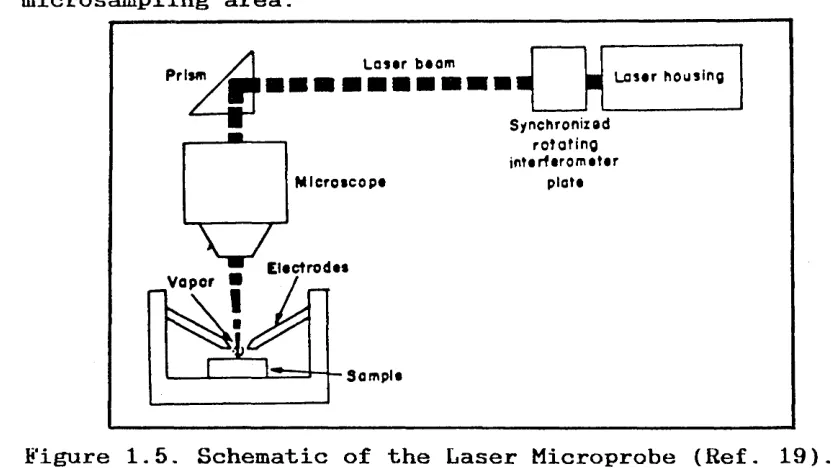
A laser can produce monochromatic, in-phase, very high intensity pulses of light energy concentrated in a very small region. A laser beam can therefore be used to
vaporize and excite analytical samples for spectroscopic examination. The laser spectroscopic source can be used to sample areas as small as 25pm in diameter. In a
Element Wavelength (nm) Detection Limit (pg/g)
Ag 328.0 0.001
As 234.9 0.18
Bi 306.7 0.01
Cd 326.1 0.001
Ga 417.2 2.0
In 451.1 0.02
Mg 285.2 0.001
lJb 283.3 0.03
Sb 259.8 0.1
Se 196.1 0.1
Sn 317.5 0.5
Te 214.2 0.06
T1 351.9 0.004
Zn 334.5 0.1
Table 1.2. Limits of Detection for Selected Elements by Hot Hollow Cathode Emission Spectrometry. All values taken from Reference 18.
sample produced by the laser beam rises between two electrodes positioned above the sample and triggers a discharge from a capacitor charged to 2000V. The
capacitor discharge augments the laser energy to further energise the sample to produce spectral line emission.
used on living tissue without destruction of the tissue. Thus the laser source is a valuable addition to the list of spectroscopic sources with special applications in the microsampling area.
Figure 1.5. Schematic of the Laser Microprobe (Ref. 19).
1.2.4. ELECTRIC ARCS AND SPARKS.
An arc is a continuous electrical discharge of high
energy between two electrodes. In the DC arc, the sample is usually packed into an anode electrode, or the sample itself becomes the anode, as for example in metals
analysis. The arc is struck and the sample is vaporized into the discharge region, where excitation and emission occur. In this technique relatively large amounts of sample are vaporized and excited, therefore limits of detection are good, but because of the unstable nature of the discharge, precision is poor. Additionally the
intensity of the emission is highly dependant upon the
L a s * r b*om Prism
M icroscop*
E l*ct ro d ** Vapor ■
Sompls
Synchronizsd r o ta tin g in t* r f* r o m * t* r
matrix. This technique is therefore used mainly for qualitative analysis.
An intermittent discharge, eg. an AC spark may also be used, and precision can be greatly improved. This is however played off against poorer detection limits, because smaller amounts of sample are vaporized.
Modern electrical discharges combine the characteristics of both arc and spark techniques (ie. a unidirectional spark is used so that the intermittent discharge always excites the cathode), so as to obtain maximum sensitivity coupled with better precision for quantitative work.
Sheathing the electrode with argon reduces the degree of self-absorption by cooled sample around the discharge, reduces background emission and stabilizes the discharge.
One of the major problems encountered with these
techniques is selective vaporization of trace elements depending upon the composition of the sample. A thorough treatment of these methods of emission spectroscopy is given by Barnes (20) and Boumans (21).
1.2.5. PLASMA EXCITATION.
(CCP), the Microwave Induced Plasma (MIP) and the Inducively Coupled Plasma (ICP).
It was Langmuir who introduced the term Plasma (as distinct from the biological term) to describe the
phenomenon which he and other physicists were studying at that time. This term is now used to denote partly or
completely ionised matter (ie. matter whose atoms are dissociated into positive or negative ions and electrons) which has volume and density properties similar to those
of the parent gas but differs from it greatly in electrical, optical and thermal properties.
The DC arc plasma is a transferred plasma, where a portion of the discharge has been moved out of the primary arc column. This is achieved by placing the electrodes at an angle to one another, and using a gas flow to bend the arc. Modern DC plasmas utilize a three electrode discharge which forms a plasma of inverted *Y* shape (22). The highest temperatures reported are
7000-9000K, but the sample does not penetrate this region. Observation of spectral emission is made below the intersection of the inverted *Y* to avoid the high plasma continuum which reults from the tungsten
electrodes vaporizing. The development of the DCP has been reviewed by Kiers and Vickers (23) and Greenfield
W electrode
cathode— •
ceramic sleeve excitation region
graphite electrode
sample argon
anode anode
Figure 1.6. The DC Plasma (Inverted ’Y ’).
In the capacitatively coupled microwave plasma, a 2450MHz magnetron valve is coupled, via a coaxial waveguide, to the plates or torch where the plasma is formed. This is a low cost plasma, but suffers from interferences from
easily ionised elements, which cause significant
variation in the excitation temperature of the plasma (24).
The microwave induced plasma may be formed in a resonant cavity using a similar generator to the CCP and input power levels of up to 200W. If a small flow of argon (eg. 300 ml/min) is passed through a small bore (2mm internal diameter) quartz tube in a microwave cavity and seeded with electrons from a high voltage spark, a self
[image:32.616.117.473.18.224.2]Thermodynamic Equilibrium (LTE). The excitation
temperature is in the region 5000-7000K, but the neutral gas temperature is less than 1000K (25). The presence of high energy electrons and metastable excited inert gas
species means that the microwave plasma is a highly efficient excitation source. The presence of highly
excited helium metastables enables the production of line spectra from such elements as chlorine, fluorine,
nitrogen and oxygen which have high excitation potentials (ll-28eV) and are difficult to excite by other sources. The main problem with this source is that it is easily extinguished by large quantities of water or other solvents (26).
The inductively coupled plasma (ICP) has been applied extensively to the analysis of solution samples in recent years (27). This technique is the excitation source
employed for the experimental work descibed in this thesis. Therefore a full discussion of the history and development of the ICP follows.
1.3. THE INDUCTIVELY COUPLED PLASMA.
1.3.1. HISTORY AND DEVELOPMENT.
excited by an alternating magnetic field. These papers were followed in 1961 by Reed (30) who described an
inductively coupled plasma torch (ICPT) operating at
atmospheric pressure on argon (alone, or mixed with other gases) and powered by a lOkW High Frequency (HF) heating unit operating at 4MHz. The torch consisted of a quartz tube, with a brass base having a tangential gas entry, placed within the work coil of the generator. A pilot plasma was first formed by the insertion of a carbon rod
into the torch, which produced thermal electrons by the Joule (Ohmic) heating effect of the alternating magnetic field. This provided the initial ionization of the argon enabling coupling to occur and the plasma to form. Reed reported the use of his plasma as a crystal growing device (31) and makes only passing mention of its possible application as a source for spectrochemical analysis (32).
In 1963 Greenfield and colleagues (33, 34) made patent applications for an ICPT adapted for use as a
spectrochemical source. This consisted of three
formed. The aerosol entered the plasma torch, passed through a ’tunnel* through the plasma fireball, and a long narrow tail flame was produced. It was this tail flame which was used as a spectroscopic source. This device was described in a paper in 1964 (35), which constitutes the earliest reference to the actual use of this type of cell, with an annular plasma, and the utilization of the emission from the tail flame remote from the intense continuous emission of the plasma fireball.
Greenfield’s work was followed in 1965 by an account by Wendt and Fassel (36) of an ICPT with laminar flow for which was claimed the advantage of less turbulence and possible greater stability than was obtained with vortex flow. In their torch emission from a part of the plasma not in contact with the atmosphere was viewed through the quartz torch. Detection limits for this torch were very low, although this may be due to the use af an ultrasonic nebulizer.
the production of an annular plasma at higher gas
velocities was proved. In 1969 Dickinson and Fassel (38) published an account of their continuing investigations into the analytical application of the ICP. They
underlined the importance of the annular plasma and
suggested that increasing the frequency of the generator would favour the production of an annular plasma.
m m
C o o l a n t
A u x i l i a r y
JT
S a m p l e
Figure 1.7. Schematic of a Plasma Torch of the Greenfield Design.
With the establishment of the plasma as an emission
led to more effective viewing of the emission. They also described a powder injection system. Using solution
nebulization techniques they determined boron and zinc in nickel alloys. The powder system whilst very effective for qualitative work was not very succesful
quantitatively. Freedom from matrix interferences was reported.
The application of the plasma torch to the determination of wear metals in oils was also reported (41). The oils were injected, in a solvent, by means of a motor driven syringe and a pneumatic nebulizer. Aluminium, iron and nickel naphthalates were used as standards.
In 1970, Pforr and Aribot (42) determined calcium,
magnesium, titanium, iron and aluminium in quartz using a powder injection system. Borms et al (43) compared an ICPT with flame emission. Despite problems with stability they reported detection limits of 0.01 to l.Opg/g for a number of elements. They also reported that their
analytical curves were linear over three decades, that no interferences were detected from lOOOpg/g of aluminium, sodium and phosphorus and that a 1000-fold excess of calcium gave an enhancement.
obtained with precision of 3 and 5% respectively. By using a nitrogen flushed optical path and monochromator, Kirkbright et al (45) were able to obtain detection
limits of 1.7pg/g for sulphur at a wavelength of 182.04nm and 0.15pg/g for phosphorus at 214.91nm. The linear
ranges extended over five decades, to above lOOOpg/g. Soil extracts were analysed for phosphorus and
coefficients of variation of 3 to 7% were reported. In an extension to this Kirkbright and Ward (46) predicted, using a theoretical model, the characteristics of an ICPT
for optical emission analysis compared to an inert gas shielded nitrous oxide-acetylene flame. A longer linear calibration range was predicted for the plasma source owing to the greater freedom from self-absorbtion under optimum operating conditions, and long residence time of analyte species in the plasma was expected to reduce solute vaporization effects. The predictions were
verified experimentally and the advantages of the use of the plasma source were demonstrated in the analysis of aluminium alloys for a number of elements.
Fassel and Kniseley (47) published a reassessment of emission spectroscopy with ICPT as against flame excited atomic absorption, fluoresence and emission spectroscopy, and concluded that the ICPT was superior on most counts. A similar system reported by Greenfield (48) in 1975 gives account of an ICP coupled to a 30-channel direct reading spectrometer with fully automatic sequential
perform simultaneous multielement analysis at both trace and major levels.
Typical results for the analytical range of a polychromator system are given in Table 1.3.
Element Wavelength run Analytical Range (pg/ml)
A1 I 308.215 0.013 -- too
As I 193.696 0.025 - - too
Cd II 214.438 0.005 -- 100
Cr I 357.869 0.001 — 100
Co II 228.616 0.006 - 100
Cu I 324.754 0.0006 -- 50
Mg II 279.553 0.0009 -- 50
Mn II 257.610 0.0006-- 50
Ni I 341.476 0.012 -- 200
Pb II 220.353 0.017 -- 100
Se I 196.026 0.055 -- 100
Sn II 189.980 0.016 -- 100
Zn II 206.200 0.005 -- 100
Table 1.3. Data Illustrating the Practical Range of a Polychromator for Multielement Analysis. All Data from Reference 49.
coolant and auxiliary gases. This pattern has been adopted by many of today’s instrument manufacturers.
Current research interests still involve torch design i
considerations, the most controversial of which involves the use of a laminar flow torch (50). Interest is also expressed in the use of mixed gas plasmas, this subject having been investigated and systematically evaluated by Choot and Horlick (51).
1.4. SAMPLE INTRODUCTION TECHNIQUES IN ICP-EMISSION SPECTROMETRY.
The attention of a number of research groups is now turning to devising more efficient, more versatile methods of sample introduction, as improvments in this may lead to improved detection capability.
Selection of the best sample introduction proceedure for an analysis requires consideration of a number of points. These include:
i) the type of sample (solid, liquid or gas), ii) the levels and also range of levels for the elements to be determined,
iii) the accuracy required, iv) the precision required,
v) the amount of material available,
vi) the number of determinations required per hour, vii) special requirements, such as whether speciation
To understand the limitations of practical sample introduction systems it is necessary to consider the atomisation source, as the proceedure chosen must be compatible with operation of the atomiser (plasma). It must also be bornein mind that the plasma has certain well defined boundaries of such properties as
temperature, chemical composition etc., the introduction procedure, selected must result in rapid breakdown of species in the atomiser, irrespective of the sample matrix.
To ensure efficient free atom production the following parameters must be known for each analyte~matr.ix~atoraiser combination:
i) the maximum acceptable drop size (for solutions), ii) the optimum plasma loading (aerosol vapour), iii) the maximum acceptable analyte mass loading, iv) appropriate gas flow patterns for effective plasma penetration,
v) suitable observation height.
The last parameter has to be selected in conjunction with the gas flow pattern of sample introduction such that adequate residence time in the plasma is provided for the material introduced to desolvate, vaporize and atomise.
In special cases, for instance when organic solvents are introduced to the ICP it is necessary to adjust the
usually requires raising the forward RF power applied to the plasma to aid decomposition of the organic species.
1.4.1. NEBULIZATION OF LIQUIDS.
Liquid sample introduction with pneumatic nebulization is the approach used in the vast majority of atomic
spectrometric determinations. The precise microscopic processes by which pneumatic nebulizers operate are not well understood, though some general priciples are known.
In simple terms, a liquid jet is shattered by interaction with a high velocity gas jet. The best description of this process is probably some type of surface stripping mechanism, such that succesive thin films of liquid are removed by the gas flow, and then spontaneously collapse under surface tension forces to produce the aerosol
droplets. The resultant aerosol generally has a very wide drop-size distribution (52).
The practical requirements for pneumatic nebulizers are the following; A high velocity (sonic to supersonic) gas
stream, a reasonable pressure drop at the liquid injection capillary for venturi effect natural
aspiration, maximum interaction between the gas and liquid streams for fine aerosol production and freedom from blockage, resulting either from particles suspended in the solution or from salt build-up at the nebulizer tip. Matrix salt tolerance is determined by both the concentration of the salt and it’s solubility
problems, whereas 10% sodium sulphate may rapidly block the nebulizer (52). A more serious problem with the ICP may be whether the plasma torch quartz injection tube can withstand the high salt level without clogging and
ultimately, devitrifying.
A number of different nebulizer designs are currently in popular use with the ICP. A rather delicate, all glass concentric ’Meinhard’ nebulizer is often used with the ICP (53). Particle blockage with these devices can be an irreversible process. Crossflow nebulizers which are much more robust are also popular with ICP users. These
nebulizers are fabricated from acid resistant materials such as PTFE or Ryton. In recent years several proprietry pneumatic nebulizers have been introduced which are
claimed to overcome some of the noise and stability
problems common to ICP pneumatic nebulizers. For instance the MAK nebulizer, named after Meddings, Anderson and Kaiser (54), is a crossflow device that operates at a very high back pressure (200psi) and is made of glass. Babbington type V-groove nebulizers may be used for high solids solutions and even slurries (55).
The fundamental limitation of all pneumatic nebulizers of conventional design is that they produce aerosols with a wide drop size distribution. This means that high
transport efficiencies can only be achieved at the expense of allowing large drops to reach the plasma.
they vaporize, due to excessive solvent loading, or give rise to vaporization interferences. In ICP spectrometry, a typical value for the amount of useful analyte reaching the plasma is about 1%. One device that produces a much finer aerosol is the fritted disk nebulizer (36). This device has been claimed to generate aerosols with a mean primary (useful) drop size of <1.0pm, and to result in a transport efficiency of 90%, but to obtain this, very low sample flow rates of O.lml/min were used (as opposed to approx. l.Oml/min for normal crossflow nebulizers), which meant that the net gain was not as high as initially
expected.
The ultrasonic nebulizer has been suggested as a
replacement for pneumatic nebulization since 1965 (56). With this device, instead of drops being stripped from a
liquid cylinder by a high velocity gas jet, surface instability is generated in a pool of liquid by a focussed or defocussed ultrasonic beam. The beam is
generated by a piezoelectronic transducer. These devices produce aerosols with mean drop diameters which appear to be a function of the excitation frequency. Ultrasonic nebulizers give a much more efficient fine aerosol
production than pneumatic nebulizers. Up to 30% efficient production of droplets in the size range from 1.5 to
2.5pm has been reported at a sample flow rate of
been used to counteract this carry-over problem (57). Despite much recent work however, the general reliability and freedom from interferences of ultrasonic nebulizers remains to be proven (58).
1.4.2. VAPOUR INTRODUCTION.
Vapour introduction techniques are well established in atomic absorption spectrometry for stable hydride forming species (eg. arsenic, antimony, bismuth, germanium, lead, selenium, tellurium and tin) and also for mercury vapour introduction. These techniques have been applied to
sample introduction with the ICP (57, 59). A more
specialized approach, which involves the production of volatile metal chelates from a wide range of transition elements has been used successfully with the ICP (58).
Vapour introduction offers several advantages over conventional liquid sample introduction; it gives
transport efficiency approaching 100% and it offers the possibility of preconcentration. Disadvantages result from significant interferences from other hydride forming elements and the adverse effect of hydrogen in the argon carrier gas upon plasma stability. Hydrogen acts to
ICP is significantly less robust to changes in its
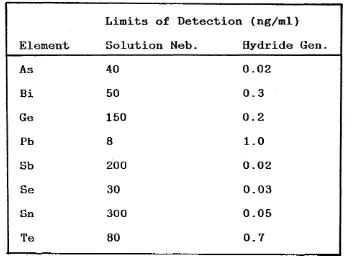
operating environment than the combustion flame. Typical hydride detection limits by ICP-ES are compared with normal solutions nebulization in Table 1.4. below.
Element
Limits of Detection (ng/ml)
Solution Neb. Hydride Gen.
As 40 0.02
Bi 50 0.3
Ge 150 0.2
Pb 8 1.0
Sb 200 0.02
Se 30 0.03
Sn 300 0.05
[image:46.614.68.421.111.368.2]Te 80 0.7
Table 1.4. Limits of Detection for Solutions Nebulization and Hydride Generation ICP-ES.
1.4.3. SOLIDS TECHNIQUES.
The value of ICP-ES for the determination of trace
through major elemental concentrations in solutions has been adequately demonstrated earlier in this work.
i) sample dissolution is often the most time consuming stage of an analytical proceedure,
ii) dissolution increases the possibility of
contamination of the sample from reagents and from the additional handling involved,
iii) volatile elements may be lost during digestion proceedures and,
iv) dilution of the sample and losses associated with nebulization efficiency and aerosol transport lead to poorer detection limits.
An attractive alternative to these disolution problems is the direct analysis of solid samples, either by insertion of the solid material directly into the plasma discharge
sample
or separate vaporization of the^followed by excitation in the ICP.
1.4.4. DIRECT SAMPLE INSERTION.
The direct sample insertion technique is based upon the use of the plasma discharge itself to achieve sample
vaporization from the solid and excitation of the analyte for emission analysis. The sample may be in the form of a liquid or solid, with little or no pretreatment. The
dependent intensities, which are influenced to some extent by probe material, geometry, sample matrix composition and analyte.
The first report of axial insertion was by Horlick and Salin in (63) in 1979 who described a simple mechanical device for introducing small solid and powdered samples into the ICP (see Figure 1.8.)
if
Graphite electroder
♦ - Auxiliary gas♦ Coolant gas ♦ T e f l o n baseCentral gas
EE
Solid quartz rod
^ .A d ju s ta b le stop
[image:48.614.93.505.76.536.2]^ ♦ “ Sliding platform Screw
Figure 1.8. Schematic of the Direct Sample Insertion Device Reported by Horlick and Salin (63). Reproduced with permission.
continuously running plasma. Using solid and solution samples they realized lower detection limits for some elements by this technique relative to solutions
nebulization. Kirkbright and co-workers published a
series of papers (65-68) discussing the development of a direct insertion system from a manual system through to a stepper motor driven system. This system allowed the
probe to be reproducibly stopped in the plasma and at various distances from the load coil, where inductive heating could be utilized to produce dry/ash sequences analogous to those used in graphite furnace AAS. This was followed by work aimed at characterizing the mechanism of vaporization, and an investigation of refractory and
carbide forming elements. Following this a number of papers by different authors have described a variety of probe, cup and wire loop (69) insertion systems powered manually, electrically and pneumatically (70,71,64). The possibility of automatic changing of the sample cups has been addressed by Horlick and Pettit (72) who describe a system using a 24 position autosampler carousel modified to accommodate probe tips, linked to the computer which controlled movement of the probe, to allow unattended sample/cup interchange.
The operating parameters of the ICP have been
plasma operation. In addition the penetration of the probe into the plasma, drying and vaporization rates, duration of residence in the plasma and sample size have been indicated to affect analytical performance.
Interferences noted to exist with the direct insertion technique are intensity offsets due to background shifts during sample insertion/vaporization. These shifts can normally be corrected for by use of background correction facilities (see section 1.5.), but the transient nature of the signal produced by direct insertion complicates
this procedure. Currently no commercial i nstruments exist
which allow simultaneous multielement quantitation of transient analyte peaks and associated background signal. Other interferences associated with cup material have been noted. When graphite is used for the sample cup these include reactivity, carbide formation,
deterioration (oxidation) and memory effects.
The main classes of samples investigated seem to have been solution samples and digestion products, although Page et al (73, 74) have published work upon the
determination of volatile trace elements in uranium oxide materials using direct insertion and a carrier
1.4.5. SEPARATE SAMPLING AND EXCITATION.
Sampling a material using one method and subsequently exciting the vaporized material using another technique
(to perform a single/multielement analysis) is a concept which has its origins in the beginning of this century. The earliest application (not including chemical
techniques) of this concept is found in a 1907 paper by Hemsalech and Wattenville (77). Their system, illustrated in Figure 1.9. involved the use of a spark to erode
material from a metal sample. The resultant dry metal aerosol was carried into a flame where atomic emission analysis was performed.
Burne Air
E - Sample
Counter Electrode
Gas
Figure 1.9. The Remote Sampling and Excitation Equipment of Hemsalech and Wattenville. Taken from Reference 77.
Since then separate sampling and excitation has taken many forms and interrupted electric arcs (78), sparks
1.4.6. ELECTROTHERMAL VAPORIZATION.
The direct vaporization of solids into an ICP, using
electrothermal vaporization (ETV) devices, similar to the graphite furnace used in AAS has been proposed since 1974
(83). The ETV-ICP-ES combination offers a number of
positive features for the determination of trace element levels in a variety of sample types and matrices;
i) It allows the direct analysis of milligram or microlitre quantities of solid and liquid samples with minimal pretreatment.
ii) Substantially higher rates of analyte transfer to the ICP are possible from the ETV device than from conventional solutions nebulization.
iii) The ICP-ES technique permits simultaneous multielement analysis to be made from the sample vapour.
iv) Operating conditions for the ETV device and the ICP can be individually optimised.
v) The form in which the analyte is evolved from the sample, either molecular or atomic is of less
importance than in GF-AAS because the high
temperatures experienced by the sample vapours in the ICP efficiently dissociate all molecular species.
Early attempts to couple ETV apparatus to an ICP were reported by Dahlquist et al (84) who developed a ’yarn’ vaporizer and Nixon et al (83) who used a tantalum
the ug/ml range for 16 elements from lOOjil samples. Kirkbright and colleagues subsequently published a succession of papers on graphite rod ETV-ICP-ES.Their graphite rod was located in a cylindrical glass manifold of about one litre volume. With this system detection
limits ranged from O.lpg/ml (beryllium, manganese and silver) to 0.2pg/ml (arsenic) with lOpl sample volumes
(81). Matrix elements were observed to affect the rate of vaporization of analyte elements and certain elements
affected the transport efficiency between the furnace and the ICP (86).
Aziz et al (87) combined a commercial furnace with ICP-ES. "Severe" matrix effects associated with the analysis of NBS Orchard Leaves and Bovine Liver (after dissolution) and diluted serum required the use of a
standard additions calibration. Detection limits obtained under compromise conditions for a number of transition elements ranged from 0.1 to 100pg/l, which were 2 to 5 times better than those obtained with solution
nebulization.
Ng and Caruso (88) applied electrothermal carbon cup vaporization to the ICP-ES technique. Their furnace enclosure was similar to that of Gunn, Millard and
Kirkbright (81) but had an internal volume of 280ml (88). Compromise conditions were used for the ICP but the
signal levels for several elements, eg. aluminium and tin by factors of 5 to 6 times. Later papers by Ng and Caruso covered the use of ammonium chloride as a vaporization aid for the determination of chromium, uranium, vanadium and zinc in synthetic solutions (89), the determination of trace elements in synthetic ocean water (90), and the analysis of organic solutions (91).
Blakemore et al (92) applied ETV-ICP-ES methods to the determination of 10 elements at trace to major levels in wastewater, blood plasma and NBS Bovine Liver, the latter analysed directly without dissolution. The standard
additions technique was applied for the wastewater and blood plasma but the analytical proceedure for bovine
liver was not stated. No detection limit data were
listed, and the absence of data for certain elements, eg. arsenic, cobalt, nickel and selenium suggests that the limits of detection may not have been adequate.
Hull and Horlick (93) combined a commercial graphite furnace with ICP-ES for the analysis of solutions,
botanical solids and coal. No ashing or dissolution steps were employed for the solid samples, which were mixed 1:1 with spectroscopic grade graphite containing 0.2% indium as an internal standard. An analytical curve covering three decades for the magnesium 252.2nm line was shown as representative of the results obtained for cadmium,
4.5%, but information on whether these analytical curves were obtained from reference solutions or reference
solids was not given.
Several charateristics of the above ETV-ICP-ES studies stand out in contrast to the potential advantages of the technique enumerated previously. The fact that operating conditions of the furnace and/or ICP were often optimised
individually for each element, and that the ETV-ICP separation of vaporization and analysis functions does not eliminate all of the bothersome analyte specificities or matrix effects encountered in ETA-AAS.
1.5. NICKEL BASED ALLOYS.
Nickel based alloys and superalloys are widely used in the manufacture of aircraft components, nuclear reactors and high temperature/pressure chemical processors. The quality of these materials must be rigorously controlled and the concentrations of particular volatile trace
elements (eg. arsenic, cadmium, lead, magnesium and zinc) must be kept low, in the order of a few parts per million or less. Such impurities can enter by a variety of
routes, for example as contaminants from raw materials, during fabrication of components or during operation in service environments and can affect the material by several mechanisms.
They require complex digestion procedures, often
involving the use of hydrofluoric or perchloric acids in pressure digestion vessels. The dissolution procedure further dilutes an already low level of analyte. To date two techniques have been successfully applied to these materials. They are i) Hot Hollow Cathode Emission
Spectrometry (12, 94-96) and ii) Graphite Furnace Atomic Absorption Spectrometry (97-105). These methods allow direct determination of the solid material, but in the case of HHC-ES the source has to be dismantled between samples which is time consuming and GF-AAS is a single element technique. Both techniques rely upon the use of CRM's or in-house RM*s for calibration purposes.
Figure 1.10.a. shows the emission spectrum recorded over the wavelength range 190-700nm for a l%w/v solution of
the nickel based alloy BAS346 introduced to the
plasma. Figure l.lO.b. shows the spectrum recorded over the same wavelength range for distilled water. The
complex emission observed for the nickel base in the region 200-400nm causes serious spectral interferences when these materials are analysed for trace elements.
Figure 1.10. illusrates one of the major problems faced by conventional spectrochemical methods for the
i.. jl ) . nowever some eiemeaus, aubctuxy uxie uxransx u j l u u
element, the 'rare* earths and the platinum group metals produce a large number of prominent lines yielding very complex line spectra (106- 108). A review of the elements present in the nickel based material (see Table 2.2.) shows the presence of a number of elements from the above mentioned groups, and gives an indication of the
problems which this matrix poses for spectrochemical emission analysis.
I--- 1--- 1---1--- 1--- 1
190 300 400 500 600 700
Wavelength (nm)
The spectral interferences encountered with the analysis of this material may be classified as follows;
i) Background Shifts,
ii) Spectral Line Overlap,
iii) Continua due to Line-Wing Broadening.
Background shifts may be simple (flat) background where the background (continuum) light level is raised
uniformly across the bandpass of the detector or it may vary from longer to shorter wavelength. When a steady
state signal is recorded it is possible to correct for background shift.
Spectral line overlaps are the result of a concomitant species in the sample (or plasma) emitting light at the same wavelength (or very close) to the analytical line of interest. Continua due to line wing broadening fall
between the two. See Figure 1.11. for illustration.
The methods normally applied to correct for these background shifts are discussed below.
In general, there are two different types of correction methods which can be used separately or together. On-peak subtraction or off-peak subtraction On-peak subtraction is necessary to correct for direct spectral overlap, off-peak is useful to correct for featureless, continuum background.
On-Peak Subtraction.
are caused dy specitic species. A l l species causing
background enhancements at a particular analyte line must be identified. The relative contribution of each of the interferent species is then experimentally determined so that correction factors for each analyte line, which are dependent on the concentrations of the concomitant
species in the sample can be calculated. The correction factors are then related to the observed signal and each species concentration in a linear fashion.
SIMPLE BACKGROUND SHIFT
SLOPING BACKGROUND SHIFT
DIRECT SPECTRAL OVERLAP
COMPLEX spectral
OVERLAP
Figure 1.11. Schematic of the Various Types of Background Interference. (Ref. 133)
Off-Peak Subtraction.
is flat, a 'one-point’ (single wavelength) correction is sufficient. The corrected analyte intensity is the
difference between the intensity measured at the analyte wavelength and the intensity measured at the background wavelength. If a sloping, but featureless background is present a 'two-point' subtraction can be used. This might be the case when the analyte is near the broadened wings of a strong emitter, such as Mg+. Two wavelengths are chosen for background measurement, one at shorter wavelength than the analyte line and one at Longer
wavelength. An average of the two is used to estimate the background at the analyte wavelength. Off-peak
subtraction can correct for continuum background and partial overlap from atomic or molecular emission. A further advantage of the off-peak correction method is that the species causing the featureless background enhancements need not be identified or quantified.
These techniques form the basis of interference
correction in emission spectrochemical analysis. However they do require a thorough knowledge of sample
1.6. AIMS AND SCOPE OF THIS WORK.
The ICP is now used in a wide range of applications in such diverse fields as Geology (110), Environmental
(111), Food and Agriculture (112) and Bio-Medical (113). However, the progress of ICP-ES into metallurgical
analysis has been slow, and the traditional arc/spark emission and X-ray fluorescence methods of analysis are
still the standard techniques used by this industry.
This has been in part due to the recent development of low cost, high precision portable spectrometers which enable conductive samples (eg. the 'melt' and the
product) to be analysed by emission spectrometry and non-conductive samples (eg. oxidic materials and slags) by XRF. In a process control environment the speed of the determination is important as the results of the analysis are required to allow modification of the melt, as well as calculation of the final product composition (114). At present ICP-ES requires the dissolution of the sample, which can be lengthy in comparison with the total
production time. In addition to this new trace level are
determinationsy^required to meet the specifications of new steels and alloys. The nickel based alloys and
superalloys are archetypal of materials in this category.
It was intended to use Direct Insertion ICP-ES to
alloy without prior dissolution. It was also intended to utilize the relatively low temperature (68) achieved by the sample probe to allow selective vaporization of the volatile trace elements, whilst leaving the majority of the matrix elements in the sample cup, thus avoiding possible spectral interferences from these elements. A direct sample introduction system was constructed in the laboratory and a series of experiments to investigate the sample type, matrix/analyte behaviour and analytical performance of the direct insertion system were
conducted. A number of other, fundamental considerations eg. cup design and heating characteristics of the system were also investigated. The analytical potential of the technique with respect to the metallurgical industry was then investigated by the analysis of the nickel base and other solid materials.
Subsequent to this the analytical potential of
electrothermal heating and vapour introduction to the ICP was investigated. This also required the in-house design and construction of an ETV-device, followed by