Munich Personal RePEc Archive
Learning entrepreneurship in a
multicultural context
Costa, Maria Teresa and Carvalho, Luísa and Sardinha,
Boguslawa
Institute Polythecnic of Setúbal - Portugal, Institute Polythecnic of
Setúbal - Portugal, Institute Polythecnic of Setúbal - Portugal
2008
Online at
https://mpra.ub.uni-muenchen.de/15840/
Learning Entrepreneurship in a Multicultural Context
Teresa Costa
Luísa Carvalho
Boguslawa Sardinha
Economics and Management Department Business School (ESCE) Polytechnic Institute of Setúbal
ABSTRACT
Nowadays learning entrepreneurship in higher education became an important
issue. International experiences promote the relationship between students from
several countries in a multicultural context.
In this sense it was developed an entrepreneurial game were tutors have the role
to support students during the activities. The objective of entrepreneurial game
objective is to create a business idea and develop a small business plan to present
to the group.
The general aim of this paper is to describe this international experience of
Setúbal Business week. The specific goals are:
Understand how students learning in an international environment;
Understand how international multicultural groups function;
Evaluate how this kind of game improve a set of competencies, such as
entrepreneurial spirit, capacity to work in an international team, oral
communication, creativity, confidence and research skills;
Evaluate business week performance in order to improve future events.
The study concludes with some recommendations and remarks about learning in
KEY- WORDS: Entrepreneurial Game; Multiculturalism; International
Environment
Introductory Note
Learning entrepreneurship in a multicultural context is the challenge of actual
societies. In this context, higher education institutions can assume an essential
role in entrepreneurial process.
The aim of this work is to describe and evaluate the international experience
developed during the Business Week which was for the first time, an
entrepreneurial game. This activity involved students and teachers from 7
countries during one week in Setúbal – Portugal.
This work was divided into two parts. The first part includes a conceptual
approach based in literature review, and the second part presents an empirical
study developed in Setúbal Business Week.
PART I. THEORETICAL APPROACH
1. Entrepreneurship Education
Nowadays, the knowledge-based society stresses the role of innovation,
demanding a more entrepreneurial society as a way to increase economic
growth, expand employment, and to increase the competitiveness of
economies (European Commission, 2003). In Europe, where unemployment
is high and where Lisbon Agenda claims for more competitiveness,
micro-economic tools available for governments in order, to, effectively
develop local economies (McMullan and Gillin, 2001).
In this context, universities and other higher institutes have a crucial role in
development of entrepreneurial programmes to stimulating improvement of
competences. Teaching will need to focus more upon entrepreneurial
pedagogy with a stronger and more holistic, integrated approach to
knowledge.
In this perspective, it is important to discuss what capacities and
competencies will need to be developed and what changes will need to be
made and how they may be best facilitated if the impact of current initiatives
is to be sustainable (Gibbs, 2005).
2. Multicultural Context
Working with multicultural groups is a challenge which involves students and
teachers. The adoption of relevant multicultural curricula, the use of
culturally sensitive assessment and intervention strategies, are relevant in
apprenticeship perspective. Teacher must attend to three major components:
awareness, knowledge, and skills (Sue, Arredondo & McDavis, 1992; Sue et
al., 1982). According with Sanchez (1995), “the awareness component
involves professionals examining their own values, myths, stereotypes, and
world view. Knowledge entails developing a non-stereotyping, flexible
understanding of cultural, social, and family dynamics of diverse groups,
along with a comprehension of the critical socio-political, historical, and
economic contexts in which people from diverse multicultural groups are
embedded. Skills require the development of culturally sensitive, flexible, and
empowering treatment and .assessment strategies that are accompanied by
communication skills, the integration of multicultural and diversity issues in
various treatment modalities, multicultural consultation, and advocacy
The case study described in the next section will consider this approach,
promoting this kind of education experience through the creation of
multicultural groups, including students from several nationalities (Portugal,
Spain, Belgium, Netherlands, Finland, Czech Republic, Poland and Latvia,).
The activities were expressed and resolved within various cultural groups
(Lee, 1995).
3. Business Week
The Business Week project provides a possibility to learn in an international
environment for students.
This project is some kind of intensive program which takes place during one
week. The objectives of BW are to:
• Encourage efficient and multinational teaching of specialist topics which
might otherwise not be taught at all, or only in a very restricted number of
universities;
• Enable students and teachers to work together in multinational groups and
so benefit from special learning and teaching conditions not available in a
single institution, and to gain new perspectives on the topic being studied;
• Allow members of the teaching staff to exchange views on teaching
content and new curricula approaches and to test teaching methods in an
international classroom environment. (Erasmus Intensive Programs-
European Union 2005).
This BWS was a unique possibility for students from low income families to
have an international experience to work with students from different
countries and to test their own capacities. The ESCE supported 2/3 of
expenses of accommodation and meals during 5 days of the game while
students paid the remaining 1/3. Even then some of our students quoted
themselves to collect money for the participation fee of one college. The
students have an opportunity to learn from each others to know a foreign
All students were accommodated on tourist traditional country-houses
together and in rooms on multinational groups. This forced them to start to
socialise with students from other cultures.
This Intensive One Week Program was organized both by teachers and
students.
Business Week Setúbal counted with the participation of 56 students on
educational activities and 15 students-volunteers.
There were 24 Portuguese students and 32 foreign students: 10 from
Belgium, 7 from Netherlands; 5 from Poland; 5 from Latvia and 5 from
Spain. The working language was English.
Beyond the pedagogical issues, students which participated in this business
week have had many different activities.
The involvement of students’ volunteers was very important to the success of
the BWS. They have met the foreign students on airport and accompanied
them to their accommodation. The volunteers also prepared the welcoming
day activities. They were coordinated by one student-volunteer, which
designed and organized all activities as his final project on his scholar
curricula.
This activity also involved about 10 teachers from ESCE which participated
as tutors of the working groups and 3 coordinators – general coordinator,
pedagogical coordinator and logistic coordinator.
The foreign students were accompanied by lectures which also participated
on pedagogical and cultural activities. The foreign lectures shared the tutoring
of working groups with Portuguese lectures. Beyond the tutoring activities
the lectures have had a possibility to discuss the future programmes to decide
the strategy for the improvement of the IBWN and to discuss the evaluation
inquiry which was proposed on BWS edition. The result of the inquiry is
discussed in the second part of this work.
The Business Week Setúbal takes part of the International Business Week
network which involves 13 schools in 8 different European countries.
This Intensive One Week Program was organized by students and teachers
The pedagogical, logistic and institutional contacts were the teacher’s
responsibility.
As the school didn’t receive any funding it was compulsory to find sponsors.
The BWS has some sponsors which supported some cost namely with
transports and with gifts we offer students and teachers. This was another task
of BWS coordinators.
PART II -Entrepreneurial Game: Case study
1. Entrepreneurial Game: A brief description
The entrepreneurial game took place in Setúbal during the Business Week
dedicated to “Entrepreneurship”. In it there were 56 students and 11 teachers
from 7 countries1. Students were divided by seven groups and each group had
2 tutors (one Portuguese and another for a foreign country). Tutors had a
special role in the game to support students during the activities. The
entrepreneurial game also was an opportunity for tutors to work in a
multicultural environment in apprenticeship perspective.
The entrepreneurial game objective is to create a business idea, in other
words, to develop a small business plan to present to the group. This Business
plan activity improves various attitudes/skills:
- creativity, confidence and team working.
Entrepreneurial games have to promote the followingcompetencies:
• entrepreneurial spirit;
• capacity to work in an international team;
• oral communication;
• creativity;
• confidence;
• research skills.
1
In order to achieve the competences, this game follows a set of pedagogical
methodologies. The game uses active methodologies to support students to
develop new ideas for their business start-ups (see Annex 1- Activities
Programme: Entrepreneurial Game).
The entrepreneurial game includes several tasks:
1. Opening Lecture, where it was presented the philosophy, methodology
and planning of game activities.
2. Discovery Group activity, with the aim to create a group spirit and to
attain better knowledge of each other.
3. Brainstorming- in order to develop a business idea each group must
present in 30 minutes at least 30 business ideas.
4. Process of selecting ideas- one group must choose the best idea of
different group. This activity allows everyone participate in the selection of
each business idea, Involving all participants.
5. Sketch of Business Plan- students should sketch “The one Page Business
Plan (OPBP)”2. The OPBP is a very straightforward, versatile, consistent,
flexible tool and can be used for a variety of purposes. The use of key words
and short phrases tells the reader or audience that only the essence of the
business concept is being presented for review. In Business Week
Entrepreneurial game the OPBP will be used as a summary exercise of a
traditional business plan.
6. Student presentation- each group presented their Business Plan in an
auditorium. At the end all the assistance voted in the best Business Plan.
7. Closing Activity- formal ending activities and announcement of the first
best Business plan and prizes delivery.
4. Methodology
2
In the end of BWS was made the inquiry3 (annex 24) to entrepreneurship
Business Week students and teachers, in November 2007. The scale applied
in inquiry comprehended items between 1 and 5.The methodology chosen to
analyse this inquiry was several hypothesis tests. The data analysis was based
in descriptive statistics supported in the inquiry results. To test our hypothesis
we used several variables such as leadership; group cohesion; competencies,
creativity and confidence.
2.1. Hypothesis
According with the literature review this research has the following hypothesis:
H1: Each group identified a leader.
H2: The groups revealed cohesion during activities.
H3: The entrepreneurial game promotes entrepreneurial competencies in a
multicultural context.
H3.1: The entrepreneurial game promotes entrepreneurial spirit (scale higher or
equal to 3).
H3.2: The entrepreneurial game promotes creativity (scale higher or equal to 3).
H3.3: The entrepreneurial game promotes confidence (scale higher or equal to
3).
H3.4: The entrepreneurial game promotes research skills (scale higher or equal
to 3).
H3.5: The entrepreneurial game promotes team working (scale higher or equal to
3).
3. Results
General characteristics
3
The answer ratio of the inquiry was about 71 % of all participants. 4
This section presents the main results about a set of participant’s characteristics.
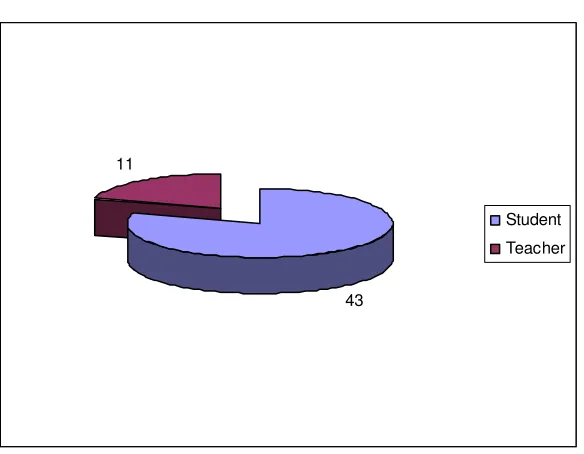
This sample represents the total of population, constituted by 80,0% of students
[image:10.595.169.461.170.397.2]and 20,0% of teachers (Figure 1).
Figure 1 – Type of participants
43 11
Student
Teacher
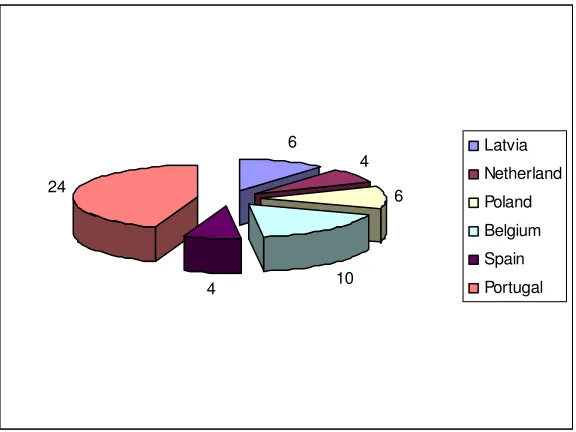
Figure 2 illustrates that the 55,5% of the participants were from Latvia,
Netherland, Poland, Belgium and Spain, and 44,5% from Portugal.
6
4
6
10 4
24
Latvia
Netherland
Poland
Belgium
Spain
Portugal
Statistical results
This objective of this section is to present the main statistical results of the
inquiry in order to confirm or refuse the hypotheses announced in the study.
Table 1 presents the participants evaluation of the activities developed in the
entrepreneurial game. The average value of all these activities is higher than 3,
proving the involvement of the group in all tasks. In addition, standard deviation
is in all cases lower than 1 provided evidence concerning consensus in answers.
Table 1- Entrepreneurial activities
Mean S.Deviat.
Opening Lecture 3,647 0,913
Discovery group activity 3,698 0,972
Brainstorming 4,245 0,830
Process of selecting idea 4,057 0,969
Draft of Business Plan 3,774 0,869
Student presentation 4,057 0,795
Closing activity 4,000 0,843
Only 17 students answered affirmatively concerning the existence of a leader in
he group. That means that H1:Each group identified a leader) is not confirmed
[image:11.595.179.467.72.288.2](Table 2).
Table 2 also demonstrates that 53,5% of students considered that the results were
[image:11.595.159.469.518.638.2]accepting the existence of group cohesion. This confirmed H2: The groups
[image:12.595.196.453.140.191.2]revealed cohesion during activities.
Table 2- Groups functioning
Leader in the group 17
The results were achived 23
Your suggestions taken into account 33
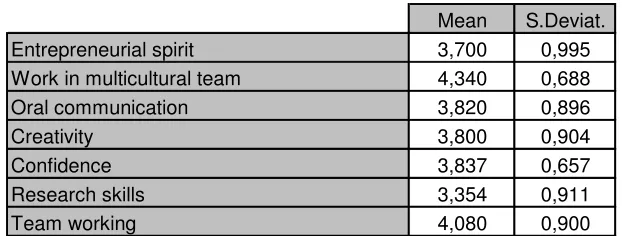
Regarding the improvement of entrepreneurial competencies in a multicultural
context, 63,0% of students reached them (Table 3), confirming H3: The
entrepreneurial game promotes entrepreneurial competencies in a multicultural
context. This hypothesis is subdivided in sub-hypotheses H3.1, H3.2, H3.3, H3.4,
H3.5 referred in table 2.
Table 3- Entrepreneurial competencies
Mean S.Deviat.
Entrepreneurial spirit 3,700 0,995
Work in multicultural team 4,340 0,688
Oral communication 3,820 0,896
Creativity 3,800 0,904
Confidence 3,837 0,657
Research skills 3,354 0,911
Team working 4,080 0,900
Concerning entrepreneurial spirit the average value is higher or equal than 3
validating H3.1: The entrepreneurial spirit (scale higher or equal to 3). Also for
creativity, the average value is higher or equal than 3 confirming H3.2: The
entrepreneurial game promotes creativity (scale higher or equal to 3).
Confidence is also one of the competencies that students considered higher
confirming H3.3: The entrepreneurial game promotes confidence (scale higher or
equal to 3). The research skills were also in scale higher than 3 confirming H3.4:
The entrepreneurial game promotes research skills (scale higher or equal to 3).
Finally concerning teamwork the average value is also higher than 3 validating
H3.5: The entrepreneurial game promotes team working (scale higher or equal to
3). All sub-hypotheses allowed standard deviation with values less than 1,
[image:12.595.158.469.355.473.2]4. Concluding Remarks
The results analysis allowed for the conclusion that participants improved
entrepreneurial competencies due to their participation in the entrepreneurial
game. The activities included in the entrepreneurial game followed a perspective
of “learning by doing”, increasing a fair competitiveness between students.
Multicultural teamwork increased availability to apprenticeship in innovative
context.
This international experience allowed for the overtaking of cultural and linguistic
barriers, and created an environment agreeable to apprenticeship.
Group dynamics were diverse and the majority of the groups assumed the
achieving of the goals game, however the strategies inside the groups were
different. In some cases the existence of a leader was important to the group
results, in other cases it was not possible to identify a group leader. The role of
the leader in such groups influenced the behaviour of group elements, in order to
allow what suggestions would be taken into account.
The involvement and enthusiasm of all participants – students and teachers,
reinforced by a parallel social program contributed to the success of this
initiative.
4. References
European Commission (2003); Green Paper: Entrepreneurship in Europe, Bruxelas
Gibb, A. (2005) “Towards the Entrepreneurial University: Entrepreneurship education as a lever for change” National Council for Graduate Entrepreneurship, Policy Paper 003
Hackbert, P. (2000) “The One Page Business Plan” Sierra Nevada College
McMullan; W. and Gillin, L. (2001) “Entrepreneurship education in the nineties: Revisited” in Entrepreneurship Education. A Global View, edited by Robert Brockhaus, Gerald Hills, Heinz Klandt and Harold Welsch, Asgate, England
Sanchez, William et al. (1995), Working with Diverse Learners and School Staff in a Multicultural Society, ERIC Clearinghouse on Counseling and Student Services Greensboro NC., American Psychological Association Washington DC.
Sue, D. W., Arredondo, P., & McDavis, R. J. (1992). Multicultural counseling competencies and standards: A call to the profession. Journal of Counseling and Development, 70(2), 477-486.
Sue, D. W., Bernier, J. B., Durran, A., Feinberg, L., Pedersen, P., Smith, E., & Nuttall, E. V. (1982). Position paper: Cross-cultural competencies. Counseling Psychology, 10, 45-52.
Annex 1. Activities Programme: Entrepreneurial Game
Day Morning Afternoon Observations Pedagogical
Materials
Tuesday 6/11 10.00h - Lecture
about the entrepreneurial process 11.00h – Team group discovery activity 12.00 –
“given a name to your group” Social activities 10.00h- Amphitheatre Karting Palmela 11.00h Work Room
1. Tutor and subgroup presentations
2. Discovery team group
3. Each group must name itself and draft a logotype. Than must present the name and logotype to others groups
Lesson (paper)
Work Guide
Wednesday 7/11 10.00h
Business Idea
Social
11.00h -13.00h Business Plan
1. Internet research on and drafting One Page Business Plan (OPBP)
Pedagogical guide (see 6.)
Thursday 8/11 10.00h – 12.00h
Presentation preparation
14.00h-17.00h Presentation and voting for the best idea
14.00h-16.30h Presentation OPBP (20 m each group) 16.30h –
presentation and peer selection of the best idea
Note: All activities in days 6, 7, 8/11 are developed in Palmela karting
A
A
n
n
n
n
e
e
x
x
2
2
.
.
B
B
u
u
s
s
i
i
n
n
e
e
s
s
s
s
W
W
e
e
e
e
k
k
E
E
v
v
a
a
l
l
u
u
a
a
t
t
i
i
o
o
n
n
I
I
-
-
G
G
e
e
n
n
e
e
r
r
a
a
l
l
I
I
s
s
s
s
u
u
e
e
s
s
1- Country:_________________________________________________
2- Student
3- Teacher
4- What is your impression about the following facilities (1=bad and 5=best):
1 2 3 4 5
Transportation to Kip
Lodging (Rooms)
Food
Coffee Break
Localization
5- If you have any suggestions please write them down
_________________________________________________________________
_________________________________________________________________
_________________________________________________________________
I
I
I
I
-
-
P
P
e
e
d
d
a
a
g
g
o
o
g
g
i
i
c
c
a
a
l
l
G
G
a
a
m
m
e
e
6- 0We want to know how your group did functioned:
Was there a leader in the group?
Did everybody work in the same way?
The results were achieved?
Do you think your group reach the competencies?
7- Did you at the end of this Business Week improve the following
competencies (1=bad and 5=best):
1 2 3 4 5
Entrepreneurial spirit
Comment_________________________________________________________
_____
Work in multicultural team
Comment_________________________________________________________
_____
Oral communication
Comment_________________________________________________________
_____
Creativity
Comment_________________________________________________________
_____
Confidence
Comment_________________________________________________________
_____
Research skills
Comment_________________________________________________________
_____
Team working
Comment_________________________________________________________
8- What do you think about pedagogical methodologies
_________________________________________________________________
_________________________________________________________________
_________________________________________________________________
_______________
9- How do you evaluate the following activities (1=bad and 5=best):
9.1- Tuesday 6/11
1 2 3 4 5
Opening Lecture
Comment_________________________________________________________
_____
Discovery group activity
Comment_________________________________________________________
_____
9.2- Wednesday 7/11
Brainstorming
Comment_________________________________________________________
_____
Process of selecting idea
Comment_________________________________________________________
_____
Draft of Business Plan
Comment_________________________________________________________
_____
9.3- Thursday 8/11
Student’s presentation
Comment_________________________________________________________
9.4- Friday 9/11
Closing activity
Comment_________________________________________________________
_____
10-Do you have any remarks (positive/negative) on this international
experience?
_________________________________________________________________
_________________________________________________________________
_________________________________________________________________
_________________________________________________________________
____________________
I
I
I
I
I
I
-
-
S
S
o
o
c
c
i
i
a
a
l
l
A
A
c
c
t
t
i
i
v
v
i
i
t
t
i
i
e
e
s
s
11-Do you have any positive/negative remarks on the social activities?
_________________________________________________________________
_________________________________________________________________
_________________________________________________________________
_________________________________________________________________
________________________________________________________________