Munich Personal RePEc Archive
Effects of Blocking Patents on RD: A
Quantitative DGE Analysis
Chu, Angus C.
Institute of Economics, Academia Sinica
September 2008
Online at
https://mpra.ub.uni-muenchen.de/10544/
Effects of Blocking Patents on R&D: A Quantitative DGE Analysis Angus C. Chu*
Institute of Economics, Academia Sinica
September 2008
Abstract
What are the effects of blocking patents on R&D and consumption? This paper develops a
quality-ladder growth model with overlapping intellectual property rights and capital accumulation to
quantitatively evaluate the effects of blocking patents. The analysis focuses on two policy variables (a)
patent breadth that determines the amount of profits created by an invention, and (b) the profit-sharing
rule that determines the distribution of profits between current and former inventors along the quality
ladder. The model is calibrated to aggregate data of the US economy. Under parameter values that match
key features of the US economy and show equilibrium R&D underinvestment, I find that reducing the
extent of blocking patents by changing the profit-sharing rule would lead to a significant increase in
R&D, consumption and welfare. Also, the paper derives and quantifies a dynamic distortionary effect of
patent policy on capital accumulation.
Keywords: blocking patents, endogenous growth, patent breadth, R&D JEL classification: O31, O34
*
“Today, most basic and applied researchers are effectively standing on top of a huge
pyramid… Of course, a pyramid can rise to far greater heights than could any one
person... But what happens if, in order to scale the pyramid and place a new block on the
top, a researcher must gain the permission of each person who previously placed a block
in the pyramid, perhaps paying a royalty or tax to gain such permission? Would this
system of intellectual property rights slow down the construction of the pyramid or limit
its heights? … To complete the analogy, blocking patents play the role of the pyramid’s
building blocks.” – Carl Shapiro (2001)
1. Introduction
What are the effects of blocking patents on research and development (R&D)? In an environment with
sequential innovations, the scope of a patent (i.e. patent breadth) determines the level of patent protection
for an invention against imitation and subsequent innovations. This latter form of patent protection, which
is known as leading breadth in the literature, gives the patentholders property rights over future
inventions. Because of the resulting overlapping intellectual property rights, an infringing inventor may
have to share her profits with the infringed patentholders and have less incentive to invest in R&D. This
negative dimension of overlapping intellectual property rights is known as blocking patents.
The main contribution of this paper is to develop an R&D-driven endogenous-growth model to
quantitatively evaluate the effects of blocking patents. To the best of my knowledge, this paper is the first
to perform a quantitative analysis on patent policy by calibrating a dynamic general equilibrium (DGE)
model that combines the following features (a) overlapping intellectual property rights emphasized by the
patent-design literature, (b) multiple R&D externalities commonly discussed in the growth literature, and
(c) endogenous capital accumulation that leads to a dynamic distortionary effect of patent protection on
saving and investment. As Acemoglu (p. 1112, 2007) writes, “… we lack a framework similar to that
which we could use to analyze the effects… of intellectual property right polices… on innovation and
economic growth.”
The analysis focuses on two policy variables (a) patent breadth that determines the amount of
profits created by an invention, and (b) the profit-sharing rule that determines the distribution of profits
between current and former inventors along the quality ladder. Because of overlapping intellectual
property rights, the current inventor, who infringes the patents of some former inventors, has to share her
profits with the infringed patentholders and extract profits from future inventors. As a result, the income
stream received by an inventor is delayed. If the growth rate of profits is lower than the interest rate, then
the stream of profits received by an inventor has a lower present value, which reduces the incentive to
invest in R&D. In other words, overlapping intellectual property rights have a positive effect as well as a
negative effect on R&D. On one hand, the consolidation of market power between patentholders increases
the amount of profits created by an invention that leads to a positive effect on R&D. On the other hand,
the lower present value of profits received by an inventor due to profit sharing leads a negative effect. For
the rest of the paper, I will refer to the positive (negative) dimension of overlapping intellectual property
rights as patent breadth (blocking patents). Although the two effects are interrelated, it is possible to have
a reduction in the extent of blocking patents without changing the level of patent breadth, and vice versa.
In order to quantify the effects of blocking patents and other externalities associated with R&D
investment, the model is calibrated to aggregate data of the US economy. The key equilibrium condition,
which is used to identify the effects of blocking patents on R&D, can be derived analytically without
relying on the entire structure of the DGE model. In particular, it can be derived from two conditions (a) a
zero-profit condition in the R&D sector, and (b) a no-arbitrage condition that determines the market value
of patents. The DGE model serves the useful purpose in providing a structural interpretation on this
equilibrium condition.
The main result is the following. Blocking patents have a significant and negative effect on R&D.
Holding patent breadth constant, minimizing the effects of blocking patents would increase the
implications. Given previous empirical estimates on the social rate of return to R&D, the market economy
underinvests in R&D relative to the social optimum, and the reduction in the extent of blocking patents
helps increasing R&D towards the socially optimal level. It is important to emphasize that the DGE
model has been made rich enough to be consistent with either R&D overinvestment or underinvestment
by combining blocking patents with multiple R&D externalities. Whether the market economy
overinvests or underinvests in R&D depends crucially on the degree of externalities in intratemporal
duplication and intertemporal knowledge spillovers, which in turn is calibrated from the balanced-growth
condition between long-run total factor productivity (TFP) growth and R&D. The larger is the fraction of
long-run TFP growth driven by R&D, the larger are the social benefits of R&D and the more likely for
the market economy to underinvest in R&D. I use previous empirical estimates for the social rate of
return to R&D to calibrate this fraction.
Furthermore, when the effects of blocking patents are mitigated, the balanced-growth level of
consumption increases permanently by a minimum of 3% (percent change). Taking into account the
transition dynamics, social welfare (defined as the lifetime utility of the representative household)
increases by a minimum of 1.7%. Finally, I identify and analytically derive a dynamic distortionary effect
of patent protection on saving and investment that has been neglected by previous studies on patent
policy, which focus mostly on the static distortionary effect of markup pricing.1 The dynamic distortion
arises because the monopolistic markup in the patent-protected industries creates a wedge between the
marginal product of capital and the rental price. Proposition 1 shows that (a) the market equilibrium rate
of investment in physical capital is below the socially optimal level if there is underinvestment in R&D,
and (b) an increase in the markup would lead to a further reduction in the equilibrium rate of investment
in physical capital. The numerical exercise also quantifies the discrepancy between the equilibrium
1
capital-investment rate and the socially optimal level and shows that reducing the extent of blocking
patents helps to decrease this discrepancy slightly.
Literature Review
This paper provides an effective method through the reduction in the extent of blocking patents to
mitigate the R&D-underinvestment problem suggested by Jones and Williams (1998) and (2000). Also,
the calibration exercise takes into consideration Comin’s (2004) critique that long-run TFP growth may
not be solely driven by R&D. Furthermore, the current paper complements the qualitative
partial-equilibrium studies on leading breadth from the patent-design literature,2 such as Green and Scotchmer
(1995), O’Donoghue et al. (1998) and Hopenhayn et al. (2006), by providing a quantitative analysis on
the effects of blocking patents. O’Donoghue and Zweimuller (2004) is the first study that merges the
patent-design and endogenous-growth literatures to analyze the effects of patentability requirement and
patent breadth on economic growth in a canonical quality-ladder growth model. The current paper
complements and extends their study by quantifying the effects of blocking patents on R&D and by
generalizing their model in a number of dimensions in order to perform a quantitative analysis. Other
DGE analysis on patent policy includes Li (2001), Goh and Olivier (2002), Grossman and Lai (2004) and
Futagami and Iwaisako (2007). These studies are also qualitatively oriented and do not feature capital so
that the dynamic distortionary effect of patent policy is absent.
In terms of quantitative analysis on patent policy, this paper relates to Chu (2007). Using a
variety-expanding model similar to Romer (1990), Chu (2007) finds that whether or not extending the
patent length would lead to a significant increase in R&D depends crucially on the patent-value
depreciation rate. At the empirical range of patent-value depreciation rates estimated by previous studies,
extending the patent length has limited effects on R&D. Therefore, Chu (2007) and the current paper
together provide a comparison on the relative effectiveness of extending the patent length and reducing
2
the extent of blocking patents in mitigating the R&D-underinvestment problem. The crucial difference
between these two policy instruments arises because extending the patent length increases future profits
while reducing the extent of blocking patents raises current profits for an inventor.
The rest of the paper is organized as follows. Section 2 describes the model. Section 3 defines the
equilibrium and analyzes its properties. Section 4 calibrates the model and presents the numerical results.
The final section concludes with some policy implications.
2. The Model
The model is a generalized version of Grossman and Helpman (1991) and Aghion and Howitt (1992). The
final goods, which can be either consumed by households or invested in physical capital, are produced
with a composite of differentiated intermediate goods. The monopolistic intermediate goods are produced
with labor and capital. The markup in these monopolistic industries drives a wedge between the marginal
product of capital and the rental price. Consequently, it leads to a dynamic distortionary effect that causes
the equilibrium rate of investment in physical capital to deviate from the social optimum. The R&D sector
also uses both labor and capital as factor inputs.
To prevent the model from overestimating the social benefits of R&D and the extent of R&D
underinvestment, the long-run TFP growth is assumed to be driven by R&D as well as an exogenous
process as in Comin (2004). The class of first-generation R&D-driven endogenous-growth models, such
as Grossman and Helpman (1991) and Aghion and Howitt (1992), exhibits scale effects and is
inconsistent with the empirical evidence in Jones (1995a).3 In the model, scale effects are eliminated as in
Segerstrom (1998). The various components of the model are presented in Sections 2.1–2.6.
3
2.1. Households
There is a unit continuum of identical infinitely-lived households, who maximize life-time utility that is a
function of per-capita consumption
c
t (numeraire). The standard iso-elastic utility function is given by(1)
U
e
ntc
tdt
−
=
− ∞
− −
σ
σ ρ1
1
0 ) (
,
where
σ
>0 is the inverse of the elasticity of intertemporal substitution andρ
is the subjective discountrate. The representative household has
L
t=
L
0exp(n
.t
) members at time t. The population size at time 0is normalized to one, and n>0 is the exogenous population growth rate. To ensure that lifetime utility is
bounded, it is assumed that
ρ
>
n
+
(1−
σ
)g
c, whereg
c is the balanced-growth rate of per-capitaconsumption. The household maximizes (1) subject to a sequence of budget constraints given by
(2)
a
t=
a
t(r
t−
n
)+
w
t−
c
t.Each member of the household inelastically supplies one unit of homogenous labor in each period to earn
a real wage income
w
t.a
t is the value of risk-free financial assets in the form of patents and physicalcapital owned by each household member, and
r
t is the real rate of return on these assets. The familiarEuler equation derived from the household’s intertemporal optimization is
(3) 1(
ρ
)σ
−= t
t t
r c
c
.
2.2. Final Goods
This sector is characterized by perfect competition, and the producers take both the output and input
prices as given. The production function for the final goods Yt is a standard Cobb-Douglas aggregator
over a unit continuum of differentiated quality-enhancing intermediate goods Xt(j) given by
(4) =
1
0
) ( ln
exp X j dj
The familiar aggregate price index is
(5) exp ln ( ) 1
1
0
=
= P j dj
Pt t .
2.3. Intermediate Goods
There is a unit-continuum of industries producing the differentiated quality-enhancing intermediate
goods. Each industry is dominated by a temporary industry leader, who owns the patent for the latest
R&D-driven technology in the industry. The production function in each industry has constant returns to
scale in labor and capital inputs and is given by
(6)
X
(
j
)
z
( )Z
tK
x,t(
j
)
L
1x,t(
j
)
j m t
t α −α
=
.) ( , j
Kxt and Lx,t(j) are respectively the capital and labor inputs for producing intermediate-goods j at
time t. Zt =Z0exp(gZt) represents an exogenous process of productivity improvement that is common
across all industries and is freely available to all producers. zmt(j) is industry j’s level of R&D-driven
technology. z>1 is the exogenous step-size of each technological improvement. mt(j) is the number of
inventions that has occurred in industry j as of time t. The marginal cost of production in industry j is
(7)
α α
α
α
−
−
=
1
) (
1
1
)
(
t tt j m t
w
R
Z
z
j
MC
t ,
where Rt is the rental price of capital.
2.4. Patent Breadth
Before providing the underlying derivations, this section firstly presents the Bertrand equilibrium price
and the amount of profits created by an invention under different levels of patent breadth
η
.(8) Pt(j) z MCt(j)
η
(9)
π
t(j)=(zη −1)MCt(j)Xt(j),4for
η
∈{1,2,3,...}. I will useµ
(z,η
)≡zη to denote the markup. The expression for the equilibrium priceis consistent with the seminal work of Gilbert and Shapiro’s (1990) interpretation of “breadth as the
ability of the patentee to raise price.” A broader patent breadth corresponds to a larger
η
. Therefore, anincrease in patent breadth increases the amount of profits created by an invention and potentially
enhances the incentives for R&D. This is the positive effect of overlapping intellectual property rights
emphasized by the patent-design literature.
The patent-design literature has identified and analyzed two types of patent breadth in an
environment with sequential innovations (a) lagging breadth, and (b) leading breadth. In a canonical
quality-ladder growth model, lagging breadth (i.e. patent protection against imitation) is assumed to be
complete while leading breadth (i.e. patent protection against subsequent innovations) is assumed to be
zero. The following analysis assumes complete lagging breadth and focuses on non-zero leading breadth,
and the formulation originates from O’Donoghue and Zweimuller (2004).5
The level of patent breadth
η
=η
lag +η
lead can be decomposed into lagging breadth denoted by] 1 , 0 (
∈
lag
η
and leading breadth denoted byη
lead ∈{0,1,2,...}. In the following, complete laggingbreadth is assumed such that
η
=1+η
lead . Nonzero leading breadth protects patentholders againstsubsequent innovations and gives the patentholders property rights over future inventions. For example, if
1
=
lead
η
, then the most recent inventor infringes the patent of the second-most recent inventor. Thefollowing diagram illustrates the concept of complete lagging breadth and nonzero leading breadth with
an example in which the degree of leading breadth is one.
4
The current inventor may capture only a fraction of these profits due to profit sharing with former inventors.
5
See Li (2001) for a discussion on incomplete lagging breadth. 1
) (j−
mt
z zmt(j)+1
patent protection for zmt(j)
) (j mt
In this example, a leading breadth of degree one facilitates the most recent inventor (i.e. zmt(j)+1) and the
second-most recent inventor (i.e. zmt(j)) to consolidate market power through a licensing agreement that
results into a higher markup against the third-most recent inventor (i.e. zmt(j)−1).6
The share of profit obtained by each patentholder in the licensing agreement depends on the
profit-sharing rule (i.e. the terms in the licensing agreement). Following O’Donoghue and Zweimuller
(2004), a stationary and exogenous bargaining outcome is assumed.
Assumption 1: The set of profit-sharing rules (Ω1,Ω2,...) is symmetric across industries. For a given
degree of patent breadth η∈{1,2,...}, Ωη ≡(Ω1η,...,Ωηη)∈[0,1]η, where Ωηi is the share of profit received
by the i-th most recent inventor, and =1Ω =1
η η
i i .
The profit-sharing rule determines the present value of profits received by an inventor. The two extreme
cases are (a) complete frontloading Ωη =(1,0,...,0)
and (b) complete backloading Ωη =(0,...,0,1) . The
effects of blocking patents can be reduced by raising the share of profits received by the current inventors
while holding patent breadth constant. Complete frontloading (if feasible) maximizes the incentives on
R&D by maximizing the present value of profits received by current inventors.
2.5. Aggregation
Define At ≡exp mt(j)djlnz
1
0
as the aggregate level of R&D-driven technology. Also, define total
labor and capital inputs for production as Kx,t = Kx,t(j)dj and Lx,t = Lx,t(j)dj respectively. The
aggregate production function for the final goods is
6
(10)
=
α 1−α , ,t xt x t tt
A
Z
K
L
Y
.The market-clearing condition for the final goods is
(11) Yt =Ct +It,
where Ct =Ltct denotes aggregate consumption and It denotes investment in physical capital. The
factor payments for the final goods can be decomposed to
(12) Yt = wtLx,t +RtKx,t +
π
t.= t j dj
t
π
( )π
is the total amount of monopolistic profits and given by(13) t = − Yt
µ
µ
π
1 ,where
µ
≡zη. Therefore, the growth rate of monopolistic profits equals the growth rate of output. Thefactor payments for labor and capital inputs employed in the intermediate-goods sector are respectively
(14) wtLxt= − Yt
µ
α
1
, ,
(15) RtKxt = Yt
µ
α
, .
(15) shows that the markup drives a wedge between the marginal product of capital and its rental price.
As will be shown later, this wedge creates a dynamic distortionary effect that decreases the rate of capital
investment. Finally, the correct value of GDP should include R&D investment such that
(16) GDPt =Yt +wtLr,t +RtKr,t. 7
t r
L, and Kr,t are respectively the number of workers and the amount of capital for R&D.
7
2.6. R&D
Denote Vi,t(j) as the market value of the patent for the i-th most recent invention in industry j. The
Cobb-Douglas specification in (4) implies that
π
t(j)=π
t for j∈[0,1]. This fact together with thesymmetry of the profit-sharing rule across industries implies that Vi,t(j)=Vi,t for j∈[0,1]. Lemma 1
derives the law of motion for Vi,t.
Lemma 1: For i∈{1,2,...,
η
}, Vi,t evolves according to a sequence of laws of motion given by(17)
r
tV
i,t=
Ω
ηiπ
t+
V
i,t−
λ
t(
V
i,t−
V
i+1,t)
,where Vη+1,t =0.
Proof: See Appendix A.
(17) can also interpreted as a no-arbitrage condition. The left-hand side is the return of holding Vi,t as an
asset. The first term on the right-hand side is the amount of profits captured by the patent for the i-th most
recent invention in an industry. The second term is the capital gain due to growth in profits. The third
term is the expected capital loss/gain due to creative destruction, and
λ
t is the Poisson arrival rate of thenext invention. When the next invention occurs, the i-th most recent inventor losses Vi,t but gains Vi+1,t as
her invention becomes the i+1-th most recent invention in the industry. When an invention is no longer
included in any licensing agreement, its market value becomes zero (i.e. Vη+k,t =0 for any k≥1).
The arrival rate of an invention for an R&D entrepreneur h∈[0,1] is a function of labor input
) ( , h
Lrt and capital input Kr,t(h) given by
(18)
λ
t(
h
)
ϕ
tK
αr,t(
h
)
L
1r−,tα(
h
)
=
.t
(19)
π
r,t(h)=V1,tλ
t(h)−wtLr,t(h)−RtKr,t(h).The first-order conditions for any R&D entrepreneur h are
(20)
−
V
t tK
rtL
rt=
w
tα
ϕ
α
)
(
/
)
1
(
1, , , ,(21)
V
t tK
rtL
rt=
R
t−1 , , ,
1
(
/
)
.
α
ϕ
α
,in which Kr,t/Lr,t =Kr,t(h)/Lr,t(h) for h∈[0,1].
To eliminate scale effects and capture various externalities, I follow previous studies to assume
that R&D productivity
ϕ
t is a decreasing function in At and given by(22)
ϕ
=
ϕ
α 1−α γ−1 1−φ,
,
)
/
(
rt rt tt
K
L
A
,where Kr,t = Kr,t(h)dh and Lr,t = Lr,t(h)dh .
γ
∈(0,1) captures the negative externality inintratemporal duplication.
φ
∈(−∞,1) captures the positiveφ
∈(0,1) or negativeφ
∈(−∞,0) externalityin intertemporal knowledge spillovers. Given that the arrival of inventions follows a Poisson process, the
familiar law of motion for R&D-driven technology is given by
(23) At = At
λ
tlnz,where the aggregate arrival rate of an invention is
(24)
λ
=
ϕ
α 1−α γ 1−φ,
,
)
/
(
rt rt tt
K
L
A
.3. Decentralized Equilibrium
In this section, I firstly define the decentralized equilibrium. Then, Section 3.1 summarizes the system of
equations that characterizes the transition dynamics. Section 3.2 derives the balanced-growth path.
Section 3.3 discusses the effects of blocking patents. Section 3.4 derives the socially optimal allocations
The equilibrium is a sequence of prices
{
w
t,
r
t,
R
t,
P
t(
j
),
V
1,t}
t∞=0 and a sequence of allocations∞ =0 ,
, ,
,
(
),
(
),
(
),
(
),
,
}
),
(
,
,
,
,
{
a
tc
tI
tY
tX
tj
K
xtj
L
xtj
K
rth
L
rth
K
tL
t t such that they are consistent with theinitial conditions {K0,L0,Z0,A0} and their subsequent laws of motions. Also, in each period,
(a) the representative household chooses {at,ct} to maximize utility taking {wt,rt} as given;
(b) the competitive final-goods firms choose {Xt(j)} to maximize profits taking {Pt(j)} as given;
(c) each industry leader for intermediate goods j chooses {Pt(j),Kx,t(j),Lx,t(j)} to maximize
profits according to the Bertrand price competition and taking {Rt,wt} as given;
(d) R&D entrepreneur chooses {Kr,t(h),Lr,t(h)} to maximize profits taking {V1,t,Rt,wt} as given;
(e) the market for the final goods clears such that Yt =Ct +It;
(f) full employment of capital such that Kt = Kx,t +Kr,t; and
(g) full employment of labor such that Lt =Lx,t +Lr,t.
3.1. Aggregate Equations of Motion
The transition dynamics of the model is characterized by a system of differential equations. The capital
stock is a predetermined variable and evolves according to
(25) Kt =Yt −Ct−Kt
δ
.R&D-driven technology is also a predetermined variable and evolves according to (23). Per-capita
consumption is a jump variable and evolves according to the Euler equation in (3). The market value of
the patent for the i-th most recent invention in an industry is also a jump variable and evolves according
to (17) for i∈{1,2,...,
η
}, and Vη+1,t =0. To close this system of differential equations, the endogenousvariables {Yt,
π
t, Rt,λ
t, rt, Lx,t, Lr,t, Kx,t, Kr,t} need to be determined by the following staticand (20) for Lx,t and Lr,t; and Kt =Kx,t +Kr,t , (15) and (21) for Kx,t and Kr,t. Given this system of
equations, the transition dynamics can be simulated using numerical methods, such as the relaxation
algorithm developed by Trimborn et al. (2008), despite the large number of differential equations.
At the aggregate level, the generalized quality-ladder model is similar to Jones’s (1995b) model,
whose dynamic properties have been investigated by a number of recent studies. For example, Arnold
(2006) analytically derives the uniqueness and local stability of its steady state with certain parameter
restrictions. Steger (2005) and Trimborn et al. (2008) numerically evaluate its transition dynamics.
3.2. Balanced-Growth Path
On the balanced-growth path, ct increases at gc, so that the steady-state real interest rate from (3) is
(26) r =
ρ
+gcσ
.Using (23) and (24), the balanced-growth rate of R&D technology gA ≡At/At is given by
(27) − − + = = − −
φ
α
α
γ
ϕ
φ γ α α 1 ) 1 ( ln ) ( . 1 1 ,, g n
z A L K g K t t r t r A .
Then, the steady-state rate of creative destruction is
λ
=
g
A/
ln
z
. The balanced-growth rate of per capitaconsumption is
(28) gc =gY −n.
From the aggregate production function (10), the balanced-growth rates of output and capital are
(29)
g
Y=
g
K=
n
+
(
g
A+
g
Z)
/(
1
−
α
)
.Using (27) and (29), the balanced-growth rate of R&D-driven technology is determined by the exogenous
labor-force growth rate
n
and productivity growth rateg
Z given by(30) − + − − − = − Z
A n g
Long-run TFP growth denoted by
g
TFP≡
g
A+
g
Z is empirically observed. For a giveng
TFP, a highervalue of
g
Z implies a lower value ofg
A as well as a lower calibrated value forγ
/(1−φ
), which in turnimplies that R&D has smaller social benefits and the socially optimal level of R&D is lower.
3.3. Blocking Patents
Equating the first-order conditions (14) and (20) and imposing the balanced-growth condition on
R&D-driven technology yield the steady-state R&D share of factor inputs given by
(31)
(
1
)
(
)
1
ην
λ
λ
µ
Ω
−
+
−
=
−
r Yr
g
r
s
s
,where
s
r=
s
K=
s
L, sK ≡Kr,t/Kt and sL ≡Lr,t/Lt. The backloading discount factor is defined as(32) ( ) (0,1]
1 1 ∈ − + Ω ≡ Ω = − η η η
λ
λ
ν
k k Y k g rthat will be discussed in further details below. Using (13) – (15), (31) becomes
(33) , ,
1
ν
(
η)
λ
λ
µ
µ
Ω
−
+
−
=
+
Y t t r t t r tg
r
Y
K
R
L
w
.The left-hand side of (33) is simply R&D as a share of GDP, whose data is readily available in the US.
Provided that
µ
,λ
, r andg
Y can be probably calibrated, (33) provides an equilibrium condition thatcan be used to identify the value of
ν
in the US economy. A small value ofν
indicates a severe problemof blocking patents. An advantage of this approach is that it does not require the knowledge of
η
or Ωη.However, a potential criticism is that the equilibrium condition is derived from the DGE model, whose
structure may not be a realistic description of the real economy.
Fortunately, Appendix B shows that (33) does not rely on the entire structure of the DGE model
and can be derived from (a) a zero-profit condition in the R&D sector, and (b) a no-arbitrage condition
that determines the market value of patents. The DGE model serves the useful purpose in providing a
patents caused by overlapping intellectual property rights. (32) shows that holding the level of patent
breadth (i.e.
η
) constant, increasing the profit share of a more recent inventor (e.g. increase Ωηk) anddecreasing the profit share of a less recent inventor (e.g. decrease Ωηk+i for any i≥1) by an equal amount
would increase
ν
becauseλ
/(
λ
+
r
−
g
Y)
is less than one given that r=ρ
+gcσ
>gc+n=gY.I define a reduction in the extent of blocking patents as an increase in
v
holdingη
constant. Forexample, for a given
η
, an increase inv
can be achieved by raising Ωη1 subject to =1Ω =1η η
i i . In the
numerical analysis, I firstly use (33) to identify the value of
ν
in the US economy. Then, I consider ahypothetical policy experiment by raising the value of
ν
to one (i.e. setting Ω1η =1that is the
complete-fronting profit-sharing rule) holding
η
(i.e. the markup) constant. However, I should emphasize that thisextreme profit-sharing rule may not be achievable in reality because it requires the previous patentholders
to let the current inventor use their technology free of charge. A more realistic policy reform would be to
improve the bargaining position of the current inventor. A hypothetical example is η (1
ε
,ε
,...,ε
)− =
Ω ,
where
ε
≡(η
−1)ε
andε
is set to a very small value through policy enforcement. From a policyperspective, this kind of profit-sharing rules that favor the current inventor can be enforced by the patent
authority through (a) compulsory licensing with an upper limit on the amount of licensing fees charged to
current inventors, and (b) making patent-infringement cases in court favorable to current inventors. The
policy experiment in Section 4 based on the complete front-loading profit-sharing rule should be viewed
as an approximation to the more realistic rules, such as η (1
ε
,ε
,...,ε
)− =
Ω , where
ε
is very small.3.4. Socially Optimal Allocations
This section firstly characterizes the socially optimal allocations and then derives the dynamic distortion
of patent policy on capital accumulation. To derive the socially optimal capital-investment rate and R&D
utility subject to (a) the aggregate production function, (b) the law of motion for capital; and (c) the law of
motion for R&D-driven technology. After deriving the first-order conditions, the social planner solves for
*
i and s*r on the balanced-growth path. The socially optimal R&D share of factor inputs is
(34)
−
+
−
=
−
A YA r r
g
r
g
g
s
s
)
1
(
1
. * *φ
γ
.The socially optimal capital-investment rate is
(35)
δ
δ
α
+
+
−
+
=
r
g
s
s
i
K r r * * *1
1
,and the market equilibrium capital-investment rate is
(36)
δ
δ
µ
α
+
+
−
+
=
r
g
s
s
i
K r r1
1
.Comparing (31) and (34) indicates the various sources of R&D externalities: (a) the negative
externality in intratemporal duplication given by
γ
∈(0,1); (b) the positive or negative externality inintertemporal knowledge spillovers given by
φ
∈(−∞,1); (c) the static consumer-surplus appropriabilityproblem given by (
µ
−1)/µ
∈(0,1], which is a positive externality; (d) the markup distortion in drivinga wedge of
µ
>1 between the payments for factor inputs and their marginal products; (e) the netexternalities of creative destruction and business-stealing effects given by the difference between
)
/(
A YA
g
r
g
g
+
−
andλ
/(
λ
+
r
−
g
Y)
; and (f) the negative effects of blocking patents on R&D throughthe backloading discount factor
ν
∈(0,1]. Given the existence of positive and negative externalities, itrequires a numerical calibration that will be performed in Section 4 to determine whether the market
economy overinvests or underinvests in R&D.
If the market economy underinvests in R&D as also suggested by Jones and Williams (1998) and
(2000), the government may want to increase patent breadth to reduce the extent of this market failure.
increase in
η
mitigates the problem of R&D underinvestment at the costs of worsening the dynamicdistortionary effect on capital accumulation.
Proposition 1: The equilibrium rate of capital investment is below the socially optimal level if there is
underinvestment in R&D. Holding the backloading discount factor constant, an increase in patent
breadth leads to a reduction in the equilibrium rate of capital investment.
Proof: (35) and (36) show that sr <sr* is sufficient for *
i
i< because
µ
>1. Holdingν
constant, anincrease in
η
increases the markup. Substituting (31) into (36) shows that ∂i/∂µ
<0.A higher aggregate markup increases the wedge between the marginal product of capital and the rental
price. This effect by itself reduces the equilibrium rate of capital investment; however, there is an
opposing positive effect from the R&D share of capital. The second part of Proposition 1 shows that the
negative effect dominates. As for the first part of Proposition 1, the discrepancy between the equilibrium
rate of capital investment and the socially optimal rate arises due to (a) the markup, and (b) the
discrepancy between the market equilibrium R&D share of capital and the socially optimal share.
Because the equilibrium capital-investment rate is an increasing function in
s
r, the underinvestment inR&D (i.e. sr <s*r) is sufficient for *
i i< .
4. Calibration
Using the framework developed above, this section provides a quantitative assessment on the effects of
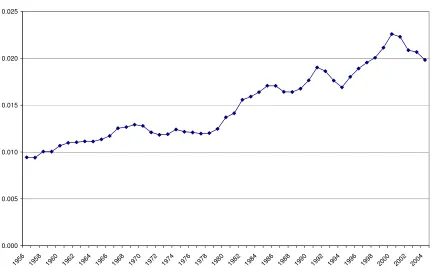
blocking patents. Figure 1 shows that in the US, private spending on R&D as a share of GDP has been
rising sharply since the beginning of the 80’s. Then, after a few years, the number of patents granted by
patent policy in the 80’s,8 the structural parameters are calibrated using long-run aggregate data of the
US’s economy from 1953 to 1980 to examine the extent of R&D underinvestment and the effects of
blocking patents before these policy changes. The goal of this numerical exercise is to quantify the effects
of eliminating blocking patents on R&D, consumption, welfare and capital investment.
4.1. Backloading Discount Factor
The first step is to calibrate the structural parameters and the steady-state value of the backloading
discount factor
ν
. The average annual TFP growth rateg
TFP is 1.33%,9 and the average labor-forcegrowth rate n is 1.94%.10 The annual depreciation rate
δ
on physical capital and the household’s discountrate
ρ
are set to conventional values of 8% and 4% respectively. For the markupµ
, Laitner andStolyarov (2004) estimate that the markup is about 1.1 (i.e. a 10% markup) in the US; on the other hand,
Basu (1996) and Basu and Fernald (1997) estimate that the aggregate profit share is about 3%. To be
conservative, I set
µ
to the lower value at 1.03.11 Some empirical studies have estimated the arrival rateλ
of inventions, and I consider a wide range of valuesλ
∈[0.04,0.20] that cover the usual estimates.12(33) shows that holding other variables constant, an increase in
λ
must be offset by a decrease inν
tohold the level of R&D constant. Therefore, at higher values of
λ
, the calibrated effects of blockingpatents would be even more severe.
For {
ν
,α
,σ
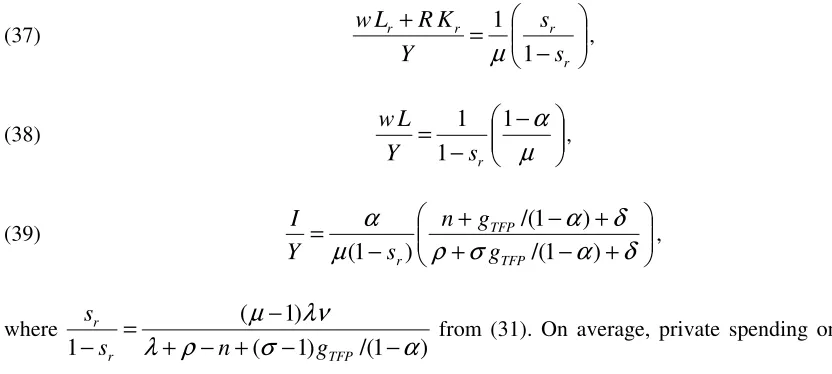
}, the model provides three steady-state conditions for the calibration (a) R&D shareof GDP in (37), (b) labor share in (38), and (c) capital-investment rate in (39).
8
See, for example, Jaffe (2000), Gallini (2002) and Jaffe and Lerner (2004) for a discussion.
9
Multifactor productivity for the private non-farm business sector is obtained from the Bureau of Labor Statistics.
10
The data on the annual average size of the labor force is obtained from the Bureau of Labor Statistics.
11
A higher markup would imply a more severe effect of blocking patents. Intuitively, a higher markup means increased profitability which must be offset by a stronger effect of blocking patents in order to hold the level of R&D in the data constant. In this case, eliminating blocking patents would lead to a more significant increase in R&D and consumption.
12
(37)
−
=
+
r r r rs
s
Y
K
R
L
w
1
1
. .µ
,(38) −
− =
µ
α
1 1 1 . r s Y L w , (39)+
−
+
+
−
+
−
=
δ
α
σ
ρ
δ
α
µ
α
)
1
/(
)
1
/(
)
1
(
. TFPTFP r
g
g
n
s
Y
I
, where ) 1 /( ) 1 ( ) 1 (1
λ
ρ
σ
α
λν
µ
− − + − + − =− r TFP
r
g n
s s
from (31). On average, private spending on R&D as a
share of GDP is 0.0115.13 Labor share is set to a conventional value of 0.7, and the average ratio of
[image:22.612.70.486.73.260.2]private investment to GDP is 0.203.14
Table 1 presents the calibrated values for the structural parameters along with the real interest rate
) 1 /(
.
α
σ
ρ
+ −= gTFP
r for
λ
∈[0.04,0.40]. [image:22.612.119.495.375.463.2]0.04 0.06 0.08 0.10 0.12 0.14 0.16 0.18 0.20 0.85 0.70 0.62 0.58 0.54 0.52 0.51 0.49 0.48 0.29 0.29 0.29 0.29 0.29 0.29 0.29 0.29 0.29 2.36 2.36 2.36 2.36 2.36 2.36 2.36 2.36 2.36 r 0.084 0.084 0.084 0.084 0.084 0.084 0.084 0.084 0.084
Table 1: Calibrated Structural Parameters
Table 1 shows that the calibrated values for {
α
,σ
,r} are roughly invariant across different values ofλ
.The calibrated value for the elasticity of intertemporal substitution (i.e. 1/
σ
) is about 0.42, which isclosed to the empirical estimates suggested by Guvenen (2006). The implied real interest rate is about
8.4%, which is slightly higher than the historical rate of return on the US’s stock market, and this higher
interest rate implies a lower socially optimal level of R&D spending in (34) and a higher steady-state
value of the backloading discount factor in (33). As a result, the model is less likely to overstate the extent
of R&D underinvestment and the degree of blocking patents. Furthermore, the fact that the calibrated
13
The data is obtained from the National Science Foundation and the Bureau of Economic Analysis. R&D is net of federal spending, and GDP is net of government spending. The data on R&D in 1954 and 1955 is not available.
14
values of
ν
∈[0.48,.0.85] are smaller than one suggests a severe degree of blocking patents in the USeconomy. Therefore, reducing the extent of blocking patents may be an effective method to stimulate
R&D. After calibrating the externality parameters and computing the socially optimal level of R&D
spending, the effects of reducing the extent of blocking patents on consumption will be quantified.
4.2. Externality Parameters
The second step is to calibrate the values for the externality parameters
γ
(intratemporal duplication) andφ
(intertemporal knowledge spillovers). To do this, I need to first determine the value ofg
A by settingTFP A g
g =
ξ
. forξ
∈[0,1]. The parameterξ
captures the fraction of long-run TFP growth driven byR&D, and the remaining fraction is driven by the exogenous process Zt such that
g
Z=
(
1
−
ξ
)
g
TFP. Foreach value of
ξ
,g
TFP,n
, andα
, the balanced-growth condition (30) determines a unique value for) 1
/(
φ
γ
− , which is sufficient to determine the effects of R&D on consumption in the long run. However,holding
γ
/(1−φ
) constant, a largerγ
implies a faster rate of convergence to the balanced-growth path.Therefore, to determine the socially optimal level of R&D, it is important to consider different values of
γ
. To reduce the plausible parameter space ofγ
andφ
, I make use of the empirical estimates for thesocial rate of return to R&D. Following Jones and Williams’ (1998) derivation, Appendix C shows that
the net social rate of return r~ to R&D can be expressed as
(40) 1 1
1 1
~ + + −
+ +
=
γ
φ
r A A
Y
s g g
g
r .
After setting r~ to the lower bound of 0.30 as in Jones and Williams (1998, 2000), (30) and (40) pin down
a unique value of
γ
andφ
for each value ofξ
.Table 2 presents the calibrated values of
γ
andφ
forξ
∈[0.25,.1.0] that correspond to 0.3~=
r .
increases,
γ
/(1−φ
) increases as shown in (30) and the intratemporal duplication effect can become moresevere while maintaining the social return of R&D in (40) at 0.3. When
ξ
equals 0.25, a social return of0.3 implies that there must be negligible duplication externality. When all the TFP growth is driven by
R&D, the duplication effect can be as severe as
γ
=0.23. [image:24.612.121.499.184.256.2]0.25 0.30 0.40 0.50 0.60 0.70 0.80 0.90 1.00 0.98 0.80 0.59 0.47 0.39 0.33 0.29 0.26 0.23 -6.29 -3.98 -1.75 -0.74 -0.20 0.12 0.33 0.47 0.57 /(1- ) 0.13 0.16 0.21 0.27 0.32 0.38 0.43 0.48 0.54
Table 2: Calibrated Externality Paramaters
4.3. Socially Optimal Level of R&D Spending
This section calculates the socially optimal R&D share of GDP in (34). Figure 3 plots the socially optimal
R&D share for each set of parameter values in Table 2 that corresponds to r~ equal 0.30.
[insert Figure 3 here]
Figure 3 shows that there was underinvestment in R&D in the US over the entire range of parameters. In a
sense, this finding is not surprising given the large estimated social return to R&D. Optimal R&D share
increases in
ξ
in Figure 3 because a largerξ
implies a largerγ
/(1−φ
) in Table 2. Applying the logapproximation ln(1+x)≈x to (C4) and combining it with (34), it can be shown that
(41) −
− −
− + −
≈
− 1 1
1 ~
1 1
1 *
*
φ
γ
φ
γ
r Y Y r
r
s g r
g r s
s
.
Therefore, for a given social return ~r of R&D, sr*/(1−sr*) increases in
γ
/(1−φ
) so long as r~>r.4.4. Eliminating Blocking patents
Given the calibrated parameter values, this section quantifies the effects of eliminating blocking patents
on R&D and consumption. Table 3 shows that eliminating blocking patents (i.e. setting
ν
=1) would leadthe US would increase from 0.0115 in the data to a minimum of 0.0136 (i.e. an increase of 18%) in Table
3. For a large value of
λ
, R&D share of GDP may even double. Table 1 shows that the calibrated valuesfor
ν
decrease inλ
; therefore, asλ
increases, the increase inν
to eliminate blocking patents is largerand hence leads to a more significant effect on R&D.
0.04 0.06 0.08 0.10 0.12 0.14 0.16 0.18 0.20 R&D 0.0136 0.0165 0.0185 0.0200 0.0211 0.0219 0.0226 0.0232 0.0237
Table 3: R&D Shares without Blocking Patents
Next, we quantify the effects of eliminating blocking patents on the level of consumption in the long run.
Along the balanced-growth path, per capita consumption increases at an exogenous rate gc. Therefore,
after dropping the exogenous growth path and some constant terms, long-run consumption can be derived
as a function of the steady-state value of the backloading discount factor
ν
through thecapital-investment rate i(
ν
) and the R&D shares
r(
ν
)
of factor inputs. It can be shown that in the case of achange in
ν
, the percent change in long-run consumption can be expressed as(42) − ∆ − − − − + ∆ − − − + − ∆ + ∆ − − − + − = ∆ )) ( 1 ln( ) 1 )( 1 ( ) 1 ( ) ( ln ) 1 )( 1 ( )) ( 1 ln( ) ( ln ) 1 )( 1 ( ) 1 ( ) ( ln
ν
αγ
φ
α
φ
ν
αγ
φ
α
γ
ν
ν
αγ
φ
α
γ
φ
α
ν
r r s s i i c .I consider the most conservative case that only one quarter of the TFP growth in the US is driven R&D
[image:25.612.76.506.399.472.2](i.e.
ξ
=0.25). A value of 0.25 forξ
implies a very small value of 0.13 forγ
/(1−φ
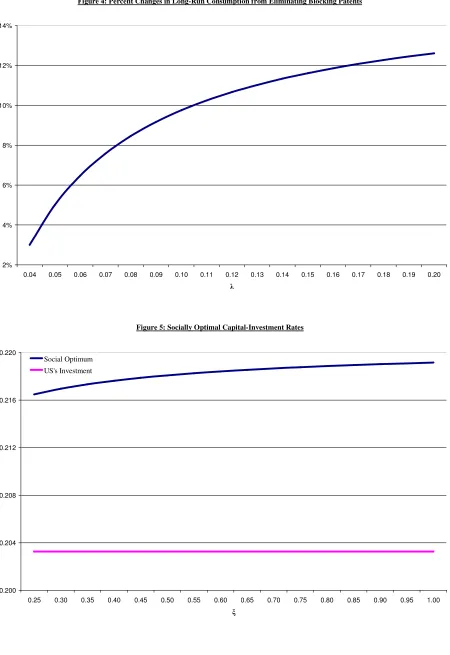
) in Table 2.15Figure 4 shows that even in this conservative case, eliminating blocking patents would raise the
balanced-growth level of consumption by at least 3% (percent change) and up to over 12% if the change in
v
islarge enough. Also, the change in consumption mostly comes from
(
γ
/((
1
−
α
)(
1
−
φ
)
−
αγ
))
∆
ln
s
r(
ν
)
in (42) that is the direct effect of R&D on consumption through technology; in other words, the other
general-equilibrium effects only have secondary impacts on long-run consumption.
[insert Figure 4 here]
15
In addition to examining the effects of blocking patents on long-run consumption, I also consider
the transition dynamic effects. I use the relaxation algorithm developed by Trimborn et al. (2008) to
compute the transition path of consumption.16 For the set of parameter values considered before (i.e.
25 . 0
=
ξ
in Table 2 andλ
∈[0.04,.0.20] in Table 3), upon eliminating blocking patents, consumptionfalls slightly on impact and then gradually rises to the new balanced-growth path.17 I use the consumption
path up to 100 years after the policy change to calculate the representative household’s utility (1) on this
new transition path and compare it to the household’s original utility on the old balanced-growth path.
Table 4 reports the percent changes in welfare (i.e. the household’s lifetime utility).18
[image:26.612.111.494.278.323.2]0.04 0.06 0.08 0.10 0.12 0.14 0.16 0.18 0.20 U 1.7% 3.2% 3.9% 4.2% 4.4% 4.6% 4.7% 4.7% 4.8%
Table 4: Percent Changes in Welfare
To have a sense on how important these changes are, an increase of 1.7% (4.8%) in the household’s
lifetime utility requires a permanent increase in consumption of 1.3% (3.7%).
4.5. Dynamic Distortion
Proposition 1 derives the condition under which the equilibrium rate of investment in physical capital is
below the socially optimal level. The following numerical exercise quantifies this wedge. Figure 5
presents the socially optimal rates of capital investment in (35) along with the US’s investment rate, and
the wedge is about 0.014 on average.
[insert Figure 5 here]
16
I would like to thank Timo Trimborn for his advice on the relaxation algorithm.
17
In fact, consumption does not necessarily fall on impact but instead gradually rises to the new balanced-growth path over a wide range of parameters that correspond to a higher social return to R&D (i.e. larger ξ, γ and φ). In other words, in a model with capital, it is possible for households to avoid short-run consumption losses by running down the capital stock, and this finding is different from models without capital accumulation. See, for example, Kwan and Lai (2003) for an interesting analysis on the transition dynamic effects of patent policy in a variety-expanding model without capital accumulation.
18
The equilibrium rate of investment in physical capital is increasing in the R&D share of capital.
Therefore, eliminating blocking patents also increases the capital-investment rate. Table 5 shows that
upon eliminating blocking patents, the steady-state capital-investment rate increases from 0.203 in the
data slightly toward the socially optimal level.
0.04 0.06 0.08 0.10 0.12 0.14 0.16 0.18 0.20 I/Y 0.204 0.204 0.205 0.205 0.205 0.205 0.206 0.206 0.206
Table 5: Capital-Investment Rates without Blocking Patents
4.6. Discussion
The numerical analysis is based on a number of calibrated parameters and variables. The key parameter is
ξ
and the key variable isν
. The calibrated values forξ
imply R&D underinvestment. A lower bound of0.25 for
ξ
is based on the previous empirical estimates on the social return to R&D. If R&D has littlesocial values, then the actual value of
ξ
would be smaller and hence there may be no underinvestment inR&D. However, even if R&D is not underinvested, reducing the extent of blocking patents would allow
the policymakers to lower the breadth (i.e. the markup) that reduces the distortionary effects of patent
policy while keeping the level of R&D constant.
The calibrated values for
ν
imply a significant effect of blocking patents. An upper bound of0.85 for
ν
is based on a number of assumptions. The first assumption is that the data on R&D investmentis reasonably accurate. If there is a large amount of R&D spending not recorded, then the identification of
ν
using (33) would imply a downward bias onν
(i.e. an overestimate of blocking patents). Secondly,applying (33) to aggregate data requires an assumption that monopolistic profits in the economy are
created by patent protection. To the extent that only a small fraction of profits is created by patent
protection, the identification of
ν
using (33) would also imply a downward bias onν
. However, using apatent-protected and R&D-intensive industries, the markup and the profit share should be much larger.19 Thirdly,
when
λ
is below the lower bound of 0.04, (33) would indicate a less significant effect of blocking patents(i.e. a larger
ν
). However, such a small value ofλ
implies that the average time between arrivals ofinventions would be longer than 25 years. On the other hand, for larger values of
λ
(e.g. Acemoglu andAkcigit (2008) consider an average arrival rate
λ
of 0.33), the calibrated values forν
would be smaller(i.e. an even more severe effect of blocking patents).
Finally, the numerical analysis is performed on a semi-endogenous growth model, in which
increasing R&D investment has no effect on long-run growth. In the case of a fully endogenous-growth
model, raising R&D through the elimination of blocking patents would increase the long-run growth rate
of consumption. For example, doubling R&D would increase the R&D-driven TFP growth rate by a
factor of 2γ in the first-generation quality-ladder growth models. So long as
ξ
andγ
are not negligible,this kind of increase in the long-run growth rate would have tremendous effects on welfare. Therefore, the
calibrated effects from a semi-endogenous growth model are likely to be conservative.
5. Conclusion
This paper has attempted to accomplish three objectives. Firstly, it develops a quantitative framework that
can be applied to evaluate the effects of blocking patents. Secondly, it applies the model to aggregate data
to perform hypothetical policy experiments. Thirdly, it identifies a dynamic distortionary effect of patent
policy on capital accumulation that has been neglected by previous studies. The numerical exercise
suggests the following findings. If a non-trivial fraction of TFP growth in the US is driven by R&D, there
is underinvestment in R&D in the economy. Then, provided that blocking patents have a significant and
negative effect on R&D, reducing this negative effect of overlapping intellectual property rights while
keeping its positive effect (i.e. patent breadth) constant can help mitigating the R&D-underinvestment
problem. The resulting increase in R&D could lead to a substantial increase in consumption.
19
The readers are advised to interpret the numerical results with some important caveats in mind.
The first caveat is that although the quality-ladder growth model has been generalized as an attempt to
capture more realistic features of the US economy, it is still an oversimplification of the real world.
Furthermore, the finding that eliminating blocking patents has substantial and positive effects on R&D
and consumption is based on the assumptions that the empirical estimates on the social return to R&D and
the data on R&D investment are reasonably accurate. The validity of these assumptions remains as an
empirical question.
Finally, I conclude this paper with some policy implications. The changes in patent policy in the
80’s are conventionally believed to include a broadening of patent breadth. The theoretical analysis
suggests that a broader patent breadth increases R&D at the costs of worsening the distortionary effects
on patent protection. In other words, there exists a welfare tradeoff using this policy instrument. On the
other hand, holding patent breadth constant, reducing the extent of blocking patents would stimulate R&D
without worsening the distortionary effects. This reasoning suggests that for the purpose of stimulating
R&D, reducing the extent of blocking patents would have been a less harmful policy instrument than
increasing patent breadth. Even if the current level of R&D is socially optimal, it would be beneficial for
the society to reduce the level of patent breadth and the extent of blocking patents simultaneously to keep
R&D constant. A lower level of patent breadth would reduce the distortionary effects of patent protection