http://dx.doi.org/10.4236/alamt.2016.62004
A New Approximation to the Linear Matrix
Equation AX = B by Modification of He’s
Homotopy Perturbation Method
Amir Sadeghi
Young Researchers and Elite Club, Robat Karim Branch, Islamic Azad University, Tehran, Iran
Received 8 November 2015; accepted 23 May 2016; published 26 May 2016
Copyright © 2016 by author and Scientific Research Publishing Inc.
This work is licensed under the Creative Commons Attribution International License (CC BY). http://creativecommons.org/licenses/by/4.0/
Abstract
It is well known that the matrix equations play a significant role in engineering and applicable sciences. In this research article, a new modification of the homotopy perturbation method (HPM) will be proposed to obtain the approximated solution of the matrix equation in the form AX = B. Moreover, the conditions are deduced to check the convergence of the homotopy series. Numerical implementations are adapted to illustrate the properties of the modified method.
Keywords
Matrix Equation, Homotopy Perturbation Method, Convergence, Diagonally Dominant Matrix, Regular Splitting
1. Introduction
Let aij m n, bij m k, xij n k
× × ×
= ∈ = ∈ = ∈
A B X , then the matrix equation in the following form, can be called “linear matrix equation”:
.
=
AX B (1) Matrix equations are arisen in control theory, signal processing, model reduction, image restoration, ordinary and partial differential equations and several applications in science and engineering. There are various approaches either direct methods or iterative methods to evaluate the solution of these equations [1]-[6].
not involve a small parameter in an equation, has a significant advantage that it provides an analytical approx-imate solution to a wide range of either linear or nonlinear problems in applied sciences. In most cases, employ-ing HPM gives a very speedy convergence of the solution series, and usually only a few iterations to acquire very accurate solutions are required, particularly when the improved version will be applied.
In terms of linear algebra, Keramati [10] first applied a HPM to solve linear system of equations Ax=b. The splitting matrix of this method is only the identity matrix. However, this method does not converge for some systems when the spectrum radius is greater than one. To make the method available, the auxiliary para-meter and the auxiliary matrix were added to the homotopy method by Liu [11]. He has adjusted the Richardson method, the Jacobi method, and the Gauss-Seidel method to choose the splitting matrix. Edalatpanah and Rashi-di [12] focused on moRashi-dification of (HPM) for solving systems of linear equations by choosing an auxiliary ma-trix to increase the rate of convergence. Furthermore, Saeidian et al. [13] proposed an iterative method to solve li-near systems equations based on the concept of homotopy. They have shown that their modified method presents more cases of convergence. More recently, Khani et al. [14] have combined the application of homotopy perturba-tion method and they have used use of different H x
( )
for solving system of linear equations. They mentioned that this modification performs better than the Homotopy Perturbation Method (HPM) for solving linear systems.According to our knowledge, nevertheless HPM has not been modified to solve a matrix equation. In this survey, the main contribution is to suggest an improvement of the HPM for finding approximated solution for (1). Moreover, the necessary and sufficient conditions for convergence of the modified method will be investi-gated. Finally, some numerical experiments and applications are drawn in numerical results.
2. Solution of the Linear Matrix Equation
In this section, first the conditions that Equation (1) has a solution are decelerated. Then, some applicable rela-tions by utilizing HPM will be attained. Eventually, convergence of HPM series will be analyzed in detail.
2.1. Existence and Uniqueness
The following theorems characterize the existence and uniqueness to the solution of Equation (1).
Theorem 2.1. [15] The linear matrix Equation (1) has a solution if and only if
( )
B ⊆( )
A . Equivalently, a solution exists if and only if AA B† =B, whereas †W is denoted a Moore-Penrose pseudo-inverse of matrix W .
Theorem 2.2. [15] Let A∈m n× , B∈m k× and suppose that AA B† =B. Then any matrix in the form
(
)
† †
,
= + −
X A B I A A Y (2) is a solution of (1), where ∈ m k×
Y is arbitrary matrix. Furthermore, all solutions of Equation (1) are in this form.
Theorem 2.3. [15] A solution of the matrix linear Equation (1) is unique if and only if †
I
=
AA . Alterna-tively, (1) has a unique solution if and only if
( )
A =0.Remark 2.4. It should be emphasized that when A is square and nonsingular matrix, †= −1
A A and so
(
− †)
=I A A 0. Thus, there is no arbitrary component, leaving only the unique solution = −1
X A B. Moreover, in the sense of linear algebra, avoiding the computation of matrix inversion is recommended because of increas-ing computational complexity.
2.2. Homotopy Perturbation Method
Now, we are ready to apply the convex homotopy function in order to obtain the solution of linear matrix equation. A general type of homotopy method for solving (1) can be described by setting AX− =B 0, as follows. Let
( )
,L U =AU−B
(3)
( )
0.F U =U−W (4) A convex homotopy would be in the following form
(
,) (
1) ( )
( )
,whenever, the homotopy H
(
U,p)
is defined by(
, 0)
( )
,H U =F U
(6)
(
,1)
( )
.H U =L U
(7) Notice that F is an operator with known solution W0. In this case, HPM utilizes the homotopy parameter p as an expanding parameter to obtain
2
0 1 2
0
i i i
p p p
∞
=
=
∑
= + + +U U U U U (8)
and it gives an approximation to the solution of (1) as
0 1 2
1
0 0
lim i .
i i p i i p ∞ ∞ → = = = = = + + +
∑
∑
V U U U U U
(9)
By substituting (3) and (4) in (5), and by equating the terms with the identical power of p, after simplification and application of the relations, we obtain
(
)
(
)
(
)
0 0 0 10 1 0
2 1 2 1 : , : , : ,
: , 2, 3, .
i
i i
p p p
p − i
− = − + − − = − + = − + = = U W
A I U U W B
A I U U
A I U U
0 0 0 0 (10)
If take U0=W0=0, this implies that
(
)
(
)
(
)
(
)
( ) (
)
1 2 1 2 3 2 1 , , ,1i i .
i+ = = − = − − = − = − = − − U B
U I A U A I B
U I A U A I B
U A I B
(11)
Hence, the solution can be expressed in the following form
( ) (
)
0 0
1 k k .
k
k k
∞ ∞
= =
≈
∑
=∑
− −U U A I B
(12)
Remark 2.5. It should be pointed out that we have focused to the solution of matrix equation AX =B, whenever all matrices are non square. But it is found that the homotopy function can not be constructed because of disagreement between dimension of matrices. This issue is presented in the following relation:
(
,) (
1) ( )
( )
.m k n k
H p p F pL
× ×
= − + =0
U U U
Thus, we considered all matrices in Equation (1) are square.
2.3. Convergence Analysis
To verify whether the sequence U in (12) is converge or not, we give following analysis. Notice that throughout the following theorems, ρ
( )
W denotes the spectral radius which is defined by( )
max ( )i i
λ σ
ρ W = ∈ W λ , when-ever σ
( )
W is spectrum of the matrix W .Theorem 2.6. The sequence
(
)
0
k m
m k
S =
∑
= A−I B is a Cauchy sequence if(
)
1.ρ A−I < (13)
Proof: It is clear that
(
)
1
m k p
m p m k
1 1 1 1 . 1 p p p
m k m k m
m p m
k k
S S
ξ
ξ
ξ
ξ
+ + + + = = − − ≤ − = = − ∑
∑
B A I B B
Hence, if ξ = A−I <1, we have obviously ρ
(
A−I)
≤1, and thenlim m p m 0.
m→∞ S + −S =
Thus Sn is a Cauchy sequence. This completes theorem. Definition 2.7. [16] A matrix A= aij is called strictly row diagonally dominant (SRDD), if we have
1,
, 1, , .
ii ij
j i j
a a i n
= ≠
>
∑
= (14)Theorem 2.8. Consider the matrix
11
1 1
diag , ,
nn
q q
=
Q where qii are diagonal elements of matrix
1
−
B A. If the matrix B A−1 be SRDD, then we have
(
1)
1.
ρ − − <
QB A I
(15)
Proof: Suppose 1
ij
q
−
=
B A and = −1 −
M QB A I, then it can be easily shown that
0, , ij ij ii i j q m i j q = = − ≠
Since B A−1 is SRDD matrix, it is clear that
1, n
ii j j i ij
q >
∑
= ≠ q . Hence, 1 1 1, 1. n n ij ijj j j i ii
q m
q
−
∞ = − ∞ =
∑
= = = ≠∑
<M QB A I
Therefore,
( )
1,ρ M ≤ M ∞ <
which completes the proof. In Theorem 2.8, the important question is “Does the matrix B A−1 is SRDD whenever A and B are
SRDD matrices?” The answer of this question is negative. Because, firstly the product of two SRDD matrices is not SRDD, as a counterexample we can pay attention to the matrices 3 1
1 2
= −
A and 0.5 0.4
1.0 3.0 − − = − − B ,
and their product is 2.5 4.2 1.5 5.6
− −
=
AB . Secondly, inversion of SRDD matrix is not SRDD. As a
counterex-ample, consider 0.5 0.4 0.1 0.3
=
A which has the inversion 1 2.7 3.6
0.9 4.5
− −
= −
A .
Now, if ρ
(
I−A)
>1, by pre-multiplying the both sides of Equation (1) by matrix Q, the following equa-tion can be obtain:1
.
− − =
QB AX Q 0 (16) To be more precise, by using convex homotopy function, we can easily verify that
( )
(
1)
1 0
1n n .
n n ∞ − + = =
∑
− −U QB A I Q (17)
In this part, we would like to show that the series
( )
(
1)
0 1
i i
m
m i
S =
∑
= − QB A− −I Q is converges. Thus, first we need the following definition and theorems.Definition 2.9. [16] Let A M N, , are three matrices satisfying A=M−N. The pair of matrices M N, is a regular splitting of A, if M is nonsingular and −1
Theorem 2.10. Let Q is nonsingular matrix such that Q and Q−1−B A−1 are nonnegative. Then the
se-quence
( )
(
1)
0
1i i
i
∞
− =
=
∑
− −U I QB A Q (18)
converges if B A−1 is nonsingular and
(
−1)
−1B A is nonnegative.
Proof: Suppose that Q is a singular matrix such that Q and Q−1−B A−1 are nonnegative. By employing
Theorem 2.9 it can be obtain that ρ
(
QB A−1 −I)
<1 as both Q and Q−B A−1 are a regular splitting of 1−
B A. This implies that
( )
(
1)
0
1
m i
i m
i
S − Q
=
=
∑
− QB A−I (19)is converges series.
3. Numerical Experiments
In this section, some numerical illustrations are provided. All computations have been carried out using MATLAB 2012 (Ra) with roundoff error u≈10−16. Moreover, the error of the approximations have been measured by the following stopping criteria:
( )
1010− ,
∞
∞
−
= U X <
E U
X (20) whereas, U is the approximated solution obtained by HPM.
Example 3.1. First example made approximating the solution of the equation AX =B by using modified HPM. In order to this purpose, two 4 4× matrices A and B are considered:
15.00 1.00 1.00 1.00 14.70 2.70 2.50 2.30
0 15.00 1.00 1.00 1.30 14.80 2.60 2.40
, .
0 0 15.00 1.00 1.40 1.40 14.90 2.50
0 0 0 15.00 1.50 1.50 1.50 15.00
− − − − − −
− − − −
= =
− −
A B
After evaluating the inversion of B and multiplying by A, it is observed that B A−1 is SRDD matrix, and
thus the matrix Q can be obtained as
(
)
11 22 33 44
1 1 1 1
diag , , , diag 1.029,1.029,1.029,1.029 .
q q q q
= =
Q
Furthermore,
(
1)
0.13
ρ − − =
I QB A . Hence, considering seven terms of homotopy series as:
(
1)
(
1)
7,
I − −
≈ + − + + −
U I QB A I QB A Q
the approximated solution could be obtained as follows:
1.0000115 0.1000043 0.1000177 0.1000207 0.1000207 1.0000115 0.1000043 0.1000177
. 0.1000177 0.1000207 1.0000115 0.1000043 0.1000043 0.1000177 0.1000207 1.0000115
− − −
− −
≈
−
U
However, the exact solution of AX=B is
1 0.1 0.1 0.1
0.1 1 0.1 0.1
.
0.1 0.1 1 0.1
0.1 0.1 0.1 1
− − −
− −
=
−
X
the residual error is 9.6263 10× −6.
Example 3.2. In this example, two n n× strictly diagonally dominant matrices are assumed as follows:
10 1 1 1 203 32 32 32
1 10 1 1 32 203 32 32
, .
1 1 1 10 n n× 32 32 32 203 n n×
= =
A B
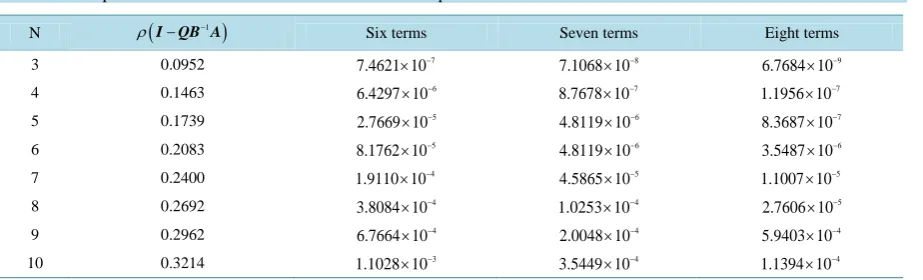
[image:6.595.86.548.582.722.2]The solution of matrix equation AX =B is approximated using HPM. The residual errors have been meas-ured for different dimension of matrices and for different terms in homotopy method. Results are reported in
Table 1. In this example, by increasing dimension of the matrices, the error of the approximation will be increased gradually. In addition, considering more terms of the homotopy method, the approximation will be more accurate.
Example 3.3 (Application in matrix inversion). If we substitute B=In in the matrix Equation (1), then we have AX =In. Thus, by applying the HPM to this equation, the inversion of matrix A can be easily eva-luated. For this purpose, assume the following n n× matrix:
,
1
, 1
1
0, . .
ij
i
i j
i j
a i j
i j
o w
=
+
= = − = +
+ −
A
This matrix is diagonally dominant and well conditioned matrix. We have used MATLAB command inv(A) with very small error 16
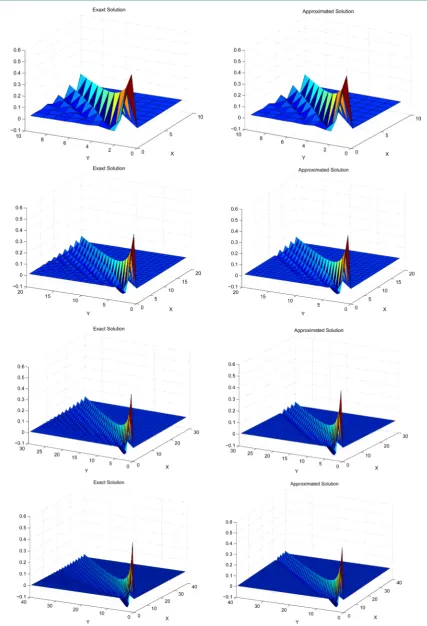
10− (we considered as exact solution) and compare it with HPM calculation. Results are shown in Figure 1. It is obviously seen that the approximated solutions for different dimensions (N = 10, 20, 30, 40) are very close to the exact solutions.
4. Conclusion
In this work, the linear matrix equation is solved by improving the well-known perturbation method. Numerical experiments demonstrated that by considering more terms of the approximations, error will be decreased dra-matically. Furthermore, if the matrix B A−1 becomes more strictly row diagonally dominant, convergence of
the homotopy series will increase. In conclusion, it is interesting to know that considering special case B=In, the proposed method can compute inverse of the matrix A efficiently. Moreover, the author found that this method could be generalized to obtain the solution of other equations.
Acknowledgements
Special thanks go to the anonymous referee for some valuable suggestions, which have resulted in the improve-ment of this work. This work is supported by Islamic Azad University, Robat Karim University, Tehran, Iran.
Table 1. Comparison error for different dimensions in Example 3.2.
N ρ
(
− −1)
I QB A Six terms Seven terms Eight terms
3 0.0952 7.4621 10× −7 7.1068 10× −8 6.7684 10× −9
4 0.1463 6.4297 10× −6 8.7678 10× −7 1.1956 10× −7
5 0.1739 2.7669 10× −5 4.8119 10× −6 8.3687 10× −7
6 0.2083 8.1762 10× −5 4.8119 10× −6 3.5487 10× −6
7 0.2400 1.9110 10× −4 4.5865 10× −5 1.1007 10× −5
8 0.2692 4
3.8084 10× − 4
1.0253 10× − 5
2.7606 10× − 9 0.2962 6.7664 10× −4 2.0048 10× −4 5.9403 10× −4
Conflict of Interests
The author declares that there is no conflict of interests regarding the publication of this article.
References
[1] Bartels, R. and Stewart, G. (1994) Solution of the Matrix Equation AX+XB=C. Circuits, Systems and Signal Processing, 13, 820-826.
[2] Benner, P. (2008) Large-Scale Matrix Equations of Special Type. Numerical Linear Algebra with Applications, 15, 747-754. http://dx.doi.org/10.1002/nla.621
[3] Golub, G., Nash, S. and Van Loan, Ch. (1979) A Hessenberg-Schur Method for the Problem AX+XB=C. IEEE Transactions on Automatic Control, 24, 909-913. http://dx.doi.org/10.1109/TAC.1979.1102170
[4] Sadeghi, A., Ahmad, M.I., Ahmad, A. and Abbasnejad, M.E. (2013) A Note on Solving the Fuzzy Sylvester Matrix Equation. Journal of Computational Analysis and Applications, 15, 10-22.
[5] Sadeghi, A., Abbasbandy, S. and Abbasnejad, M.E. (2011) The Common Solution of the Pair of Fuzzy Matrix Equa-tions. World Applied Sciences, 15, 232-238.
[6] Sadeghi, A., Abbasnejad, M.E. and Ahmad, M.I. (2011) On Solving Systems of Fuzzy Matrix Equation. Far East Journal of Applied Mathematics, 59, 31-44.
[7] He, J.H. (1999) Homotopy Perturbation Technique. Computer Methods in Applied Mechanics and Engineering, 57-62.
http://dx.doi.org/10.1016/s0045-7825(99)00018-3
[8] He, J.H. (2000) A Coupling Method of a Homotopy Technique and a Perturbation Technique for Non-Linear Problems.
International Journal of Non-Linear Mechanics, 35, 37-43. http://dx.doi.org/10.1016/S0020-7462(98)00085-7
[9] He, J.H. (2003) Homotopy Perturbation Method: A New Non-Linear Analytical Technique. Applied Mathematics and Computation, 135, 73-79. http://dx.doi.org/10.1016/S0096-3003(01)00312-5
[10] Keramati, B. (2007) An Approach to the Solution of Linear System of Equations by He’s Homotopy Perturbation Me-thod. Chaos, Solitons & Fractals, 41, 152-156. http://dx.doi.org/10.1016/j.chaos.2007.11.020
[11] Liu, H.K. (2011) Application of Homotopy Perturbation Methods for Solving Systems of Linear Equations. Applied Mathematics and Computation, 217, 5259-5264. http://dx.doi.org/10.1016/j.amc.2010.11.024
[12] Edalatpanah, S.A. and Rashidi, M.M. (2014) On the Application of Homotopy Perturbation Method for Solving Sys-tems of Linear Equations. International Scholarly Research Notices, 2014, Article ID: 143512.
http://dx.doi.org/10.1155/2014/143512
[13] Saeidian, J., Babolian, E. and Aziz, A. (2015) On a Homotopy Based Method for Solving Systems of Linear Equations.
TWMS Journal of Pure and Applied Mathematics, 6, 15-26.
[14] Khani, M.H., Rashidinia, J. and Zia Borujeni, S. (2015) Application of Different H x
( )
in Homotopy AnalysisMe-thods for Solving Systems of Linear Equations. Advances in Linear Algebra & Matrix Theory, 5, 129-137.
http://dx.doi.org/10.4236/alamt.2015.53012
[15] Laub, A.J. (2005) Matrix Analysis for Scientists and Engineers. SIAM, Philadelphia.
http://dx.doi.org/10.1137/1.9780898717907
[16] Saad, Y. (2003) Iterative Methods for Sparse Linear Systems. 2nd Edition, SIAM, Philadelphia.