Discussions on Applied Mathematics in
Decision-Making Modeling with Decision
Support Systems and Knowledge Based
Systems
necula, sabina-cristiana
Alexandru Ioan Cuza University of Iasi
October 2010
Online at
https://mpra.ub.uni-muenchen.de/51542/
SABINA CRISTIANA NECULA
Department of Research
Alexandru Ioan Cuza University of Iasi
Carol I Blvd, no.22, 700505
ROMANIA
[email protected]
This paper tries to discuss some findings in mathematical decision making modeling models with applications in business processes. We start by presenting some technological implications and implementations of decision making models. After this we discuss some implementations realized by us and that consists in a neural network, a JAVA implementation of the decision making model, an expert systems shell implementation and an implementation with ontology and inference engine. The paper ends with usefull conclusions drawn for decision making modeling activities.
decision making, DSS, KBS, ontology, inference engine, OWL
Better decisions means improving information provided. We tried in this paper to outline that the knowledge of acting from the decision models must be implemented to improve information, to actually provide better information to the user. Using decision models for problem solving task proved to be a success in the past. It concluded in static models, non adaptive ones, with some utility for the user because they captured a kind of model that impose performing an action by the decision maker in the form of transferring knowledge from the model to human being.
Certainly the methods, techniques and tools for data analysis and knowledge extraction are from many areas of research (artificial intelligence, mathematics and statistics, psychology and cognotics) and the application field is important. Researchers’ concerns are oriented towards the unification of these methods; therefore the subject of any research in this area of computer based modeling is interdisciplinary.
Implementation of functionalities offered by IT in developing decision models always resulted in a systemic approach to decision making process so that solutions are hybrid forms of technology to solve a function, not necessarily decisions.
Generally speaking in developing computer based models choosing a representation technique is realized conforming to the balance between data and knowledge detained in making decisions. If there is much more knowledge then inferring rules is the solution. If there is much more data the solution is represented by data mining techniques. If data is labeled the solution are supervised leaning algorithms. If data is not labeled the
solution is represented by unsupervised learning algorithms. Usually data and knowledge are insufficient and becomes necessary using data to extract relationships in order to discover knowledge or to use knowledge in order to improve relationships between data structures.
Technologically speaking, the IT solution is represented by decision support systems (DSS) integration with intelligent technologies. Such systems offer users flexible tools to analyze important data sets. A system to assist decision should be simple, robust, easy to control, adaptive, comprehensive, and easy to communicate with.[3, p.2] Queries needed to assist decision making examine / explore current and historical data, identify trends and create aggregate useful data to assist decision making. On Line Analytical Processing (OLAP) [1, pp.65 74] and data mining [7,17] are tools to assist decision making ad hoc queries.
Artificial intelligence provides theory and techniques to assist decision making process in the sense identified by the authors C.W. Holsapple and A.B. Whinston. The reasoning was identified as a critical issue in relation to decision making. It is the base for received information evaluation. Perception and thought have been recognized as critical elements of decision making.
!
number of flexible economic mathematic models and with the opportunity of using simulation technique. Decision makers often need one interface with all information sources. They seek information in a logical order of solving the decision problem. Every decision maker has its own logical order. Decision maker seek information and evaluates it like: much, less, improbable, possible. Visualization is also important. Case studies are also important. Similarity cases are of importance. Information alert or some suggestions offering in seeking information are also valuable.
These decision makers come from different business area, different countries, different government policies, different management approaches. So…from the informatics point of view which is the actual problem that needs a solution? It seems that the actual problem remains integration not of the systems but of information. So…we might say that semantic web [5] efforts must concern business software developers. We discuss in the following the solution proposed by the present article in improving decision making process. Operational research models aren’t perfect, estimation statistical model aren’t perfect either unless they work with big data sets. Risk’s models evaluation found solution in fuzzy models. Every method, technique or algorithm has limits because its uses depend on decision problem’s context.
DSS are more a philosophy and not actually a single technology. Their role is o assist decision maker in order to solve the structured part of the decisions’ problems. DSS are problem oriented and uses: analytical models, databases, decision making reasoning and interactive functionalities in order to assist solving semi structured decisions. Meanwhile Business Intelligence concept evolved we can say that, for the moment, DSS have tools for analyzing big data sets, performance management, dashboards, and scorecards. [6]
DSS evolution came from hardware and software evolution. So many technical personal assistants leaded to continuous evolving of the decision maker’s possibility to develop its own decisions models. Developing integrated systems leaded to possibility to use big data sets in analyses undertaken by decision makers. It remains one single problem: semantics. The decision maker is not concerned with the actual name of data structures, he/she seeks some information and although this information is available this integrated and all performed systems are not capable to provide because of technical integration limits.
Without treating in details Knowledge Based Systems we can say from the start that the first limit is imposed by still not finding commercial uses of AI (in the sense of business processes assisting). Business software developers are not oriented to AI techniques. They know only one thing: good AI means automation; clearly AI
has to be applied in manufacturing and intelligent robots. Expertise and domain problems are small and depend on context. Clearly they approach the semantic problem starting from data structures classifying problem, they build metamodels for every interrelated system. KBS usually don’t have the possibility to learn because they don’t work on big data sets. Without learning nobody can talk about an actual intelligent system. KBS aren’t capable to adapt which is another important characteristic for intelligent purpose of a system.
"
The analysis of decisions through modeling starts on one hand from the assumption of accepting the human limits of information processing and, on the other hand, from the consideration of the necessity of incorporation of judgments and intuitions, of the result of imagination and creativeness of the decisional factors.
Important to remember is the fact that simulation is especially valuable for problems that cannot be approached through mathematical, analytical or of optimization methods. Albeit simulation and optimization are quantitative methods based on mathematical models, the fundamental difference between these two approaching lies in the role of decision variables.
In case of modeling with intelligent technologies, the values of decision variables are input data of the model. Through the incorporation of expertise and decisional factors reasoning in knowledge base, the best way to action is evaluated. By means of using intelligent technologies, one can assure the intelligence of business processes. Intelligence is the ability of something (a system, apparatus or being) to evaluate the possibility of reaching a goal and of using this evaluation in the achievement of the goal (Pierce’s semiotic definition of intelligence). [10]
an intelligent informational solution which incorporates knowledge from a specific domain of action.
The selection process takes into consideration the following features: the efficiency of fixed assets, accounting values existent in enterprise’s data base, the estimation of an eventual depreciation of fixed assets (knowledge captured from experience), extent of the eventual expenses with repairing and modernization of the fixed assets. In order to develop the prototype of expert system, the expert systems generator of the most recent generation of Exsys Inc Corporation was used (Exsys Developer). In order to implement the rules, the system works with decision trees. The generator offers the possibility of extracting the necessary data from firm’s database. The prototype remains in the attention of subsequent elaborations.
The economic decision regarding the fixed assets is based on the accounting decision regarding the establishment of depreciation’s dimension. In making this decision (mapped on a different decisional tree in EXSYS Developer) is necessary to determine at some point in time if it is estimated that in the near future the recoverable value of the asset will decrease in such way that will become smaller than the accounting value (qualitative factor marked down as Q5).
The formalization of asset depreciation determination knowledge was accomplished by means of decisional tables and decisional tree. The quantitative factors are represented by: average interest rate for the past three months (n 3) [RA]; average interest rate in month n 4 [RP]; actual operating time [TE]; allowed operating time [TN]; accounting actual value [VNC]; recoverable value [VRec] and are represented at the level of artifact under the form of variables. Qualitative factors are represented by the estimation of possible increase of average interest rate (inflation rate) such as the accounting actual value exceeds the recoverable value and by the estimation of possible use of artifact after the expiration of its life. Knowledge regarding the establishment of asset efficiency trend is inferred based on quantitative factors and constitutes control knowledge at conceptual level, represented by means of time relations. Likewise, in case of establishing the actual trend of interest rates on the market, we are talking about control knowledge at conceptual level. In the situation in which one of these factors records a descending trend, the triggering of knowledge regarding the establishment of fixed assets depreciation is necessary.
In order to determine the future trend of inflation rate for to establish an eventual adjustment of recoverable value under net accounting value, we have chosen, depending on techniques, methods and informational instruments of modelling, the following ways:
• Extraction of knowledge from accountants experience regarding this estimation — EXSYS Developer Implementation;
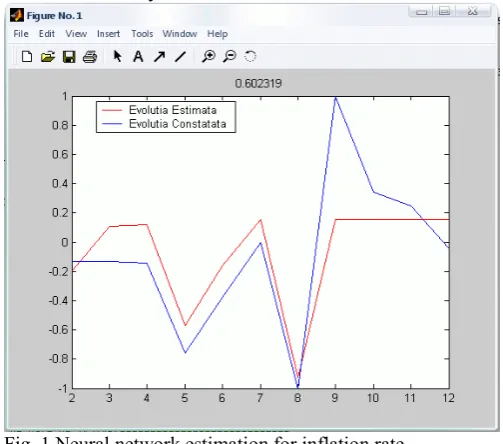
[image:4.595.307.559.171.393.2]• Use of the estimation realized by a neuronal network — implementation accomplished in MATLAB — in order to establish the prevision model, monthly data extracted from the statistical yearbook of Romania from the last 10 years were used.
Fig. 1 Neural network estimation for inflation rate
• Use of the estimation realized based on the mathematical model of estimation — implementation accomplished in JAVA; the mathematical model of estimation was obtained by using the analytical method of adjustment and had as a result the procurement of trend function:
yti = a + bti = 1.103011 + 0,000217 x ti (1)
• Use of the estimation realized based on the mathematical model with Win QSB Forecasting tested in ECO INFOSOC: The Excellence Centre of Research – ASE BucurePti.
can be associated to various objectives of the enterprise. The decisional factor is interested about the best action path to follow. In case that the decisional factor wishes to use the estimations of some results of a decision, he/she will be able to use the informational solution implemented with the help of program package Win QSB.
The limits of information integration means for decision modeling the following problems:
1) Data input sources vary. Therefore, it becomes necessary the necessity of changing conceptual structure according to the decision’s moment and situation. 2) Decision models’ variables come from multiple data sources (internal system or external sources of information). Therefore, it becomes necessary to describe data sources in order to assure semantic interoperability.
There are two costly phases in the process of information integration:
1) Specifying schemata for each data source; 2) For each pair input data source – computer based application that uses data source there is a need to realize an input/output mapping.
On the bases this is our solution. We propose extracting ontologies for different sources of data in OWL formats [19], firing rules that belongs and are specified and edited by decision maker in the moment of making decisions and after that extracting from the improved ontology information needed. So in the following we present shortly the results of our solution.
"#
$
We used D2RQ (open source tool) [2], PostgreSQL (open source database management system), SWOOP [8] (to transform RDF files in OWL files), Protégé [14] (ontology editor). The actual example was undertaken on the problem of fixed assets depreciation. Once the RDF file is obtain SPARL queries can be addressed in a web browser. Rules specifications have been realized by using JessTAB available with Protégé. Resulted ontology is presented in figure 2.
Once the relevant OWL concepts and SWRL rule have been represented in Jess (Fig.2), the Jess execution engine can perform inference. As rules fire, new Jess facts are inserted into the fact base.
(defrule depreciere
?f < (object (is a vocab0:postgres_mijlocfix) (OBJECT ?obj)
(vocab:mijlocfix_valcapitalizata ?k)
(vocab:mijlocfix_valoarecontabilaneta ?c&:(< ?k ?c)))
=>
(slot set ?f depreciere "da"))
Fig.2 Impairment rule defined by using JESS
"#
%
We imagined a scenario in which the decision makers would need information from active markets (unstructured data files), information from internal systems (relational databases) and after that he/she would be capable to edit a decision rule that would have to attach new values to actual instances of the ontology. After firing the presented rule the facts stored in Jess are the same but they have an additional slot named “impairment” if the condition specified in the rule is true. There exists a slot named “depreciere” (impairment) that we defined in OWL ontology as a property of vocab0:mijlocfix_nrinventar (fixed_asset) with the accepted values “da” (yes) and “nu” (no). The slot does not belong to the ontology provided by relational database schemata, it was defined by us and its value is attached to the individuals only if the rule proves to be true. Once OWL ontology is improved it can be visualized in a web browser by using SPARQL (Fig. 3).
Fig.3 OWL file presented in Internet Explorer browser We used relational databases, unstructured data files, ontology, and inference engine. Due to software actual limits we used no more than 6 tools in order to demonstrate our idea.
& '
tools, web browser tools that can interfere with internal systems.
There is no need to discover new reasoning techniques. The only way in which people solve problems is IF…THEN….ELSE controls. But these controls must be user oriented, must be specified by decision makers and not by software developers.
Rules separation from data level offers the possibility to adapt for a system and permits scalability and heterogeneity. Rules based management systems have specifications that constraint data.
Numerical factors integration with qualitative factors must be realized depending on the structuring level and on the context dependencies. If numerical factors might be identified then economical models might be applied. If the factors are qualitative and their appreciation depends on context and is realized by the decision maker the decision models must be specified by the decision maker.
Starting from the definition of knowledge level proposed by A. Newell, from the decision making phases discussed by H. Simon and from the literature existent in the field of developing knowledge based systems we treat in the following the concept of knowledge. Anyhow, in our opinion a piece of knowledge or for some reason knowledge seen as atomic structure must: be a symbol part from an ontology that describes its existence, to participate in making logical inferences and to improve the original ontology of which it initially belongs.
Organizations develop physical logical models or information system starting from a function approach, a process approach or a domain approach. Either is the methodology chosen for developing and implementing information systems the difficulties arise from information organization and integration limits. Every participant in the development process has a different view on system’s model depending on the expertise of every participant. The end user wants a system oriented on its needs, the developer wants a system oriented on its developing methodology, and the implementation team wants a system adequate to available psychical architecture.
Although the place where rules specification is above the data level, on the abstractions levels the situation is the other way around. The values specified by rules are part of a piece of knowledge and the most abstract element which defines data is the class’s vocabulary from which data comes.
A knowledge piece is characterized by instances of the object classes and by rules of reasoning that access this piece of knowledge. Instances don’t necessarily belong to classes’ views of the system. Often they belong to the classes from the conceptual domain. Relationships are complex and depend on system views’
organization and on semantic equivalences between views. Specifying pieces of knowledge can not be undertaken on the data level or on ontology level. Accounting has its own methods of synthesizing data. In actual decision support systems this information is described in deposits. Information is used by decision models. The logic of using information in reasoning process is not offered to the decision maker and data organization structure doesn’t permit knowledge acquisition.
From our experience in modeling decisions during the PhD program and two research grant programs that we manage we observed that all the literature related to decision modeling refers to analytical models usually based on mathematics or expert systems models based on the so called knowledge captured from experts. In fact, in practice these models are not used. Every idea, philosophy or technology proves its usefulness by using it in practice. But we cannot say that the analytical models or expert systems models are used in practice because these models have an embedded form of knowledge hidden in some sort of technology. In our opinion, for the decision makers use some models it is necessary that they can specify the constraints, the inferring chains of rules without knowing the intrinsic part of the metamodel.
Humans recognize, classify and evaluate messages in order to perceive and to attach meaning. This would have to be a method to organize concepts to represent some sort of meaning and this kind of methods use semantic technologies models.
This work was supported by CNCSIS UEFISCSU, project number PN II RU code 188/2010.
[1] Airinei D., , Polirom Publishing House, IaPi, 2002, p. 23
[2] Bizer C, D2RQ V0.5 Treating Non RDF Databases as Virtual RDF Graphs, 2006, at http://sites.wiwiss.fu berlin.de/suhl/bizer/D2RQ/, accessed 30 June 2007
[3] Chandrasekaran B, Design Problem Solving: A Task Analysis, American Association for Artificial Intelligence, 1990, vol. 11, no. 4, pp. 59 71, http://www.cse.ohio state.edu/~chandra/ai mag design ps.pdf
[4] Chandrasekaran B, From Numbers to symbols to Knowledge Structures: AI Perspectives on the Classification Task, IEEE, 1988, vol.18, no.3, pp.415 425, http://www.cse.ohio state.edu/~chandra/From numbers symbols
[5] Chen H, et.al., Toward a Semantic Web of Relational Databases: a Practical Semantic Toolkit and an In Use Case from Traditional Chinese Medi cine, ISWC
2006 Conference,
http://iswc2006.semanticweb.org/items/Chen2006kx. pdf
[6] Epstein M.J., Westbrook R.A., Linking Actions to Profits in Strategic Decision Making,
! , 2001, vol. 42, nr. 3, pp. 38 49 [7] Fayyad U, Shapiro G, Smyth P, From Data Mining
to Knowledge Discovery in Databases, American Association for Artificial Intelligence, 1996, www.aaai.org/AITopics/assets/PDF/AIMag17 03 2 article.pdf
[8] Google, Semantic Web Ontology Editor, at http://code.google.com/p/swoop/
[9] Mihalache, S.C, Accounting Decisions’ Modelling with Intelligent Technologies, " # $ #
% & , on Mathematics and Computers in Business and Economics (MCBE’07), WSEAS Press, Vancouver, Canada, 2007, : 162 170
[10] Mihalache, S.C, The Accounting Decisions and their Modelling Using Specialized Computer Based
Tools, # ' (
( #, 7(13): 25 51, 2007
[11] Mihalache, S.C, Thinking in Decision Rules: Specifying a Metamodel to Organize Information, ) ( * % % , vol. 28(2), Springer Science + Business media LLC, New York, USA, 2009
[12] Musen M, Modern Architectures for Intelligent Systems: Reusable Ontologies and Problem Solving Methods, AMIA Annual Symposium, Orlando, FL, 1998, http://smi.stanford.edu/smi web/reports/SMI 98 0734.pdf
[13] Newell A, Simon H, GPS, A Program That Simulates Human Thought, in & (
# ( #, eds. Feigenbaum E. Feldman J (1995) American Association for Artificial Intelligence Press Edition, pp.279 293, http://www.cog.jhu.edu/faculty/smolensky/050.326 626/Foundations%20Readings%20PDFs/Newell&Si mon 1963 GPS.pdf
[14] Protégé, The Protégé Ontology Editor and Knowledge Acquisition System from Stanford University, at http://protege.stanford.edu/
[15] Schreiber G, et.al., %
+ # & # ,
MIT Press, London, England, 2000, pp.403 418 [16] Studer R, Benjamins VR, Fensel D, Knowledge
Engineering: Principles and Methods, in , % (1998) 25(1 2):161 197 http://hcs.science.uva.nl/usr/richard/postscripts/dke.p s
[17] Tang Z, MacLennan J, # -) ! .//0, 2005, Wiley Publishing Inc, Indianapolis, Indiana
[18] W3C, Resource Description Framework (RDF), at http://www.w3.org/RDF/