Munich Personal RePEc Archive
Corporate Hedging and Shareholder
Value
Aretz, Kevin and Bartram, Söhnke M.
Lancaster University Management School, Lancaster University
Management School
1 February 2009
Online at
https://mpra.ub.uni-muenchen.de/14088/
Corporate Hedging and Shareholder Value
Kevin Aretz* and Söhnke M. Bartram**
Abstract
According to financial theory, corporate hedging can increase shareholder value in the presence of capital market imperfections such as direct and indirect costs of financial distress, costly exter-nal financing, and taxes. This paper presents a comprehensive review of the extensive existing empirical literature that has tested these theories, documenting overall mixed empirical support for rationales of hedging with derivatives at the firm level. While various empirical challenges and limitations advise some caution with regard to the interpretation of the existing evidence, the results are, however, consistent with derivatives use being just one part of a broader financial strategy that considers the type and level of financial risks, the availability of risk-management tools, and the operating environment of the firm. In particular, recent evidence suggests that de-rivatives use is related to debt levels and maturity, dividend policy, holdings of liquid assets, and the degree of operating hedging. Moreover, corporations do not just use financial derivatives, but rely heavily on pass-through, operational hedging, and foreign currency debt to manage financial risk.
Keywords: Corporate finance, risk management, exposure, foreign exchange rates, derivatives
JEL Classification: G3, F4, F3 This version: March 5, 2009
*
Lancaster University, Management School, Department of Accounting and Finance, Lancaster LA1 4YX, United Kingdom, phone: +44 (1524) 592 402, Email: <[email protected]>.
**
Corresponding author, Lancaster University and SSgA, Management School, Department of Accounting and Fi-nance, Lancaster LA1 4YX, United Kingdom, phone: +44 (1524) 592 083, fax: +1 (425) 952 10 70, Email: <[email protected]>, Internet: <http://www.lancs.ac.uk/staff/bartras1/>.
Corporate Hedging and Shareholder Value
Abstract
According to financial theory, corporate hedging can increase shareholder value in the presence of capital market imperfections such as direct and indirect costs of financial distress, costly exter-nal financing, and taxes. This paper presents a comprehensive review of the extensive existing empirical literature that has tested these theories, documenting overall mixed empirical support for rationales of hedging with derivatives at the firm level. While various empirical challenges and limitations advise some caution with regard to the interpretation of the existing evidence, the results are, however, consistent with derivatives use being just one part of a broader financial strategy that considers the type and level of financial risks, the availability of risk-management tools, and the operating environment of the firm. In particular, recent evidence suggests that de-rivatives use is related to debt levels and maturity, dividend policy, holdings of liquid assets, and the degree of operating hedging. Moreover, corporations do not just use financial derivatives, but rely heavily on pass-through, operational hedging, and foreign currency debt to manage financial risk.
Keywords: Corporate finance, risk management, exposure, foreign exchange rates, derivatives
1 Motivation
Non-financial firms engage in corporate risk management on a regular basis, as documented
in their annual reports or surveys of derivatives’ use (see e.g. Bodnar et al., 2003; 1999;
1998; Tufano, 1996 for the U.S.). For most non-financial firms, the main objective of their
risk-management activities consists of hedging against foreign exchange rate and interest rate
risk (84% and 76% of the U.S. survey’s derivatives’ users, respectively), even though firms
often also attempt to time hedging decisions based on their market views, a practice called
‘selective hedging’ (Brown et al., 2006). The fact that derivatives use is common practice
appears prima vista in line with existing positive theories that justify risk management at the
firm level as beneficial to the shareholders of a firm in the presence of capital market
imper-fections. While these theories suggest several ways in which corporate hedging can increase
shareholder value (e.g. by lowering the costs of financial distress), the empirical evidence
that numerous studies provide remains controversial and without a clear bottom line.
Therefore, this paper contributes to the literature by providing a detailed and
compre-hensive overview and analysis of the theoretical arguments and the corresponding empirical
evidence in the existing literature pertaining to corporate risk management as a lever for
shareholder value creation. In particular, it summarizes theoretical arguments suggesting that
shareholders’ wealth can be increased through corporate hedging by exploiting capital
mar-ket imperfections that result in underinvestment and asset substitution problems, costly
di-vergent interests between managers and shareholders, costly external financing, direct and
indirect costs of financial distress, and taxes. The paper reviews the proxy variables that have
of the many studies testing positive rationales of corporate hedging. While there is some
evi-dence in support of theoretical predictions, the empirical results are overall fairly mixed.
Thus, it would appear that existing theoretical explanations have little to no explanatory
power for determining which firms use derivatives. At the same time, it may be that risk
management arises from other factors not well motivated by existing risk management
the-ory, such as earnings smoothing, speculation, or industry competition, that are difficult to
examine empirically (Core et al., 2002; Brown, 2001; Tufano, 1996). Nevertheless, the
re-sults are in line with derivatives use being just one part of a broader financial strategy that
considers the type and level of financial risks, the availability of risk-management tools, and
the operating environment of the firm. In particular, recent evidence suggests that derivatives
use is related to debt levels and maturity, dividend policy, holdings of liquid assets, and the
degree of operating hedging (Bartram, Brown and Fehle, 2009). Moreover, corporations do
not just use financial derivatives, but rely heavily on pass-through, operational hedging, and
foreign currency debt to manage financial risk (Bartram, Brown and Minton, 2009; Guay and
Kothari, 2003; Kedia and Mozumdar, 2003). Overall, these corporate hedging activities
ap-pear to be effective, since an extensive literature shows only weak evidence of the effect of
financial risks, such as unexpected exchange rate changes, on stock returns.
At the same time, a number of empirical challenges and potential shortcomings may
limit the conclusions that can be drawn from some of the existing evidence. In particular,
most empirical studies fail to account for the endogeneity of variables describing different
dimensions of corporate financial policy and strategy, such as investment opportunities,
lev-erage, dividends, etc. Worse, there are significant identification problems for techniques such
im-portant for hedging decisions. Few studies have tried to address these issues with
simultane-ous equations or structural corporate finance models that may reduce some of these issues
and take a step towards yielding unbiased estimates of the underlying structural parameters.
A detailed understanding of the underlying structural parameters is also required in
or-der to be able to properly capture complex relations between risk management and other
cor-porate policies/characteristics. To illustrate, growth opportunities imply stronger motives for
corporate hedging due to bigger underinvestment problems, but they are also associated with
fewer free cash flow problems, which reduce the incentives to hedge. The complexities of
these relations make it difficult to estimate such firm-specific parameters using
cross-sectional data.
Furthermore, there are several challenges with capturing financial risk management at
the firm level. While financial theory provides rationales for corporate hedging in general
and while firms use a combination of different hedging channels in corporate practice
(in-cluding derivatives, foreign currency debt, operational hedging, and pass-through), empirical
tests frequently focus only on derivatives use at the firm level. Moreover, it is difficult to
assess the extent of hedging accurately, due to the complex combination of various hedging
tools with different time horizons, payoff profiles, notional amounts, exercise prices, etc., and
also due to limited accounting disclosure and time-varying exposures. Finally, most
empiri-cal studies classify firms as either hedgers or non-hedgers, without allowing for the
possibil-ity that a firm could move between the two groups over time. Such problems limit the power
of the tests.
The paper is organized as follows. Section 2 presents various theoretical arguments
proxies that can be used to test the theoretical predictions as well as the corresponding
exist-ing empirical evidence. The section ends with a discussion of the empirical challenges and
limitations of empirical tests of risk management theories. Finally, Section 3 provides a
summary and conclusion of the paper.
2 Theory and Evidence of Value Creation through Corporate Risk
Manage-ment
Basic economic theory seems to imply that corporate risk management cannot contribute to
the creation of shareholder value (see Dufey and Srinivasulu, 1983, for an extensive
discus-sion). For example, according to the Modigliani and Miller (1958) propositions corporate
financing decisions cannot be used to increase firm value in perfect capital markets since
shareholders can easily replicate them. Consequently, since corporate risk management can
be seen as a financing policy, it cannot contribute to firm value creation in an M&M world
(Bartram, 2002; Stulz, 2000; 1996; Smith, 1995; Culp et al., 1994; Mayers and Smith, 1982).
As a result, for corporate risk management to increase firm value it must be the case
that one or more of the assumptions of the M&M framework are violated. In other words, the
benefits of corporate hedging (if they exist) should arise due to capital market imperfections,
which prevent shareholders from being able to perfectly replicate risk management at the
firm level (Stulz, 2001; Fite and Pfleiderer, 1995; Smith et al., 1990).1 As discussed below,
capital market imperfections that provide positive rationales for corporate risk management
consist e.g. of direct and indirect costs of financial distress, costly external financing, and
1
corpo-taxes. In addition to these firm-specific determinants of corporate risk management, the
eco-nomic and legal environment of the country a firm is located in may also impact the decision
to hedge.
Theories of corporate risk management are typically tested empirically using binary
va-riables that indicate whether a firm uses derivatives or not (e.g., Bartram, Brown and Fehle,
2009; Mian, 1996; Nance et al., 1993), and the use of derivatives is interpreted as an
indica-tion of corporate hedging in general.2 For selected, commodity-based industries (e.g., oil,
gold), sometimes more detailed information about the use of derivatives is available,
ena-bling empirical studies to use variables such as (net) notional values of derivatives or the
percentage of production hedged, which might more accurately measure the extent of
corpo-rate hedging (Lel, 2006; Dionne and Triki, 2005; Haushalter, 2001; 2000; Tufano, 1996).
Most empirical studies relate these proxies for corporate risk management to firm,
in-dustry or country characteristics in order to test whether firms with particular properties that
according to financial theory should benefit most from corporate hedging are indeed more
likely to use derivatives and/or use them to a larger extent (Bartram, Brown and Fehle, 2009;
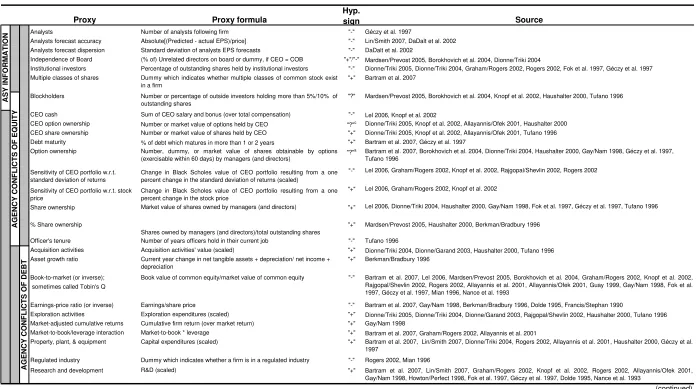
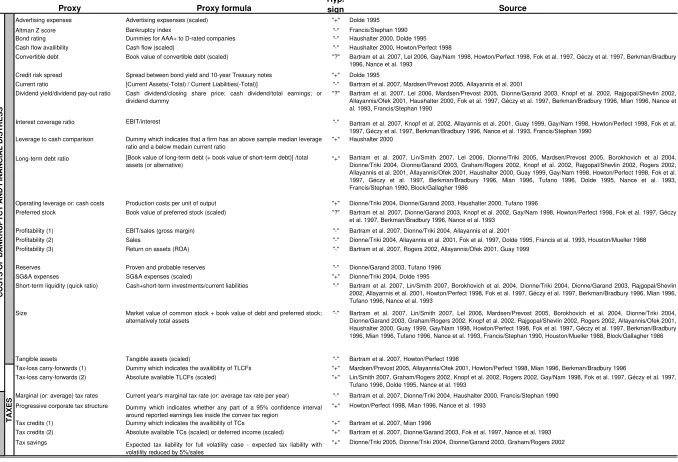
Haushalter, 2000; Tufano, 1996). A large number of different proxies are used to test the
2
underlying theories (Table 1).3 Moreover, a few studies analyze whether the determinants for
the decision to hedge and the extent of hedging are different (Graham and Rogers, 2002;
Al-layannis and Ofek, 2001), while other studies consider different types of hedging, e.g.
ex-change rate or interest rate risk (Bartram, Brown and Fehle, 2009; Graham and Rogers,
2002), commodity price risk (Géczy et al., 2006; Haushalter, 2000), or alternative risk
man-agement strategies that do not involve derivatives (Petersen and Thiagarajan, 2000).4
Some studies investigate the impact of corporate governance on the importance of
dif-ferent rationales for hedging at the firm level (Lel, 2006). To illustrate, managers may use
corporate hedging to increase the utility of their compensation packages particularly in firms
with weak governance. Finally, there are also some studies that more directly test the value
implications of corporate hedging, by relating derivatives use to leverage (Graham and
Rog-ers, 2002) or relative valuation metrics such as the market-to-book ratio (Mackay and
Moel-ler, 2007; Jin and Jorion, 2006; Allayannis and Weston, 2001).5
Nevertheless, almost all empirical work in this area faces some significant challenges
that need to be considered when interpreting the results. To illustrate, endogeneity and
3
While the studies included in the tables that are discussed in this section are meant to provide a com-prehensive overview of the empirical evidence on positive corporate risk management theories, the large num-ber of studies on this subject makes it impossible to include all of them. As a result, some studies are excluded from the tables, particularly those that largely verify whether results obtained for the United States also hold for firms in other countries.
4
Bartram, Brown and Fehle (2009) estimate a (simultaneously estimated) multivariate PROBIT model for FX, IR, and CP derivatives use, as well as ordered LOGIT models with the dependent variables as either the number of exposures (FX, IR, and CP) hedged, or the number of derivative types utilized (Forward, Futures, Swap, and Option).
5
fication problems, empirical modeling of structural relations, identifying appropriate proxy
variables for corporate hedging beyond the use of derivatives, assessing the extent of
corpo-rate hedging in the face of multi-faceted hedging stcorpo-rategies and time-varying exposures, are
major issues that many studies in this literature fail to address and, thus, potentially severely
limit the conclusions that can be drawn from their results.
2.1 Agency Costs
2.1.1 Underinvestment and Asset Substitution Problems
A company can be seen as a nexus of contracts between different parties, such as, e.g.,
man-agers, shareholders, creditors, and employees (Jensen and Meckling, 1976). Since manman-agers,
who run the company as agents on behalf of shareholders, are more involved in the daily
activities of the firm, they enjoy an information advantage over their principals, i.e.
share-holders. Given that both groups may not share common goals, conflicts can emerge since it is
typically not possible to prevent non-value maximizing behavior via perfect contracts (Fama
1980).
Yet even if managers act in line with shareholders’ interests, they still might forgo
val-ue-enhancing projects, if the gains of accepting these projects accrue mostly to bondholders
(underinvestment problem). This situation arises typically when a firm is highly levered and
firm value is low, as bondholders are reimbursed before shareholders, and thus valuable
pro-jects might not benefit shareholders. Solutions to this problem, such as, e.g., rewriting or
negotiating debt contracts, are often costly and thus impractical (Smith et al., 1990; Myers,
1977).
While the underinvestment problem can be alleviated through reduction of debt
benefits of debt. This stems from the fact that corporate hedging reduces the volatility of firm
value and thus makes it less likely that firm value drops to levels at which there are
incen-tives for shareholders to forgo positive NPV projects (Smith, 1995; Bessembinder, 1991;
Smith et al., 1990; Mayers and Smith, 1987).
Further conflicts of interest between shareholders and debtholders can arise, however,
as it is usually beneficial for shareholders of a leveraged firm to substitute highly risky
in-vestment projects, possibly even with negative NPV, for safe inin-vestment project (asset
sub-stitution or risk shifting problem). This incentive can be explained by the fact that
sharehold-ers’ claim on firm value has the properties of a call option on the assets of the firm with the
debt value as strike price (Mason and Merton, 1985; Merton 1974). As the value of options
increases with the volatility of the underlying asset, shareholders increase the value of their
position by replacing safe assets with risky assets.
Since debtholders anticipate this opportunistic behavior, they demand either higher
yields on the capital provided and/or protective covenants. Both of these possibilities create
additional costs that reduce firm value (Smith and Warner, 1979). Corporate risk
manage-ment stabilizes firm value and hence reduces the chance that states of the world occur in
which shareholders have strong incentives to shift towards riskier assets (Smith, 1995;
Campbell and Kracaw, 1990). Thus, if a firm has committed itself to a corporate hedging
policy, agency costs are reduced. However, it is difficult for a company to credibly guarantee
the continuing existence of corporate hedging, as it might consider discontinuing risk
man-agement, if it winds up in a situation in which taking on more risky projects is very beneficial
Nevertheless, Morellec and Smith (2007) show that shareholders will typically benefit
from negotiating the issuance of debt and the hedging strategy simultaneously, since lenders
will provide the same funds at a lower rate. Consistent with this result, many firms appear to
arrange credit lines as well as hedging programs through the same financial institution, which
enables the bank to monitor the borrowers’ hedging programs. Consequently, other financial
institutions or contracting parties may also offer more favorable terms to companies that
es-tablish lines of credit and hedge positions with the same bank.
Agency problems between principals and agents arise in a world of incomplete
con-tracting and asymmetric information. Variables used in empirical studies to proxy for such
information asymmetries are the number (or the percentage) of outstanding shares owned by
institutional investors, the number of large blockholders, usually with a stake above five or
ten percent, the existence of multiple share classes, the number of analysts following a firm,
and analysts’ mean accuracy and dispersion in forecasting a firm’s earnings. Firms that are
owned to a large extent by institutional investors, tracked by a large number of analysts, that
do not have multiple share classes, and whose earnings can be predicted with great accuracy
and low dispersion face less informational asymmetry, and therefore should be less likely to
hedge (DaDalt et al., 2002; Visvanathan, 1998; DeMarzo and Duffie, 1991). In contrast, the
hypothesized sign of proxies for large blockholders depends on their diversification level.
While a high percentage of well diversified outside blockholders should significantly
en-hance information availability and reduce incentives to hedge, corporate hedging could also
be an effective way for less diversified outside blockholders to reduce their unsystematic
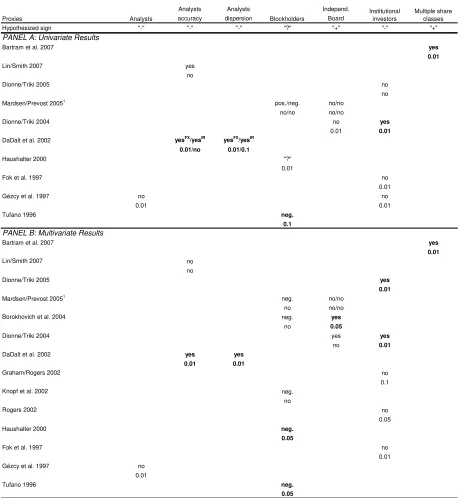
There is only limited empirical evidence on the relation between corporate hedging and
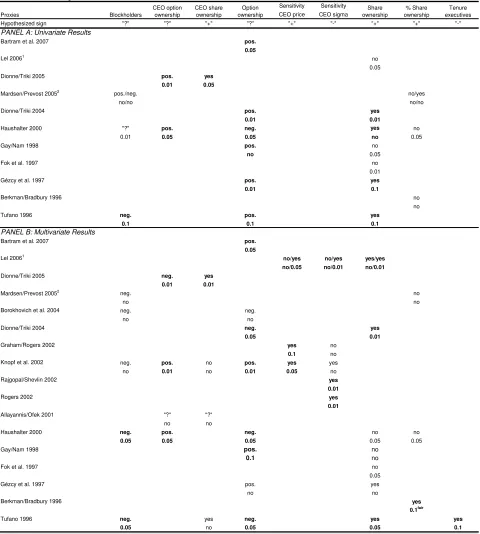
asymmetric information (Table 2). While variables proxying for institutional ownership and
analysts following are generally significant, the effect is often not of the predicted direction
(Graham and Rogers, 2002; Rogers, 2002; Géczy et al., 1997). Only more recent studies
sometimes obtain the predicted association (Dionne and Triki, 2005; 2004). As theory
sug-gests, the existence of multiple share classes leads to higher derivatives’ use (Bartram,
Brown and Fehle, 2009). Large blockholders are always negatively associated with corporate
hedging (Mardsen and Prevost, 2005; Borokhovich et al., 2004; Haushalter, 2000; Tufano,
1996). Thus, if large blockholders are mainly well-diversified shareholders, which may be
reasonable to assume, this would represent evidence supporting the asymmetric information
argument. Finally, the mean accuracy and the dispersion of analysts’ earnings forecasts show
significant associations with corporate hedging in the predicted directions (DaDalt et al.,
2002).6
Underinvestment and asset substitution problems are more important for firms with
high growth opportunities, as the value of these firms would suffer most from failing to
in-vest into the available profitable projects, and high leverage, as these firms are more likely to
end up in states of nature in which these conflicts can occur.7 As a result, high growth
oppor-tunities and high leverage should increase the incentives for corporate hedging. Proxies
which measure the existence and magnitude of available growth opportunities include
re-search and development (R&D) expenditures, property, plant, and equipment (PP&E)
6
Demsetz and Lehn (1985) argue that ownership structure is endogenous, giving rise to potentially im-portant simultaneous equations biases for analyses that do not account for these effects.
7
poten-ditures, the asset growth rate, and attempted acquisition activities. For certain industries (e.g.,
gold, gas, and oil producers), exploration expenditures are used as an alternative proxy. Since
these proxies directly measure the resources invested into growth activities, there should be a
positive relation between these variables and growth opportunities and, in turn, also a
posi-tive relation with corporate hedging (unless these variables also proxy for free cash flow
problems).
Other proxies measure the availability of positive NPV projects in a more indirect way,
such as the earnings-to-price and the book-to-market ratio. A lower book-to-market ratio
indicates higher availability of growth opportunities, suggesting a higher propensity to hedge.
Similarly, firms with currently low earnings yet high share price appear to derive most of
their firm value from profitable prospective expansion opportunities. Therefore, the
earnings-to-price ratio and corporate derivatives’ use should be negatively related. Finally, an increase
in a firm’s growth opportunities is expected to lead to significant cumulative abnormal
re-turns (CARs) (Gay and Nam, 1998). As a result, companies with high CARs should be more
inclined to hedge.
Regulated industries are often characterized by lower levels of information
asymme-tries than other indusasymme-tries (Mian, 1996). Hence, it is easier for creditors to monitor the
behav-ior of managers, and thus to inhibit them from shifting risk or turning down profitable
in-vestment projects. Furthermore, it can be argued that regulated industries in general, first, do
not enjoy the same growth opportunities as unregulated industries and, second, operate in
more stable environments (Smith and Watts, 1992). It can thus be hypothesized that firms in
regulated industries have a lower demand for corporate hedging than firms in unregulated
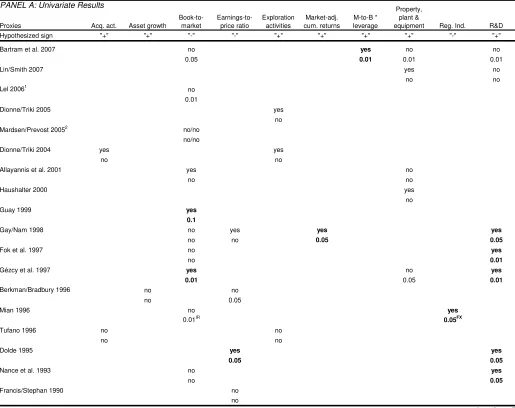
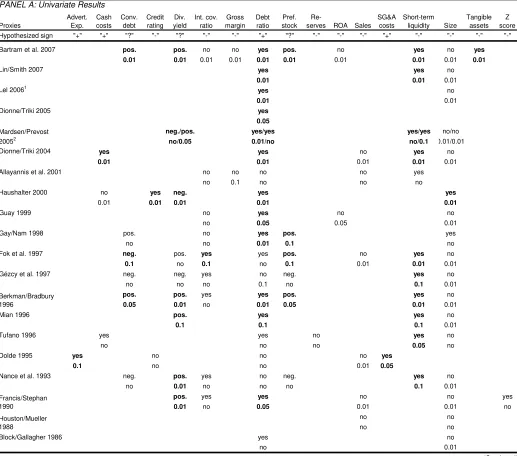
Empirical results strongly support the hypothesized relation between R&D
expendi-tures and corporate risk management (Table 3) (Lin and Smith, 2007; Knopf et al., 2002;
Allayannis and Ofek, 2001; Gay and Nam, 1998; Howton and Perfect, 1998; Fok et al., 1997;
Géczy et al., 1997; Dolde, 1995; Nance et al., 1993). At the same time, the coefficients of
PP&E expenditures, the asset growth rate, and the value of attempted acquisitions never have
the correct sign at any conventional significance levels. Only one study finds the predicted
relation between high exploration activities (in the gold mining industry) and derivatives’ use
(Rajgopal and Shevlin, 2002), while the evidence in other studies is either insignificant or in
the opposite direction (Dionne and Triki, 2005; Haushalter, 2000; Tufano, 1996), which may
be due to the relation between growth options and corporate hedging being more complex
than conjectured in these empirical studies (Morellec and Smith, 2007).
With regards to the more indirect measures of growth opportunities, the
earnings-to-price ratio, which is mainly used in earlier studies, offers some support for the agency cost
hypothesis in multivariate tests (Gay and Nam, 1998; Berkman and Bradbury, 1996).
More-over, while hypotheses related to book-to-market are often not validated, CARs associate
with corporate hedging at significant levels in the right direction (Gay and Nam, 1998).
Fi-nally, there is strong evidence suggesting that firms in regulated industries face lower
incen-tives to engage in corporate hedging (Rogers, 2002; Mian, 1996).
The evidence partially supports the hypothesis that financial constraints concurrent
with growth opportunities lead to a higher propensity for corporate hedging. These tests are
market-to-book ratio or R&D expenditures.8 Since large growth opportunities and high financial
lever-age increase the value of this interaction term, a positive relation between the interaction
term and corporate risk management should be expected. Although this can be confirmed for
the interaction term with the market-to-book ratio, no evidence is found for the interaction
term based on R&D expenditures (Bartram, Brown and Fehle, 2009; Graham and Rogers,
2002; Géczy et al., 1997). Lastly, the positive association between corporate hedging and the
interaction term of leverage with the market-to-book ratio appears to be conditional on strong
corporate governance structures (Lel, 2006).
Furthermore, the simultaneous effect of financial leverage and growth opportunities on
corporate hedging can be tested by controlling for differences in cash ratios. By adding a
cash dummy to the OLS regression, the evidence supports hypotheses related to the
earnings-to-price ratio, R&D expenditures, and CARs (Gay and Nam, 1998). Overall, however, the
empirical support for theories of motives for corporate hedging based on agency costs of debt
are mixed at best.
2.1.2 Management Compensation, Incentive Structures, and Risk Preferences
Managers and shareholders might also have divergent interests, because managers like to
spend cash on perquisites when the proportion of managerial ownership in a company is low.
In addition, managers likely consider their personal attitudes towards risk when choosing the
company’s level of risk, which may not perfectly match shareholders’ preferences (May,
1995; Smith and Stulz, 1985). While active monitoring can prevent managers from behaving
in non-maximizing ways, no single shareholder has strong incentives to engage in
8
ing, as the gains accrue to all other investors in case ownership is widely dispersed and
moni-toring is costly (free-rider problem). Large shareholders, however, such as institutional
inves-tors, have higher incentives to exercise careful vigilance, since they are not only bearing the
costs, but also obtain a significant part of the benefits. Still, there are disadvantages to
hold-ing large blocks of shares in one company, such as foregone diversification benefits
(Marko-witz, 1952).
Often, management has an undiversified wealth position in a firm due to current and
future income and non-monetary utility components, such as reputation, awards, and
promo-tions. As managers’ welfare is strongly related to the ongoing existence of the business,
man-agers might be inclined to reduce the firm’s risk characteristics to levels conflicting with
shareholder value maximization or, alternatively, to demand higher compensation for being
exposed to high business risk (Mayers and Smith, 1990; Stulz, 1990; 1984).
Risk management at the firm level can make it more attractive for undiversified
inves-tors to hold large equity-blocks by reducing idiosyncratic risk. As concentration among
shareholders increases, so does monitoring, leading to more efficiently managed businesses
and, in turn, higher cash flows (Stulz, 2001; Fite and Pfleiderer, 1995). With regards to
man-agement, corporate hedging might lower the variability and thus the level of compensation
required by managers by decreasing firm-specific risk (DeMarzo and Duffie, 1995).
More-over, it might lower managers’ incentives to pursue more costly diversification strategies,
like operative diversification of businesses (Bodnar et al., 1997; Berger and Ofek, 1995;
Comment and Jarrell, 1995).
In addition to monitoring, managerial incentive packages are often used to align the
share-holder value. Consequently, managerial compensation is often tied to a firm’s stock price.
Compensation and stock price can be linked linearly, as in case of managerial share
pro-grams, for which changes in firm value translate in a linear fashion into changes in
compen-sation.9 As managers are, however, more risk-averse than shareholders due to their
undiversi-fied wealth position, share programs induce managers to reduce firm-specific risk even
fur-ther. In contrast, non-linear incentive structures, like stock option programs, offer more than
proportional benefits for increases in firm value, creating a convex payoff scheme. Therefore,
non-linear compensation packages might, contrary to share programs, provide incentives for
managers to bear more risk.
Nevertheless, when management compensation is tied to the stock price, changes in
compensation are sometimes unrelated to managers’ decisions, but are due to general market
fluctuations, thus exposing managers to uncontrollable systematic risk. This might entail
dys-functional behavior, such as managers hurting firm value to lower their exposure (Stulz,
2001). Moreover, the distinction between high- and low-qualified managers becomes blurred
when management performance is distorted by non-core business risks. Consequently,
corpo-rate risk management can add value by alleviating the impact of market fluctuations on firm
value, thus helping to distinguish between efficient and inefficient managers (Bartram, 2000;
Campbell and Kracaw, 1987). In addition, a strengthened correlation between managerial
9
performance and shareholder value renders incentive programs more efficient tools for
stimulating managers to focus on shareholder value.
Theory models that examine agency conflicts between shareholders and bondholders as
well as between shareholders and managers simultaneously can lead to richer predictions
than discussed so far. For instance, Morellec and Smith (2007) argue that corporate hedging
can also control free cash flow problems. Thus, more growth options increase
underinvest-ment problems, but also imply fewer free cash flow problems because of fewer assets in
place. Corporate risk management lowers the probability of both high and low cash flows,
and thus reduces the costs of both overinvestment as well as underinvestment.
Given the potential of corporate hedging to reduce the unsystematic risk of the firm, it
can be argued that the amount (or percentage) of outstanding shares owned by large,
ill-diversified investors should be higher for firms that use derivatives. Hence, variables
indicat-ing the existence of blockholders other than managers or directors who hold shares in excess
of 5% or 10% are used in some empirical studies. Contrary to theoretical predictions, this
variable is generally negatively associated with corporate hedging (Table 4) (Haushalter,
2000; Tufano, 1996). This result could be driven by the fact that the proxy used does not
dis-tinguish between diversified and ill-diversified investors, while the hypothesized effect
per-tains to investors that are not well diversified. Therefore, it could be sensible to use proxies
that measure large blockholdings of more than 5% or 10% of shares and distinguish between
different types of investors.
Early empirical studies investigate the effect of management compensation packages
on corporate hedging policies by analyzing the amount (or fraction) of shares and options
that for firms that award company shares, managers face incentives to hedge more, and thus
these variables should be positively correlated. Executive stock option programs, on the other
hand, should be negatively associated with corporate risk management, as corporate hedging
decreases the volatility of firm value, and therefore the value of stock options.
These arguments, however, can be criticized on the grounds that they ignore the fact
that management share and option programs can have different sensitivities of value towards
changes in share price and volatility. For example, strike prices of management option plans
are often set close to the market price, so that even modest performance moves them
in-the-money (Gay and Nam, 1998). More interestingly, anecdotal evidence suggests that deep
out-of-the-money options are in many cases replaced with at-the-money options (Browning and
Jereski, 1997).10 These stock option plans therefore generate incentives similar to share
pro-grams. To overcome these issues, some studies employ the sensitivities of the value of the
CEO portfolio with respect to changes in stock price and volatility, calculated with the
Black-Scholes (1973) formula (Lel, 2006; Graham and Rogers, 2002; Knopf et al., 2002).
Since inefficient and low-qualified managers benefit from the fact that non-business
risks distort the relation between corporate performance and management skills, they have
incentives to avoid corporate risk management (Breeden and Viswanathan, 2006). Also, if
younger managers work harder than older managers and are motivated to build a strong
repu-tation, an officer’s tenure can be used as a measure to test for divergent interests between
efficient and inefficient managers (Tufano, 1996). Besides an officer’s tenure, a manager’s
educational background could also influence his corporate hedging policy (Dionne and Triki,
2005).
10
The empirical evidence for the absolute value (or percentage) of shares owned by the
CEO or directors and managers is overall mixed (Table 4) (Mardsen and Prevost, 2005;
Di-onne and Triki, 2004; Haushalter, 2000; Gay and Nam, 1998; Géczy et al., 1997; Berkman
and Bradbury, 1996; Tufano, 1996). Studies examining the sensitivity of the CEO portfolio
towards changes in the share price in general find more supportive results (Graham and
Rog-ers, 2002; Knopf et al., 2002). Additionally, the significant negative association between
of-ficers’ tenure and risk management provides evidence for the relevance of management
qua-lification (Tufano, 1996). Last but not least, it seems that only firms with weak corporate
governance use derivatives to hedge the risks associated with executive stock plans (Lel,
2006).11 Potential management performance indicators that could be considered in future
research to control for management quality when testing the relations between derivatives
use and company stock programs for management are economic value added (EVA),
eco-nomic profit (EP), or cash value added (CVA).
There is also significant evidence for differences in managerial option holdings of
companies using derivatives and those which do not, although the relation differs across
ana-lyses (Bartram, Brown and Fehle, 2009; Dionne and Triki, 2004; Haushalter, 2000; Gay and
Nam, 1998; Géczy et al., 1997; Tufano, 1996). Studies examining the sensitivity of the CEO
portfolio towards changes in volatility find the theorized association in all but one case at
conventional significance levels (Graham and Rogers, 2002; Knopf et al., 2002; Rajgopal
and Shevlin, 2002; Rogers, 2002). Again, this association appears conditional on the
corpo-rate governance structure of the firms analyzed (Lel, 2006). In conclusion, hypotheses related
11
to agency conflicts between shareholders and managers are often only weakly confirmed as
motives for value creation through risk management at the firm level.
2.1.3 Coordinating Investment and Financing Policies
Risk management at the firm level can increase firm value by aligning corporate investment
and financing policies. As future cash flows are uncertain, internal funds that are used to
fi-nance growth opportunities often vary significantly. As a result, in situations in which
inter-nal funds are insufficient to finance all positive NPV projects, a firm is either forced to cut
back on its investment plan or to raise external equity or debt.
External capital, however, is costly due to agency conflicts. More specifically, as
credi-tors incorporate their expectations about bankruptcy and financial distress into their lending
decisions, a non-zero probability of default induces them to demand higher yields on the
company’s debt. Although this enables them to obtain a fair value from their investment, it
increases the firm’s cost of debt and thus decreases firm value (Myers, 1993; 1984). Another
way to protect their claims consists of covenants which restrict managerial decision-making
with respect to financing and investment policies. These covenants can, however, also prove
value reducing if they turn out ex post to deter managers from following sound investment
projects (Bartram, 2000).12 Similarly, the issuance of new equity has a negative effect on
firm value, as investors anticipate incentives of management to issue new stock when it is
overvalued (Asquith and Mullins, 1986).
Because of these costs of external capital, firms more often cut back on their
invest-ment expenditures than turn to financial markets, thereby foregoing profitable investinvest-ment
12
projects. In fact, the empirical evidence suggests that higher cash flow volatility may lead to
permanent cutbacks in investment (Minton and Schrand, 1999). Corporate hedging can
en-sure that firms have sufficient internal funds to finance their profitable growth opportunities
without having to raise outside capital – which however also reduces the discipline that
capi-tal markets impose on managers (Chang, 2000; Tufano, 1998). Moreover, firms exhibiting a
strong natural association between the availability of and need for internal funds should face
lower incentives to hedge (Spanò, 2001; Moore et al., 2000; Copeland and Copeland, 1999;
Mello and Parsons, 1999; Fite and Pfleiderer, 1995; Santomero, 1995; Froot et al., 1994;
1993; Lewent and Kearney, 1990).
Similar to the asset substitution and the underinvestment problem, the coordinated
fi-nancing and investment hypothesis depends upon the existence of cash flow constraints and
available growth opportunities in the presence of capital market frictions. As a result, the
same proxies can be employed to test this hypothesis. Moreover, it can be investigated
whether companies with a greater correlation between available and needed funds hedge less
frequently than companies with a lower correlation. The existing evidence strongly supports
this hypothesis (Gay and Nam, 1998). Likewise, there is strong support for the hypothesis
that companies using derivatives exhibit a lower sensitivity of investment to pre-hedging
cash flows (Allayannis and Mozumdar, 2004). In contrast, there is also evidence that the
ef-fect of derivatives use on cash flows is small (Guay and Kothari, 2003). Indirect evidence
supporting this theory is found in Géczy et al. (1997), while direct evidence can be found in
2.1.4 Costs of Bankruptcy and Financial Distress
Levered companies run the risk that their cash flows are not sufficient to meet all fixed
pay-ment obligations timely and in full. This risk increases with higher leverage or more volatile
cash flows. A company that is unable to fulfill its fixed payment obligations is forced into
bankruptcy, at which point creditors and shareholders try to recover their investments in the
firm. However, although creditors are holders of priority claims, there is often a costly
dis-pute about the actual distribution of residual firm value (Warner, 1977a).
Furthermore, even before a company is actually filing for bankruptcy, it may encounter
indirect costs of bankruptcy, if insolvency is expected in the near future. These costs are due
to the reluctance of suppliers and customers to deal with the company, a distraction of
man-agement attention, risk premia reflected in higher manman-agement and employee compensation,
etc. Direct costs of bankruptcy accrue in the actual bankruptcy procedure and pertain mainly
to lawyers’ charges, administrative and accounting fees, and expenses for expert witnesses.
On average, direct costs of bankruptcy are usually only in the order of 1% to 3% of
share-holder value (Weiss, 1990; Warner, 1977b). In contrast, indirect costs tend to be much larger
than direct costs and can approach 20% of company value (Cutler and Summers, 1988).
The expected costs of financial distress stem mostly from low levels of company value,
i.e. they are the product of the probability of these states of nature times the actual costs. As
corporate risk management decreases the likelihood of reaching these left-tail realizations by
reducing the volatility of firm value, it lowers the expected costs of financial distress (Stulz,
2001; Raposo, 1999; Santomero, 1995; Dolde, 1993; Rawls and Smithson, 1990; Smith et al.,
1990; Mayers and Smith, 1982). However, corporate risk management increases firm value
debt-equity ratio, it allows firms to enjoy greater tax shields (Graham and Rogers, 2002;
Lel-and, 1998).
Given that corporate risk management can lower the present value of bankruptcy and
financial distress costs, firms with a high probability of default and/or high financial distress
costs should be more likely to engage in corporate hedging. This hypothesis can be tested
using the long-term debt ratio and the interest coverage ratio, which both give an indication
of the probability of financial distress. A firm with high leverage has higher payment
obliga-tions, and should therefore be more likely to experience difficulties in honoring these
com-mitments. It thus might have stronger incentives to hedge. In the same vein, the interest
cov-erage ratio should be negatively associated with corporate hedging, since a higher interest
coverage ratio suggests more pre-tax income to satisfy committed payments.
The use of the long-term debt ratio is not without controversy. If financial distress costs
do not only depend on a firm’s debt ratio, but also on other industry-specific, exogenous
fac-tors (such as the level of competition, rivalry, etc.), a firm with high distress costs might have
a low debt ratio, and still face high incentives to hedge. A modified financial distress proxy
subtracts the industry’s median leverage ratio from the firm’s leverage ratio, and a debt ratio
above-industry level would indicate a high probability of distress (Géczy et al., 1997).
Fur-thermore, it is possible that high leverage only leads to default in combination with a lack of
available cash. A potentially better, more forward looking proxy for the default risk of a firm
would consist of the default probability implied in the firm’s stock or option price (Bartram
et al., 2007; Vassalou and Xing, 2004; Merton, 1974). As mentioned before, important
leverage might induce more hedging, but hedging also allows for a larger debt ratio with
concomitant increases in tax shields.
As cash and marketable securities can be used to cover financial obligations,
particu-larly short-term liabilities, higher short-term liquidity should result in a lower need for
hedg-ing. By the same token, companies that are paying high dividends have few incentives to
hedge, as it can be argued that only highly liquid firms can commit themselves to paying out
dividends. In contrast, if firms exhaust their liquidity by paying dividends, they might have
incentives to hedge. Preferred stock and convertible debt may constrain firms financially and
thus create greater distress costs (Géczy et al., 1997). Alternatively, they could be a means to
control the firm’s agency conflicts and could thus act as substitutes for corporate risk
man-agement with derivatives (Nance et al., 1993), so that the direction of the relation of these
variables with derivatives use is an empirical question. Moreover, there are also potentially
important endogeneity biases with regards to dividend policy that complicate the analysis
(Smith and Watts, 1992).
Other market participants’ assessment of a firm’s survival chances might also help to
proxy for the probability of bankruptcy and financial distress. More specifically, credit
rat-ings and the credit risk spread, i.e. the yield difference between a firm’s bonds and 10-year
Treasury notes, contain important information about a firm’s financial risk. Firms with low
credit ratings and high credit risk spreads should face a higher probability of distress, and
they should thus be more inclined to use corporate hedging.
By the same token, a firm’s profitability might also be a determinant of its corporate
hedging policy, since less profitable companies likely have more difficulties in meeting their
will hedge more than more profitable firms. Popular measures of profitability are gross
mar-gin, sales, and the return on assets (ROA). Since the presence of tax-loss carry-forwards
indi-cates the existence of net losses during at least one of the last years, tax-loss carry-forwards
should also be positively associated with corporate risk management. Furthermore,
produc-tion costs can be used to make inferences about the likelihood of financial distress, since, as a
rule of thumb, for many firms financial distress becomes serious when prices drop below
production costs, which is more likely to happen for firms with high production costs
(Tu-fano, 1996).
Several studies employ discriminant analysis to predict the likelihood of a firm’s
bank-ruptcy. Firms with higher predicted probabilities of future bankruptcy, e.g. based on Z-scores
(Altman, 1983), should be more inclined to hedge. Moreover, financial distress costs are a
function of the extent of intangible assets. As tangible assets can be easily sold in case of
bankruptcy, firms with a high proportion of tangible assets should have a lower level of
fi-nancial distress costs than firms with significant intangible assets. Since the costs of fifi-nancial
distress are not proportional to firm size (Warner, 1977b), small firms have higher distress
costs (as a fraction of firm value). Similarly, firms with large advertising and selling, general,
and administrative (SG&A) expenses often have more unique products that are harder to
liq-uidate quickly.
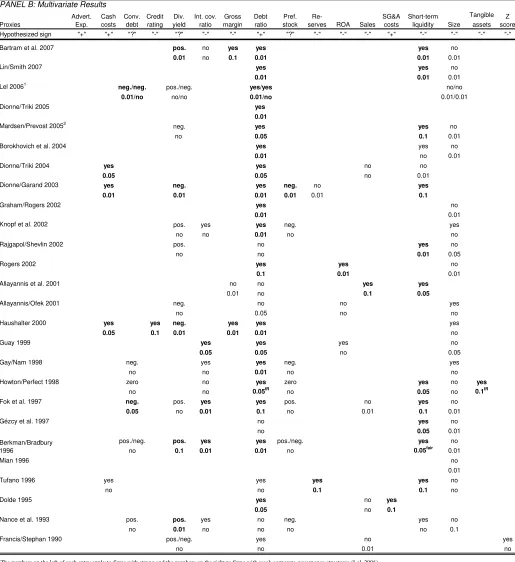
The long-term debt ratio and the interest coverage ratio are widely used to test the
fi-nancial distress hypothesis. Despite the discussed potential endogeneity problems, most
stud-ies obtain a significant positive relation between the long-term debt ratio and corporate
hedg-ing (Table 5) (Bartram, Brown and Fehle, 2009; Dionne and Triki, 2005; Graham and
1998; Fok et al., 1997; Berkman and Bradbury, 1996; Mian, 1996). This association,
how-ever, seems to be only significant for firms with strong corporate governance structures (Lel,
2006). As different risk levels could distort the hypothesized relation between corporate
hedging and the long-term debt ratio, it might be important to control for risk exposure
(Dolde, 1995). After sorting sample firms into groups of similar primitive risk, the evidence
strongly supports the predicted relation between corporate hedging and debt levels.
The evidence also strongly suggests that users of derivatives exhibit lower short-term
liquidity than those without derivatives (Lin and Smith, 2007; Allayannis et al., 2003; Dionne
and Garand, 2003; Fok et al., 1997; Géczy et al., 1997; Tufano, 1996). With respect to
divi-dends (or dividend yields), however, no clear pattern emerges, i.e. while many studies obtain
significant results, the relation varies across analyses (Bartram, Brown and Fehle, 2009;
Dionne and Garand, 2003; Haushalter, 2000; Berkman and Bradbury, 1996; Mian, 1996).
Similarly inconclusive results obtain for preferred stock and convertible debt, as these
prox-ies are often insignificant at conventional levels (Gay and Nam, 1998; Fok et al., 1997).
To control for endogeneity in the choice of capital structure and hedging, these
deci-sions can be modeled simultaneously. The results of simultaneous equation models largely
confirm a significant positive association between debt levels and hedging (Bartram, Brown
and Fehle, 2009; Graham and Rogers, 2002; Géczy et al., 1997). This is evidence for
in-creased firm value via tax benefits of debt. For oil and gas producers, firms using derivatives
show higher leverage ratios and lower current ratios than the industry median at the 1%
sig-nificance level (Haushalter, 2000). Finally, although the sign is sometimes in the predicted
direction, the interest coverage ratio is often insignificant at conventional levels (Howton and
The remaining variables generate mixed results. For example, the evidence on credit
ratings and production (or cash) costs is always significant with the correct sign (Dionne and
Triki, 2004; Dionne and Garand, 2003; Haushalter, 2000). In univariate analyses, all three
profitability measures indicate that counter to theory more profitable companies hedge more,
while they are sometimes positively and sometimes negatively associated with derivatives
use in multivariate tests. The evidence on tax-loss carry forwards is mixed, and will be
exam-ined more carefully in the next section.
With regards to the size of financial distress costs, firms using derivatives show lower
ratios of tangible assets to total assets than firms not using derivatives (Howton and Perfect,
1998). In contrast, the evidence for variables proxying for the uniqueness of a firm’s products
appears weak (Dolde, 1995). Moreover, the evidence suggests that large firms face stronger
incentives to hedge than small firms, and thus seems to indicate that corporate hedging
ex-hibits significant economies of scale. However, there exists some evidence that the extent of
corporate hedging and firm size are negatively related, i.e. for firms having a risk
manage-ment program in place small firms hedge more than large firms (Graham and Rogers, 2002;
Allayannis and Ofek, 2001; Haushalter, 2000). Results using the Z-score are similar (Francis
and Stephan, 1990). In summary, there is some evidence suggesting that bankruptcy and
fi-nancial distress costs are important determinants of corporate hedging, but the evidence is not
entirely unambiguous.
2.2 Corporate Taxes
If the tax schedule is convex, i.e. if taxes increase more than proportionally with taxable
in-come, volatile taxable income results in a higher tax burden than stable pre-tax income. To
from higher income states exceed additional taxes from lower income states, thus lowering
the average corporate tax burden (Stulz, 2001; Bartram, 2000; Graham and Smith, 2000;
1999; Santomero, 1995; Smith, 1995; Kale and Noe, 1990; Mayers and Smith, 1990; Rawls
and Smithson, 1990; Smith et al., 1990; Smith and Stulz, 1985).
Convexity in the tax schedule can be attributed to the influence of statutory
progressiv-ity. However, statutory progressivity is relatively limited in most tax systems (Mayers and
Smith, 1990). In addition, indirect effects can give rise to convex tax functions. Most often,
these indirect effects come through special tax preference items, explicitly tax-loss
carry-forwards and/or investment tax credits, which are subject to restrictive rules and regulations.
As a consequence, in states of low income or losses firms are not able to fully utilize the
ben-efits of these effects (MacKie-Mason, 1990).13 Given the potential for corporate risk
man-agement to reduce the tax burden, firms with more income in the convex region of the tax
code or with more special tax items, should have stronger incentives to use derivatives to
hedge. Consequently, proxies to analyze this hypothesis either focus on income in the convex
tax region or on special tax items.
Taxable income, possibly averaged over several years, is typically used to assess
whether the taxable income of a firm is in the convex region of the tax schedule. A more
ap-propriate proxy is to construct a 95% confidence interval around current earnings (Howton
and Perfect, 1998). If this interval overlaps with the convex tax region, a firm is assumed to
face convexity in its tax code. As tax schedules in most countries are convex up to the
high-est marginal tax rate and then become linear, a low tax rate indicates a stronger impact of
convexity. Finally, the most elaborate and accurate procedure is to compute the tax savings
13
(or increases) from a 5% reduction in income volatility. Under convex tax regimes, volatility
reductions lead to tax savings. Other proxies are scaled measures of tax-loss carry-forwards,
foreign tax credits or investment tax credits. Alternatively, in order to avoid scaling
prob-lems, a dummy variable can denote the availability of tax preference items.
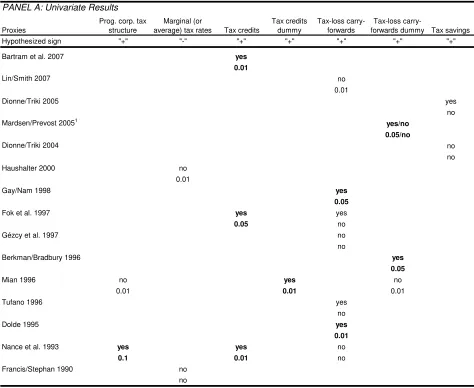
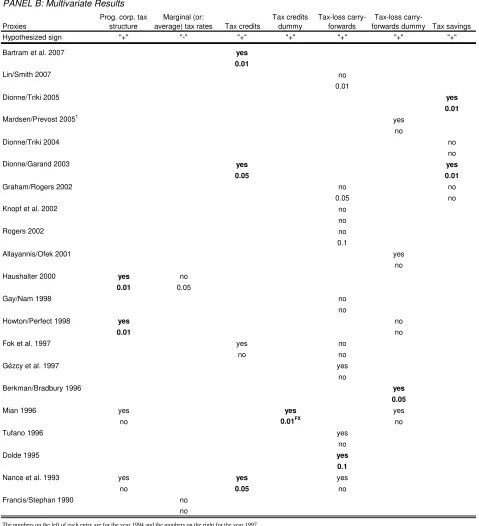
Overall, the empirical evidence based on a tax code progressivity dummy indicating
in-come in the convex tax region provides support for the tax hypothesis (Table 6) (Haushalter,
2000; Howton and Perfect, 1998; Nance et al., 1993). In contrast, marginal (or average) tax
rate proxies can lead to significant results, but in the wrong direction (Haushalter, 2000).
There is, however, some evidence to support the tax hypothesis when the tax savings from
volatility reductions are considered (Dionne and Triki, 2005; Dionne and Garand, 2003).
This might be explained by the fact that the tax incentive to hedge in order to increase
lever-age is larger than the tax incentive of progressivity (Graham and Rogers, 2002; Graham and
Smith, 1999). Scaled values and dummies for tax preference items generally lead to
qualita-tively similar findings. In the majority of cases, tax-loss carry-forwards do not significantly
associate with corporate hedging. In contrast, tax credits provide (stronger) incentives to
en-gage in financial risk management (Bartram, Brown and Fehle, 2009; Dionne and Garand,
2003).
In sum, there is some, albeit weak empirical support for the tax hypothesis. The
diffi-culties of finding empirical support for this hypothesis might be due to the fact that the tax
incentives to hedge are relatively small compared to other incentives and might thus be hard
to identify in statistical tests. It is also possible that firms with the strongest convexity in their
tax code are small firms with zero expected income. Last but not least, income volatility can
2.3 Country-specific Determinants of Hedging
Decisions of firms to engage in risk management may not only be determined by firm
char-acteristics, but the characteristics of the country they are located in may provide additional
factors that impact hedging at the firm level. In particular, firms located in economies with
more developed and liquid derivatives markets may hedge more because they have greater
access to derivatives and thus can hedge more cheaply. The legal system might also affect
corporate hedging. In countries with strong legal systems, the costs of contracting might be
low, thus facilitating corporate derivatives’ use. In contrast, it could be the case that the gains
from corporate hedging might be higher in countries with weak legal systems due to higher
direct bankruptcy costs, rendering corporate hedging more valuable. At the same time,
share-holders can easily replace managers as a result of weak firm performance in countries with
stronger shareholder rights, thus creating an incentive for managers to hedge against weak
firm performance caused by financial risk. In a different vein, firms located in smaller
econ-omies that tend to be less stable may have stronger incentives to engage in hedging. By the
same token, firms in economies with high economic, financial, and political risk are likely to
exhibit higher derivatives’ use (Bartram, Brown and Fehle, 2009; Bodnar et al., 2003).
While country-specific determinants of derivatives’ use at the firm level have so far not
been widely examined, it appears that the size of a country’s local derivatives market
associ-ates positively and significantly with a firm’s hedging decision, which is consistent with the
costs of hedging being lower in more liquid derivatives markets. Moreover, firms
headquar-tered in countries facing high financial and economic risks usually hedge more, since they
face larger exposures, while firms headquartered in countries with high political risk tend to
employ corporate risk management less frequently. The evidence on other country-specific
2.4 Direct Evidence of Value Creation through Corporate Risk Management
An alternative to testing whether firms for which theory suggests that they have large
tives to hedge employ corporate risk management more frequently than firms with low
incen-tives is to directly test for the impact of corporate hedging on firm value, often measured by
relative valuation metrics such as market-to-book.14 The empirical evidence provides some
support for an increase of shareholder wealth through corporate risk management, for
in-stance by approximately 4% for a large sample of U.S. firms with exchange rate exposure
(Allayannis and Weston, 2001) and 12-16% for a sample of firms belonging to the U.S.
air-line industry (Carter et al., 2006). Moreover, there is some evidence that the value impact of
corporate risk management might depend on corporate governance structures, i.e. there
seems to be a positive value impact only in countries with strong corporate governance
(Al-layannis et al., 2004).
In contrast, other studies either find insignificant value effects, or even that corporate
hedging decreases firm value (Guay and Kothari, 2003; Nguyen and Faff, 2003).
Neverthe-less, these tests potentially suffer from difficulties of correctly specifying the empirical tests.
To illustrate, it might be the case that the supportive evidence in previous studies is driven by
the fact that derivatives’ use proxies for other firm attributes which are known to affect
shareholder wealth (Lookman, 2003). Again, there is additional evidence from more detailed
data available for commodity-based industries. In particular, a recent study investigates the
hedging activities of 119 U.S. oil and gas producers from 1998 to 2001 and evaluates their
14
effect on firm value, based on detailed information on the extent of hedging and on the
valua-tion of oil and gas reserves (Jin and Jorion, 2006). While hedging reduces the firms’ stock
price sensitivity to oil and gas prices, hedging does not seem to affect the market value of
firms in this industry. The evidence of studies directly analyzing the value impact of
corpo-rate hedging is thus fairly mixed and inconclusive to date as well, suggesting the need for
further empirical, and possibly theoretical, analysis on this issue.
As often in corporate finance, empirical tests of value effects of corporate hedging are
plagued by endogeneity problems, i.e. firm value determines the hedging choice, rather than
hedging determining value. Several papers have dealt with these issues in various ways, such
as simultaneous equations models (Bartram, Brown and Fehle, 2009; Graham and Rogers,
2002), or sample selection (Jin and Jorion, 2006; Guay, 1999). Bartram et al. (2006) study a
global sample of 6,896 non-financial firms from 47 countries. Controlling for endogeneity
using several different techniques, they find strong evidence that the use of financial
deriva-tives reduces firm risk as well as some evidence that derivative use is related to higher firm
value (as measured by market-to-book).
In summa, the comprehensive analysis of positive theories of value creation through
corporate risk management and the corresponding extensive body of empirical evidence
sug-gests as a bottom line that these theoretical arguments are rather unsuccessful in determining
derivatives use by non-financial firms. This main conclusion, however, is consistent with
arguments and evidence presented in Bartram, Brown and Fehle (2009) suggesting
deriva-tives use as part of the financial strategy of the firm, taking into account the type and level of
financial risks, the availability of risk management tools, and the operating environment of
maturity, dividend policy, holdings of liquid assets, and the degree of operating hedging. At
the same time, corporations do not just use financial derivatives, but rely heavily on
pass-through, operational hedging, and foreign currency debt to manage financial risk (Bartram,
Brown and Minton, 2009; Guay and Kothari, 2003; Kedia and Mozumdar, 2003). As a result,
the impact of financial risk, such as unexpected changes in exchange rates, on non-financial
firms is generally small, after accounting for the effect of different forms of hedging, as
evi-denced by low fractions of firms with significant foreign exchange rate exposure (see e.g.
Jorion 1990)15. At the same time, the hedging decisions of firms may be influenced by what
other firms in the same industry do, as an unhedged firm’s foreign exchange exposure
in-creases with the extent of hedging in the industry (Nain, 2004).
2.5 Challenges and Limitation of Empirical Tests
Empirical tests of positive theories of corporate risk management are challenging.
Conse-quently, the results of empirical studies are subject to various caveats and limitations that are
important to consider when interpreting the findings.16 As mentioned above, most empirical
studies do not account for the endogeneity of variables describing different dimensions of
corporate financial policy and strategy. To illustrate, empirical studies typically use measures
of investment opportunities, leverage, debt maturity, dividends, executive stock options, cash
holdings, Altman’s Z-score, ownership concentration, governance index, etc., which are all
endogenous at some level. As a result, the overwhelming majority of the available empirical
evidence suffers from a serious simultaneous equations bias (Guay, 1999).
15
See Bartram and Bodnar (2007) for a review of the extensive literature on foreign exchange rate expo-sure.
Moreover, a fundamental identification problem rears its head in this context. To
illus-trate, it is challenging to find empirical proxies of determinants of corporate hedging that are
not at the same time also determinants of other corporate finance dimensions such as
lever-age, compensation or payout policy, and vice versa. Worse, it is not clear that financial
the-ory is as yet rich enough to resolve this problem. For example, most determinants of leverage
are also important for hedging decisions (Graham and Rogers, 2002). Only few, recent
stud-ies have tried to address these issues, while many studstud-ies do not recognize the problem, let
alone employ statistical methods, such as simultaneous equations models and structural
cor-porate finance models, that may allow alleviating the problems and take a step towards
yield-ing unbiased estimates of the underlyyield-ing structural parameters.17
It is also important to appreciate that there are variables whose impact on risk
man-agement is non-linear. A number of papers argue, for example, that the firm’s investment
opportunity set affects its hedging incentive, since more growth opportunities imply bigger
underinvestment problems, and higher costs imply stronger motives to hedge. But more
as-sets in place (i.e. fewer growth opportunities) entail also bigger free cash flow problems,
which mean stronger incentives to hedge (Morellec and Smith, 2007). A detailed
understand-ing of the underlyunderstand-ing structural parameters is required in order to be able to capture these
effects properly in empirical analyses. Moreover, financial theory does not clearly indicate
that these firm-specific parameters are appropriately estimated using cross-sectional data.
In addition, existing theories pertain to the economic motives of financial risk
man-agement or hedging in general. Nevertheless, empirical tests frequently focus only on one
17
single dimension of risk management, namely on the use of financial derivatives, to proxy for
hedging at the firm level. In contrast, firms typically use a whole range of coordinated risk
management instruments, including foreign currency debt, operational hedging measures,
and pass-through. However, there is only limited analysis of the choice between hedging
with different instruments (such as foreign currency derivatives or foreign currency debt).18
To illustrate, a company may have an exposure and a strong motive to hedge, but might do so
using hybrid debt instruments (e.g. foreign currency debt, which can be decomposed into a
domestic bond plus an embedded currency derivative) instead of (stand-alone) derivatives. In
fact, very little of the theory is developed at a sufficient level of detail to specify the
particu-lar hedging instrument that should be used (Bartram, 2006; Gay et al., 2003; Brown and Toft,
2002).
In general, the actual extent of hedging by corporations is extremely difficult to assess.
This is true not only with regards to the fact that firms use a portfolio of different risk
man-agement measures. Even with regards to just the use of financial derivatives, the extent of
hedging is hard to quantify.19 Beyond potential limitations of accounting disclosure,
expo-sures of firms vary over time, and so does the size of their hedges for each horizon into the
future. Firms effectively hold (and roll over) portfolios of derivatives with different payoff
profiles (linear and non-linear), notional amounts, expiration dates, exercise prices, etc., and
the combined effect of this portfolio on the risk profile of the firm is hard to assess, since
hedging metrics like deltas depend on the prices at which they are evaluated. Finally, most
empirical studies classify firms as either hedgers or non-hedgers, without allowing for the
18
Mello et al. (1995) examine the role of operational hedging and its relation to financial hedging, while Bodnar et al. (2002) consider operational hedging and pass-through.
possibility that firms could move between the two groups over time. These data problems
limit the power of empirical tests in this area.
3 Summary and Conclusion
Although corporate risk management cannot increase shareholder value in an M&M world,
hedging at the firm level can create value to the benefit of shareholders in the presence of
real world capital market imperfections, such as direct and indirect costs of financial distress,
costly external financing, and taxes. This paper carefully compiles, classifies and analyzes
the extant evidence on this issue culled from numerous empirical studies, highlighting areas
where the evidence is ambiguous and further research is needed. Overall, most proxy
vari-ables used to test whether corporate hedging can lower agency costs, such as the
underin-vestment or the asset substitution problem, lead to fairly mixed results, though a small
num-ber of proxies, such as R&D expenditures, show effects in the predicted direction at
conven-tional significance levels.
Similar conclusions can be drawn from tests whether corporate risk management
alle-viates agency conflicts between managers and shareholders. In particular, while management
share programs in many cases induce firms to hedge, there is little convincing evidence that
executive stock option programs lead to opposite incentives. In contrast, some support exists
for the coordinated financing and investment hypothesis when examined separately from
other agency costs theories. Support for positive theories based on bankruptcy and financial
distress costs mainly stems from the long-term debt ratio, which may suffer from important
endogeneity problems with regards to financial risk management. Other proxies, e.g. the
in-terest coverage ratio, on the other hand, often associate with corporate hedging in the wrong