http://www.scirp.org/journal/ojapr ISSN Online: 2329-8413
ISSN Print: 2329-8421
Non-Negative Matrix Factorization Based UKF
Algorithm for Constant Modulus Signals in
Adaptive Beamforming
Ranganathan Vignesh, K. A. Narayanankutty
Department of Electronics and Communication Engineering, Amrita School of Engineering, Coimbatore, Amrita Vishwa Vidyapeetham (Amrita University), Coimbatore, India
1. Introduction
Adaptive blind beamforming plays an important role in the contemporary communica-tion systems where it constantly tributes to the enhancement of the signals that tend to be received or transmitted. Adaptive beamforming is achieved through varying the tap weights assigned to each antenna at every time instant applying signal processing algo-rithm.
The weights are adjusted such that maximum array sensor gain is obtained with
mi-Abstract
Blind adaptive beamforming is getting appreciated for its various applications in contemporary communication systems where sources are statistically dependent or independent that are allowed to formulate new algorithms. Qualitative performance and time complexity are the main issues. In this paper, we propose a technique for constant modulus signals applying basic non-negative matrix factorization (BNMF) in blind adaptive beamforming environment. We compared the existing Unscented Kalman Filter based Constant Modulus Algorithm (UKF-CMA) with proposed NMF-UKF-CMA algorithm. We see there is a better improvement of sensor array gain, signal to interference plus noise ratio (SINR) and mean squared deviation (MSD) as the noise variance and the array size increase with reduced computational complexity with the UKF-CMA.
Keywords
Blind Adaptive Beamforming, NMF-UKF-CMA, Performance Comparison, UKF-CMA, MSD, SINR
How to cite this paper: Vignesh, R. and Narayanankutty, K.A. (2016) Non-Negative Matrix Factorization Based UKF Algorithm for Constant Modulus Signals in Adaptive Beamforming. Open Journal of Antennas and Propagation, 4, 119-127.
http://dx.doi.org/10.4236/ojapr.2016.43009
Received: July 10, 2016 Accepted: August 19, 2016 Published: August 22, 2016
Copyright © 2016 by authors and Scientific Research Publishing Inc. This work is licensed under the Creative Commons Attribution International License (CC BY 4.0).
http://creativecommons.org/licenses/by/4.0/
nimal amount of residual error. On processing the beamforming signals, the computa-tional complexity depends on the algorithm which works upon the signals. The recent UKF-CMA algorithm for blind beamforming application works quite well compared to other beamforming techniques such as Least Mean Squared-Constant Modulus Algo-rithm (LMS-CMA) and Recursive Least Mean Squared-Constant Modulus AlgoAlgo-rithm (RLS-CMA) with higher computational complexity [1].
The UKF-CMA algorithm enabled in Gaussian conditions converges to optimal so-lution when measurement noise is considered. However, UKF-CMA with process noise results in sub-optimal solution [2][3]. The CM criterion is incorporated into Weiner filter through which adaptability is achieved [2]. Generally, Constant Modulus (CM) cost functions with quadratic nature are very sensitive to array tap weights and can be minimized using Stochastic Gradient Descent methods (SGD) and the stability of SGD methods relatively depends on the step-size selected and thus results in slow rate of convergence [2].
An approximation of various CM algorithms is proposed. The computational cost of the Lagrangian formulated beamforming methods is higher over the regularized beam-forming methods [4]. In unscented transform, the choice of sigma points is controlled by λ, which in turn linearises equal to the second order Gauss filter that results in
op-timal convergence of the solution [3][5]. A new discriminant based non-negative ma-trix factorization algorithm is proposed for facial image characterization problems where discriminant analysis is based on the classification features [6].
A variant of NMF algorithm is proposed for blind source separation where it is a promising solution for spectral unmixing in hyper-spectral image processing and fea-ture extraction [7]. Different methods of initialization are studied for NMF algorithm, where initialization plays an important role since decomposition is non-convex with many local minima [8].
Non-Negative Matrix Factorization Algorithm
Non-Negative Matrix Factorization (NMF), a relatively novel technique for dimen- sionality reduction, has been in the growing fast since its origin. It incorporates the non-negativity constraint and thus achieves the parts-based representation as well as enhancing the construe of the problem correspondingly [9][10]. Some new algorithms for NMF are proposed for blind source separation application when sources are statistically dependent by imposing constraints to the matrix [11]. Multichannel NMF decomposition algorithms are proposed for blind audio source separation. More variants of NMF algorithms for blind sources separation techniques can be found in
[12]-[14]. An extensive survey of NMF algorithms can be seen in [15]. In rectangular matrix, the solution is normally iterative and the steps normally require a
( )
min ,
s b× × s b . In NMF, we make sure that the complexity is reduced to s b t× × ,
is not true in general case, NMF forces the coefficient matrix to be positive-definite that results in closed-form solution.
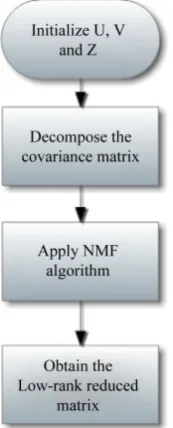
Figure 1 describes about the flow of the algorithm. The algorithm can be given as,
Initialize U Vo, o and m=0
for
1
m+ ← m
U U o
[
m]
m m m
ZV
U V V
1
m+ ← m
V V o 1
1 1
m
m m m
+
+ +
Z U
V U U
1
m← +m
end
Where ∈ s b×
Z , s t m
× +
∈
U , b t
m
× +
∈
V are non-negative matrices and the reduced
rank t is given by t<min
( )
s b, where(
s b t, ,)
∈+.In this paper, we have reduced the computational complexity of UKF-CMA algorithm by reducing dimensionality of the matrix computation, which is achieved through the non-negative matrix factorization.
Note: Notations followed in the paper are bold small letters are vector. Capital letters are matrix.
2. Beamforming Model
Consider a linear array of size L of uniform spacing
2
d ≤λ and n is the number of
source signals (interference and desired signals). The signal output of an adaptive beamformer is represented as [1],
m = m
z u w (1)
The input signal vector L1
m
×
∈
u as,
m = m+ m
u Ds n (2)
where ∈ L×1
w , sm← s1,m;s2,m;;sn m, is the source signal vector whose first ele-
ment is desired signal and remaining elements of the vector are made as interference signals, L1
m
×
∈
n is circular complex Gaussian noise at m-th time instant.
The spatial signature matrix D= Θ Θ
[
1 2 ΘL]
, WhereL k×
∈
D ,
( 1)
2
1e−jγ 1e−j γ 1e−j L− γ
Θ =
, γ =k do sin
( )
θj , γ is the array phase function, kois the phase constant, d is the array spacing, θi is th
i element of the AOA vector
1
L
θ∈ × .
The Constant Modulus (CM) cost function for adaptive beamforming problem can be formulated as
( )
,
min
q p p q = m −ζ
w J w u w
(3)
where p>0, q>0 and ζ is the signal modulus of the desired signal sm, which is
a known a priori. As stated, the optimization problem is non-convex and non-linear.
3. Algorithm Formulation
The constant modulus criterion in (3) assumes that the unknown system model fm
for the input signal um is equal to the constant modulus of the desired signal ζ in (5).
| 1
m m− ←
f f (4)
| 1
p m m m
ζ ← u f − (5)
The final state space model is obtained by incorporating process noise qm. Since
initial received signal is unknown, so we take it as noise vm adding to the model in (7).
Applying the non-linearity g .
( )
= p in (8).| 1 | 1
m← m m m− + m m−
f A f q (6)
(
)
| 1 1
m m L vm
ζ ← f − + + (7)
(
| 1)
g
m← m m−
Z f (8)
1 1 0 0 m m m
m zm
− − ← ← I f A f u
where L1L1, L1 1
m m
+ × + + ×
∈ ∈
A f and L1 1
m
+ ×
∈
q is the process noise.
In (10) Zm ≈Z is approximated by non-negative matrix factorization.
m m ←
Z U V (9)
m m → m
U V Z (10)
where s b m
×
∈
Z , Um∈+s t× , Vm∈b t+× are non-negative matrices and the reduced
ignore the process noise qm on including leads to suboptimal solution.
4. Proposed NMF-UKF-CMA Algorithm
The proposed NMF-UKF-CMA algorithm is as follows, Input: um, wm, L, α , β, κ, λ, wm, wc
Initialize: α←1, β ←2, κ ←0, nw← +L 1, λ←α2
(
nw+ − −κ 1)
nw+2,(
1)
(
,)
,2
m w w
w
ones n n n λ
← +
w wc ←wm, m
( )
1 ,w n λ λ ← + w
( ) (
1)
1 2c
w
n
λ α β
λ
← + − +
+
w then initialize the unscented Kalman filter with
[ ]
0 0
ˆ ← ; , ←1nw
w 1 0 P I of size nw×nw,
for m≥1
do
Compute and update
• Extract the sigma points 2 1 | 1
W nw nw
m m
× +
− ∈ as
(
)
(
)
| 1 ˆ 1 ˆ 1 1 ˆ 1 1
Wm m− ←wm− wm− + nw+λ Pm− wm− − nw+λ Pm− (11)
where w∈nw×1 is an initial weight vector.
• Extract matrix Am for the input signal um as
0 0 m m I u ← A
and then get the sigma points 2 1 | 1
W nw nw
m m
× +
−
− ∈ for the updated state as
| 1 | 1
Wm m mWm m
−
− ←A − (12)
where nwnw m
×
∈
A .
• Extract the posteriori estimate 1 | 1
ˆ nw
m m
× −
− ∈
w as
2 1 | 1 1 ˆ W w n j j
m m m m
j + − − − = ←
∑
w w (13)
where j denotes the j-th column vector for Wm m| 1
−
− and j—the element for vector
w w
n n m
×
∈
w .
• Extract the sigma priori covariance nwnw m
× −∈
P as
(
)(
)
2 1
| 1 | 1
1
W W
w n
j j j j j
m c m m m m m m
j + − − − − − − − = ←
∑
− −P w w w (14)
where j is the j-th column vector for m
−
w and j-th element for vector wc.
• Extract the sigma points 2 1 | 1 w w n n m m × + − − ∈
Z through non-linear function as
(
)
| 1 g W | 1
j
m m m m
− −
− ← −
Z (15)
where g .
( )
← .p for each element of the j-th column vector for Wm m| 1−
− for
1, 2, , 2 w 1
j← n + .
• The output sigma points are approximated using non-negative matrix factorization
algorithm as 2 1 | 1 w w n n m m × + − − ∈
| 1 | 1 | 1
m m m m m m
−
− ← − −
Z U V (16)
where nwtw m
× +
∈
U , 2nw1tw m
+ × +
∈
V are non-negative matrices and reduced rank
(
)
min , 2 1
w w w
t < n n + .
• Applying the output sigma points to extract the estimated output 1 | 1
ˆ nw
m m
× −
− ∈
z as
2 1
| 1 | 1
1
ˆ w j
n j
m m m m m
j + − − − − = ←
∑
z w Z (17)
• The obtained crosscovariance matrix nw1
mm
×
∈
C as
(
)
(
)
2 1
| 1 | 1 | 1
1 ˆ W w j n j j
mm c m m m m m m m
j + − − − − − − − = ←
∑
− −C w w Z z
(18)
• The obtained autocovariance Rmm as
(
)(
)
2 1
2
| 1 | 1
1
ˆ ˆ
w j j
n j
mm c m m m m m m v
j σ + − − − − − − = ←
∑
− − +R w Z z Z z
(19)
where 2 1 | 1 1 1 ˆ 1 w n j
v j m m
w
n
σ − −
− =
=
−
∑
z• Now apply the Kalman innovation matrix and the update formulas as
1
m mm mm
−
←
K C R (20)
(
)
*ˆm← ˆm− + m ζ −ˆm−
w w K z (21)
1 | 1
m m m m mm m
− −
−
← −
P P K R K (22)
• Update the optimal weight vector m
(
1:nw 1,1)
−
← −
w w . end
5. Simulation and Results
In this section, the performance of NMF-UKF-CMA algorithm is compared with existing UKF-CMA algorithm. An uniform linear array of length L = 20 and of spacing
2
d=λ for simulation. The constant modulus signals are generated by Minimum
Shift Keying (MSK) Modulation scheme with unity modulus and the interference plus noise signal were set as Gaussian distributed random variables with mean, 0 and noise variance of 1. An uniform distribution of −π to π is followed for phase. The desired direction of arrival is set as 10˚ and for interference signals are set as 25˚, −30˚ and −45˚. The CMA criterion is chosen as p = 1 and q = 2 in the simulations, for which we achieve optimal signal-to-interference-plus-noise ratio (SINR). In addition to SINR in dB, Mean Square Deviation (dB) and Array Sensor Gain (dB) are the parameters, also used to estimate the performance of the array algorithms. MSD is defined as
(
)
10
20 log sm−zm sm . The value of ν is set as 0.75 in all the simulations. The plots
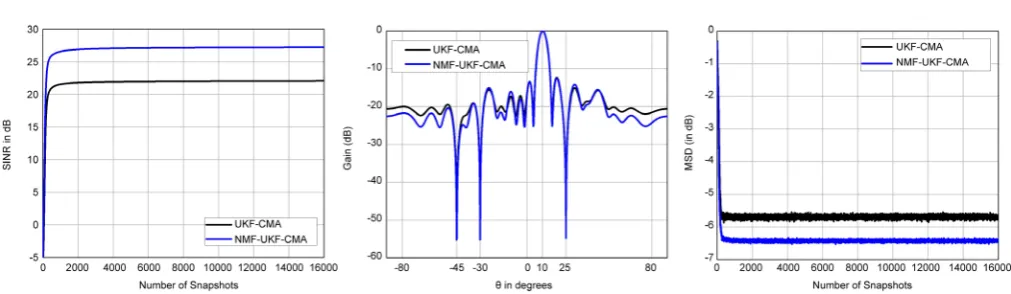
simulated are stochastic averages of 500 independent simulations. Simulation-1
In Simulation-1, The interference plus noise signal of variance ( 2
n
Figure 2. Simulation 1: SINR in dB (left), Array Sensor Gain in dB (center), MSD in dB (right) with 2
0.1
n
σ ← .
CMA for the given noise variance to the UKF-CMA. The proposed NMF-UKF-CMA algorithm attains much better SINR compared with UKF-CMA as the sample size increases. The convergence of NMF-UKF-CMA algorithm gives better attenuation of interferences compared to UKF-CMA and it converges within the limited sample space.
Simulation-2
In Simulation-2,The interference plus noise signal of variance ( 2
n
σ ) is set as 0.0316. From Figure 3, We achieve similar results compared to UKF-CMA as the noise variance decreases. We could observe betterment of proposed algorithm MSD com- pared to UKF-CMA. The SINR values of NMF-UKF-CMA algorithm closely follow the UKF-CMA algorithm.
Simulation-3
In Simulation-3, The number of antennas L in the array is increased to 60 and remaining parameters are set as in simulation 1. From Figure 4, we achieve an in- creased SINR for NMF-UKF-CMA algorithm as the number of antenna is increased.
Simulation-4
In Simulation-4, The number of sources M is increased to 7, interference’s added in the direction of 35˚, 55˚, −55˚ and the number of antennas L is decreased to 4 and p is set as 0.5 for the simulation are performed. From Figure 5, As seen, there is de- gradation in SINR as the number of sources increased. The similarity in performance can be seen for NMF-UKF-CMA and UKF-CMA as the number of sources increased.
6. Conclusion
Figure 3. Simulation 2: SINR in dB (left), Array Sensor Gain in dB (center), MSD in dB (right) with 2
0.0316
n
[image:8.595.261.483.245.421.2]σ = .
Figure 4. Simulation 3: SINR for M=4, L=60 and 2
0.1
n σ = .
Figure 5. Simulation 4: SINR for M=7, L=4 and 2
0.1
n σ = .
[image:8.595.261.484.458.640.2]References
[1] Bhotto, Md.Z.A. and Bajic, I.V. (2015) Constant Modulus Blind Adaptive Beamforming Based on Unscented Kalman Filtering. IEEE Signal Processing Letters, 22, 474-478. [2] Triechler, J.H. and Agee, B.G. (1983) A New Approach to Multipath Correction of Constant
Modulus Signals. IEEE Transactions on Acoustics, Speech, and Signal Processing, 31, 459- 472.
[3] Julier, S.J. and Uhlmann, J.K. (2004) Unscented Filtering and Nonlinear Estimation.
Pro-ceedings of the IEEE, 92, 401-422. http://dx.doi.org/10.1109/JPROC.2003.823141
[4] J Li, J. and Stoica, P. (2005) Robust Adaptive Beamforming. Wiley, Hoboken.
[5] Julier, S. J. (2002) The Scaled Unscented Transformation. Proceedings of the 2002 American
Control Conference, 6, 4555-4559. http://dx.doi.org/10.1109/acc.2002.1025369
[6] Kotsia, I., Zafeiriou, S. and Pitas, I. (2007) A Novel Discriminant Non-Negative Matrix Factorization Algorithm with Applications to Facial Image Characterization Problems. IEEE
Transactions on Information Forensics and Security, 2, 3.
http://dx.doi.org/10.1109/TIFS.2007.902017
[7] Rajabi, R. and Ghassemian, H. (2015) Spectral Unmixing of Hyperspectral Imagery Using Multilayer NMF. IEEE Geoscience and Remote Sensing Letters, 12, 38-42.
http://dx.doi.org/10.1109/LGRS.2014.2325874
[8] Grais, E.M. and Erdogan, H. (2013) Initialization of Nonnegative Matrix Factorization Dic-tionaries for Single Channel Source Separation. Signal Processing and Communications
Applications Conference (SIU), Haspolat, 24-26 April 2013, 1-4.
http://dx.doi.org/10.1109/siu.2013.6531172
[9] Lee, D.D. and Seung, H.S. (1999) Learning the Parts of Objects by Non-Negative Matrix Factorization. Nature, 401, 788-791. http://dx.doi.org/10.1038/44565
[10]Lee, D.D. and Sebastian, S.H. (2001) Algorithms for Non-Negative Matrix Factorization.
Advances in Neural Information Processing Systems 13, MIT Press, Cambridge, 556-562.
[11]Cichocki, A., Zdunek, R. and Amari, S. (2006) New Algorithms for Non-Negative Matrix Factorization in Applications to Blind Source Separation. 2006 IEEE International
Confe-rence on Acoustics Speech and Signal Processing Proceedings, Toulouse, 14-19 May 2006,
V-V. http://dx.doi.org/10.1109/ICASSP.2006.1661352
[12]Ozerov, A. and Fevotte, C. (2009) Multichannel Nonnegative Matrix Factorization in Con-volutive Mixtures. With Application to Blind Audio Source Separation. IEEE International
Conference on Acoustics, Speech and Signal Processing, Taipei, 19-24 April 2009, 3137-
3140. http://dx.doi.org/10.1109/icassp.2009.4960289
[13]Yang, Z., Zhou, G., Ding, S. and Xie, S. (2010) Blind Source Separation by Nonnegative Ma-trix Factorization with Minimum-Volume Constraint. International Conference on
Intelli-gent Control and Information Processing (ICICIP), Dalian, 13-15 August 2010, 117-119.
http://dx.doi.org/10.1109/icicip.2010.5565228
[14]Krbz, S. and Gunsel, B. (2012) Perceptually Weighted Non-Negative Matrix Factorization for Blind Single-Channel Music Source Separation. 21st International Conference on
Pat-tern Recognition (ICPR), Tsukuba, 11-15 November 2012, 226-229.
[15]Wang, Y.X. and Zhang, Y.J. (2013) Nonnegative Matrix Factorization: A Comprehensive Review. IEEE Transactions on Knowledge and Data Engineering, 25, 1336-1353.
Submit or recommend next manuscript to SCIRP and we will provide best service for you:
Accepting pre-submission inquiries through Email, Facebook, LinkedIn, Twitter, etc. A wide selection of journals (inclusive of 9 subjects, more than 200 journals)
Providing 24-hour high-quality service User-friendly online submission system Fair and swift peer-review system
Efficient typesetting and proofreading procedure
Display of the result of downloads and visits, as well as the number of cited articles Maximum dissemination of your research work