
Munich Personal RePEc Archive
Deforestation and multinational
companies: a conceptual note
Digdowiseiso, Kumba
University of National, Indonesia
8 April 2010
Online at
https://mpra.ub.uni-muenchen.de/22093/
Deforestation and Multinational Companies (MNCs):
A Conceptual Note
1. Finding the link
According to the Global Forest Resource Assessment Report in 2000 (FAO 2001a cited in
Koyunen and Yilmaz, 2009), the most comprehensive survey on forest resources, 3.9 billion
hectares of the earth's land area is covered by forests. It was estimated that the original forest
cover was approximately 6.0 billion hectares (Bryant et al 1997 cited in Koyunen and Yilmaz,
2009) and therefore, it indicates that the world has lost about 40% of forest area.
Industrial corporations have abundant resources in terms of technological innovations and
investment capital in boosting their production (Usui, 2002). In a period of globalization,
privatization, and market liberalization, they are seen as one of the most important factors to
shape the future of the world. However, those factors have brought not only an increase in wealth
but also in transnational threats. Environmental damage caused by commercial activities of
transnational corporations (TNCs) is one of such threats while almost all countries have the
discrepancy in environmental laws (Morimoto, 2005).
Some studies found that cleaner technology and better environmental management of MNCs
often disseminates a pollution effect to host country firms (Gentry 1998 cited in Zarsky, 2006).
Other studies found that MNCs act as agents of ecological degradation, either by transferring
outdated technology, disregarding local laws, extracting host countries resources, or by following
poor local environmental practice (Zarsky 2002a cited in Zarsky, 2006). Therefore, this paper
tries to shed some light on the problem in forestry MNCs.
2. What’s wrong with the MNCs?
The first MNCs were publicly listed corporations in search of new raw materials and new
markets (Laffiteau, 2008). Their access to international capital markets allowed them to fund
significant investments in exploration for resources and the research and development required to
maintain and to strengthen their positions in the energy and technology industries, which in turn,
fuelled the growth of other industries.
As technological change accelerated, research and development costs increased. As a result,
and to amortize their investments in order to compete with the competitors when the next
technological advance comes (Laffiteau, 2008). MNCs influence the industrial policies of their
home nations and ones of host countries, where they establish production facilities, indigenously
(Baylis & Smith, 2001). However, there is a significant difference between the rules of the home
countries in which most of the MNCs are headquartered and ones of host countries where a
number of MNCs are engaged in pollution-intensive industries (Morimoto, 2005).
Generally, the rules of developed countries are much stricter than those of developing
countries. It has been persistently alleged that MNCs conduct their operations in developing host
countries in accordance with much lower environmental standards than those adopted in their
home countries (Morimoto, 2005). Also, legal disputes about which nations’ laws apply further
complicate the regulation of environmental practices of MNCs and their subsidiaries. This
problem of extraterritoriality is inherent in the structure of all TNCs (Baylis & Smith, 2001),
which in turn, causing TNCs’ operations become illicit.
Thus, transparency in MNCs can serve as an effective risk management tool to diminish the
opportunities for corruption as well as to improve a company’s image. Also, it improves a
country’s management of resources by providing relevant information to government entities, parliaments and civil society, and contributes to a more stable investment environment of good
governance and rule of law that benefits for both the country and the company.
3. The drivers of deforestation
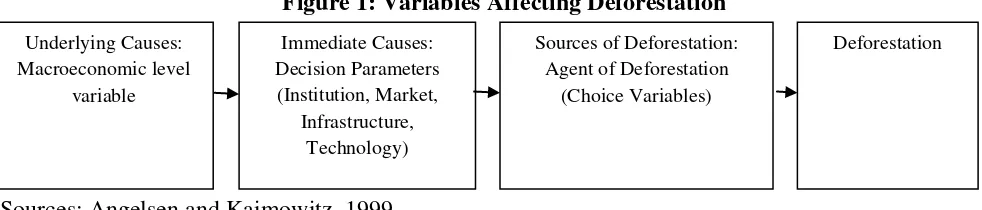
The starting point of defining deforestation is to identify the agents of deforestation such as
small farmers, ranchers, loggers, and corporations (see Figure 1). These agents’ actions are the
sources of deforestation (Angelsen and Kaimowitz, 1999). The next step might focus on agents’
decisions, which are based on their own characteristics (background, preferences, and resources)
and on decision parameters such as prices, technology, institutions, new information, and access
to services and infrastructure. Together, these factors determine the set of available choices and
the incentives for different choices, which may be seen as the immediate causes of deforestation
(Angelsen and Kaimowitz, 1999). Finally, the agents’ characteristics and decision parameters
influence agents’ decisions through several channels such as the market, the dissemination of new technologies and information, the development of infrastructure, and institutions,
Figure 1: Variables Affecting Deforestation
Sources: Angelsen and Kaimowitz, 1999
Human activities that directly affect the environment act as the immediate causes of
deforestation in which originate from land-use and directly impact upon forest cover (Kaimowitz
and Angelsen, 1998). However, Transparency International report (2008) indicates that corporate
behavior could be one of the immediate causes of deforestation because certain countries has
been experiencing in great wealth generated by extractive industries.
The immediate causes can be divided into agricultural expansion, harvesting or extraction of
wood, expansion of infrastructure while underlying driving forces endorse proximate causes
(Kaimowitz and Angelsen, 1998). They measure a complex of social, political, economic,
technological, and cultural variables that constitute initial conditions in the human-environmental
relations. Angelsen and Kaimowitz (1999) point out that it is more difficult to establish clear
links between underlying factors and deforestation since the causal relationships are less direct.
Deforestation rates increase because of rising populations, which need more land for forest-based
products. Also, growing populations push down the wage rates. But population growth induces
technological progress and institutional changes that reduce pressures on forests.
In contrary, there is a concise evident between immediate factors and deforestation which
makes farmers, loggers, and corporations decide to clear more forest (Angelsen and Kaimowitz,
1999). One example is agricultural price. Substantial evidence supports the assertion that higher
prices for agricultural products stimulate forest clearing as the corporations, existing population
and migrants opt to attain a higher profit. Another example is when farmers and corporations can
obtain property rights by clearing forests which can encourage them to clear larger areas. Also,
this relationship can be determined through timber prices where higher prices for timber are
likely to promote deforestation by making logging more profitable.
4. The pros sides of MNCs activities
It is clear that from the previous section, MNCs act as an agent of deforestation. Until the
1980s, MNCs were legally accountable only to their shareholders for the financial performance
Underlying Causes: Macroeconomic level
variable
Immediate Causes: Decision Parameters
(Institution, Market, Infrastructure,
Technology)
Sources of Deforestation: Agent of Deforestation
(Choice Variables)
of the corporation (Abdul-Gafaru, 2006). This view considered multinationals as purely
profit-minded entities that did not have any legal obligation in incorporating society’s interest into their
activities.
From the 1980s onwards, however, a series of environmental catastrophes associated with
the activities of MNCs coupled with the recognition that humanity’s survival were largely
depend on the continued functioning of the natural environment (Disseindorf 2000 cited in
Abdul-Gafaru, 2006). Given that MNCs are the most important players involved in
environmentally damaging activities, many scholars call upon business enterprises to place the
long-term sustainability of the environment.
It is widely accepted that technological progress is an important factor in protecting the
natural environment (Abdul-Gafaru, 2006). If increased technology could contribute to improved
environmental management capacity, then it might be true that MNCs are the key to achieving
sustainable development, because they are the main transmission mechanisms of technology to
developing countries. In 1995, over 80% of global royalty payments and license fees were paid
by MNC subsidiaries to their parent companies (UNCTAD 1997 cited in Abdul-Gafaru, 2006).
MNCs are not only the major technology innovators, but they also possess skills in the safe
handling, transport, storage, use and disposal of toxic materials, and in the development of
pollution abatement technologies (Morimoto, 2005). Moreover, multinational enterprises can
positively contribute to sustainable development through the transfer of environmental
managerial skills that are not available to host developing countries (DiConti 1992 cited in
Morimoto, 2005).
In another perspective, Transparency International report (2008) on promoting revenue
transparency in oil and gas industries states that International Oil Corporations (IOCs) show
better results in reporting on anti-corruption programmes and operations than in the area of
payments to host governments, making payments transparency the weakest area evaluated.
Companies such as Shell and BG Group demonstrate best practice, making available
relevant information on their anti-corruption strategies and efforts. These results seem to reflect
an increase in regulations (particularly from home governments and stock exchange listing
requirements) requesting companies to implement company-wide measures related to
5. The cons sides of MNCs activities
The fact that MNCs possess clean technologies that can enhance environmental
sustainability puts a doubt on whether MNCs’ technology is safe for host developing countries
(Abdul-Gafaru, 2006). MNCs usually have a negative effect on the environment when they
newly produce in a host country due to their greater technological capacity with more
ecologically damaging. The damaging environmental effects have increased as the market
penetration and share of MNCs rise. For example, they involve in a large part of increased forest
logging and deforestation in Asia-Pacific (TWN 1997 cited in Abdul-Gafaru, 2006).
In addition, it has been suggested that MNCs apply inferior environmental technology,
management practices and standards in their developing countries’ subsidiaries in order to reduce
the costs (Abdul-Gafaru, 2006). A large proportion of equipment transferred to developing
countries has been argued either too sophisticated to be accustomed or too obsolete to increase
efficiency. Also, MNCs often put more emphasize on technological dependence than sustainable
development as they supply technology with high price.
The most significant aspect of the MNCs’ technology relates to their environmental and
safety dimensions as a part of their CSR guidelines (Abdul-Gafaru, 2006). There are claims that
due to the high environmental standards in developed countries, MNCs systematically shift their
environmentally noxious operations to developing countries. However, in a comprehensive
study, UNCTAD (1988 cited in Abdul-Gafaru, 2006) finds that while the number of industrial
accidents appears to have risen over the last fifteen years, available evidence indicates that many
accidents have occurred in purely national firms or in state-owned enterprises.
In the proponent view, TI report (2008) indicates that the most notable feature of National
Oil Corporations (NOCs)’ revenue transparency practices is the strong tendency for companies
to report data on operations and regulatory and procurement issues rather than on payments to
the government or on anti-corruption programmes. In contrast, weak results in reporting
payments to governments or anti-corruption programmes can be associated with a number of
factors, including governmental restrictions on disclosure by state-owned companies, as the case
in Pertamina Indonesia. However, some NOCs tend to show better results for the category of
performance than for policy and management systems. Examples of this include China National
fact that the in-country interaction with IOCs leads NOCs to perform higher standards than their
own stated policies.
6. MNCs and environmental damage: Asian Countries Case
In Indonesia, Sinar Mas and Raja Garuda Mas operate large pulp processing mills which are
directly linked to affiliated paper production mills. Both groups established holding companies,
Asia Pulp and Paper Co. Ltd. (APP) and Asia Pacific Resources International, Ltd. (APRIL),
respectively. According to WWF (2006), Riau province is the home of two of the world’s largest
pulp mills which produces more than two thirds of Indonesia’s pulp and is covered with more
timber plantations and oil palm concessions than other provinces in Indonesia. Whether in the
name of oil palm or of timber plantation development, forest clearings in Riau have provided a
steady source for these two resident pulp and paper companies.
Although pulpwood plantations can be economically attractive to investors because of
strong demand and a short growing period, they still supply only a small fraction of the raw
material needed for the booming pulp industry (WWF, 2006). Both mills still relied on the
clearing of natural forests for about 70 percent of their total wood supply. WWF (2006)
calculated that about 170,000 hectares of natural forests were cleared to feed APP and APRIL’s
pulp mills in Riau in 2005. While the operators were only interested in the timber, the land was
left barren, elephant and tiger habitats were destroyed, and the soil was eroding.
Text Box 1: Malaysian Case
Source: Morimoto, 2005
7. Moving forward
Multinational corporations can voluntarily play a significant role in enhancing
practices. However, the adoption and effectiveness of business-led voluntary initiatives is
fortuitous, because it depends upon the commitment of a given corporation to the concept of
corporate social responsibility. But if the environment is enabling for the survival of mankind, its
protection should be objective and guaranteed. Yet, only in the context of legally binding
regulatory measures should multinationals be compelled to conduct business in an
environmentally friendly manner.
It can be argued that each approach should be seen as complementary to the other. A blend
of both binding regulation and voluntary standards can ensure the realization of social
responsibility of extractive corporations. Preventive measures including the integration of social
and environmental concerns into extractive projects through impact assessment, stakeholder
consultation and addressing human rights issues and social provisioning in the affected area can
mitigate political risk factors in the extractive industry and can fill gaps in the framework of
corporate self-regulation and regulation by a host country. Also, the influence of home
government regulations on anti-corruption performance suggests that such requirements could
also be applied to transparency of payments to host governments.
References
Abdul-Gafaru, Abdulai. (2006). “Are Multinational Companies Compatible with Sustainable Development? The Experience of Developing Countries.” Georgia Tech Center for International Business Education and Research, Working Paper Series 2007-2008 No. 001-07/08
Angelsen, A. and Kaimowitz, D. (1999). “Rethinking the Causes of Deforestation: Lessons from
Economic Models.” The World Bank Research Observer. Vol. 14, No. 1, pp. 73-98
Baylis, J. and Smith, S. (2001). The Globalization of World Politics: An Introduction to International Relations. Oxford University Press, Oxford
Kaimowitz, D. and Angelsen, A. (1998). Economic Models of Tropical Deforestation: A Review. Center for International Forestry Research, Bogor, Indonesia. Available online at
www.cifor.cgiar.org/publications/pdf_files/Books/model.pdf
Koyunen, C. and Yilmaz, R. (2009). “The Impact of Corruption on Deforestation: A Cross
-Country Evidence.” The Journal of Developing Ideas, Vol. 42, No. 2, pp. 213-222
Laffiteau A., Charles. (2008). “Environmental Rights Agreements between Non-Governmental Organizations and Multi-National Corporations: A Paper Alliance or A Marriage of Mutual
Morimoto, T. (2005). “Growing Industrialization and Our Damaged Planet: The Extraterritorial Application of Developed Countries: Domestic Environmental Laws to Transnational Corporations Abroad.” Utrecht Law Review, Vol. 1, Issue No. 2, pp. 134-159
Transparency International. (2008). “Promoting Revenue Transparency: Report on Revenue Transparency of Oil and Gas Companies.” Available online at http://transparency.org/policy_research/surveys_indices/promoting_revenue_transparency Usui, Mikoto. (2002). ”The Role of Private Business in International Environmental
Governance.” Available online at www.unu.edu/inter-linkages/docs/IEG/Usui.pdf
WWF. (2006). “The Eleventh Hour for Riau’s Forest: Two Global Pulp and Paper Companies
will Decide Their Fate.” Available online at
http://assets.wwfid.panda.org/downloads/bgr_06_2006_1.pdf
Zarsky, Lyubal. (2006). “From Regulatory Chill to Deepfreeze?.” Journal of International Environmental Agreements, Vol. 6, No. 4, pp. 395-399
![Monopotassium octapyridinium tris[hexachlorobismuthate(III)]](data:image/gif;base64,R0lGODlhAQABAIAAAP///wAAACH5BAEAAAAALAAAAAABAAEAAAICRAEAOw==)