Kingmakers and leaders in coalition
formation
Brams, Steven J. and Kilgour, D. Marc
New York University, Wilfrid Laurier University
March 2010
Online at
https://mpra.ub.uni-muenchen.de/22710/
Kingmakers and Leaders in Coalition Formation
Steven J. Brams
Department of Politics
New York University
New York, NY 10003
USA
[email protected]
D. Marc Kilgour
Department of Mathematics
Wilfrid Laurier University
Waterloo, Ontario N2L 3C5
CANADA
[email protected]
Abstract
Assume that players strictly rank each other as coalitionpartners. We propose a
procedure whereby they “fall back” on their preferences, yielding internally compatible,
or coherent, majority coalition(s), which we call fallback coalitions. If there is more than
one fallback coalition, the players common to them, or kingmakers, determine which
fallback coalition will form. The first player(s) acceptable to all other members of a
fallback coalition are the leader(s) of that coalition.
The effects of different preference assumptions—particularly, different kinds of
single-peakedness—and of player weights on the number of coherent coalitions, their
connectedness, and which players become kingmakers and leaders are investigated. The
fallback procedure may be used (i) empirically to identify kingmakers and leaders or (ii)
normatively to select them. We illustrate and test the model by applying it to coalition
formation on the U.S. Supreme Court, 2005-2009, which shows the build-up over stages
Kingmakers and Leaders in Coalition Formation1
1. Introduction
Members of voting bodies may form coalitions for a variety of reasons. In this
paper, we assume they do so in order to belong to a coalition with a simple majority of
members (though a decision rule based on weights will be used later).
In voting bodies with more than a few players, many winning coalitions are often
possible. In this paper, we focus on those that, in a sense to be made precise later, are
internally compatible, or coherent, and therefore likely to be stable. If there is only one
coherent coalition, we assume that it forms and will indeed be stable.
But if there is more than one coherent coalition, we identify kingmakers, who are
the common members of all coherent coalitions who collectively decide which coalition
will be “king.”2
If they agree on a preferred coherent coalition, we assume it will form
and be stable. If they disagree on which coherent coalition to support, their disagreement
presumably creates instability.
The leader of a coherent coalition is the first member to be acceptable to all
members. Although leaders may also be kingmakers, this need not be the case.
To identify coherent coalitions—and ultimately kingmakers and leaders—we
assume that players strictly rank each other, from best to worst, as coalition partners.
1
We are grateful for the valuable research assistance of Gustave Camilo, Alexandra Franz, and Joshua Revesz. We thank Han Il Chang, Michael J. Laver and Jeffrey R. Lax for helpful comments on an earlier version of this paper.
2
We could as well use the terms “queen” and “queenmaker” instead of “king” and “kingmaker.” With no intention of favoring one gender or the other, we use the latter terms for convenience. Whether a
kingmaker is a man or a woman, we mean a player who can choose among majority coalitions to
These rankings determine coherent winning coalitions, based on a process whereby
players “fall back” on their preferences until one or more winning coalitions forms.
We begin by assuming that the preference rankings of the players are “ordinally
single-peaked,” but later we show how this assumption can be tightened to “cardinally
single-peaked.” Such a tightening rules out disconnected coalitions—those that leave out
a member along, say, a left-right scale.
The paper proceeds as follows. In section 2 we define and illustrate two different
kinds of signal-peakedness, ordinal and cardinal. We describe in section 3 the fallback
model, which determines both how many and which coherent winning coalitions can
form.
In section 4, we show that if preferences are ordinally single-peaked, a coherent
coalition may be disconnected when there are 5 or more players. If there are 4 players,
either a simple-majority or grand coalition may form, whereas only a simple-majority
coalition may form if there are 3 players.
In section 5 we show that if there are two or more coherent winning coalitions,
there must be at least two kingmakers. There may be more than two if there are at least 7
players, and there may be more than two coherent coalitions if there are at least 9 players.
In section 6 we analyze the role that leaders play. Among our findings is that
leaders, who will generally be middle players in a coherent coalition—neither the
leftmost nor the rightmost players—may on occasion be extreme. In the latter case,
however, there will be middle player(s) who are also leaders. In section 7 we show that
In section 8 we apply the fallback model to coalition formation on the U.S.
Supreme Court, 2005-2009. Among other things, we show how the model sheds light on
the build-up of a 4-person liberal, and two 4-person conservative, coalitions and why a
5-person conservative coalition eventually became winning, though the 4-5-person liberal
coalition was, in a sense, the tighter of the two.
In section 9 we illustrate how the different weights of players (e.g., parties in a
parliament) may affect coalition formation, showing, for example, that a unique
disconnected FB coalition may form with as few as 4 players. For different
configurations of 4 large and small players, we calculate the probability that FB
coalitions are disconnected or contain superfluous members.
Besides its use as an explanatory and predictive tool, we suggest in section 10 how
the fallback model might be used for normative purposes. Applied to players with
different weights like political parties, it provides a method for selecting a governing
coalition, and identifying its kingmakers and leaders, in a parliament.
2. Preference Profiles and Single-Peakedness
We assume that all players, designated 1, 2, . . ., n, strictly rank each other as
coalition partners, as illustrated by Example A, where n = 5:
Example A. 1: 2 3 4 5 2: 1 3 4 5 3: 4 5 2 1 4: 3 2 1 5 5: 4 3 2 1
We suppose a simple majority of players is needed to form a winning coalition.
Each player ranks itself first—that is, it most desires to be included in any majority
coalition partner, followed by players 3, 4, and 5 in that order. A complete listing of all
players’ preferences, as illustrated in Example A, is called a preference profile.
The single-peakedness assumption is that the players can be placed along a line—
in order 1, 2, 3, …, n from left to right—so that each player’s preference for coalition
partners is single-peaked in that it declines monotonically to the left and right of its own
position. A preference profile that satisfies this condition is called ordinally
single-peaked (Brams, Jones, and Kilgour, 2002, 2005). Such profiles are commonly assumed
in spatial models of candidate and party competition and are empirically valid
representations of preferences in many countries.
To express ordinal single-peakedness in another way, consider any subset of
players along the line; call the left-most player l and the right-most player r. The set is
connected if it is of the form {l, l + 1, …, r}: It contains exactly the players from l to r,
inclusive (Brams, Jones, and Kilgour, 2002).
A preference profile is ordinally single-peaked if and only if, for each k = 1, 2, …,
n, every player’s k most-preferred coalition partners, including itself, form a connected
set. Thus in Example A, when k = 3, the most-preferred 3-coalitions of players—123 for
player 1, 213 for player 2, 345 for player 3, 432 for player 4, and 543 for player 5—are
all connected sets. For all other k between 1 and 5, it is easy to see that the
most-preferred k-coalitions of all players are connected, so the preference profile of Example A
is ordinally single-peaked.
An ordinally single-peaked preference profile may or may not be geometrically
realizable in the sense that the n players can be positioned along the real line to satisfy the
the one closer to its own position. If players can be so positioned, the preference profile
is called cardinally single-peaked.
Preferences are cardinally single-peaked when players can be positioned so that a
player’s preference decreases as distance from its position increases. To illustrate,
assume 5 players are positioned along a line as follows,
1_2_______________3_____4_5
and all players perceive these distances in the same way (e.g., they view the gap between
players 2 and 3 to be bigger than that between players 3 and 4). Then it is easy to verify
that these positions are consistent with the following rankings of coalition partners by
each player:
Example B. 1: 2 3 4 5 2: 1 3 4 5 3: 4 5 2 1 4: 5 3 2 1 5: 4 3 2 1
To see that the preference profile in Example A is not cardinally single-peaked,
assume that player i is located at position pi on the line. We denote the distance between
positions pi and pj by dij = |pi – pj|. From player 3’s preference ordering, and because
player 4 must be located between players 3 and 5, d54 < d53 < d32. But from player 4’s
ordering, and because player 3 must be located between players 2 and 4, d32 < d42 < d54.
This contradiction shows that the ordinally single-peaked preference profile of Example
A is not cardinally single-peaked.
Single-peakedness that is ordinal but not cardinal may be interpreted to mean that,
while the players agree on the ordering of their positions, they have different perceptions
of the distances between players. In Example A, player 3 and player 4’s perceptions may
Player 3’s perception: 1 2 3 4 5
Player 4’s perception: 1 2 3 4 5
For player 3, the distance between it and player 2 is greater than the distance between
players 5 and 4, whereas for player 4 the opposite is true, though the two players have the
same left-right ordering. If player preferences are not ordinally (and therefore not
cardinally) single-peaked, we say they are not single-peaked.
3. The Fallback Model: Coherent Winning Coalitions
We now turn to issues of coalition formation. First, if there is cardinal
information on player positions, it is natural to suppose that the players closest to each
other are most likely to join in a coalition. If the players’ positions are at p1, p2, … , pn,
the diameter of a nonempty coalition S is the maximum value of |pi – pj| for any members
i and j in S. We think of any coalition with smaller diameter as more likely, and call the
minimal winning coalition with minimum diameter the minimal-diameter coalition.
What if there is not cardinal information on player positions? Assume, instead,
that player preferences are ordinally single-peaked, so they may not be representable on a
line. The fallback (FB) process of majority coalition formation unfolds as follows
(Brams, Jones, and Kilgour, 2002, 2005; Brams and Kilgour, 2001):
1. Each player considers only its most preferred coalition partner. If two players
mutually prefer each other, and this is a majority of players, then this is the majority
coalition that forms. The process stops, and we call this a level 1 majority coalition,
2. If there is no level 1 majority coalition, each player then considers its two most
preferred coalition partners. A coalition then forms consisting of any maximal subset
containing a majority of players that mutually prefer each other at these two levels.
(There may be more than one such coalition.) The process stops, and we call this a level
2 majority coalition.
3. The players successively descend to lower and lower levels in their rankings
until a majority coalition (or coalitions), all of whose members mutually prefer each
other, forms for the first time. The process stops, with the set of largest majority
coalition(s)—not contained in any others at this level—designated FB coalitions.3
What does FB yield in Example A? At level 1, observe that player 1 prefers player
2, and player 2 prefers 1, so we designate 12 as a level 1 coalition, as is also coalition 34.4
Descending one level, players 3 and 5 find each other acceptable, yielding 35 as a
coalition at level 2. Descending one more level, majority coalitions 124 and 234 form for
the first time: Each player in these coalitions finds the other two players acceptable at
level 3 (or better). In summary, we have the following coalitions at each level:
Level 1: 12, 34 Level 2: 35 Level 3: 124, 234
3
In Brams, Jones, and Kilgour (2005), we called the set of such coalitions FB1 coalitions, where the
subscript 1 indicated majority coalitions that form for the first time. Because in this paper we do not consider as coherent those coalitions that form later (i.e., after further descent), we drop the subscript 1. For a stronger notion of coherence based on a “build-up” model of coalition formation, see Brams, Jones, and Kilgour (2002, 2005). Build-up coalitions tend to be larger than fallback coalitions, primarily because the build-up process precludes coalitions from forming whose members rank outside members higher than inside members.
4
Note that coalitions are listed at the level at which they form, except that subcoalitions
forming simultaneously are never listed. Thus, 14, 23, and 24 form at level 3 but do not
appear in our listing, because they are proper subsets of coalitions 124 or 234.
Since coalitions 124 and 234 are the first majority coalitions to form, the process
stops, rendering FB = {124, 234}. These are the coherent majority coalitions, because
they are the first to form in the descent process and maximize the minimum ranking of
any player (Brams and Kilgour, 2001).5
If the descent process were to continue to level 4, every player would be
acceptable to every other, yielding the grand coalition, 12345—as well as the eight
3-player coalitions that did not form earlier and the five 4-3-player coalitions. But since these
3-player and 4-player coalitions are proper subsets of the grand coalition, they would not
be listed as level 4 coalitions—only 12345 would be. But because 12345 is not the first
majority coalition to form under FB, it is not an FB coalition.
4. Disconnected, Simple-Majority, and Grand Coalitions
In this and the next two sections, we assume that the preferences of players are
ordinally single-peaked. In section 7 we impose the more stringent requirement of of
cardinal single-peakedness and compare the predictions of the ordinal and cardinal
models.
Preferences in Example A are ordinally single-peaked, but one of the two FB
coalitions (124) is disconnected: There is a “hole” due to the absence of player 3. Player
3 is excluded from coalition 124 because, whereas players 1 and 2 necessarily rank player
5
3 higher than player 4 (because of ordinal single-peakedness), player 3 ranks players 2
and 1 at the bottom of its preference order. In particular, player 3 does not consider
player 1 acceptable at level 3, which excludes player 3 from FB coalition 124.
It is easy to extend Example A to show that one or more FB coalitions may be
disconnected if there are more than 5 players. However, a minimum of 7 players is
required for there to be a unique FB coalition that is disconnected (Brams, Jones, and
Kilgour, 2005).
Unlike Example A, there may be no simple-majority FB coalition—the only FB
coalition may be the grand coalition, as illustrated by the following 4-player example:
Example C. 1: 2 3 4 2: 1 3 4 3: 4 2 1 4: 3 2 1
Checking the coalitions that form at each level,
Level 1: 12, 34 Level 2: 23 Level 3: 1234
we see that there is no 3-player simple-majority coalition at level 2. Instead, there is a
direct jump to the grand coalition, 1234, at level 3, making it the unique FB coalition. On
the other hand, if player 3’s preference were 3: 2 1 4 in Example C, the simple-majority
coalition 123 would form at level 2.
A disconnected coalition, like 124, cannot form in a 4-player example. This is
because player 4 cannot accept player 1 until the fallback process descends to level 3,
which would produce the grand coalition, 1234, instead.
Proposition 1. FB coalitions maximize the minimum ranking of a player and are
Pareto-optimal. If player preferences are ordinally single-peaked, an FB coalition may
be disconnected if and only if n ≥5, and a disconnected coalition may be the unique FB
coalition if and only if n ≥7.
Curiously, when preferences are ordinally single-peaked, the grand coalition
cannot be an FB coalition if there are n=3 players. To see this, note first that the
preferences of players 1 and 3 are fixed by the ordinal single-peakedness assumption.6
Thus, there are only two possible examples:
Example D. 1: 2 3 2: 1 3 3: 2 1
and the “mirror image,” Example D’, in which player 2’s preference is 2: 3 1. In
Example D, the FB coalition 12 forms at level 1, whereas coalition 23 forms at level 1 in
Example D’. Thus, if n = 3 and preferences are ordinally single-peaked, the FB coalition
is either 12 or 23—depending on the preference of player 2—which makes player 2 a
“kingmaker” in a sense to be defined in section 4. More generally, we have
Proposition 2. Assume player preferences are ordinally single-peaked. If n = 3,
FB coalitions must be of size 2. If n = 4, FB coalitions must be of size 3 or 4. If n ≥5,
6
FB coalitions must have at least membersand at most members. In
particular, the grand coalition can be an FB coalition if and only if n = 4.7
Proof. The cases n = 3 and n = 4 are discussed above. Also, an FB coalition must
contain at least , for otherwise it would not be a majority coalition. To complete
the proof, we show that a FB coalition must form at or prior to depth ,
which implies that it contains at most players.
Now suppose that n≥ 5, and that d is an integer satisfying 1 ≤d≤ . Define
the following subsets of players: SL= {1, 2, …, d}, S = {d + 1, d + 2, …, n – d}, and SU =
{ n – d + 1, n – d + 2, …, n}. (SL contains the d left-most players, and SU the d
right-most. The nonextreme players are in S, which is nonempty because d≤ (n – 1)/2, which
implies that d + 1 ≤n – d.) Any player i’s dleast-preferred coalition partners must be
within SLU SU. In particular, if i S, then i’s n – d – 1 most-preferred coalition partners
can exclude only members of SLU SU, and therefore must include all members of S other
than i.
Note that S contains n – 2d players. Select and note that (since n≥ 5)
d < n /4, so that n – 2d > n/2, which implies that S is a majority coalition. It follows that,
7 Note that , called the floor function, indicates the largest integer equal to or less than m, and , the
if no FB coalition forms at level less than n – d – 1, then an FB coalition including all
players in S must form at level n – d – 1. Moreover, the largest coalition that can form at
this depth contains players. Q.E.D.
As a corollary to the theorem, note that, if n≥ 5, an FB coalition must form at or
after level and at or prior to level . Thus, if n = 5, an FB coalition
must form at either level 2 or 3—but never at level 4, which yields the grand coalition.
5. Kingmakers in Fallback Coalitions
So far we have shown that if preferences are ordinally single-peaked, a single FB
coalition of 2 players forms at level 1 when n = 3 (Examples D and D’). When n = 4, a
single FB coalition of 3 players forms at level 2, or a single FB coalition of 4 players (i.e.,
the grand coalition, 1234) forms at level 3. Only when n≥ 5 is it possible for there to be
more than one FB coalition, whose common members are kingmakers: They determine
which, if any, FB coalition forms.
In Example A, players 2 and 4 are common to FB coalitions 124 and 234, but they
disagree on which of the two FB coalitions they prefer. Player 2 prefers coalition 124,
because it ranks noncommon player 1 above noncommon player 3, whereas player 4
prefers coalition 234 because of the opposite ranking. This split of the kingmakers on
which FB coalition they prefer suggests that either is possible, leaving the outcome
indeterminate. Such indeterminacy may lead to a factional battle between players 2 and 4
over which FB coalition will prevail.
Example E. 1: 2 3 4 5 2: 3 4 1 5 3: 4 2 1 5 4: 3 5 2 1 5: 4 3 2 1
The coalitions that form at each level are as follows:
Level 1: 34 Level 2: 23, 45 Level 3: 123, 234
Players 2 and 3, which are common to (connected) FB coalitions 123 and 234, are the
kingmakers. Because each prefers noncommon player 4 (in 234) to noncommon player 1
(in 123), the kingmakers will both support 234 over 123. Hence, FB coalition 234 will
form and be stable because of the agreement of the kingmakers.
There are two kingmakers in both 5-player examples, A and E. In each example,
preferences are ordinally but not cardinally single-peaked.8
In principle, it is possible for
for exactly one player to be common to two majority coalitions (e.g., player 3 is the
unique common member of 123 and 345), but this can never happen under FB with
ordinally single-peaked preferences, as shown by the following proposition:
Proposition 3. Assume player preferences are ordinally single-peaked. Any pair
of distinct FB coalitions must have at least two common members (kingmakers), whose
preferred FB coalition may or may not be the same.
Proof. Two distinct majority coalitions must have at least one member, say i, in
common. Suppose that there are no other common members. Then in order for i to find
the n – 1 other members of the two coalitions acceptable, the FB descent must go to level
n – 1, which is the level that produces the grand coalition and makes it the unique FB
8 In section 2, we showed this for Example A. For Example E, assume that players 1, 2, 3, 4, and 5 can be
positioned along a line such that their preferences decrease with distance. Using the notation of section 2, we first show that d45 < d12. From player 4’s preferences, d45 < d24, and from player 2’s preferences, d24 <
d12, so together we have d45 < d12. But we can also show that d12 < d45. From player 3’s preferences, d34 <
d23 and d13 < d35. Rewriting the first inequality as -d23 < -d34 and summing yields d12 = d13 – d23 < d35 – d34 =
coalition. This contradiction shows that there must be at least two common members.
Examples A and E show that common members (kingmakers) may agree or disagree on
which FB coalition is preferable. Q.E.D.
We next show that as the number of players increases, there may be more than two
common members (kingmakers).
Proposition 4. Assume player preferences are ordinally single-peaked. If n < 5,
there is one FB coalition and, therefore, no kingmakers. If n = 5, there can be at most
two kingmakers. If n > 5, there may be more than 2 kingmakers.
Proof. We showed previously that if n = 3, there is one simple-majority FB
coalition, and if n = 4 there is also one FB coalition, which may be either simple majority
or grand. When n = 5, there may be two FB coalitions (Examples A and E) and therefore
at least two kingmakers (Proposition 3). For there to be 3 kingmakers when n = 5, the FB
coalitions would have to be 1234 and 2345, with common members 2, 3, and 4. But this
would require that player 3 find both players 1 and 2 on its left and players 4 and 5 on its
right acceptable. This can only happen when FB descends to level 4, which results in the
grand coalition, 12345, in which case there is only one FB coalition and no kingmakers.
Now consider the following 6-player example:
Example F. 1: 2 3 4 5 | 6 2: 3 4 1 5 | 6 3: 2 1 4 5 | 6
4: 3 2 5 1 | 6 5: 6 4 3 2 | 1 6: 5 4 3 2 | 1
It is easy to verify that at level 4 in the FB descent (one level from the bottom)—shown
have 3 common members (kingmakers), 2, 3, and 4. This 6-player example can readily
be extended to more than 6 players. Q.E.D.
Not only may there be more kingmakers as the number of players increases, but
there also may be more FB coalitions.
Proposition 5. Assume player preferences are ordinally single-peaked. If n ≤ 8,
there cannot be more than 2 FB coalitions, but if n ≥9, there may be more than 2 FB
coalitions.
Proof. To verify the extreme case, suppose that n = 8 and that S1, S2, and S3 are
distinct FB coalitions of size 5. First suppose that S1, S2, and S3 have a common member,
say i. Then at the level of formation of the FB coalitions, i must approve all members of
S1 S2 S3. There are two possibilities: connected coalitions, such as 12345, 23456,
and 34567, or at least one coalition with a hole, such as 12345, 45678, and 12678.
In the first case, there must be a common player, such as 4, who finds acceptable
every player except 8, so the coalitions must form at level 6. But at level 6, every player
finds acceptable every other player except either 1 or 8, so (at least) the coalition 234567
must form, contradicting the assumption that 23456 and 34567 form as distinct coalitions.
In the second case, left-out players in the hole, such as 4, find acceptable players
outside the hole, such as 2 and 6, at the required level, because they are members of both
connected coalitions, 12345 and 45678. Moreover, player 2 must prefer 4 to 6, and
player 6 must prefer 4 to 2. Thus, any coalition that contains 2 and 6 must contain 4.
The argument applies for any coalition with a hole.
Example G. 1: 2 3 4 5 6 7 | 8 9 2: 1 3 4 5 6 7 | 8 9 3: 2 1 4 5 6 7 | 8 9
4: 3 2 5 6 1 7 | 8 9 5: 4 3 6 7 2 1 | 8 9 6: 7 5 4 3 8 2 | 1 9
7: 8 9 6 5 4 3 | 2 1 8: 9 7 6 5 4 3 | 2 1 9: 8 7 6 5 4 3 | 2 1
When the level of descent reaches 6 (two levels from the bottom), FB coalitions 12345,
23456, and 34567 form. Thus, there are 3 FB coalitions. Q.E.D.
In Example G, note that players 3, 4, and 5 are “full kingmakers,” as they belong to all
three FB coalitions. Also, players 2 and 6 each belong to two of the three FB coalitions,
so they are “partial kingmakers.” Subsequently, we will focus on full kingmakers (or just
kingmakers), who are common members of every FB coalition.
The maximum number of FB coalitions increases with the number of players. For
example, when n = 13, four FB coalitions can form at level 9, as Example H
demonstrates.
Example H. 1: 2 3 4 5 6 7 8 9 10 | 11 12 13 2: 1 3 4 5 6 7 8 9 10 | 11 12 13
3: 2 1 4 5 6 7 8 9 10 | 11 12 13 4: 3 2 1 5 6 7 8 9 10 | 11 12 13
5: 4 3 2 1 6 7 8 9 10 | 11 12 13 6: 5 4 3 2 1 7 8 9 10 | 11 12 13
7: 8 9 10 6 5 4 3 2 1 | 11 12 13 8: 9 10 11 7 6 5 4 3 2 | 1 12 13
9: 10 11 12 8 7 6 5 4 3 | 2 1 13 10: 11 12 13 9 8 7 6 5 4 | 3 2 1
11: 12 13 10 9 8 7 6 5 4 | 3 2 1 12: 13 11 10 9 8 7 6 5 4 | 3 2 1
13: 12 11 10 9 8 7 6 5 4 | 3 2 1
It is not difficult to ascertain that the FB coalitions in this example are 1234567,
We next show that, for any integer k = 3, 4, 5, …, there exists an ordinally
single-peaked preference profile that leads to the formation of k FB coalitions. These profiles
require n < 4k – 3 players, which we conjecture are the minimal profiles that yield k FB
coalitions.9
Proposition 6. Let k ≥ 2 be an integer. Then there is an ordinally single-peaked
preference profile in which there are n = 4k – 3 players, and k FB coalitions of size s =
2k – 1 form at level l* = 3k – 3.
Proof. We define the preference of the n = 4k – 3 players. Let xi(l) be player i’s
lth most-preferred coalition partner) for l = 1, 2, ..., 4k− 4 = n − 1. First, set
x1(l) = l + 1 and x4k− 3(l) = 4k− 3 −l for l = 1, 2, ..., 4k− 4.
For i = 2, 3, ..., 2k− 2, define
xi(l) = i−l for l = 1, 2, ..., i− 1, and
xi(l) = l + 1 for l = i, i + 1, ..., 4k− 4.
For i = 2k− 1, 2k, 2k + 1, ..., 3k− 3, let
xi(l) = i + l for l = 1, 2, ..., k− 1,
xi(l) = i + k−l− 1 for l = k, k + 1, ..., i + k − 2, and
xi(l) = l + 1 for l = i + k −1, i + k, ..., 4k− 4.
Finally, for i = 3k− 2, 3k− 1, ..., 4k− 4 = n− 1, set
9
More precisely, we conjecture that if n≥ 5, then a maximum of FB coalitions can form.
The previous analysis established that the conjecture is true when n = 5 (k = 2) and n = 9 (k = 3), which are the values for which (n + 3)/4 is an integer. Example H demonstrates that k = 4 coalitions can form when n
xi(l) = i + l for l = 1, 2, ..., n−i− 1 and
xi(l) = i−l for l = n−i, n − i + 1, ..., 4k− 4.
Next we determine the FB coalitions that form, given this preference profile. Note
that for any i≤ 2k− 2, player i’s l* = 3k− 3 most-preferred coalition partners include 1,
2, ..., i− 1 and i + 1, i + 2, ..., 3k− 2. Now fix j = 1, 2, ..., or k. Since j≤ 2k− 2, players
j, j + 1, ..., 2k− 2 find all players in {1, 2, ..., 3k− 2} acceptable at level l*.
Now consider any player i where 2k− 1 ≤i≤j + 2k− 2. (Note: In the case j = k
and i = 3k− 2, a special argument is required. We give it in the next paragraph.) Player
i’s l* = 3k− 3 most-preferred coalition partners include i, i + 1, ..., i + k− 1, i− 1, i− 2,
..., i− 2k + 2. Therefore, each player i in the indicated range finds all players j, j + 1, ...,
2k− 2, 2k− 1, ..., j + 2k− 2, j + 2k− 1, ..., 3k− 2 at level l*. This shows that the
coalition {j, j + 1, ..., j + 2k− 2} forms at level l*.
For the case j = k, the last player in the coalition {j, j + 1, ..., j + 2k− 2} is i = 3k−
2. Consideration of xi(d) in this case shows that player i = 3k− 2 finds all players in {k,
k + 1, ..., 4k− 3} acceptable at level l*. Q.E.D.
Proposition 6 gives the levels at which 2, 3, 4, . . . FB coalitions can form, which
are 3, 6, 9, . . . for n = 5, 9, 13, . . .. Thus, when n increases by 4, the FB coalitions, now
larger by one member, forms three levels later. This increase is consistent with the
conclusions of Proposition 2, in which the rate of increase of the maximum level of
formation increases is about ¾ of the rate of increase of the number of players.
We next return to the situation in which there are multiple FB coalitions. If all
kingmakers, who belong to two or more FB coalitions, agree on a preferred coalition, we
there is only one FB majority coalition, it will also be stable—at least compared with
coalitions that form later, including the grand coalition.
It is useful to refine the concept of stability to take account of size when there is
only one FB coalition. Following Riker’s (1962) size principle, we hypothesize that the
larger a unique FB coalition, the less stable it will be.
In a 3-player system, there is only one FB coalition, which depends on the
preference of the middle player (see Examples D and D’). In section 4 we suggested that
pivotal role that the middle player assumes is akin to that of kingmaker, even though
there cannot be multiple FB coalitions in these examples.
When there are 3 kingmakers, as in Examples F and G, the greater their
disagreement on a single FB coalition, the less stable the one that actually forms is likely
to be. To illustrate these different levels of stability, consider Example F, in which
kingmakers 2 and 3 prefer FB coalition 1234 over 2345, whereas kingmaker 4 prefers
2345 over 1234, rendering 1234 majority-preferred. Likewise, in Example H, 3 of the 4
kingmakers prefer coalition 1234567.
By contrast, in Example G, kingmaker 3 prefers coalition 12345, kingmaker 4
prefers coalition 23456, and kingmaker 5 prefers coalition 34567, so there is no
majority-preferred coalition. The preferences of players 2 and 6, who may also have input as
partial kingmakers, make agreement even less likely, because player 2 prefers coalition
12345 and player 6 prefers coalition 34567. Hence, whichever of these FB coalitions
forms, kingmakers will be unhappy, suggesting that any winning coalition will be
unstable.
A leader of an FB coalition is a player who is acceptable to all other members of a
coalition before, or at the same time as, all other members of the coalition. In Example A
(5 players), the leader of coalition 124 is player 2 at level 2 (players 3 and 4 become
acceptable only at level 3), and the leader of coalition 234 is player 3 (players 1 and 4
become acceptable only at level 3). While player 2 is also a kingmaker, player 3 is not.
Note that the leaders in each of these FB coalitions are middle players—they are
neither the leftmost nor the rightmost players in each coalition. (We call the leftmost and
rightmost player extreme players.) Likewise in Example C (4 players), wherein 1234 is
the unique FB coalition, the leaders are the two middle players, 2 and 3, which become
acceptable at level 2. In Example E (5 players), the unique leader in FB coalition 234 is
middle player 3 at level 1.
Despite this preponderance of middle players as leaders, extreme players may also
be leaders.
Proposition 7. Assume player preferences are ordinally single-peaked. Then an
extreme player may be a leader, but if so, there is another leader that is a middle player.
Proof. If n = 3, an extreme player cannot be a leader (see Example D). So assume
that n≥ 4, and let i and j (with i < j) be extreme members of an FB coalition. Suppose
that j is a leader of the FB coalition. For definiteness, place j at the extreme right of the
coalition, and let k be the member of the coalition immediately to the left of j, so that i < k
< j, as illustrated below:
i______________________k__j
least one level prior to approving of j. Because j must approve of k at the same level as
the leftmost coalition member, i, approves of j, there must be players to j’s right whom j
prefers to k. In this case, k is also a leader. Q.E.D.
Example E provides an illustration of Proposition 7. Players 2 (middle) and 3 (extreme)
share leadership in FB coalition 123 at level 2.
While an extreme player may be a leader, most of our examples suggest that
middle players are more likely to be leaders. Our earlier 3-player case (Example D) is
instructive in understanding the leadership advantage that middle players enjoy. In this
example, the unique FB coalition is 12, with both players 1 and 2 leaders at level 1. If
player 2’s preference were 2: 3 1 (Example D’), 23 would be the FB coalition, and player
2 would still be a leader, this time with player 3.
Assume player 2 is equally likely to favor player 1 (Example D) or player 3
(Example D’). With the latter players’ preferences fixed by ordinal single-peakedness,
player 2 is twice as likely to be a leader as player 1 or player 3.
What relationship, if any, exists between leaders and kingmakers? The answer
seems quite murky when preferences are ordinally single-peaked—leaders may or may
not be kingmakers. In section 7 we investigate consequences of the more stringent
assumption of cardinal single-peakedness on FB coalitions and leaders.
7. FB Coalitions When Preferences Are Cardinally Single-Peakedness
Our previous propositions apply when the players’ preference profile is ordinally
be cardinally rather than ordinally single-peaked—and show that multiple coalitions may
still form, but they are always connected and their leaders are always middle players.
Consider again Example B, wherein preferences are cardinally single-peaked,
because the players can be positioned along a line as follows:
1_2_______________3_____4_5
The resulting orderings are then:
Example B. 1: 2 3 4 5 2: 1 3 4 5 3: 4 5 2 1 4: 5 3 2 1 5: 4 3 2 1
At level 1, coalitions 12 and 45 form, and at level 2 FB coalition 345 emerges and is the
unique FB coalition.
It is known (Brams, Jones, Kilgour, 2002) that when preferences are cardinally
single-peaked, coalitions must be connected. It may seem plausible that such preferences
might also preclude multiple FB coalitions, but this is not the case.
Proposition 8. Assume preferences are cardinally single-peaked. If n < 5, there is
one FB coalition. If n ≥5, there may be more than one FB coalition.
Proof. The first part of the proposition was established by Proposition 5, because
cardinally single-peaked preferences are always ordinally single-peaked. Now consider
the following 5-player example, in which the exact positions of players on the line
segment from 0 to 13 are specified:
Example I. 1_______2_________3_______4_________________________5 (0) (2) (5) (7) (13)
1: 2 3 4 5 2: 1 3 4 5 3: 4 2 1 5 4: 3 2 5 1 5: 4 3 2 1
It is easy to check that two FB coalitions, 123 and 234, form at level 3. This example can
readily be extended to show that more than one FB coalition can also form when n > 5.
Q.E.D.
Proposition 9. Assume preferences are cardinally single-peaked. Then any
leader of an FB coalition is a middle player of that coalition.10
Proof. The extreme players of an FB coalition approve of each other at a lower
level of descent than do the middle players, because the distance from middle to extreme
players is less than the distance from one extreme player to the other. Therefore, the
middle players of the FB coalition will be approved of earlier in the descent process,
ensuring that one or more of them will be leader(s) of the FB coalition to the exclusion of
any more extreme players. Q.E.D.
Proposition 9 contrasts with our earlier result for ordinally single-peaked
preferences (Proposition 7), in which extreme players in an FB coalition may be
(nonexclusive) leaders. To summarize our findings on the effects of cardinal
single-peakedness, there (i) may be more than one FB coalition if n≥ 5 and (ii) leaders of FB
coalitions are always middle players. We next turn to testing the FB model, applying it to
recent decisions of the U.S. Supreme Court. We compare its predictions with those of a
one-dimensional scaling model.
10
8. Coalition Formation on the U.S. Supreme Court: An Illustration
In the November issues of the Harvard Law Review each year, statistics are given
on the percent agreement of each justice with every other justice on “full-opinion
decisions” involving “substantial legal reasoning” in the previous term of the U.S.
Supreme Court. Using these statistics, Franz (2009) applied the FB model to all natural
courts—those with the same set of justices over terms beginning in October and
concluding in late June or early July of the next year—that encompassed at least two
terms between 1969 and 2009. We illustrate the application of FB model to the most
recent natural court (2005-09), which comprised the nine justices shown below.
Justice MQ Score Ranking of Coalition Partners
Clarence Thomas (T) 2.697 Sc R A K So B G St Antonin Scalia (Sc) 1.364 T R A K So B G St Samuel Alito, Jr. 1.101 A Sc K T So B G St John G. Roberts Jr. (R) 1.006 R K Sc T B So G St Anthony M. Kennedy (K) 0.345 R A B So Sc T G St Steven G. Breyer (B) -0.791 G B St K R A Sc T David H. Souter (So) -0.920 So St B K R A Sc T Ruth Bader Ginsburg (G) -1.035 So G St K R A Sc T John Paul Stevens (St) -1.608 G So B K R A Sc T
These justices are listed from the most conservative (Clarence Thomas) to the most
liberal (John Paul Stevens), according to a one-dimensional ideological scaling technique
developed by Martin and Quinn (1999). Based on this technique, cardinal positions (MQ
scores) can be assigned to the justices based on their numerical MQ scores; they indicate
placements on this conservative (positive scores) – liberal (negative scores) dimension.
We emphasize, however, that each justice’s ranking of every other justice as a
in the 2005-2009 period, Thomas agreed most often with Scalia (84.7 percent of the cases
they both participated in) and least often with Stevens (41.7 percent of the cases they both
participated in).
There were 224 cases in this period and, with one exception (Samuel Alito, Jr.),
each justice participated in at least 213 of them. Alito, who joined the Court on January
31, 2006, participated in only 182 cases.
In the fallback process, the coalitions that form at each level, up to the
simple-majority FB coalition of five justices that forms at level 6, are shown below. By all
accounts, the FB coalition of the five most conservative justices, indicated in boldface at
level 6, was a dominant force in this natural court (Stearns, 2008; Toobin, 2008; Liptak,
2009).
Level Coalitions
1 (Scalia, Thomas); (Alito, Roberts); (Ginsburg, Souter) 2 (Roberts, Scalia); (Alito, Kennedy); (Ginsberg, Stevens, Souter) 3 (Alito, Kennedy, Roberts); (Alito, Roberts, Scalia);
(Breyer, Ginsburg, Souter, Stevens)
4 (Breyer, Kennedy); (Alito, Roberts, Scalia, Thomas); (Alito, Kennedy, Roberts, Scalia)
5 (Breyer, Kennedy, Roberts); (Breyer, Kennedy, Souter)
6 (Breyer, Kennedy, Roberts, Souter); (Alito, Kennedy, Roberts, Scalia, Thomas) .
Perhaps surprisingly, a liberal 4-person coalition forms at level 3, even before the
two conservative 4-person coalitions form at level 4, suggesting that the four liberal
justices have more affinity than the more conservative justices, who include “middle”
justice Kennedy in one 4-person coalition and the extreme justice Thomas in the other.11
11
Notice that neither of the 4-person conservative coalitions expands to a majority coalition
at level 5, but at level 6 both Kennedy and Thomas are both included in a 5-person
conservative coalition that becomes the FB majority coalition.
The chief justice, John G. Roberts Jr., is the unique leader of the 5-person
conservative FB coalition, acceptable to all members at level 2. Franz (2009) shows that
since 1969, the chief justices have invariably been leaders—perhaps aided by their
opinion-assignment power—though in the natural courts of 1987-89 and 1990-92,
Kennedy and the then-chief justice, William H. Rehnquist, were both leaders, and in the
natural court of 1976-80, Lewis F. Powell, Jr., and the then-chief justice, Warren E.
Burger, also shared leadership. The latter two justices were also kingmakers, along with
Rehnquist and Byron White, in the 1976-80 natural court, the only one in the last 40
years with more than one FB coalition and, therefore, with kingmakers.
Returning to the 2005-09 natural court, the preferences of the nine justices, as
given by their agreement rankings, are neither ordinally nor cardinally single-peaked.
Note, for example, that Thomas’s ranking and Stevens’s ranking are not diametrically
opposed —and neither are the rankings of any other pair of justices—as must be true of
some pair in any ordinally or cardinally single-peaked preference profile. Clearly, the
Martin-Quinn scaling of the justices, which presupposes that their preferences are
cardinally single-peaked, does not fully account for their voting behavior.12
Using the MQ scores, we can determine the 5-member coalition with the smallest
diameter, which is the cardinal prediction as defined above. This coalition turns out to be
12
the liberal 4-person coalition that forms at level 3, plus Kennedy, whose diameter is
0.345 + 1.608 = 1.953.
But this relatively cohesive coalition, which one would expect on the basis of the
MQ scores, formed far less frequently than the conservative 5-person coalition that also
includes Kennedy. For the 2005-09 natural court, statistics that the Harvard Law Review
compiles on 5-4 decisions show that the 5-person liberal coalition formed only 15 times
in 71 cases (21 percent), whereas the 5-person FB conservative coalition formed 35 times
(49 percent).
Much rarer is the 5-person middle-of-the-road coalition of (Alito, Roberts,
Kennedy, Breyer, Souter) that is predicted by the FB model when it is applied to the
justices rankings derived from the MQ scores (not shown). In fact, this coalition formed
only twice (3 percent) over the 4-year period of the natural court.
We conclude that neither the 5-person minimum-diameter coalition nor the
outcome of the FB model applied to the MQ scores is an accurate predictor of 5-4
Supreme Court decisions, perhaps in part because the justices’ preferences are neither
ordinally nor cardinally single-peaked, as defined by their agreement-score rankings.
The FB model, based on agreement rankings, is not only a far better predictor but also
gives insight into the build-up of nonwinning into winning coalitions. In particular, in
2005-09 it singles out a tight 4-person liberal coalition, which generally failed to achieve
majority status for want of a fifth justice (this coalition’s best prospect, Kennedy, ranked
the extreme liberals, Ginsberg and Stevens, below the extreme conservative, Thomas).
We next show that when player preferences are ordinally single-peaked but the
players have different weights—as would be the case in a parliament if the players are
parties and hold different numbers of seats—a unique disconnected coalition may form
with only 4 players. (Recall that 7 players are required if the players have equal weights.)
We assume in our subsequent analysis that the players may be either large (2
votes) or small (1 vote). We identify the players using the first few letters of the
alphabet, with large players indicated in upper case (e.g., A) and small players indicated
in lower case (e.g., a).
Proposition 10. Assume players are not equally weighted, none is of majority
size, and their preferences are ordinally single-peaked. A unique disconnected FB
coalition may form if and only if there are at least 4 players.
Proof. If n = 3, the middle player will be in an FB coalition with either the player
on its left or the player on its right at level 1. This coalition is connected and unique.
Now assume that there are 4 players, one with weight 2 (A) and the other 3 with
weight 1 each (a, b, c). In Example J, the preference profile is ordinally single-peaked
with respect to ordering A a b c.
Example J. A: a b c a: b c A b: a A c c: b a A
At level 1, ab forms, but at level 2, ac and Ab form. The latter is not only an FB coalition
with a majority of 3 votes but also disconnected. This example can readily be extended
to show that a unique, disconnected coalition may form with 5 or more players. Q.E.D.
Example J illustrates a case with 1 large and 3 small players. What if there are 2
examples, showing in the first a configuration in which a disconnected FB coalition
forms (as in Example J). In the second example, however, a connected FB coalition
forms, but it is likely to become disconnected for strategic reasons.
Example K represents a configuration of 2 large and 2 small players that is
ordinally single-peaked with respect to ordering A a B b.
Example K. A: a B b a: B b A B: a A b b: B a A
At level 1, aB forms, but at level 2, ab and AB form. The latter is not only an FB
coalition with a majority of 4 votes but also disconnected.
Now consider Example L, with respect to ordering A a B C.
Example L. A: a B C a: A B C B: a A C C: B a A
At level 1, Aa forms, but at level 2, connected FB coalition AaB forms. However, player
a is superfluous, because this coalition would be winning without player a.13
Thus,
players A and B might have good reason to eject player a, even though player a is the
bridge, ideologically speaking, between players A and B. But, by themselves, the latter
two players constitute a disconnected majority coalition.
Note that because the FB coalitions in Examples J, K, and L are unique, there are
no kingmakers in these examples. In Examples J and K, there is no single leader,
because the two members of each FB coalition find each other acceptable at the same
time (i.e., at level 2).
13
In Example L, by contrast, player a is the unique leader in FB coalition AaB (at
level 1), even though it seems to be at risk of being cast out for strategic reasons.
Patently, the preferences of the players, on which FB coalitions are based, may clash with
the strategic realities of coalition formation, and even a leader may be found superfluous
and ejected.14
Proposition 10 demonstrates the possibility of unique disconnected coalitions with
as few as 4 players, but it does not address the probability of their occurrence, to which
we now turn. For the configuration (1 large, 3 small), there are four ways the large
player, A, can be positioned from left to right, but they fall into pairs: A is either at one
end, which we show as on the left in the top half of Table 1 (A a b c); or A is in the
middle, which we show as second-from-the-left in the bottom half of Table 1 (a A b c).
We do not show the mirror-image arrangements where A is on the right or
second-from-the right. As well, we show only one of second-from-the 3! = 6 ways that second-from-the three small players can
be assigned to their positions.
Table 1 about here
In the top half of the table, middle players a and b may rank the other players as
shown in the first two columns (the extreme players, A and c, have only one possible
ranking of the others because of ordinal single-peakedness, so their rankings are not
shown). Likewise in the bottom half, we give the possible rankings of the middle
14
players, A and b, in the first two columns. For each half, we show in the second two
columns the unique FB coalition that forms, the level at which it does so, and its leaders.
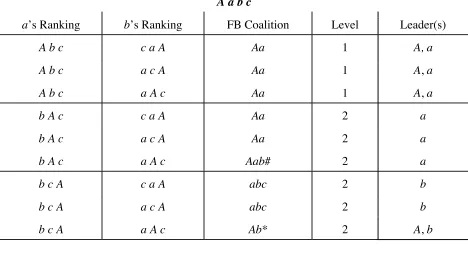
Observe that only in the last row of the top half of Table 1 does a disconnected
coalition (Ab), indicated by an asterisk (*), form. If the 18 cases in Table 1 are
equiprobable, then the probability of a disconnected coalition is 1/18 0.056, or about 6
percent.
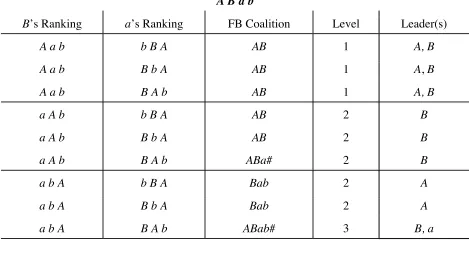
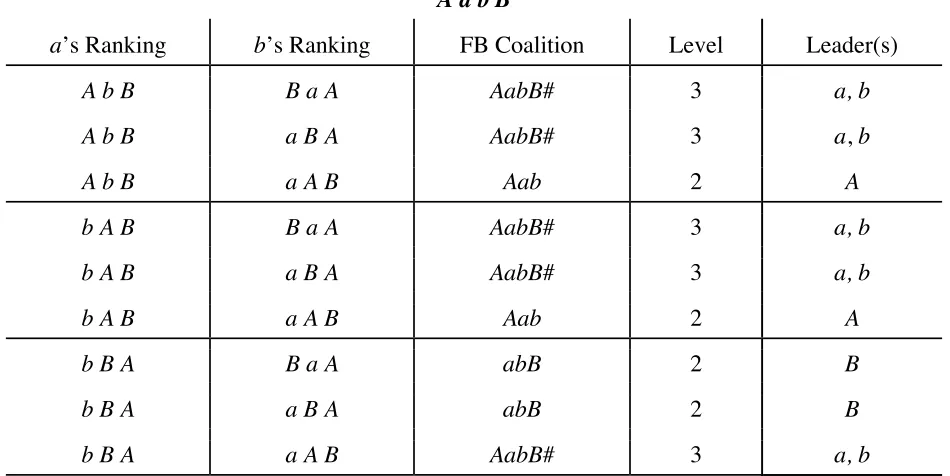
Table 2 shows all the ways of positioning (2 large, 2 small) players, in which we
assume A is always to the left of B, and a is always to the left of b. As in Table 1, we
show the rankings of the middle players in the first two columns, and the FB coalitions,
the levels at which they form, and their leaders in the last two columns.
Table 2 about here
Unlike Table 1, the 18 lines in the first half and the 18 in the second half (i.e., the
continuation) of Table 2 cannot be counted equally. In the second half, the mirror image
of ordering can be obtained by reversing players of equal weight—A and B, a and b, or
both, giving (2)(2)(2) = 8 cases. For example, the mirror image of A a b B is B b a A,
which can be obtained by exchanging players of equal weight. Thus, each line of the
second half of Table 2 represents 4 rather than 8 distinct cases.
By contrast, the mirror image of A a B b (in the first half of the table) is b B a A,
which cannot be obtained by reversing equally weighted players. Hence, in the first half
of the table, each line represents 8 distinct cases. If all distinct cases are equiprobable,
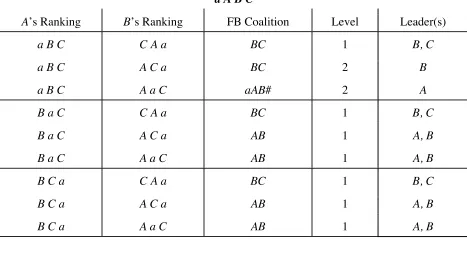
Finally, in Table 3, we show all the ways of positioning (3 large, 1 small) players,
using the same notation as in Tables 1 and 2. In this configuration, however, that there
are no disconnected FB coalitions.
Table 3 about here
Notice that there are FB coalitions with superfluous members, which are indicated
by the number sign (#), in all three configurations. Assuming all distinct cases in each
are equiprobable, their probabilities are 1/9 0.111 for (1 large, 3 small) players (Table
1), 23/54 0.426 for (2 large, 2 small) players (Table 2), and 1/6 0.167 for (3 large, 1
small) players (Table 3). Clearly, superfluous players are relatively common in the latter
two configurations.
Perhaps surprisingly, a superfluous player is not necessarily a small player, as in
Example L, but can also be a large player—and even both a large and a small player
when the grand coalition forms at level 4 (this happens in several cases in Tables 2 and
3). Also note that leaders may be either small or large players (sometimes both);
moreover, they are always middle players in FB coalitions that have 3 or 4 members.
We conclude that while the theoretical probability of disconnected coalitions is
small (6 percent in Table 1, 4 percent in Table 2, and 6 percent in Table 3), the
probability of superfluous members may be much larger (11 percent in Table 1, 43
percent in Table 2, and 17 percent in Table 3). In the latter two configurations, oversized
winning coalitions are quite likely, at least initially, to form.
But it is also likely that superfluous members will not survive a process in which
the coalition trims its sails for cost reasons, or minimizes ideological distances. As a case
coalitions. It seems probable that either one large or two small players are likely to leave
in each since they are superfluous.
It would be useful to analyze data on coalitions that actually formed in
parliamentary systems—or perhaps weighted voting bodies like the EU Council of
ministers—in which there is information on the ordering of players on a one-dimensional
or two-dimensional scale (Naurin and Wallace, 2008). Does the FB model predict which
players coalesced? How often do disconnected coalitions, or coalitions with superfluous
players, form, and is this frequency in accord with theoretical calculations grounded in
the equiprobability assumption? If not, how might this assumption be modified?
10. Conclusions
We assume in the FB model that players strictly rank each other as potential
coalition partners. FB then identifies coherent majority coalitions, in which all members
find each other acceptable for the first time in the descent process.
If preferences are ordinally single-peaked, FB coalitions, from simple majority to
grand—but grand only if n = 2 or 4—may form. In general, the number of possible FB
coalitions increases with n, the number of players, for which we gave a formula. We also
gave a formula for the maximum level at which an FB coalition must form.
If n≥ 5 and two or more FB coalitions form, they will have at least two common
members; moreover, these coalitions may be disconnected. We called the common
members kingmakers, because they determine which FB coalition will actually be
An FB coalition is stable if it is unique or—if there is more than one FB
coalition—the kingmakers agree on which coalition they prefer. If the kingmakers
disagree, there is likely to be a struggle, rendering unstable any FB coalition that forms.
The leader(s) of an FB coalition are the first player(s) to be acceptable to all its
members. If preferences are ordinally single-peaked, leaders are usually middle players
in a coalition—neither the leftmost nor the rightmost members—but they can be extreme
members as well. If preferences are cardinally single-peaked, however, leaders are
always middle players.
The U.S. Supreme Court, 2005-2009, featured a 5-member conservative coalition,
which was an FB coalition and was decisive in almost half the cases with 5-4 decisions.
This coalition is predicted by the FB model but not by by Martin-Quinn scores, which
presume that the justices can be ordered along a single dimension although their
preferences, based on their agreement scores, are not ordinally or cardinally
single-peaked. In addition, the FB model provided insight into the build-up of nonwinning
coalitions into winning coalitions, especially the predominant conservative coalition that
has recently dominated the Court.
If players are not equally weighted, unique disconnected FB coalitions may form
when there are as few as 4 players. We showed this to be true in three configurations—(1
large, 3 small), (2 large, 2 small), and (3 large, 1 small)—and illustrated the calculation of
all possible positions and preferences of such players for the purpose of determining the
probability of there being a disconnected FB coalition, or one with superfluous members
In theory, disconnected coalitions are infrequent in the first two configurations and
impossible in the third, but superfluous members are quite common in the second and
third configurations. In the latter two configurations, oversized coalitions may form
initially, but they are likely to get pared down. Their leaders may be either large or small
players (or both) and are sometimes superfluous.
Insofar as players explicitly or implicitly rank coalition partners, one can test,
empirically, propositions in this paper in parliamentary democracies. While it is not
obvious how one can operationalize kingmakers, who often play hidden roles, it should
be possible to identify FB coalitions and leaders.
One can determine, for example, which coalitions of parties form a government—
or compete to form one—and identify who their leaders are (usually the heads of the
largest parties, who tend to be centrists). One can also ascertain when coalitions are
disconnected, as has happened on occasion in countries like Germany and Israel when the
large left and right parties combined, leaving out small parties in the middle.
FB could be used for the normative purpose of selecting a governing coalition and
its leaders. This would seem a serious alternative to the haggling and infighting—
sometimes lasting over weeks or months—that undermines coalition formation in some
parliamentary systems. While institutional reforms of this kind are not unknown (Brams,
2008), it would be wise to precede the adoption of FB with empirical studies that help to
References
Brams, Steven J. (2008). Mathematics and Democracy: Designing Better Voting and
Fair Division Procedures. Princeton, NJ: Princeton University Press.
Brams, Steven J., Michael A. Jones, and D. Marc Kilgour (2002). “Single-Peakedness
and Disconnected Coalitions.” Journal of Theoretical Politics 14, no. 3 (July):
359-383.
Brams, Steven J., Michael A. Jones, and D. Marc Kilgour (2005). “Forming Stable
Coalitions: The Process Matters.” Public Choice 125, nos. 1-2 (October): 67-94.
Brams, Steven J., and D. Marc Kilgour (2001). “Fallback Bargaining.” Group Decision
and Negotiation 10, no. 4 (July): 287-316.
Edelman, Paul H., and Jim Chen (2007). “The Most Dangerous Justice Rides into the
Sunset.” Constitutional Commentary 24, no. 1: 199-219.
Franz, Alexandra (2009). “Coalition Formation in the U.S. Supreme Court from 1969 to
2009.” Preprint, Department of Politics, New York University.
Liptak, Adam (2009). “Roberts Court Shifts Right, Tipped by Kennedy.” New York
Times (June 30).
Martin, Andrew D., and Kevin M. Quinn (2002). “Dynamic Ideal Point Estimation via
Markov Chain Monte Carlo for the U.S. Supreme Court, 1953-1999.” Political
Analysis 10: 134-153.
Naurin, Daniel, and Helen Wallace (eds.) (2008). Unveiling the Council of the European
Union: Games Governments Play in Brussels. New York: Palgrave Macmillan.
Stearns, Maxwell L. (2008). “Standing at the Crossroads: The Roberts Court in
Toobin, Jeffrey (2008). The Nine: Inside the Secret World of the Supreme Court. New
York: Anchor.
Riker, William H. (1962). The Theory of Political Coalitions. New Haven, CT: Yale
Table 1. FB Coalitions with Players A (Weight 2) and a, b, c (Weight 1 Each)
A a b c
a’s Ranking b’s Ranking FB Coalition Level Leader(s)
A b c c a A Aa 1 A, a A b c a c A Aa 1 A, a A b c a A c Aa 1 A, a
b A c c a A Aa 2 a
b A c a c A Aa 2 a
b A c a A c Aab# 2 a
b c A c a A abc 2 b
b c A a c A abc 2 b
b c A a A c Ab* 2 A, b
a A b c
A’s Ranking b’s Ranking FB Coalition Level Leader(s)
a b c c A a aA 1 a, A a b c A c a aA 1 a, A a b c A a c aA 1 a, A b a c c A a Ab, aA 2 b, A b a c A c a Ab 1 A, b b a c A a c Ab 1 A, b b c a c A a Abc# 2 B b c a A c a Ab 1 A, b b c a A a c Ab 1 A, b
* = disconnected coalition