CESSATION OF OVERLOADED HOST BY INCREASE THE
INTER-MIGRATION TIME IN CLOUD DATA CENTER
1
TAMILVIZHI.T, 2PARVATHA VARTHINI.B,
1
Research Scholar, Faculty of Computing, Sathyabama University,
Chennai, Tamil Nadu, India; [email protected]
2
Professor & Dean, St. Joseph’s College of Engineering,
Chennai, Tamil Nadu, India
E-mail: [email protected],[email protected]
ABSTRACT
The user in distributed environment using the datacenter in extreme manner which results in host overloading and lacking of energy efficiency in data centers. In this paper the computing nodes in the cloud datacenter are reduced by migration method. The idle use of virtual machine consumes extreme electricity and emits Carbon-di-oxide which results in harmful environment. To overcome the host overloading we introduce the Inter-Migration method which switch between both active and sleeping nodes in data centers. The proposed system overcome the time variation and system mismatch in reallocate VMs by switching of deactivates and reactivates computing nodes. The nodes in the data centres are spited by cloud broker. The cloud broker change the data center from cloud node if shortage occurs, it limits the application from activate node to sleeping node. It acts as an intermediate between the consumer and provider in VM environment. The consumer directly request for service. VM placement algorithms are introduced to execute the multiple nodes of data center in replication environment. While executing the VM placement algorithm continuous exchange of information between global and local manager required to manage the host overload.
Keywords: Cloud Node, Data Center, Virtual Machine (VM), Migration, Cloud Broker
1. INTRODUCTION
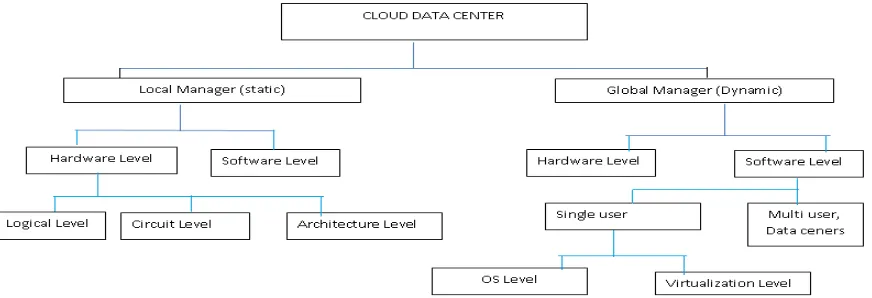
Host overloading in cloud data center is aborted by introducing virtual global manager [9].
In Figure. 1, Dynamic virtual machine
[image:1.612.88.524.562.711.2]consolidation creates single point of failure in global manager.
Figure 1: Levels in cloud data center
global manager in failure of primary instance.
Load balancer act as the intermediation of local manager, global manager and replicated global manager and distributes the local manager’s request to set of replicated global manager. Cloud computing provides on demand services for computing nodes in the distributed platform.
The maintenance cost and investments in private infrastructure increase the source of cloud data center to improve the efficiency of private computing and cloud platform. The rapid use of operating system leads to computational needs of data base and high consumption of energy which results in the emission of Carbon dioxide (CO2). The problem can be initiated by the improvements in the cloud data centers. The energy consumption of data centers are consumed by the highly adoption of computing resources. To overcome the consumption energy are converted to ensure the various application.
The main goal of work is to develop an effective cloud architecture that could tolerate overload occurrences before hand and suggest appropriate solutions to maintain data traffic and availability of the system thus makes it more reliable and flexible.
2. RELATED WORKS
The large infrastructures in the cloud data centers consumes more energy, so the active nodes without workloads are eliminated from the data centers or converted into sleep mode. Again it will
be reactivates if workload gets initiated.
[image:2.612.95.294.580.713.2]Decentralization of the resource management algorithm leads important role in cloud platform by handling the thousands servers in the resource management system. To overcome the problem of host overloading in the previous work we have proposed four adoptable methods to Increase the Inter-Migration Time in Cloud Data Center.
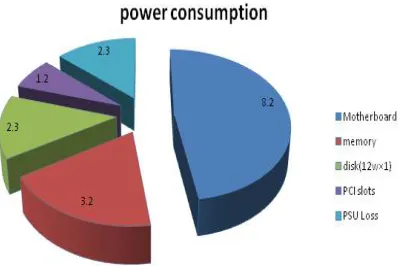
Figure 2: Power Consumption in Cloud Data Center
1) When the host is overloaded, the data centers in virtual machine should be migrating to other server hosts [1].
2) Enable host server into low- power mode in Figure. 2.
3) Migrate Virtual Machine to data centers from an overloaded host [3].
Detecting overloaded host influences the resource allocation of QoS, it leads to the space shortage and performance degradation [13]
1. Dynamic Placement Of Virtual Machines For
Managing SLA Violations
Domain: reallocation of virtual machine
Research Methodology: Systematic Literature Review, Survey, Interactive conversation
Description: Authors proposed lightweight virtual machine mechanism in cloud for running WRF application. Results show that proposed mechanism is better to achieve good performance [10].
Issues and performance aspects: Elasticity of on demand public clouds will reduce the above
2. A Price-and-Time-Slot-Negotiation Mechanism
for Cloud Service Reservations
Domain: Negotiation distubuted and parallel systems
Research Methodology: Systematic Literature Review
Description: Different time slots are introduced on the basis of a novel time-slot utility function [11].
Issues and performance aspects: No improvement in QoS negotiation.
3. Dynamic power Management for non-stationary service requests
Domain: Power management
Research Methodology: Systematic Literature Review
Description: The aim of Dynamic Power
Management is a design is to reduce power consumption of electronic systems.
Issues and performance aspects: No practical performance and results.
4. Dynamic Placement of Virtual Machines for Managing SLA Violations
Research Methodology: Systematic Literature Review
Description: Introduced the usage of data center in dynamic system [4].
Issues and performance aspects: Disable the instance once the application code is complete to avoid being charged for unused or ideal instance.
5. An Integrated Approach to Resource Pool Management: Policies, Efficiency and Quality Metrics
Domain: Pooling
Research Methodology: Systematic Literature Review and Survey, Interactive conversation [12]
Description: Minimize the usage of servers in same time will reduce power sources [5]
[image:3.612.94.292.336.475.2]Issues and performance aspects: OS sensible
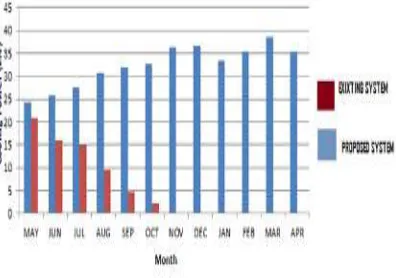
Figure 3: Proposed Vs Existing System
6. Performance and Power Management for Cloud Infrastructures
Domain: Power management
Research Methodology: Systematic Literature Review
Description: virtual power states which allow virtualization-management-policies to save power. From the live migration and consolidation of virtual
machines to the creation of management
frameworks which encapsulate the whole workflow [6] in Figure. 3.
Issues and performance aspects: [2] the cooling of machines and the influences of machines running with 100 % workload on the temperature weren’t considered (only modelled as perceptual energy costs).
7. Server Workload Analysis for Power
Minimization using Consolidation
Domain: Power minimization
Research Methodology: Systematic Literature Review and Survey, Interactive conversation
Description: Achieve power savings and manage the workload analysis using power minimizing consolidation [7].
Issues and performance aspects: workload leads to correlation.
Thus our framework helps in reducing the network
congestion and increases data availability
preventing overloads.
3. MATERIALS AND METHODS
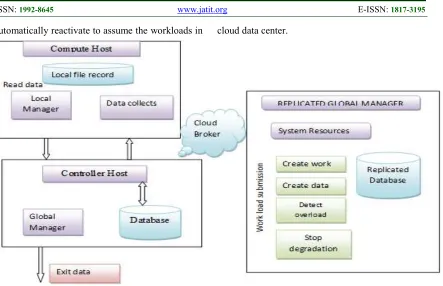
Cloud data infrastructure provides the data integration and time migration by transmitting the resources in data center [8] in Figure. 4. The structural designs focus the customized operating system by the use of communication protocols. The standard way of service oriented architecture access the cloud brokerage by replicating the database stored in the cloud data center. The services may be utilized and accessed by the authorized and standard users. The system model provides the functional benefits and offers the dedicated environment with data security and integrity. The replication manages the hybrid (combination of local and global cloud data) cloud models that increase the usability and flexibility of resources to manage the host overloading. The new virtual technology provides various new schemas. The virtual machine allows multiple instances of an
operating system associated with various
applications to run on single physical machine. It offers a great impact which allow quickly to provisioning and deployment of applications and their underlying operating systems onto an Infrastructure that expands and contracts as needed to handle the load. The Flexibility defines the resources to come in handy.
Dynamic consolidations of Virtual Machines are utilized to improve the cloud data centers. To increase the inter migration time workloads of cloud are periodically monitored and reallocated by migration depends on their current resources. The active servers are minimized and referred to host to
handle the excess workload. The energy
automatically reactivate to assume the workloads in cloud data center.
Figure 4: Proposed System Design with cloud environments
3.1.VM Selection Algorithm
Use to select the suitable sleeping host from the data center. The selection is based on scheduling. Demand-demand their need based on the demand only we’ll select VM Service- after selecting service will be provided
Input: A system state history Input: M, the maximum allowed OTF
Output: A VM migration time
while history is not empty do
if OTF of history ≤ M then
return the time of the last history state
else
drop the last state from history
end if
end while
3.2.VM Re-placement algorithm
When deploy or migrate a virtual machine to a host, Virtual Machine Manager (VMM) uses virtual machine replacement (also known as intelligent replacement) to evaluate the suitability of available
hosts. The replacement algorithm analyses
performance data for the workload and the host, and then rates hosts on a scale of one to five stars to indicate the best replacement choice.
Steps involved,
1. Create a new virtual machine from a disk.
2. When you create a new virtual machine
the host rating is used to offer suggestions for selecting a host.
3. Existing current virtual machine if
overload occurs.
4. Migrate a Virtual Machine
5. Move to new Virtual Machine on (offline,
quick migration, live migration) VMM provides host ratings to help you select appropriate hosts.
6. However, it is assumed that there is only
one instance of the global manager deployed on a single controller host, which makes decisions regarding placement of VMs selected for migration.
7. This limits the scalability of VM
8. To address the problem of a single point of failure, it is possible to run a second instance of the global manager, which initially does not receive requests from the local managers and gets automatically activated when the primary instance of the global manager fails.
4. PERFORMANCE EVALUATION
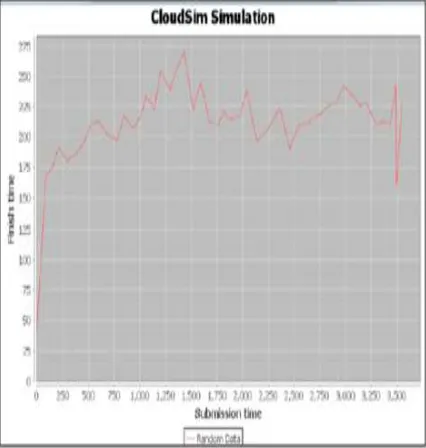
The capabilities of cloud application tend the performance of server infrastructure. In Figure. 5, Low memory space in disk, servers, poor network connections, lower bandwidth will reduce the performance. While a conjunction of poor resources also leads to reduce the performance level. Sometimes the poor architecture also reduces the performance application in cloud servers. For lower level comparison the performance application must be tested in both local and global cloud environments.
[image:5.612.316.521.92.335.2]Figure. 5: Cloud environments in the cloudsim simulator with submission time and finishing time
Figure. 6: Performance of cloud data center with cloudlet and VM
Some applications aspects like bandwidth, network access also cause reduction in performance level. The major performance level in cloud architecture will depends on network traffic and use of account in same time with same traditional architectures. Reduction in consumer’s rate also important issues due to performance level tends to lose usability in Figure. 6. A consumer and usability rate reduce the cloud optimization in data center. To increase the effective rate throughput value will be measured on the data transmission from local to global data center. To speed up the transmission automatically improves the performance level.
Scalability:
[image:5.612.91.304.367.591.2]Sensitivity(%): 100
Specificity(%): 80
Accuracy(%): 93.7500
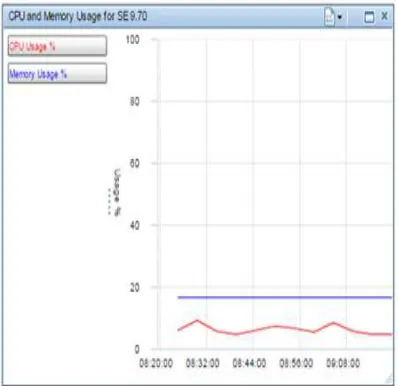
[image:6.612.101.526.63.382.2] [image:6.612.91.289.171.418.2]Swapping the both cloud data centers in Figure. 7, Figure. 8, Figure. 9 and Figure. 10.
Figure. 7: Level 1 - Performance of cloud data center with CPU and Memory Usage
Figure. 8: Level 2 - Performance of cloud data center with CPU and Memory Usage
[image:6.612.314.513.347.540.2]Figure. 9: Level 3 - Performance of cloud data center with CPU and Memory Usage
Figure. 10: Level 4 - Performance of cloud data center with CPU and Memory Usage
5. CONCLUSION AND FUTURE WORK
[image:6.612.91.274.456.687.2]proposed framework, an efficient and fault tolerance technique is provided and it is detected to show reduced energy consumption and cost overhead. To improve the efficiency the new impact of cloud architecture is practised across global and local data centers. This Research work can be extended for future research in the following directions, such as realtime implementation and Increase the QoS parameters.
ACKNOWLEDGEMENT
The authors would like to thank the reviewers for their detailed reviews and constructive comments, which have helped improve the quality of this paper. Special thanks go to Sathyabama Univesrsity for providing us with various resources and an unconditional support for carrying out this work.
REFRENCES:
[1] Aibo Song, Wei Fan, Wei Wang, Junzhou Luo,
Yuchang Mo, “Multi-objective Virtual
Machine Selection for Migratig in Virtualized
Data Centers”, Lecture Notes in Computer
Science, Vol.7719, pp.426-438, 2013.
[2] Akshat Verma, Gargi Dasgupta, Tapan Kumar
Nayak, Pradipta De, Ravi Kothari, “Server Workload Analysis for Power Minimization
using Consolidation”, USENIX'09 Proceedings
of the 2009 conference on USENIX Annual technical conference, pp. 28-42, 2009.
[3] Anton Beloglazov and Rajkumar Buyya,
“Managing Overloaded Hosts for Dynamic Consolidation of Virtual Machines in Cloud Data Centers Under Quality of Service
Constraints”, IEEE Transactions on Parallel
and Distributed Systems, Vol. 24, No. 7, pp.1366- 1379, 2013.
[4] Anton Beloglazov and Rajkumar Buyya,
“Energy-Efficient Management of Virtual
Machines in Data Centers for Cloud
Computing”, Cluster, Cloud and Grid
Computing (CCGrid) IEEE/ACM International Conference, pp.577 – 578, 2010.
[5] Daniel Gmach , Jerry Rolia ; Ludmila
Cherkasova ; Guillaume Belrose ; Tom
Turicchi ; Alfons Kemper, “An integrated approach to resource pool management:
Policies, efficiency and quality metrics”, IEEE
International Conference on Dependable Systems and Networks with FTCS and DCC (DSN), pp.326 – 335, 2008.
[6] Eui-Young Chung, Benini,
L., Bogliolo,A., Yung-Hsiang Lu, De Micheli,
G, “Dynamic power management for
nonstationary service requests”, IEEE
Transactions on Computers, Vol.51, No.11, pp.1345 – 1361, 2002.
[7] Hien Nguyen Van, Frédéric Dang Tran,
Jean-Marc Menaud, “Performance and Power
Management for Cloud Infrastructures”, IEEE
3rd International Conference on Cloud Computing, pp.329 – 336, 2010.
[8] Kaixiang Huang, Yue Chen, Hongyong Jia,
Julong Lan, Xincheng Yan and Zhiwei Wang, “Fast Multicast Scheme with Secure Network
Coding in Cloud Data Centers”, Computer
Science and Information Systems, 13(2), 531– 545, 2016.
[9] Mohammed Rashid Chowdhury,Mohammad R
aihan Mahmud, Rashedur M. Rahman,
“Implementation and performance analysis of
various VM placement strategies in
CloudSim”, Journal of Cloud
ComputingAdvances, Systems and
Applications, Vol.4, No.20. pp.1-21, 2015.
[10]Norman Bobroff, Andrzej Kochut , Kirk Beaty,
“Dynamic Placement of Virtual Machines for
Managing SLA Violations”, IEEE
International Symposium on Integrated
Network Management, pp.119 – 128, 2007.
[11]Seokho Son , Kwang Mong Sim, “A Price-
and-Time-Slot-Negotiation Mechanism for
Cloud Service Reservations”, IEEE
Transactions on Systems, Man, and
Cybernetics, Part B (Cybernetics), Vol.42, No.3, pp.713 – 728, 2012.
[12]Vijay. G.R., Rama Mohan Reddy.A, “Cloud
Data Management Interface based Storage
Virtualization Mechanism for Cloud
Computing”, International Journal of
Engineering and Advanced Technology, Vol.2,
No.4, pp.506-509, 2013.
[13]Zoltán Ádám Mann, “Modeling the virtual
machine allocation problem”, In the
Proceedings of the International Conference on Mathematical Methods, Mathematical Models and Simulation in Science and
Engineering (MMSSE 2015), pp.102-106,