ISSN: 1992-8645 www.jatit.org E-ISSN: 1817-3195
345
ENHANCING THE AD-HOC MESH NETWORKS
INFRASTRUCTURE IN RURAL AREAS: ADAPTIVE APPROACH
1
IBRAHIM OBEIDAT, 2ALI ABU ABID, 3HUTAF NATOUREAH
1
Affiliation, Department of Computer Information System, Hashemite University, Jordan
2
Affiliation, Department of Information Technology, Saudi Electronic University, Saudi Arabia
3
Affiliation, Department of Computer Information System, Hashemite University, Jordan
E-mail: [email protected], [email protected], [email protected]
ABSTRACT
Rural areas all over the world continue to be poorly covered and are not considered as an achievable business case by telecommunication operators. This is due to high implementation costs compared to the profit. The growth in telecommunications, as well as new mobile technology has expanded the gap between rural and urban areas in networks’ infrastructure. To solve this issue, this research uses ad-hoc mesh networks, where each node has a transmission range of one kilometer, which means it needs a third party to play the role of relay if the distance is more than one kilometer. Findings of this research suggest that if the area coverage is less than or equal to 5%, the number of relay nodes reduces by 50%, whereas if the reduction in relay nodes is 8.5% when the area coverage is more than 5%, then the second assumption is more precise and effective.
Keywords: Ad-Hoc Mesh Networks, Connectedness, Terranet, Adjacency Matrix, Adaptive Threshold
1. INTRODUCTION
The idea of this research project comes as a continuation of previous research which was done by Natoureah, Melhem, and Obeidat(1), which discovered the percentage of enhancement in the number of nodes that should play the role of a relay in a network. The area coverage (i.e. the geographic area where the station can communicate) is less than or equal to 5%, requires 40% of the nodes to play as a relay, but only needs 10% of the nodes to act as a relay if the area coverage is larger than 5%. The assumption of the previous research (i.e. which have done by Natoureah, Melhem, and Obeidat, 2010) was with a fixed points threshold regardless of the area size. Whereas, this research uses ad-hoc mesh networks, where each node has a transmission range of one kilometer, it needs a third party to play the role of the relay if the distance is more than one kilometer. This research focuses on the coverage area, it intended to find the percentage of enhancement reached concerning the number of nodes should act as a relay in ad-hoc mesh network
The concept of decentralized communication has been applied to networks without a base station (2). Each node within the network only needs to
transmit as far as the next node. Terranet technology is one of the decentralized networks where the nodes can only transmit for a kilometer. Therefore, some nodes should
act as a router to forward data from nearby nodes to nodes that are further away (i.e. more than one kilometer). When a Terranet phone is switched on, it begins search for other phones within the effective range. Once it finds other devices, they connect to each other. However, if an actual number is dialed, the handset checks a person being called within the range of any handset in the network to complete the call.
The concept of Terranet technology is based on a combination of new technologies such as wireless sensor networks (WAS), peer-to-peer (P2P) networks, mobile ad-hoc networks (MANET), and vehicular ad-hoc networks (1, 3) . These technologies are based on a decentralized communication concept.
ISSN: 1992-8645 www.jatit.org E-ISSN: 1817-3195
346 distributed and wired nodes (5).The wireless protocol can be selected depending on the application requirements. Some of the accessible standards contain 2.4 GHz radios based on two standards: 1) IEEE 802.15.4; and 2) IEEE 802.11 (Wi-Fi) (6). Moreover, for proprietary radios, which are regularly 900 MHz, engineers have created WSN applications for areas such as health care, utilities, and remote monitoring (6).
A mobile ad-hoc network (MANET) is defined as “a collection of autonomous mobile nodes that communicate using a wireless link without support from any pre-existing infrastructure network” (7). This type of ad-hoc networkcan change locations and configure itself on the fly. The nodes work in multi-hop networks as hosts, as well as routes. Furthermore, they forward packets wirelessly towards other mobile nodes (8, 9). The wireless mesh infrastructure is a decentralized network in which every node performs as a router to convey data from neighboring nodes to nodes that cannot be reached in a single hop, resulting in a network that can span larger distances (1).
Vehicular ad-hoc networks (VANETs) depend on an efficient routing protocol designed under conditions where there are relatively large numbers of closely spaced vehicles (10). These protocols are designed for urban areas with great node density (11). Connected networks are not appropriate for packet distribution in a sparse, partially connected VANET. Most of the previous researches are focused on how to encourage mobile users to leave their mobiles open and let them work as a relay by proposing different strategies — for instance, a points system — where the strategy tries to force users to work a relay by applying a rule of losing points if they are not cooperative, so the points system mission was to make the average network connectivity high as possible (10). In our previous research we found the percentage of nodes that was required to act as a relay in order to get high connectivity relating to the area coverage, but in this research we focus on the enhancement percentage regarding the number of relays compared to the actual number of relays gained when applying the methodology proposed by (10)
This paper continues with a literature review of connectedness on ad-hoc mesh networks. This is followed by a research approach description.
Next, results are reported and discussed. Finally, the paper concludes by highlighting the most important contribution of this research.
2. LITERATURE REVIEW
The existing scholarly literature on the connectedness on ad-hoc mesh networks by using Terranet technology is very sparse. However, Natoureah et al. (1) tried to find the percentage of nodes in ad-hoc mesh networks within rural areas which would work as a relay in every time slot. This is related to the actual area coverage of nodes required to have full connectedness. Furthermore, they built a simulation using the adjacency matrix to indicate the connectivity between the network elements. The matrix was constantly updated until each element in the matrix referred to the nodes that could act as a relay. By applying the algorithm on: a) different area sizes; b) different coverage percentages for each size; and c) different relay percentages for several times, the results showed that for area coverage of less than 5%, 40% of the nodes should act as relays, whereas 10% was enough for areas with node coverage greater than 5% (1).
In addition, Obeidat, Bsoul, Khasawneh, and Kilani (2) conducted research to find out the critical number of nodes which makes the network fully connected in a particular area. They proposed a method to enhance the intermediate node to agree to be a router to forward the data from the sender to the receiver. Their method aimed to encourage users to keep their phones on by giving each phone a rank. Therefore, phones with a higher rank would have a better chance of making a call via intermediate nodes (2).
Jindal(12) assumed that routing algorithms for MANETs nodes were supportive and non-malicious. Consequently, a malicious attacker could easily become an significant routing agent and disrupt the operation of the network by disobeying the protocol specifications (13).
ISSN: 1992-8645 www.jatit.org E-ISSN: 1817-3195
347 To evaluate the performance of the BBR protocol and epidemic routing, they use a geographic, Traffic Information (GTI)-based mobility model. The results of the simulation indicated that in rural network conditions, a restricted flooding protocol, for instance, a BBR protocol, works well and provides the benefit of not relying on a location service needed by other protocols proposed for VANETs (11).
Ding and Bhargava(14) from Purdue University tried to investigate P2P file-sharing over MANET technologies, whereby they proposed five routing protocols of different complexity, some of which were broadcast-based algorithms while others were DHT (Distributed Hash Table)-based algorithms. The protocols were broadcast over broadcast, broadcast, DHT over broadcast, DHT over DHT, and DHT. Then they compared them through a table of complexities (14). They also proposed five routing methods with a variety of complexity in order to enable P2P file-sharing over mobile ad-hoc networks. They evaluated and compared the
complexity of these approaches, and
concluded that the cross-layer protocols performed better than simply overlaying a P2P searching protocol on mobile ad-hoc networks.
Xu(15) proposed a PODS research project which was conducted at the University of Hawaii. This research project developed a wireless network of environmental sensors to examine why endangered type of plants were growing in certain areas but not in
neighboring areas. They deployed
“camou_aged” as a sensor node (called Pods) in the national park of Hawaii Volcanos. The Pods consisted of: a) a computer; b) a radio transceiver; and c) environmental sensors relaying sensor data through awireless connection back to the Internet. Bluetooth
and 802.11b were chosen as
Medium Access Control (MAC) data are delivered in Internet Protocol (IP) packets. For the purpose of the Pods design, the researcher identified the energy efficiency and developed an ad-hoc routing protocol (i.e. Multi-Path On-demand Routing (MOR)). Furthermore, two types of sensors data were collected: a) weather data that was tested every ten minutes; and b) image data that were collected once every hour (15).
Furthermore, other researchers used a mote-based tiered sensor network to monitor storm petrel behavior (16). Srivastava, Muntz, and Potkonjak(17) presented a “Smart Kindergarten” that built a sensor-based wireless network for early childhood education. It was envisioned that the interaction-based instruction method would soon be replaced by the traditional stimulus-responses based methods (17).
On the other hand, a societal-scale sensor network is capable of increasing energy-provision chain efficiency, and consists of three
components: a) distribution; b)
energy-generation; and c) the infrastructure of consumption. It was reported that a 1% load reduction because of demand response could lead to a 10% reduction in the wholesale price, whereas, a 5% load response could reduce the wholesale price by half. Recent energy regulations in California proposed a gradual rollout planned for the energy supply chain as part of an integrated network of: a) information processing; b) monitoring; c) controlling; and d) actuating devices. This was in the hope of spread the energy consumption over time to reduce peak demand (18).
Heinzelman, Murphy, Carvalho, and Perillo(19) stated a diversity of related middleware, and argued that no current approach delivers all the management tools needed by sensor network applications. They had to develop a new middleware called “Milan” in order to meet the needs of sensor network applications. Milan permits applications to identify a policy for managing sensors and the network. However, the actual implementation of this policy was influenced within Milan. It can assist sensor network application development (19).
Gutierrez, Mejías, Van Roy, Velasco, and Torres(20) tried to combine WSN and P2P networks to simplify the systems development process that relies on the functionality of WSN.
Consequently, they proposed building a
programming abstraction that lets developers
focus on the development of system
functionality. Similarly, they suggested the usage of feedback loops as a technique to develop and design the mechanisms of the abstraction, as well as to outline their self-managing behavior (20).
ISSN: 1992-8645 www.jatit.org E-ISSN: 1817-3195
348 ground. For example, in some research WSN monitored the temperature of the surrounding areas and sent the attained value to a P2P network. Then, after some processing the P2P node determined that given the value reported for the temperature was crucial to measure humidity. P2P did this by sending a message back to the WSN asking it to measure the new variable (20).
Furthermore, Papadopouli and Schulzrinne(21) introduced a P2P architecture called “7DS.” This enables sharing the resources in a self-organizing, as well as P2P, fashion, with no need for an infrastructure. Nonetheless, it places stress on the application layer instead of on the network routing protocols (21).Another model to improve the performance in a heterogeneous wireless mesh network was developed by Yang and Fei(22). The mechanism of this model was grounded on a bipartite graph to reduce starvation and increase the utilization of the bandwidth. A simulator was built to dynamically allocate channels to competing users. The proposed approach resulted in significant performance benefits in the heterogeneous environment (22).
Finally, a new approach was proposed for supporting Quality of Service (QoS) in a clustered MANET by providing MANET with intercluster/intracluster service differentiation, in order to improve the overall performance of the network, by increasing the overall network throughput and decreasing the overall end-to-end delay (23).
However, there is a lack of literature on how to enhance the ad-hoc mesh network infrastructure in rural areas. To fill this gap, this research uses ad-hoc mesh networks, where each node has a transmission range of one kilometer, which means it needs a third party to work as a relay if the distance is more than one kilometer.
3. RESEARCH APPROACH
Many researchers in the literature
attempted to find answers to the following questions:
1. How can communication networks be
implemented in rural areas?
2. Is it feasible to have a fully underlined
infrastructure?
3. How can users be encouraged to
participate in the success of a
decentralized collaborative
environment?
4. How many users will be sufficient to
work as routers between senders and receivers in each time slot?
5. How can users be made satisfied with
the service?
For instance, Terranet technology suggests employing an ad-hoc mesh network where each node transmission range does not exceed one kilometer, and there is no need to establish a communication infrastructure, as instead nodes are supposed to work collaboratively to support the communication service. However, as a result of the fact that nodes in these areas rarely have their batteries turned on all the time, in addition to the overhead of consuming batteries while participating in others’ sessions, Ranganathan and Shekhar(10) concentrated on the issue of encouraging mobile nodes to participate in the success of this network.
In this research project, the researchers intended to find the percentage of enhancement reached concerning the number of nodes that should act as a relay in an ad-hoc mesh network in rural areas. This idea continues previous research done by Natoureah et al. (1). which found the percentage of nodes acting as a relay over time in a specific area relative to the current area coverage, in order to keep the network fully connected.
Furthermore, the researchers present an
experimental study on an ad-hoc mesh network, where nodes move randomly in a predetermined area. we used a simulation These nodes are able to send and receive messages from each other. Each node is given a number of points, which will be decreased and incremented in each time slot: if the node participates in routing messages it will gain points, and it will lose points in the opposite scenario. When the node’s points reach a threshold value, then it should participate in routing messages to get more points and exceed this threshold value before losing the service. our simulations were build using c++ language and we uses the adjacency matrix , where we used a one to simulate a path between the nodes and zero otherwise
ISSN: 1992-8645 www.jatit.org E-ISSN: 1817-3195
349 is that it assumes a fixed and a predetermined threshold, whereas in reality networks are variable and unstable; the number of nodes and their location changes dynamically. In addition, the high possibility that the number of relays selected will be larger than required may result in low node power utilization, or this number will be less than required, resulting in low connectivity.
In this research, two experimental stages were tested. In the first stage we implemented the previous point strategy assuming a fixed point threshold value, whereas, in the second stage a dynamic and changeable system was assumed, thus the points threshold was determined for every time slot according to the number of existing nodes and the coverage percentage. That is, if the number of nodes at that time slot covered only 5% or less of the total area, then 40% of the existed nodes should play the role of relay, otherwise it was enough to let just 10% of the nodes act as a relay to reach a 100% fully connected environment. The point threshold value was determined when we found the sufficient number of relays according to the required percentage (40% or 10%).
There are a set of parameters used in the experiment. The minimum and maximum ratings were assumed to be 5 and 100, respectively, where the threshold was assumed to be 85: in each time slot, a node agreeing to act as a relay was awarded 4 points, but it lost 1 point if it refused. These metrics values are the same as those used in research Ranganathan and Shekhar(10), by applying their suggested point strategy.
Several experiments were conducted in different locations, starting from 1.5 to 3 kilometers with different area coverage. Results were analyzed according to the percentage of connectivity gained, the percentage of failed sessions, and the average number of relays per experimental time.
4. FINDINGS AND DISCUSSION
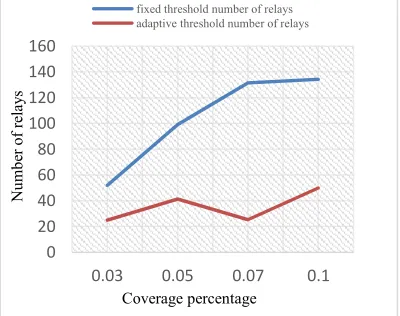
To analyze our results, we will start with the first analysis metric: the average number of relays selected over the simulation time. We note that the number of relays decreased by 46.75238 percent when area coverage was 3%, by 58.33837 when area coverage was 5%, by
78.3074 when area coverage 7%, and by 65.29375 percent when area coverage was 10%. Figure 1 summarizes the average number of relays for all areas relating to the coverage percentage.
[image:5.612.324.524.281.439.2]This decrease is reasonable since for a large coverage percentage there is no need to choose a high number of nodes to be relays because of the high accessibility between the nodes, as seen from the high enhancement percentage (nearly 65% for 10% coverage percent). On the other hand, low coverage may require most of the nodes to redirect messages to the others, since the accessibility will be low between these scattered nodes.
Figure 1. Average Number of Relays
When analyzing the second direction—the average connectivity—we note that the decrease in the percentage of relays did not affect the connectivity negatively. This was concluded from the average connectivity, which decreased from 0.999 to reach 0.932343867 on average. This percentage of connectivity is still a very high percentage that is able to attain high user satisfaction with the delivered service. Figure 2 shows that the connectivity was very high and equivalent to the original percentage gained by the fixed threshold, but this percentage decreased a little (nearly 0.10 percent) while area coverage increased.
0 20 40 60 80 100 120 140 160
0.03 0.05 0.07 0.1
fixed threshold number of relays adaptive threshold number of relays
Coverage percentage
N
u
m
b
er
o
f
re
la
y
ISSN: 1992-8645 www.jatit.org E-ISSN: 1817-3195
350 Figure 2. Average Connectivity Percentage
In Figure 3, we note that the percentage of session failure, the third direction, also increased a little, but still with an acceptable percentage, of 0.068075 on average. This percentage increased when area and coverage percentage increased, which is the case whereby a collaborative decentralized environment may not be needed, and the solution of building a communication infrastructure would be acceptable.
Figure 3. Average Percentage of Failed Sessions
The problem of providing communication arosejust when there was a very small number of nodes distributed in a relatively large area. In this case, it is reasonable to encourage those nodes to work in a collaborative distributed environment, where there is no need to consume money in building a communication infrastructure for those few nodes.
In this collaborative environment, if users did not agree to turn on their mobiles all the time, or they did not welcome the idea of forwarding messages to participate in the success of other’s session., then this proved that 40% of nodes is needed to work as relays, while area coverage is less than 5%, otherwise, it is sufficient to have just 10% working as relays. These results, summarized from our previous research, have proved the ability to decrease the needed number of relays by nearly 50%, and this percentage increases with the increase in area coverage, while maintaining an acceptable service level.
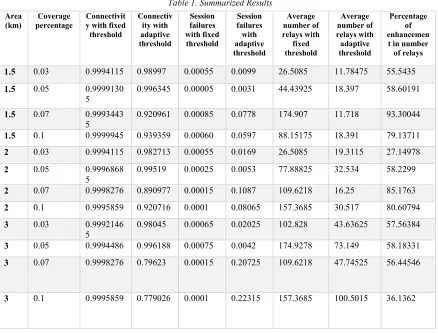
Table 1 (Please See Appendix A) shows the numeric results to show the average connectivity, number of relays, and percentage of failed sessions for different areas and coverage percentages. The results are viewed with fixed and adaptive thresholds.
5. CONCLUSION
This paper presents a way to increase
performance and user satisfaction in a
decentralized collaborative mesh network for rural areas, by applying an adaptive threshold to reduce the number of relay nodes, this is done by applying a points strategy in which it is effective in a dynamic situation i.e. it simulates a real mobile communications.
To find the percentage of enhancement we presented an experimental study for a real dynamic environment, where nodes moved and communicated with each other. These nodes worked as a collaborative system, where each node was assumed to work as a relay in this environment according to its current points, which fluctuated according to the node’s behavior; that is, they decreased and increased over the time depending on whether it forwarded a message between other nodes. The node was responsible for gaining points over an assumed point threshold. This strategy was suggested by Ranganathan and Shekhar(10), who found that when the nodes worked in a collaborative and not in a selfish manner, the connectivity reached 100%. Nevertheless, they did not present any results regarding the number of nodes playing the role of relay over the time.
This simulator was tested in two stages. In the first stage, the point threshold was assumed to be fixed despite the actual area coverage, whereas, 0
0.05 0.1 0.15 0.2
0.03 0.05 0.07 0.1
average failed sessions with fixed threshold average failed sessions with adaptvie threshold
coverage percentage
C
o
v
er
ag
e
p
er
ce
n
ta
g
e
0.8 0.85 0.9 0.95 1 1.05
0.03 0.05 0.07 0.1
average conncectivity with fixed threshold average connectivity with adaptvie threshold
Coverage percentage
C
o
v
er
ag
e
p
er
ce
n
ta
g
ISSN: 1992-8645 www.jatit.org E-ISSN: 1817-3195
351 in the second stage of the study, we assumed the threshold was changeable and adaptive to the current area coverage. The run was repeated for 1.5 kilometers, 2 kilometers, and 3 kilometers, with varied area coverage. Several attempts were made to gain as accurate results as possible. Results were analyzed according to the
percentage of connectivity gained, the
percentage of failed sessions, and the average number of relays per simulation time.
As a result, this paper found that 50% of relays were reduced when applying the dynamic threshold for area coverage less than or equal to 5%, and nearly 7% were reduced when area coverage was larger than 5%, while the average connectivity for the network remained high and acceptable (0.932343867). The number of failed sessions also remained within an acceptable range, although it increased to 0.068075 for high area coverage.
In conclusion, applying a points strategy will be effective and worthwhile if the points threshold is dynamic, so that the threshold value adapts to the coverage percentage of the area.
ACKNOWLEDGMENTS
The authors would like to thank the Research
Deanship of the Hashemite University for
supporting and sponsoring this research project.
REFERENCES
[1] Natoureah HS, Melhem H, Obeidat I.
Attainment the Connectedness in Ad-hoc
Mesh Networks for Rural Areas.
International Journal of Advancements in Computing Technology. 2014;6(2):66.
[2] Obeidat I, Bsoul M, Khasawneh A, Kilani
Y. Enhancing the Connectedness in Ad–hoc
Mesh Networks using the Terranet
Technology. World Academy of Science, Engineering and Technology, International Journal of Electrical, Computer, Energetic, Electronic and Communication Engineering. 2012;6(4):418-20.
[3] Marques A, Silva FMd, Rocha R, editors.
P2P over mobile ad-hoc networks. Sensor, Mesh and Ad Hoc Communications and
Networks Workshops, 2009 SECON
Workshops' 09 6th Annual IEEE
Communications Society Conference on; 2009: IEEE.
[4] Alkhateeb F, Al Maghayreh E, Aljawarneh
S, editors. A multi agent-based system for securing university campus: Design and architecture. 2010 International Conference on Intelligent Systems, Modelling and Simulation; 2010: IEEE.
[5] Tejas T. Thorat, Ankush B. Zatale,
Balbudhe P. Energy Efficiency Data Gathering Using Shortest Tranjectory in Wireless Sensor Network. International Journal of Advanced Research in Computer
Science and Software Engineering.
2016;6(3).
[6] Instuments N. What Is a Wireless Sensor
Network? 2016. Available from:
http://www.ni.com/white-paper/7142/en/.
[7] 7. Meher PK, Kulkarni P, editors.
Analysis and Comparison of Performance of TCP-Vegas in MANET. Communication
Systems and Network Technologies
(CSNT), 2011 International Conference on; 2011: IEEE.
[8] Castro MC, Kassler AJ, Chiasserini C-F,
Casetti C, Korpeoglu I. Peer-to-peer overlay in mobile ad-hoc networks. Handbook of Peer-to-Peer networking: Springer; 2010. p. 1045-80.
[9] TechTerms. MANET Definition 2016.
Available from:
http://techterms.com/definition/manet.
[10] Ranganathan K, Shekhar V. Encouraging
Cooperation in Ad-hoc Mobile-Phone Mesh Networks for Rural Connectivity: Springer; 2010.
[11] Zhang M, Wolff RS. Routing protocols for
vehicular ad hoc networks in rural areas.
Communications Magazine, IEEE.
2008;46(11):126-31.
[12] Jindal S. Enhanced WSN Transmission
Scheme using Fuzzy based Swarm
Intelligence Approach. 2015.
[13] Goyal P, Batra S, Singh A. A literature
review of security attack in mobile ad-hoc networks. International Journal of Computer Applications. 2010;9(12):11-5.
[14] Ding G, Bhargava B, editors. Peer-to-peer
file-sharing over mobile ad hoc networks. Pervasive Computing and Communications Workshops, 2004 Proceedings of the Second IEEE Annual Conference on; 2004: IEEE.
[15] Xu N. A survey of sensor network
applications. IEEE Communications
Magazine. 2002;40(8):102-14.
[16] Mainwaring A, Culler D, Polastre J,
ISSN: 1992-8645 www.jatit.org E-ISSN: 1817-3195
352 sensor networks for habitat monitoring. Proceedings of the 1st ACM international workshop on Wireless sensor networks and applications; 2002: ACM.
[17] Srivastava M, Muntz R, Potkonjak M,
editors. Smart kindergarten: sensor-based wireless networks for smart developmental problem-solving environments. Proceedings of the 7th annual international conference on Mobile computing and networking; 2001: ACM.
[18] Berkeley C. Smart Energy 2014. Available
from:
http://www.citris.berkeley.edu/smartenergy/ smartenergy.html.
[19] Heinzelman WB, Murphy AL, Carvalho HS,
Perillo MA. Middleware to support sensor
network applications. Network, IEEE.
2004;18(1):6-14.
[20] Gutierrez G, Mejías B, Van Roy P, Velasco
D, Torres J, editors. WSN and P2P: a self-managing marriage. Adaptive and Self-Organizing Systems Workshops, 2008 SASOW 2008 Second IEEE International Conference on; 2008: IEEE.
[21] Papadopouli M, Schulzrinne H. A
Performance Analysis of Ë: A Peer-to-Peer Data Dissemination and Prefetching Tool for Mobile Users. Citeseer; 2001.
[22] Yang J, Fei Z, editors. Bipartite graph based
dynamic spectrum allocation for wireless mesh networks. Distributed Computing Systems Workshops, 2008 ICDCS'08 28th International Conference on; 2008: IEEE.
[23] Almobaideen W, Hushaidan K, Sleit A,
ISSN: 1992-8645 www.jatit.org E-ISSN: 1817-3195
[image:9.612.86.524.117.450.2]353 Appendix A: Overall Summary of the Findings
Table 1. Summarized Results
Area (km)
Coverage percentage
Connectivit y with fixed
threshold
Connectiv ity with adaptive threshold
Session failures with fixed threshold
Session failures with adaptive threshold
Average number of relays with
fixed threshold
Average number of relays with adaptive threshold
Percentage of enhancemen
t in number of relays
1.5 0.03 0.9994115 0.98997 0.00055 0.0099 26.5085 11.78475 55.5435
1.5 0.05 0.9999130
5
0.996345 0.00005 0.0031 44.43925 18.397 58.60191
1.5 0.07 0.9993443
5
0.920961 0.00085 0.0778 174.907 11.718 93.30044
1.5 0.1 0.9999945 0.939359 0.00060 0.0597 88.15175 18.391 79.13711
2 0.03 0.9994115 0.982713 0.00055 0.0169 26.5085 19.3115 27.14978
2 0.05 0.9996868
5
0.99519 0.00025 0.0053 77.88825 32.534 58.2299
2 0.07 0.9998276 0.890977 0.00015 0.1087 109.6218 16.25 85.1763
2 0.1 0.9995859 0.920716 0.0001 0.08065 157.3685 30.517 80.60794
3 0.03 0.9992146
5
0.98045 0.00065 0.02025 102.828 43.63625 57.56384
3 0.05 0.9994486 0.996188 0.00075 0.0042 174.9278 73.149 58.18331
3 0.07 0.9998276 0.79623 0.00015 0.20725 109.6218 47.74525 56.44546